

Power Your Software Testing with AI Agents and Cloud
The Native AI-Agentic Cloud Platform to Supercharge Quality Engineering. Test Intelligently and Ship Faster.


- TestMu AI (Formerly LambdaTest)
- /
- Learning Hub
- /
- State Transition Testing: A Comprehensive Guide to Optimizing Test Coverage
On This Page
- What Is State Transition Testing?
- Why State Transition Testing Matters
- Designing State Transition Test Cases
- State Transition Table: One-Dimensional vs. Two-Dimensional
- How to Calculate the Number of Test Situations
- State Transition Testing vs. Statement Coverage Testing
- Advanced Topics in State Transition Testing
- Real-World Examples of State Transition Testing
- Conclusion
State transition testing is a black-box technique that validates how a system moves between states in response to inputs, triggers, or events. It checks the flow of the whole system, not isolated functions.
For systems where states and transitions are central, such as authentication, financial transactions, or multi-step workflows, this technique is indispensable. It confirms the system responds correctly to events and surfaces incorrect state changes.
Overview
To optimize test coverage for multi-step workflows, use state transition testing to validate how systems move between states. Apply All-Transitions Coverage as your primary strategy to verify every allowed state change, ensuring that complex sequences and edge cases are thoroughly validated.
What is state transition testing, and how does it work?
- State transition testing: This black-box technique validates how a system moves between different states based on user actions, making it ideal for login flows, checkout processes, and ATM operations.
How to design effective state transition test cases?
- One-dimensional transition tables: This tabular format lists every state transition as its own row with the current state, triggering event, guard condition, next state, and expected action.
- Two-dimensional transition tables: This tabular format maps current states against events to easily highlight blocked, undefined, or invalid transitions at a glance.
Coverage strategies in state transition testing
- All-States Coverage: This testing strategy ensures that every possible state in the system is visited and tested at least once.
- All-Transitions Coverage: This testing strategy verifies that every allowed transition between states is executed and tested to ensure basic path validation.
- Transition Pair Testing: This advanced testing strategy tests all sequences of two consecutive transitions to ensure sequence accuracy and reveal edge-case failures.
- Round-Trip Coverage: This testing strategy ensures that the system can successfully return to its initial state after completing a series of transitions.
Why state transition testing matters for complex systems
- TestMu AI: This platform automates state transition testing by running test suites across real devices and browsers to increase throughput.
- HyperExecute: This orchestration tool runs state transition tests with faster execution speeds and automatic retries on failed tests.
- KaneAI: This AI-powered tool applies natural language processing to author tests, generate test cases, and analyze state transition models to reduce manual effort.
What Is State Transition Testing?
State transition testing is a black-box technique that treats a system as a finite state machine and verifies it moves between states correctly when triggered by specific events or actions.
In a finite state machine (FSM), a system exists in distinct states, and each transitions in response to a defined event. This builds on black box testing principles: behavior is validated without reading the code.
For instance, a login system may have three states:
- Logged Out (initial state)
- Logging In (processing the user credentials)
- Logged In (successful authentication)
A transition occurs when a user enters credentials, and the system moves between the states. State transition testing checks to ensure that these transitions occur smoothly, correctly, and consistently under various conditions.
Key Concepts in State Transition Testing:
- State: Represents the condition or situation of the system at a given moment.
- Event: Triggers that cause a state change. These can be user actions or system events.
- Transition: The actual change in state that occurs when an event happens.
- Action: The activities the system performs when transitioning between states (e.g., updating a status or sending a notification).
- Guard: A condition that must be true for a transition to occur.
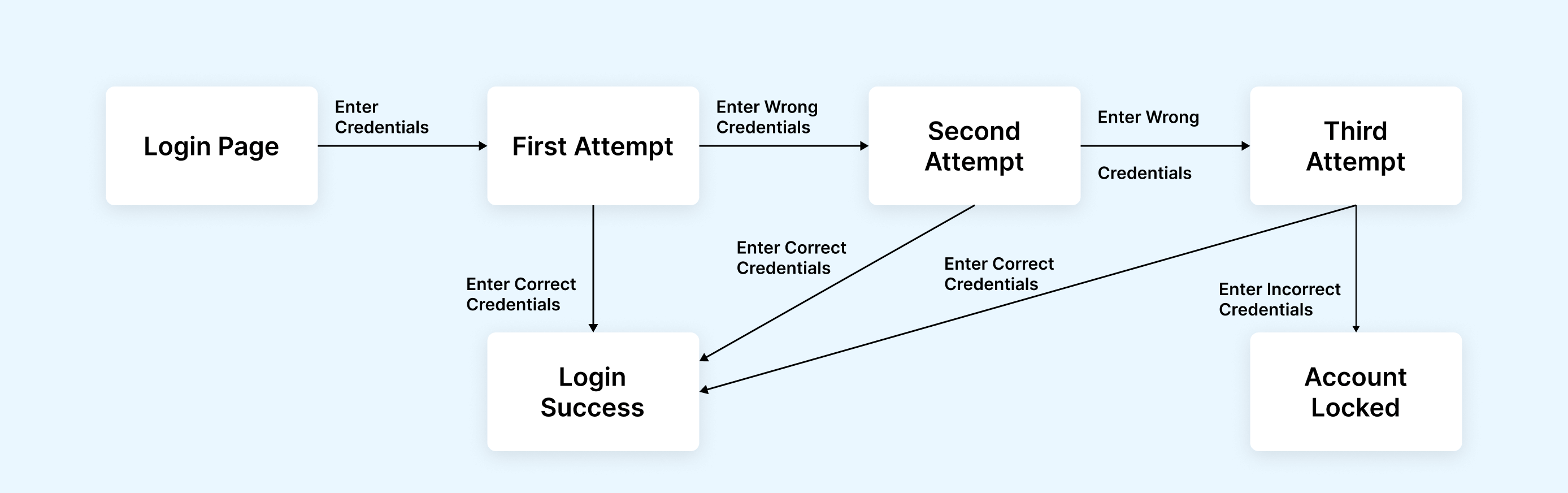

Note: State transition testing pairs well with a cloud grid when you need the same behavioral suite verified across many browser and OS combinations. Run it on TestMu AI to confirm transitions behave consistently everywhere.
Why State Transition Testing Matters
State transition testing matters because systems with multiple states fail on inconsistent handling or incorrect transitions, defects other techniques often miss but that break real user workflows.
Consider an e-commerce platform, where transitions move through the shopping cart, checkout, payment processing, and order confirmation.
If a user skips payment or reaches confirmation without valid details, the result is a failed transaction or a security hole.
By covering every possible transition, this technique verifies that expected and unexpected states are handled correctly across both normal and edge-case scenarios.
Key Terminologies: States, Events, Guards, Actions
To get a firm grasp of state transition testing, it’s essential to understand the key terminologies:
- State: A specific condition or situation that the system is in (e.g., logged in, logged out).
- Event: A trigger or action that causes the system to transition from one state to another (e.g., clicking the "Login" button).
- Guard: A condition that must be met for a transition to occur (e.g., entering valid credentials).
- Action: What happens when a state transition occurs (e.g., a user session is created after logging in).
- Entry/Exit Actions: Actions performed when entering or exiting a state (e.g., displaying a welcome message when entering the logged-in state).
Designing State Transition Test Cases
Designing state transition test cases requires a well-structured approach that systematically identifies system states, defines triggering events, models state changes, and builds test scenarios to validate valid flows, negative transitions, and critical edge cases.
Steps to Perform State Transition Testing
Designing effective state transition tests requires following a systematic approach. Here's a step-by-step guide to help you create comprehensive state transition test cases:
- Identify States: Identify all the possible states in the system. These could be the different conditions a system can exist in.
- Define Events: Recognize the events that can trigger transitions between states.
- Model Transitions: Use a state transition diagram or table to map the relationships between states, events, and transitions.
- Generate Test Cases: Based on the state transition model, generate test cases for valid transitions, invalid transitions, and boundary conditions.
- Execute Tests: Run the test cases and observe if the system behaves as expected across all transitions.
This approach ensures comprehensive test coverage and helps identify potential failures in transitions that may not be obvious through other testing methods.
Coverage Criteria and Test Selection Strategies
When designing state transition tests, you’ll need to determine the level of coverage required. The most common strategies include:
- All States Coverage: Ensures that each state in the system is visited at least once.
- All Transitions Coverage: Ensures that each valid transition between states is tested.
- All Transition Pairs: This strategy tests all sequences of two transitions, ensuring that the system handles consecutive state changes correctly.
- Round-Trip Coverage: Ensures that the system can return to its initial state after completing a series of transitions.
While "All States Coverage" and "All Transitions Coverage" are the most basic strategies, more advanced methods like Transition Pair Testing and Round-Trip Coverage ensure thorough testing of the state machine.
Test Sequence Generation (Paths, State-pairs, Loops)
Generating test sequences is a critical part of the process. These sequences cover all transitions, including loops (a state transitions back to itself) and state pairs (two transitions occur in sequence).
In a banking application, for instance, you test the sequence where a user moves from logged in to transaction pending, then transaction completed, and finally logged out.
Each of these paths and their permutations must be validated so no ordering slips through untested.
Handling Invalid / Negative Transitions
State transition testing verifies invalid transitions as well as valid ones. A user might attempt to log in without credentials, or try to reach a function that is not available in the current state.
By designing tests for these invalid transitions, you can ensure that the system handles error states properly, such as displaying error messages or logging out users after multiple failed attempts.

State Transition Table: One-Dimensional vs. Two-Dimensional
A state transition table captures the same information as a state transition diagram, but in a tabular format that is easier to review for completeness. There are two common forms of this table.
A one-dimensional table lists every transition as its own row, with columns for the current state, the triggering event, the guard condition, the next state, and the expected action.
It reads like a flat log of transitions, simple to build but harder to scan for gaps.
A two-dimensional table maps current states against events. Rows are current states, columns are possible events, and every cell holds the resulting next state.
Cells that stay empty or are marked invalid highlight blocked or undefined transitions, so missing paths and error conditions are easy to catch at a glance. The example below models a simple login system.
| Current State \ Event | Enter Valid Credentials | Enter Invalid Credentials | Click Logout |
|---|---|---|---|
| Logged Out | Logging In | Logged Out | Invalid |
| Logging In | Logged In | Logged Out | Invalid |
| Logged In | Invalid | Invalid | Logged Out |
Here the "Invalid" cells represent transitions that should never occur, such as logging out while already logged out. Testing both the valid cells and the invalid ones ensures the system rejects impossible actions gracefully.
How to Calculate the Number of Test Situations
The number of test situations comes directly from the transition table. For a simple state machine, count every valid transition, one per populated cell.
Then add one test for each invalid transition you want confirmed as blocked.
To estimate the upper bound, multiply the number of states by the number of events. In the login example, three states and three events give nine combinations.
Four are valid and five are invalid, so full cell coverage needs nine test situations.
For complex machines, repeat this per state, then layer in transition-pair and round-trip sequences where event order matters. Counting valid and invalid transitions separately keeps large models from hiding untested paths.
Note: Counting transition-pair and round-trip sequences by hand grows fast as a model adds states. Tracking those runs and results in a single dashboard on TestMu AI keeps large state machines from hiding untested paths.
State Transition Testing vs. Statement Coverage Testing
Statement coverage is a white-box metric that measures how much of the source code a test suite actually executes. It is calculated with a simple formula:
Statement Coverage = (Executed Statements / Total Statements) × 100
Because it works at the code level, statement coverage needs visibility into the implementation. It reports which lines ran, not whether the system behaved correctly across states.
As a result, statement coverage can read high even while important behavioral paths go unexercised.
State transition testing, by contrast, is a black-box technique built around a finite state machine. It ignores the code and verifies that valid and invalid transitions behave as expected.
The two are complementary: statement coverage confirms code is reachable, while state transition testing confirms the system responds correctly to event sequences.

Advanced Topics in State Transition Testing
As applications grow in complexity, testing state transitions becomes more challenging and often requires advanced approaches and automation. The following areas outline how these challenges can be effectively addressed.
Handling Complex / Hierarchical States
As systems grow more sophisticated, states may become hierarchical or include parallel processes. In a banking system, a user might move between logged-in, account settings, and admin states.
Testing must cover these hierarchical transitions and confirm that parent-to-nested moves occur correctly.
Extended / Parameterized Transitions (EFSMs)
Extended Finite State Machines (EFSMs) add parameters and guard conditions that make behavior more dynamic. A game might transition a player from game over to scoreboard based on both the game state and the score.
Designing tests for EFSMs requires a more advanced understanding of parameterized transitions, as the system’s state may depend on specific input values, such as user behavior or environmental factors.
Automation and Tool Support
Automating state transition testing raises throughput once a model has many paths. The TestMu AI platform runs these tests across real devices and browsers.
HyperExecute orchestrates the runs with faster execution and automatic retries on failed tests.
KaneAI applies natural language processing to test authoring, generating tests and analyzing state transition models to reduce manual effort and improve accuracy.
Real-World Examples of State Transition Testing
Understanding state transition testing becomes easier when applied to real systems. The examples below show how state transitions work in both simple and more complex application scenarios.
Simple Example: Login System
Let’s look at a simple login system to understand how state transition testing works. This system might involve states such as:
- Logged out (initial state)
- Logging in (after credentials are entered)
- Logged in (successful authentication)
State transition tests would ensure that a valid login successfully transitions the system from logged out to logged in, while invalid credentials should trigger a return to the logged out state.
Complex Example: E-commerce Checkout Flow
An e-commerce platform is a more complex scenario, where users move through shopping cart, checkout, payment processing, and order confirmation.
Testing covers valid transitions, such as cart to checkout, and confirms that invalid ones, such as skipping payment, trigger error handling.
Conclusion
State transition testing is essential for systems with multiple states. Sound test design and automation together give you comprehensive coverage and surface defects early in development.
The TestMu AI platform supports state transition testing across real devices and browsers. With HyperExecute, you can cut test execution times and validate transitions automatically in both positive and negative scenarios.
Start by mapping your states, then automate the highest-risk transitions first.
Author

Rajas Nawar

Rajas Nawar is a Community Contributor at TestMu AI (formerly LambdaTest), where he authors software-testing content for QA engineers and testers. His articles cover black box testing, state transition testing, CI/CD test case templates, and software-testing interview questions, giving testing teams practical guides and ready-to-use templates for their quality assurance work.


Frequently asked questions
Did you find this page helpful?
More Related Learning Hubs
TestMu AI forEnterprise
Get access to solutions built on Enterprise
grade security, privacy, & compliance
- Advanced access controls
- Advanced data retention rules
- Advanced Local Testing
- Premium Support options
- Early access to beta features
- Private Slack Channel
- Unlimited Manual Accessibility DevTools Tests