

Next-Gen App & Browser Testing Cloud
Trusted by 2 Mn+ QAs & Devs to accelerate their release cycles


On This Page
- What is Sanity Testing?
- Importance of Sanity Testing
- Example of Sanity Testing
- Salient Features of Sanity Testing
- When to Perform Sanity Testing?
- Process of Sanity Testing
- Limitations of Sanity Testing
- Best Practices of Sanity Testing
- What is Regression Testing?
- Importance of Regression Testing
- Example of Regression Testing
- Salient Features of Regression Testing
- When to Perform Regression Testing?
- Process of Regression Testing
- Limitations of Regression Testing
- Best Practices of Regression Testing
- Sanity Testing vs Regression Testing: Key Differences
- Tools Used for Sanity and Regression Testing

Sanity Testing vs Regression Testing: Key Differences
This blog on sanity testing vs regression testing highlights the key differences between sanity and regression testing with examples and best practices.

Nazneen Ahmad
December 19, 2025
As part of the Software Development Life Cycle (SDLC), different types of testing are performed, each targeting specific elements and aspects of the software application. Among those, sanity and regression testing are two of the most important types of software testing.
Comparing sanity testing vs regression testing, sanity testing is the process that involves a quick test of the software application when it goes through any minor changes to make sure that the software is stable for further testing. When it comes to regression testing, it validates the changes made to the software (fixing bugs, adding features) haven’t broken anything and that everything built previously works as expected.
Knowing the difference between sanity testing and regression testing is essential to effectively allocating resources and prioritizing testing efforts per the software project’s needs.
In this blog, we will compare sanity testing vs regression testing and highlight their key differences, including their features, purpose, benefits, and others.
What is Sanity Testing?
Sanity testing is the process that evaluates the specific software application functionality after its deployment with added new features or modifications and bug fixes.
In simple terms, it is the quick testing to check whether the changes made are as per the Software Requirement Specifications (SRS). It is generally performed after the minor code adjustment to ensure seamless integration with existing functionalities. If the sanity test fails, it’s a red flag that something’s wrong, and the software might not be ready for further testing. This helps catch problems early on, saving time and effort down the road.
Importance of Sanity Testing
In this section of the blog on sanity testing vs regression testing, we will list the reasons for performing sanity testing.
One of the main reasons for performing a sanity test is to save time and resources on faulty builds or functionality and ensure the build’s stability.
Here are several reasons highlighting the importance of sanity testing:
- Identify any conflicts or compatibility issues between different components of the system.
- Validate that recent modifications haven’t introduced any major errors or instability into the system.
- Ensure that essential features of the software application work correctly after changes or updates.
- Provide reassurance to stakeholders and end-users that the software remains reliable and functional.
- Facilitate quick releases by quickly validating critical functionalities without conducting exhaustive testing.
- Focus testing efforts on high-priority areas to maximize efficiency while maintaining a reasonable confidence level in the software quality.

Example of Sanity Testing
Let’s look at an example of sanity testing for an eCommerce website after a new feature is implemented:
Test Scenario: The website recently added a feature allowing users to add items to the cart.
Sanity Tests:
- Adding Item to Cart: This verifies that the core functionality of adding items to the cart hasn’t been broken by the checkout process changes.
- Checkout Initiation: Proceeding through checkout ensures there are no unexpected roadblocks at the beginning of the checkout flow.
- Shipping Selection: This step checks that selecting a shipping option functions as intended and integrates with the updated checkout process.
- Payment Information and Order Placement: Entering payment details and placing the order confirms that these crucial steps haven’t been disrupted by the changes.
- Order Confirmation: Verifying the order confirmation email or on-screen message ensures the entire checkout process leads to a successful order placement.
Salient Features of Sanity Testing
In this section of the blog on sanity testing vs regression testing, let’s look at the salient features of sanity testing.
Sanity testing acts as a checkpoint in the Software Development Life Cycle, ensuring critical functionalities are working correctly before proceeding with more rigorous testing.
- Delves deep into specific functionalities, ensuring they work as expected, but it doesn’t aim to cover everything like comprehensive regression testing.
- Identifies issues early, sanity testing paves the way for smoother regression testing by pinpointing areas that need more attention.
- Acts as an adaptable verification method to check for resolved defects or newly introduced features in specific modules
- Helps catch configuration and deployment issues early on, preventing delays and ensuring a smooth testing process.
- Offers a streamlined approach to validate core functionalities before deployment when there is a time constraint.
- Tests are often performed manually by testers due to their narrow focus and need for quick turnaround.
When to Perform Sanity Testing?
To perform sanity testing, it is important to know exactly when to execute the sanity test in the SDLC, which could maximize its effectiveness. Here’s a deeper look at why each of these moments is crucial:
- After Code Modifications: It should be performed after code changes to provide faster feedback. They can identify regressions introduced by the modifications, allowing developers to fix them quickly.
- After Bug Rectifications: It should be performed after bug fixes to ensure the implemented features haven’t caused new bugs elsewhere in the code.
- Before Regression Testing: It should be performed before regression testing to unearth major issues.
- During Sprint Evaluation: It should be performed before each sprint to uncover significant issues early on within a short development cycle.
- Before Releases: It should be performed before a production release to confirm core functionalities are working as expected and the software is stable for deployment.
By strategically incorporating sanity testing throughout these SDLC phases, you can significantly enhance the overall quality and efficiency of your software development process.
Process of Sanity Testing
By understanding the sanity testing process, you can effectively implement it in your Software Development Life Cycle to ensure the early detection of critical issues and improve overall software quality.
In this section of the blog on sanity testing vs regression testing, let’s look at the process of sanity testing.
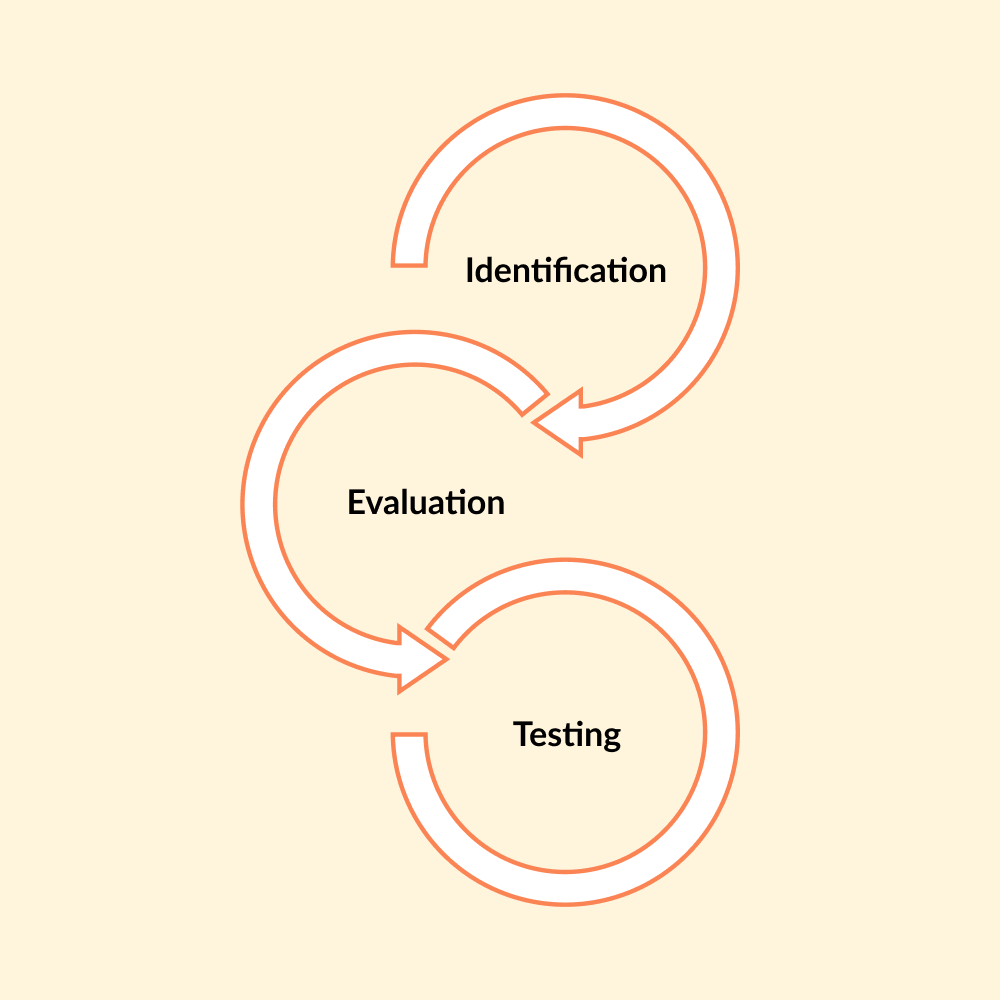
Here are the steps that you can follow to run sanity tests:
- Identification: In the first step, we define the scope of the sanity test by identifying new functionalities and features, along with any code modifications introduced during bug fixes. This helps us determine which areas of the software have changed and require testing.
- Evaluation: Here, we analyze the newly identified components and modifications. This involves reviewing relevant documents like the Software Requirements Specification to understand the expected behavior of these changes.
- Testing: This is the execution phase, where we thoroughly test the identified areas. The tests should be designed to quickly verify if the functionalities work as intended based on the evaluation stage. Sanity testing often relies on manual testing due to its narrow focus and need for fast results. However, some repetitive tasks can be automated for efficiency. However, testers can choose the type of approach depending on the requirement or specification of the application or the bugs identified.
Limitations of Sanity Testing
Sanity testing offers advantages like speed and early defect detection, but it also has limitations to consider:
- It is often a manual testing process, leading to a lack of documented test cases for future reference or regression testing.
- It focuses on core functionalities and doesn’t cover everything. This can leave undiscovered issues in untested areas.
- It might lead to false positives, where a bug goes undetected when it’s not.
- It doesn’t delve into the software’s design structure, making it difficult to identify design-related issues.
- It can be time-consuming, especially for complex software applications.
In the next section of this blog on sanity testing vs regression testing, let’s explore some best practices for performing sanity testing.
Best Practices of Sanity Testing
To ensure your sanity tests run smoothly and deliver the most value, it’s important to follow certain best practices. By following these best practices, you can leverage sanity testing effectively to ensure the stability and functionality of your software application throughout the development process.
- Clearly define the objectives and requirements of your sanity test. This helps you focus on the most critical aspects of the software application and tailor your tests accordingly.
- Develop your test cases based on the criticality and risk level of the software application. Prioritize tests that cover essential functionalities first.
- Maintain a consistent testing environment for all sanity tests. This includes using standardized configurations for software, hardware, and network settings. This helps isolate issues and ensure the tests are focused on the software.
- Automate your sanity tests. This not only saves time during execution but also ensures consistency and repeatability throughout the development process.
- Document the results of your sanity tests. This includes recording test case results, identifying defects, and the actions taken to resolve them. This documentation is a valuable reference for future testing and helps track progress over time.
As mentioned earlier, sanity testing ensures the software build is stable for further testing or, let’s say, regression testing. In the next section of this blog on sanity testing vs regression testing, we will discuss regression testing in detail.
What is Regression Testing?
Regression testing is the process of re-running tests on existing software applications to verify that new changes or additions haven’t broken anything. It’s a crucial step performed after every code alteration, big or small, to catch regressions – the re-emergence of old bugs due to new changes.
By re-executing testing scenarios that were originally scripted when known issues were initially resolved, you can ensure that any recent alterations to an application haven’t resulted in regression or compromised previously functioning components.
While such tests can be manually performed in small-scale projects, in most cases, re-running a set of tests with each update is too laborious and complex to manage, requiring automated testing tools.
Importance of Regression Testing
One of the main reasons for performing a regression test is to ensure existing features continue to work as expected after modifications are done.
Here are several reasons highlighting the importance of regression testing:
- Uncover new bugs that might have been introduced during development. This allows developers to quickly catch and fix issues, saving time and resources.
- Provide a layer of assurance that code modifications haven’t broken existing functionalities. This builds trust in the development process and the overall stability of the software.
- Lead to a higher quality software product if performed consistently. You deliver more stable and reliable software to your users by identifying and resolving bugs early and often.
- Streamline the testing process when automated. This allows for faster release cycles, as you can deploy new features or bug fixes with more confidence that existing functionalities remain intact.
- Mitigate the risks associated with software updates. By proactively identifying and fixing issues before they reach production, you minimize the potential for bugs and crashes in the released software.
In the next section of the blog on sanity testing vs regression testing, let’s look at when you should run the regression tests.
Example of Regression Testing
Let’s look at an example of regression testing for an eCommerce website that checks the order placement functionality:
Pre-Conditions:
- The user has added at least one item to their shopping cart.
- The shopping cart displays accurate information about the added items (quantity, price, etc.).
Regression Tests:
- Initiate Checkout: The user clicks the checkout button on the shopping cart page.
- Guest vs. Logged-in User: It tests checkout with a guest user (if applicable) and a logged-in user account (if available). Also, verify if the login/account creation functionality works seamlessly during checkout.
- Shipping Address: It verifies the user can enter a new shipping address or select a saved address (if applicable).
- Shipping Options: It verifies available shipping options are displayed accurately with estimated delivery times and costs.
- Payment Information: It verifies various supported payment methods are displayed (e.g., credit card, debit card, digital wallets).
- Order Review and Confirmation: It verifies the order summary and displays accurate information about the purchased items, selected shipping options, and total order costs.
Salient Features of Regression Testing
Regression testing in the Software Development Life Cycle ensures existing functionalities are not compromised when new changes or tweaks are implemented.
- Aims to verify that recent code changes haven’t adversely impacted existing functionalities across the software system.
- Involves the repeated execution of test cases to ensure consistent results and validate the stability of the software over time.
- Leverages test tools to streamline the execution of test cases, allowing for quicker validation of software changes.
- Optimizes testing efforts as test cases are selected based on factors like priority, criticality, risk, and code coverage.
- Allows test suite management by updating existing test cases and incorporating new ones to accommodate changes in the software.
When to Perform Regression Testing?
Determining when to use regression testing is crucial for maintaining software quality standards. In this section of this blog on sanity testing vs regression testing, you will learn when you should perform regression testing.
- Following Code Changes: It should be performed whenever code modifications occur to identify unintended consequences and ensure that existing functionality remains unaffected.
- Post-Bug Rectifications: It should be performed after resolving defects by re-running test cases to confirm that there are no more issues.
- Before Major Releases: It should be performed before deployment to ensure the overall quality and stability of the software.
- During Maintenance: It should be performed after maintenance releases to prevent bugs and maintain quality standards over time.
- During Integration Testing: It should be performed when integrating updated modules and components to identify integration bugs.
- Post Infrastructure Changes: It should be performed when upgrading test environments to verify compatibility and detect potential issues.
In the next section of the blog on regression testing vs sanity testing, we will see how to perform regression testing.
Process of Regression Testing
By understanding the regression testing process, you can effectively implement it in your development cycle to ensure the early detection of critical issues and that your existing software application is not compromised by the new changes.
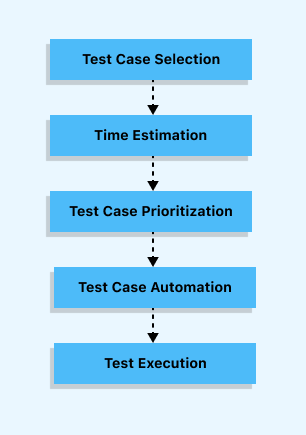
Here are the steps that you can follow to run regression tests:
- Test Case Selection: The choice of test cases depends on the component undergoing significant code alterations. Testers categorize tests into reusable and obsolete cases. Reusable ones are reserved for future regression cycles, while obsolete cases are omitted from subsequent regressions.
- Time Estimation: Following test case selection, this step involves estimating the time required for test execution.
- Test Case Prioritization: Testers prioritize test cases according to recent code changes, streamlining regression efforts. High-priority cases are executed first, followed by medium and low-priority ones.
- Test Case Automation: Here, the testers need to decide between manual and automated testing based on the volume of test cases identified during time estimation.
- Test Execution: All test cases are executed in priority order to uncover defects and validate the functionality of the software application.

Note: Automate regression testing on the cloud. Try TestMu AI Today!
Limitations of Regression Testing
While regression testing has numerous benefits, it comes with a few limitations. Here are some of those:
- It primarily focuses on ensuring existing features work as expected. It might not uncover entirely new issues or edge cases that haven’t been previously tested.
- It is not always feasible to create tests covering every aspect of the software. New functionalities might require new tests, and existing tests might need updates to stay relevant. Maintaining complete test coverage can be difficult.
- It can sometimes produce false positives (indicating a bug when there isn’t one) or false negatives (missing actual regressions).
- It can be time-consuming when performed manually and requires significant resources. Therefore, running an extensive suite of tests can slow down development cycles.
Best Practices of Regression Testing
It’s important to follow a few best practices to ensure your regression tests run seamlessly. This will help you ensure the stability and functionality of your software application is not affected by any new changes.
- Create a test plan that outlines which tests are critical and how frequently they should be conducted.
- Evaluate the requirements of testers to keep test plans updated and relevant.
- Prioritize tests based on their impact on the software’s functionality.
- Thoroughly document the testing procedure, specifying test cases and their testing frequencies.
- Analyze user interaction with the web application to identify high-usage areas for targeted testing.
- Diversify the regression test suite by incorporating various types of tests.
- Integrate new tests into the testing suite when introducing new features or functionality.
- Enhance the regression testing process iteratively by analyzing test results and making necessary adjustments.
Sanity Testing vs Regression Testing: Key Differences
In the above sections of this blog on sanity testing vs regression testing, we have explored sanity and regression testing.
Now let us see the key difference between sanity and regression testing:
| Aspect | Sanity Testing | Regression Testing |
|---|---|---|
| Purpose | Quickly verifies if major functions are working as expected. | Ensures that new changes don’t adversely affect existing functionalities. |
| Scope | Focuses on specific areas or features of the software application. | Covers the entire system, including both old and new functionalities. |
| Frequency | Conducted after minor changes or bug fixes. | Performed after significant modifications or additions to the codebase. |
| Resource Needs | Requires fewer resources. | Demands more resources for detailed testing. |
| Time Required | Quick and less time-consuming. | More extensive and time-consuming due to broader coverage. |
| Depth of Testing | Surface-level, verifying basic functionality. | Deep and thorough examination of features to detect regressions. |
| Test Cases | Limited and targeted, often focusing on critical features. | Extensive, covering various scenarios and edge cases. |
| Automation | Can be manual, especially for smaller projects. | Frequently automated for efficiency, especially in larger projects. |
In the next section of the blog on sanity testing vs regression testing, we will check out the tools used for sanity and regression testing.
Tool Used for Sanity and Regression Testing
Using automated testing tools for sanity and regression tests alleviates the workload of testers and developers, speeding up the software release process with the execution of sanity and regression tests. Here are several popular automation testing tools for performing sanity tests:
- Selenium: It is an open-source tool for web automation, supporting multiple programming languages such as Java, JavaScript, Python, etc.
- Playwright: It is a Node.js library designed for end-to-end testing, capable of automating Firefox, WebKit, and Chromium using a single API.
- Cypress: It is an open-source tool for front-end testing and is known for its unique DOM manipulation techniques. It is compatible with programming languages like C#, Perl, PHP, etc.
- Appium: It is another open-source tool for mobile app testing, allowing the creation of test scripts in various programming languages to interact with mobile apps on real devices or emulators, facilitating smoke and sanity tests for mobile applications.
While the mentioned tools are just a few examples among many automation options available, it’s essential to consider different test automation frameworks and tools based on specific application requirements.
Testers and developers leverage these automation tools for test execution on the local and cloud grid. However, you can harness their potential better with cloud-based testing platforms like TestMu AI to attain better test coverage, scalability, and reliability.
TestMu AI is an AI-powered test orchestration and execution platform that allows developers and testers to perform sanity and regression testing at scale on a remote test lab of 3000+ real environments. It provides manual and automation testing with various frameworks like Selenium, Playwright, Cypress, Appium, etc.
With TestMu AI cloud-based infrastructure, sanity and regression tests offer benefits such as reducing infrastructure costs, enabling scalability for automated tests, developing team collaboration, and providing flexibility in the testing environment.
For more tutorials on using TestMu AI for automation testing, visit and subscribe to the TestMu AI YouTube Channel.
Conclusion
In this blog on sanity testing vs regression testing, we have discussed the differences between sanity and regression testing. Both testing types are important in the software development process to ensure software applications are bug-free and function as expected.
Ideally, sanity testing acts as an initial validation of functionalities, followed by regression testing, which offers a thorough evaluation of all features without time constraints. This sequential approach ensures that new changes do not disrupt existing functionalities, highlighting the complementary nature of these two methods in a robust software testing process.


Frequently asked questions
Did you find this page helpful?
More Related Hubs
TestMu AI forEnterprise
Get access to solutions built on Enterprise
grade security, privacy, & compliance
- Advanced access controls
- Advanced data retention rules
- Advanced Local Testing
- Premium Support options
- Early access to beta features
- Private Slack Channel
- Unlimited Manual Accessibility DevTools Tests