

Power Your Software Testing with AI Agents and Cloud
The Native AI-Agentic Cloud Platform to Supercharge Quality Engineering. Test Intelligently and Ship Faster.


- TestMu AI (Formerly LambdaTest)
- /
- Blog
- /
- 7 Principles of Software Testing: Unlock QA Success
7 Principles of Software Testing Every QA Should Know
Learn the 7 Principles of Software Testing with real-world examples in this complete guide. Improve QA processes, ensure quality, and deliver faster software
Last Updated on:
The seven principles of software testing are ISTQB-defined rules for finding defects, prioritizing risk, and knowing when testing is enough.
Demand for the discipline is real: according to The Business Research Company, the global testing software market reached USD 63.56 billion in 2026 and is projected to reach USD 93.51 billion by 2030.
This guide covers all seven ISTQB principles with real-world examples and shows how automation testing applies each one.
Key Takeaways
- Testing shows the presence of defects but cannot prove software is bug-free, so QA teams work to reduce the risk of major failures instead of chasing zero defects.
- Exhaustive testing is impossible because modern systems hold millions of data, action, and environment combinations, so effort goes to critical functionality and high-risk areas first.
- Early testing saves time and money, since a defect caught while reviewing requirements costs far less to correct than the same defect found after deployment.
- Defect clustering means most bugs sit in a small number of complex or frequently changed modules, so regression suites should target those hotspots before every release.
- The pesticide paradox describes a test suite that stops finding new defects when it runs unchanged, which is why test cases need regular review, updates, and fresh scenarios.
- Testing is context dependent, so a healthcare application needs HIPAA compliance checks while a casual game is judged on user experience, speed, and graphics.
- The absence-of-errors fallacy warns that software passing every functional test can still fail users, as with an e-learning platform that is hard to navigate and slow to load.
- TestMu AI is an AI-native cloud testing platform that runs automated web and mobile tests in parallel across 3,000+ browsers and operating systems, with CI/CD integration.
What Are the 7 Principles of Software Testing?
To help QA teams test effectively, the International Software Testing Qualifications Board (ISTQB) has defined seven core principles of software testing. These principles help the QA professionals to focus on critical areas, use resources efficiently, and avoid ineffective practices.
These software testing principles are as follows:
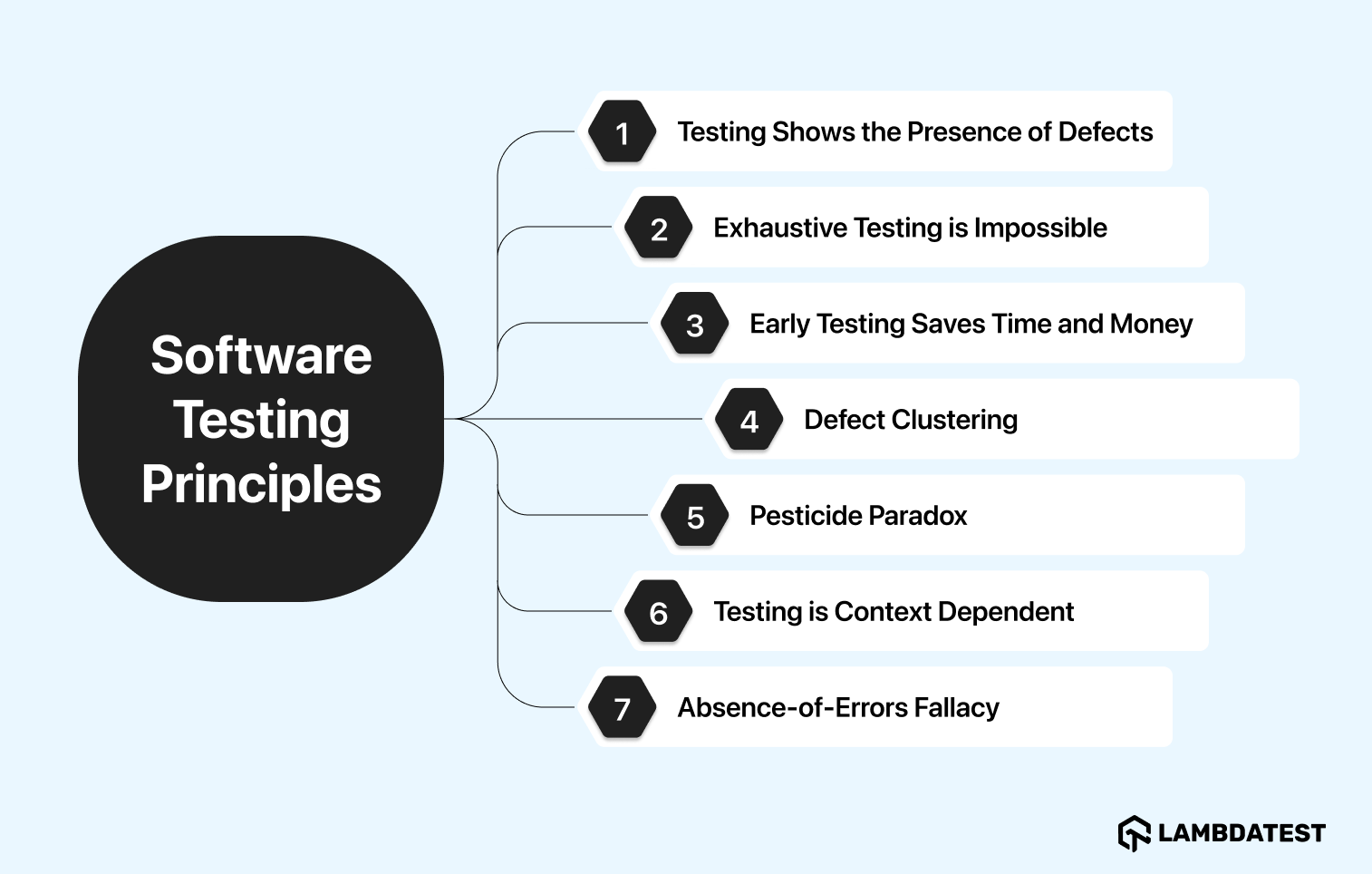
1. Testing Shows the Presence of Defects
According to the first principle of Software Testing, testing can identify defects in software but cannot guarantee that the software is 100% bug-free. Even after extensive software testing, there may still be undiscovered issues.
Think of it like detecting as many problems as possible but not focusing perfection. In real-world projects, users may use software in unexpected ways, and it’s impossible to test every single condition they might encounter.
Importance: It helps QA teams and stakeholders set realistic expectations. In this way, their aim shifts from achieving “zero defects” to reducing the risk of major failures before software release. This approach often goes hand in hand with risk-based testing, where testing efforts focus on areas with the highest business or technical impact.
Example: A QA team tests an e-commerce website and finds a bug in checkout page. They fix it, and all related tests pass. Later, a user reports that the discount coupon feature doesn’t work under certain conditions. This proves that even after fixing known issues, new or hidden defects can still exist.
2. Exhaustive Testing is Impossible
According to this principle, it’s not feasible to test every possible input, path, or test case in a software application.
Modern systems can have millions of combinations of data, user actions, and environments, making complete coverage impractical. Even the best QA strategy must focus on the most important and risky areas instead of testing everything.
Importance: It helps QA testers and project managers prioritize test cases. By focusing on critical functionalities and high-risk areas, teams save time, reduce costs, and still deliver high-quality software.
Example: A QA team is testing a ride-booking app. Now, instead of checking every possible pickup and drop-off location in every city, based on this principle they should test the important routes in high-demand areas and different network conditions. This ensures coverage of real-world, high-priority scenarios without wasting time on unlikely combinations.
3. Early Testing Saves Time and Money
According to this principle, starting testing activities as early as possible in the development lifecycle prevents defects from spreading into later stages. The earlier a defect is found, the cheaper and easier it is to fix. Testing is not just a final-stage activity it should be integrated from the beginning.
Importance: It reduces rework, prevents major release delays, and ensures a smoother development cycle. Finding a bug during requirements analysis costs far less than discovering it after deployment.
Example: While reviewing the requirements for a payroll system, the QA team spots a mismatch in salary calculation logic before coding even begins. Correcting it during the planning phase takes just hours fixing it after launch would have taken weeks and risked financial errors for thousands of employees.
4. Defect Clustering
According to this principle, most defects are often found in a small number of modules or components. These areas usually have complex logic, poor code quality, or frequent changes, making them more prone to issues.
Automated regression suites can target these high-risk areas, making the testing process faster and more consistent.
Importance: By identifying and focusing on high-defect areas, QA testers can allocate resources efficiently and improve software quality faster. Test strategies can prioritize these “hotspots” for better software testing.
Example: In a banking app, the transaction history module has historically shown multiple bugs. Knowing this, the QA team performs extra rounds of regression testing on this module before every release, catching recurring issues before users do.
5. Pesticide Paradox
According to this principle of software Testing, running the same set of tests repeatedly will eventually stop finding new defects.
Over time, these tests become less effective because the software stabilizes in those tested areas. To uncover new bugs, test cases must be reviewed and updated regularly. You can also relate this with our article on Software Testing Techniques.
Importance: It encourages test case optimization, fresh scenarios, and a focus on evolving user behaviors. This prevents testing from becoming routine and missing critical defects.
Example: A QA team testing a food delivery app runs the same regression suite every sprint. After a few months, no new defects are found. They add new scenarios like testing orders during network drops or payment retries and immediately uncover hidden issues in the payment gateway.
6. Testing is Context Dependent
According to this principle, the approach to testing depends on the type of application, industry requirements, and risk factors. The testing method for a banking app will differ greatly from that of a gaming app because the stakes, user expectations, and regulatory needs are different.
Importance: It ensures the testing process is tailored for the best results. Applying the wrong testing approach can waste resources and still miss critical defects.
Example: A QA team working on a healthcare system application must perform strict compliance testing as per HIPAA regulations, on the other hand a QA team testing a casual game focuses on user experience, speed, and graphics. Both are testing, but the context shapes the strategy.
7. Absence-of-Errors Fallacy
According to this principle, having no known defects does not guarantee that the software meets user needs or business goals. A product can be bug-free and still fail if it doesn’t solve the problem it was intended to solve.
Importance: It reminds QA testers that quality is not just about detecting and fixing bugs, it’s about ensuring the software delivers value and meets requirements.
Example: A QA team delivers an e-learning platform that passes all functional tests. However, after release, students complain that the interface is hard to navigate and loading times are slow. The application is technically “error-free” but still fails to satisfy users.
Key Takeaway: The seven ISTQB principles state that testing reveals defects without proving their absence, that exhaustive testing is impossible, and that a defect found during requirements review costs far less than one found after deployment. Defect clustering points QA effort at the few modules that produce most bugs, while the pesticide paradox explains why an unchanged test suite stops finding new ones. Context decides the approach for each product, and the absence-of-errors fallacy holds that software with no known defects can still fail to meet user needs.
How Automation Testing Follows Software Testing Principles?
Automation testing doesn’t replace the core principles of software testing, it helps teams follow them more effectively. Here’s how:
- Testing shows the presence of defects: Automated test suites quickly flag issues in each build, helping QA teams catch problems early and maintain stability.
- Exhaustive testing is impossible: Automation uses risk-based testing, data-driven tests, and prioritization to focus on the most critical scenarios instead of testing every possible case.
- Early testing saves time and cost: Continuous integration (CI) pipelines run automated tests from the start, preventing small bugs from becoming costly post-release issues.
- Defect clustering: Automated regression suites can target high-risk modules where defects tend to appear most often, ensuring focused and efficient testing.
- Pesticide paradox: Regularly updating and expanding automated test cases ensures they stay effective and detect new issues instead of missing them due to repetitive runs.
- Testing is context-dependent: Automation frameworks like Selenium, Cypress, or Playwright are chosen based on the project type, tech stack, and testing needs.
- Absence-of-errors fallacy: Even if automation finds no bugs, additional tests like user acceptance testing (UAT) confirm the product still meets real user requirements.
TestMu AI is an AI-native cloud testing platform that helps you run automated tests for your web and mobile apps without managing devices in-house. You can parallel test across 3,000+ browsers, OS, and real devices, making sure your app works everywhere. With seamless CI/CD integration, you can release faster, fix issues quicker, and deliver a better experience for every user.

How Do AI Testing Agents Apply the 7 Principles of Software Testing?
AI testing agents still follow all seven ISTQB principles: they generate test cases and target defect clusters faster, but exhaustive coverage, context judgment, and real quality remain human calls.
- Exhaustive testing, faster: AI test-generation tools such as GitHub Copilot can draft far more test cases per hour than a person, but they still cannot cover every input combination, so teams still apply principle two and prioritize the highest-risk paths.
- Defect clustering, automated: An agent that reads commit history and code-coverage reports can flag the modules with the most past defects and route new test cases there first, doing by tooling what principle four already recommends by hand.
- A new pesticide paradox: Asked to add tests for the same feature, an LLM tends to generate near-duplicate scenarios unless the prompt forces variation, so a team must diversify its prompts the same way principle five says to diversify test cases.
- Context still needs a human: An AI agent can draft test steps, but deciding whether a healthcare app needs HIPAA checks or a game needs frame-rate checks is a judgment call principle six leaves to the tester, not the tool.
Conclusion
The seven principles of software testing are important for reliable, high-quality software. They show that testing is about reducing risk, not about chasing perfection. They also explain that starting tests early in the development cycle and focusing on high-risk areas can save both time and cost.
Another important point is keeping test cases updated so they remain effective, which, when supported by automation and the right software testing tools, these principles deliver faster feedback, wider test coverage, and consistent results, helping teams release user-ready software without compromising quality.
Leveraging AI in software testing can further enhance accuracy and speed, making the entire process smarter and more efficient. You can also read our article about the different types of software testing.
Author

Prince Dewani
Blogs: 30

Prince Dewani is a Community Contributor at TestMu AI specializing in AI agents, software testing, QA, and SEO. He is certified in Selenium, Cypress, Playwright, Appium, Automation Testing, and KaneAI, and presented academic research on AI agents at PBCON-01. At TestMu AI, he has also carried out extensive cross-browser research on the support of modern web technologies such as WebGPU, WebAssembly, WebXR, WebGL2 and other web technologies, validating their compatibility and feature parity across major browsers and rendering engines through rigorous hands-on testing. Prince has hands-on experience building AI agent workflows using Anthropic Claude, Google Antigravity, n8n, LangChain, and other agentic frameworks, and works regularly with MCP and A2A protocols. He shares his work with 5,500+ QA engineers, developers, DevOps experts, tech leaders, and AI agent practitioners on LinkedIn.
Reviewer

Himanshu Sheth
Reviewer
Himanshu Sheth is the Director of Marketing (Technical Content) at TestMu AI, with over 8 years of hands-on experience in Selenium, Cypress, and other test automation frameworks. He has authored more than 130 technical blogs for TestMu AI, covering software testing, automation strategy, and CI/CD. At TestMu AI, he leads the technical content efforts across blogs, YouTube, and social media, while closely collaborating with contributors to enhance content quality and product feedback loops. He has done his graduation with a B.E. in Computer Engineering from Mumbai University. Before TestMu AI, Himanshu led engineering teams in embedded software domains at companies like Samsung Research, Motorola, and NXP Semiconductors. He is a core member of DZone and has been a speaker at several unconferences focused on technical writing and software quality.


Frequently asked questions
Did you find this page helpful?
More Related Blogs
TestMu AI forEnterprise
Get access to solutions built on Enterprise
grade security, privacy, & compliance
- Advanced access controls
- Advanced data retention rules
- Advanced Local Testing
- Premium Support options
- Early access to beta features
- Private Slack Channel
- Unlimited Manual Accessibility DevTools Tests