

Power Your Software Testing with AI Agents and Cloud
The Native AI-Agentic Cloud Platform to Supercharge Quality Engineering. Test Intelligently and Ship Faster.


- TestMu AI (Formerly LambdaTest)
- /
- Blog
- /
- Choosing the Right JavaScript Frameworks for Your Project
Choosing the Right JavaScript Frameworks for Your Project
Choosing the right JavaScript frameworks starts with your project. Compare React, Vue, Ember, Preact, Polymer, and Storybook on rendering, support, and testing.

Last Updated on:
Choosing the right JavaScript frameworks starts with four project facts: your rendering model, your hiring pool, the framework's support status, and your testing setup.
Support status settles the shortlist faster than preference: Vue 2 reached end of life on December 31, 2023, and the Polymer library now sits in maintenance mode with Lit as its recommended replacement.
This guide covers frameworks versus libraries, isomorphic rendering, React, Ember.js, Vue.js, Polymer, Preact, Storybook, and how AI coding assistants change your framework choice.

Key Takeaways
- Choosing the right JavaScript framework depends on your project's rendering model, your hiring pool, the framework's support status, and your testing needs, not on which framework is most popular.
- React is maintained by Meta, powers Facebook and Instagram, and renders efficiently when a complicated component changes its UI frequently.
- Vue 2 reached end of life on December 31, 2023, so new Vue projects should start on Vue 3 and use Pinia as the official state library.
- The Polymer library is in maintenance mode, and the Polymer Project recommends Lit for new Web Components development.
- Preact cuts a React application's main bundle by at least one third, and Preact-compat lets an existing React project swap React out for Preact.
- A framework that publishes an llms.txt documentation index or an official MCP server gives an AI coding assistant current API facts instead of outdated training data.
Framework or Libraries
Both these terms are synonymous and often times are interchangeable. In layman terms both Framework and library are codes of JavaScript, the difference lies in their functionality. While frameworks are codes by using which a developer can customize everything within the software/app/website by modifying the codes in accordance with the framework rules, libraries, on the other hand, provide you with the functionality that can be directly used by you while scripting.
Key Takeaway: A JavaScript framework gives a developer rules to customize code within, while a JavaScript library gives a developer functionality to call directly from their own script.
Isomorphic
Often termed as a universal framework, they have changed the way everything is done. The main motivation behind the framework was to optimize the website loading time and streamline JS bundles. This was also the main reason behind its popularity.
A Few years ago the client-side and server-side frameworks used to be different. JavaScript was opted more for client-side, because it ignores a few errors providing the user with a seamless experience. Python and PHP were mostly used on the server-side.
When the concept of isomorphic library came into existence, developers started using these libraries. The Isomorphic framework breaks the barrier between server and client-side. It allows developers to use components of the framework on both ends. Because of this the JS bundle also gets a little sleeker as instead of having two frameworks, the solution now share one.
Key Takeaway: An isomorphic JavaScript framework runs the same components on both the server and the client, which shortens website loading time and keeps the JavaScript bundle slimmer than shipping two separate frameworks.
REACT
React JS is popular because a large community of JavaScript developers supports it. Meta maintains the library, and it powers Facebook and Instagram.
React has made quite an impact on both designers and developers, and the feature-rich library has made complex integrations a bit easier. It enables the developers to make encapsulated components that manage their own state and then these components are composed to make complex UI.
Features like lazy loading have been successfully implemented on a large scale because of it. Using React Boilerplate and React Starter-kit you can easily make interactive interfaces. The concept of reacting is to put HTML in JS rather than vice versa because JavaScript is more powerful than HTML.
They provide you with a predefined environment and let you code. The declarative view makes the coding predictable hence the code becomes easy to debug. Using React will push you to make your own framework. Pairing it with Next.js will smoothen things on the server side and all the heavy lifting will be done on the back-end.
React stack usually includes Redux, React.route, React.saga and Node.js. Myntra to exploits react although they only use parts of it because such a website has minimal interaction between sibling components. React has a high rendering performance when there is a complicated component change with frequent UI changes.
They prefer preact because it's smaller and provides them greater speed. eBay on the other hand spice things up by adding Angular and Ember along with the preact library. That seems to be the trend in modern e-commerce websites.
Npm is a trustworthy package manager. Earlier npm had too many issues as the packages were scattered, Yarn was introduced as directory for npm. It is a godsend for developers, npm has vast community support and npm too has become faster and almost equal to yarn in terms of package management. React and Redux come handy while handling the packages. Start up with your free practical React Redux testing.
React applications can be more complex compared to testing other libraries or frameworks, but it is certainly achievable. Learn how to perform React testing and enhance your web and native application.

Note: Run tests using various JavaScript frameworks over 3000+ browsers and OS combination and enhance your testing efficiency Try TestMu AI Now!
Key Takeaway: React builds complex user interfaces from encapsulated components that manage their own state, and pairing React with Next.js moves the server-side work to the back end.
Ember.js
Ember.js stands out as an open-source JavaScript framework tailored for constructing scalable single-page web applications, particularly suited for business needs. Unlike other frameworks, Ember.js is built on the Model-View-ViewModel (MVVM) architecture, which forms its core foundation.
Originally known as SproutCore 2.0, Ember.js was renamed by its creator Yehuda Katz, a prominent developer renowned for his contributions to jQuery. One of Ember's standout features is its Ember Command-line Interface (CLI) tool, revered for its productivity-enhancing capabilities, which greatly contributes to its status as one of the premier JavaScript frameworks.
Despite being one of the older front-end JavaScript frameworks, Ember.js remains robust and maintains a substantial user base, counting major companies like Microsoft, LinkedIn, Netflix, and Twitch among its enthusiasts.
Key Takeaway: Ember.js is an open-source framework built on the Model-View-ViewModel architecture for scalable single-page business applications, and Microsoft, LinkedIn, Netflix, and Twitch all run on Ember.js.
Vue.js
Vue is simply the best of both worlds, meaning it lies somewhere between the dictatorship of Angular and democratic chaos of React. This young JS framework has gained some serious popularity without having been associated or backed by any giant. The framework is used by Alibaba, Nintendo and Gitlab. A team of 16 people made Vue into a very simple yet efficient JS framework.
Too many cooks spoil the broth, working on the similar motto ex google employee Evans set out to achieve benchmarks in the JavaScript. Vue uses JS ES5 or ES6 depending upon how the user wishes and also supports TypeScript.
Vue is no longer a young framework, and its ecosystem now covers routing, state, testing, and build tooling. Start any new project on Vue 3, because Vue 2 reached end of life on December 31, 2023 and no longer receives features, updates, or fixes. Vue stays a blend of flexibility and coding discipline, and it provides just enough framework that you do not feel bound.
Just like React has Redux, Vue has Pinia as its official state library, and Vuex is now in maintenance and will not gain new features. Memory use and runtime performance with Vue are strong, and the runtime stays small next to most competing frameworks.
Vue adopts current tooling without complicating the whole project. Combining Vue 3 with server side rendering (SSR), a Pinia store, and a GraphQL client like Apollo gives you a light, fast, and robust application while providing a good user and developer experience too.
Key Takeaway: Vue 2 reached end of life on December 31, 2023, so start new Vue work on Vue 3 with Pinia, because Vuex is now in maintenance and gains no new features.
Polymer
Google introduced polymer to empower the developers to fully take advantage of the latest web technologies. Youtube has renovated it gaming stream using Polymer, it is indeed very fast. The most notable feature in Polymer is the ability to reuse custom elements to interoperate with a browser's built-in elements. Polymer.dom was released with an intent to enable the developers of the DOM manipulation which paved the way for new libraries and frameworks to be used with it.
Version 3 of Polymer added data system improvements that make debugging easier and simplify the data flow between elements. Polymer 3 also dropped Bower and moved to npm, so a Polymer project installs and versions the same way as any other npm project.
Polymer App toolbox helps you build and deliver cutting-edge progressive web apps with minimal overhead and payload, by leveraging powerful web platform features like Web Components, Service Worker and HTTP/2.
The toolbox provides a component-based architecture, responsive layouts, a modular router, localization support, turnkey support for local storage and offline caching, and efficient delivery of unbundled app resources. Adopt these features individually, or use them together to build a full-featured progressive web app.
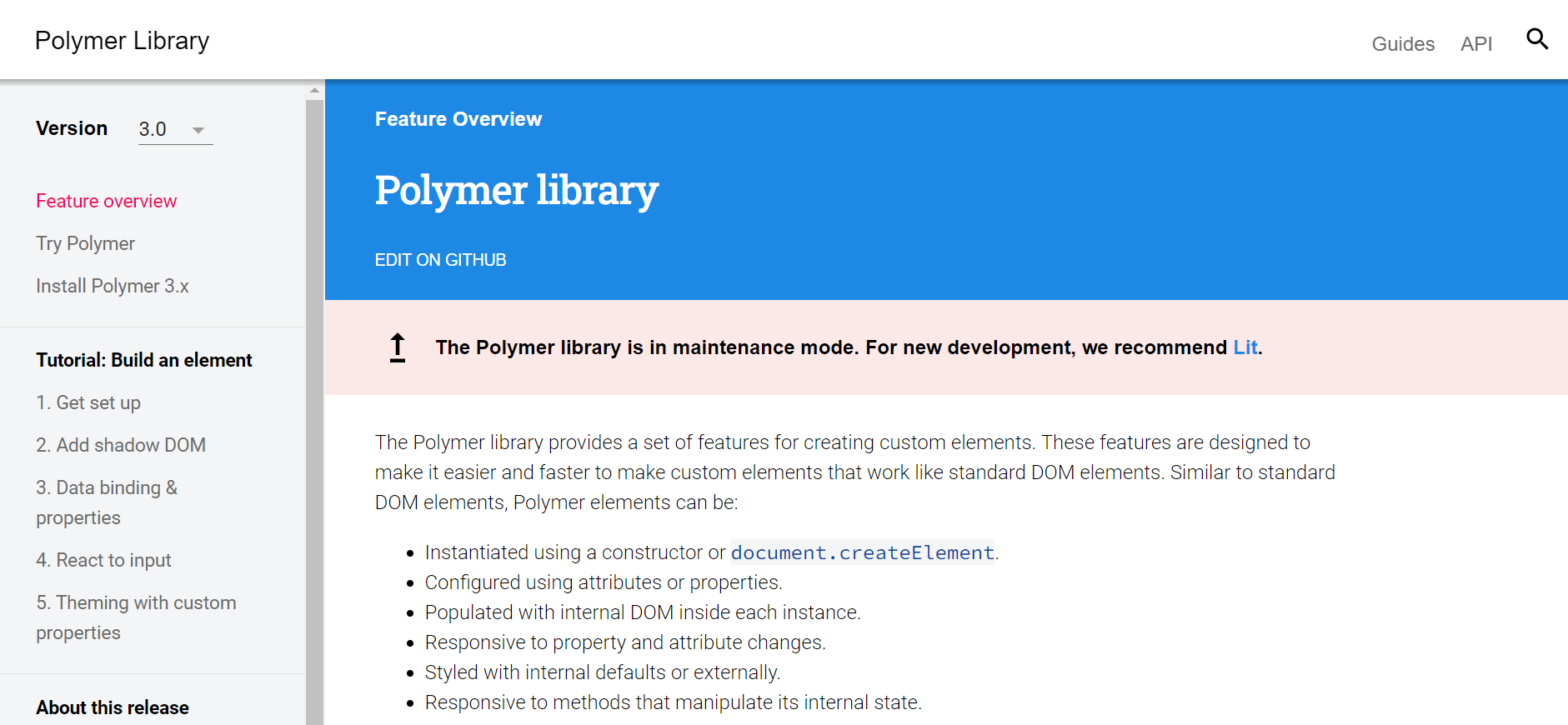
The Polymer library now sits in maintenance mode, and the Polymer Project recommends Lit for new development. Lit keeps the same Web Components foundation, ships a smaller runtime, and uses standard JavaScript template literals in place of Polymer HTML templates. Treat Polymer as a codebase you maintain, and start new custom element work on Lit.
Key Takeaway: The Polymer library sits in maintenance mode and the Polymer Project recommends Lit, so treat an existing Polymer codebase as maintenance work and start new custom element development on Lit.
Preact
Most of the people are afraid of using React mainly because of its size and performance. Preact was introduced mainly due to the following reasons, and it is amazing how easily you can swap your react with the preact counterparts.
It is known to have quite a reputation in enhancing the performance of mobile web applications. Changing React & React DOM with Preact-compat paired with Webpack and boom all your worries go out of the window.
Using preact will reduce your main app bundle by at least one third (may vary depending on app), the only catch being that testing gets complicated. The alternative to this maybe using react for development and preact for production. Enzyme, the older React test utility that Preact migration notes still mention, ships official adapters only up to React 16, so a current project tests Preact components with Preact Testing Library instead. Lyft and Uber used preact and it improved the performance because it is simply faster and smaller. Like react it also has virtual DOM that acts as a reagent enhancing its speed.
Key Takeaway: Preact reduces a React application's main bundle by at least one third and improved performance for Lyft and Uber, but testing gets more complicated, so some teams develop with React and ship Preact to production.
Storybook
Storybook is a free, open-source JavaScript framework renowned for its ability to create and test separate UI elements. Trusted by thousands of teams for UI development, testing, and documentation, Storybook simplifies issue detection and resolution by allowing developers to construct a catalog of components and interact with them in a live environment.
Storybook 10 is the current major line. That release, published on October 28, 2025, makes Storybook ESM only and cuts install size by 29 percent, so confirm that your bundler and Node setup handle ES modules before you upgrade an older Storybook project.
Read the comprehensive guide on Storybook testing to get started with testing Storybook applications.
To learn more about other JavaScript frameworks that can help you perform automation testing with ease follow this blog on other best JavaScript frameworks and choose the right JavaScript frameworks based on your project needs.
Regardless of the JavaScript framework you select, it's advisable to test your applications in real-world environments. This is where cloud-based testing platforms like TestMu AI come into the scenario.
TestMu AI is an AI-native test orchestration and execution platform that enables JavaScript application testing and automation across a browser farm with over 3000+ browser and OS combinations. This platfrom supports various JavaScript testing frameworks like Selenium, Cypress, Playwright, Mocha, and TestCafe, facilitating automated testing at scale.
Key Takeaway: Storybook is a free, open-source tool that builds a catalog of individual UI components and lets developers interact with each component in a live environment to spot and fix issues.
How Do AI Coding Assistants Change Your Framework Choice?
Add one question to your checklist: does the framework publish machine readable documentation and an official Model Context Protocol (MCP) server? That answer decides how current your AI assistant is on the framework. An assistant answers from training data, so it reproduces the API that was common when that data was collected, not the API in the release you installed.
Several projects close that gap with an llms.txt file, a plain text index that points an assistant at the Markdown source of each documentation page. React, Vue, Next.js, Nuxt, Svelte, and Preact each serve one. Nuxt also serves every documentation, blog, and deploy page as Markdown when you append .md to the URL, and the Next.js file names the documentation version it covers, so you can see which release an answer came from.
Two projects go further and run a server the assistant can call. Svelte hosts an MCP server at mcp.svelte.dev and ships the same server as the @sveltejs/mcp npm package. It returns the documentation section the task needs, then statically analyses the Svelte code the agent produced and suggests fixes. The Angular CLI starts its own server with npx @angular/cli mcp, and the default tools include search_documentation, get_best_practices, list_projects, run_target, and onpush_zoneless_migration. The --read-only and --local-only flags limit what the agent is allowed to do.
Weigh this alongside the rendering model, the hiring pool, and support status. A framework with an llms.txt index and an official MCP server gives your assistant current facts and leaves your reviewers less generated code to correct. A framework with neither pushes that correction work back onto people, and on a large codebase that cost is real.
Key Takeaway: A framework that publishes an llms.txt documentation index or runs an official MCP server, as Svelte and Angular both do, keeps an AI coding assistant on the current API and leaves reviewers less generated code to correct.
Conclusion
Match the framework to four facts about your project before you commit. The rendering model comes first, because server rendered and streamed pages point to React with Next.js or Vue with Nuxt, while an internal dashboard can stay a client-side single page app. The hiring pool comes second, since a small team can only maintain what it can recruit for. Support status comes third, and the testing story comes last, because your component model decides which test runners and selectors your team can use.
Two compile-first options belong on the shortlist even though this guide does not cover them in depth. The Svelte documentation describes Svelte as a framework that uses a compiler to turn declarative components into lean, tightly optimized JavaScript, and Solid states that instead of using a Virtual DOM, it compiles its templates to real DOM nodes and updates them with fine-grained reactions. Judge that smaller runtime against the same four facts: rendering model, hiring pool, support status, and testing story.
Maturity in JS is accepting the fact that there is no 'best' overall framework or library. In the end it boils down to what your project requires, and it is always advisable to use more than one library. For instance React components can be used to limit along with Vue quite a lot of times.
If you have a big team then Angular provides an extra edge because of its fixed procedures and syntax. Both Angular and Vue are great if you love using templates. If server-side rendering is the objective then both React and Vue have potential to solve your problems, same will be the case if you are using it for startups.
Personally, though I favor Vue out of all three. With Vue you have functioning frameworks enough for you to start scripting, no additional libraries need to be connected. Most companies are switching from Angular to Vue just to bridge the gap between senior and junior developers because it is easy to learn. Vue is now mature, and its ecosystem is wide enough for most product teams. The Polymer library never became mainstream, and Lit now carries that Web Components work forward.
JavaScript world is a lot bigger than you might think, expand your horizons and learn more and more about different frameworks and libraries. Tell us about your experiences in the comment section.
Happy Scripting!




JavaScript Framework Selection FAQs
Did you find this page helpful?
More Related Blogs
TestMu AI forEnterprise
Get access to solutions built on Enterprise
grade security, privacy, & compliance
- Advanced access controls
- Advanced data retention rules
- Advanced Local Testing
- Premium Support options
- Early access to beta features
- Private Slack Channel
- Unlimited Manual Accessibility DevTools Tests