

Power Your Software Testing with AI Agents and Cloud
The Native AI-Agentic Cloud Platform to Supercharge Quality Engineering. Test Intelligently and Ship Faster.


- TestMu AI (Formerly LambdaTest)
- /
- Blog
- /
- Black Friday and Cyber Monday Testing: Complete Checklist
Black Friday and Cyber Monday Testing: Complete Checklist
Test your website and mobile app for Black Friday and Cyber Monday traffic. Get a BFCM testing checklist, load and payment checks, and device coverage.
Last Updated on:
Black Friday and Cyber Monday testing checks that your website and mobile app handle peak traffic across load capacity, payment gateways, coupon logic, inventory sync, security, and device coverage. Shopify rehearsed the 2025 Black Friday peak with five scale tests from April through October, each sized at 150 percent of the previous year load.
This guide covers what the two days are, how big the sales get, how to scale test execution, a BFCM testing checklist, testing techniques, failure rehearsal, how AI changes the work, and the impact on stakeholders.
Key Takeaways
- Black Friday falls on November 27 and Cyber Monday on November 30 in 2026, and shopping traffic starts building from the first week of November, so BFCM testing should cover the whole month.
- US shoppers spent $257.8 billion online during the 2025 holiday season, including $11.8 billion on Black Friday and $14.25 billion on Cyber Monday.
- Smartphones carried 56.4% of online transactions across the 2025 holiday season, which makes the mobile shopping experience the first thing to test before Black Friday and Cyber Monday.
- A Black Friday and Cyber Monday test plan should cover load capacity, payment gateways, coupon logic, inventory synchronization, security, and cross-device coverage.
- Shopify rehearsed failure before Black Friday and Cyber Monday 2025 with five scale tests from April through October, each sized at 150% of the previous year load.
- Visits to US retail sites from generative AI tools rose 693.4% year over year across the 2025 holiday season, so server-rendered prices and accurate product structured data belong in BFCM test scope.
What Is Black Friday and Cyber Monday?
Black Friday and Cyber Monday are one of the largest shopping events in the US that come after Thanksgiving.
In the United States (US), Black Friday is the Friday that falls after Thanksgiving. This is regarded as the unofficial beginning of the shopping season, where retailers sell products at huge discounts and attractive deals. Black Friday usually goes on in-store with limited quantities. But now, things are very different since many sales take place online as well.
Cyber Monday is an online shopping event that comes after Black Friday. It offers deals on technical products. However, over the years, it has become much more than just tech. So, almost everything goes on sale nowadays.
Both dates move every year because they are tied to Thanksgiving. Thanksgiving falls on November 26 in 2026, so Black Friday is November 27 and Cyber Monday is November 30. Traffic starts building from the first week of November, so scope your release freeze and your load tests around the whole month rather than the two headline days.
Key Takeaway: Black Friday is the Friday after Thanksgiving and Cyber Monday is the Monday after Black Friday, which places the two days on November 27 and November 30 in 2026.
Will Black Friday and Cyber Monday See Big Sales?
According to Adobe, US shoppers spent $257.8 billion online between November 1 and December 31 of the 2025 holiday season, up 6.8% year over year. That was the first holiday period to cross a quarter of a trillion dollars online.
Black Friday alone accounted for $11.8 billion of US online spending, up 9.1% year over year. All of that lands inside a single 24-hour window, so the load your systems absorb is concentrated rather than spread across the season.
For businesses, this means an opportunity to prepare for higher traffic, fine-tune site performance, offer personalized promotions, and strengthen customer support to convert spikes in demand.
Cyber Monday was larger still at $14.25 billion, up 7.1% year over year, and Cyber Week as a whole brought in $44.2 billion, up 7.7%. Between 8 pm and 10 pm on Cyber Monday, shoppers spent $16 million every minute.
This continued growth signals that shoppers still prioritize convenience and online deals even after Black Friday, giving brands an extended window to drive revenue through optimized digital experiences and post-sale engagement strategies.
Mobile is now the default shopping device rather than the secondary one. Smartphones carried 56.4% of online transactions across the season, and on Cyber Monday mobile drove 57.5% of online sales, worth $8.2 billion and up 8.0% year over year. The phone experience is the one to test first.
AI assistants are now a real source of retail traffic. Adobe recorded a 693.4% year-over-year rise in visits to US retail sites from generative AI tools across the season, and a 670% rise on Cyber Monday alone. Those visitors arrive from assistants that read pages programmatically, so server-rendered prices, accurate product structured data, and stable responses under repeated crawling belong in your BFCM test scope.
Black Friday and Cyber Monday are peak shopping events, drawing millions of online buyers. To capitalize on this surge, businesses must ensure their websites and mobile applications perform seamlessly under high traffic. Any glitches or slowdowns can lead to lost sales and damage the brand's reputation. Testing ensures smooth performance, enhances user experience, and supports successful BFCM campaigns.
Key Takeaway: US online spending reached $257.8 billion across the 2025 holiday season and smartphones carried 56.4% of online transactions, which makes the mobile experience the first thing to test before Black Friday and Cyber Monday.
Scale Your Black Friday and Cyber Monday Testing With TestMu AI
A feasible approach for testing here is to leverage cloud-based platforms like TestMu AI. It is an AI testing platform that allows developers and testers to perform manual and automation testing at scale across 3000+ real environments.
Here is the snap of the cross-browser tests run on the TestMu AI platform:
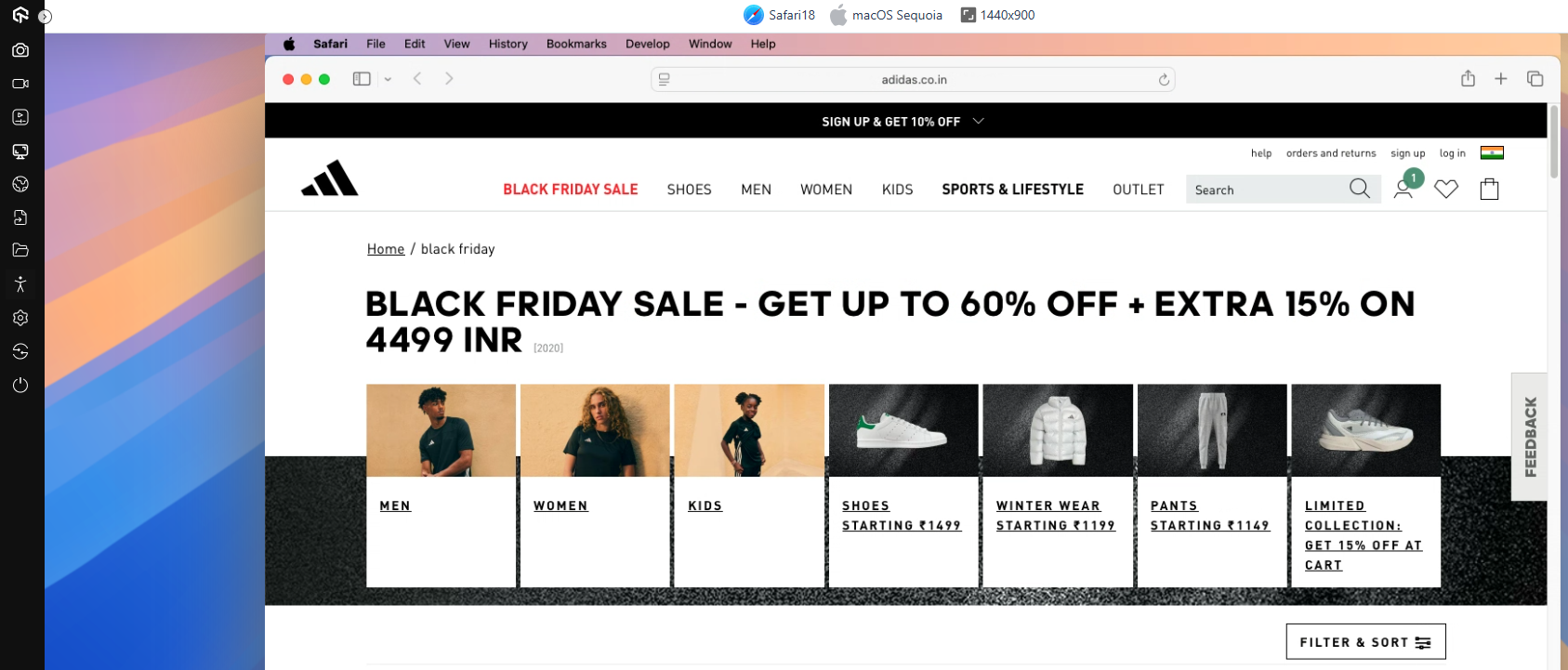
When it comes to performance testing, TestMu AI offers HyperExecute, an end-to-end test orchestration platform that lets you run performance tests using tools such as JMeter. HyperExecute offers test execution, which is up to 70% faster than any other cloud grid.
To get started, check out this guide on performance testing with HyperExecute.

As we discussed above, prioritizing the mobile-first approach is crucial since most of the traffic comes from mobile devices. It ensures your websites are optimized for different screen sizes.
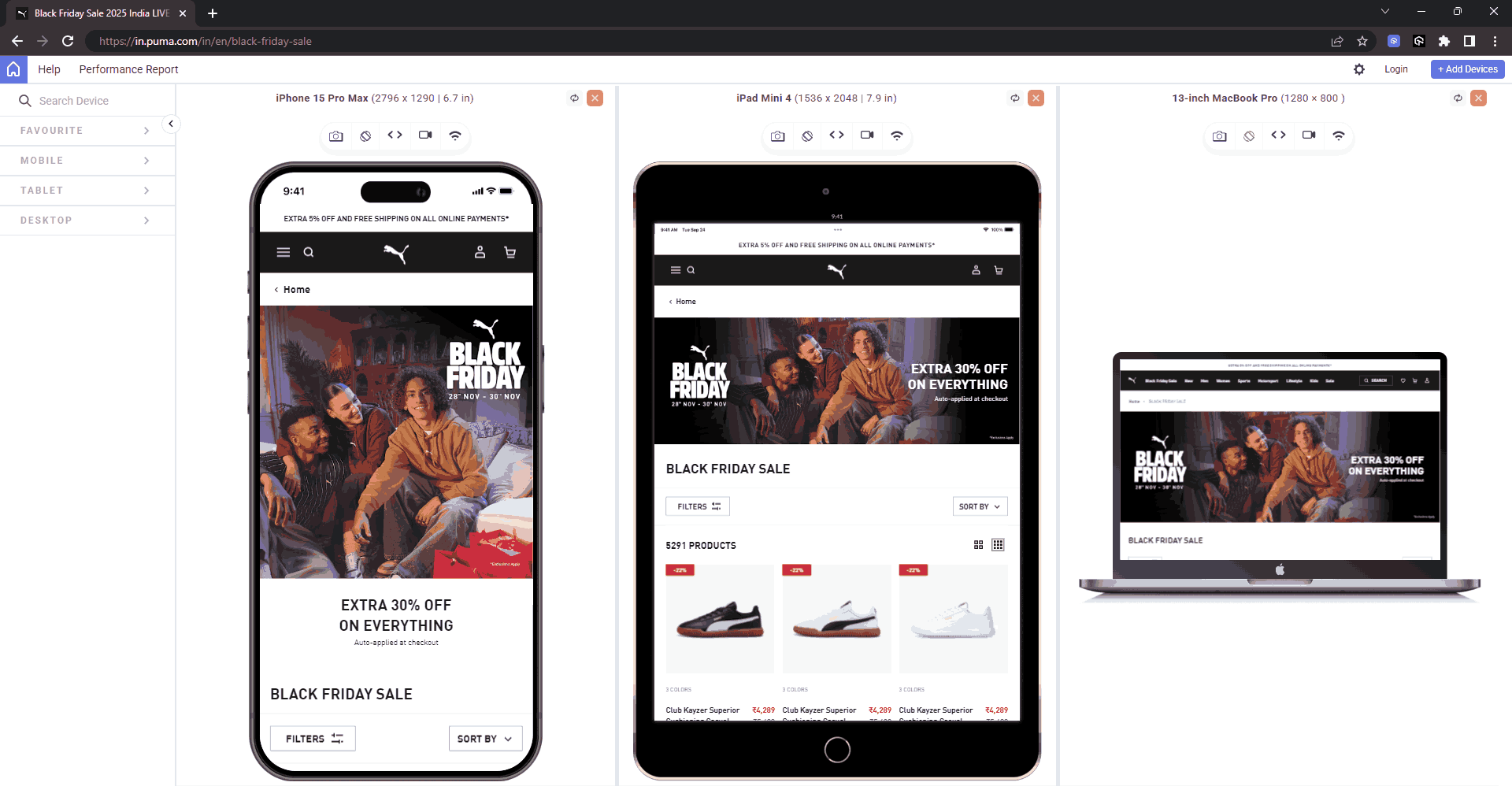
For this, TestMu AI offers a responsive testing tool known as LT Browser that allows you to run mobile-friendly tests across 53+ device viewports such as mobile, tablet, desktop and laptops.
Harness KaneAI for Black Friday and Cyber Monday
You can leverage AI in your BFCM testing using GenAI test agents such as KaneAI.
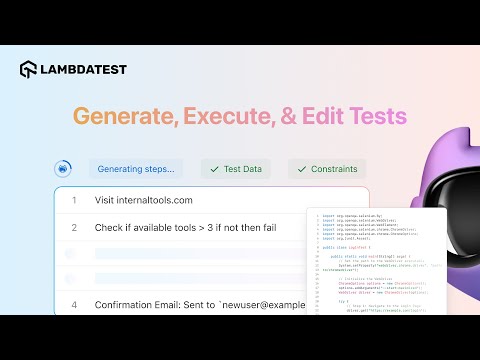
TestMu AI KaneAI is a Generative AI testing tool for high-speed quality engineering teams that lets you create, write and debug automated tests using natural language commands.
Features:
- Intelligent Test Generation: Automatically creates and refines test cases using NLP-based instructions.
- Smart Test Planning: Transforms high-level goals into clear, automated test plans.
- Multi-Language Code Export: Produces tests that work across multiple programming languages and frameworks.
- Show-Me Mode: Makes debugging easier by turning user actions into simple, natural language steps for better consistency.
- API Testing Support: Seamlessly adds backend testing to strengthen overall coverage.
- Wide Device Coverage: Enables testing across 3000+ browsers, devices, and operating systems.
To get started, head over to the documentation on getting started with KaneAI.

Key Takeaway: Cloud testing platforms cover Black Friday and Cyber Monday readiness by running manual, automation, performance, and responsive checks across thousands of real browser and device environments.
Testing Checklist for Black Friday and Cyber Monday
As eCommerce thrives, ensuring a smooth and secure shopping experience has never been more crucial. So, here is a testing checklist for BFCM to ensure a seamless shopping experience for your customers.
- Simulate Heavy Website Traffic With Load Testing: Simulate high visitor surges to measure system limits and prevent crashes, slow pages, and downtime.
- Have an Effective Server Configuration: Configure hardware and load balancers properly to manage heavy traffic and maintain stable uninterrupted service during peak.
- Test Website Updates for Seamless UX: Verify new banners, pages, and design changes function correctly without disrupting existing features or usability standards.
- Implement Cross-Platform Testing for a Hassle-Free BFCM: Ensure consistent performance and responsive design across mobile, tablet, and desktop shopping experiences during peak.
- Test Server-Side Synchronization for Managing Product Catalog Updates: Confirm accurate inventory updates prevent overselling and incorrect availability displays during intense shopping periods.
- Perform UI/UX Testing of Coupon Codes: Ensure discounts apply correctly without stacking errors or confusing customers during promotional checkout processes and payments.
- Test for Smoother Transactions: Validate payment gateways handle peak volumes reliably across networks and devices without failed charges or delays affecting sales.
- Run Security Tests: Identify vulnerabilities protect customer data prevent breaches and ensure safe encrypted transactions against fraud during high traffic shopping events.
- Test Geolocation to Ensure Global Reach: Verify regional compliance localized content correct restrictions and appropriate user experiences for international shoppers worldwide effectively.
Key Takeaway: A Black Friday and Cyber Monday testing checklist runs from load testing and server configuration through coupon code validation, payment gateway checks, security testing, and geolocation coverage.
Testing Techniques for Black Friday and Cyber Monday
Comprehensive testing is required to ensure the eCommerce experience is seamless. For this, there are different software testing techniques that you can perform to check various aspects like functionality, user experience, performance, security, and more.
- Functional Testing: Validate checkout flow accuracy from product selection through payment confirmation ensuring all steps function correctly without disruption during peak sales hours.
- User Experience Testing: Gather real user feedback identify friction points and refine design elements to improve engagement satisfaction and overall shopping journey efficiency.
- Performance Testing: Measure page speed manage load efficiently and ensure stable performance under high traffic conditions without slowing key user interactions.
- Security Testing: Assess system vulnerabilities simulate threats and confirm compliance standards to protect customer data and secure financial transactions during heavy demand.
- Error Handling and Monitoring: Detect system errors promptly monitor performance continuously trigger alerts and enable rapid resolutions ensuring stable reliable service during high traffic sales periods.
Key Takeaway: Functional, user experience, performance, security, and error monitoring testing each cover a different failure mode that appears during Black Friday and Cyber Monday traffic.
How Do You Rehearse Failure Before Black Friday?
Rehearse failure by running scale tests and chaos testing experiments in the months before the sale, then fixing whatever breaks. Load testing shows your system survives the traffic you expect. Failure rehearsal shows it recovers when a dependency stops answering, and that is the scenario that takes checkout down on the day.
Shopify publishes how it prepares. Its engineering team ran five scale tests from April through October ahead of BFCM 2025, and by the fourth test the platform handled 146 million requests per minute and more than 80,000 checkouts per minute. It sized those runs at 150% of the previous year load. From early spring it also ran game days that exercised checkout, payment processing, order creation, and fulfillment while failures were injected into the path.
The injection layer can be open source. Toxiproxy is a TCP proxy that Shopify has used internally since October 2014 and ships under the MIT license. It applies named toxics to a connection, including latency, bandwidth, timeout, reset_peer, packet_loss, and down. Point a staging checkout at a proxied payment gateway, apply the latency toxic, and you find out whether your timeout and retry logic protects the order or strands it.
Choose experiments that map to real BFCM failure modes. Steadybit lists five to run before peak: auto-scaling under CPU or memory stress, server failure and traffic rerouting, database failover, latency injection into checkout, and a blocked third-party service such as a payment processor or shipping API. Give the runs time as well as load. Test Triangle in its 2026 load testing guide recommends starting three to four months out and holding soak tests for 48 to 72 hours, because memory leaks and database contention surface only after sustained load. Set a configuration freeze as well. A 2026 ecommerce holiday readiness guide recommends locking store configuration by mid-October so a late change cannot take the site down, and it gives your final scale test a stable build to run against.
Key Takeaway: Load testing shows a system survives the Black Friday traffic you expect, while chaos experiments such as injecting latency into checkout show whether the system recovers when a payment or shipping dependency stops answering.
How Does AI Change Black Friday and Cyber Monday Testing?
AI changes Black Friday and Cyber Monday testing by adding a second kind of buyer: a shopping agent that reads your pages programmatically and can drive checkout on its own. Your test scope now covers what an agent can parse and complete, not only what a person sees in a browser.
That traffic also converts better. Adobe Analytics found that shoppers arriving from generative AI tools converted 31% more than shoppers from other sources across the 2025 holiday season, rising to 38% more on Black Friday itself. They also spent 45% more time on site and viewed 13% more pages per visit.
Two published specifications now define how an agent finishes a purchase. The Agentic Commerce Protocol, released by Stripe and OpenAI under the Apache 2.0 license, lets a compatible agent initiate checkout on your store and pass a payment credential without exposing the buyer's underlying card details. Google announced the Agent Payments Protocol (AP2) on September 17, 2025 with more than 60 organizations including Mastercard, PayPal, and Adyen. AP2 signs each step as a Mandate, using an Intent Mandate for what the shopper asked for and a Cart Mandate that locks the exact items and price before payment.
That gives testers concrete assertions. Check that prices and stock status render server side rather than only after client JavaScript runs, that product structured data matches the price charged at checkout, and that checkout endpoints stay correct when an agent retries them. The limitation is that you cannot assert on the agent's own wording, because model output varies between runs. Test the contract instead: the response your endpoints return, the mandate your checkout accepts or rejects, and the order record that results.
Key Takeaway: AI shopping agents read product pages programmatically and can complete checkout through published specifications such as the Agentic Commerce Protocol and Google AP2, so Black Friday test scope should cover server-rendered prices, accurate product structured data, and checkout endpoints that answer an agent correctly.
Impact of Black Friday and Cyber Monday on Stakeholders
During Black Friday and Cyber Monday, most purchases now happen online, as consumers take advantage of digital deals, convenience, and home delivery options.
- Impact on Customers: Customers increasingly prefer online shopping due to convenience and variety. They can browse thousands of products quickly, but limited stock creates urgency.
High traffic often causes website slowdowns or downtime, especially on Black Friday, making the shopping experience unpredictable.
- Impact on Sellers: Sellers on platforms like Amazon or their own sites face both opportunities and challenges.
They can move overstocked or unsold products quickly, gain new customer sign-ups from high traffic, risk losses due to steep discounts, handle logistical challenges with high order volumes, and need to restock popular items promptly.
- Impact on Developers: Developers must prepare websites and apps for predictable surges in traffic, unlike other events.
They may hire additional staff for demand spikes, manage unusual shopping patterns, allocate extra resources for operations and support, optimize system architecture for heavy loads, and expand testing to prevent disruptions.
- Impact on Testers: Testers ensure applications perform flawlessly under extreme conditions. Their role is critical for revenue protection.
They validate software handles massive traffic loads, test access across browsers, devices, and operating systems, verify API stability during spikes, ensure payment interfaces work seamlessly, and confirm rapid response to potential issues.
Key Takeaway: Black Friday and Cyber Monday affect customers, sellers, developers, and testers differently, and testers carry the job of proving the application holds up under peak traffic, payments, and API load.
Author

Harish Rajora
Blogs: 100


Harish Rajora is a software developer at TestMu AI with over 6 years of hands-on experience in Python and cross-platform application development across Windows, macOS, and Linux. He has authored 800+ technical articles and worked on large-scale projects, including GenAI applications and core engineering features used by millions. Harish has led DevOps initiatives building CI/CD pipelines with Jenkins, AWS, GitLab, and GitHub, and holds an M.Tech in Software Engineering from IIIT Allahabad.


Black Friday and Cyber Monday Testing FAQs
Did you find this page helpful?
More Related Blogs
TestMu AI forEnterprise
Get access to solutions built on Enterprise
grade security, privacy, & compliance
- Advanced access controls
- Advanced data retention rules
- Advanced Local Testing
- Premium Support options
- Early access to beta features
- Private Slack Channel
- Unlimited Manual Accessibility DevTools Tests