

Power Your Software Testing with AI Agents and Cloud
The Native AI-Agentic Cloud Platform to Supercharge Quality Engineering. Test Intelligently and Ship Faster.


- TestMu AI (Formerly LambdaTest)
- /
- Blog
- /
- What Is Agentic Automation? How It Works and What Breaks
What Is Agentic Automation? How It Works and What Breaks
Agentic automation gives software a goal instead of a script. See how it works, where it fits, and what our cloud runs showed actually breaks when a UI changes.
Published on:
Overview
Agentic automation runs a business process by giving software a goal instead of a fixed sequence of steps. The system decides which action comes next at runtime, calls the tools it needs, and adapts when conditions differ from the previous run, rather than halting on the first unexpected input.
How Is Agentic AI Different From Automation?
- Goal-given rather than steps-given: a scripted bot repeats an encoded sequence exactly, while an agentic automation is told what outcome to reach and selects the actions itself on each run.
- Silent divergence: when reality changes, a script stops with an error someone notices, whereas an agent picks a different route and reports success, so a wrong outcome can look identical to a right one.
- Coupling moves, it does not disappear: our runs on the TestMu AI Browser Cloud showed a scripted bot failing every attempt once element IDs changed, and an agent failing every attempt once the visible labels were reworded.
- Variable cost and latency: two runs of the same goal can take a different number of model calls and a different amount of time, which makes per-run cost a planning input rather than a fixed line item.
How Do You Test an Agentic Automation Before Production?
Score a pass rate across many repeated runs against a fixed environment instead of one happy path, shadow the agent alongside the process it replaces, sample its output for human review, and name a rollback owner before go-live.
An accounts payable bot has processed the same supplier invoice every week for two years. This week the supplier adds a line item for freight, the purchase order no longer matches to the cent, and the bot stops. A ticket opens, someone reconciles it by hand, and the queue drains by Friday.
Agentic automation proposes a different ending. Give the software the goal, let it look up the delivery note, work out that freight explains the variance, and post the match. That is a real capability, and it is also where a specific new risk enters: the run that quietly resolves the variance the wrong way looks exactly like the run that resolves it correctly.
What Is Agentic Automation?
Agentic automation is the practice of running a business process by giving software a goal rather than a script. The system perceives its environment, decides which action comes next, calls tools or systems to carry it out, and adjusts when the situation differs from the last run.
The distinction worth holding on to is between the capability and the operating model. Agentic AI describes what the software can do: plan, use tools, and act toward an objective. Agentic automation describes what happens when you point that capability at a process that used to have an owner, a runbook, and an audit trail.
You will also see this written as agentic AI automation, which collapses both halves into a single phrase. It refers to the same thing, and if that is the term you searched for, this is the right page.
That second half is the part most explainers skip, and it is where the operational questions live. A capability has features. A process has a cost per error, a compliance position, and someone whose name is on it.
Agentic Automation vs Agentic Process Automation
Agentic process automation, usually shortened to APA, is the same idea scoped to a complete end-to-end business process rather than an individual task. The acronym is a vendor coinage built to echo RPA, and it signals ambition about scope rather than a different underlying technology.
Treat agentic automation, agentic AI automation and APA as interchangeable labels when you read vendor material, and pay attention to scope instead. An agent that reconciles one exception type is a different proposition from an agent that owns procure-to-pay, even when both are sold under the same label.
Buying intent is still well ahead of deployment. In a January 2025 poll of 3,412 webinar attendees reported by Gartner, 19% of organizations had made significant investments in agentic AI and 42% had made conservative ones, while 31% were still taking a wait and see approach or were unsure.
Where Agentic Automation Fits in an Existing Estate
Most organizations considering this already run automation. The useful question is not which approach is better in the abstract, but which of your current automations should stay as they are, which should gain an agent at the edges, and which should be rebuilt.
- Leave it scripted - high volume, structured input, stable interface, and a known cost per run. Robotic process automation (RPA) is cheaper and more predictable here, and swapping it for an agent buys nothing.
- Add an agent at the exception path - the deterministic route keeps running, and only the cases that would previously have opened a ticket get routed to an agent. This is the lowest-risk entry point because the blast radius is already bounded by the exception queue.
- Rebuild around a goal - the process depends on unstructured input, the rules have grown into a thicket of special cases, and the maintenance burden now exceeds the original automation benefit.
- Do not automate it yet - the outcome cannot be checked without a human reading it, and a wrong result is expensive or hard to reverse.
The boundary between rule-based execution and learned behavior is worth understanding properly before you place anything on this list, and the trade-offs are covered in more depth in RPA vs AI.
What We Measured: Scripted Bots and Agents Under UI Change
The most common claim made for agentic automation is that agents adapt when a screen changes while scripted bots break. We tested that claim directly on real Chrome sessions rather than accepting it, because the answer determines which processes are safe to hand over.
How We Ran It
Both arms ran on real Chrome sessions on the TestMu AI Browser Cloud against the same target, the Input Form Submit page on the TestMu AI Selenium Playground. The goal was identical in every run: fill the contact form and verify each value landed by reading it back from the page.
- Scripted strategy - resolves each field by the element ID stored when the automation was first built, the way a recorded bot replays a flow.
- Agent strategy - stores no selectors and re-derives each target at runtime from the visible affordance, the way a goal-driven agent reads a page before acting.
- Success condition - a step counted as passing only when the value read back from the field matched what was written, so a click that silently did nothing counted as a failure.
Arm one varied chain length, running the same goal at 2, 4, 6, 8, 10 and 12 steps, five runs each. Arm two held length at six steps and varied the page instead, across four conditions, five runs per strategy per condition. The predictions for arm two were written into the script before it ran.
// Agent strategy: no stored selector, resolve from the visible label each run
const field = page.getByPlaceholder(step.intent, { exact: true });
if (await field.count() !== 1) return { ok: false, reason: 'no unique match' };
await field.fill(step.value);
return { ok: (await field.inputValue()) === step.value };
What the Runs Showed
Arm one produced nothing. All 30 runs passed at every chain length, because on a stable, well-labelled form every target resolved to exactly one candidate. There was no ambiguity for either strategy to get wrong, and chain length alone did not degrade anything.
Arm two is where the difference appeared, and it is symmetrical.
| Page condition | Scripted bot | Agent |
|---|---|---|
| Control, page unchanged | 5 of 5 passed | 5 of 5 passed |
| Element IDs changed, labels identical | 0 of 5 passed | 5 of 5 passed |
| Labels reworded, IDs identical | 5 of 5 passed | 0 of 5 passed |
| Fields reordered on the page | 5 of 5 passed | 5 of 5 passed |
Robustness is the wrong word for what separates these two columns. Each strategy is coupled to a different artifact, and each one failed when its own artifact moved. The scripted bot depends on the code, so a redeploy that changed generated IDs stopped it. The agent depends on the copy, so a content edit that reworded the labels stopped it, while the underlying fields stayed exactly where they were.
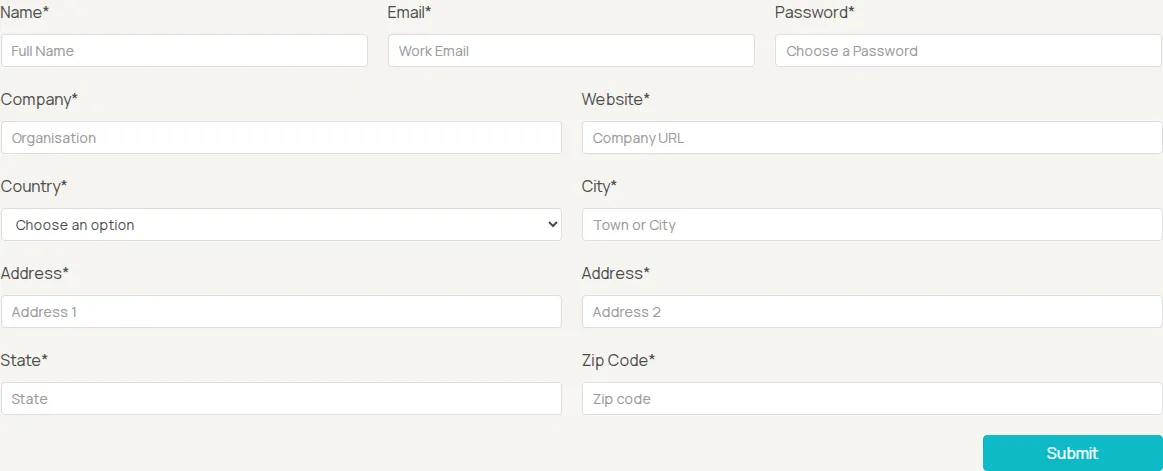
The screenshot above is the condition that defeated the agent. The field headings still read Name, Email and Password, but the placeholder text inside them now reads Full Name, Work Email and Choose a Password. A copy change no developer would flag as a breaking change removed every target the agent was looking for.
Two limits are worth stating plainly. This was one form on one site, and every failure here was a clean no-match that halted immediately, which is the detectable case. The dangerous case, an agent confidently matching the wrong element and continuing, did not arise on a form this unambiguous, and that is precisely the case a production process needs to be tested for.

What Changes When a Process Runs on a Goal
The internal mechanics of the plan, act and observe loop are covered in agentic workflows. What follows is the part a process owner inherits once that loop is running inside something they are accountable for.
- The path is no longer fixed - two runs of the same goal can take different routes, so "what did it do" becomes a question you answer per run from a trace rather than by reading the automation.
- The audit trail loses its shape - a scripted process has a knowable step list that an auditor can review once. An agentic one produces a different sequence each time, which changes what evidence you have to retain and for how long.
- Failure gets quieter - a script throws where it cannot proceed. An agent chooses an alternative and reports completion, so the failure signal you used to rely on is gone.
- Cost and latency vary per run - the number of model calls needed to reach the goal is not fixed, which makes both budget and service-level targets ranges rather than constants.
- The model is a dependency - a provider updating a model version can change behavior in a process you did not touch, which is a supply chain relationship no scripted bot has.
Independent measurement supports treating autonomy as partial rather than settled. METR tracks the length of task that frontier agents can complete autonomously at 50% reliability, and reports it doubling roughly every seven months. The trend is fast, and the benchmark is still a coin flip.
On consequential work the gap is wider. In TheAgentCompany, a Carnegie Mellon benchmark of 175 real professional tasks inside a simulated software company, the most competitive agent tested completed 30% of tasks autonomously. That figure reflects the model generation available when the benchmark was published in December 2024 and should be read as a floor rather than a current ceiling.
Which Processes Should You Hand to an Agent?
Most selection advice sorts processes by how much judgment they need. That is the wrong first axis. Judgement tells you whether an agent could do the work; reversibility tells you what happens when it does the work wrong. Score a candidate process on four questions before anything else.
- Is the outcome independently verifiable? If correctness can only be judged by the same reasoning that produced it, you have no check. A posted invoice can be reconciled against a bank statement; a summary of a customer call often cannot be checked at all.
- Is the action reversible? Drafting, flagging and routing are reversible. Payments, deletions, external emails and status changes that trigger downstream systems are not.
- What does one wrong run cost? Multiply by the run rate, not by the pilot volume. A process running four times an hour produces roughly a thousand outcomes a week.
- How many runs execute before a human sees one? This is the real blast radius. An agent reviewed daily on a process that runs hourly can be wrong twenty-three times before anyone knows.
Processes that answer well on all four are the ones to start with, and they are usually less glamorous than the demo. For a broader survey of where organizations have actually deployed this, see these real-world agentic AI examples.
Skipping this screen has a documented cost. Gartner predicts that by 2027, 40% of enterprises will demote or decommission autonomous AI agents due to governance gaps identified only after production incidents occur. In that pattern the controls exist. They get calibrated after the incident that reveals which ones were needed.
How Do You Know It Works Before You Turn It On?
Runtime monitoring, approval gates and audit logs are all worth having, and none of them is verification. They tell you what an agent did after it did it. Verification is the work of establishing, before go-live, that the agent reaches the right outcome often enough to be trusted with the process.
The intent is widespread and the practice is not. In a survey of 3,235 business and technology leaders across 24 countries, Deloitte found close to three-quarters of companies planning to deploy agentic AI within two years, while only 21% of those companies reported a mature model for agent governance. The same survey found only 25% of respondents had moved 40% or more of their AI pilots into production.
- Write an observable success condition - something a second system can check without rerunning the agent's reasoning. If you cannot express it, the process failed question one of the screen above.
- Measure a pass rate, not a demo - run the same goal many times against a fixed environment and record how often it succeeds. One successful walkthrough tells you the happy path exists, not how often you land on it.
- Shadow the incumbent process - run the agent alongside the current one without letting it act, and compare outcomes on real volume. Disagreements are your test cases.
- Set a review sampling rate - decide what fraction of runs a human reads, and set it from the blast radius answer rather than from convenience.
- Name a rollback owner and trigger - decide in advance what threshold reverts the process to its previous implementation, and who is accountable for pulling it.
The mechanics of scoring non-deterministic output are a discipline of their own, covered in AI agent testing. Where a platform helps is in running that evaluation at a volume a person cannot. TestMu AI's Agent Testing platform generates test scenarios from an uploaded document, runs them through specialized evaluators in parallel, and scores each conversation on dimensions including hallucination, completeness, context awareness and root-cause understanding, ending in a red, amber or green production-readiness verdict rather than a wall of transcripts. The platform overview documentation walks through connecting an agent and running a first suite.

Note: Score an agent against repeatable scenarios before it touches a live process, not after. Try TestMu AI free!
Agentic Automation Inside Software Delivery
Software delivery is the one domain where agentic automation runs in both directions at once, and the distinction matters because teams routinely conflate them.
- Agents performing QA - authoring tests from a plain-language description, maintaining selectors as an application changes, and triaging failures. This is the direction covered in agentic QA.
- QA performed on agents - establishing that an agent, whether it ships in your product or runs one of your processes, behaves acceptably across repeated runs. This is the direction that gates the first one.
Our own arm-two result is a small illustration of why the second matters. An agent that resolves targets from visible labels will survive the refactor that breaks your scripted suite and fall over on a copy change nobody thought to announce. Neither behavior is discoverable from a demo. Both are discoverable from repeated runs against a deliberately mutated environment.
That kind of repetition needs browsers that behave like real ones. TestMu AI's Browser Cloud supplies real, full-featured Chrome sessions on demand for agents to act through, with a built-in tunnel that reaches localhost and staging environments and full session transparency so a failed run can be inspected rather than guessed at. Both arms of the study above ran on it, which is how the per-step read-back verification was possible at all.

Conclusion
Pick the process you can undo. Take one exception path with a verifiable outcome and a reversible action, shadow an agent against it for two weeks, compare every disagreement, and only then let it act with a sampling rate and a named rollback owner attached.
The reason to start narrow is that the returns so far reward patience. An IBM Institute for Business Value study of 2,000 CEOs found that only 25% of AI initiatives had delivered expected ROI over the past few years and only 16% had scaled enterprise-wide, even as 61% reported actively adopting AI agents.
Nothing in our runs suggested agents are fragile, and nothing suggested they are self-correcting either. They moved the coupling from the code to the copy. Knowing which artifact your automation depends on, and testing against changes to that artifact before go-live, is the part you control.
When you are ready to make that a gate rather than a habit, TestMu AI's Agent Testing platform scores an agent across repeated scenarios and returns a production-readiness verdict, and the Agent Testing CLI documentation covers wiring that run into a pipeline so nothing ships on an unverified agent.
Author

Saurabh Prakash
Blogs: 20

Saurabh Prakash is an Engineering Manager at TestMu AI (formerly LambdaTest), where he leads engineering on agentic AI development and scalable system architecture for the quality engineering platform. He has also contributed to Test at Scale, the company's open-source test intelligence platform. He brings over 9 years of experience across Node.js, Java, Spring, MVC, data structures, algorithms, and scalable system design, with earlier roles as SDE 2 at Zomato, Senior Software Engineer at LogicHub, and Software Development Engineer at Directi. Saurabh holds a B.Tech in Computer Science and Engineering from Delhi Technological University.
Reviewer

Sirajuddin Khan
Reviewer
Sirajuddin Khan is Vice President of Product Management at TestMu AI (formerly LambdaTest), where he drives the company's agentic AI product strategy, building a suite of autonomous agents that includes Agentic Browsers and Agentic Visual Testing and shifting the unit of work from test execution to autonomous outcomes. One of the company's earliest product leaders, he has owned the roadmap for the high-performance execution cloud and grew the cross-browser testing products from early adoption to market leadership. He brings over a decade of experience across SaaS, B2B, and eCommerce, with earlier product roles at Wydr and ShopClues, where his catalog and search work cut delivery SLAs and lifted seller activity. Sirajuddin holds an MBA in Information Technology from Sikkim Manipal University and a B.Tech in Computer Science Engineering from Maharshi Dayanand University.


Agentic Automation FAQs
Did you find this page helpful?
More Related Blogs
TestMu AI forEnterprise
Get access to solutions built on Enterprise
grade security, privacy, & compliance
- Advanced access controls
- Advanced data retention rules
- Advanced Local Testing
- Premium Support options
- Early access to beta features
- Private Slack Channel
- Unlimited Manual Accessibility DevTools Tests