

Power Your Software Testing with AI Agents and Cloud
The Native AI-Agentic Cloud Platform to Supercharge Quality Engineering. Test Intelligently and Ship Faster.


- TestMu AI (Formerly LambdaTest)
- /
- Blog
- /
- RPA vs AI: Key Differences and How They Work Together
RPA vs AI: Key Differences and How They Work Together
Compare RPA vs AI on data handling, decision logic, and maintenance. See when to use each, how they combine into intelligent automation, and how to test both.
Last Updated on:
Automation programs fail in two opposite ways. Teams point rules-based bots at judgment-heavy workflows and watch the exception queue swallow the savings, or they hand deterministic back-office processes to AI and inherit probabilistic errors that no auditor will sign off on. Both failures trace back to the same root: getting the RPA vs AI decision wrong at design time.
The failure modes are not even similar. A robotic process automation (RPA) bot halts loudly when a form field moves; an AI assistant confidently quotes a refund policy that does not exist. Choosing, combining, and validating the two starts with understanding exactly where one ends and the other begins.
Overview
Use RPA to automate high-volume, rules-based tasks with structured data, and deploy AI to handle unstructured inputs and probabilistic decisions requiring judgment. Combining these technologies allows you to build end-to-end intelligent automation pipelines that must be validated on real browsers and devices before production.
What Is the Difference Between RPA and AI?
- Best for rules-based execution: RPA - This technology executes predefined, script-based steps on structured data, making it ideal for high-volume tasks like invoice entry and report generation.
- Best for unstructured data: AI - This technology builds statistical models to interpret ambiguous inputs and make probabilistic decisions, making it ideal for tasks requiring judgment like document classification.
When Should You Choose AI, or Both?
- Best for cross-browser testing: TestMu AI - This platform provides an automation cloud to execute and validate your automation workflows on real browsers and devices before production.
RPA: Automation That Follows the Rules
RPA is software that mimics human interactions with digital systems by following explicit, predefined rules: clicking buttons, reading fields, copying values between applications, and filling forms. A bot does exactly what its script says, every run, with no learning involved.
The category is growing fast. Precedence Research estimates the global RPA market at $35.27 billion in 2026, projected to reach $247.34 billion by 2035 at a 24.20% CAGR.
Typical RPA characteristics:
- Structured inputs: spreadsheets, form fields, database records, and fixed-format files. A bot cannot interpret a scanned handwritten note without help.
- Deterministic logic: if-this-then-that rules defined up front. The same input always produces the same output, which makes runs auditable.
- Interface-level integration: bots operate through the UI or screen layer, which is why they suit legacy systems that expose no API.
- Brittleness to change: a renamed field or moved button breaks the script until a human repairs it.
In practice, RPA overlaps heavily with the browser-level tooling QA teams already know. The same techniques appear across web automation tools and desktop automation tools, and platforms like TestMu AI run those browser flows at cloud scale. The operational weak points that follow from these characteristics, and the fix for each, are broken down in this guide to common RPA challenges.
AI in Automation: Systems That Learn
AI in automation refers to systems that learn patterns from data and apply them to inputs they have never seen: classifying documents, extracting intent from free text, transcribing speech, or deciding the next step in a workflow. Where RPA encodes rules, AI approximates judgment.
The capabilities that matter for automation work:
- Machine learning (ML): models trained on historical data to classify, predict, or rank, such as flagging which invoices are likely duplicates.
- Natural language processing (NLP): reading and generating text, which turns emails, tickets, and PDFs from dead ends into automatable inputs.
- Computer vision and OCR: extracting structured values from scans, screenshots, and images.
- Agentic reasoning: large language models that plan multi-step tasks, choose tools, and adapt when a step fails.
Adoption of the autonomous end of that spectrum is still early. In the Stack Overflow Developer Survey 2025, 52% of developers either do not use AI agents or stick to simpler AI tools, and 38% have no plans to adopt agents. The judgment layer is powerful, but teams are adopting it carefully, one validated workflow at a time.

Note: Whether your automation is a rules-based bot or an AI agent, it has to survive real browsers, devices, and network conditions. TestMu AI gives you 3,000+ browser and OS combinations and 10,000+ real devices to run it against. Sign up free and run your first cloud test.
RPA vs AI: The Key Differences
The practical differences show up in five places: the data each handles, how decisions are made, what maintenance looks like, how failures behave, and what skills the team needs. The 24.20% growth rate Precedence Research projects for RPA exists precisely because rules-based execution stays cheap and predictable at scale.
| Dimension | RPA | AI |
|---|---|---|
| Input data | Structured only: forms, tables, fixed-format files with known fields | Unstructured and structured: free text, images, audio, documents |
| Decision logic | Explicit rules written by a developer; deterministic every run | Probabilistic model output; the same input can yield different results |
| Learning | None; behavior changes only when someone edits the script | Improves with training data, feedback loops, and model updates |
| Failure mode | Loud: bot halts or errors when the UI or data format changes | Quiet: plausible but wrong output that passes unnoticed without evaluation |
| Maintenance | Script repair whenever screens, fields, or flows change | Retraining, prompt updates, and drift monitoring over time |
| Auditability | High: every decision traces to a written rule | Harder: decisions trace to model weights and training data |
| Team skills | Process mapping, scripting, screen-layer automation | Data engineering, model evaluation, prompt and agent design |
The failure-mode row deserves the most attention. A broken bot stops and pages someone; a misfiring model keeps producing confident answers. That asymmetry drives everything about how each technology is deployed and tested. It is sharpest in computer use agents, which read the screen and re-plan every step instead of replaying a recorded selector.
Choosing Between RPA, AI, or Both
Map the decision to three properties of the process: input structure, decision complexity, and change frequency. The Stack Overflow numbers above are a useful sanity check here; most teams still run far more deterministic automation than agentic automation, and that is a rational allocation, not a lag.
- Use RPA alone when inputs are structured, rules are expressible, and volume is high: nightly data entry, cross-system reconciliation, report generation, migrations between legacy systems without APIs.
- Use AI alone when the task is pure judgment over unstructured input with a human or system consuming the output directly: ticket triage, document classification, conversational support.
- Combine them when a workflow starts with perception and ends with execution: AI reads the invoice PDF and extracts fields, then a deterministic bot keys the validated values into the ERP.
- Reconsider both if the system exposes an API. Direct integration beats screen-layer automation on reliability whenever it is available.
Three signals tell you the initial choice was wrong:
- Your RPA scripts are full of exception branches. If more than a handful of rules exist just to handle input variations, the input is not really structured; move perception to an AI layer.
- Your AI workflow has human reviewers approving nearly every output. If the decision was expressible as rules all along, a deterministic bot is cheaper and auditable.
- Your bot breaks weekly. A target application that changes constantly punishes screen-layer automation; push for API access or use self-healing element detection instead of raw selectors.
Tooling follows the same split. Rules-first teams often build on open-source stacks, and our roundup of Python frameworks for automation covers libraries that handle browser, desktop, and workflow automation without commercial RPA licensing.
From Intelligent Automation to Agentic Automation
The combination has a name: intelligent automation, sometimes intelligent process automation (IPA). The architecture is consistent across vendors: AI components handle perception and judgment at the edges, and RPA-style execution handles the deterministic middle.
A concrete pipeline for an accounts-payable workflow:
- OCR + vision model converts the scanned invoice into fields and line items.
- ML classifier validates the extraction, flags anomalies, and routes low-confidence documents to a human queue.
- RPA bot keys the approved values into the ERP, updates the tracking sheet, and files the confirmation.
- Exception loop feeds human corrections back into the classifier as training data.
The next step in that evolution is agentic automation, where an AI agent plans the whole workflow and picks its own tools rather than following a fixed orchestration script. The reasoning behind that shift, and where generative models fit into it, is covered in our comparison of agentic AI vs generative AI.
Because these four terms get conflated in vendor material, here is the distinction in one place:
- RPA: bots executing predefined steps on structured data; no decision-making beyond the written rules. Teams typically use process mining and task mining to find the repetitive processes worth handing to these bots.
- AI: models that learn from data and interpret unstructured input; decisions are probabilistic and made per input.
- Intelligent automation: AI perception feeding RPA execution in one pipeline; AI at the edges, rules in the middle.
- Agentic automation: the model, not a rule set, decides the sequence at runtime.

Testing RPA Bots and AI-Driven Automation
This is the part most RPA vs AI comparisons aimed at operations teams skip, and it is where the difference between the two technologies bites hardest. A rules-based bot and an AI agent fail differently, so they demand different validation strategies.
Validating Rule-Based Bots and Scripted Automation
Deterministic automation gets deterministic testing: assert exact outputs, replay the same inputs, and re-run the suite whenever the target application changes. The dominant cost is maintenance, because every UI change breaks selectors in the bot and in its tests at the same time.
This is the problem KaneAI, TestMu AI's GenAI-native testing agent, was built for. You author test flows in plain English, and its smart element detection resolves targets by intent instead of brittle selectors, so a renamed field becomes a self-healing review instead of a rewrite. Generated tests export to Selenium, Playwright, Cypress, or Appium, so the suite stays portable.
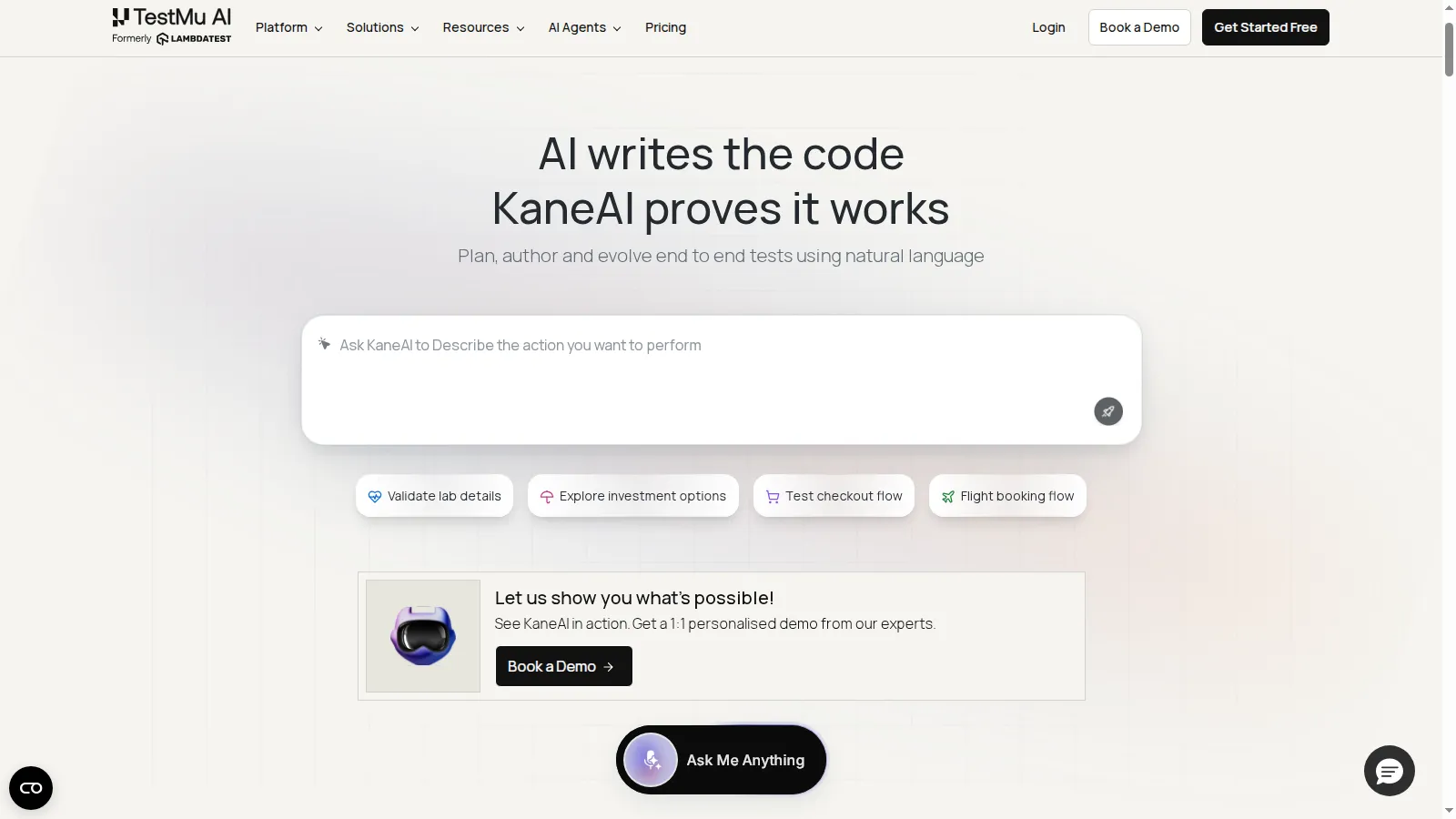
The screenshot above is from a live cloud browser session we ran against the KaneAI authoring surface: you describe the action, and the agent plans, authors, and evolves the end-to-end test from that intent.
Evaluating AI Agents and Non-Deterministic Automation
Exact assertions collapse when the same input can produce different valid outputs. Testing shifts to evaluation: scoring responses across quality dimensions, over many scenarios, against a definition of correct behavior. NIST's AI Risk Management Framework frames the goal as incorporating trustworthiness considerations into the design, development, use, and evaluation of AI systems, and evaluation is the part automation teams own.
TestMu AI's Agent Testing platform operationalizes this: it deploys 15+ specialized evaluator agents against your chat, voice, or phone agent, scores every interaction across 9 quality metrics including hallucination detection, bias detection, completeness, and context awareness, and rolls the results into a Green, Yellow, or Red production-readiness verdict. Uploading a PRD or policy document auto-generates 60 to 100+ test scenarios, so coverage does not depend on a human writing every case.
The practical rule: validate rule-based automation with regression suites, and validate AI-driven automation with metric-based evaluation runs. Shipping either without its matching test strategy is how the halted bot and the confidently wrong assistant from the introduction both end up in incident reviews.
Conclusion
Start by making the RPA vs AI call for one workflow you run today: structured inputs and fixed rules mean RPA, unstructured inputs and judgment mean AI, and perception-plus-execution means both. Then attach the matching validation strategy before the automation touches production, not after the first silent failure.
RPA is not legacy and AI is not a replacement; a market headed toward $247.34 billion by Precedence Research's estimate will contain plenty of both, increasingly orchestrated by agents. If your next step is the testing side, the KaneAI getting started guide walks through authoring your first natural-language test on TestMu AI in a few minutes.
Author

Sonali
Blogs: 4


Sonali is a QA Automation Tester with 4+ years of experience in designing automation frameworks and script coding using Selenium-BDD and Data-Driven frameworks, UFT, RPA, Appium, and API testing with Postman and Rest Assured. Skilled in Java, Python, Oracle, and SQL, she has delivered projects for clients including SBI, Aditya Birla Sun Life Insurance, and BNP Paribas. She holds certifications in MongoDB and Python.
Reviewer

Srinivasan Sekar
Reviewer
Srinivasan Sekar is Director of Engineering at TestMu AI (formerly LambdaTest), where he leads engineering and open-source initiatives behind the Selenium and Appium automation grid and owns TestMu AI's MCP Server. A committer to Appium and a contributor to Selenium, WebdriverIO, Taiko, and AppiumTestDistribution, he brings over 15 years of experience in quality engineering and open-source technologies. He is the author of the Apress book 'The MCP Standard: A Developer's Guide to Building Universal AI Tools with the Model Context Protocol,' a Certified Kubernetes and Cloud Native Associate, and an international conference speaker. Before TestMu AI he spent over eight years at Thoughtworks as a Principal Consultant and Quality Architect. Srinivasan holds a B.Tech in Information Technology from Anna University.


RPA vs AI FAQs
Did you find this page helpful?
More Related Blogs
TestMu AI forEnterprise
Get access to solutions built on Enterprise
grade security, privacy, & compliance
- Advanced access controls
- Advanced data retention rules
- Advanced Local Testing
- Premium Support options
- Early access to beta features
- Private Slack Channel
- Unlimited Manual Accessibility DevTools Tests