
E2E Testing for Chat, Voice, Phone and Video AI Agents
Run Thousands of Test Scenarios against Your Agent and Catch Hallucinations, Bias, and Toxicity Before Users Do.

Zero Data Retention (ZDR): What It Covers and How OpenAI and Anthropic Do It
What zero data retention (ZDR) covers, how OpenAI ZDR with Private Safety Processing compares with Claude's EFS, the exceptions, and how to verify it.
Published on:
On This Page
Zero data retention (ZDR) means the AI provider doesn't store your prompts or their responses once they've replied. Since September 2026, both OpenAI and Anthropic have ZDR on their most capable models and have implemented automated safety review of encrypted records, which are stored in your own cloud bucket. OpenAI refers to this as Private Safety Processing (PSP) and Anthropic refers to it as Enterprise Frontier Safeguards (EFS).
Key facts as of November 26, 2026
- OpenAI announced PSP on 19th August 2026, started a phased rollout on 22nd September (OpenAI) and published the white paper on 26th October (PSP white paper).
- Under PSP, the encrypted records go to your own S3, Azure Blob, GCS or OCI bucket. OpenAI requires you to keep them for at least 30 days, the same as their 30-day TTL (OpenAI PSP guide).
- Anthropic has had a 30-day retention requirement in place for their Covered Models (currently Claude Fable 5, 5.1 and 5.2 and Claude Mythos 5, 5.1 and 5.2) since 9th June 2026 (Claude Help Center).
- Anthropic announced EFS on 1st September 2026 (Anthropic). Encrypted safety data stays in your bucket for up to 28 days; your team will review the flagged cases, and the product is in beta (Claude docs).
TL;DR
Zero data retention (ZDR) means an AI provider keeps no copy of your prompts or the model's responses after it replies. OpenAI and Anthropic both offer ZDR to approved API customers, and on their most capable models they now pair it with automated safety review of encrypted records that sit in your own cloud bucket.
How Do OpenAI and Anthropic Run Zero Data Retention?
- OpenAI zero data retention: ZDR with Private Safety Processing writes selected records, encrypted, to your own S3, Azure Blob, GCS or OCI bucket. Automated review returns bounded signals, and OpenAI can no longer decrypt a record after its 30-day TTL.
- Anthropic zero data retention: Claude data retention is 30 days on the Covered Models (Claude Fable 5 and Mythos 5, 5.1 and 5.2). Enterprise Frontier Safeguards, in beta, gives ZDR on them by sealing safety data in your own S3 or GCS bucket for up to 28 days.
- Human review under ZDR: OpenAI staff do not read Private Safety Processing records, except images flagged as potential CSAM. Under Enterprise Frontier Safeguards, Anthropic Human Review is always off, and your own team answers each Safety Case within 7 calendar days.
What Does a Zero Data Retention Policy Leave Out?
- Zero data retention policy scope: A ZDR policy is a contract amendment plus an account setting, applied per organization, project or workspace. Stateful features such as OpenAI Assistants, Files and Batches, and Claude Batch and code execution, fall outside it.
- ChatGPT data retention: OpenAI's ZDR controls cover the API platform, so the OpenAI data retention policy for ChatGPT Free, Plus, Go and Pro is unchanged. ChatGPT Enterprise customers configure retention through a separate control.
- ZDR verification: Read the active policy in each provider console, run negative tests such as retrieving a foreground store: true response by ID, and fail CI on non-ZDR endpoints. TestMu AI's Agent Testing then tests the agent itself before release.
What Is Zero Data Retention (ZDR)?
Zero data retention is a contract term as much as it is a configuration setting, which effectively means the AI provider won't store your request content after it's responded to. No major provider enables it by default.
OpenAI, Anthropic and Mistral will all approve it on a case-by-case basis. On Google Cloud, you get to it by turning off caching, logging and stateful features, and by avoiding features whose storage can't be turned off, such as Grounding with Google Search or Google Maps.
OpenAI's ZDR "excludes customer content from abuse monitoring logs". It also forces the store parameter to false on /v1/responses and /v1/chat/completions "even if the request attempts to set the value to true" (OpenAI data controls). Under Anthropic's Legacy ZDR, Anthropic "does not store customer prompts or responses at rest after the API response is returned" (Claude API and data retention).
What ZDR Is Not
- ZDR is not "no training". OpenAI has not trained on API data at all by default since March 1st 2023, with or without ZDR. Mistral states, "You do not need ZDR to opt out of model training" (Mistral docs).
- ZDR is not "no logs ever". Under PSP, OpenAI "keeps an index with operational metadata and a storage reference, not a copy of the content". Anthropic says it will still retain the User Safety classifier results under ZDR to enforce its Usage Policy (Anthropic Privacy Center).
- ZDR supports short-lived caches. OpenAI's prompt caching "may store encrypted key/value tensors in GPU-local storage" for up to 24 hours.
- ZDR does not override the law. Anthropic states that they "may retain data where required by law" or where content is flagged for up to 2 years. At OpenAI, standard abuse monitoring logs are kept for up to 30 days "unless longer retention is required by law". ZDR keeps your content out of those logs, which is why ZDR traffic was outside the scope of the 2025 New York Times preservation order.
- ZDR is not account-wide by default. OpenAI has it per organization or project; Anthropic has it per organization.
How Is ZDR Any Different From No Training, Data Residency and Customer-Managed Keys?
ZDR controls whether the provider retains your content after the response. The other controls below deal with other risks, and most enterprises will combine a number of them.
| Control | What it stops | What it does not stop |
|---|---|---|
| Zero data retention | Provider storing prompts and responses after the response | In-memory processing, metadata, legally required retention, stateful features |
| No-training commitment | Training on your data | Storage for abuse monitoring (OpenAI default: up to 30 days) |
| Data residency | Processing or storage outside a chosen region (OpenAI residency regions, Claude inference_geo) | Retention in that region |
| Customer-managed keys (CMEK, OpenAI EKM) | Decryption once you revoke the key | Storage itself; revoking EKM "does not delete" records (OpenAI PSP guide) |
| Self-hosted models | Third-party provider access | Your own logging; you also lose provider safety review |
Under GDPR ZDR supports data minimisation (Article 5(1)(c)) and storage limitation (Article 5(1)(e)). Under PSP or EFS, however, your safety bucket and your own app logs become personal data stores with their own retention obligations.
What Is a Zero Data Retention Policy?
A zero data retention policy is the contract amendment and account setting that brings ZDR into effect. OpenAI refers to the contract as "our ZDR amendment" (OpenAI), and the console will show the active policy name per project.
Anthropic has ZDR enabled per organization via their sales team. The provider's feature eligibility table then determines which endpoints the policy applies to.
Why Are OpenAI and Anthropic Changing Their Zero Data Retention Policies?
A provider that keeps nothing can only assess one request at a time and so can't link a seemingly innocuous request today to a related one tomorrow.
Anthropic put it this way: "Some attacks only become visible across multiple requests." Their examples are Best-of-N jailbreaking (hundreds of slightly different prompts), state-sponsored espionage and data extortion campaigns (Claude Help Center). OpenAI's Head of Product Policy, Aleah Houze, gave reporters a very similar example: a user looks at the software weaknesses of a company in one chat and then asks about remote access in another (Axios, Aug 19 2026).
OpenAI's PSP announcement identifies four patterns that a single request may not reveal. These are: repeated probing of safeguards, coordination across accounts, disguised threats and agentic tasks that continue to run after having been told to stop.
How Does OpenAI's Zero Data Retention Work With Private Safety Processing?
ZDR with Private Safety Processing is an OpenAI API retention policy which involves automated offline safety review and OpenAI retaining absolutely nothing of your prompts or responses. The three principles OpenAI lists are customer control of content, no human review and retention for safety only (OpenAI PSP guide).
The flow, from the PSP guide and technical white paper:
- You set up storage. An admin in a ZDR-approved organization creates a bucket, adds a 30-day lifecycle rule on the
openai/prefix (S3 and GCS) and grants access to OpenAI. The admin then registers and validates the bucket. PSP is enabled per project. - The request runs fine. OpenAI doesn't keep the prompt or response in its own logs.
- Some interactions are selected for review. Selection is via a safety classifier referral or an approved sampling policy. "A referral does not establish a policy violation." OpenAI "can sample up to 100% of traffic" in dual-use areas (e.g., cybersecurity); the actual maximum will vary by product offering and can be significantly lower.
- The record is encrypted and written to your bucket. There's an inner layer which uses OpenAI-managed HPKE keys and an optional outer layer which uses your own key via Enterprise Key Management (EKM). OpenAI only retains a metadata index entry. "There is no fallback mechanism to store customer content within OpenAI in case of a failure."
- Automated review runs in a sealed environment. A Safety Review Runtime will only decrypt the record in an approved, hardware-attested safety runtime that disables human access, using an approved reviewer prompt and output schema.
- Only bounded signals come out. The whitepaper's example categories are bio, cyber and misalignment, with at most four signals per result and an allow/block decision. OpenAI's August announcement talks about alerts in terms of category and severity, but the whitepaper makes no mention of a severity scale.
- You get the notification, and you go investigate. OpenAI can notify you that a finding requires follow-up. The white paper refers to this as "not an enforcement decision but the start of a collaborative effort". OpenAI cannot read the records in plaintext during the course of the investigation.
- Everything expires at 30 days. Records have a 30-day TTL after which OpenAI can no longer decrypt them and the index entry is deleted. CSAM images are the one retention exception in that they "will continue to be retained for manual review and reporting purposes, even in Zero Data Retention deployments". PSP also "currently does not impose a limit on the total information disclosed across repeated reviews of the same content".
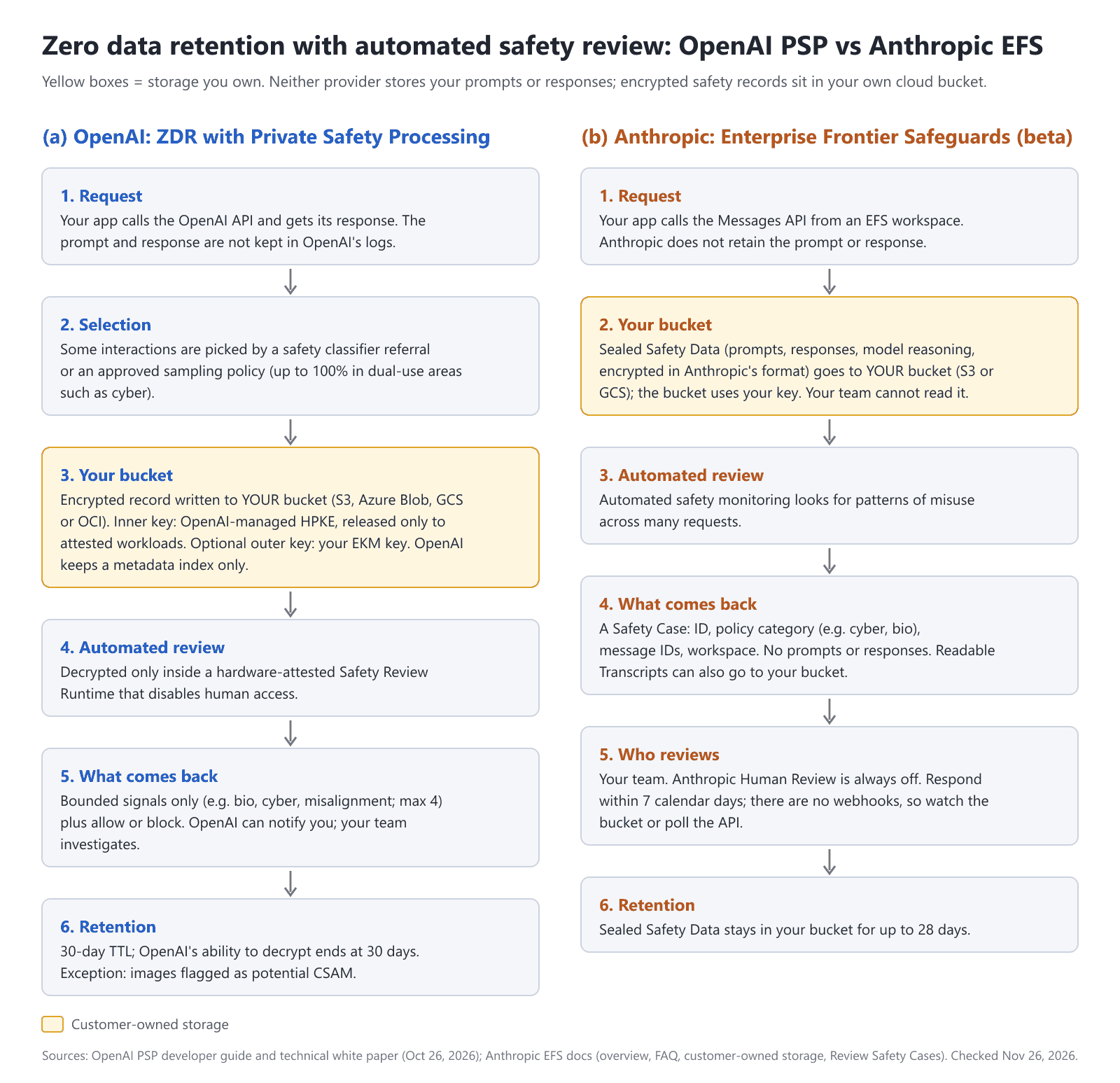
How OpenAI PSP and Anthropic EFS deal with safety review under the zero data retention regime (as per each provider's documentation as checked on 26th November 2026).
PSP vs Private Retention With PSP
OpenAI hosted storage is a separate policy (Private Retention with PSP (formerly Eyes Off)). Under that policy, customer content will be retained in encrypted abuse monitoring logs in OpenAI-managed infrastructure and will be excluded from human review unless required by law (OpenAI data controls). The whitepaper explicitly states this is not ZDR.
In August, OpenAI announced it was working on an OpenAI-hosted option which would be encrypted with customer-controlled keys. You need to check with OpenAI to confirm which key model applies to your organization.
Anthropic's equivalent is Enterprise Data Controls: on Anthropic-managed storage you can attach a customer-managed key, turn off Anthropic Human Review or both. Anthropic says this setup "isn't EFS and isn't ZDR" (EFS FAQ).

Running adversarial tests against ZDR models?
Note: Keep the evidence your team will need for their safety reviews. See how Agent Testing from TestMu AI runs simulated users against chat and voice agents prior to release, with the transcripts that you keep. Book a demo.
What's Claude's Data Retention Policy, and Does Anthropic Have a Zero Data Retention Policy?
Anthropic has zero data retention on the Claude API for approved organizations. As of November 2026, they have three arrangements: Legacy ZDR, HIPAA readiness and Enterprise Frontier Safeguards (EFS ZDR) (Claude API and data retention). The model you call will determine which of those you can use.
Covered Models and the 30-Day Rule (June 2026)
From 9th June 2026: "Prompts submitted to, and outputs generated by, covered models are retained for 30 days". Anthropic designates covered models one at a time: Claude Fable 5 and Claude Mythos 5 on 9th June, the 5.1 models on 31st August and the 5.2 models on 9th November 2026 (Covered Models).
A Legacy ZDR workspace that calls a Covered Model will result in a 400 invalid_request_error unless Anthropic has specifically authorized it. The workaround in this case is to have a separate workspace with 30-day retention.
Anthropic's own risk report described the change as "a decision we believe will be unpopular with customers who have come to expect zero retention" (via Axios). In the EFS announcement, Anthropic stated that many of its customers, "especially in regulated industries", found it "difficult to use models with data retention" (Anthropic, Sept 1, 2026).
Enterprise Frontier Safeguards (September 2026)
Enterprise Frontier Safeguards is ZDR for organizations using Anthropic's most capable models. Anthropic doesn't store the prompts and responses. Sealed Safety Data (the prompts, responses and model reasoning, in Anthropic's format and encrypted) goes to a bucket you own (EFS overview).
- Storage: Amazon S3 or Google Cloud Storage on Claude Platform. The September announcement also mentions Azure Blob, but the docs list only S3 and GCS as of Nov 26. Sealed Safety Data stays up to 28 days, and your team cannot read it even in your own bucket (customer-owned storage).
- Detection: Automated safety monitoring looks for patterns of misuse across many requests (e.g., attempts to develop offensive cyber or biological capabilities) (EFS FAQ).
- Review: "Anthropic Human Review is always off " with EFS. People in your organization will be reviewing Safety Cases. A Safety Case has its ID, the policy category (e.g. cyber, bio), the IDs of the associated messages and where their Transcripts are, and the workspace. It contains no prompts or responses (Review Safety Cases).
- Response clock: You must respond within 7 calendar days. Anthropic doesn't notify you automatically and doesn't send webhooks, so you're on your own in terms of watching your bucket or polling the Safety Cases API. If a Safety Case doesn't get a response, then Anthropic may suspend access. Anthropic states that 24/7 coverage is not required: you can route the alerts into a queue that someone checks every working day.
- Transcripts: Readable transcripts can go into your bucket. They may contain requests that never result in a Safety Case, so be very careful about who can read them.
- Scope: Every Messages API request in an EFS workspace for every model. Code execution, Files API, Batch results and Managed Agents sessions are all excluded, and EFS workspaces will not accept new batches.
- If your bucket fails. S3 requests will continue to go through for up to 24 hours before they may be refused. Anthropic doesn't fall back to its own storage. Any data that never makes it to your bucket will be deleted roughly 72 hours after the request on the Claude platform, so please get your account team on board as quickly as possible if you have a failure.
- Cost and access: Anthropic doesn't charge you for EFS; your cloud provider will bill the storage. Access is via your account team, or a request form if you don't have one.
In their September 1st announcement, Anthropic said: "eligible customers will receive ZDR on Fable 5 and Fable 5.1 until EFS is ready". Anthropic's Covered Models page now extends that option to Fable 5.2: eligible customers "will receive the option to use ZDR with Fable 5.2, Fable 5.1, and Fable 5 for their own internal business applications", for a limited time and as a transition to EFS. Check with your account team for the current status.
How Do OpenAI, Anthropic, Google and Mistral Stack Up on ZDR?
OpenAI and Anthropic both maintain encrypted safety records in a bucket that the customer owns and differ on who actually reviews the findings. Google and Mistral don't have a cross-session safety layer of that type documented. Cells checked 26th November 2026.
| Dimension | OpenAI ZDR with PSP | Anthropic EFS | Google Cloud (Vertex AI) | Mistral |
|---|---|---|---|---|
| What the provider retains | Metadata index only (deleted after 30 days) | Record of Safety Correspondence, no prompts | Cache up to 24 h unless disabled; Search grounding logs up to 3 days | No inputs or outputs, for supported stateless calls |
| Where safety data lives | Your bucket: S3, Azure Blob, GCS or OCI | Your bucket: S3 or GCS (Claude Platform) | No customer-bucket safety layer documented | No customer-bucket safety layer documented |
| Who holds the keys | OpenAI HPKE keys released only to attested workloads; optional outer EKM key you hold | Sealed in Anthropic's format; bucket encrypted with your key | Google default encryption for the durable cache; CMEK not supported for it | Not documented on the ZDR page |
| Human review by provider | None, except CSAM images | Anthropic Human Review always off; your team reviews Safety Cases | Not documented on the ZDR page; Google "may log prompts to detect potential abuse" for Google models under GCP terms | Not documented on the ZDR page |
| Cross-session detection | Yes: automated review across related interactions | Yes: automated monitoring for patterns of misuse across many requests | Not documented | Not documented |
| Eligibility / how to get it | ZDR approval via OpenAI sales, then storage setup per project | Account team or request form; new workspace if on Legacy ZDR | Configure caching, logging and grounding; OpenAI flagship models need approval per project | Request via support; Mistral "may approve or deny it" |
| Key exclusions | Assistants, Threads, Files, Vector stores, Batches, Fine-tuning, Conversations, Evals, Agents, ChatKit threads, Audio voices | Code execution, Files API, Batch, Managed Agents | Deep Research agent (7 days), Grounding with Google Maps (30 days), Sandbox API | Agents, batch files, Conversations, Libraries, Files, Vibe Work, Chat, Studio Observability traces; Labs and Public Preview models |
| Status (Nov 26, 2026) | Phased rollout since Sept 22, 2026; OpenAI has not published a GA date | Beta | Configuration guide published (page updated Nov 24, 2026) | Available on pay-as-you-go for supported stateless calls |
Gemini Developer API note: Google's Gemini API page states that if your workload requires guaranteed zero data retention or enterprise data processing agreements, then you should use Vertex AI. Abuse monitoring logs and the 30-day Search grounding storage still apply on the Developer API (Google AI Studio docs).
Azure OpenAI note. Microsoft has Modified Abuse Monitoring, not a product called ZDR. For approved customers, the data storage and human review steps are skipped (though automated review may still be carried out) (Microsoft Learn, data privacy). For models released on or after 1st November 2026, Modified Abuse Monitoring will cease on a date to be announced with at least 30 days' notice per model (Microsoft Learn, abuse monitoring).
Does ZDR Carry Over to Amazon Bedrock, Google Cloud and Azure?
ZDR generally doesn't carry over. Anthropic's 30-day rule for Covered Models also applies to ZDR organizations that get to Claude via Amazon Bedrock, Google Cloud's Agent Platform or Microsoft Foundry (Claude Help Center). On Bedrock and on Claude Models on Google Cloud (Google managed), the cloud provider is the data processor (Claude API and data retention) and EFS on Bedrock is enabled via AWS (EFS FAQ).
OpenAI's PSP white paper only covers first-party OpenAI traffic, and Bedrock is outside its scope. On Google Cloud, "Existing ZDR approvals for the direct OpenAI API don't apply to Agent Platform" (Google Cloud docs). You'll need to confirm ZDR on each and every path.
What Does 'Zero Data Retention' Not Cover?
Zero data retention covers stateless inference. Anything that needs to store something in order to work is outside of that. Documented exceptions as of 26th November 2026:
| Exception | What is kept | Source |
|---|---|---|
| Stateful APIs and files | OpenAI Assistants, Threads, Files, Vector stores, Batches, Fine-tuning, Conversations, Evals, Agents, ChatKit threads and Audio voices keep application state "until deleted" and are not ZDR-eligible | OpenAI |
| Batch and code execution on Claude | Batch keeps data 29 days; code execution containers keep data up to 30 days | Anthropic |
| CSAM images | Retained for manual review even with ZDR, Modified Abuse Monitoring or Private Retention with PSP | OpenAI |
| Flagged content and legal holds | Anthropic may keep flagged inputs and outputs up to 2 years, and data the law requires, even under ZDR | Anthropic |
| Provider-imposed retention on specific models | OpenAI may make models ineligible for ZDR for specific customers, with written notice ("Safety Retention") | OpenAI |
| Consumer and personal accounts | Claude Free, Pro, Max and Ultra are not covered; OpenAI's ZDR controls don't apply to ChatGPT Free, Plus, Go or Pro | Anthropic, Axios |
| MCP servers and third-party tools | "Data sent to an MCP server is subject to their data retention policies"; Anthropic does not cover third-party integrations | OpenAI, Anthropic |
| Gateways | Gateways such as OpenRouter keep request metadata (token counts, latency, model, cost) | OpenRouter |
ZDR makes absolutely no mention of your own application logs, your own tracing tools or your own analytics.
Why Does Zero Data Retention Matter to the Enterprise?
Zero data retention means there's nothing for a provider to be asked to hand over in the course of a lawsuit, and it changes the controls that your auditors will look at.
- Legal discovery. The 2025 NYT v OpenAI preservation order was for consumer ChatGPT and non-ZDR API data. OpenAI stated that it "does not impact API customers who are using Zero Data Retention endpoints" and the obligations terminated on 26th September 2025 (OpenAI).
- Regulated data. With respect to PHI, Anthropic states that HIPAA readiness "is designed as an alternative to ZDR" with a different feature set.
- Security reviews. Under PSP and EFS, your own bucket will contain encrypted safety records for up to 30 days (PSP) or 28 days (EFS) (plus readable Anthropic Transcripts if you turn those on). Your security team should be reviewing the access policies, keys and lifecycle rules of that bucket in exactly the same way as they would any other sensitive data store.
Enterprise Checklist: Questions to Ask Your AI Vendor Before Signing
Ask these 10 questions before you sign and get the answers in writing. They're also applicable to SaaS vendors who are calling a model on your behalf.
The list covers model provider retention. For testing tool vendors, the SOC 2 questions from our AI testing data security guide will be of use.
- Which endpoints and features are ZDR eligible on our contract? Just ask for the eligibility table.
- Is ZDR enabled at the organization, project or workspace level? Which of ours is currently covered, and will the new ones inherit it?
- Which models need retention or a safety program such as PSP or EFS? What happens to our traffic if we don't turn one on?
- What metadata do you retain under ZDR (classifier scores, safety signals, request IDs)? Where do any of the safety records actually reside, and under what keys?
- Can your staff ever read our content in plaintext, and is every access logged and visible to us?
- What causes a safety review, and can sampling go right to 100% of our traffic?
- What does a safety alert contain, how is it delivered, and what response time do you expect from us?
- What happens to the requests if our bucket or key becomes unavailable?
- How do you deal with legal holds and preservation orders, and will you let us know when the law permits?
- Which sub-processors, cloud marketplaces, gateways or model providers are between our app and the model, and does ZDR apply to each of those paths?
TestMu AI's read: what a published data retention policy looks like.
Note: TestMu AI publishes its own defaults in a public data retention policy (last updated 11th November 2026). The default is 30 days from creation for test builds, videos, logs, uploaded apps and audit records. SmartUI screenshots are retained for 1 year. Test Manager and KaneAI entities have no retention limit, and enterprise customers can request longer periods. The AI trust page states: "Your inputs and outputs are never used to train any LLM models". This is a policy for data on the TestMu AI platform itself and is not a zero data retention policy. Ask every AI vendor in your stack (including us) for the same: the periods per data type on a dated public page.
How Do You Confirm That Zero Data Retention Is Actually in Effect?
Check two places: the provider's settings and your own app's traffic. A signed contract in no way proves that every project, every key and every code path is using ZDR.
Configuration Checks by Provider
- OpenAI: Open Settings → Organization → Data controls → Data Retention. For PSP, the project should be showing "Validated" for storage and "Zero Data Retention with Private Safety Processing" as its policy (OpenAI Help Center). "Validated" simply indicates one successful check has been carried out; it doesn't in any way monitor the health of the bucket.
- Anthropic: Go to Settings > Privacy Controls > Data retention period, then the per-workspace setting on the Data retention page. For EFS, the first object should be in your bucket within about 10 minutes, and CloudTrail will log every time Anthropic assumes your S3 role. Legacy ZDR organizations are not able to call the Claude API from a browser, as CORS requests will be rejected.
- Google Cloud: set
"disableCache": trueviacacheConfig, turn request-response logging off and setstore = falseon the Interactions API. - Mistral: Look for ZDR under Admin Panel > Vibe > Privacy.
- Gateways: On OpenRouter, set
provider.zdr: trueso that the requests go only to the ZDR endpoints.
Negative Tests Worth Running
A negative test proves a setting is live by verifying that something fails.
- Create a foreground (non-background) response with
store: truein an OpenAI ZDR project and then try to retrieve it by ID. ZDR treats store as false, so the retrieval should fail. - Call a Claude covered model from a legacy ZDR workspace. You'll get a 400 error stating that data retention must be enabled.
- Submit a batch from a Claude EFS workspace. EFS workspaces will not accept new batches.
Test Your Own AI App and Agent Stack
Under PSP and EFS, your team responds to the provider's safety questions and provides evidence as to what your agent sent and why. Your own red team or adversarial test traffic can be what triggers one of the four typical outcomes (Anthropic lists "Authorized work" as an example: "your red team ran a penetration test under the Cyber Verification Program").
Run your adversarial suites from a dedicated project/workspace. Log each response id against the test run and keep the transcripts and verdicts in your own storage.
1. A deterministic egress test in CI. Fail the build if any code path calls a non-ZDR endpoint. Your app must accept an injected OpenAI client.
Tested on 26th Nov 2026 with pytest and the OpenAI Python SDK 3.59 (which uses httpx2). On SDK 2.x, you'd need to change httpx2 to httpx.
# test_zdr_egress.py: fail the build if a non-ZDR OpenAI endpoint is called
import httpx2
from openai import OpenAI
from my_app import run_support_flow  # your entry point; takes an OpenAI client

BLOCKED = ("/v1/files", "/v1/assistants", "/v1/threads", "/v1/vector_stores",
           "/v1/batches", "/v1/conversations", "/v1/fine_tuning", "/v1/evals",
           "/v1/agents", "/v1/chatkit", "/v1/audio/voices")

def test_only_zdr_eligible_endpoints():
    calls = []
    def handler(request):
        calls.append(request.url.path)
        # minimal stub the SDK can parse for responses and list calls
        return httpx2.Response(200, json={"id": "resp_test", "object": "list",
                                          "data": [], "output": []})
    client = OpenAI(api_key="test",
                    http_client=httpx2.Client(transport=httpx2.MockTransport(handler)))
    run_support_flow(client, "Reset my card PIN")
    bad = [p for p in calls if p.startswith(BLOCKED)]
    assert not bad, f"Non-ZDR endpoints called: {bad}"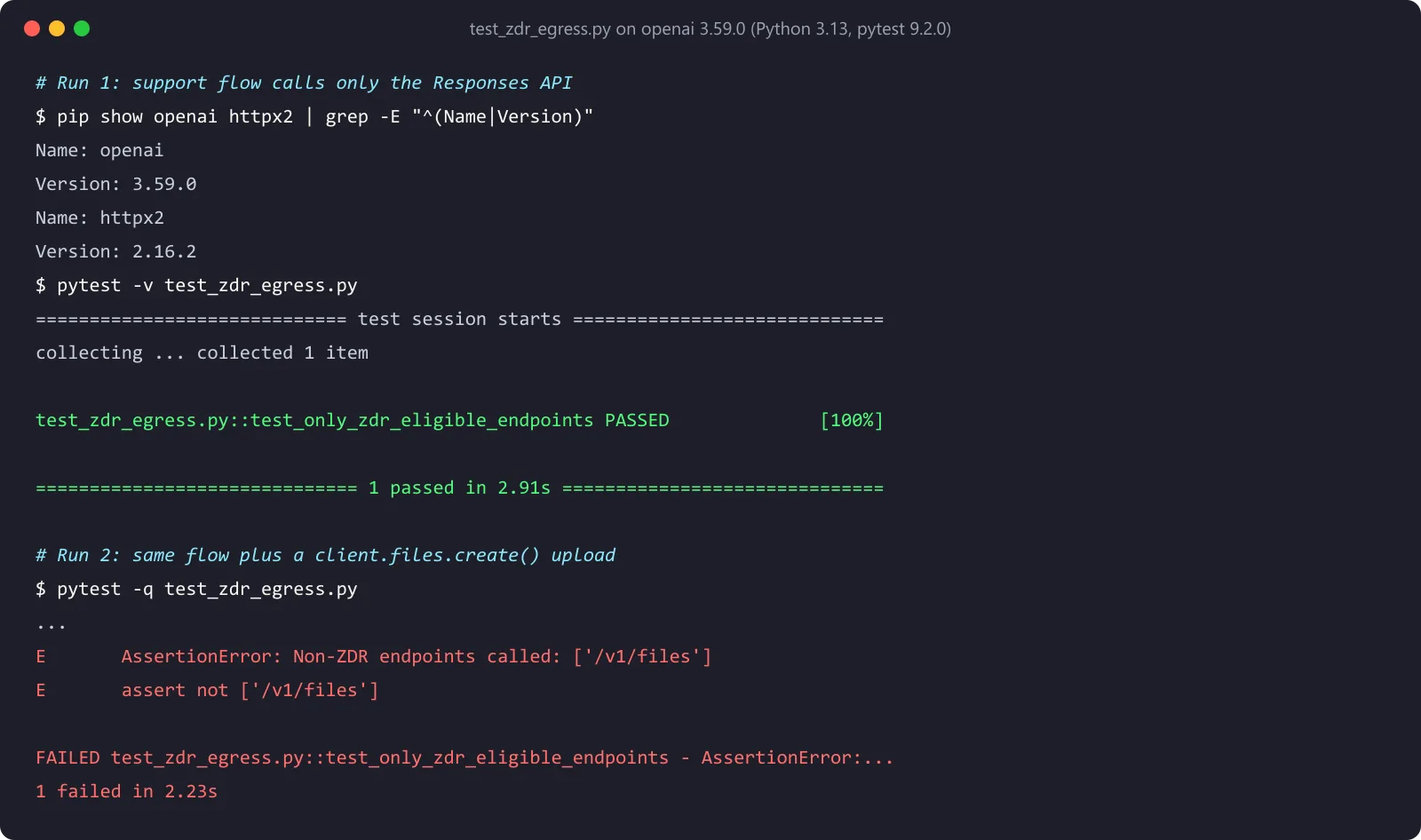
2. Behavioral testing of the agent itself. Run simulated users against the agent prior to release to look for prompt injection, hallucination, toxicity and compliance gaps. TestMu AI Agent Testing covers chat, voice, phone and IVR agents, including simulated calls that can be run to test voice agents prior to go-live, and provides a Green, Yellow or Red go-live verdict.
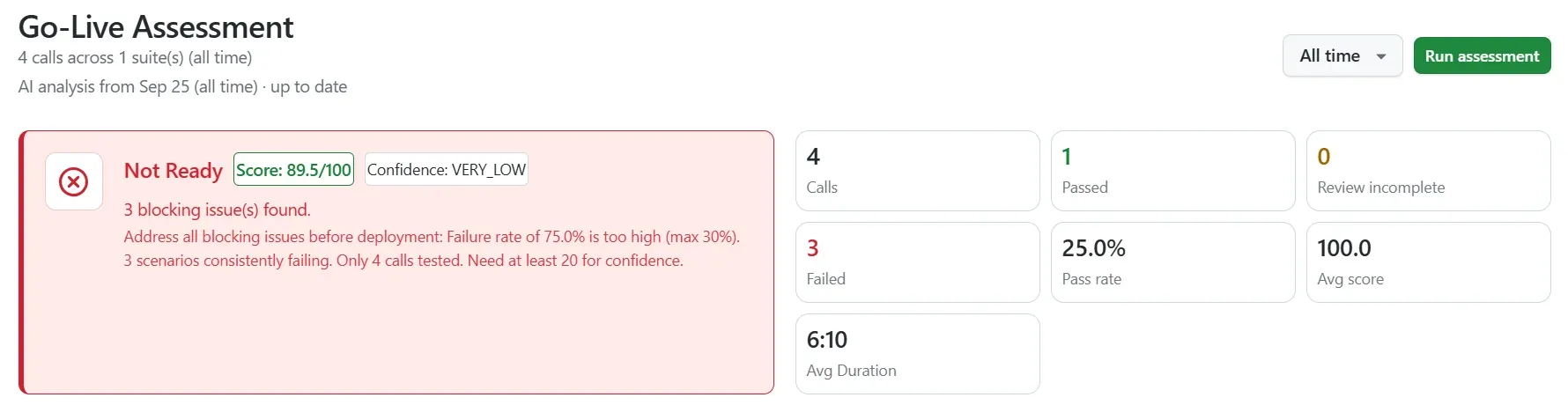
For agents that are acting via tools, files and APIs, Agent Assurance looks at what the agent actually did. Its Rook CLI runs functional and adversarial test scenarios, and reports pass, fail or unable to verify on each criterion.
The judges in Rook CLI check the agent's tool calls, files and API effects. The session transcript "stays on your machine unless you export it". Methodology is described in how to audit AI agent workflows with evidence.
Conclusion
Zero data retention keeps your prompts and responses out of the provider's storage after each response, but it is separate from the training opt-out and still allows short-lived caches and retention the law requires. With PSP and EFS, OpenAI and Anthropic now run safety review on records written to storage you own, and under EFS your own team answers each Safety Case. ZDR applies per path, so confirm it for every provider, cloud marketplace and feature you use, then verify it with configuration checks and negative tests.
Running AI agents on ZDR models? Your team now answers the provider's safety reviews, so keep evidence of what your agents do before release.
Testing an AI agent? TestMu AI's Agent Testing validates chat, voice and IVR agents before your customers talk to them.
Author

Prakaash Ojha
Prakaash is the Senior Vice President, InfoSec, Compliance & AI Governance at TestMu AI. He has over 24 years of experience building and maturing enterprise security, privacy, risk, and GRC programs. An ISO/IEC 42001:2023 Lead Auditor, Prakaash helps organizations adopt AI responsibly by turning complex regulatory and risk requirements into practical controls that support innovation, customer trust, and sustainable growth.
Reviewer

Mudit Singh
Reviewer

Mudit Singh is Co-Founder and Head of Growth at TestMu AI, and a member of the founding team that has grown the platform to 2.8M+ users across 132 countries. He drives growth and go-to-market across the full product portfolio, including KaneAI, Kane CLI, the Real Device Cloud, SmartUI, accessibility testing, and HyperExecute. Over more than eight years on the founding team he has helped build and bring these testing products to market from scratch, scaling the company from cross-browser testing into a full-stack agentic AI quality engineering cloud backed by Sequoia, Qualcomm Ventures, and Premji Invest. He brings over 15 years of experience building and marketing software products and holds a B.Tech in Computer Science from Jaypee Institute of Information Technology.


Frequently Asked Questions About Zero Data Retention
Did you find this page helpful?
More Related Blogs

TestMu AI forEnterprise
Get access to solutions built on Enterprise
grade security, privacy, & compliance
- Advanced access controls
- Advanced data retention rules
- Advanced Local Testing
- Premium Support options
- Early access to beta features
- Private Slack Channel
- Unlimited Manual Accessibility DevTools Tests