
Run End-to-End Tests from Your Terminal with Kane CLI
Author and Run Tests Right from the Terminal in Natural Language, with an Evidence-Backed Pass or Fail from a Real Browser.
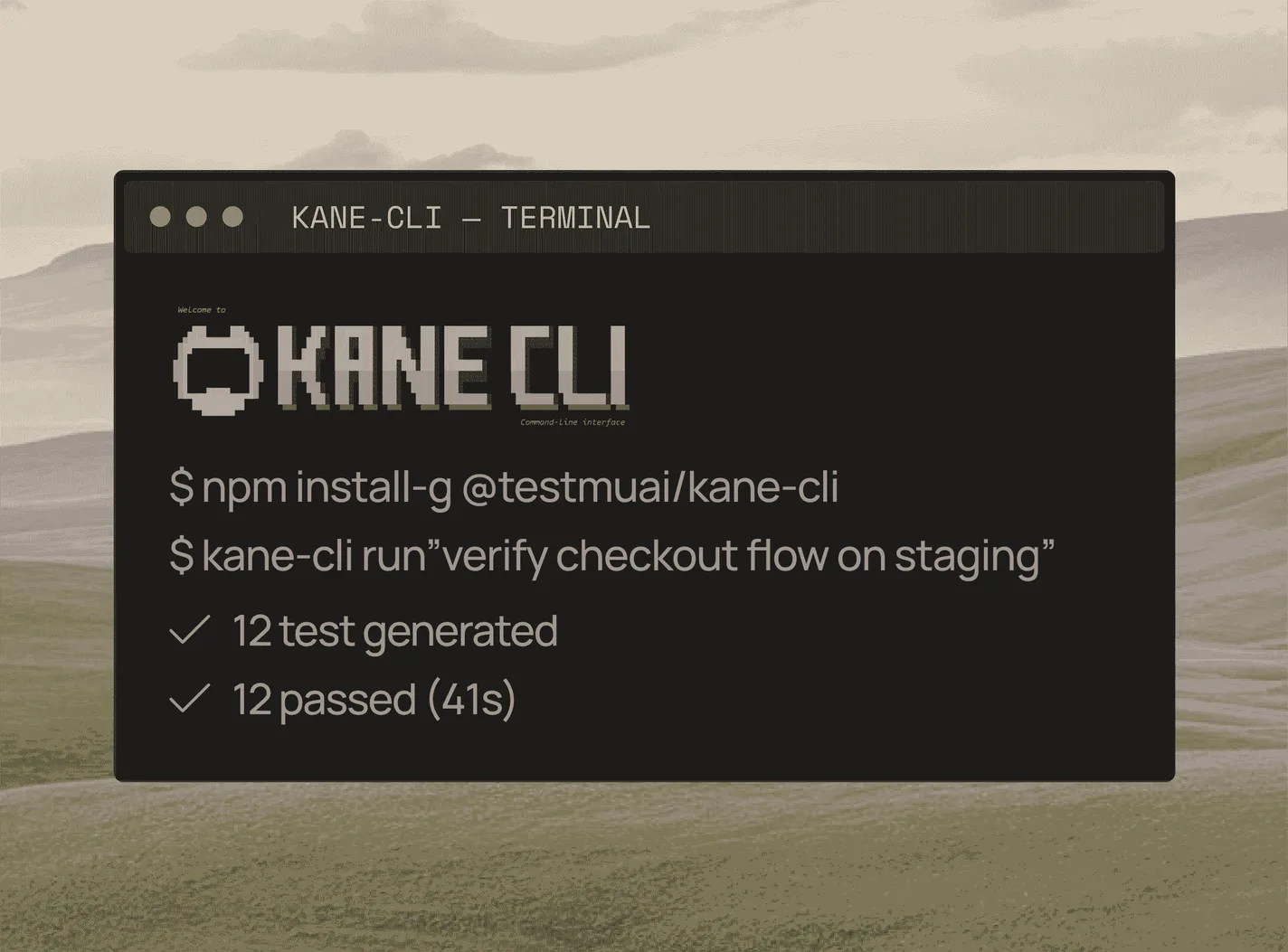
npm install -g @testmuai/kane-cli
Will AI Replace QA Testers? No - It Just Made Verification the Bottleneck
Will AI replace QA testers? AI made code cheap and verification the bottleneck. The data, the Proof Gap, and the Verifier Ladder skills testers need now.
Published on:
Every few months, someone comes along and declares QA is dead. This year the case seems very strong indeed, with at least one of the leading AI labs claiming that its coding agent is now writing 80% of the code that it ships.[1] If the agent writes the code and the tests, then who on earth do you need a tester for?
Look at what that very same lab reports, and you get the complete opposite story.
TL;DR
Will AI replace QA testers? The 2025-26 data says no. AI has made writing code cheap and verifying it the constraint. One AI lab has 8x more code per engineer per quarter than they did in 2021-25 and 25x CI job volume in six months. Testing isn't going away; it's just moving from being the thing that runs the scripts to being the thing that proves that the agent-written software actually works.
The Future of Software Testing With AI-Generated Code
- Script execution: The answer to "will AI replace software testers" is no for the role and yes for much of the repetitive script running. Manual execution of test cases written by others is the QA work most exposed as coding agents scale.
- AI-generated code testing: Testing AI-generated code means checking an agent's change with a check the agent did not write. AI code verification hands the change to a separate verifier that runs it against the original request and keeps the evidence.
- Agent harness: An agent harness is the code and configuration that let a model act, through prompts, tools, permissions and stop rules. Verifying an agent means checking what it did through that harness, not the summary it reports.
QA Skills for AI and AI Reliability
- QA skills for AI: The skills that hold value are defining what correct means, designing checks independent of the code's author, running them at scale and turning results into evidence. They belong to the quality engineer for AI-written code and the verification architect.
- AI reliability: AI reliability engineering holds a model-backed feature to a stated objective with a measured indicator. AI verifiability is the share of its behavior that someone else can confirm from evidence.
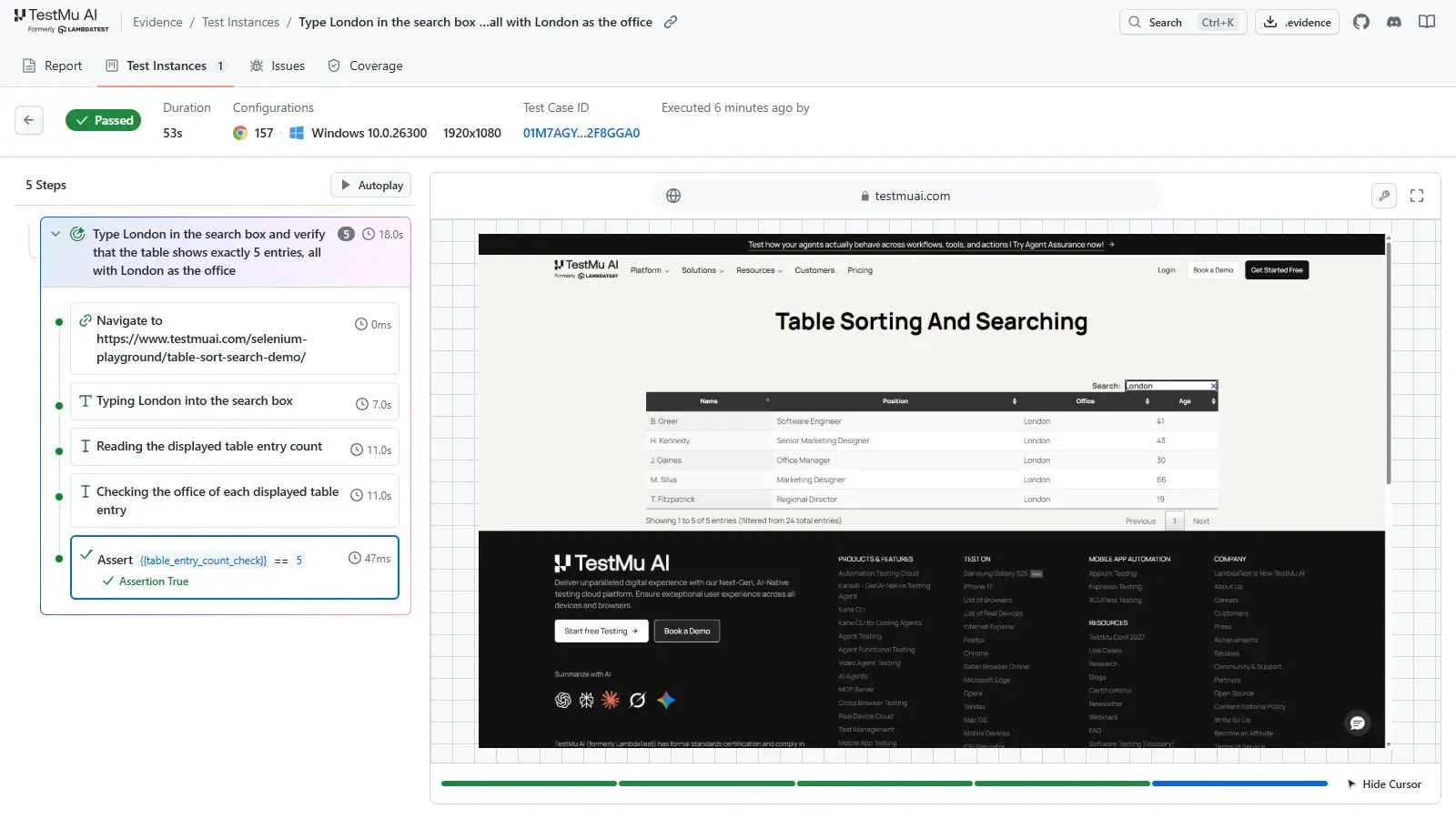
- Kane CLI: Kane CLI by TestMu AI checks agent-written changes in a real browser, and every run saves a Kane CLI evidence pack with step screenshots, network and console logs that a reviewer can open.
Will AI Replace QA Testers?
No. AI is taking over the most labor-intensive part of software work (typing the code) and making the more expensive part (proving it works) more valuable. What will shrink is testing as it relates to the manual, repetitive execution of scripts.
What will grow is verification: defining what "correct" means, building checks that don't rely on the code author, and producing the evidence that a release is safe.
The most obvious one is the lab whose models do so much of that coding.
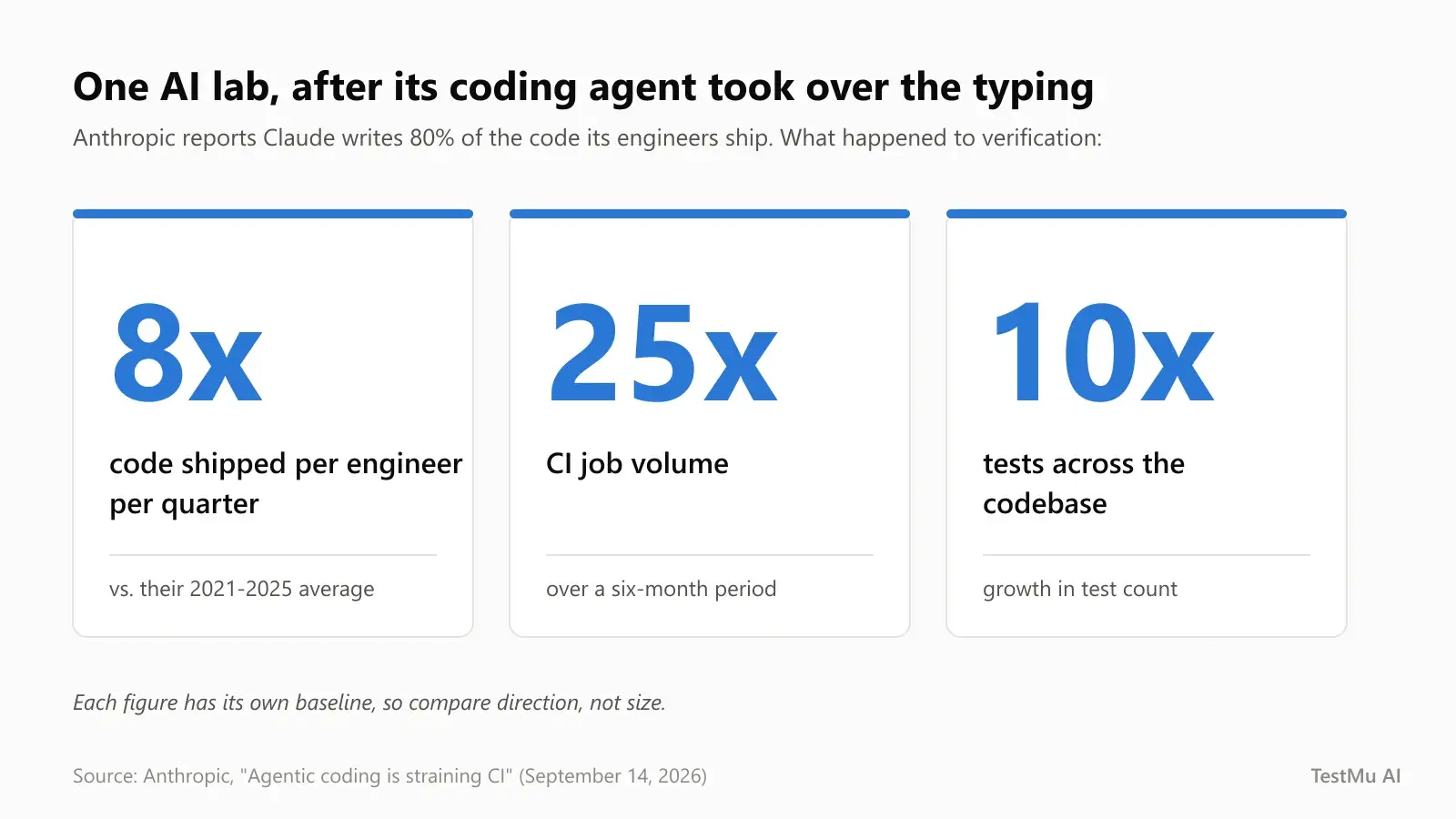
Anthropic says Claude writes 80% of the code their engineers ship, that engineers ship on average 8x as much code per quarter as they did in 2021-2025, and that their CI job volume has increased 25x over 6 months, with tests across the codebase up 10x (Anthropic, Sep 2026). Same article: "Writing code is no longer the constraint."
Earlier in 2026, Anthropic was reporting a 200% increase in code output per engineer over the course of a year, and that code review had become a bottleneck (Anthropic, Mar 2026).
On 9th November, they described a single build in which a model had orchestrated over 1,000 sub-agents working around the clock for eight days (Anthropic, Nov 2026).
Read those together. One of the most AI-native engineering teams in the world actually ended up with far more tests than before. Their test count went up tenfold, and they ended up having to redesign the system that works out which tests to run.
Why Is AI-Generated Code Creating a Verification Bottleneck?
Because code volume is compounding whilst trust in that code is not. Generation scales with compute. Verification still needs a definition of correct, an environment to run in, and someone to be accountable for the result.
The volume side:
- GitHub's Octoverse 2025 reported a record 518.7m merged pull requests on public and open source repos (up 29% year on year), and its Copilot coding agent generated over 1m pull requests between May and September 2025 (GitHub, Oct 2025).
- Sonar's 2026 State of Code survey of over 1,100 developers found that AI is being used to generate or assist with 42% of committed code. That's set to rise to 65% by 2027 (Sonar, Jan 2026).
- Menlo Ventures has an estimate of $34.0bn of enterprise spend on coding programs. The labs' own coding agents are going from around $1bn in 2025 to a $24bn run rate annually (Menlo Ventures, Nov 2026).
The trust side:
- In the same Sonar survey, 96% of developers said they don't have complete confidence in AI-generated code, yet only 48% of them always check it before they commit.
- Stack Overflow's 2025 survey found that 84% of developers either use or plan to use AI tools. 46% of respondents actively distrust the accuracy of the tools and 66% cited "almost right, but not quite" as the biggest single frustration.
- Google's DORA 2025 research found that 90% of respondents use AI at work, 30% report little or no trust in AI-generated code, and AI adoption still has a negative relationship with software delivery stability (Google Cloud, Sep 2025).
The defect side:
- Veracode tested code from over 100 LLMs and found vulnerabilities introduced in 45% of the test cases (Veracode, July 2025).
- CodeRabbit's analysis of 470 PRs found 10.83 issues per AI co-authored PR as opposed to 6.45 per human PR. Logic and correctness issues were 75% more prevalent in the AI co-authored PRs (CodeRabbit, Dec 2025).
Sonar, CodeRabbit and Veracode all have code quality (or security) tools, so their numbers are vendor data. The direction of the numbers, though, is in line with the independent sources (DORA and Stack Overflow) and the lab data: more code, less trust per line of code and an ever-increasing pile of change that nobody has actually proven works.
What Is the Proof Gap?
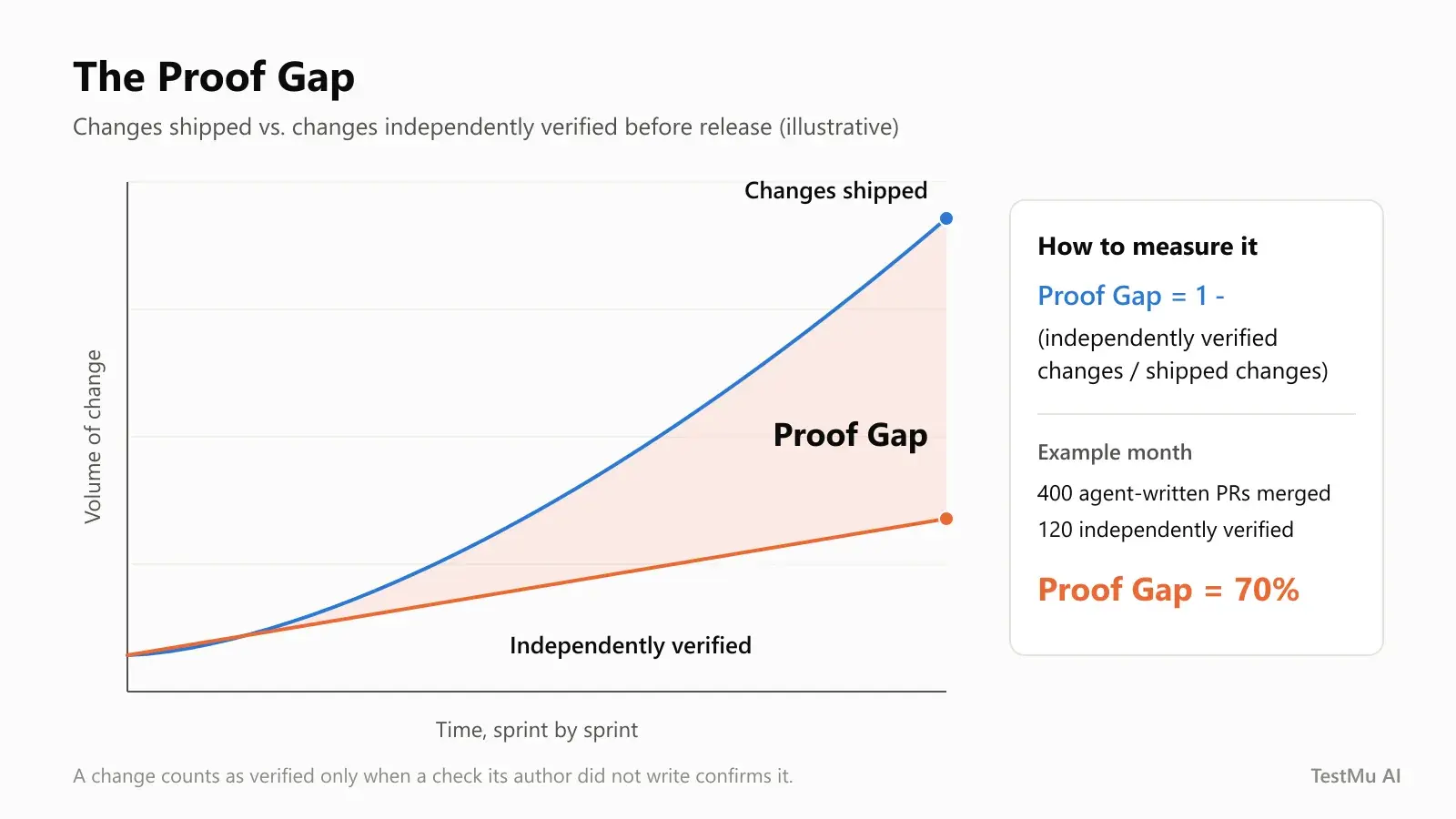
The Proof Gap is the gap between how much change a team ships and how much of that change is independently proven prior to release. That gap grew quite slowly when humans were writing all the code. With coding agents, it can grow quite dramatically every sprint.
I use one rule to explain it to boards: when code gets cheap, proof gets expensive.
The gap has three causes, and each maps to a principle we hold at TestMu AI:
- Self-grading. A coding agent that writes the feature and the tests is checking its own work. Our first principle is that no model checks its own work. A test suite written by the same agent, in the same session, against the same misunderstanding can pass.
- Missing evidence. "The agent says it's done" is not evidence. Every major change should leave behind a human-readable record of what was tested, where, and what the results were.
- Late testing. The verification that only runs prior to a quarterly release is simply not going to keep up with the agents that are opening pull requests every hour. You need continuous testing, including against failures and attacks.
How to measure it? Count the changes you merged last month. Count how many of those were verified by a check their author didn't write (whether that author is a person or an agent). Then...
Proof Gap = 1 − (independently verified changes ÷ shipped changes)
An illustrative example: a team that in a single month is merging 400 agent-written PRs and independently verifying 120 of them has a proof gap of 70%. Track that number month on month. If your output is going up and the gap is widening, then you're accumulating risk at a faster rate than you're shipping value.
Closing the proof gap is the job. That's why QA isn't going to die.
What the "QA Is Dead" Crowd Gets Right
A credible case has to reckon with the counter-evidence, and there is some.
| Data point | What it means | Source |
|---|---|---|
| BLS projects QA analysts and testers to grow 6% from 2025 to 2035, versus 10% for software developers | Testing roles are growing, but more slowly than development | BLS, Aug 2026 |
| Gartner predicts 60% of organizations will adopt smaller software engineering teams at scale by 2029, up from 15% in 2026 | Fewer people per team at scale; dedicated tester roles may be folded into others (our inference) | Gartner, Jul 2026 |
| Forrester says most organizations plateaued at 25% automation of their testing | Traditional automation hit a ceiling | Forrester, Jan 2026 |
| Only 15% of respondents have scaled GenAI in quality engineering enterprise-wide | Adoption is broad, but scaling is rare | World Quality Report 2025 |
So the honest answer isn't "testers are safe." It's narrower and more useful: the tester who only executes scripts is exposed; the tester who can verify agent output is not.
BLS still counts 187,600 QA analyst and tester jobs in 2025 and projects 198,200 by 2035, at a median pay of $104,300 in May 2025.[11] The work is changing shape, not vanishing.
What Skills Do QA Engineers Need in the Age of AI?
The skills that close the Proof Gap are: defining what is correct, designing independent checks, running those checks at scale, and then turning the results into evidence. We map that as the Verifier Ladder.
| Rung | Role | What the human owns | What AI takes on |
|---|---|---|---|
| 1 | Script runner | Executing test cases written by others | Increasingly automated away |
| 2 | Automation engineer | Building and maintaining test suites | Authoring and self-healing tests from plain English |
| 3 | Quality engineer for AI-written code | Deciding what to test in agent-generated change, catching self-graded tests, owning release gates | Generating candidate tests and test data at volume |
| 4 | Verification architect | Designing the independent verification layer: evidence, continuous testing, agent release gates | Running thousands of checks in parallel, on real browsers and devices |
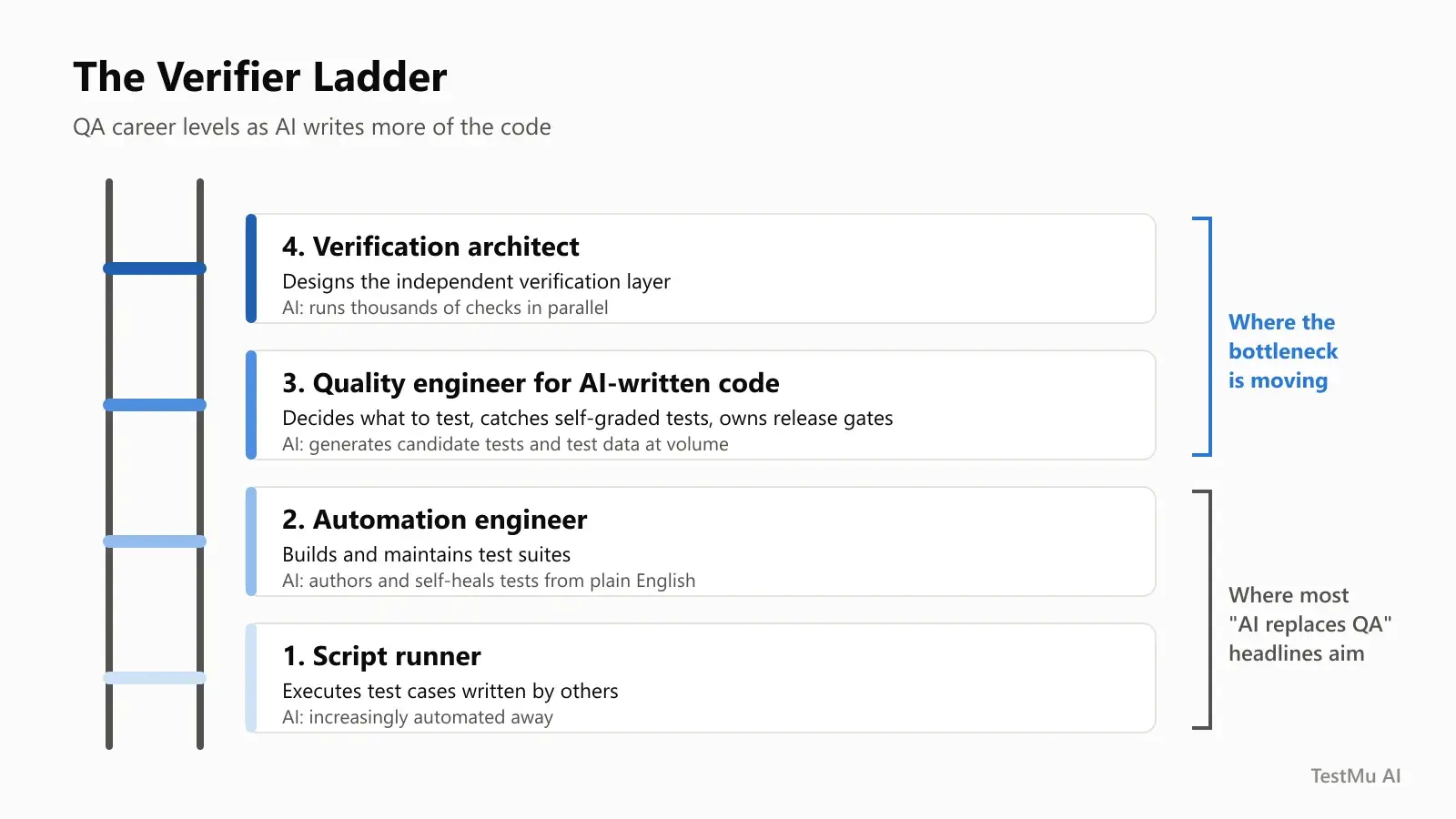
Rungs 1 and 2 are where the "AI replaces QA" headlines are all about. Rungs 3 and 4 are where the bottleneck is actually moving.
Qodo (another code quality vendor) did a survey of 800 US developers and engineering leaders in 2026 and found that 26% in each of those groups identified reviewing and validating AI-generated code as the biggest constraint in their delivery pipeline (Qodo, Sep 2026).
How to climb, starting this quarter:
- Pick one service where a coding agent writes the code and measure the proof gap (what proportion of the merged change was confirmed by a check that its author, person or agent, didn't write)?
- Separate the author of the change from the verifier of the change. The agent that makes the change doesn't write the test to verify it.
- Make evidence the output: every release ships with a readable record of what ran, on which environment, and the result.
- Gate merges on deterministic checks so the same build will always produce the same verdict.
- Test the agents themselves (not just the code they produce) if your product contains any chat, voice or other AI agents.
What This Means for CIOs and Founders
Budget for verification at the rate you budget for generation. If seat licenses for coding agents are going to double your output, then your test execution, your environments and your quality headcount can't just stay where they are. Anthropic's own numbers prove the point: 8x the code per quarter compared to their 2021-25 average and 25x the CI jobs in six months.[1]
Three predictions, each tied to a trend above:
- By 2028, test execution and orchestration is going to be a massive line item in AI engineering budgets. The driver is CI volume, not tool hype. Anthropic's 25x increase in six months is a very early indication of what agent-heavy teams are going to encounter.
- "Who verified this?" is the standard question in a code review and audit. 96% of developers don't fully trust AI code (Sonar), and AI adoption is linked to lower delivery stability (DORA). Self-graded changes will simply not clear review in any well-run team.
- The best testers are the most leveraged people on small teams. Gartner's smaller team prediction is a two-way street, really: a 5-person team that's shipping agent-scale output is going to need someone whose entire job is proof.
My view is that testing will become a $65-100bn market over the next 10 years (verification is the bit of software that doesn't get cheaper as generation does). That's a forecast, not a fact. I'd rather be judged on that in 2030 than try to hedge it now.
How Does TestMu AI Help to Close the Proof Gap?
TestMu AI is the independent verification layer for AI-written software and AI agents. It's built for deterministic, replayable test runs so a result can be audited.
- Kane CLI enables developers and their coding agents to verify what's been built from the terminal in a real browser and on mobile, with the evidence of what's been built being something a reviewer can check.
- KaneAI enables testers (including those who don't write code) to write end-to-end tests in plain English. That's a very practical path from rung 1 to rung 3.
- HyperExecute (our AI Test Orchestration platform) runs the tests at the volume that agent-written code demands, along with TestMu AI's real device cloud.
- Agent Testing and Agent Assurance are the ones that test and assure the AI agents themselves prior to release.
The Bottom Line: Will AI Replace QA Testers?
AI will do a lot of the test typing. It won't do the verification, though. The more code the machines write, the more you're going to need someone to verify it actually works, and that person absolutely can't be the machine that wrote it.
QA isn't dying; it's just being promoted. The question for every tester is where they currently are on the ladder, and for every CIO, what size their Proof Gap has become.
Testing from the terminal? Kane CLI by TestMu AI lets SDETs and developers plan, write, run and debug tests from the command line.
Sources
- Anthropic - Agentic coding is straining CI (14 Sep 2026): 80% Claude-authored, 8x code per quarter, 25x CI jobs, 10x tests, quote.
- Anthropic - Code Review for Claude Code (9 Mar 2026): 200% output growth; review "has become a bottleneck".
- Anthropic - Claude Fable and Mythos 5.2 (9 Nov 2026): 1,000+ subagents for eight days.
- GitHub Octoverse 2025 (28 Oct 2025): 518.7M merged PRs, +29%; 1M+ Copilot coding agent PRs.
- Sonar - State of Code developer survey (8 Jan 2026): 42% to 65%; 96%; 48%.
- Menlo Ventures - 2026 State of Enterprise AI (3 Nov 2026): $34.0B coding; labs' coding agents $1B to $24B.
- Stack Overflow Developer Survey 2025 - AI: 84%, 46%, 66%.
- Google Cloud - DORA 2025 report (24 Sep 2025): 90%, 30%, stability relationship.
- Veracode - GenAI code security (30 Jul 2025): 45%.
- CodeRabbit - State of AI vs human code (17 Dec 2025): 470 PRs; 10.83 vs 6.45; 75%.
- US BLS - Occupational Outlook Handbook (updated 27 Aug 2026): 6% vs 10%, 187,600 to 198,200, $104,300.
- Gartner - smaller software engineering teams (7 Jul 2026): 60% by 2029, from 15%.
- Forrester - Autonomous Testing Platforms Wave Q4 2025 (9 Jan 2026): 25% automation plateau.
- World Quality Report 2025 (13 Nov 2025): 15% enterprise-wide.
- Qodo - 2026 State of AI Code Quality (23 Sep 2026): 26% primary constraint.
Author

Maneesh Sharma
Blogs: 4


Maneesh Sharma is Chief Operating Officer at TestMu AI, where he leads the company's revenue functions across go-to-market, sales, RevOps, customer success, and the partner ecosystem, driving its global expansion. He brings over 27 years of experience across product, go-to-market, and business operations. Before TestMu AI he was Managing Director and General Manager for GitHub across India and APAC, Head of Partner Sales and Ecosystem at Adobe, Chief Revenue Officer at WizIQ, and Head of Products and Solutions at SAP India. Maneesh holds an MBA from IIM Bangalore and a B.E. in Electronics and Communications from NIT Surat.
Reviewer

Mayank Bhola
Reviewer
Mayank Bhola is Co-Founder and Head of Products at TestMu AI, where he leads the entire product portfolio across KaneAI, Kane CLI, HyperExecute, SmartUI, the Real Device Cloud, Accessibility, and other software testing product lines. As an early Lead Architect he designed and built the company's flagship Tunnel technology from scratch, created the React-based automation platform, and architected the data-intensive pipelines and FAAS services that scale it. He brings more than 10 years of experience in software development and product engineering, with earlier roles as Head of Technology at Juggernaut Books and Senior Software Engineer at PressPlay TV and Zomato. Mayank holds a B.Tech in Computer Engineering from JIIT Noida.


Frequently Asked Questions
Did you find this page helpful?
More Related Blogs

TestMu AI forEnterprise
Get access to solutions built on Enterprise
grade security, privacy, & compliance
- Advanced access controls
- Advanced data retention rules
- Advanced Local Testing
- Premium Support options
- Early access to beta features
- Private Slack Channel
- Unlimited Manual Accessibility DevTools Tests