

Power Your Software Testing with AI Agents and Cloud
The Native AI-Agentic Cloud Platform to Supercharge Quality Engineering. Test Intelligently and Ship Faster.


- TestMu AI (Formerly LambdaTest)
- /
- Blog
- /
- SLM vs LLM: Choosing the Right Small Language Model Size
SLM vs LLM: Choosing the Right Small Language Model Size
A small language model runs on ordinary hardware fast enough to serve one user, and an LLM is one that does not. SLM vs LLM compared, with 200 measured runs.
Last Updated on:
Overview
A small language model runs on ordinary hardware fast enough to serve one user, and a large language model is one that does not. Size mostly buys stored world knowledge, not reasoning ability, so the choice is decided by measuring both candidates on your own requests rather than by comparing parameter counts.
What Separates an SLM From an LLM?
- Deployment footprint: NVIDIA Research defines a small language model as one that fits on a common consumer electronic device and answers fast enough to serve a single user's agentic requests. Runs on consumer hardware: yes for an SLM, no for an LLM.
- Factual recall: Large model size is non-negotiable for recalling world facts. Microsoft's Phi-3 report puts phi-3-mini at 64.0 on TriviaQA against 85.8 for GPT-3.5, and states plainly that the model lacks the capacity to store much factual knowledge.
- Narrow-task reasoning: Small language models are not automatically worse at reasoning. Microsoft's Phi-3 report scores phi-3-mini, at 3.8 billion parameters, at 68.8 on MMLU 5-shot, above Llama-3-In 8B at 66.5 in the same table.
- Robustness under noise: Benchmark scores hide brittleness that production exposes. The GSM-Symbolic study recorded phi-3-mini falling from 85.0 percent to 18.0 percent when one inconsequential clause was added to the same maths problems.
- Offline operation: Small language models can run entirely on local hardware, which is what makes data residency and offline use possible. Requires an internet connection: no for a locally hosted SLM, yes for an API-served LLM.
- Parameter count is losing its meaning as a size label, because mixture-of-experts models activate a small share of their weights per token while still requiring all of them resident in memory.
How Do You Prove Which Size You Need?
- Golden set: Assemble 50 to 200 real requests from your own production traffic and write the known-correct answer for each one by hand, before any model sees them.
- Acceptance floor: Fix the passing score in writing before any result is visible, so the measured number decides the model rather than an impressive demo.
- Scored comparison: Run both candidates against that same set and compare accuracy, latency, and cost. TestMu AI's Agent Testing standardises the scoring of non-deterministic output.
Microsoft's Phi-3 technical report records phi-3-mini, a 3.8 billion parameter model, scoring 68.8 on MMLU 5-shot while Llama-3-In 8B scores 66.5 and Mistral 7B scores 61.7 in the same table. A model less than half the size wins on a general knowledge benchmark.
That single row breaks the assumption most SLM vs LLM comparisons are built on. Bigger is not reliably better, smaller is not reliably worse, and the honest answer to which one you should use cannot be read off a spec sheet. It has to be measured on the requests your users actually send.
This article covers the definitions and the comparison table you came for, then goes further: where small models measurably break, what we found running 200 calls against a small and a large model ourselves, and the eval harness that turns the choice into a number instead of an opinion.
What Is a Small Language Model (SLM)?
SLM stands for small language model. A small language model (SLM) is a language model compact enough to run on ordinary consumer hardware and respond fast enough to be usable by one person in real time. A large language model (LLM) is one that cannot.
That framing comes from NVIDIA Research's 2025 position paper Small Language Models are the Future of Agentic AI, which defines an SLM as a model that "can fit onto a common consumer electronic device and perform inference with latency sufficiently low to be practical when serving the agentic requests of one user," and an LLM, bluntly, as "a LM that is not a SLM."
The definition is deliberately about deployment rather than parameter count. The paper does offer a working number, noting the authors "would be comfortable with considering most models below 10bn parameters in size to be SLMs" as of 2025, but the load-bearing test is whether the model fits your hardware and hits your latency budget.
What is a large language model (LLM)?
A large language model is any language model that does not meet the small-model bar above: it needs a multi-GPU cluster or a provider API rather than a laptop. Both classes are the same technology, with the same transformer architecture, the same next-token prediction, and the same training and fine-tuning pipeline.
What differs is scale of parameters and training data, and everything downstream of that: memory footprint, inference cost, response latency, breadth of world knowledge, and where the model can physically run.
What Is the Difference Between an SLM and an LLM?
The differences that change an architecture decision, rather than the ones that only sound impressive:
| Dimension | Small language model | Large language model |
|---|---|---|
| Working size | Commonly under 10 billion parameters, the range NVIDIA Research names as its 2025 working threshold. | Tens to hundreds of billions, with frontier totals typically undisclosed by the provider. |
| Where it runs | Laptop, phone, or a single GPU, which is what makes offline and on-premise operation possible. | Provider API or a multi-GPU cluster, so requests leave your network unless you self-host at cost. |
| Factual recall | The weak axis. Microsoft attributes phi-3-mini's low TriviaQA score directly to insufficient capacity to store facts. | The strong axis. Broad world knowledge is largely a function of parameters and training corpus size. |
| Narrow-task reasoning | Competitive, and sometimes ahead of models twice the size once fine-tuned on the domain. | Strong and more consistent across unfamiliar task shapes it was never tuned for. |
| Latency | Sub-second responses are achievable, which is what makes conversational and agentic loops feel live. | Typically several seconds for a full answer, and more when reasoning modes are enabled. |
| Cost shape | Low per token, or fixed hardware cost if self-hosted, which caps spend at high volume. | Higher per token and scales linearly with usage, so cost grows with product success. |
| Data residency | Full control when run locally, which is usually the deciding factor in regulated environments. | Governed by the provider's terms and region options rather than by your own infrastructure. |
| Main failure mode | Confidently wrong on facts outside its training focus, and brittle when inputs get noisy. | Cost and latency overruns, plus over-qualified answers on trivial requests. |
Read the table as a map of where to look, not as a verdict. Every row shifts with the specific models you shortlist, which is why the last two sections of this article are about measurement rather than selection criteria.
How Small Is a Small Language Model?
No standards body defines the boundary. The practical answer is the deployment test in the NVIDIA Research definition above, with its parameter guideline serving as a rough sanity check rather than a rule.
Parameter count is getting less useful as a label, for two reasons worth understanding before you write it into a requirements document:
- Mixture-of-experts architectures activate only a fraction of their weights for any given token, so a model can advertise a small active-parameter figure while still needing every parameter loaded in memory. The number that fits your GPU is the resident total, not the active count.
- Quantization changes the footprint without changing the parameter count. The same model at 4-bit and 16-bit precision has identical parameters and very different memory requirements, and measurably different output quality.
- Hosted model tiers rarely publish parameter counts at all. When a provider offers a fast tier and a frontier tier, you are choosing a size class you cannot inspect, which leaves measured behaviour as the only evidence available.
The practical move is to stop treating "how many parameters" as the question. Ask instead what fits on the hardware you intend to ship on, what latency it delivers there, and what it scores on your own tasks.
How do you run a small language model locally?
Local execution is the whole point of the size class, and the tooling is mature. Ollama, LM Studio, and llama.cpp all run open-weight small models on a laptop, usually from a quantized GGUF build; vLLM covers the server side when you move the same model onto your own GPU.
Whichever runtime you pick, treat the quantized build as a different model from the full-precision one. Quantization is a regression event, so re-run your evaluation set against the exact build you intend to ship rather than the numbers on the vendor's model card.
What Are Some Examples of Small Language Models?
The best-known small language models are Microsoft's Phi-3-mini, Meta's Llama 3.2 1B and 3B, Google's Gemma 2 2B, Alibaba's Qwen2.5-3B, and Hugging Face's SmolLM2. All are open-weight and small enough to run on consumer hardware, and every figure in the table below is taken from that vendor's own model card rather than a secondary roundup.
| Model | Developer | Parameters | Context window | License |
|---|---|---|---|---|
| Phi-3-mini-4k-instruct | Microsoft | 3.8B | 4K tokens | MIT |
| Llama 3.2 1B | Meta | 1.23B | 128K tokens | Llama 3.2 Community License |
| Llama 3.2 3B | Meta | 3.21B | 128K tokens | Llama 3.2 Community License |
| Qwen2.5-3B-Instruct | Alibaba | 3.09B total, 2.77B non-embedding | 32,768 tokens | qwen-research |
| SmolLM2-1.7B-Instruct | Hugging Face | 1.7B | 8,192 tokens | Apache 2.0 |
| Gemma 2 2B | 2B family name, card reports 3B total | Not stated on the model card | Gemma license |
The Gemma row is the useful one to dwell on. A model marketed as 2B reports 3B total parameters on its own card once embeddings are counted, and publishes no context window there at all, which is the earlier warning about parameter counts made concrete. Read the card, not the name.
When Should You Use a Small Language Model?
Use a small language model when the work is processing text you supply, and a large one when the work depends on knowledge the model has to already hold. That single distinction settles most cases before any benchmark is involved.
| Workload | Which size, and why |
|---|---|
| Classification and intent routing | SLM. The label set is fixed and supplied in the prompt, so no stored world knowledge is required. |
| Entity extraction from a document | SLM. The source text sits in front of the model, which makes this processing rather than recall. |
| Summarising text you provide | SLM, provided the input fits the context window in the table above. Check that number first. |
| On-device or offline assistant | SLM. Running locally is the defining property of the class and the only way to keep data on the device. |
| Open-domain factual questions | LLM. This is recall of stored facts, the axis where Microsoft states its own small model lacks capacity. |
| Long multi-step reasoning | LLM. The scaling curves below are steepest here, and our own run failed only on multi-step arithmetic. |
| Noisy or adversarial user input | LLM, or an SLM you have explicitly tested for robustness. Benchmark scores do not predict this. |
Retrieval changes the arithmetic. Feeding the right passage into a small model's prompt converts a recall problem into a processing one, which is why teams often find a smaller model viable only after adding retrieval.
Are Small Language Models Less Accurate Than LLMs?
Vendor benchmark tables are the most reliable public evidence here, provided you compare within a single table. Scores from different reports use different shot counts, metric variants, and evaluation harnesses, so mixing them produces a comparison that looks rigorous and means nothing.
Two vendor cards show the same shape. Meta's Llama 3.2 card, GSM8K at 8-shot chain-of-thought, instruction-tuned models:
| Model | GSM8K, 8-shot CoT |
|---|---|
| Llama 3.2 1B | 44.4 |
| Llama 3.2 3B | 77.7 |
| Llama 3.1 8B | 84.5 |
Google's Gemma 2 card, HumanEval pass@1:
| Model | HumanEval pass@1 |
|---|---|
| Gemma 2 2B | 17.7 |
| Gemma 2 9B | 40.2 |
| Gemma 2 27B | 51.8 |
Both curves are steepest at the bottom. Going from 1B to 3B buys far more than going from 9B to 27B, which means the interesting question is rarely "small or large" but "how far down can I go before the curve falls off for my task."
Knowledge recall behaves differently from reasoning. The Phi-3 technical report cited earlier has phi-3-mini scoring 64.0 on TriviaQA against 85.8 for GPT-3.5, on the same table where it beat Llama-3-In 8B on MMLU. Microsoft names the cause without hedging: "The model simply does not have the capacity to store too much 'factual knowledge', which can be seen for example with low performance on TriviaQA."
This is the single most actionable finding in the comparison. If your feature needs the model to know things, size matters enormously. If it needs the model to process things you supply in the prompt, size matters much less, which is why retrieval augmentation so often removes the need for a bigger model. Our guide to RAG testing covers how to validate that retrieval layer once you add one.
What do small models get wrong that benchmarks do not show?
A benchmark score describes behaviour on clean, well-formed inputs. Real users do not send those.
The GSM-Symbolic study tested exactly this gap by adding what the authors call "seemingly relevant but ultimately inconsequential statements" to maths problems that were otherwise unchanged. Phi-3-mini scored 85.0 percent on the GSM8K subset and 18.0 percent on GSM-Symbolic-NoOp, a 67-point collapse caused by nothing more than an irrelevant sentence.
Treat robustness as a separate acceptance criterion from accuracy. A model that scores well on curated questions and falls apart on messy ones is not ready, and no published benchmark will tell you which one you have.
What We Measured Across 200 Runs
Published benchmarks answer general questions. To show what this decision looks like on real hardware, we ran our own comparison on 9 August 2026 and are reporting exactly what came back, including the part that did not match our hypothesis.
How we ran the SLM vs LLM comparison
- Two hosted models from the same provider and the same generation, gemini-3.1-flash-lite as the small tier and gemini-3.1-pro-preview as the large tier, so the harness, API, and prompt format were identical for both. Neither provider publishes parameter counts for these hosted tiers, so this compares size classes rather than measured model sizes.
- Ten multi-step arithmetic word problems, each with a single verifiable numeric answer worked out by hand before the run.
- Each problem was asked in two forms, once clean and once with a single irrelevant clause appended, replicating the GSM-Symbolic NoOp perturbation.
- Five repeats per problem per condition per model at temperature 0, giving 200 calls in total.
- Scored on exact numeric match, with wall-clock latency recorded per call.
SLM vs LLM benchmark results: accuracy and latency
================ RESULTS ================
gemini-3.1-flash-lite    clean  n= 50  acc=   80%  median=  852ms  allRunsAgree=10/10
gemini-3.1-flash-lite    noop   n= 50  acc=   80%  median=  752ms  allRunsAgree=10/10
gemini-3.1-pro-preview   clean  n= 50  acc=  100%  median= 4415ms  allRunsAgree=10/10
gemini-3.1-pro-preview   noop   n= 50  acc=  100%  median= 5136ms  allRunsAgree=10/10

---- small-tier per-problem accuracy ----
P1  exp=  297  clean=  0% [306]    noop=  0% [306]
P2  exp=   22  clean=100% [22]     noop=100% [22]
P3  exp=  810  clean=100% [810]    noop=100% [810]
P4  exp=  225  clean=100% [225]    noop=100% [225]
P5  exp=   50  clean=100% [50]     noop=100% [50]
P6  exp= 2700  clean=100% [2700]   noop=100% [2700]
P7  exp=   89  clean=100% [89]     noop=100% [89]
P8  exp=  984  clean=  0% [1026]   noop=  0% [1026]
P9  exp=   56  clean=100% [56]     noop=100% [56]
P10 exp=  100  clean=100% [100]    noop=100% [100]
Across all 100 calls per model in this TestMu AI run, the small tier answered 80 percent correctly at a median of 829 ms, and the large tier answered 100 percent correctly at a median of 4,682 ms. The small tier was roughly 5.6 times faster at the median and got one problem in five wrong.
Two results surprised us. The irrelevant clause changed nothing for either model, so at this difficulty we did not reproduce the GSM-Symbolic collapse. And the small tier's failures were not random at all.
The finding that matters: wrong, but never flaky
On both problems it failed, the small tier returned the same wrong number ten times out of ten. It answered 306 where the answer was 297, and 1026 where the answer was 984, with zero variance across every repeat and both conditions.
That has a direct consequence for how you test. Re-running a failing request will not reveal the bug, because the model is not unstable. It has a stable, confident, incorrect reasoning path, and it will walk that path every single time.
A spot-check of three prompts that happen to land on the eight it gets right will pass, and ship a model that failed one problem in five across this TestMu AI run. Only a fixed set of requests with known-correct answers catches this, which is the entire argument for the harness in the next section.
Scope this honestly: ten problems, one provider, one task family, one day. It is a demonstration of method rather than a benchmark, and the numbers would move with a different task mix. The method is the transferable part.

Note: Scoring non-deterministic output is the hard part of this comparison. TestMu AI's Agent Testing platform generates 60 to 100+ scenarios from a document you upload and scores every response across nine quality dimensions including hallucination detection, completeness, and context awareness, then returns a Green, Yellow, or Red production-readiness verdict. Try it free
How Do You Choose Between an SLM and an LLM?
Run both candidates against 50 to 200 real requests from your own traffic that have known-correct answers, score them on the same harness, and compare accuracy, latency, and cost against an acceptance floor you set in advance. The number decides the question, not the demo.
- Pull 50 to 200 real requests from production logs or support transcripts. Synthetic prompts you invent will flatter both models, because you unconsciously write them in the shape the model handles well.
- Write the known-correct answer for each one, by hand, before any model sees it. This is the slow part and the part that makes the rest trustworthy.
- Set the acceptance floor now, in writing. Deciding that 92 percent is the bar after seeing that your preferred model scored 91 is how model choices get rationalised rather than made.
- Score deterministic checks first. Exact match, numeric equality, valid JSON, and required-field presence are free, fast, and unarguable, so reserve model-graded scoring for the genuinely open-ended responses.
- Run each request several times. Our run showed why: repetition separates a model that is unstable from one that is reliably wrong, and those two defects need completely different fixes.
- Record latency and token cost on the same pass, since a model that clears the accuracy bar at eight seconds a request may still be unusable in an interactive product.
- Wire the set into CI as a regression gate. Model versions change under you, and a silent provider update is indistinguishable from a prompt regression without a fixed set to re-run.
Steps four and five are where teams stall, because grading open-ended text consistently is genuinely difficult. TestMu AI's Agent Testing platform is built for that problem: it applies the same nine scored dimensions to every scenario and attaches an evaluation-confidence level to each metric, so a Green verdict backed by high confidence reads differently from the same verdict on thin scenario volume. The agent features and metrics documentation lists what each dimension measures.
For a deeper treatment of scoring methodology, our guides to LLM evaluation and LLM testing cover judge design, metric selection, and regression strategy in more detail than fits here.
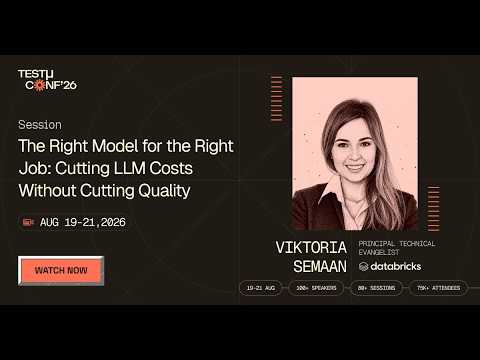
In this TestMu Conf 2026 session, Viktoria Semaan runs that same loop across open source, proprietary, and fine-tuned models in The Right Model for the Right Job: Cutting LLM Costs Without Cutting Quality, covering how to define custom metrics for your own use case and how to calibrate an LLM judge cheaply enough to run it on the open-ended responses that steps four and five leave unscored.
Is a Small Language Model Cheaper Than an LLM?
Per token, almost always. As a decision, it expires fast, because the price of a fixed capability level has been falling faster than the gap between model sizes. Cost is the reason teams reach for a small model most often, and the reason that holds up worst over time.
Stanford HAI's 2025 AI Index Report found that the cost of querying a model scoring the equivalent of GPT-3.5 on MMLU "dropped from $20.00 per million tokens in November 2022 to just $0.07 per million tokens by October 2024."
Read that carefully, because it is easy to misquote. It is the price of buying a fixed capability level, not the price of any one model, and it is inference pricing rather than training cost. What it tells you is that a decision justified purely on today's token price has a shelf life measured in quarters.
Give the choice an explicit re-review date rather than treating it as settled architecture. The workload that needed a small model on cost grounds last year may not this year, and the reverse is equally possible once usage scales.
How Fast Is a Small Language Model?
Fast enough that the industry benchmark for small-model inference asks for a first token in under half a second. Latency is more durable than cost as a decision input, and unlike cost there are published thresholds you can assert against.
MLCommons defines these service-level targets for its small-model inference benchmark on Llama 3.1 8B:
| Scenario | Time to first token | Time per output token |
|---|---|---|
| Server | Under 2 seconds | Under 100 milliseconds |
| Interactive | Under 0.5 seconds | Under 30 milliseconds |
Those thresholds are useful precisely because they convert into a test assertion. Pick the scenario that matches your product, then fail the build when a model or prompt change pushes you past it. Note that time to first token is a different metric from the total response time recorded in the TestMu AI run above, so measure the one your assertion actually names rather than substituting whichever number you already have.

Should You Use an SLM and an LLM Together?
Framing this as a single either-or choice is usually the mistake. NVIDIA Research argues for heterogeneous agent systems in which small models handle the default path and a large model is invoked sparingly for the requests that need it.
The paper walks through several well-known open-source agents and estimates that a substantial share of the subtasks in each could move to a small model. Those are the authors' own estimates rather than measured results, and they are published without a stated methodology, so treat them as an argument for trying the split rather than as a target to plan against.
A routed system inherits the strengths of both tiers and one new component that nobody tests: the router. Its failure mode is quiet and expensive, because a router that escalates too rarely does not throw an error, it just returns the small model's confidently wrong answer and calls it done.
Test the router as a unit in its own right:
- Assemble a set of requests you know exceed the small model's capability, and assert that every one of them escalates. This is the test that catches an under-escalating router.
- Track escalation rate as a production metric with alerting. A rate that drifts down is usually a silent quality regression, not an efficiency win.
- Run both tiers against the same request periodically and compare outputs, which surfaces the cases where the small model was confidently wrong and the router accepted it.
- Measure end-to-end latency on the escalation path rather than the happy path, since a routed request pays the small model's cost before the large model even starts.
Routing is an agent-architecture decision as much as a model one, and our agentic AI guide covers the surrounding patterns. For a current view of which large models are worth having on the escalation path, see our roundup of popular LLMs.
Conclusion
Start by pulling 50 real requests out of your logs this week and writing the correct answer for each by hand. That set, not a spec sheet, is what answers the SLM vs LLM question for your workload, and it keeps answering it every time a model version changes underneath you.
The evidence points the same way throughout. Small models give up factual recall first and narrow-task reasoning last, they can beat models twice their size on the right benchmark, and their failures are stable enough that casual testing will miss them entirely. Ours returned the identical wrong answer on ten consecutive runs.
When you get to the point of scoring open-ended responses at volume, TestMu AI's Agent Testing platform runs your scenarios against chat, voice, and phone agents and returns per-metric scores with a production-readiness verdict, so a model swap becomes a measured regression check rather than a judgement call. The getting started guide walks through connecting an agent and running the first evaluation.
Author

Anubhav Singhmaar
Blogs: 36

Anubhav Singhmaar is an AI Product Manager at TestMu AI driving Kane CLI, the command-line tool that brings browser automation to the terminal, turning natural-language flows into runs in a real Chrome browser that return pass or fail with shareable proof. He owns the roadmap and prioritization and works with engineering to ship developer-facing features. Before TestMu AI, he spent over four years at Sprinklr owning enterprise voice AI across APAC and EMEA. A mechanical engineer turned product manager, he grounds guidance in real QA workflows.
Reviewer

Samyak Goyal
Reviewer
Samyak Goyal is a Senior Member of Technical Staff at TestMu AI engineering Kane CLI, the command-line tool that runs browser automation from the terminal, where a flow described in natural language executes in a real Chrome browser and returns pass or fail with shareable proof. He is a backend engineer with 4+ years of experience, previously an SDE at Innovaccer, where he built APIs, introduced Kafka, and cut deployment from weeks to hours. Samyak also builds multi-agent systems, skill-orchestration frameworks, and a personal copilot that indexes 200+ microservice repositories.


SLM vs LLM FAQs
Did you find this page helpful?
More Related Blogs
TestMu AI forEnterprise
Get access to solutions built on Enterprise
grade security, privacy, & compliance
- Advanced access controls
- Advanced data retention rules
- Advanced Local Testing
- Premium Support options
- Early access to beta features
- Private Slack Channel
- Unlimited Manual Accessibility DevTools Tests