
Agent Assurance for your AI Deployment
Test how your agents actually behave across workflows, tools, and actions. Catch failures and vulnerabilities before they ship.
npm install -g @testmuai/rook
- TestMu AI (Formerly LambdaTest)
- /
- Learning Hub
- /
- OpenAI GDPval Benchmark: Tasks, Grading, Scores and Limits
OpenAI GDPval Benchmark: Tasks, Grading, Scores and Limits
OpenAI GDPval tests AI on 1,320 real work tasks from 44 occupations. See what the 220 open tasks hold, how experts grade them, and why GDPval-AA scores differ.
Published on:
OVERVIEW
The 220 public GDPval tasks come with 10,453 grading criteria, all marked in the data as written by a person, with a median of 47 per task. A script run on 2026-10-19 counted them in OpenAI's open dataset, along with the sectors, occupations, file types and prompt lengths of the open set.
Those criteria, and the expert graders behind GDPval's headline score, judge one thing: the finished file. They say nothing about how the file was made, which starts to matter when an agent with a shell and a browser produces it.
Overview
GDPval is OpenAI's benchmark of 1,320 real work tasks from 44 occupations in the 9 US sectors that each contribute more than 5% of GDP. Each task asks for a deliverable such as a spreadsheet, legal memo or slide deck, and blinded occupation experts grade the model's file against one a professional made.
How Many Tasks Are in GDPval?
- GDPval full set: The full GDPval set holds 1,320 tasks, 30 for each of the 44 occupations, with a median expert time of 4 hours per task. Public: No.
- GDPval gold subset: The GDPval gold subset holds 220 tasks, 5 per occupation, in the openai/gdpval dataset on Hugging Face, with prompts, reference files, the professionals' deliverables and 10,453 rubric items marked as human-written. Public: Yes. License stated on the dataset card: No.
How Is GDPval Scored?
- Win-or-tie rate: OpenAI's headline GDPval figure is the percentage of graded comparisons in which a model's deliverable is rated better than or as good as the professional's; Table 2 of OpenAI's GDPval paper reports the win rate alone. Grader: Occupation experts.
- Comparisons per prompt: In OpenAI's GDPval paper, each model answered every prompt 3 times and 3 different experts graded each answer, giving 9 comparisons per prompt per model, with a tie scored as 0.5.
- Margin on 220 tasks: A 50% GDPval score measured on the 220 gold tasks has a 95% margin of about 6.6 points, so two models near 40% need a gap of about 9 points before the difference stands out from sampling error.
What Is the Difference Between GDPval and GDPval-AA?
- GDPval-AA: GDPval-AA is Artificial Analysis's run of the same 220 open tasks, with models working in an agentic loop with a shell and web browsing. Judge: one of three frontier LLMs per comparison. Scale: Elo anchored at 1600. Human baseline: No.
- Score scales: A GDPval win-or-tie percentage measures a model against a professional, while a GDPval-AA Elo rating measures a model against other models, so a GDPval score and a GDPval-AA rating cannot be compared.
Can I Run GDPval Myself?
- inspect_evals: The UK AI Security Institute's inspect_evals package wraps the 220 GDPval gold tasks as a ready task on its Inspect framework and runs them in a Docker sandbox whose image can take up to 10 minutes to build.
- OpenAI-hosted leaderboard: OpenAI's GDPval pages say the OpenAI-hosted leaderboard is no longer active and that you run your own grading on the released rubrics and gold deliverables. Hosted leaderboard active: No.
What Does GDPval Not Measure?
- Excluded work: GDPval leaves out manual labor and tasks that need extensive tacit knowledge, personal data, proprietary software or communication between people, and every GDPval prompt is fully specified and answered in one shot.
- Process steps: GDPval graders and rubric items judge only the delivered files, so the commands run, sources fetched and tools called on the way to a deliverable are not part of a GDPval score.
- Agent Assurance: Agent Assurance by TestMu AI tests an agent before release rather than the model underneath, checking tool calls against declared tools, files changed under declared paths and records through an approved read-only tool. Pre-alpha: Yes. Publicly installable: Yes.
What Is GDPval, OpenAI's Benchmark of Real Work Deliverables?
The GDPval benchmark is OpenAI's test of how well AI models produce real work deliverables, such as a spreadsheet, a legal memo or a slide deck, for 44 occupations in the 9 US sectors that each contribute more than 5% of GDP, as set out in OpenAI's GDPval report. Occupation experts grade a model's file against the file a professional made for the same request.
The GDPval paper was submitted to arXiv on 5 October 2025 by Tejal Patwardhan and colleagues at OpenAI. Task writers needed at least 4 years of experience in their occupation, and each task got an average of five human reviews, never fewer than three.
| Property | GDPval full set | GDPval gold subset |
|---|---|---|
| Tasks | 1,320 | 220 |
| Tasks per occupation | 30 | 5 |
| Most reference files in one task | 38 | 17 |
| Median expert time per task | 4 hours | 5 hours (longest: 100) |
| Public | No | Yes: prompts, files, gold deliverables, rubrics |
| Used for the paper's headline model results | No | Yes |
The times come from the paper's summary tables for each set. A 5-hour median puts GDPval tasks far from the single-question format of most model benchmarks: each one is a short work assignment with attachments. The MMLU benchmark, built from multiple-choice exam questions, and SimpleQA, built from short fact-seeking questions, are typical of that format.
GDPval Gold Subset: Sectors, Files and Rubric Items Across 220 Open Tasks
The gold subset lives in the openai/gdpval dataset on Hugging Face. Its commit history there shows the first upload on 25 September 2025 and a commit titled "Release GDPval v2 (rubrics + deliverables)" on 10 February 2026, which added the rubric and expert-deliverable columns counted below.
How Were the GDPval Gold Subset Figures Counted?
The dataset card states no license, so this page publishes aggregate counts only. A Node.js 25.5 script run on 2026-10-19 did the following:
- Fetched all 220 rows through the Hugging Face datasets-server rows API, which needs no key, in pages of 100.
- Tallied tasks per sector and per occupation.
- Counted reference files and expert deliverable files by file extension.
- Parsed each task's rubric_json field and counted items, penalty items with a negative score, and the points available per task.
- Flagged rubric items whose text names a file type or format word, such as xlsx, workbook, slide or format, with one regular expression.
- Counted words in each prompt.
It printed this:
Tasks: 220
Sectors: 9, occupations: 44
Tasks per occupation: 5

Tasks per sector
   25  Professional, Scientific, and Technical Services
   25  Government
   25  Information
   25  Manufacturing
   25  Real Estate and Rental and Leasing
   25  Finance and Insurance
   25  Wholesale Trade
   25  Health Care and Social Assistance
   20  Retail Trade

Reference files
  tasks with at least one   125 (56.8%)
  files in total            261
  most in one task          17
  top types  xlsx 86, pdf 74, docx 67, png 9, wav 8, zip 3

Expert (gold) deliverable files
  files in total            248
  top types  pdf 85, xlsx 65, docx 64, pptx 17, zip 5

Rubric items (rubric_json)
  items in total            10453
  per task min/median/max   14 / 47 / 137
  written by a human        10453
  penalty items (score < 0) 94 in 18 tasks
  median points available   71.5
  items naming a file/format 1614 (15.4%)

Prompt length (words)
  min/median/max            100 / 307 / 1064
Sectors and Occupations in the GDPval Gold Subset
Every occupation gets exactly 5 tasks, so no job dominates the score. Retail Trade has 20 tasks instead of 25 because the paper lists four occupations for it, against five for each of the other eight sectors.
- Equal weight - a task from Software Developers counts as much as one from Concierges, although the paper's table puts their total pay at $239.18B and $1.80B a year.
- Small cells - a per-occupation result in the gold subset rests on 5 tasks, so one task moves it by 20 points.
- Prompt length - prompts run from 100 to 1,064 words, with a median of 307, so most tasks state the audience, the inputs and the expected format at length.
A typical prompt opens with a role and a job. The first task in the set, from Accountants and Auditors, begins: "You are an auditor and as part of an audit engagement, you are tasked with reviewing and testing the accuracy of reported Anti-Financial Crime Risk Metrics."
Reference Files and Expert Deliverables in GDPval
- Inputs - 125 of the 220 tasks (56.8%) attach at least one reference file, 261 in total, led by spreadsheets (86), PDFs (74) and Word files (67). One task attaches 17.
- Outputs - the professionals' gold deliverables are 248 files for 185 tasks, mostly PDF (85), Excel (65) and Word (64), plus 17 PowerPoint decks.
- Audio and archives - the inputs include 8 WAV files and 3 ZIP archives, so a model that reads text only cannot attempt every task.
The GDPval paper's PDF says 67.7% of tasks need at least one reference file, next to a table that is labelled gold set but whose maximum of 38 files matches the full set; in the open 220 the share is 56.8%. Quote the open-set figure when your own run used the open set.
Rubric Items per GDPval Task
Each task's rubric is a list of weighted checks on the deliverable. In the first task, the opening item checks that the submission is an Excel workbook with a set file name.
- Size - rubrics range from 14 to 137 items, with a median of 47 and a median of 71.5 points available.
- Penalties - 94 items carry a negative score and they sit in 18 tasks, so most rubrics only add points.
- Authorship - all 10,453 items have author_type set to human.
- Format checks - 1,614 items (15.4%) name a file type or format word. The rest check content: figures, sections, calculations and instructions followed.
Every item describes a property of the submitted files. None of the fields records the steps, tools or sources used to make them.
GDPval Grading: Expert Pairwise Comparisons and the Win-or-Tie Rate
For the gold subset, experts from the task's occupation saw the request, the reference files and two or more unlabeled deliverables, then ranked them with written reasons. According to the paper, grading one comparison took over an hour on average.
- Three outcomes - each comparison scores 1 when the model's deliverable is preferred, 0 when the professional's is, and 0.5 for a tie.
- Win rate and win-or-tie rate - results can count wins alone or wins plus ties, and the paper's headline figure counts both.
- Repeats - each model was sampled 3 times per prompt and each sample was graded by 3 different experts, giving 9 comparisons per prompt per model.
- Grader agreement - on the paper's agreement measure, where a tie set against a win counts as half agreement, two experts grading the same sample scored 70.8%, and OpenAI's experimental automated grader, based on GPT-5-high, scored 65.7% against experts.
- Ungradable tasks - 12 of the 220 tasks were marked ungradable for the automated grader, which had no internet access and could run only Python.
Blinding was partial. The paper notes that OpenAI outputs often used em dashes, Claude outputs often wrote in the first person and Grok sometimes named itself, so graders may have guessed the source.
OpenAI's GDPval grading page now says the rubrics and gold deliverables are open-sourced, so you run your own grading. It calls pairwise human expert preference the standard and an LLM judge on the rubrics "a rough estimate", and its leaderboard page says the OpenAI-hosted leaderboard "is no longer active".
Published GDPval and GDPval-AA Scores
The first four rows come from Table 2 of the GDPval paper and use expert graders on the gold subset. The last three come from the Artificial Analysis GDPval-AA leaderboard, version 2.1, read on 2026-10-19, and give each Elo rating with its 95% interval.
| Model | Score | Metric and grader | Source |
|---|---|---|---|
| GPT-5 | 39.0% | Win rate (wins only), expert graders | GDPval paper, Table 2 |
| o3 | 35.2% | Win rate (wins only), expert graders | GDPval paper, Table 2 |
| o4-mini | 29.1% | Win rate (wins only), expert graders | GDPval paper, Table 2 |
| GPT-4o | 12.5% | Win rate (wins only), expert graders | GDPval paper, Table 2 |
| Claude Opus 5.5 (Max, Default Fallback) | 1866 ±26 | Elo with 95% interval, LLM judge panel | GDPval-AA v2.1, 2026-10-19 |
| Muse Wonder Full (Max) | 1857 ±25 | Elo with 95% interval, LLM judge panel | GDPval-AA v2.1, 2026-10-19 |
| Claude Sonnet 5.5 (Max, Default Fallback) | 1838 ±23 | Elo with 95% interval, LLM judge panel | GDPval-AA v2.1, 2026-10-19 |
- One metric in the paper rows - all four figures are the win rate the paper's Table 2 uses for its speed and cost analysis, counting only deliverables rated better than the human one; the paper plots its win-or-tie results per model in a chart with no matching table, so they are not repeated here.
- No conversion - a percentage against a professional and an Elo rating against other models are different scales, so no row in the top half can be compared with a row in the bottom half.
- Dated rows - the Elo rows change as models are added and the fit is updated; check the leaderboard before quoting them.
GDPval vs GDPval-AA: Expert Graders Against an LLM Judge and Elo
GDPval-AA runs OpenAI's open tasks through Artificial Analysis's own harness. Its page says models get "shell access and web browsing capabilities in an agentic loop via Stirrup", and its GDPval-AA methodology says a judge sampled from a panel of three frontier LLMs ranks each pair of submissions blindly, with ties counted as half-wins in the Elo fit.
| Aspect | GDPval (OpenAI paper) | GDPval-AA v2.1 |
|---|---|---|
| Tasks scored | 220 gold tasks | 220 tasks |
| How the model works | OpenAI models with web search and code interpreter; Claude sampled through its user interface | Agentic loop with a shell and web browsing |
| Compared against | The professional's deliverable | Another model's submission on the same task |
| Grader | Blinded occupation experts | One judge per comparison, picked from three frontier LLMs |
| Scale | Percent of wins, or wins and ties | Elo, anchored at DeepSeek V4.1 Flash (max) = 1600 |
| What a number tells you | Share of comparisons won, or won and tied, against the professional | Distance from the anchor model's 1600, with no human baseline |
Setup and grading together can move a score a long way. The inspect_evals GDPval README from the UK AI Security Institute reports that GPT-5 with low thinking scored 47.3% ± 6.2% through OpenAI's automated grader, and notes that OpenAI's official leaderboard reported a lower 31.9% for wins only and 34.6% for wins and ties. The README does not attribute the gap, and its run swapped OpenAI's code interpreter for bash and Python tools in a Docker sandbox.
- Self-preference - the paper found its GPT-5-based grader agreed less with experts when grading capable OpenAI models, which the paper links to a 2024 study finding that LLM evaluators favor their own generations.
- Judge choice - an LLM judge is cheaper than an hour of expert time per comparison, and the trade-off is the agreement gap above; LLM-as-a-judge covers how to calibrate one against human labels.
- Harness - a shell, a browser and installed libraries decide which file types a model can open and produce, so the same model can score differently in two harnesses.
How Big a GDPval Score Gap Is Real?
The script below treats each task as one independent trial and computes the 95% margin of a win-or-tie rate on the 220 gold tasks and on the 1,320-task full set.
// gdpval-margin.mjs: 95% margin of a win-or-tie rate
// One task = one independent trial (normal approx.)
const z = 1.96;
const margin = (p, n) =>
  100 * z * Math.sqrt((p * (1 - p)) / n);
const log = (s) => console.log(s);

log("95% margin (percentage points)");
log("rate   220 tasks   1,320 tasks");
for (const p of [0.3, 0.4, 0.5]) {
  const a = margin(p, 220).toFixed(1);
  const b = margin(p, 1320).toFixed(1);
  const pct = (p * 100).toFixed(0);
  log(`${pct}%      +/-${a}       +/-${b}`);
}
log("");
// Two independent scores on the same set: variances add
const gap = (p, n) => Math.SQRT2 * margin(p, n);
log("Gap needed between two models near 40%");
log(`  220 tasks:   ${gap(0.4, 220).toFixed(1)} points`);
log(`  1,320 tasks: ${gap(0.4, 1320).toFixed(1)} points`);
Run with Node.js 25.5 on 2026-10-19, it printed:
95% margin (percentage points)
rate   220 tasks   1,320 tasks
30%      +/-6.1       +/-2.5
40%      +/-6.5       +/-2.6
50%      +/-6.6       +/-2.7

Gap needed between two models near 40%
  220 tasks:   9.2 points
1,320 tasks: 3.7 points- 220 tasks - a 50% rate is good to about ±6.6 points, close to the ±6.2 that the inspect_evals run reports from bootstrapping its grades.
- Two models - near 40%, two independent scores on the gold subset need about 9 points between them before the difference stands out from sampling error; on the full set, about 4.
- Repeats do not add tasks - the paper's 9 comparisons per prompt narrow grader and sampling noise, but the margin on task difficulty still rests on 220 tasks.
Both models answer the same 220 tasks, so a paired comparison is usually tighter than this independent-samples gap; the score-gap section of the LLM benchmarks reference covers the paired and clustered methods for any benchmark.
What Does GDPval Not Measure?
The limitations section of the GDPval paper's HTML version names most of the gaps itself. Others follow from the counts above.
- Physical and interpersonal work - manual labor is excluded, and so are tasks needing extensive tacit knowledge, personal data, proprietary software or communication between people.
- Finding the context - tasks are fully specified and one-shot. In the paper's under-contextualized experiment, prompts cut to 42% of their token length made GPT-5 perform worse.
- Long tasks - win rates were highest on tasks of 0 to 2 hours and fell as expert completion time rose.
- Severity - a loss is a loss in the score; when experts re-rated GPT-5's losing deliverables, about 29% were bad or catastrophic and about 3% catastrophic.
- How the work was done - graders see the request, the reference files and the deliverables, and every rubric item describes the files, so commands run, sources fetched and tools called are not part of the grade.
- Your own work - five tasks per occupation say little about the documents, policies and tools of one team; a golden dataset built from your own cases answers that.
The process gap is small while a model answers in one turn. With a shell and a browser, as in GDPval-AA, a model can download data, run code and write files on the way to its deliverable, and none of those steps reaches the judge.
How to Run GDPval Yourself
The inspect_evals GDPval implementation runs on the UK AI Security Institute's Inspect framework, and its README on GitHub gives the install and run commands:
pip install "inspect-evals[gdpval]"
inspect eval inspect_evals/gdpval \
  --model openai/gpt-5-nano
The same README says the task runs in a Docker sandbox and that building its image can take up to 10 minutes, so build it before the first run; the README gives the build command. Its last step, submitting results through OpenAI's grading form, no longer applies: OpenAI's grading page now asks you to run your own grading, as described above.
- Fix the setup first - record the model version, reasoning effort, tools, harness and installed libraries; the paper's own prompt tuning added 5 points to GPT-5's win rate.
- Run all 220 tasks, several times - the paper sampled each model 3 times per prompt, and dropping hard tasks changes what the score means.
- Collect every deliverable file - the inspect_evals task writes them to a timestamped output folder that can be uploaded to Hugging Face.
- Grade with experts where the decision matters - pairwise expert preference is the standard OpenAI names; an LLM judge on the released rubrics and gold deliverables is the rough estimate.
- Report the margin - give n, samples per task, the grader and the 95% margin next to the score, and say whether it counts wins or wins and ties.
OpenAI's automated grader could not grade 12 of the 220 tasks, so a run graded by an LLM judge should list the tasks it skipped.
Agents on GDPval-Style Work: Checking the Actions Behind an Agent's Deliverable
A GDPval-AA run is already an agent at work: shell access, web browsing and files written along the way. When your own agent does work like this for customers, the file it hands back is one output, and the records it changed, the tools it called and the files it touched are the rest.
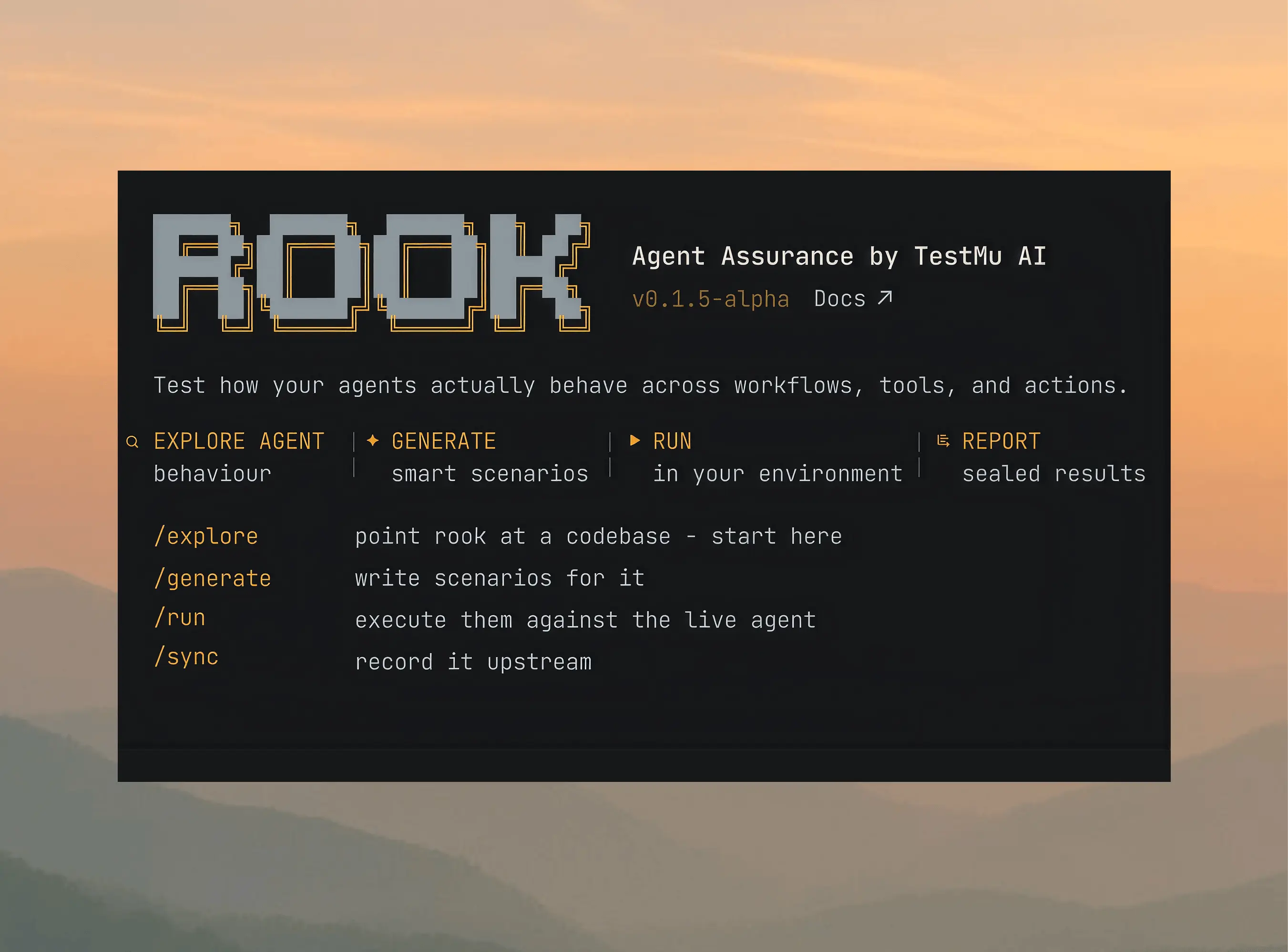
Before such an agent reaches customers, you can put it through release tests with TestMu AI's Agent Assurance. The product ships as the Rook CLI, which is pre-alpha and publicly installable:
npm install -g @testmuai/rook
rook --version
It runs on macOS and Linux, and 64-bit Windows through npm or WSL; npm needs Node.js 20 or newer, and Homebrew and the shell installer are covered in the Rook CLI installation guide.
- Scenarios from your agent - it reads the agent's code, its spec or an API spec and writes scenarios with acceptance criteria, functional and adversarial by default.
- Staging runs - your actual agent is called against a staging environment or from CI, and anything it writes there stays written, because nothing is rolled back.
- Artifacts - for an agent that returns a report or file, it checks that the artifact exists, its type and size, and its content where it can be read; what it cannot read is Unable to Verify.
- Actions - it compares tool calls with the tools the agent declares, including ones it must not call, checks files changed under the declared paths and reads records through a read-only tool you approve.
| Question | GDPval-style deliverable score | Agent Assurance run |
|---|---|---|
| What is scored | A model's files against a professional's or another model's | Your agent, one criterion at a time |
| Where tasks come from | Experts in 44 occupations | Your agent's code or spec |
| Tool calls and side effects | Not part of the grade | Checked against declared tools, paths and records |
| Adversarial cases | Not included | Generated by default |
| Results nobody could check | No per-criterion verdict; OpenAI's automated grader marked 12 of 220 tasks ungradable | Unable to Verify, kept out of the pass rate |
Each criterion ends as Pass, Fail or Unable to Verify. Model judges score some criteria, yet an agent saying it saved the file or updated the record is never accepted as proof; the evidence from the run decides, as the Agent Assurance overview docs describe.
Most eval and observability tools score what your agent said and recorded. Agent Assurance checks what the run changed, and reports what it could not verify. It is not a model benchmark: it tests your agent, not the model underneath, so it complements a GDPval number in a model choice.
Using GDPval in a Model Decision
Start with the occupations closest to your work, read the five gold tasks for each, and treat a gap smaller than the margin worked out above as a tie. Then score the shortlisted models on your own cases, using the steps in AI agent evaluation.
If the model will run inside an agent that changes files or records, install the Rook CLI with npm install -g @testmuai/rook and point Agent Assurance at a staging copy before the agent ships.
Author

Anubhav Singhmaar
Blogs: 46

Anubhav Singhmaar is an AI Product Manager at TestMu AI driving Kane CLI, the command-line tool that brings browser automation to the terminal, turning natural-language flows into runs in a real Chrome browser that return pass or fail with shareable proof. He owns the roadmap and prioritization and works with engineering to ship developer-facing features. Before TestMu AI, he spent over four years at Sprinklr owning enterprise voice AI across APAC and EMEA. A mechanical engineer turned product manager, he grounds guidance in real QA workflows.
Reviewer

Samyak Goyal
Reviewer
Samyak Goyal is a Senior Member of Technical Staff at TestMu AI engineering Kane CLI, the command-line tool that runs browser automation from the terminal, where a flow described in natural language executes in a real Chrome browser and returns pass or fail with shareable proof. He is a backend engineer with 4+ years of experience, previously an SDE at Innovaccer, where he built APIs, introduced Kafka, and cut deployment from weeks to hours. Samyak also builds multi-agent systems, skill-orchestration frameworks, and a personal copilot that indexes 200+ microservice repositories.


GDPval FAQs
Did you find this page helpful?
More Related Learning Hubs

TestMu AI forEnterprise
Get access to solutions built on Enterprise
grade security, privacy, & compliance
- Advanced access controls
- Advanced data retention rules
- Advanced Local Testing
- Premium Support options
- Early access to beta features
- Private Slack Channel
- Unlimited Manual Accessibility DevTools Tests