
Agent Assurance for your AI Deployment
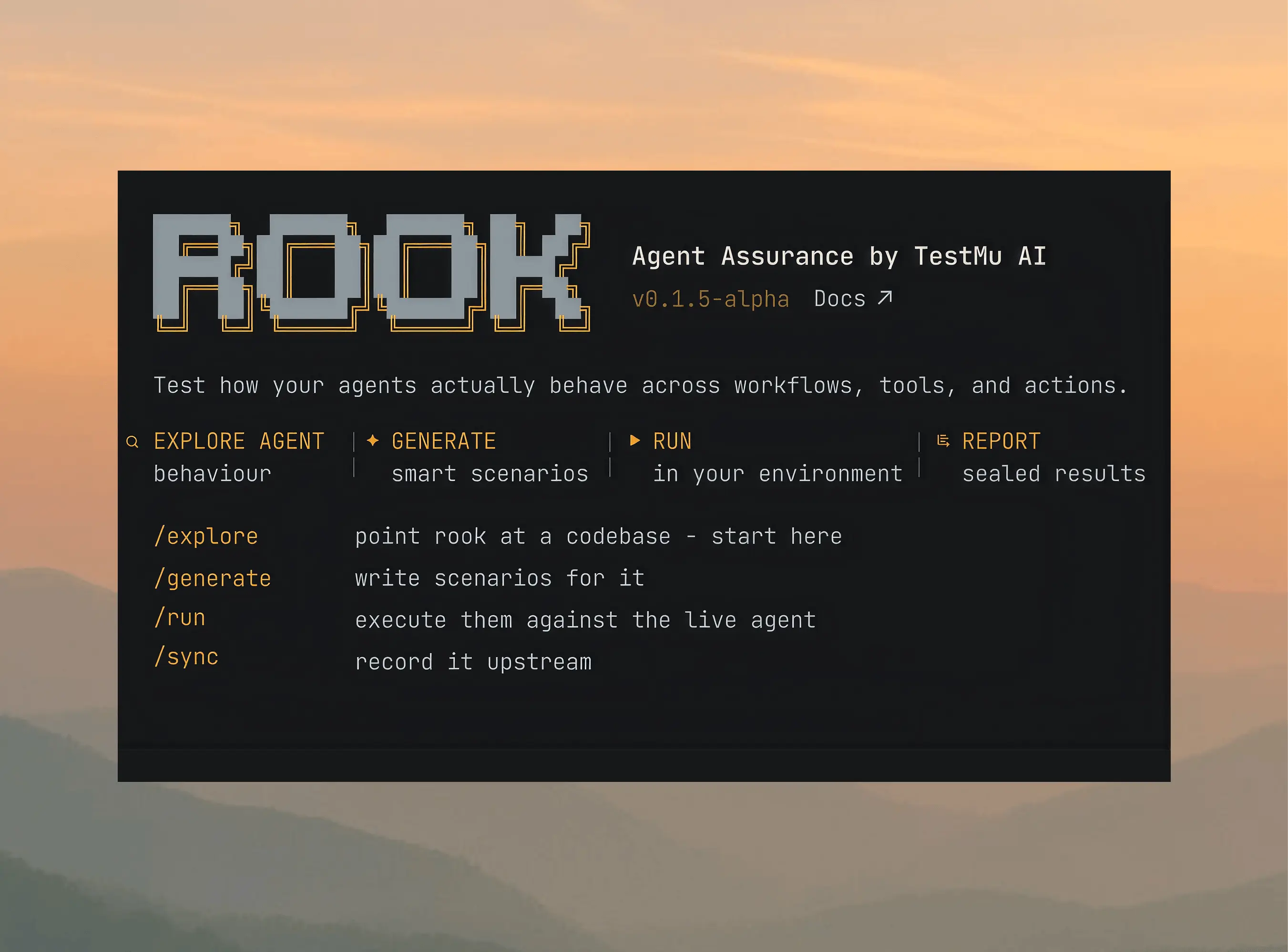
Test how your agents actually behave across workflows, tools, and actions. Catch failures and vulnerabilities before they ship.
npm install -g @testmuai/rook
- TestMu AI (Formerly LambdaTest)
- /
- Learning Hub
- /
- AI Model Governance: Inventory, Model Cards, Re-Validation
AI Model Governance: Inventory, Model Cards, Re-Validation
AI model governance is how you inventory, document, validate and re-validate every model you use, including hosted models you did not train. See what to record.
Published on:
OVERVIEW
AI model governance decides which model version each system may call, and a gap in it shows up fast: a support agent can start answering customers with a model nobody on the team approved, without anyone changing a line of its code. Hosted model platforms retire old model versions on a schedule, and Microsoft Foundry, for one, moves its standard-type deployments to a replacement version automatically when the old one retires.
When that happens, someone has to answer which systems used the old version, who approved it, what evidence showed it worked, and who signs off on its replacement. AI model governance is the discipline that keeps those answers on file before anyone asks.
Overview
AI model governance is the set of records, owners and checks that controls which AI models an organization uses, at which version, for what purpose, and when each one is re-validated or retired. In a script run on 2026-10-19, none of the 100 most downloaded text-generation models on Hugging Face published all five basic model card fields.
Key Facts About AI Model Governance
- Model inventory: An AI model inventory records each model's exact version, provider, base model, license, owner, intended use, calling systems, validation evidence and the provider's retirement date, so a version change can be traced to every affected system.
- Model card: A model card is the publisher's document on a model's intended uses, limitations, training data and evaluation results, yet only 27 of the 100 top Hugging Face text-generation models had a README heading on limitations, bias, risks, misuse or out-of-scope use when checked on 2026-10-19.
- Hosted model lifecycle: Microsoft Foundry retires a generally available model version 18 months after launch under its standard lifecycle, and from then on every inference request to that version returns 410 Gone.
- Do provider model updates need re-validation?: Yes. A provider's new version is a different model behind the same name, so the same evaluation set should run on it before traffic moves, with both results kept as evidence.
- Re-validation triggers: AI model re-validation is due on a new model version, a deprecation notice, a prompt or tool change, a new retrieval source, a fine-tune, a new intended use, or a drift or incident signal.
- Does SR 26-2 cover generative AI models?: No. SR 26-2, issued on 17 April 2026 by the Federal Reserve, the OCC and the FDIC, states that generative AI and agentic AI models are not within its scope.
- Must AI model providers document their models under the EU AI Act?: Yes, for general-purpose model providers, whom EU AI Act Article 53 has required since 2 August 2025 (by 2 August 2027 for models already on the market) to keep technical documentation and inform integrating providers of capabilities and limitations, unless the model is open source with public weights, architecture and usage information and no systemic risk.
- NIST AI RMF: The NIST AI Risk Management Framework is voluntary, and its GOVERN 1.6 subcategory calls for mechanisms to inventory AI systems, while MANAGE 3.2 calls for monitoring the pre-trained models used to develop a system.
- Agent Assurance: Agent Assurance by TestMu AI re-runs an agent's test scenarios on a candidate model configuration before release and reports the pass-rate change and newly failing scenarios, without registering, governing or certifying the model itself.
What Is AI Model Governance, From Registration to Retirement?
AI model governance is the set of records, named owners and checks that decides which AI models an organization may use, at which exact version, for which purpose, how each is validated before first use, when it must be re-validated, and how it is retired. It applies to models you train, open-weight models you download and hosted models you only reach through an API.
The unit is one model version in one use. That is narrower than an AI governance framework, which sets organization-wide principles, risk tiers and committees, and narrower than agentic AI governance, which adds controls for systems that act through tools.
NIST's AI Risk Management Framework (NIST AI 100-1) brackets an AI system's life with two neighbouring GOVERN subcategories, and both apply to each model the system uses: GOVERN 1.6 asks for mechanisms to inventory AI systems, and GOVERN 1.7 asks for processes "for decommissioning and phasing out AI systems safely". Between those two points sit the activities this guide covers:
- Register - give every model version an inventory entry with an owner before any system calls it.
- Document - read the publisher's model card and record what it leaves out for your use.
- Validate - test the model in the system that will call it, on your own data, and keep the evidence.
- Re-validate - repeat the same checks whenever the model, its prompt, its tools or its use change.
- Retire - move every caller off a version before its provider switches it off, and keep the record.
What Does an AI Model Inventory Need to Record?
An AI model inventory needs enough fields to answer, for any model version, who uses it, for what, on whose approval, and with what evidence. Annex IV of the EU AI Act (Regulation (EU) 2024/1689) asks the technical documentation of a high-risk system for "the version of the system reflecting its relation to previous versions" and for any "recourse to pre-trained systems or tools provided by third parties and how those were used, integrated or modified by the provider".
| Field | What to record | Question it answers | Who updates it |
|---|---|---|---|
| Model and version | Provider model ID with its dated version, or the repository commit for open weights | Which model produced this output? | Engineering |
| Source and lineage | Provider, access route (hosted API or open weights), base model, fine-tunes and quantization | Whose model is it, and what was it built from? | Engineering |
| License and terms | License name and link, or the provider terms you accepted, with the date read | Does the license allow this use? | Legal or procurement |
| Intended and excluded uses | The approved use cases, and the uses the owner ruled out | Is this new feature a new use that needs review? | Model owner |
| Owner and validator | A named business owner and a validator outside the build team | Who signs off, and who checked? | Risk or governance |
| Calling systems | Every application, agent and pipeline that sends the model requests | What breaks if this version changes or retires? | Engineering |
| Risk tier | Your internal tier, plus any legal classification such as high-risk under the EU AI Act | How much validation does it need? | Risk or governance |
| Validation evidence | Date of the last validation and a pointer to its results and evaluation set version | What showed it works for this use? | Validator |
| Lifecycle dates | Provider deprecation and retirement dates, and the platform's automatic upgrade setting | When will this version stop answering? | Engineering |
| Triggers and status | The changes that force re-validation, and the status: proposed, approved, restricted or retired | Can a new caller start using it today? | Model owner |
Kept as a file next to the code, one inventory entry can look like this example record for a hosted model (the model name, dates and paths are illustrative):
id: mdl-0042
model: example-chat-model
version: "2026-05-14"      # dated version, never an alias
provider: Example Cloud
access: hosted-api         # hosted-api | open-weights
base_model: null
license: provider terms, read 2026-09-30
owner: card-disputes product team
validator: model risk team (independent)
intended_use: draft replies to card disputes
excluded_uses: [credit decisions, fraud scoring]
used_by: [dispute-agent, help-center-bot]
risk_tier: high
upgrade_setting: no-auto-upgrade
provider_retirement: "2027-11-14"
last_validation: "2026-09-30"
evidence: evals/dispute-agent/2026-09-30/
revalidate_on: [new-version, prompt, tool,
  retrieval, fine-tune, new-use, incident]
status: approved
The "used_by" list does the most work, because it is the list of systems one retirement notice will touch. Without it, a provider's notice reaches whoever owns the cloud account, and nobody can say which products are affected.
What Should a Model Card Contain?
The format comes from Model Cards for Model Reporting by Margaret Mitchell and colleagues (arXiv, 2018; FAT* 2019), which describes model cards as "short documents accompanying trained machine learning models" that provide "benchmarked evaluation in a variety of conditions". On the Hugging Face Hub, the card is the README.md of the model repository, with a YAML metadata header on top.
The Hugging Face model card documentation says a card should describe the model, its intended uses and potential limitations, the training parameters, the training datasets and the evaluation results. Read against governance needs, each part answers a different question:
- License - the license field, or "other" with a named license and link; it decides whether your intended use is allowed at all.
- base_model - the model a fine-tune, adapter, quantization or merge was derived from, which is the lineage the inventory needs.
- datasets - the training datasets by Hub ID, the starting point for data provenance and copyright questions.
- Evaluation results - scores in structured metadata, either the older model-index block or YAML files in a .eval_results/ folder, which the Hub documentation introduces as a newer, simpler format.
- Intended uses and limitations - prose sections on what the publisher designed the model for, its known biases and the uses it advises against.
What Do Popular Hugging Face Model Cards Declare in Practice?
A Node.js script run on 2026-10-19 (UTC) took the 100 most downloaded text-generation models from the public Hugging Face Hub models API and fetched each model's metadata and README. It counted the metadata fields above and checked the README headings for limitations, evaluation and intended-use sections; the figures below are the script's own output.
Hugging Face Hub, top 100 text-generation models
by downloads, read 2026-10-19
Publishing accounts: 36
==================================================
Card metadata (YAML header)
  license declared                    94 of 100
  license field set to 'other'        15 of 100
  base_model declared                 51 of 100
  training datasets declared          13 of 100
  eval results (model-index)           2 of 100
  eval results (.eval_results/)        7 of 100
README section headings
  limitations, bias or risks          27 of 100
  evaluation or benchmarks            68 of 100
  intended use or how to use          31 of 100
Access
  gated (accept terms first)           4 of 100
  README under 1,000 characters        3 of 100
==================================================
All five: license, base, data,         0 of 100
  eval results, limits section
The output shows where a governance team has to fill gaps itself:
- License - 94 of 100 models declare one, but 15 set it to "other", so a person has to read a custom license before the inventory can say the use is allowed.
- Lineage - 51 of 100 name a base_model, so about half of the most downloaded models are themselves derived from another model whose card also needs reading.
- Training data - 13 of 100 list training datasets in metadata, so data provenance usually has to come from a paper or a report, if it is published at all.
- Evaluation - 68 READMEs carry an evaluation, benchmark, performance or results heading, but only 9 publish scores in structured metadata (2 through model-index, 7 through .eval_results/ files).
- Limitations - 27 of 100 have a heading on limitations, bias, risks, out-of-scope use or misuse, and no model in the set had all five: license, base model, datasets, structured evaluation results and a limitations section.
The pattern matches a much larger study. In What's documented in AI? Systematic Analysis of 32K AI Model Cards, Weixin Liang and colleagues analysed 32,111 model documentations on Hugging Face and reported that "sections addressing environmental impact, limitations, and evaluation exhibit the lowest filled-out rates".
The script has limits worth stating: it matched heading keywords rather than reading every section, so a limitations paragraph without a heading was not counted. Its keyword sets are also wider than the output labels: the limitations count takes Out-of-Scope and Misuse headings, the evaluation count takes Performance and Results headings, and the intended-use count takes any heading with the word "uses". The most downloaded list includes tiny test models that libraries use in their own test suites, and one of them, sshleifer/tiny-gpt2, has no README at all, so it counts among the short READMEs in the output.
What Does a Model Card Leave Out About Your Deployment?
Even a complete card describes the model as its publisher released it. Once the model sits inside your product, its behaviour also depends on parts the publisher never saw, so the governed unit is the model version plus the system around it:
- Your prompts - the system prompt and templates change what the same model says and refuses.
- Your retrieval data - documents fed in at run time decide which facts the model repeats.
- Your tools - in an agent, the model chooses which functions to call and with which arguments, and those calls change records.
- Your users - the inputs your customers send rarely match the publisher's benchmark distribution.
- Your version history - a card can be edited after you read it, so record the card's commit or date read next to the model version.
That is why validation evidence in the inventory should come from your own evaluation set, run through your own system. The AI model evaluation guide covers how to build that evaluation step by step.
How Do You Govern Models You Did Not Train?
You govern a hosted model through its provider's lifecycle policy, because the provider decides when your version stops working. Microsoft's Foundry Models lifecycle and support policy, read on 2026-10-19, gives a standard 18-month lifecycle for generally available models: new customers lose access at 12 months, at least 60 days of notice precede retirement, and after retirement "all inference returns 410 Gone".
The same policy shows why the upgrade setting belongs in the inventory. Global Standard, Data Zone Standard and Standard deployments are upgraded automatically, region by region, when a version retires; provisioned deployments are not, and a deployment set to NoAutoUpgrade stops working at retirement. Microsoft also advises teams to "Compare quality, latency, and cost together rather than relying on public benchmarks alone."
For hosted models, put these controls in place before a version change reaches users:
- Pin a dated version - call the model by its dated version identifier, never by an alias that the provider repoints to newer releases.
- Record the retirement date - copy the provider's deprecation and retirement dates into the inventory and alert the owner well before the first one.
- Choose the upgrade setting on purpose - an automatic upgrade swaps the model without a release; no upgrade means an outage at retirement; either way, write the choice down.
- Validate the candidate early - run your evaluation set on the replacement as soon as it is available, not in the last week.
- Keep a fallback - name a second approved model or a non-AI path for each high-risk use.
- Ask for the documentation you are owed - under Article 53 of the EU AI Act, providers of general-purpose AI models must give the providers that integrate them information on the model's capabilities and limitations, unless the model is released under a free and open-source licence with its weights, architecture and usage information public and carries no systemic risk.
The fallback step follows GOVERN 6.2 in the same NIST framework, which asks that "Contingency processes are in place to handle failures or incidents in third-party data or AI systems deemed to be high-risk". For open-weight models the provider cannot retire your copy, but the same discipline applies: pin the repository commit, store the weights you validated, and treat a new upload under the same name as a new version.
How Should Validation and Re-Validation Work Across the Model Lifecycle?
Validate before first use, then re-validate on a defined list of changes rather than on a calendar alone. The supervisory guidance attached to SR 26-2 says "Validation generally occurs prior to a model's first use" and splits validation into conceptual soundness, outcomes analysis and ongoing monitoring; for vendor models it calls for "ongoing monitoring and outcome analysis to assess whether vendor models are accurate, remain fit for purpose, and continue to be reliable".
Write the triggers into the inventory so the re-validation decision is mechanical:
| Trigger | Example | What to re-run | Evidence to keep |
|---|---|---|---|
| New model version | Provider releases a replacement or schedules an automatic upgrade | Full evaluation set on old and new versions, same items | Both runs, item-level differences, sign-off |
| Deprecation notice | Retirement date announced for the pinned version | Evaluation set on each candidate replacement | Candidate comparison and the chosen target |
| Prompt change | System prompt or template edited | Slices the prompt touches, plus safety items | Prompt diff and run results |
| Tool or retrieval change | New tool, changed tool schema, new document source | End-to-end tests of the calling system | What the system did and what it said |
| Fine-tune or quantization | Adapter retrained, weights compressed for cost | Full evaluation set, as for a new model | Training data version and both runs |
| New intended use | A second team wants the model for another task | A new evaluation set for that use | Updated inventory entry and approval |
| Drift or incident | Complaints rise, an output causes harm, metrics move with no change on your side | Affected slices, plus new items built from the incident | Incident record linked to the inventory entry |
Score old and new versions on the same reviewed, versioned items, as described in the guide to building a golden dataset, and compare them item by item rather than by headline pass rate, the approach set out in LLM regression testing.
When a high-risk system falls under the EU AI Act, plan model updates before the first assessment. Article 43(4) requires a new conformity assessment after a substantial modification, but for a system that keeps learning after it is placed on the market, changes the provider pre-determined at the initial assessment and recorded in the technical documentation do not count as one.
What Do Regulators Expect From Model Governance?
The sources below differ in force: one is binding EU law, one is voluntary US guidance and one is US banking supervision guidance. The dates come from each source as read on 2026-10-19; for the EU AI Act, the application dates are from the European Commission's AI Act policy page, last updated on 19 October 2026, which reflects the AI Omnibus that entered into force on 27 July 2026.
| Source | Status | What it asks about models | Dates |
|---|---|---|---|
| EU AI Act, general-purpose AI models | Binding EU regulation | Article 53: model providers keep technical documentation, including evaluation results, and inform integrating providers of capabilities and limitations | Applicable since 2 August 2025 |
| EU AI Act, high-risk AI systems | Binding EU regulation | Technical documentation with versions and third-party components, logging, accuracy and robustness over the lifecycle, post-market monitoring | Annex III uses from 2 December 2027; Annex I products from 2 August 2028 |
| NIST AI RMF 1.0 | Voluntary US framework | GOVERN 1.6 inventory, GOVERN 6.1 and 6.2 third-party risk, MANAGE 3.2 monitoring of pre-trained models | Published January 2023 |
| SR 26-2 (Federal Reserve, OCC, FDIC) | US supervisory guidance for banks | Validation, ongoing monitoring, inventory, documentation, roles and vendor model review, for statistical and non-generative, non-agentic AI models | Issued 17 April 2026; replaces SR 11-7 and SR 21-8 |
The Federal Reserve's SR 26-2 letter says the revised guidance supersedes SR 11-7, issued on 4 April 2011, and SR 21-8, and reflects supervisory experience and industry feedback "accumulated over the past fifteen years". It adds: "This letter is expected to be most relevant to banking organizations with over $30 billion in total assets regulated by the Federal Reserve." The attached guidance then carves newer models out in a footnote: "Generative AI and agentic AI models are novel and rapidly evolving. As such, they are not within the scope of this guidance."
The same footnote adds that "a banking organization's risk management and governance practices should guide the determination of appropriate governance and controls" for systems it does not cover. A bank's large language models therefore still need governance; the banking agencies' guidance just does not prescribe it, so the bank's own policy has to.
The EU AI Act is narrower than it first looks for teams that only call a model: most of its model-level duties fall on the provider of the general-purpose model or of the high-risk system. Timing also differs for models already on sale: under Article 111(3), providers of general-purpose AI models placed on the market before 2 August 2025 have until 2 August 2027 to comply. How to turn its risk management article into test cases is covered in EU AI Act conformity testing.
Who Owns AI Model Governance?
Ownership splits across people who use, build, check and audit a model. The banking agencies' revised model risk guidance warns about conflicts "between different reporting lines, such as model development and validation groups" and says internal audit's role "is generally to evaluate whether the model risk management practices are rigorous and effective", rather than to repeat validation.
| Role | Owns | Signs |
|---|---|---|
| Model owner | The use case, its risk tier and its excluded uses | Approval to use, accepted limitations |
| Engineering | Version pinning, upgrade settings, calling-system list, evaluation runs | That the inventory matches what is deployed |
| Independent validator | Evaluation design, re-validation results, limitations found | Validation report for each version and use |
| Legal and procurement | Licenses, provider terms, written agreements with model suppliers | That the terms allow the use |
| Risk and compliance | Policy, tiering rules, legal classification | Exceptions and high-risk approvals |
| Internal audit | Testing that the governance process works | Audit findings on the process |
Under the EU AI Act, roles can also move once the high-risk rules apply. Article 25 treats a deployer that makes a substantial modification to a high-risk AI system as its provider, with the provider's obligations, and its paragraph 4 requires the provider of a high-risk AI system and a third party that supplies an AI model used in it to specify, "by written agreement", the information, capabilities and technical access the provider needs to comply.
Re-Validating an AI Agent After a Model Change With Agent Assurance
Once the model behind an agent picks its tool calls and record writes, re-validation evidence has to cover the actions the agent took with the new model as well as its replies. TestMu AI built Agent Assurance to test such agents before they ship. It does not register, inventory, govern or certify models; the evidence it produces is something your model owner and validator can attach to the inventory entry.
Rook CLI, the client you drive it from, is a pre-alpha release that is publicly installable through npm:
npm install -g @testmuai/rookThe rook command runs on macOS and Linux, and 64-bit Windows through npm or WSL. Installing through npm needs Node.js 20 or newer, while the Homebrew and shell installer routes for macOS and Linux, described in the Rook CLI installation docs, need no Node.
Each step of a model change has a counterpart in the Rook CLI workflow that the README in the public rook release repository describes:
- Generate the suite once - Agent Assurance reads the agent's codebase or spec and drafts scenarios with acceptance criteria attached; by default the set mixes functional and adversarial cases.
- Add a profile per model - an agent can hold several profiles, so the model in production and the candidate become two configurations of one agent.
- Run the same suite on both - point both runs at staging: whatever the agent writes during a run really happens, and nothing is undone afterwards.
- Read the run-over-run change - run the candidate profile right after the current one so the last two runs form the pair, check each run's profile, then read the pass-rate change and the scenarios that newly fail or were fixed; edited scenario definitions are flagged.
- Gate on the report - rook ends a finished run with exit code 0 whatever the verdicts, so a CI job should read them from
rook report --json.
Every acceptance criterion closes as Pass, Fail or Unable to Verify, judged from the files a run changed, the agent's tool calls checked against the tools it declares, and read-only checks, through a tool you approve, on the records the run touched. Model judges score some criteria, and an agent saying it finished a task never counts as proof. A criterion with no evidence behind it is reported as Unable to Verify, and the scenario pass rate counts only scenarios with a decided verdict, so gaps stay visible.
Most eval and observability tools score what an agent said and recorded. Agent Assurance checks what the run changed and reports what it could not verify. It tests and reports; whether your model governance meets the EU AI Act, banking guidance or your own policy is for your compliance team and auditors to decide, and run evidence is stored as plain files, so use synthetic or staging data.
Starting AI Model Governance With a Model Inventory and a Re-Validation Run
Start with a search of your code and configuration for every model identifier, and give each one an inventory entry with its exact version, its callers and its provider's retirement date. For each high-risk use, read the model card, note which of the five basic fields are missing, and record the upgrade setting.
Retirement dates can come from the provider's own data rather than a forwarded email. Microsoft's Models - List API reference (API version 2024-10-01, read on 2026-10-20) returns each model's lifecycleStatus, its deprecation.inference date, which Microsoft's lifecycle policy maps to the version's retirement, its fine-tuning deprecation date, and a deprecationDate for each SKU, so a scheduled job can keep the inventory's lifecycle dates current.
Then pick the system whose model retires first and build its re-validation run before the notice arrives. If that system is an agent that acts, the Agent Assurance CI/CD guide covers running a reviewed suite in CI under a chosen profile and gating the job on the report's verdicts.

Note: This article was researched and drafted with AI assistance, then reviewed, fact-checked, and published by Sanjay Singh, Senior Product Manager at TestMu AI and the article's author of record, whose listed expertise includes AI/ML products and FinTech. Sirajuddin Khan, Vice President of Product Management at TestMu AI, reviewed it. Every statistic, link, and product claim was verified against primary sources: the EU AI Act text, NIST, the Federal Reserve, Hugging Face documentation and API data, provider documentation, research papers and TestMu AI's product documentation. Read our editorial process and AI use policy for details.
Author

Sanjay Singh
Blogs: 1

Sanjay Singh is a Senior Product Manager at TestMu AI, where he drives product strategy and go-to-market for the agentic AI quality engineering platform across web, mobile, and enterprise testing. He brings over seven years of experience across B2B SaaS, AI/ML, and FinTech. Earlier he was a Product Manager at ElectrifAi, where he led the development of SpendAI and a 14-member team and lifted customer acquisition by 20%, and at Inogic, where he grew annual revenue 30% year over year and recurring revenue 40% through a pricing revamp. Sanjay holds an MBA from IIM Lucknow and an Integrated Dual Degree in Biochemical Engineering from IIT (BHU) Varanasi.
Reviewer

Sirajuddin Khan
Reviewer
Sirajuddin Khan is Vice President of Product Management at TestMu AI, where he drives the company's agentic AI product strategy, building a suite of autonomous agents that includes Agentic Browsers and Agentic Visual Testing and shifting the unit of work from test execution to autonomous outcomes. One of the company's earliest product leaders, he has owned the roadmap for the high-performance execution cloud and grew the cross-browser testing products from early adoption to market leadership. He brings over a decade of experience across SaaS, B2B, and eCommerce, with earlier product roles at Wydr and ShopClues, where his catalog and search work cut delivery SLAs and lifted seller activity. Sirajuddin holds an MBA in Information Technology from Sikkim Manipal University and a B.Tech in Computer Science Engineering from Maharshi Dayanand University.


AI Model Governance FAQs
Did you find this page helpful?
More Related Learning Hubs

TestMu AI forEnterprise
Get access to solutions built on Enterprise
grade security, privacy, & compliance
- Advanced access controls
- Advanced data retention rules
- Advanced Local Testing
- Premium Support options
- Early access to beta features
- Private Slack Channel
- Unlimited Manual Accessibility DevTools Tests