
Power Your Software Testing with AI Agents and Cloud
The Native AI-Agentic Cloud Platform to Supercharge Quality Engineering. Test Intelligently and Ship Faster.

- TestMu AI (Formerly LambdaTest)
- /
- Blog
- /
- Patched Is Not Proven: The Testing Lesson in the eMudhra Certificate Compromise
Patched Is Not Proven: The Testing Lesson in the eMudhra Certificate Compromise
Published on:
Browser users were protected from the eMudhra certificate compromise within days. Firefox and Chrome blocked the eight compromised intermediates on October 17, Apple devices on October 19 and Microsoft platforms on October 20.[3]
The rest of the stack was slower. API clients, language runtimes and container images check certificates on their own, so each one needed its own patch. That gap is the testing lesson in Cloudflare's report on its response: patched is not proven until the real application has been tested on the TLS path its users actually hit.
TL;DR
The eMudhra certificate compromise is an October 2026 incident in which the private keys behind eight widely trusted eMudhra intermediate certificates were weak enough to recover, so anyone could forge a certificate for any domain. Its testing lesson is that a patch is proven only when the real application still works on its real TLS path.
- TLS encryption: Was TLS encryption broken in the eMudhra certificate compromise? No. Cloudflare says its fixes address certificate-based authentication, not a weakness in TLS's encryption algorithms.
- Browser revocation: Firefox and Chrome blocked the eight intermediates on October 17 through quick-revocation lists such as OneCRL and CRLSets, followed by Apple devices on October 19 and Microsoft platforms on October 20.
- Passing checks: Does a passing browser or curl check prove a service is safe? No. A check proves only the verification path it ran through, so a background service with its own verifier can still trust the compromised chain.
- Non-browser clients: HTTP libraries, language runtimes, container base images and bundled trust stores each need their own update to distrust the compromised eMudhra intermediates, followed by a reload, restart or redeploy before the running service uses it.
- Disabling verification: Should you switch off certificate verification to clear errors after patching? No. Cloudflare warns that it removes the authentication protection the patch restored, so fix the trust store or the certificate instead.
- Post-patch proof: To prove an eMudhra patch worked, re-run the sign-in, checkout and payment journeys in your regression testing suite through the real application on the devices customers use. TestMu AI runs these flows with Kane CLI and on 10,000+ real Android and iOS devices.
- Issuer check: To see which certificate authority issued each certificate in a chain before and after a reissue, paste it into the free certificate decoder, which shows issuer, subject and validity dates.
What Happened
On October 19, 2026, Cloudflare learned that attackers had compromised the private keys behind eight eMudhra intermediate certificates. Browsers, operating systems, and Cloudflare itself trusted those certificates. Because the keys were weak, an attacker could forge a certificate for any domain and use it to impersonate a server, intercepting or changing its traffic.
Cloudflare patched critical services before public disclosure and says it found no active exploitation on its services. It shipped updates to its WARP and 1.1.1.1 clients and to Cloudflare Tunnel, and deployed mitigations across its CDN, developer and Zero Trust products.
This was not a flaw in TLS encryption. It was a failure of trust: the internet's system for deciding which server is really who it claims to be.
Timeline
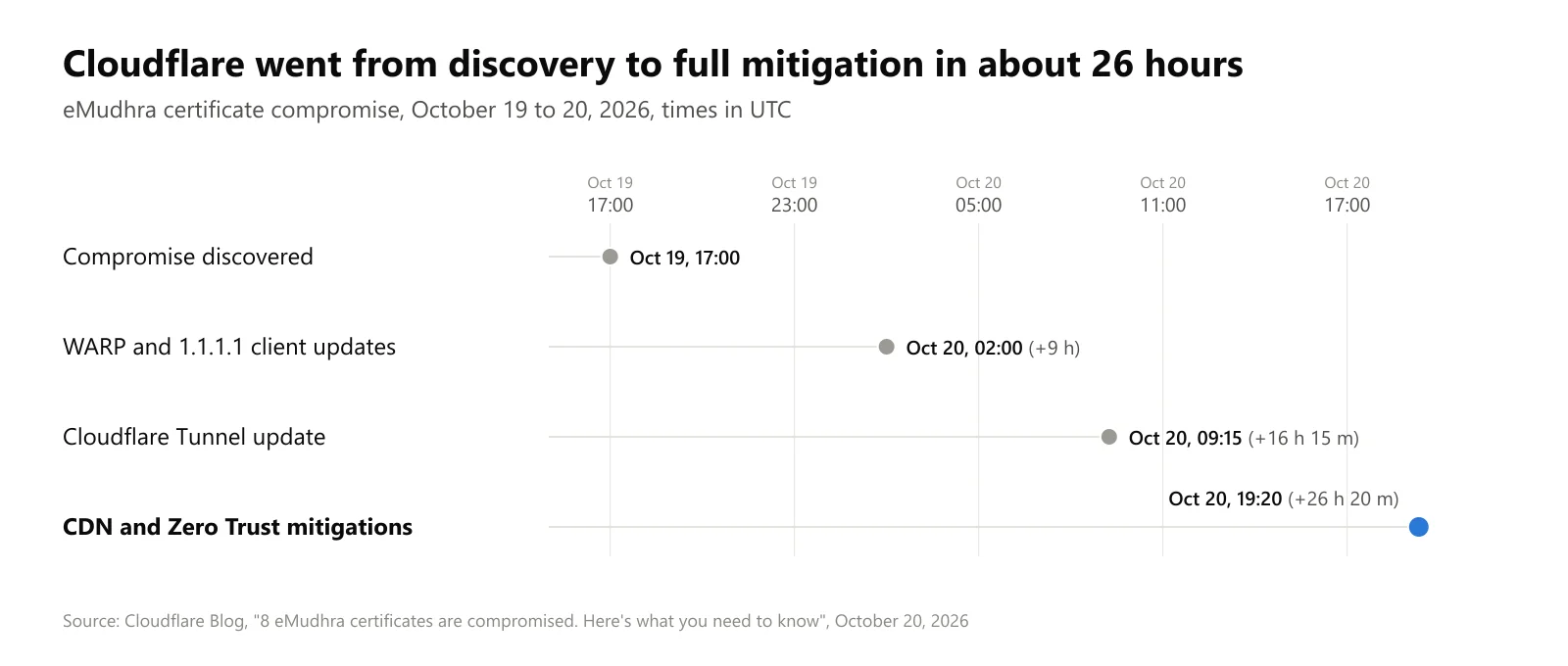
Cloudflare's response timeline · 4 milestones
Client updates shipped nine hours after discovery, with one iOS app still awaiting App Store review. Cloudflare fully deployed CDN and server-side Zero Trust mitigations about 26 hours in, and says further remediation is still underway.[1]
Why Browsers Flipped a Switch and Everyone Else Couldn't
Browsers removed the risk with what Cloudflare calls a switch flip. Most use quick-revocation lists, such as Chrome's CRLSets, and each browser is a single application to update.
Everything else is harder. Certificate checks are scattered across HTTP libraries, language runtimes, operating systems, container base images, and custom trust stores.
Cloudflare's fix meant updating shared trust stores and base images, then reloading, restarting, and redeploying services so the change took effect. Apps with their own bundled trust stores needed separate work.
Cloudflare's warning to developers is blunt: updating the SDK alone may not change anything, because the real check can sit several layers beneath it. The fix isn't finished when the patch is installed. It is finished when the service running in production is using it.
The Testing Lesson Hiding in a Security Post
The most important sentence in Cloudflare's post is not about cryptography. It is about proof: validate through the application's actual TLS path.
A browser check passing does not prove a background service is safe. A curl test passing does not prove an app that uses a different verifier is safe.
That is the rule every test team should take from this incident.
- A test proves only the path it ran through. Checking one tool, one machine, or one library tells you only about that path. Proof has to come from the real application, on the real path, in the environment users actually hit.
- Never turn a check off to make red go green. Cloudflare warns that patched systems may throw certificate errors, and that disabling verification to silence them removes the protection the patch restored. Test suites face the same temptation every day.
- A fix isn't done until you've verified it where it runs. Installed isn't deployed, and deployed isn't proven. Each step needs its own evidence.
- Know what you depend on. Cloudflare points developers to their dependency tree because vulnerability checks often hit an indirect dependency nobody chooses.
Where TestMu AI Fits
To be clear about scope: TestMu AI is not a certificate authority or a security scanner, and nothing here detects forged certificates. We fit in the work that follows an incident like this.
Distrusting a certificate is a deliberate break. Once trust stores are patched, anything that still depends on those certificates stops working. Cloudflare says so directly: it is adding alerts for customers still using the distrusted certificates, because they would cause breakages.
That can be your own site, or a payment provider or partner API your app calls behind the scenes. If you reissue from a different authority, the new certificate must be trusted on the oldest phones and browsers your customers still use.
So the question after the patch is simple: do our real user journeys still work on the browsers and devices our customers actually have?
- Prove it on the real path. KaneAI and Kane CLI run critical flows like sign-in, checkout, and payments end to end through the actual application. A checkout test also exercises the payment call behind it, so a backend connection that broke after the patch shows up as a failed checkout, not a silent one.
- Prove it across what users run. Real Device Cloud and cross-browser testing cover the phones, operating system versions, and browsers your customers use, where trust in a new certificate can differ.
- Prove it fast. HyperExecute runs those suites in parallel, shortening the gap between an emergency patch and proof that nothing broke.
- Never heal a real failure to green. In Kane CLI, healing can change how a test reaches a step, never the pass criteria. Report a broken flow as a bug. It is the same discipline Cloudflare asks for: don't disable the check to silence the error.
One honest limit. End-to-end tests catch the systems that fail closed, the ones that now refuse a connection they should accept.
Proving that a service refuses a forged certificate it should reject is security testing, and it needs the checks Cloudflare and Mozilla describe. You need both.
The principle behind TestMu AI covers the first: an independent verification layer that produces evidence of how your software behaves, not assumptions about it.

Note: To rerun a Kane CLI suite on HyperExecute after an emergency patch, kane-cli testrun run --remote --parallel 4 spreads the tests across four grid runners and returns one exit code. See Kane CLI remote execution for setup, or try TestMu AI free.
Patched Is Not Proven
Cloudflare closes by arguing that a trust store can't be a static list. It must be updatable quickly, because trust can break overnight.
The same goes for confidence in your software. A green dashboard from last week says nothing about the system after this week's emergency patch. Teams that come through incidents like this cleanly can prove, quickly and on the real path, that everything still works.
Patched is not proven. Prove it.
Sources
- [1] 8 eMudhra certificates are compromised. Here's what you need to know, Cloudflare Blog, October 20, 2026
- [2] Cloudflare's announcement on X
- [3] eMudhra Intermediate CA Compromise, Dennis Jackson's test site and patched-package list, October 20, 2026
Author

Anurag Sharma
Blogs: 6

Anurag Sharma is Senior Vice President of Engineering at TestMu AI, leading platform and product engineering across the testing cloud. He improved the streaming technologies behind live and screenshot testing, built the components that run the automation and manual test grids, and created an SSH-based Tunnel over a TCP proxy to test locally hosted and firewall-protected websites. He also built a microservice that scales virtual machines across bare-metal servers on demand using server health stats and weighted round robin. He brings over 12 years of experience across Golang, Node.js, Python, Java, Redis, Kafka, and MySQL, with earlier work engineering decision-support systems for Indian Railways.
Reviewer

Mayank Bhola
Reviewer
Mayank Bhola is Co-Founder and Head of Products at TestMu AI, where he leads the entire product portfolio across KaneAI, Kane CLI, HyperExecute, SmartUI, the Real Device Cloud, Accessibility, and other software testing product lines. As an early Lead Architect he designed and built the company's flagship Tunnel technology from scratch, created the React-based automation platform, and architected the data-intensive pipelines and FAAS services that scale it. He brings more than 10 years of experience in software development and product engineering, with earlier roles as Head of Technology at Juggernaut Books and Senior Software Engineer at PressPlay TV and Zomato. Mayank holds a B.Tech in Computer Engineering from JIIT Noida.


eMudhra Certificate Compromise FAQs
Did you find this page helpful?
More Related Blogs

TestMu AI forEnterprise
Get access to solutions built on Enterprise
grade security, privacy, & compliance
- Advanced access controls
- Advanced data retention rules
- Advanced Local Testing
- Premium Support options
- Early access to beta features
- Private Slack Channel
- Unlimited Manual Accessibility DevTools Tests