

Power Your Software Testing with AI Agents and Cloud
The Native AI-Agentic Cloud Platform to Supercharge Quality Engineering. Test Intelligently and Ship Faster.


- TestMu AI (Formerly LambdaTest)
- /
- Blog
- /
- How Enterprises Can Shift Left: A Practical Guide
How Enterprises Can Shift Left: A Practical Guide
Learn how enterprises shift left by defining outcomes, aligning teams on a shared vision, prioritizing upstream practices, and measuring quality and speed.
Last Updated on:
On This Page
- First things first, understand Shift-left
- Start with Why, defining the outcomes
- Share the vision to align the organization
- Prioritize Shift-left activities and measurement
- Expand linking shift-left outputs to the outcomes
- How do enterprises shift left on security and compliance?
- How does AI change shift-left for enterprises?
- Shift-left for Enterprises, a necessary transformation
Enterprises shift left by moving quality, security, and design work upstream in the software lifecycle so defects surface while they are still cheap to fix. Static application security testing, software composition analysis, and secrets detection run inside the pull request, mapped to the practice groups in NIST SP 800-218. This guide explains what shift-left means, how to define outcomes, share the vision, prioritize activities and measurement, link outputs to outcomes, extend the work to security and compliance, and handle AI-generated code.
Key Takeaways
- Shift-left moves quality activities upstream in the software lifecycle so defects are detected earlier, which reduces the cost of fixing them by a factor of 10 to 100.
- An enterprise shift-left initiative starts by defining the business outcomes it must contribute to, before teams adopt practices such as Behavior Driven Development.
- Shift-left performance is measured in three categories: key business outcomes, software lifecycle performance on quality and speed, and the shift-left practices teams actually perform.
- Aligning an organization on shift-left needs a shared vision that answers what changes for each team and builds a quality engineering culture where anyone can block the flow to improve it.
- Enterprises expand shift-left by starting with one small team likely to succeed, then replicating its practices through ambassadors, reusable templates, and training materials.
- Enterprises shift left on security by running static application security testing, software composition analysis, secrets detection, and dynamic testing inside the pull request instead of a pre-release review.
First things first, understand Shift-left
The philosophy of shift-left is to improve the outputs of the software production process by performing upstream activities that help to detect issues earlier, reducing the cost of fixing them by a factor of 10 to 100. In reality, there is even more value in shift-left than cost reductions.
"Shift-left is about accelerating the delivery of valuable software." - Antoine Craske
The early involvement of actors contributing along the software lifecycle enables them to include by design requirements that avoid costly reworks once software has already been produced. That's where shift-left is more than shift left testing: upstream quality contributes to more speed.
Companies capture additional value with shift-left by improving the collaboration of the teams with shared methodologies, constraints, and reviews. The upstream involvement fosters an environment where software is improved even when ideas are still on paper, supporting faster cycles.

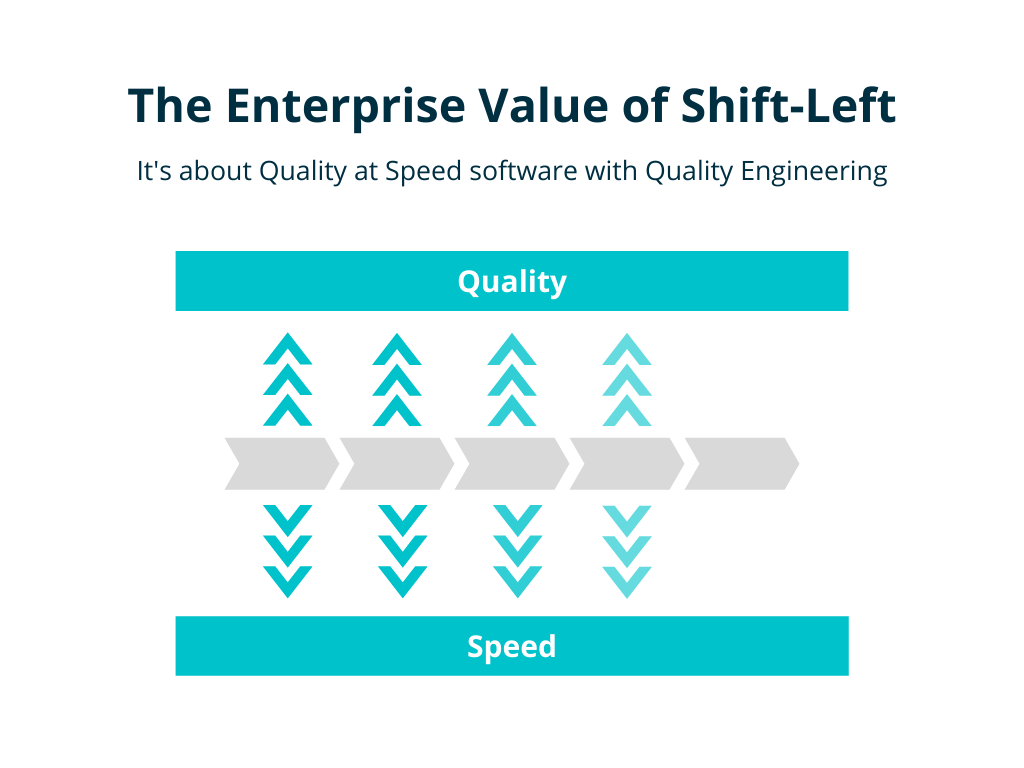
Shifting-left is, therefore, a must-have for companies searching to accelerate their digital transformation. It enables faster iterations of software delivery that are improved earlier, tested faster, and delivered with a continuous velocity, contributing to organizational agility.
Shift-left now has to cover AI-generated code. Coding assistants produce implementation, tests, and configuration inside the same pull request, so review, static code analysis, and dependency checks have to run at that point rather than in a later QA cycle. Enterprises that treat assistant output as untrusted input apply the same specification, review, and test gates they apply to code written by hand.
Key Takeaway: Shift-left is more than testing earlier, because involving contributors upstream builds requirements in by design, avoids costly rework, and now extends to reviewing AI-generated code inside the same pull request.
Start with Why, defining the outcomes
The initiation of a shift-left dynamic usually leaves the team full of energy to implement practices they have heard about, such as Behavior Driven Development (BDD), starting to measure how many scenarios they cover. It must start the other way by defining the expected outcomes.
Enterprises aiming to embrace a shift-left dynamic must be able to articulate its contribution to the company strategy and business objectives. Even if shift-left activities can actually be measured locally, their bottom-line impact is to contribute to the business outcomes.
But there are difficulties for organizations to measure the outcomes of a shift-left initiative. Delayed feedback loops create a time gap between the implementation of practices and the measurement of results; thereby complicating the correlation between shift-left outputs with business outcomes.
That's why organizations must measure shift-left performance in three main categories:
- Key business outcomes (i.e. KPIs) like customer satisfaction or new revenue streams
- Software lifecycle performance on quality and speed (e.g. Accelerate)
- Shift-left practices concrete actions through metrics.
These outcomes will drive the formulation of the enterprise shift-left vision.
Key Takeaway: A shift-left initiative must begin by defining the expected business outcomes, then measure progress across key business outcomes, software lifecycle quality and speed, and the shift-left practices applied.
Share the vision to align the organization
Organizational alignment is critical for creating a shared understanding about the need for change, what are the expectations, and what is likely to change for the teams. The burning questions to answer for everyone are "What's in it for me" and "What's next?".
That stage is about creating content about the shared vision that can be presented in town-hall, team meeting and other instances. The key motivations defined in the previous must be present and easily remembered, easing the adoption and recall among teams.
One must-have message is about creating a quality engineering culture, where all actors collaborate along the lifecycle with the quality and speed imperatives in mind. Like in Toyota factories, anyone not satisfied with the outputs at one stage must be able to block the flow to improve it directly.
The start of the initiative is then about managing a series of incremental organizational transitions, starting small while keeping the entire enterprise up-to-date. The first transition requires leveraging your guiding coalition and identifying your "early wins shift-left team".
Key Takeaway: Sharing a memorable shift-left vision in town halls and team meetings creates the alignment needed to start incremental transitions, beginning with a guiding coalition and an early wins shift-left team.
Prioritize Shift-left activities and measurement
The first team to start with shift-left practices must be composed with a high probability of succeeding, picking your best assets with the necessary skills, open to new ideas and enable to drive the implementation of shift-left practices in short cycles.
The objectives and context must be first assessed to define the most valuable priorities that will contribute to key outcomes of quality and speed. The practices to implement must either contribute to improve the products upstream or reduce the risks of introducing defects along the software lifecycle.
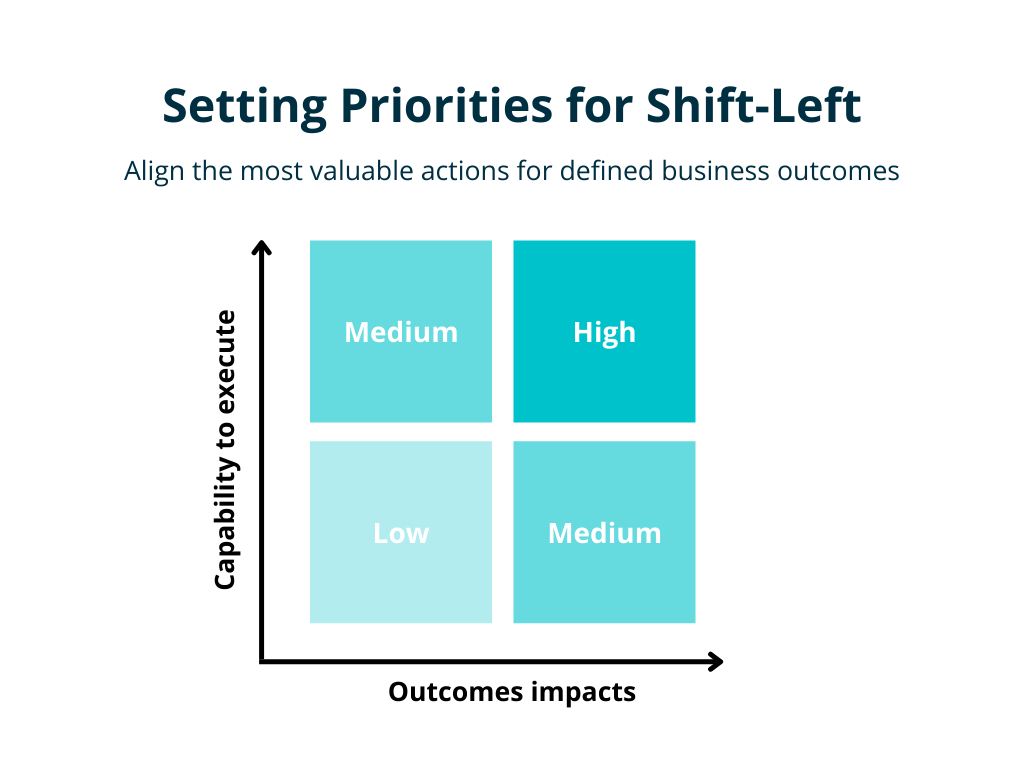
The team has to analyze its software lifecycle performance according to the outcomes defined in the first step. For example, if the objective is to increase customer activation by 5%, deliver daily instead of every week, the team needs to define which shift-left practices make more sense.
Identifying the shift-left activities that could provide more value can be done with questioning:
- What actions that, if improved or added, would contribute to the outcomes?
- Where are the limiting factors in our current software lifecycle?
- At which stage non-functional requirements are best tackled?
- Which activities are generating the most rework? Why?
- Which steps are most likely to introduce defects?
The team can then identify which practices and measurements are more useful. If teams have too many reworks from the testing stage, they can invest in BDD in their user stories to perform them earlier with test automation. If there are security concerns, architecture reviews can be set up.
It is essential to systematically drill-down into the root causes of the identified symptoms to prioritize the correct shift-left actions. Teams can introduce defects due to weak test environment management, and not because of the quality of the specifications. That's why measurement is needed.

Key Takeaway: Choosing shift-left practices means analyzing where the current software lifecycle creates rework and defects, then drilling into root causes so the practices selected address the real limiting factor.
Expand linking shift-left outputs to the outcomes
Shift-left for Enterprises should deliver successful incremental transitions to unlock its full potential across the organizations. Measurement is useful to follow the implementation progress but also to define when the switch to a new transition is required.
Once the first team has delivered valuable changes with shift left practices, it is then time to expand them among teams. It is critical at that stage to ensure the scalability of your foundations in terms of methodology, architecture, organization, management and skills.
Start by ensuring a properly-defined set of shift-left guidelines and practices that can be replicated by other teams using ambassadors from the early wins team. Similarly, ease the adoption with reusable templates, technology assets, and training materials.
Scaling holds better when the platform carries the practice. Enterprises move shift-left checks into the service templates and pipelines that every team already starts from, so linting, contract tests, dependency scanning, and policy checks run by default instead of depending on each team to remember them. The platform team owns those defaults, and the product teams keep ownership of the results they produce.
The continuous measurement across your three categories will help you link shift-left outputs to the outcomes, ensuring that the expansion of the practices is effectively contributing to your enterprise objectives. That's indeed why you started the initiative in the first place.

Key Takeaway: Shift-left scales when guidelines, reusable templates, and default pipeline checks live in the platform every team starts from, and when continuous measurement links shift-left outputs to business outcomes.
How do enterprises shift left on security and compliance?
Enterprises shift left on security by running vulnerability and dependency checks inside the pull request, and by producing compliance evidence as a build output. In most enterprises the pre-release security review is the last sequential gate still standing, and it returns work to teams weeks after they wrote it. Four scan types replace it at the source: static application security testing on the changed code, software composition analysis on the dependency tree, secrets detection on the diff, and dynamic testing against a deployed preview environment.
NIST publishes the practice list those scans can be mapped to. The Secure Software Development Framework, NIST SP 800-218, groups its practices under Prepare the Organization, Protect the Software, Produce Well-Secured Software, and Respond to Vulnerabilities. A companion profile, SP 800-218A, extends the same structure to generative AI and dual-use foundation models, which is the part that applies when assistants and agents contribute code and pull in dependencies nobody on the team selected.
Regulation now sets the deadline for enterprises selling into the EU. Under the Cyber Resilience Act, Regulation (EU) 2024/2847, reporting obligations have applied since 11 September 2026. A manufacturer must send an early warning within 24 hours of becoming aware of an actively exploited vulnerability, a fuller notification within 72 hours, and a final report no later than 14 days after a corrective measure is available. The main obligations apply from 11 December 2027. A 24 hour clock cannot be answered by a quarterly audit, so component inventory moves into the build. Both bill of materials formats are already standardised, CycloneDX as ECMA-424 and SPDX as ISO/IEC 5962:2021, so the pipeline can emit the inventory that shows which products contain a given component.
Key Takeaway: Enterprises replace the pre-release security gate with static analysis, software composition analysis, secrets detection, and dynamic testing in the pull request, and emit a CycloneDX or SPDX bill of materials so Cyber Resilience Act reporting deadlines can be met.
How does AI change shift-left for enterprises?
AI changes shift-left by pushing the review burden into the pull request, because assistants now generate a large share of the change volume arriving there. The 2025 DORA State of AI-assisted Software Development report found that 90% of respondents use AI at work, while 30% report little or no trust in the code it generates. The same report records a positive relationship between AI adoption and software delivery throughput, and a continuing negative relationship with software delivery stability.
That combination is a shift-left problem. More change arriving faster, reviewed by people who do not fully trust it, is the exact condition upstream controls exist for. DORA attributes the instability to missing control systems rather than to the generated code itself, naming strong automated testing, mature version control practices and fast feedback loops as the capabilities that decide whether the acceleration helps or hurts.
Tooling has moved to the same place. GitHub Copilot code review runs on the pull request, gathers project context, and can open a pull request carrying its suggested fixes, with Lite and Balanced review effort levels. GitHub documents the limits plainly: it is not guaranteed to spot all problems or issues in a pull request, it skips dependency manifests such as package.json and Gemfile.lock along with log files and SVG files, and its agentic features depend on GitHub Actions runners. The skipped dependency manifests matter, because that is where software composition analysis belongs. An enterprise shift-left design therefore treats an AI reviewer as one more upstream check, never as a replacement for the scanners or the human reviewer.
Key Takeaway: AI raises delivery throughput but lowers stability, so enterprises keep automated testing, version control discipline and pull request scanning as the upstream controls, and treat an AI code reviewer as an added check rather than a replacement.
Shift-left for Enterprises, a necessary transformation
We saw that shift-left starts by clarifying the Why in the expected business contribution. That focus is what enables the implementation of the most valuable shift-left practices along their software lifecycle, depending on their context and priorities.
Enterprises able to shift-left can accelerate the delivery of quality (at speed) software, enabling them to sustain the necessary rhythm of the digital transformation. That velocity sustains the capability of the organization to remain valuable in our challenging ecosystem.
Shifting-left is a business imperative supported by, and not driven by technology. Only organizations that formulate a compelling shift-left vision can drive the necessary transitions to deliver sustainable changes for quality at speed software.
And, it all starts with the right leadership and vision
Author

Antoine Craske
Blogs: 10


Antoine Craske is a community contributor with 15+ years of experience spanning software architecture, quality engineering, and large-scale technology transformation. He has worked extensively on continuous testing, CI/CD practices, and software quality at enterprise scale, alongside leading architecture and engineering teams as a CTO and Chief Architect. Antoine is the author of multiple books on quality engineering and system architecture, a frequent conference speaker, and the creator of frameworks focused on measurable improvements in software delivery and testing practices.


Enterprise Shift-Left FAQs
Did you find this page helpful?
More Related Blogs
TestMu AI forEnterprise
Get access to solutions built on Enterprise
grade security, privacy, & compliance
- Advanced access controls
- Advanced data retention rules
- Advanced Local Testing
- Premium Support options
- Early access to beta features
- Private Slack Channel
- Unlimited Manual Accessibility DevTools Tests