

Power Your Software Testing with AI Agents and Cloud
The Native AI-Agentic Cloud Platform to Supercharge Quality Engineering. Test Intelligently and Ship Faster.


- TestMu AI (Formerly LambdaTest)
- /
- Blog
- /
- Can Coding Agents Test Their Own Code
Can Coding Agents Test Their Own Code
Coding agents catch mechanical faults in their own output but not misread requirements, because the code and the test share one interpretation.
Last Updated on:
An agent ships a checkout change on a Friday. It writes the feature, writes the tests, runs them, and reports eleven passing.
On Monday the discount field accepts negative numbers. Every test still passes, because every test was written by the thing that misunderstood the requirement.
That failure is not a tooling gap. It is a structural property of asking one interpretation to check itself.
TL;DR
Coding agents test their own code well enough to catch mechanical faults and badly enough to miss the expensive ones. The dividing line is whether a failure requires information the agent did not already have when it wrote the code.
- Reliably caught - crashes, type errors, broken imports, and anything that contradicts the code the agent just wrote.
- Reliably missed - misread requirements, because the test encodes the same misreading as the feature.
- The fix is not a second agent - it is a source of truth the coding agent did not produce.
- Three things make it work - execution in a real browser, artifacts in your repo, and a human gate on destructive changes.
Can a Coding Agent Test Its Own Code
Partly, and the split is predictable. It catches faults that contradict the code in front of it, and misses faults that require knowing what the code was supposed to do.
That distinction is worth more than a general opinion about whether AI can be trusted. It tells you exactly which reviews you can drop and which you cannot. For the measured evidence behind that broader question, see can you trust ai generated code.
What Happens When One Agent Writes Both
The code and the test inherit one reading of the requirement. If that reading is wrong, the test does not disagree with the code. It confirms it, and the suite goes green.
Statisticians would call this correlated failure. Two checks that share an input are not two checks.
- The proofreader problem - an author reads past their own errors because they know what the sentence meant to say.
- The discount field - nobody stated that a discount cannot exceed the order total, so nothing written was going to check it.
- Volume does not help - ten tests from one misreading are still one misreading.
This is why coverage percentages mislead on agent-written suites. High coverage of the wrong intent is still the wrong intent.
What Independent Verification Actually Requires
Independence is not about who runs the check. It is about whether the thing confirming the work also produced it, and whether the result survives outside the session.
Three properties separate evidence from a self-report.
- Executed, not reasoned - the check ran against the running application rather than against the diff.
- Durable - the result is a file in your repository, not terminal output that scrolls away.
- Attributable - you can see which steps ran, in what order, and what each one asserted.
A deterministic verifier gives you all three without adding a second reasoning layer to supervise. Kane CLI from TestMu AI takes a natural-language objective and drives a real Chrome browser to a pass or fail.
- Separate from the author - the pass is decided by observable evidence, not by the system that wrote the code.
- One portable pack - results, per-step screenshots, and console output travel in a single evidence file.
- Fails the build - a failing verification stops the pipeline before agent-written code reaches main.
- Pushes through surprises - redirects and error pages are treated as data rather than reasons to stop.
Installed as a skill, the coding agent calls it after building something and reads the verdict back.
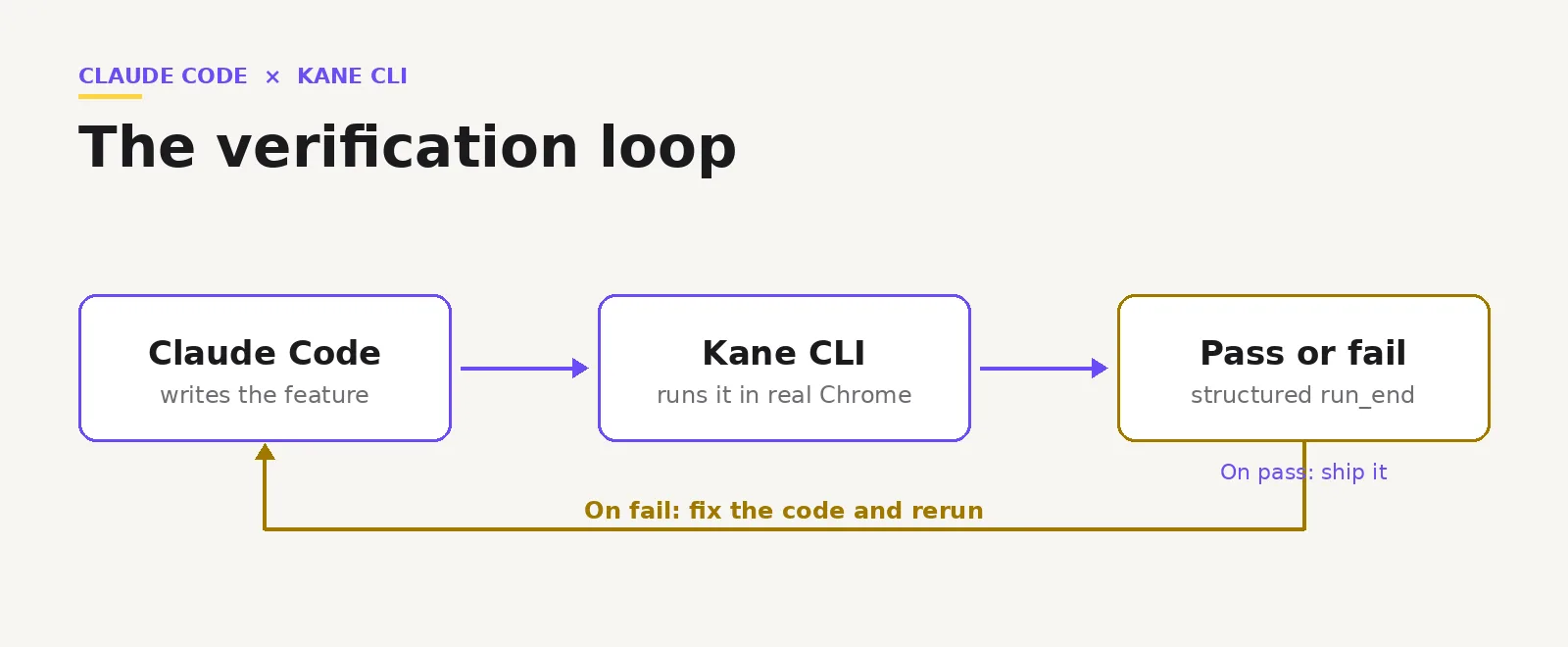
In practice the call is one line, and the objective states the rule nobody wrote down.
# the coding agent invokes this itself, then reads the result
kane-cli run --agent --headless \
  "apply a discount larger than the order total,
   assert the form rejects it and the total never goes below zero"

# exit 0 = the rule holds. exit non-zero = the agent shipped the bug it could not see.
Setup and the command reference live in the Kane CLI introduction documentation. For background and scheduled work, we covered the pattern in async agents and Kane CLI. Why the builder and the checker should be separate agents is the subject of Devin builds, Kane CLI checks.
Note what the objective above contains. It states a rule the agent was never told, which is the part a human still has to supply.

Which Failures Self-Testing Actually Catches
Sorting failures by whether the agent already had the information needed to spot them gives a usable rule.
| Failure | Self-testing catches it | Why |
|---|---|---|
| Crash or exception | Yes, reliably | The code contradicts itself and running it shows that |
| Type or import error | Yes, reliably | Caught before the test even executes |
| Regression in a touched file | Usually | An existing test already encodes the old behaviour |
| Broken rendering | Only with a real browser | Nothing in the source says the button became unclickable |
| Misread requirement | No | Code and test encode the same misreading |
| Missing requirement | No | You cannot test for a rule nobody stated |
Read the last two rows as your remaining job. Everything above them is increasingly safe to delegate.
Why a Real Browser Changes the Answer
One row in that table moves depending on your setup. Broken rendering is invisible to an agent reasoning about source code and obvious to one watching a page.
A unit test proves a function returned a value. It says nothing about whether the element rendered, stayed visible, or survived the stylesheet that shipped alongside it.
- Overlap - a new banner covers the submit button. Every unit test still passes.
- Race on load - the handler binds after first paint, so the first click does nothing.
- Silent console error - a third-party script throws and the page half-renders.
- State that never clears - a modal closes visually and keeps intercepting clicks.
None of those appear in a diff. All of them appear in the first ten seconds of driving the page.
This is the cheapest upgrade available, because it converts a class of invisible failures into visible ones without changing how the agent works.
It still does not touch the bottom two rows. A browser shows you what happened, not what should have happened.

Note: Agent output scales faster than review does. Start verifying on TestMu AI free and put a real browser behind every agent change.
Where a Second Agent Helps and Where It Does Not
A common answer to this problem is to add a dedicated testing agent. It helps in some places and quietly fails in others.
- Helps on fresh eyes - a second agent reading only the requirement can spot what the first one skipped.
- Helps on breadth - it explores edge cases the implementing agent had no reason to consider.
- Fails on shared context - if it reads the same ticket and the same code, it inherits the same blind spot.
- Fails on accountability - two non-deterministic systems agreeing is not proof, it is a coincidence with better odds.
The useful version gives the second agent something the first did not have. That usually means the specification, the ticket, or a real user session.
Our comparison of Claude Code vs Antigravity covers how two harnesses differ on the evidence they leave behind, which matters more here than model quality.
How to Set a Human Gate That Works
Reading every agent-written line does not scale, and it spends attention in the wrong place. Gate on blast radius instead.
- Let the agent merge low-risk, reversible changes when the evidence file passes.
- Require a human decision on payments, auth, data deletion, and migrations.
- Review the evidence rather than the diff, and ask what the assertions proved.
- Treat a healed test as a review trigger, since healing can hide a real regression.
The fourth point catches teams out. A suite that repairs itself will happily repair away the signal you needed.
Gating by blast radius rather than by author also survives scale. The rule does not change when the agent goes from writing ten files a week to a hundred.
| Change type | Gate | Reason |
|---|---|---|
| Copy, styling, config toggle | Evidence file passes, agent merges | Reversible in one commit |
| New feature behind a flag | Evidence plus a spot check | Contained by the flag |
| Auth, payments, deletion | Named human approval, logged | Failure is not reversible |
| Schema or data migration | Human approval plus a rehearsal | Rollback is harder than rollout |
Teams that skip this end up in one of two failure modes. Either everything needs approval and the agent stops being useful, or nothing does and the first bad merge is expensive.
Grading an Agent From Outside Its Own Loop
The same correlated failure shows up when the thing under test is the agent itself rather than a checkout form. Agent Assurance from TestMu AI reads your codebase, writes the test suite, runs your agent for real, and grades every criterion against observed evidence: files changed on disk, artifacts produced, and tool calls checked against the agent's declared tool surface. Its Autonomous Agent category, for agents that act rather than talk, is on a waitlist.
- Four headless commands - explore finds the agents in a repository, generate writes scenarios, run executes them against the live agent, report reads the results back.
- Gate on the report - a finished run exits 0 whether scenarios passed or failed, so CI parses rook report --json and reads the per-criterion verdicts.
- Exit 1 covers everything else - signed out, refused, unreachable, bad flags, or a run that never started.
- Three verdicts - Pass, Fail, and Unable to Verify, where the third is excluded from the pass-rate denominator and reported next to the pass rate as the assurance gap.
The agent you point the rook CLI at is yours, and its writes are real, so the documented advice is to run it against staging. A run cannot roll back what the agent changed, though the judges that grade each criterion read state without altering it. The CLI is pre-alpha and Apache 2.0 licensed.
What to Change First
So the answer to the title is a qualified yes, and the qualification is the whole point.
An agent can test its own code for everything except whether the code was the right thing to build. Three changes move the line.
- Put a real browser behind every UI change, so rendering failures stop being invisible.
- Store verification artifacts in the repository, so evidence outlives the session.
- Write the unstated rules down, because that is the only gap tooling cannot close.
The third one is unglamorous and does the most work. Every requirement you leave implicit is a test nobody will write. Writing those rules down as commands an agent can actually run is the subject of agents md.
Once independence is settled, the remaining question is where the independent check runs and what it hands back, which continuous verification for AI-generated code covers stage by stage from the agent loop through to production.
For scoring behaviour that varies between runs, our guide to AI agent testing covers evaluation beyond a single pass or fail.
If you want the numbers behind the argument, the published studies on AI-generated code bugs disagree on size by a factor of eight, and the reasons they disagree tell you which gate to add first.
For a measured example of the blind spot, we rendered ten agent-written components at six widths and found that all ten passed on desktop and all ten failed on mobile, which our study of how to verify AI-written UI changes across viewports reports in full.
Two Testμ 2026 sessions pick this up in practice: The Human Quality Layer for AI Agents and Inside Replit’s Self-Driving Company.
Author

Samyak Goyal
Blogs: 31

Samyak Goyal is a Senior Member of Technical Staff at TestMu AI engineering Kane CLI, the command-line tool that runs browser automation from the terminal, where a flow described in natural language executes in a real Chrome browser and returns pass or fail with shareable proof. He is a backend engineer with 4+ years of experience, previously an SDE at Innovaccer, where he built APIs, introduced Kafka, and cut deployment from weeks to hours. Samyak also builds multi-agent systems, skill-orchestration frameworks, and a personal copilot that indexes 200+ microservice repositories.
Reviewer

Anubhav Singhmaar
Reviewer
Anubhav Singhmaar is an AI Product Manager at TestMu AI driving Kane CLI, the command-line tool that brings browser automation to the terminal, turning natural-language flows into runs in a real Chrome browser that return pass or fail with shareable proof. He owns the roadmap and prioritization and works with engineering to ship developer-facing features. Before TestMu AI, he spent over four years at Sprinklr owning enterprise voice AI across APAC and EMEA. A mechanical engineer turned product manager, he grounds guidance in real QA workflows.


Agent Self-Testing FAQs
Did you find this page helpful?
More Related Blogs
TestMu AI forEnterprise
Get access to solutions built on Enterprise
grade security, privacy, & compliance
- Advanced access controls
- Advanced data retention rules
- Advanced Local Testing
- Premium Support options
- Early access to beta features
- Private Slack Channel
- Unlimited Manual Accessibility DevTools Tests