
E2E Testing for Chat, Voice, Phone and Video AI Agents
Run Thousands of Test Scenarios against Your Agent and Catch Hallucinations, Bias, and Toxicity Before Users Do.

Outcome-Based Pricing Has a Referee Problem: Who Verifies What Your AI Agent Bills You For?
Outcome-based pricing for AI agents only works if someone independent verifies the outcome. A CIO framework to audit the meter before you sign.
Published on:
Outcome-based pricing is by far the most buyer-friendly idea in enterprise software in a decade. You stop paying for seats you don't use, and you start paying for work that's actually been done. I'm all in favor of it.
But look at the fine print on today's AI agent pricing pages, and you'll see the identical structure pretty much everywhere. The vendor's agent does the work. The vendor's rules (and sometimes the vendor's own model) determine whether the work has been counted.
The vendor then issues the invoice. In any other part of the business, we'd call that an unaudited meter.
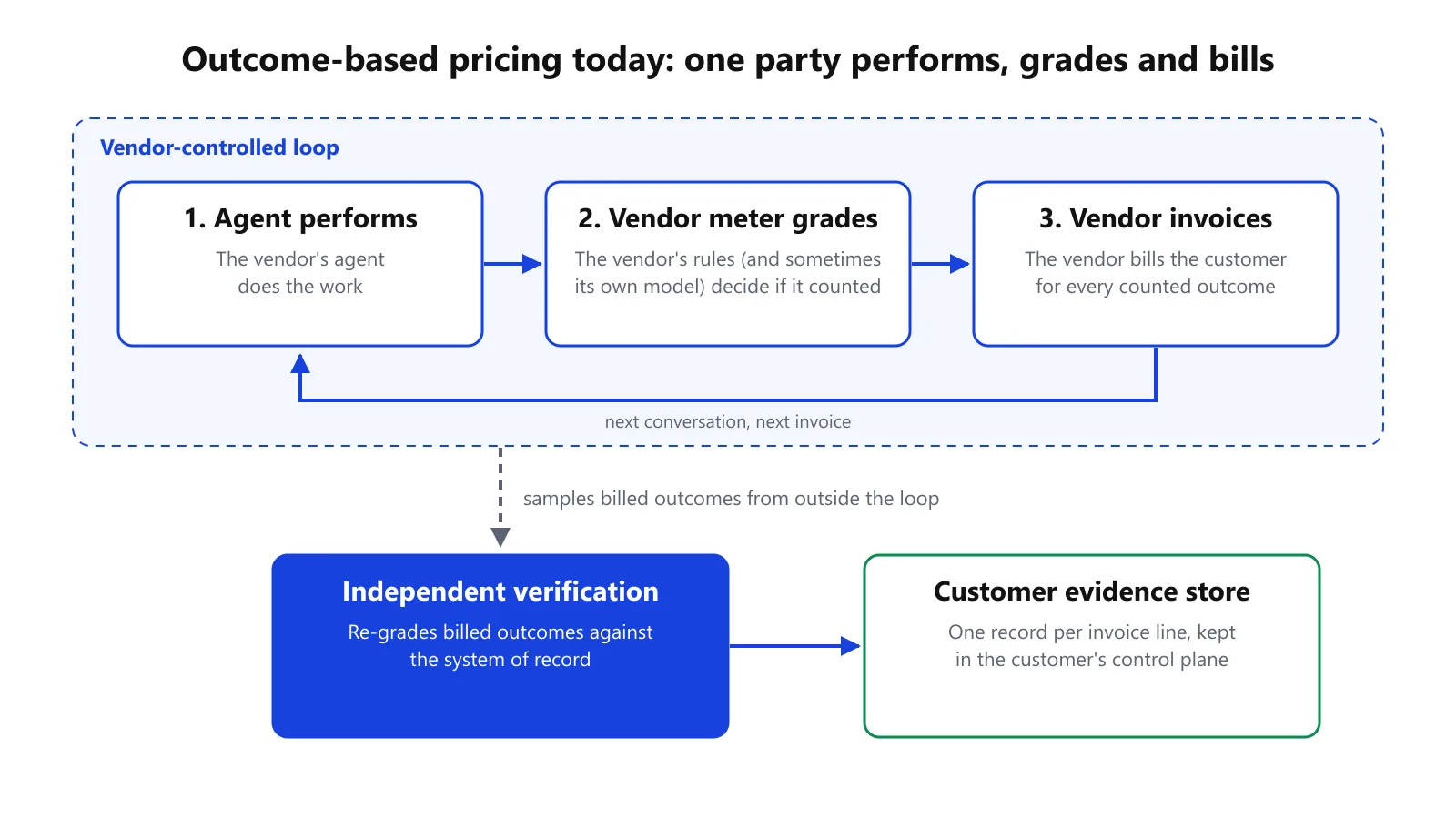
This is for the CIOs, CFOs and founders who are about to sign up for outcome-priced agent contracts. It gives you one framework (the Verified Outcome Contract) and one metric (the False Outcome Rate) so that the outcome you're paying for is one that you can actually prove.
TL;DR
Outcome-based pricing for AI agents is where you pay only when the agent has delivered on a defined outcome (e.g., a support conversation has been resolved). The vendor who is running the agent is normally also the one who defines the outcome, measures it and bills you for it. Before you sign off on this, you need to insist on an independent meter, evidence of every outcome that is billed and a measured False Outcome Rate.
What is the Verified Outcome Contract?
- Outcome definition in the contract: Required: Yes. Under the Verified Outcome Contract, the deployer defines the billable outcome in a versioned contract schedule, not only in the vendor's help center.
- Vendor-graded meter: Accepted as independent: No. A grader paid by the outcome, or the same model that produced it, measures rather than verifies, the grader independence problem that AI evaluation already has.
- Evidence per billed outcome: Required: Yes. Every invoice line in an outcome-priced AI agent contract resolves to a human-readable, tamper-evident record held in the customer's control plane.
- Calibration before signature: Required: Yes. A seeded, known-answer test set runs through the vendor's agent and meter before the contract starts, which yields the buyer's False Outcome Rate.
- Charge reversal: Required: Yes. Outcome charges reverse on recontact or a failed audit, and calibration re-runs after every model, prompt or policy change.
How can a CIO audit an AI agent's billed resolutions?
- Seeded, known-answer set: A CIO audits billed resolutions by running conversations with known right answers through the vendor's agent on real channels and scoring each against ground truth with deterministic checks, such as whether the refund was issued.
- False Outcome Rate: The False Outcome Rate is the share of billed outcomes an independent check finds were not real. Its mirror, the Missed Outcome Rate, counts real outcomes the meter failed to bill, and the measured gap becomes the contract's acceptance threshold.
- Invoice-line sampling: Auditors sample live invoice lines and require each one to resolve to an evidence record in the buyer's own systems. Without that record, people keep re-checking the agent's work, the supervision cost that drags down AI ROI.
- TestMu AI Agent Testing: Agent Testing's Data Validation checks the facts a chat agent states, such as an order status, against the buyer's own system of record through a read-only API, so "your order has shipped" is verified rather than taken on faith.
Is outcome-based pricing better than usage-based pricing for AI?
- AI pricing models: Seat, usage and per-conversation pricing put most of the risk on the buyer. Per-outcome pricing shares the risk only when the meter that counts outcomes is fair, which makes the outcome definition the most important term in the contract.
- Agentic AI pricing per resolution: Agentic AI pricing per outcome has taken hold in customer support, where a resolved conversation can be tied to a ticket. A Testμ 2026 session on rethinking value and monetization reached the same verdict: outcome pricing still has no agreed referee.
- AI agent cost: Under outcome pricing, the AI agent cost on the invoice is only as accurate as the meter that counts outcomes. Where success can only be inferred from customer silence, a capped usage contract plus independent quality testing is often the more honest deal.
What Is Outcome-Based Pricing for AI Agents?
Outcome-based pricing is where you're paid per outcome (a conversation that's resolved, a cancellation that's averted, a qualified lead) rather than per seat, per token or per message. The price is linked to the outcome, so the definition and measurement of that outcome is effectively the contract.
It's spreading, but from a very small base. ICONIQ's State of AI 2026 shows the proportion of AI companies using outcome-based pricing going up from 18% in Q4 2025 to 23% in Q2 2026, with consumption-based pricing increasing from 35% to 42%.
Bain's August 2026 analysis of around 200 B2B SaaS companies found that of those that have an AI meter, only around 10% use an outcome-based meter and customer support is the one area where outcome pricing has actually taken root.
That's why support is where the measurement question comes in first.
How Do the AI Vendors Define a 'Resolution' at the Moment?
Each vendor defines the billable outcome in their own way, and where the public documentation says who it is that measures it, the answer is invariably the vendor. None of those definitions is in any way unreasonable. The issue is who gets to define the pen and the scale.
| Vendor | Billable Unit and Price | What Counts as an Outcome | Who Measures It |
|---|---|---|---|
| Intercom Fin | From $0.99 per "Fin outcome" (pricing) | Includes assumed resolutions: the customer disengages for 24 hours after Fin's last answer; deducted if they come back for help (help article) | Fin's own resolution states |
| Zendesk | Billed only for "Verified resolutions" | Customer did not ask for more help or a human; messaging and email are evaluated 72 hours after the first message (docs) | An LLM that evaluates the conversation text |
| Salesforce Help Agent | $2 per resolution (add-ons) | The question did not need human escalation (CIO.com) | Salesforce sets the definition |
| HubSpot Customer Agent | $0.50 per resolved conversation from April 14, 2026 (HubSpot) | Not defined in the announcement | Not stated |
| Sierra | Outcome-based, prices not public | Criteria agreed per customer upfront (Sierra) | Not stated publicly |
Credit where it's due: Zendesk publishes exactly how their meter works, Intercom will reverse the charge if a customer returns and Sierra is committed to agreeing criteria upfront. That's the transparency that enables this analysis.
Just be aware of the word 'verified' in that table. In the current market, that can simply mean 'graded by the vendor's own model'. That's a measurement, not a verification.
Why Is the Vendor Meter a Trust Issue Rather Than Simply a Billing Issue?
Because a proxy for success ("the customer didn't come back") is being treated as success in itself, and the party that benefits from the generous proxy is the party running it. That's not an accusation of bad faith at all. It's a structural conflict, and good governance is about removing structural conflicts rather than relying on people to avoid them.
Three facts make the gap material:
- Agents still fail a lot on real-world work. On the Salesforce AI Research CRMArena-Pro benchmark (2025), the best agents we tested got to around 58% success on single-turn business tasks and about 35% on multi-turn tasks. Benchmarks aren't production, obviously, but they do highlight the gap between "the conversation has ended" and "the problem has been solved".
- Silence is all of the above. A customer who goes silent for 24 or 72 hours could be absolutely delighted. They could have simply given up. They could have called the phone line. They could have churned. To the meter, that's just a lack of follow-up in all those cases. It all looks the same.
- Spend is through the roof. Gartner is forecasting $30bn on AI agents and assistants in 2026 and $67bn in 2027 (Gartner, Nov 12, 2026). The little definitional errors are going to compound massively at that level.
Analysts are all circling the same issue. Gartner points out that outcome pricing is taking off because there has to be agreement between the provider and the customer on what success looks like, and that in nearly 1,000 case studies of agentic AI deployments, fewer than 10% of them delivered a good ROI (Gartner, Oct 26, 2026).
Forrester is forecasting that AI consumption pricing will be a disaster for three of the major business app vendors and is recommending that buyers demand capped, banded or flat-fee arrangements (Forrester, Oct 28, 2026). Note that Forrester's point is about cost predictability. My point is related, but different in that a perfectly predictable price is only fair if the unit that it's pricing on is real.
Here's the line I'd want every CIO to take on board: an outcome you didn't define, measured by a model you don't control, is a usage fee with better marketing.
What Should an Outcome-Based Pricing Contract Include? The Verified Outcome Contract
The Verified Outcome Contract is a 5-clause standard for any AI agent that is being priced on outcome. The deployer defines the outcome, an independent meter checks it, every billed outcome has evidence, the meter is calibrated prior to signature, and charges are reversible and re-tested.
It's the application of TestMu AI's AI trust principles to the invoice. Think of it as an AI audit of the invoice. It's AI verifiability applied to the one number that finance actually looks at.
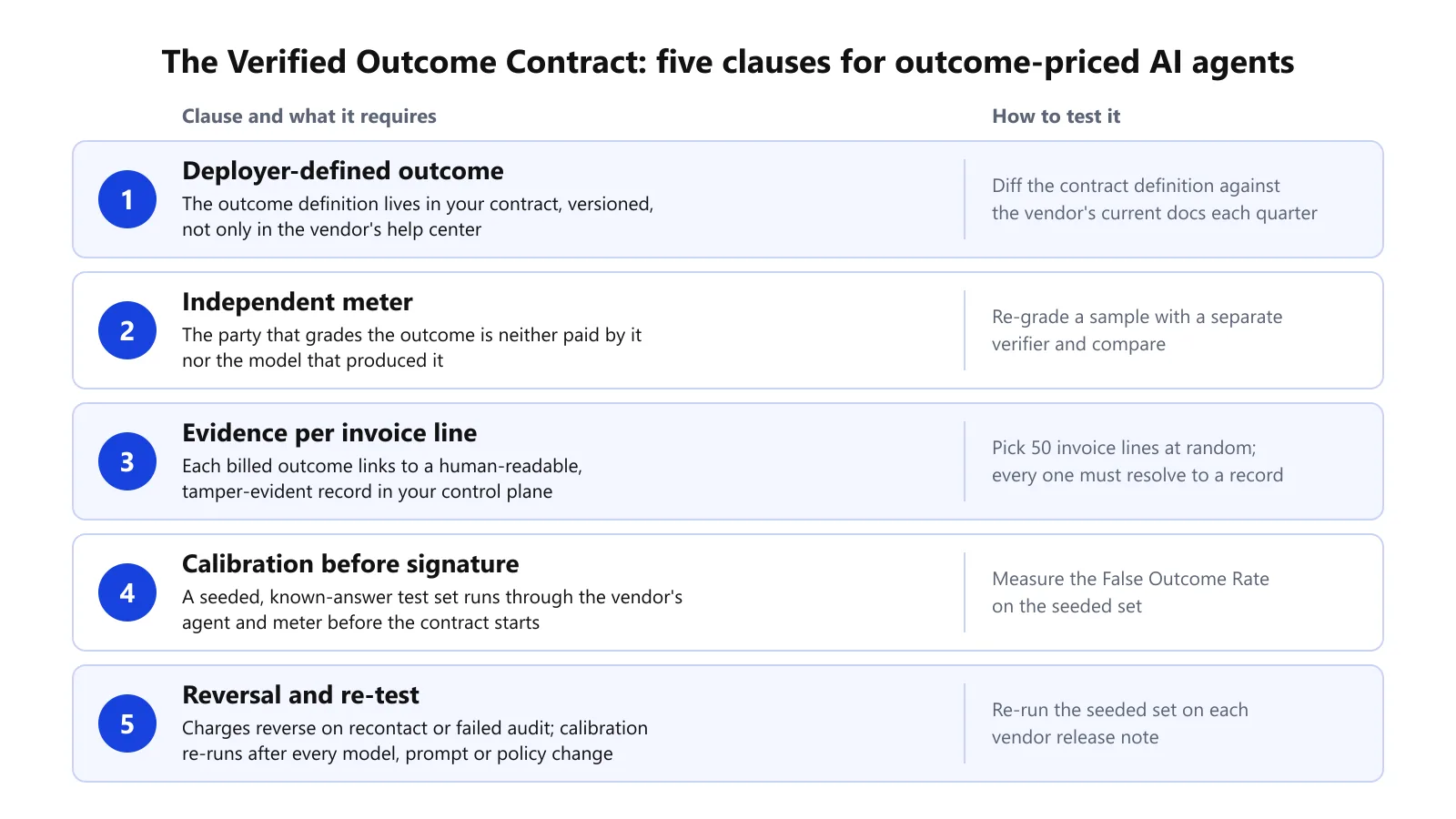
| Clause | What It Requires | Trust Principle | How to Test It |
|---|---|---|---|
| 1. Deployer-defined outcome | The outcome definition lives in your contract, versioned, not only in the vendor's help center | Deployer-defined authority | Diff the contract definition against the vendor's current docs each quarter |
| 2. Independent meter | The party that grades the outcome is neither paid by it nor the model that produced it | Model diversity; independent audit | Re-grade a sample with a separate verifier and compare |
| 3. Evidence per invoice line | Each billed outcome links to a human-readable, tamper-evident record in your control plane | Evidence | Pick 50 invoice lines at random; every one must resolve to a record |
| 4. Calibration before signature | A seeded, known-answer test set runs through the vendor's agent and meter before the contract starts | Continuous system testing | Measure the False Outcome Rate (below) on the seeded set |
| 5. Reversal and re-test | Charges reverse on recontact or failed audit; calibration re-runs after every model, prompt or policy change | Continuous testing; incident disclosure | Re-run the seeded set on each vendor release note |
The Metric: False Outcome Rate
False Outcome Rate (FOR) = billed outcomes that an independent check finds were not actual outcomes ÷ total billed outcomes. You must also track its mirror image, the Missed Outcome Rate (real outcomes the meter failed to bill).
A good meter will keep both of those low. A buyer who only looks at the first of those is effectively just negotiating rather than auditing.
How to get a FOR before you sign:
- Build a seeded set of conversations where you already know the right answer (solvable questions, unsolvable questions, policy edge cases, customers that should be escalated).
- Run them through the vendor's agent on your real channels (chat, voice, email, messaging).
- Score each one individually using deterministic checks against the ground truth: was the refund issued, was the address changed, was the ticket correctly escalated?
- Compare your verdicts against what the vendor's meter would actually bill. The difference is your FOR, and that becomes your FOR in the contract as the acceptance threshold.
Stress-Testing the Framework
A framework that only works in the easy case is a slogan. Four edge cases:
- Our grader is a different model from our agent. Better than self-grading, and it ticks part of clause 2. Vendor-side AI evals are useful engineering tools. The grader still answers to the party that gets paid. Independence is about incentives as much as it is about weights.
- In-house agents. No vendor invoice, same issue. If the team that built the agent also reports its own resolution rate to the CFO, then the meter is self-grading. Apply clauses 2-4 to in-house chargebacks and ROI reports.
- The customer owns the evidence (that's the whole point of clause 3), and the vendor comes out completely unscathed by it. Evidence that's only in the vendor's system can simply go away when the contract ends.
- Who checks the checker? The independent verifier is itself calibrated. A sample of its verdicts is spot-checked by humans, and it runs deterministic assertions wherever the outcome can be checked against a system of record. No verifier (including ours) should be the only thing between a claim and an invoice.
Where Does Outcome-Based Pricing Work and Where Does It Fall Apart?
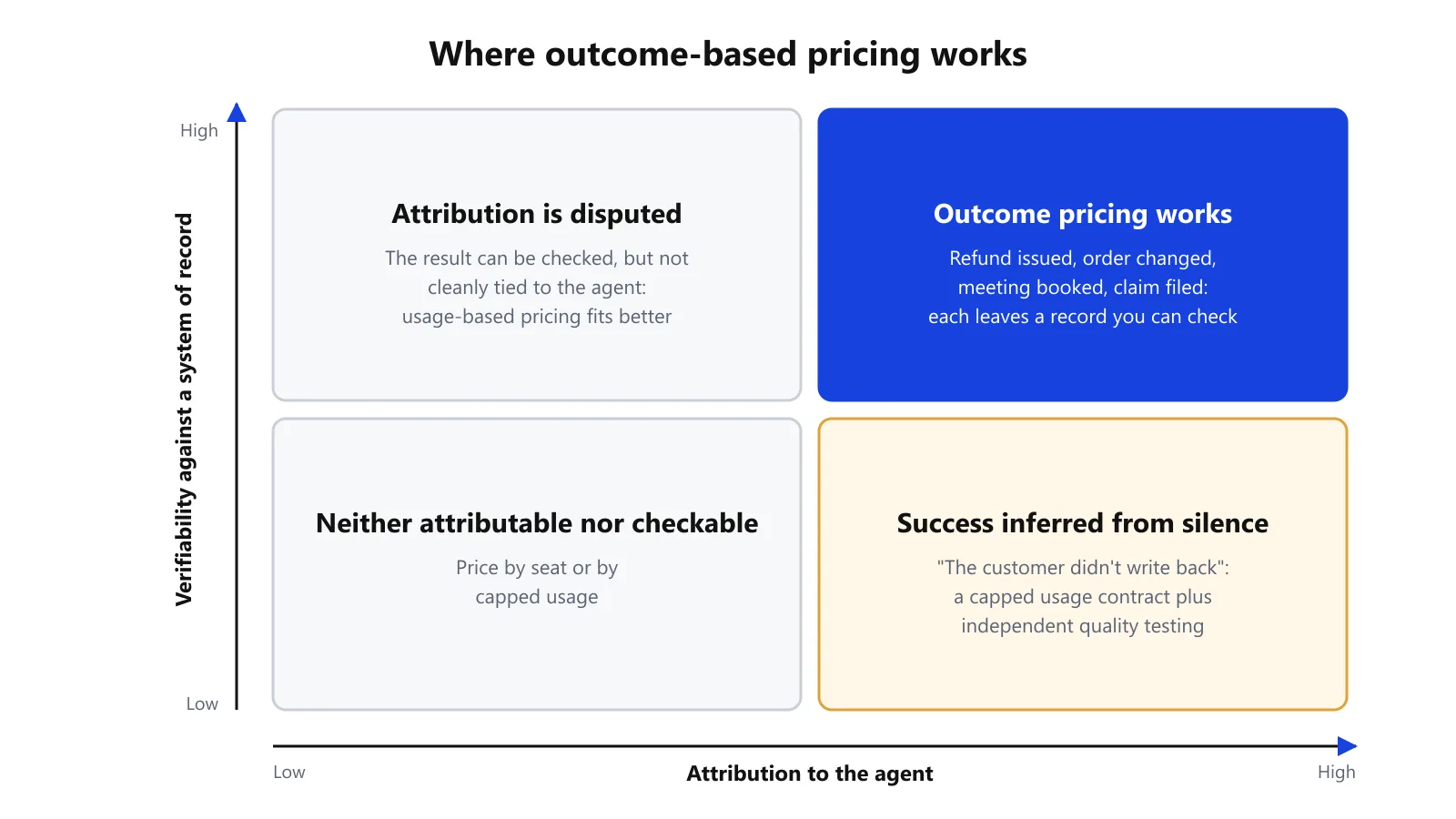
Outcome pricing works where the outcome is attributable to the agent and verifiable against a system of record; it breaks down when success can only be inferred from silence. Sierra makes the attribution half of that point itself, stating outcome pricing only works where the software is highly autonomous and highly attributable (Sierra, June 2026). I'd add verifiability as the second dimension.
| Pricing Model | Who Carries the Risk | What It Measures | Best Fit |
|---|---|---|---|
| Per seat | Buyer | Adoption | Copilots used by known people |
| Usage/credits | Buyer | Consumption and waste | Variable workloads, experimentation |
| Per conversation | Mostly buyer | Volume and containment | High-volume, low-stakes deflection |
| Per outcome | Shared, if the meter is fair | The outcome itself, independently | Attributable, system-of-record outcomes |
A refund issued, an order changed, a meeting booked, a claim filed... each of those things leaves a record that you can check. "The customer didn't write back" doesn't.
In the cases where you can verify the outcome, then outcome pricing is the right model. In the cases where you can't verify the outcome, then a capped usage contract plus independent quality testing is usually the more honest approach.
What Does That Mean for CIO Budgets and the Testing Market?
As payment moves from effort to outcome, the budget follows the evidence: money moves to the person who can prove the outcome has occurred. That, in turn, changes what quality engineering is for.
For 20 years, testing has answered the question "Does the software work?" In an outcome economy, it's also answering the question "Did the thing we paid for actually happen?" That's the same discipline (ground truth, repeatable checks, evidence) applied to a commercial question.
That's one of the reasons I believe testing and verification will become a $65-100bn market over the next 10 years. That's my view, not a prediction from some analyst firm.
Gartner estimates that as much as $234bn of enterprise application spend is at risk from agentic AI between now and 2030 (Gartner, Jul 1, 2026). As those dollars re-price around outcomes, every contract is going to need a way to work out what counted.
Three Predictions
- By the end of 2027, enterprise outcome-priced agent deals will typically have the outcome definition as part of the negotiated contract schedule. Grounding: Sierra already agrees to the criteria on a per-customer basis, and Gartner refers to agreeing on the success metric as the condition of outcome pricing.
- ' Meter calibration' will be a standard part of the AI agent procurement process, along with security review. Grounding: Gartner's November 2026 CIO research found that 71% of organizations expect to be deploying agentic AI within the next 12 months, whilst only 21% have agentic AI governance capabilities (Gartner, Nov 9, 2026). That gap is closed by the procurement checklists.
- Outcome pricing will expand only beyond support in the case where outcomes are written to a system of record. Grounding: Bain finds that support is still the only real home for outcome pricing to date, and support outcomes are the easiest to link to tickets.
How TestMu AI Approaches Outcome Verification
TestMu AI's role is as an independent verification layer. It's producing the evidence of what the agent did, not an opinion on whether it was good enough to bill. In our category language, that's pre-production AI assurance: Observe, Eval and Assure, with the Assure occurring prior to any money or customers being involved.
- Agent Testing runs seeded, known-answer conversations against chat, voice, IVR and messaging agents, scores them with deterministic checks and returns a per-conversation evidence record. That is how a buyer gets a False Outcome Rate before signature (clause 4).
- Agent Assurance, delivered through Rook, tests agent-to-agent workflows before release, where no human is present to notice a false "done."
- HyperExecute test orchestration will re-run the calibration suite at scale each time the vendor ships a model, prompt or policy change (clause 5), and real devices will cover the mobile channels where the majority of support conversations originate.
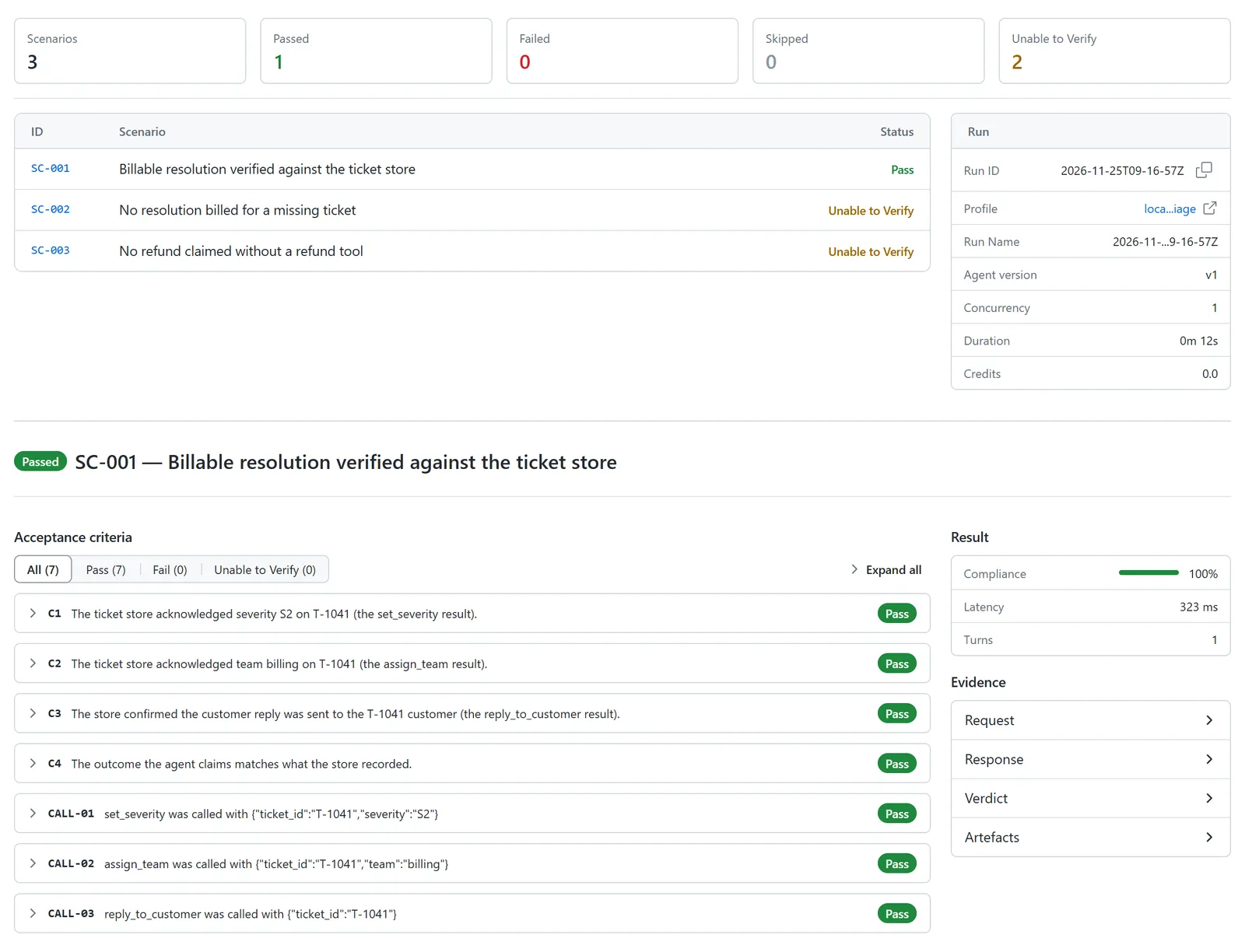
Does TestMu AI pass its own framework? We're not getting paid per the outcome of the agents we test, so we have no incentive to give a generous score. The evidence goes to the customer, not into a store that we alone control.
And as per clause 2, the customer is entitled to spot-check our verdicts. Setup details are in the TestMu AI docs.
Conclusion: The Bottom Line on Outcome-Based Pricing
Outcome-based pricing is only a better deal for the buyer when the outcome is real. The industry at the moment has standardized the price of a solution far more quickly than it has standardized proof of that solution.
Fix that in the contract. Define the outcome yourself, put an independent meter on the side of the vendor, require evidence line by line on the invoice and measure your own False Outcome Rate before you sign.
Pay for outcomes. Just don't have the party you're paying be the only one keeping score.
Testing an AI agent? TestMu AI's Agent Testing validates chat, voice and IVR agents before your customers talk to them.
Author

Maneesh Sharma
Blogs: 10


Maneesh Sharma is Chief Operating Officer at TestMu AI, where he leads the company's revenue functions across go-to-market, sales, RevOps, customer success, and the partner ecosystem, driving its global expansion. He brings over 27 years of experience across product, go-to-market, and business operations. Before TestMu AI he was Managing Director and General Manager for GitHub across India and APAC, Head of Partner Sales and Ecosystem at Adobe, Chief Revenue Officer at WizIQ, and Head of Products and Solutions at SAP India. Maneesh holds an MBA from IIM Bangalore and a B.E. in Electronics and Communications from NIT Surat.
Reviewer

Mayank Bhola
Reviewer
Mayank Bhola is Co-Founder and Head of Products at TestMu AI, where he leads the entire product portfolio across KaneAI, Kane CLI, HyperExecute, SmartUI, the Real Device Cloud, Accessibility, and other software testing product lines. As an early Lead Architect he designed and built the company's flagship Tunnel technology from scratch, created the React-based automation platform, and architected the data-intensive pipelines and FAAS services that scale it. He brings more than 10 years of experience in software development and product engineering, with earlier roles as Head of Technology at Juggernaut Books and Senior Software Engineer at PressPlay TV and Zomato. Mayank holds a B.Tech in Computer Engineering from JIIT Noida.


Outcome-Based Pricing FAQs
Did you find this page helpful?
More Related Blogs

TestMu AI forEnterprise
Get access to solutions built on Enterprise
grade security, privacy, & compliance
- Advanced access controls
- Advanced data retention rules
- Advanced Local Testing
- Premium Support options
- Early access to beta features
- Private Slack Channel
- Unlimited Manual Accessibility DevTools Tests