
Agent Assurance for your AI Deployment
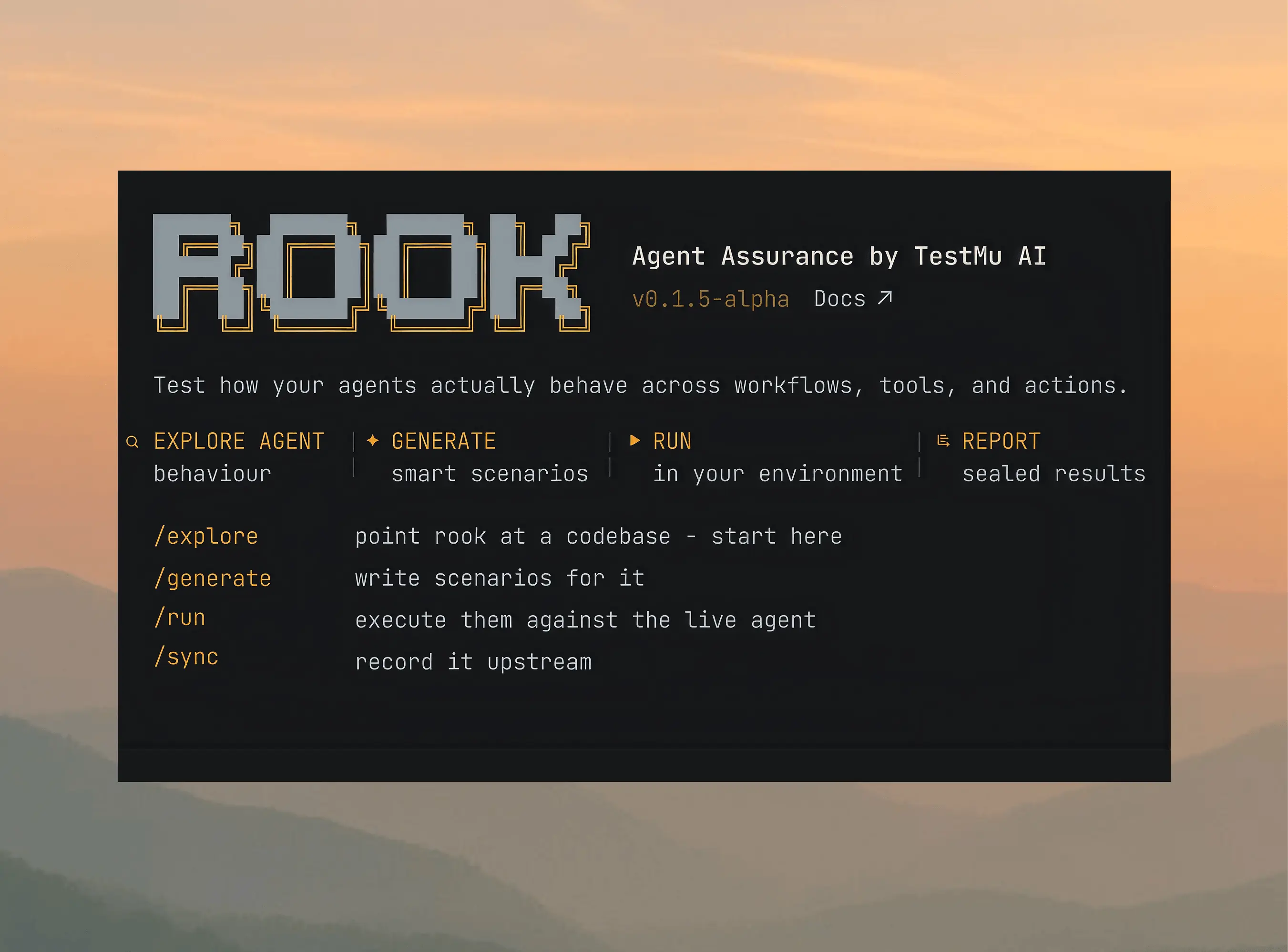
Test how your agents actually behave across workflows, tools, and actions. Catch failures and vulnerabilities before they ship.
npm install -g @testmuai/rook
- TestMu AI (Formerly LambdaTest)
- /
- Blog
- /
- What Is AI Assurance? Techniques and Evidence for AI Agents
What Is AI Assurance? Techniques and Evidence for AI Agents
AI assurance checks whether an AI system meets its criteria. Learn the UK DSIT techniques, how it differs from observability and evals, and what AI agents need.
Published on:
Suppose a release review has to decide whether a refund agent can go live. Engineering brings traces from a staging trial and an eval score for the agent's replies, but the reviewer asks which refunds actually reached the payments system, and whether any skipped the approval limit. Answering that is the job of AI assurance.
AI assurance is the work of building justified confidence that an AI system meets the criteria set for it, and communicating that confidence with evidence. For an agent that acts, the evidence has to come from what each run changed, because the agent's own account of its work is the weakest signal available.
Overview
AI assurance checks whether an AI system meets its criteria, such as regulation, standards or company policy, and communicates the result with evidence others can rely on. For AI agents that call tools and change records, that evidence must come from the systems each agent changed, which most observability and eval tools do not check by default.
AI Assurance Techniques Listed by the UK Government
- DSIT portfolio: The UK government's Portfolio of AI assurance techniques, published on 7 June 2023, gives eight assurance techniques as examples. They run from impact assessment, which anticipates a system's effects, to formal verification, which uses mathematics to establish whether a system satisfies requirements.
- Techniques library: The gov.uk AI assurance techniques library reports 75 case studies, and its technique filter has 11 options, adding data assurance, risk assessment and assurance warranty to the eight techniques in DSIT's portfolio.
How AI Assurance Differs From Observability and Evals
- Observability: Traces, logs and metrics from real traffic explain what an AI system did and why, and most of that record builds up after release.
- Evals: Code checks, LLM judges or human labels score an AI system's outputs against a rubric. By default, a high score says the replies met the rubric; whether each claimed action took effect needs a separate check.
- Pre-release assurance: The AI agent under test runs against staging before release, and each written criterion is graded on what the run changed, with anything the evidence could not settle reported as Unable to Verify.
- Assurance verdict: A usable assurance verdict names the criterion, cites the evidence and gives Pass, Fail or Unable to Verify. Coverage belongs beside the pass rate, because a 100% scenario pass rate with 40% of criteria verified is weak evidence.
- Agent Assurance: TestMu AI's Agent Assurance derives scenarios from an agent's code or spec, invokes that agent against staging and checks each criterion against observed evidence. Publicly installable: Yes (npm, or Homebrew on macOS and Linux). Runs on 64-bit Windows: Yes (through npm or WSL). Stage: pre-alpha.
What Is AI Assurance?
AI assurance is the process of measuring and evaluating an AI system against written criteria, such as a law, a standard, an ethical guideline or a company policy, and reporting the result with the evidence behind it. Its output is a reasoned judgment that an auditor, a regulator or a release manager can act on.
The UK Department for Science, Innovation and Technology (DSIT) gives one widely used definition. Its Portfolio of AI assurance techniques, published on 7 June 2023, defines it this way: AI assurance "is about building confidence in AI systems by measuring, evaluating and communicating whether an AI system meets relevant criteria", with regulation, standards, ethical guidelines and organizational values as its examples of such criteria.
DSIT's Introduction to AI assurance of 12 February 2024 condenses it further: in the case of AI, "assurance measures, evaluates and communicates the trustworthiness of AI systems". Read as engineering requirements, the definitions ask for:
- Confidence with reasons - a belief backed by evidence, never a guarantee; an assured system can still fail on a case nobody tested.
- Written criteria - something specific to assure against, such as a regulation clause, a standard or a policy line, written down before the check.
- Communicated results - evidence that reaches the people who decide, as a report, a certificate or a release verdict.
In the US, NIST's AI Risk Management Framework, released on 26 January 2023 for voluntary use and now being revised as part of the White House AI Action Plan, covers the same ground from the risk side.
The AI RMF Core has four functions (govern, map, measure and manage); under measure, AI systems are to be tested before deployment and at regular points in operation, and measurement outcomes go to manage for risk monitoring and response. Read that way, most assurance work belongs to measure and feeds manage, with govern running through the other three.
What Are the Main AI Assurance Techniques?
The DSIT portfolio presents eight techniques as examples, introduced with "Some of these are listed below". The right-hand column is this article's mapping to the engineering work each one implies for an agent that acts.
| Technique | What the DSIT portfolio describes | Engineering analogue for an agent that acts |
|---|---|---|
| Impact assessment | Anticipates a system's effect on environmental, equality, human rights, data protection or other outcomes | Mapping what each tool can change, such as payments, emails or customer records, before the agent is given it |
| Impact evaluation | The same questions, asked in retrospect once the system is in use | Reviewing production incidents and turning each one into a pre-release scenario |
| Bias audit | Checks inputs and outputs for unfair bias in the data or in a decision or classification | Running one task for customers with different attributes and comparing the actions taken, along with the wording |
| Compliance audit | Reviews adherence to internal policies and procedures, or to external regulations and legal requirements | Writing a policy line as a criterion graded on observed calls, such as no refund above the limit without an approval record |
| Certification | An independent body attests that a product, service, organization or person was tested against, and met, objective standards | Happens outside the test run; retained run evidence is part of what an assessor reads |
| Conformity assessment | Gives assurance that a product, service or system meets its specified or claimed expectations before it enters the market, with activities such as testing, inspection and certification | Per-criterion verdicts from a pre-release gate are test evidence an assessment can use; the assessment itself is a separate step |
| Performance testing | Measures performance against predetermined quantitative requirements or benchmarks | Task success rates and eval scores against thresholds set before the run |
| Formal verification | Uses the formal methods of mathematics to establish whether requirements are satisfied | Rarely practical for a model's choices; usable for deterministic parts, such as a permission rule |
The gov.uk AI assurance techniques library goes wider: its technique filter has 11 options, adding data assurance, risk assessment and assurance warranty, and the page reports 75 case studies.
DSIT's 2024 Introduction to AI assurance also lists risk assessment first among its six techniques.
The library's use-case filter includes "virtual agents or artificial conversational interfaces" and "robotic process automation and decision management", so systems that act are in scope. The short descriptions leave the evidence for such a system to the team that owns it.
How Does AI Assurance Change When AI Agents Act?
The definition carries over to agents; the evidence it takes is what changes. Some DSIT descriptions are framed around outputs, as when a bias audit examines inputs, outputs and the outcome of a decision. An agent plans steps, calls tools and changes records in other systems, which strains output-only checking:
- Effects outside the reply - a refund succeeds or fails in the payments record, whatever the reply says; the Agent Assurance docs warn that an agent "can produce a confident, well-written summary of work it never completed".
- One step can hide another - a wrong tool call at step two can be masked by a plausible recovery later, so a check on the final answer can still pass.
- Tools change on their own schedule - a renamed parameter in an API the agent calls can break it while the model and prompt stay the same.
- Write access raises the stakes - with a refund, email or delete tool, a failure costs whatever that tool can change.
The question moves from what the system said to what it did, and what evidence shows it. The post introducing Agent Assurance lists failure modes that slip past a transcript, such as confident false reports and silent policy violations. Policies, audit trails and how NIST compares with the EU AI Act are covered in agentic AI governance.
What Is the Difference Between AI Assurance, Observability and Evals?
Observability explains what an AI system did, mostly in production; evals score outputs against criteria someone defined; pre-release AI assurance decides whether an agent meets its written criteria, with evidence behind each verdict. Production tracing reports a failure after it shipped, and it is not built to hold the release that caused it.
The table compares the categories with Agent Assurance as the pre-release example. Its first and last rows are this article's framing, and the rows between follow the comparison in the Rook CLI README.
| Agent Assurance | AI eval tools | LLM observability | |
|---|---|---|---|
| Question it answers | Does this agent meet its written criteria for release, and what shows it? | How good were these outputs, by our scoring criteria? | What happened in production, and why? |
| Test cases | From your code or spec | Written or synthesized | From production traces |
| Tool calls | Against declared tools | Against your lists | Logged, optionally scored |
| Side effects | Files, artifacts, probes | Scripted per task | Trace data only |
| Grading | Claimed actions aren't proof | LLM judge or code checks | LLM judge or human review |
| Adversarial tests | Generated by default | Add-on in some tools | Not generated |
| When it runs | Before release, in CI | CI and live traffic | Production, plus CI |
| Unverifiable results | Reported separately | Errors or opt-in skips | Left unscored |
| Typical owner | QA or platform engineering, with risk and governance reading the result | AI engineering or applied science | Platform, SRE or AI engineering |
The eval and observability columns describe what each category does by default, not one product: several eval tools generate cases, check tool calls against a list and run red-team modules, and some observability platforms can also run datasets as offline experiments in CI.
Most observability and eval tools score an agent's replies and traces; Agent Assurance checks what each run changed and counts separately what it could not verify. The hub on AI observability covers tracing and metrics in production, and the guide to AI evals explains how an eval works and how to run one.
What Should an AI Assurance Verdict Contain?
For a governance team the verdict is the deliverable, and for an engineering team it is the release gate. A verdict that serves both includes:
- The criterion - one checkable statement traceable to a policy or spec, such as a rule that a refund over the approval limit needs an approval record.
- Evidence of what changed - recorded tool calls, files written, artifacts, command output and exit status, and records read back from the target system; the agent's reply carries the least weight.
- A three-way outcome - Pass when the criterion was checked and held, Fail when it was checked and did not hold, and Unable to Verify when the evidence could not settle it, counted on its own and never as a pass or a Fail.
- Coverage beside the pass rate - in an example in the Agent Assurance docs, eight scenarios pass and none fail, a 100% scenario pass rate, while 12 of the 20 acceptance criteria behind them are Unable to Verify: 40% of criteria verified. Say which denominator each figure uses.
- Reproducibility - the scenario definitions, agent version, invocation profile and date, so a rerun can be compared; an LLM agent can take a different path each time, so expect comparable results rather than identical ones.
- Retention - verdicts and evidence stored with the build, failed runs included, so a later review can see what the release decision rested on.
Sign-off, exceptions and the changes that should trigger a new run belong to the release record around the verdict, which AI agent validation walks through.
Which Pre-Release Assurance Checks Can You Run With Agent Assurance?
TestMu AI's Agent Assurance produces this kind of verdict for agents you own that act on systems: agents that use tools, edit files, call APIs and change records. It is pre-alpha and publicly installable. The terminal command is rook; install it from npm and confirm the version:
npm install -g @testmuai/rook
rook --version
Installing through npm takes Node.js 20 or newer. The Rook CLI install docs list macOS and Linux, and 64-bit Windows through npm or WSL, as supported platforms, and give brew install lambdatest/rook/rook for Homebrew users on macOS or Linux.
- Scenarios from code or spec - it explores a local checkout of the agent, or its PRD or spec, and generates scenarios across three classes and 16 categories. By default, generation plans functional and adversarial scenarios, though the planner can leave attacks out for a small agent; attack scenarios are mapped to the OWASP Top 10 for LLM Applications (2025), the OWASP Top 10 for Agentic Applications (2026) and MITRE ATLAS.
- The real agent, on staging - it invokes the agent through a profile you add, such as an HTTP endpoint or a command. It does not sandbox the agent or undo its writes, which is why runs belong on staging.
- Criteria graded on evidence - each acceptance criterion is checked against files changed, artifacts produced, tool calls compared with the agent's declared tools, and read-only checks through a tool you approve, as far as the access and profile you give it allow. Model judges score some criteria, but an action the agent only claims is never taken as proof.
- Verdicts and run-over-run changes - each criterion gets a single verdict of Pass, Fail or Unable to Verify, with a count of its own kept for the unverifiable ones; a second run shows which scenarios newly fail and which were fixed.
For a release gate, the Agent Assurance CI/CD docs call a zero exit code "not an agent-quality gate", and the Rook CLI README explains why: a run that finishes exits 0 even when some scenarios fail. Gate on the JSON from rook run --json, which carries ok, run_id, halted and, when available, the report totals; the docs' sample gate script fails closed when a required total is missing.
Run unmodified against four hand-made result files on 17 October 2026 (Node.js 25.5.0; sample data, not a rook run), that script passed only the complete suite:
rook-run.json      passed failed unverifiable  gate
all-passed              3      0            0  exit 0
one-failed              2      1            0  exit 1
one-unverifiable        2      0            1  exit 1
totals-missing          -      -            -  exit 1
In the docs, the GitHub Actions, Jenkins and Argo CD examples use a strict gate that blocks on Unable to Verify without relabeling it as Fail. None is an automatic pull-request check: the GitHub Actions workflow is triggered manually, the Jenkins job runs on a reviewed branch and the Argo CD job runs after a sync.
The docs list its pre-alpha limits: commands and stored file formats can change; native file, image and pull-request attachment delivery is not implemented yet; and it records image dimensions but cannot judge image pixels. It does not watch production traffic or block anything at runtime, and whether an agent meets a regulation stays a decision for your compliance team and auditors.
For a first read on one attack surface before a suite exists, the Agent Red-Team Scan sends prompt injection, jailbreak and PII-leak probes to an LLM API you name and scores how it held up. It tests the model endpoint, not the actions an agent takes.
If the agent talks to people instead of acting on systems, Agent Testing is the TestMu AI product for it, with simulated personas across chat, voice, phone, video and image agents.
Conclusion
Pick one agent that changes real state, such as a refund, ticket-routing or code-change agent, and write five acceptance criteria for it, two of them adversarial. Check them in a staging run and count how many the run could verify from the systems the agent touched; read beside the pass rate, that count shows how much of the agent's behavior your evidence covers today.
Once the suite is stable, run it with Agent Assurance as a release gate on the report's verdict totals; the setup is in Run Agent Assurance in CI/CD.
Author

Sirajuddin Khan
Blogs: 9

Sirajuddin Khan is Vice President of Product Management at TestMu AI, where he drives the company's agentic AI product strategy, building a suite of autonomous agents that includes Agentic Browsers and Agentic Visual Testing and shifting the unit of work from test execution to autonomous outcomes. One of the company's earliest product leaders, he has owned the roadmap for the high-performance execution cloud and grew the cross-browser testing products from early adoption to market leadership. He brings over a decade of experience across SaaS, B2B, and eCommerce, with earlier product roles at Wydr and ShopClues, where his catalog and search work cut delivery SLAs and lifted seller activity. Sirajuddin holds an MBA in Information Technology from Sikkim Manipal University and a B.Tech in Computer Science Engineering from Maharshi Dayanand University.
Reviewer

Saurabh Prakash
Reviewer
Saurabh Prakash is an Engineering Manager at TestMu AI, where he leads engineering on agentic AI development and scalable system architecture for the quality engineering platform. He has also contributed to Test at Scale, the company's open-source test intelligence platform. He brings over 9 years of experience across Node.js, Java, Spring, MVC, data structures, algorithms, and scalable system design, with earlier roles as SDE 2 at Zomato, Senior Software Engineer at LogicHub, and Software Development Engineer at Directi. Saurabh holds a B.Tech in Computer Science and Engineering from Delhi Technological University.


AI Assurance FAQs
Did you find this page helpful?
More Related Blogs

TestMu AI forEnterprise
Get access to solutions built on Enterprise
grade security, privacy, & compliance
- Advanced access controls
- Advanced data retention rules
- Advanced Local Testing
- Premium Support options
- Early access to beta features
- Private Slack Channel
- Unlimited Manual Accessibility DevTools Tests