

Power Your Software Testing with AI Agents and Cloud
The Native AI-Agentic Cloud Platform to Supercharge Quality Engineering. Test Intelligently and Ship Faster.


- TestMu AI (Formerly LambdaTest)
- /
- Blog
- /
- 11 Test Automation Challenges and How to Solve Them
11 Test Automation Challenges and How to Solve Them
Flaky tests, brittle locators, test data, CI/CD, slow feedback: here are 11 common test automation challenges and practical ways to solve each one.
Last Updated on:
On This Page
Almost every team adopts test automation for the same reasons: faster feedback, repeatable regression, and coverage that manual testing cannot match at speed. The reasons it disappoints are just as consistent. Suites turn flaky, maintenance eats the time that was supposed to be saved, and a green build stops meaning the product works. These are not tool problems so much as design and process problems, and each one has a known fix.
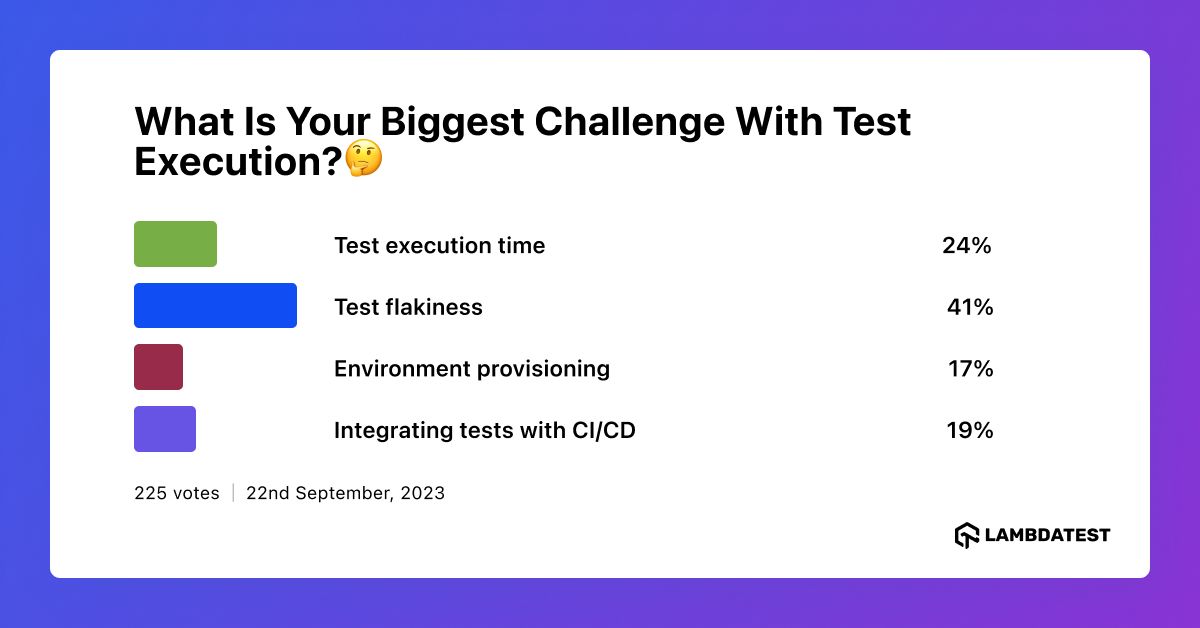
To ground this in what practitioners actually report, a TestMu AI LinkedIn poll asked testers about their biggest challenge with test execution. The responses, shown below, mirrored the same recurring hurdles covered in this guide, from flaky results to environment and data problems.
11 Test Automation Challenges and How to Solve Them
Each challenge below pairs the problem with a concrete way to overcome it, ordered roughly the way teams hit them, from picking a tool to debugging a failing pipeline.
1. Choosing the Right Automation Tool
Automation is tool-dependent, and the market is crowded, so teams often pick on hype and regret it a quarter later when the suite is unmaintainable or the tool cannot talk to their stack.
How to overcome it: Run a short proof of concept before committing. Score candidates against five things that predict maintenance cost: does it match your team's language, does it integrate with your CI, does it report failures usefully, does it cover cross-browser and mobile, and how does it handle element changes. The tool your developers will actually contribute tests to beats the one with the longest feature list.
2. Deciding What (and What Not) to Automate
You cannot automate everything, and trying to is how teams end up with a slow, brittle suite that still misses the bugs that matter. Automating an unstable feature just means rewriting the test every sprint.
How to overcome it: Automate the stable, high-value, repetitive paths first: smoke tests, core regression, and data-driven flows that are tedious to run by hand. Leave exploratory, usability, and one-off checks to manual testing, where human judgment finds what no assertion was written for. A simple risk-versus-frequency matrix turns this from an argument into a decision, and you can size the payback of automating those paths with this test automation ROI calculator.
3. Flaky Tests and the Maintenance Trap
This is the challenge that kills most automation efforts. A minor UI refactor turns the suite red, engineers spend the sprint re-pointing selectors instead of writing coverage, and flaky tests slowly erode trust until people stop believing a red build.
How to overcome it: Cut the maintenance surface. Use stable, intention-revealing locators, promote repeated flows into reusable modules so one fix propagates everywhere, and lean on AI-assisted self-healing so element changes do not mean a manual rewrite. TestMu AI's KaneAI uses smart element detection to re-anchor steps when the UI shifts, which turns maintenance from "rewrite the broken test" into "review the automatic heal."

Note: Author and maintain tests in natural language, with self-healing that re-anchors steps when your UI changes, on TestMu AI. Try KaneAI free
4. Waits and Synchronization
Dynamic content that loads asynchronously is the single most common source of flakiness. A test that clicks before an element has rendered fails intermittently, and hardcoded sleeps either slow every run down or fail anyway on a slow day.
How to overcome it: Replace fixed sleeps with explicit waits that block on a specific condition, such as an element becoming clickable or visible. Wait for the state you actually need rather than a guessed duration. Pair explicit waits with stable Selenium locators so the wait has a reliable target to resolve.
5. Test Data Management
Tests that depend on shared, hand-seeded data pass alone and fail together. Two tests updating the same record collide, environment drift leaves stale data behind, and a run that worked yesterday breaks today because someone changed a fixture.
How to overcome it: Generate data per test at runtime so no two tests can collide, and have each test create its own preconditions rather than depending on another test running first. Mock external services to control their responses, use containerized environments (Docker) for a clean slate each run, and clean up exactly what each test created rather than wiping a shared table.
6. Integrating Automation into CI/CD Pipelines
Automation only pays off when it runs on every change, but a slow or unreliable suite becomes a pipeline bottleneck that teams start skipping, which defeats the point entirely.
How to overcome it: Wire the suite into CI/CD so it triggers on every merge in Jenkins or GitHub Actions, run tests in parallel to keep feedback fast, and use selective execution to run only the tests affected by a change on pull requests while reserving the full suite for nightly runs. Fast, trustworthy feedback is what keeps the gate from being bypassed.

7. Slow Feedback and Long Execution Times
A suite that takes an hour to run gets run less often, and delayed feedback means bugs are found long after the change that caused them, when they are more expensive to fix.
How to overcome it: Parallelize. Once tests are independent, run them concurrently instead of one after another. When a single machine runs out of headroom, move execution to a cloud grid. TestMu AI's HyperExecute distributes a suite across just-in-time infrastructure and runs it up to 70% faster than a traditional grid, which turns an hour-long run into a few minutes without buying hardware.
8. Cross-Browser and Device Coverage
A site that works in Chrome on a developer's laptop can break in Safari on an older phone. Maintaining a physical lab of browsers, operating systems, and devices to catch this is expensive and never complete.
How to overcome it: Run cross-browser testing on a cloud grid instead of owning the hardware. TestMu AI's real device cloud provides 10,000+ real Android and iOS devices and 3,000+ browser and OS combinations on demand, so coverage becomes a configuration choice rather than a procurement project, and you test on real devices rather than emulators that hide rendering bugs.
9. Telling Real Failures From Flaky Results
A red build could be a genuine regression, infrastructure flakiness, an environment blip, or a data problem. When a false positive costs an afternoon of chasing a bug that does not exist, and a false negative ships a real one, telling them apart by digging through logs run by run does not scale.
How to overcome it: Let the data point you at the chronic offenders. TestMu AI's Test Insights surfaces the consistently failing tests by failure frequency and runs agentic root cause analysis that correlates network, console, and framework logs into a fast lead on why a test failed, so you fix flakiness at the source instead of playing whack-a-mole one failure at a time.

10. Skills and Maintainable Framework Design
Automation needs people who understand both the application and sound engineering practice. A suite written without structure becomes a tangle of copy-pasted selectors that only its author can touch, and that author eventually leaves.
How to overcome it: Treat test code as production code. Use a maintainable pattern such as the Page Object Model to separate page structure from test logic, review tests in the same pull requests as the app, and invest in upskilling so the framework is not a single person's private knowledge. Structure is what lets a suite grow without collapsing under its own weight.
11. Debugging and Reporting Failures
When a test fails in CI on a machine you cannot see, a bare stack trace rarely tells you why. Reproducing the failure locally wastes time, and unclear reports mean real failures get dismissed as noise.
How to overcome it: Capture rich evidence on every run: video of the session, step-by-step screenshots, and network and console logs alongside the assertion error. Full context at the moment of failure is what lets you diagnose a red build from the report instead of rerunning it, and it makes the difference between a report the team trusts and one it learns to ignore.

Conclusion
Start with the challenge costing your team the most right now. For most suites that is flakiness and maintenance, so fix the locators and add self-healing before you chase broader coverage. Then work outward: isolate your data, wire the suite into CI with parallel execution, and add real-device coverage once the core is stable.
To run all of this on managed infrastructure, TestMu AI's test automation cloud runs Selenium, Cypress, and Playwright suites across browsers and devices, and the HyperExecute documentation walks through wiring a parallel run into your pipeline. Automation is one of the tools in your garage, not the whole garage: use it where it earns its place, keep the tests isolated and maintainable, and it stays a safety net rather than a liability.
Author

Harshit Paul
Blogs: 93


Harshit Paul is Director of Product Marketing at TestMu AI (formerly LambdaTest), with over 8 years of experience in product and growth marketing for developer and QA tools, leading the Agentic AI in Quality Engineering space. He has authored 80+ technical articles for TestMu AI on software testing and automation, and hosted webinars on Selenium, automation testing, browser compatibility, DevOps, and continuous testing. He has led go-to-market and technical marketing initiatives across software testing products, contributing to SEO, content strategy, and developer marketing. He began his career as a certified Salesforce developer at Wipro Technologies, where he worked for 2 years before moving into marketing. Harshit holds a degree in computer programming from Vivekananda Institute of Professional Studies.
Reviewer

Himanshu Sheth
Reviewer
Himanshu Sheth is the Director of Marketing (Technical Content) at TestMu AI, with over 8 years of hands-on experience in Selenium, Cypress, and other test automation frameworks. He has authored more than 130 technical blogs for TestMu AI, covering software testing, automation strategy, and CI/CD. At TestMu AI, he leads the technical content efforts across blogs, YouTube, and social media, while closely collaborating with contributors to enhance content quality and product feedback loops. He has done his graduation with a B.E. in Computer Engineering from Mumbai University. Before TestMu AI, Himanshu led engineering teams in embedded software domains at companies like Samsung Research, Motorola, and NXP Semiconductors. He is a core member of DZone and has been a speaker at several unconferences focused on technical writing and software quality.


Test Automation Challenges FAQs
Did you find this page helpful?
More Related Blogs
TestMu AI forEnterprise
Get access to solutions built on Enterprise
grade security, privacy, & compliance
- Advanced access controls
- Advanced data retention rules
- Advanced Local Testing
- Premium Support options
- Early access to beta features
- Private Slack Channel
- Unlimited Manual Accessibility DevTools Tests