
Power Your Software Testing with AI Agents and Cloud
The Native AI-Agentic Cloud Platform to Supercharge Quality Engineering. Test Intelligently and Ship Faster.

- TestMu AI (Formerly LambdaTest)
- /
- Blog
- /
- 15 Best AI Powered Software Testing Tools in September 2026
15 Best AI Powered Software Testing Tools in September 2026
AI powered testing tools that generate cases, heal them and judge what broke. 15 platforms compared on the AI capability each brings and where the tests end up.
Published on:
A regression suite of any age carries a hidden tax. Selectors drift, a redesign breaks forty cases at once, and the engineer who understood the flakiest twelve has moved teams. None of that is a testing problem in the traditional sense; it is a maintenance problem that testing tools created.
AI powered testing tools are aimed at that tax rather than at execution speed. I lead engineering on agentic AI at TestMu AI, and the fifteen products below are grouped by what their AI actually does to the work, because that is what separates them once the marketing is set aside.
Overview
AI powered testing tools apply machine learning and language models to authoring, maintaining and interpreting tests, not just to running them. Fifteen platforms qualify in 2026, and the useful way to tell them apart is which part of the work their AI absorbs and what you are left holding afterwards.
- Best across the whole lifecycle: TestMu AI - authoring through KaneAI, verification through Kane CLI, and evaluation of AI agents through Agent Testing, with suites exporting to four standard frameworks.
- Best for maintenance relief: testRigor - anchors the case to a plain-English description, so a UI framework change does not break a suite that is still accurate.
- Best for visual correctness: Applitools Autonomous - Visual AI reads the rendered page the way a person does, catching appearance defects that state assertions cannot see.
- Best when nobody can own the suite: Meticulous - a script tag records real sessions and the suite writes and prunes itself, with no test authored by hand.
- Best for regulated rollout: UiPath Test Cloud - derives cases from requirements and repairs them mid-run, behind audit-ready trails, PII masking and policy enforced as code.
- Best for packaged enterprise software: Tricentis Tosca - model-based automation with an agentic tier, arranged around SAP, Oracle, Salesforce, ServiceNow and Workday.
- The same walls stop all fifteen: CAPTCHAs, browser-initiated downloads, deeply nested frames, and anything rendered in canvas or WebGL.
What Are AI Powered Testing Tools?
AI powered testing tools are platforms that apply machine learning and language models to the work of testing, rather than only to running the scripts a person already wrote. The AI shows up in authoring the case, keeping it alive as the product changes, deciding whether a failure is real, and explaining what broke.
That distinction matters commercially. A tool that speeds up execution saves compute; a tool that absorbs authoring and maintenance saves the engineering hours that make a suite expensive to keep.
The same products are marketed as AI powered software testing tools, AI testing tools, autonomous testing platforms and AI-assisted QA, and the labels do not track any real difference in capability. The useful question is which part of the job the AI takes over.
What Does AI Actually Change in the Testing Process?
Across the fifteen products below, the AI does one or more of five distinct jobs. Reading a tool against this list is faster than reading its homepage.
- Generation - a case is produced from a description, a requirement document, a recorded session or a crawl of the running application, with no script written by hand.
- Maintenance - the tool re-resolves the original intent after the interface moves, whether by re-reading the page, relocating an element mid-run, or raising the fix as a pull request.
- Interpretation - a failure is classified as a genuine defect or an absorbed change, and grouped with related failures rather than dropped as a raw log.
- Perception - the product is judged on what rendered rather than on what the DOM reports, which is the only way appearance defects get caught.
- Coverage discovery - the tool decides what is worth testing by exploring the application or watching real usage, instead of waiting for someone to specify it.
Very few products do all five. Most are strong at two, which is why the comparison below is organised around capability rather than a single score.
For the wider background, the AI in software testing guide covers the techniques, and the agentic QA tools roundup narrows to the subset where the agent runs the loop unattended.
How We Picked These
Every capability described below was checked against the vendor\u0027s own live product pages and documentation in September 2026. Anything that could not be confirmed there is described in general terms or left out.
Inclusion turned on three tests, and the second carries the most weight because it is the only one you cannot cheaply reverse.
- Real AI in the workflow - the product does at least two of the five jobs above, rather than adding a model to a recorder.
- What you keep - whether the suite survives the end of the contract as code you hold.
- Verifiable claims - the capability is stated on the vendor\u0027s own pages, not inferred from a comparison article.
Quick Comparison
| Tool | What its AI is strongest at | Where the tests live |
|---|---|---|
| TestMu AI | Authoring, execution and agent evaluation | Exports to Selenium, Playwright, Cypress, Appium |
| testRigor | Plain-English authoring | Vendor platform |
| mabl | Consolidated multi-surface platform | Vendor platform |
| Applitools Autonomous | Visual validation | Vendor platform |
| Functionize | Purpose-built testing models | Vendor platform |
| Tricentis Tosca | Model-based enterprise automation | Vendor platform |
| UiPath Test Cloud | Governed lifecycle automation | Vendor platform |
| QA Wolf | Managed coverage, owned code | Playwright and Appium code you keep |
| TestSprite | Exploration-led generation | Vendor platform, open-source CLI |
| Checksum | Repair as a pull request | Playwright code in your repository |
| Meticulous | Zero authoring, zero maintenance | Generated from recorded sessions |
| Autify | Web, mobile and desktop | Vendor platform, integrates with Playwright |
| Autosana | Natural-language mobile and web | Vendor platform |
| Revyl | Mobile app mapping and screen reading | Vendor platform |
| Spur | Specialised agents per testing concern | Vendor platform |
The 15 Best AI Powered Software Testing Tools
1. TestMu AI
TestMu AI is a quality engineering platform built on autonomous agents, which write tests, run them and improve them instead of leaving each stage to a separate tool. Three products carry that across the lifecycle rather than one doing everything badly.
KaneAI is the authoring side. Give it a prompt, a PRD, a Jira ticket, a recording or a pull request and it plans the case, writes it, executes it and keeps it alive as the product shifts underneath, across web, mobile, API, database, accessibility and visual layers.
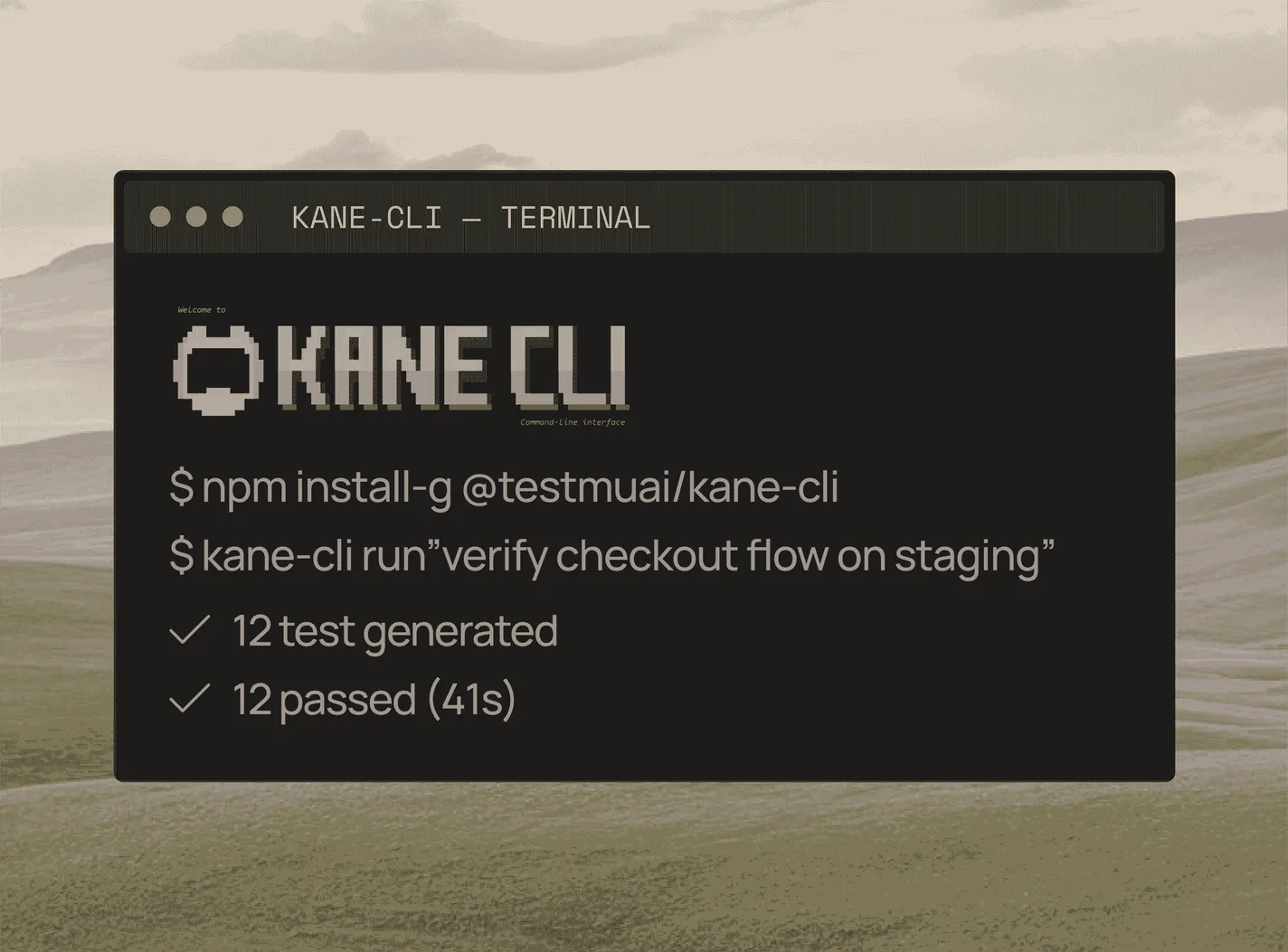
Kane CLI is the verification side, and it is the piece built for machine callers. An objective in plain language becomes a real Chrome session over the DevTools Protocol, and a pass is only issued once DOM state, a URL change, a network response, a console log or a screenshot backs it up.
Agent Testing covers the third job, grading AI agents themselves on hallucination, bias, completeness and context awareness. Output from any of it leaves as Selenium, Playwright, Cypress or Appium code and executes on the TestMu AI automation cloud across 3,000+ browser and OS combinations and 10,000+ real devices. For agents that talk on camera, such as AI interviewers, the guide to video agent testing shows how a session with a simulated candidate is recorded and graded.
Key features
- Prompt to executable case - a sentence, ticket or recording becomes a running test without a script in between.
- Six layers, one flow - web, mobile, API, database, accessibility and visual checks share a single authoring path.
- Terminal-native verification - Kane CLI runs headless in CI and emits structured events for machine consumers.
- Callable by coding agents - installs into Claude Code, Codex CLI and Gemini CLI as a skill.
- Corroborated verdicts - a pass needs DOM, URL, network, console or screenshot evidence behind it.
- Portable output - suites leave as Selenium, Playwright, Cypress or Appium code.
Where it fits: Teams that want the AI to reach across authoring, execution and agent evaluation instead of buying three products, and who need the result to run on more than one browser.
Why Choose TestMu AI Over Other Tools?
Most tools here apply AI to a single stage. TestMu AI applies it across three, and Kane CLI is installable directly inside Claude Code, Codex CLI and Gemini CLI, so the agent writing the feature can verify it without leaving its own loop. Because suites export to four standard frameworks, that breadth never becomes a lock-in problem.
2. testRigor
testRigor treats the sentence as the test. Write what a user would do in plain English and the platform resolves it into the searches, presses and clicks required, with no element named anywhere.
The consequence shows up in maintenance. Because the specification carries the intent, a case survives a UI framework change as long as the description remains accurate, which removes the usual cause of a broken suite.
Its span is unusually wide for an AI tool: web across browsers, native and hybrid mobile, Windows desktop, API invocation and validation, mainframe systems, two-factor login flows, and email, SMS and phone calls through a Twilio integration.
Key features
- Sentences compile to steps - plain English resolves into the actions between intent and outcome.
- Reach past the browser - web, mobile, Windows desktop, API and mainframe in one product.
- Messaging and telephony - email, SMS and phone calls through a Twilio integration.
- Second-factor logins - authenticator apps, SMS and email are handled.
- Healing at the spec - a case holds while its description is true, whatever the markup does.
- Manual suites convert - existing manual cases import and become automated.
Where it fits: QA groups with a mixed-skill roster and an estate where the browser is only one of several surfaces that need covering.
3. mabl
mabl earned its position by adding AI to a mature platform rather than building a young product around it, and the payoff is how much fits in one console.
Web end-to-end sits beside iOS and Android, APIs that ingest existing Postman collections, and checks aimed at the output of AI features themselves. Auto-healing and failure triage span all four rather than being bolted onto one.
MCP servers open it to coding agents, and the product speaks separately to developers testing in the IDE, QA teams working at scale, and executives reading quality numbers.
Key features
- Four surfaces, one console - web, iOS and Android, APIs, and AI feature output.
- Postman collections import - existing API work carries over rather than being rebuilt.
- Healing across surfaces - auto-repair and triage apply platform-wide, not per product.
- Reachable by agents - MCP servers let Claude Code and comparable tools drive it.
- Three audiences served - distinct paths for developers, QA and reporting.
Where it fits: Organisations retiring a shelf of single-purpose tools, where one console covering everything outweighs holding the test code yourself.
4. Applitools Autonomous
Of the five jobs, perception is the one almost nothing here attempts. State can be inspected by anything; whether the page looks right is a separate question, and Applitools Autonomous is the entry built to answer it.
Getting started takes one of three forms and none involves code: crawl the site from a URL or URL list, record a genuine user flow into editable steps, or write the steps out in English.
Its Visual AI interprets the rendered page as a reader would rather than querying the DOM, so rearranged markup does not register as a break. Deliberate redesigns are absorbed in bulk, because the platform gathers every case a change touches and updates them together.
Key features
- Scriptless entry - crawl a URL, record a session, or describe the steps.
- Reads the page, not the DOM - Visual AI interprets what rendered the way a person would.
- One checkpoint per screen - a single visual assertion replaces a column of individual ones.
- Redesigns absorbed at once - every affected case updates as a set.
- Checks generated code - an MCP server positions it above AI-written code as the deterministic layer.
Where it fits: Products where a broken layout costs as much as a broken endpoint, running beside a functional tool rather than replacing one.
5. Functionize
Functionize makes a claim none of the others make: the models doing the work were built for testing rather than borrowed from general use.
It describes the shape as generative intent over a deterministic core. Agents interpret what you meant, and machine learning confirms how the application actually behaved, which splits the guessing from the checking.
In use it is a describe-and-forget loop: state what good looks like, and Studio builds, runs and keeps the case green, absorbing change through auto-healing. Its enterprise reach covers Salesforce, ServiceNow, Workday and SAP.
Key features
- Testing-specific models - proprietary models built for the domain rather than repurposed general ones.
- Intent above a deterministic core - agents interpret meaning while ML verifies observed behaviour.
- Describe and it builds - state what good looks like and Studio produces, runs and maintains it.
- Change absorbed automatically - auto-healing keeps cases green through UI movement.
- Enterprise applications - Salesforce, ServiceNow, Workday and SAP.
Where it fits: Enterprise web workflows, especially across packaged applications, where a model trained on testing is preferred to a general-purpose one.
6. Tricentis Tosca
Tosca is the entry here whose AI sits on top of something older and deliberately unfashionable: an application model, from which cases get assembled instead of recorded.
Tricentis kept that base and layered AI over it, and the layer is shipped as named products rather than described as a capability: an AI workspace, agentic orchestration, agentic test creation, agentic end-to-end generation and agentic performance testing.
Where it earns the shortlist is packaged software, since the catalogue is arranged by application rather than by feature: SAP, Oracle, Salesforce, ServiceNow, Snowflake and Workday. Test management, performance testing and quality analytics come from the same portfolio.
Key features
- Model-driven cases - built from a structured representation rather than a captured session.
- Named agentic tier - AI workspace, orchestration, creation, automation and performance testing.
- Packaged application catalogue - SAP, Oracle, Salesforce, ServiceNow, Snowflake and Workday.
- Adjacent products bundled - test management, performance testing and quality analytics in one portfolio.
Where it fits: Enterprises whose revenue paths run through packaged software at a scale where modelling the application repays the modelling effort.
7. UiPath Test Cloud
Of the five jobs, UiPath is unusual for doing four of them, and doing maintenance at a moment nothing else on this list attempts.
Generation starts from written requirements rather than a prompt. Repair then happens mid-execution: a moved element is reasoned about, matched to intent and relocated while the run continues.
What surrounds those jobs is the reason enterprises shortlist it. Audit-ready trails, masked PII, role-based access and policy enforced as code are native rather than added, spanning APIs, databases and mainframes as much as desktop, web and mobile, and reaching SAP, Oracle, Workday, Epic and Salesforce.
Key features
- Requirements become cases - agents derive tests from written requirements without scripting.
- Repair inside the run - moved elements are relocated mid-execution rather than failing it.
- Application coverage - mainframes and databases alongside desktop, web, mobile and APIs.
- Packaged software covered - SAP, Oracle, Workday, Epic and Salesforce on Windows and macOS.
- Audit before autonomy - execution trails, PII masking, role-based access and policy-as-code ship with it.
- Load testing included - functional and performance testing live in the same product.
Where it fits: Regulated environments where someone will eventually ask how the agent reached its conclusion and a passing result is not a sufficient answer.
8. QA Wolf
QA Wolf splits coverage discovery from generation and gives each to a different agent, which is why what it produces is broader than a prompt-driven tool.
One agent explores the application and documents its workflows; the second writes code against that map. The result is production-grade Playwright for web and Appium for mobile, which the company describes as exportable and yours to keep.
Maintenance is handled by people rather than by the model, since this ships as a managed service with QA engineers embedded and video playbacks attached to every failure. The trade is that their schedule becomes yours.
Key features
- Map before automation - one agent documents the workflows, a second writes against them.
- Output you keep - Playwright and Appium code the vendor describes as exportable and yours.
- Engineers included - embedded QA staff own maintenance and strategy.
- Everything in parallel - the suite runs at once rather than sequentially.
- Failures as recordings - each failure returns as a playback rather than a trace.
Where it fits: Teams needing coverage faster than they can hire, who still refuse to end up with a suite they cannot take elsewhere.
9. TestSprite
TestSprite is built for the case where coverage discovery matters more than authoring, because there is nothing to author against yet.
It reads the codebase and the PRD before it touches anything, then releases agents into the live application together, some through the browser and others against the API, so one pass reaches frontend, backend and data.
Verification reaches developers two ways, through an MCP server inside the editor or an open-source CLI in the pipeline, with Claude Code, Cursor and VS Code listed as compatible. Letting an agent choose priorities has a cost: it will produce coverage for flows you would never have ranked, so budget time to prune the first pass.
Key features
- Reads before exploring - ingests code and PRD to work out what the application should do.
- Concurrent agents - features are covered at once rather than in a single crawl.
- Frontend, backend and data - all three verified in the same run.
- Editor and pipeline doors - an MCP server for in-editor checks, an open-source CLI for CI.
- Reruns per commit - the suite re-executes on change and mends itself as elements move.
- Causes, not logs - failures return with a proposed root cause and a fix.
Where it fits: Products carrying little end-to-end coverage today, where producing a suite at all is the immediate problem.
10. Checksum
Checksum writes Playwright directly into your repository as code you can read, edit, run anywhere and keep, and positions itself at teams already shipping with coding agents.
Its repair loop is the differentiator. A changed selector or shifted flow is detected, fixed, and raised as a pull request for review rather than silently rewritten or simply reported as red.
It slots into an existing pipeline and runs on every commit, without displacing whatever framework is already in place.
Key features
- Code in your repo - Playwright output you can modify, run anywhere and retain.
- Fixes arrive as PRs - detected breakage is repaired and submitted for human review.
- Fast to first coverage - built to stand up broad end-to-end coverage in weeks.
- Every commit - runs inside the CI you already have.
- Standard format - the suite is ordinary Playwright rather than a proprietary shape.
Where it fits: Teams wanting agent-generated coverage that still lands as reviewable code, with repairs passing through code review like any other change.
11. Meticulous
Meticulous is the only entry here that does coverage discovery from actual traffic instead of from a crawl or a document.
A script tag in development, staging and preview records what real people did, and the platform tracks which code branches those sessions executed before generating visual end-to-end tests over the workflows and edge cases they touched. Replayed backend responses keep changing data from producing false failures and remove the need for dedicated test accounts.
Maintenance disappears as a task rather than getting easier. Cases arrive when a feature starts being used and retire when it stops, and no engineer touches either transition.
Key features
- No cases written - a script tag records real sessions in place of authored tests.
- Branch-aware - tracks which code paths interactions executed and covers them.
- Recorded backends - responses replay from capture, so changing data does not break runs.
- Self-pruning suite - cases are added and retired automatically as the product moves.
- Impact shown on the PR - the effect across user workflows is visible before merge.
- Massively parallel - a compute cluster covers thousands of screens in under 120 seconds.
Where it fits: Frontend teams with real traffic flowing through staging or production who want regression coverage nobody has to own.
12. Autify
Autify is one of the few here whose AI perceives as well as generates. Its flagship agent, Aximo, drives end-to-end tests using natural language alongside visual recognition, across web, mobile and desktop.
That third surface is the rare part. Desktop software sits beside the browser and the handset rather than being someone else's problem, and none of it requires a script or a selector.
Maintenance runs on flexible locators so cases bend as the interface moves, and the platform hands off to Playwright for teams that want execution on infrastructure they already understand.
Key features
- Autonomous agent - Aximo executes end-to-end tests using language and visual recognition.
- Three application types - web, mobile and desktop from one agent.
- No-code objectives - plain language replaces scripts and selectors.
- Adaptive locators - self-healing keeps cases working as the interface evolves.
- Playwright connection - integrates with Playwright for scaled execution.
- Whole lifecycle - regression, smoke, functional and visual scenarios covered.
Where it fits: Teams whose surface includes desktop software alongside web and mobile, wanting one no-code agent across all three.
13. Autosana
Autosana concentrates on one job and does it visibly well: keeping a run alive when the application does something unexpected.
Coverage runs across all three of iOS, Android and the web, with flows written in plain language, so a manual tester works from the dashboard while an engineer wires the same product into a pipeline.
When a step fails, the agent re-plans instead of reporting a break, and will scroll to find an element that has moved out of the viewport. Its users report the gains landing in the parts of mobile that usually defeat automation, meaning deep links, authentication and embedded webviews. It also markets itself to teams shipping with coding agents.
Key features
- Built for agent workflows - sold as the layer that completes a coding agent’s cycle.
- Not mobile-only - the web sits alongside iOS and Android in the same product.
- Written, not coded - scenarios described in plain language with no scripting step.
- Re-plans mid-run - a failing flow is adjusted rather than reported broken.
- Difficult mobile paths - deep links, authentication and embedded webviews.
Where it fits: Teams whose agents ship mobile and web together and who want a testing layer someone outside engineering can drive.
14. Revyl
Revyl applies its AI to a surface most of this list treats as secondary. It compiles the mobile build in a cloud environment, launches it, and reads the screens visually while walking user flows, recording the evidence as it goes.
Atlas is where the intelligence concentrates. It maintains a continuously updated map of what the application genuinely does, which is coverage discovery aimed at an app binary rather than a website.
For a young product the surfaces are unusually open: a CLI, an MCP server, GitHub Actions, an API and a Cursor plugin, so verification can be triggered from a pipeline or from an editor.
Key features
- Cloud build and launch - compiles and runs iOS and Android binaries rather than testing a web view of them.
- Atlas application map - a continuously refreshed record of what the app actually does.
- Screen-level reading - flows are judged on the rendered screen with the evidence retained.
- Pipeline and editor triggers - CLI, MCP server, GitHub Actions, API and a Cursor plugin.
Where it fits: Mobile-led products where a bad release reaches users through an app store rather than a deploy, and a web-first tool would cover the wrong surface.
15. Spur
Spur answers a question the rest of this list mostly ignores: whether one agent should be asked to judge a checkout flow and a mistranslated currency symbol with the same attention.
Its answer is one agent per concern. Exploratory work covers unpredictable paths, functional agents take multi-step journeys, UI and UX agents hunt typos, broken links and layout faults, localisation agents check language, currency and regional formatting, another set exercises AI features such as chatbots, search and recommendations, and mobile agents run iOS and Android.
Everything is authored in English, and the agents handle planning, execution and reporting without supervision, treating a pop-up or an out-of-stock item as something to work around. A web app is supplied by URL, a native app by build file, and GitHub Actions carries it into CI.
Key features
- An agent per concern - exploratory, functional, UI and UX, localisation, AI features and mobile each get their own.
- Localisation coverage - language, currency and regional formatting checked as a first-class case.
- Adapts to the unexpected - pop-ups and out-of-stock items are handled rather than treated as failures.
- Plans and reports itself - the agents decide the run and write up the outcome.
- Existing cases import - suites can be brought across from established test management tools.
Where it fits: Consumer products sold across regions, where a currency format or a translated string breaks trust as fast as a broken endpoint.

Note: Generated tests are only worth the infrastructure they run on. KaneAI authors from plain English and hands back Selenium, Playwright, Cypress or Appium code, so the AI accelerates the work without deciding where it lives. Try it free!
Where Does AI Powered Testing Still Fall Short?
These limits are documented by the vendors rather than inferred here, and they hold across the list because they come from driving a real browser at all.
- CAPTCHAs - none of the fifteen defeat one, so disable the challenge in test environments or hand the step to a person.
- Files the browser downloads - a triggered download usually lands on disk without surfacing in the run output, leaving the assertion nothing to read.
- Frames nested out of view - a payment frame on screen is normally fine; frames several levels deep and off-screen have to be named in the objective.
- Canvas and WebGL - clicks register and rendered change is visible, but pixel accuracy and animation correctness are not verifiable.
- Very long transitions - anything past roughly half a minute burns the step budget, so raise the ceiling or split the case around it.
- Sparse documentation - tools that read requirements to decide coverage produce thin results when there is little written down.
How to Choose
Work backwards from the part of the job that is costing you, since almost every product here is credible at something and none is credible at everything.
- Is authoring the bottleneck? Generation-led products earn their place: TestSprite explores and writes, Meticulous derives the suite from real sessions, and KaneAI turns a ticket or a prompt into a running case.
- Is maintenance the bottleneck? Look at where the case is anchored. testRigor ties it to a sentence, Applitools to the rendered page, UiPath to runtime intent, and Checksum sends the repair through code review.
- What has to survive cancellation? If the answer is a working suite, that narrows to TestMu AI, QA Wolf and Checksum before any feature comparison starts.
- What is your surface? Desktop or mainframe alongside web points to testRigor, UiPath Test Cloud or Autify; packaged enterprise software points to Tricentis Tosca, UiPath or Functionize; mobile-led products point to Autosana.
Then prove it on something difficult. A login page separates nothing, while an authenticated multi-step checkout with a conditional form will tell you more in an afternoon than a month of feature tables.
Conclusion
Name the part of your testing that costs the most engineering time, match it to one of the five AI jobs above, and trial the two products on this list strongest at that job. The tool that removes the most hours without taking the suite hostage is the one to keep.
If your team is already generating features with coding agents, add the verification step into the same loop. The getting started with KaneAI documentation covers setup, and the agentic AI testing tools roundup goes deeper on the fully autonomous end of this category.
Author

Saurabh Prakash
Blogs: 20

Saurabh Prakash is an Engineering Manager at TestMu AI, where he leads engineering on agentic AI development and scalable system architecture for the quality engineering platform. He has also contributed to Test at Scale, the company's open-source test intelligence platform. He brings over 9 years of experience across Node.js, Java, Spring, MVC, data structures, algorithms, and scalable system design, with earlier roles as SDE 2 at Zomato, Senior Software Engineer at LogicHub, and Software Development Engineer at Directi. Saurabh holds a B.Tech in Computer Science and Engineering from Delhi Technological University.
Reviewer

Sri Harsha
Reviewer
Sri Harsha is Engineering Manager of the Open Source Program Office at TestMu AI, where he leads open-source engineering behind the Selenium and Appium automation grid and builds agentic AI systems for quality engineering. He is a member of the Selenium Technical Leadership Committee and a committer to WebdriverIO and Appium, and was recognized with the LambdaTest Delta Award 2023 for Best Contributor in open-source testing. He brings over 10 years of experience in software testing and automation, with earlier roles at EPAM Systems and ZenQ. Sri Harsha holds a B.Tech in Computer Science from Jawaharlal Nehru Technological University.


AI Powered Software Testing Tools FAQs
Did you find this page helpful?
More Related Blogs

TestMu AI forEnterprise
Get access to solutions built on Enterprise
grade security, privacy, & compliance
- Advanced access controls
- Advanced data retention rules
- Advanced Local Testing
- Premium Support options
- Early access to beta features
- Private Slack Channel
- Unlimited Manual Accessibility DevTools Tests