
Power Your Software Testing with AI Agents and Cloud
The Native AI-Agentic Cloud Platform to Supercharge Quality Engineering. Test Intelligently and Ship Faster.

- TestMu AI (Formerly LambdaTest)
- /
- Blog
- /
- 10 Best Agentic QA Tools in September 2026
10 Best Agentic QA Tools in September 2026
Ten agentic QA tools compared on autonomy, test ownership, coding-agent support and execution breadth, with a stated methodology and honest limits.
Published on:
An AI coding agent ships a feature in four minutes and reports that it passed. It read the source, ran the unit tests, and never opened a browser. The button wired to the wrong endpoint, the redirect that 404s, and the modal that will not close are all invisible to it.
That gap is what agentic QA tools exist to close. I evaluate agentic testing tooling as part of building Kane CLI at TestMu AI, and the pattern I keep seeing is that the word agentic gets applied to anything with a model in it, so the first job of this article is to draw the line.
Overview
Agentic QA tools author a test from stated intent, run it against the live application, read the result, and repair the test when the UI moves. Ten tools qualify in 2026, ranked here on autonomy, where the test lives, coding-agent support, and execution breadth rather than on vendor labelling.
- Best for coding-agent workflows and execution breadth: TestMu AI - Kane CLI installs as a skill into Claude Code, Codex CLI and Gemini CLI, and KaneAI runs the resulting suites across 3,000+ browser and OS combinations and 10,000+ real devices.
- Best for owning your test code: QA Wolf - generates production-grade Playwright and Appium code that stays yours and exportable, backed by a managed service that triages failures before they reach your team.
- Best for zero-to-suite exploration: TestSprite - reads your code and PRD, then sends multiple agents through the running application at once to write the end-to-end tests nobody got around to.
- Best for the widest application surface: testRigor - writes tests in plain English across web, mobile, desktop, API and mainframe, which few other tools on this list attempt.
- Best for visual correctness: Applitools Autonomous - validates the full rendered page with Visual AI that reads a page the way a person does, catching appearance defects the state-based tools on this list cannot see.
- Best for packaged enterprise applications: Tricentis Tosca - pairs model-based end-to-end automation with an agentic layer for test creation, orchestration and performance, across SAP, Oracle, Salesforce, ServiceNow and Workday.
- Best for governed enterprise rollout: UiPath Test Cloud - generates tests from requirements and self-heals locators at runtime, with audit-ready execution trails, PII masking and policy-as-code built in.
- Every tool here fails on the same things: CAPTCHAs, browser-initiated downloads, deeply nested iframes, and pixel-level correctness inside canvas or WebGL.
What Makes a QA Tool Agentic?
Recording a click path and replaying it is automation, and a model that suggests a better selector is assistance. Neither is agentic.
The labels are no help either. Agentic QA tools, agentic AI testing tools and autonomous testing platforms name the same shelf rather than the same capability, so the only way to compare them is against what the agent is actually allowed to do without you.
The line worth drawing is whether the agent closes its own loop. Four capabilities have to be present together.
- Authoring from intent - the agent produces the test from a description of the outcome, not from a recorded session or a hand-written selector.
- Execution against the running application - it drives a real browser or device and observes what rendered, rather than reasoning about source code.
- Interpretation - it decides whether a failure is a genuine defect or a UI change it should absorb, and says which.
- Repair - it resolves the original intent again after the interface moves, with no code change from you.
A tool that does the first three and makes you fix the selector is an assistant with good marketing. The repair step is where the maintenance cost actually goes.
If the category itself is new to you, the agentic QA guide covers the workflow before the tooling, and agentic design patterns for software testing covers how these loops are structured.
How We Evaluated
Most published rankings of the best agentic testing tools are written by a vendor that appears in them, which is why the criteria here are stated before the list rather than after it.
Every claim below was checked against the vendor's own live documentation and product pages in September 2026. Where a capability could not be confirmed on the vendor's site, it is described qualitatively or left out.
The ranking runs on five criteria, weighted toward the two that decide long-term cost.
- Autonomy - does the agent author, run, interpret and repair, or only some of those?
- Test ownership - where does the test live, and what do you keep if you stop paying? This is weighted heavily because it is the hardest thing to reverse.
- Coding-agent surface - can Claude Code, Cursor or a CI job invoke it through MCP, a CLI, or an installable skill?
- Execution breadth - which browsers, operating systems and real devices does it actually run against?
- Reviewability - can a human read the test and the evidence, or does trust rest on a green tick?
Quick Comparison
| Tool | Where tests live | Coding-agent surface | Strongest at |
|---|---|---|---|
| TestMu AI | Exports to Selenium, Playwright, Cypress, Appium | Skills for Claude Code, Codex CLI, Gemini CLI | Agent-native CLI plus grid-scale execution |
| QA Wolf | Playwright and Appium code you keep | Exportable code into any pipeline | Owned code plus managed failure triage |
| TestSprite | Vendor platform, open-source CLI | MCP server and CLI | Generating a first suite from nothing |
| mabl | Vendor platform | MCP servers | Web, mobile, API and accessibility in one console |
| testRigor | Vendor platform, plain English | Platform integrations | Breadth across web, mobile, desktop, mainframe |
| Applitools | Vendor platform | MCP server | Visual correctness the others cannot check |
| Tricentis Tosca | Vendor platform, model-based | Agentic orchestration inside the platform | SAP, Oracle, Salesforce and other packaged apps |
| UiPath Test Cloud | Vendor platform | Agents across design, execution and management | Governed rollout with audit trails and PII masking |
| Revyl | Vendor platform | CLI, MCP, GitHub Actions, Cursor plugin | Mobile-first verification on cloud devices |
| Autosana | Vendor platform | Built to close the loop with coding agents | Natural-language flows across iOS, Android and web |
The 10 Best Agentic QA Tools
1. TestMu AI
TestMu AI is an AI-native agentic quality engineering platform, built so teams can create, run and tune their testing workflows through autonomous agents rather than through hand-written scripts. At its centre is KaneAI, a GenAI-native testing agent that plans, authors, executes and maintains test cases from natural-language prompts. It turns PRDs, Jira tickets and recordings into executable tests, and self-heals them as the application changes.
That authoring reach spans the stack rather than the browser alone, covering web, mobile, API, database, accessibility and visual checks in one connected flow.
Its output is not locked in. Suites export to Selenium, Playwright, Cypress and Appium, and run on the TestMu AI automation cloud across 3,000+ browser and OS combinations and 10,000+ real devices.
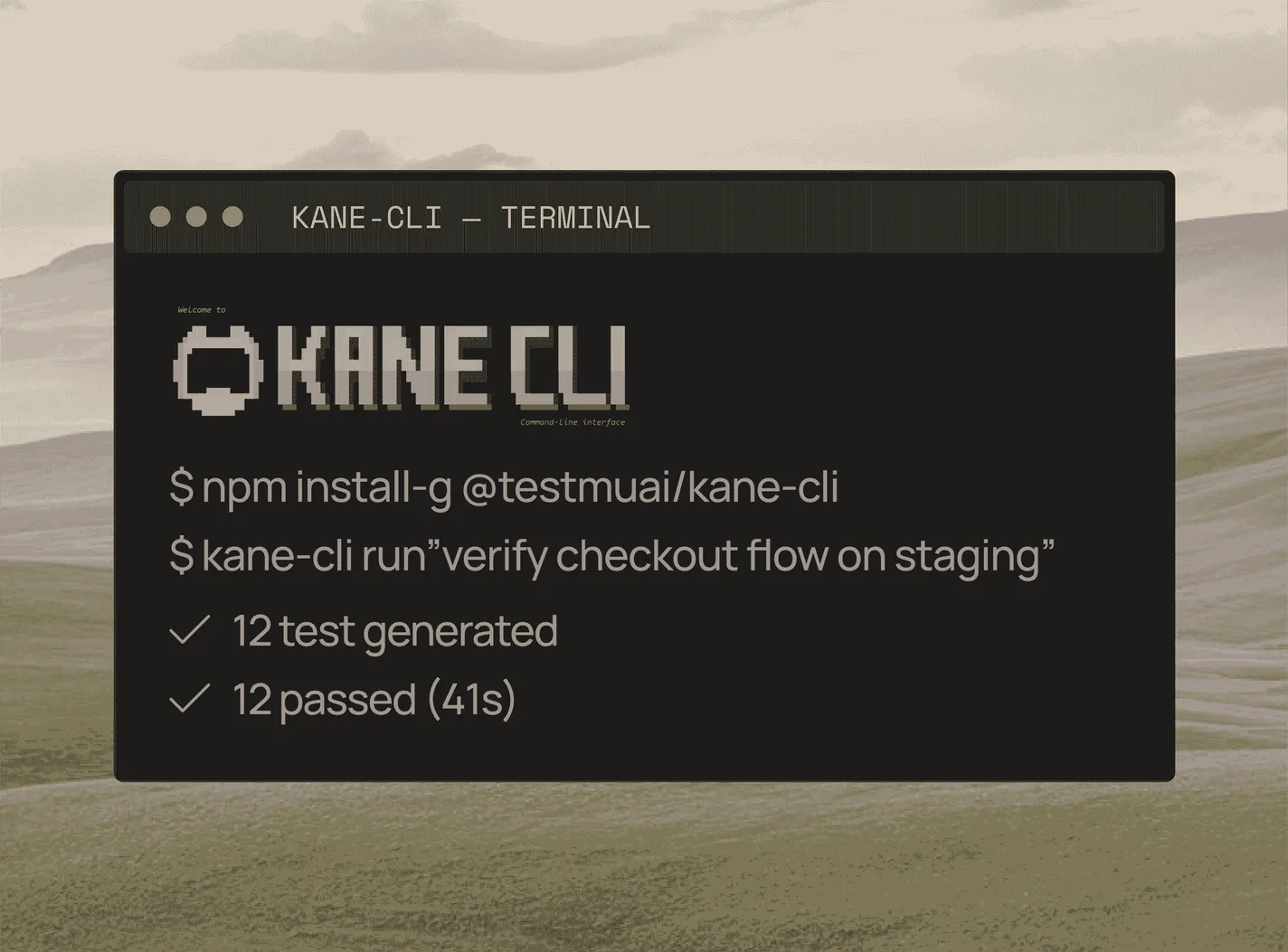
Kane CLI is the verification agent. It takes a natural-language objective, drives a real Chrome instance through the Chrome DevTools Protocol, and returns an evidence-backed verdict.
The determinism claim is narrower than it sounds and worth stating precisely. The model’s reasoning path varies between runs; what is held stable is the verdict, which is granted only when the expected state is confirmed through DOM state, URL changes, network responses, console logs or screenshots.
It runs in three modes: an interactive terminal UI, a headless CLI for pipelines, and an agent mode that emits an NDJSON event stream ending in a run_end event carrying the full result. Standard exit codes make it a normal pipeline citizen.
For coding-agent workflows this is the strongest surface on the list. Kane CLI installs as a skill into Claude Code, Codex CLI and Gemini CLI with a single command, so the agent that wrote the feature can verify the rendered result before claiming it works.
Agent Testing covers the inverse problem. Rather than using an agent to test software, it deploys testing agents against chat, voice and phone agents, scoring hallucination, bias, completeness and context awareness.
Key features
- Natural-language objectives - Kane CLI takes a stated objective and drives real Chrome through the Chrome DevTools Protocol, with no selectors to write.
- Three run modes - an interactive terminal UI, a headless CLI for pipelines, and an agent mode that emits an NDJSON event stream.
- Installable agent skills - one command installs it into Claude Code, Codex CLI and Gemini CLI.
- Evidence-backed verdicts - a pass requires confirmation from DOM state, URL changes, network responses, console logs or screenshots.
- Framework export - KaneAI suites export to Selenium, Playwright, Cypress and Appium.
- Grid-scale execution - 3,000+ browser and OS combinations and 10,000+ real devices.
Where it fits: Teams whose features are already being written by AI coding agents and who need the verification step inside that same loop, without trading away cross-browser and real-device coverage.
Why Choose TestMu AI Over Other Tools?
Most entries here specialise in one part of the cycle. TestMu AI covers authoring through KaneAI, execution across its own browser and real-device grid, and the evaluation of AI agents through Agent Testing, from a single platform. Kane CLI is also installable directly into Claude Code, Codex CLI and Gemini CLI, so the agent writing your code can call the verifier without leaving its own loop.
2. QA Wolf
QA Wolf splits the job across two agents. A mapping agent explores the application and documents its workflows, then an automation agent writes the test code from that map.
The output is the reason it leads on ownership. Tests are production-grade Playwright for web and Appium for mobile, which QA Wolf describes as exportable and yours to keep, so leaving does not cost you the suite.
It also runs as a managed service, with embedded QA engineers handling maintenance and strategy, and video playbacks for investigating failures. That combination suits a team that wants coverage without hiring for it.
The trade is control. A managed service sets the cadence, and the coding-agent story is weaker than tools built around MCP, so an agent in your IDE reaches it through the exported code rather than directly.
Key features
- Two-agent pipeline - a mapping agent documents the application workflows, then an automation agent writes the code.
- Owned output - production-grade Playwright for web and Appium for mobile, described as exportable and yours to keep.
- Managed service - embedded QA engineers handle maintenance and test strategy.
- Parallel execution - the suite runs fully in parallel rather than serially.
- Video playbacks - failures arrive with recordings for investigation.
Where it fits: Teams that want broad coverage without hiring QA headcount, and that treat owning the test code as non-negotiable.

Note: Agent-authored tests still have to run somewhere real. KaneAI authors from plain English and exports to the framework your team already uses, so the agent's output lands as code you own rather than rows in a console. Try it free!
3. TestSprite
TestSprite is aimed at the suite you never wrote. It reads your code and PRD for context, then sends multiple agents through the running application at once, driving a real browser or hitting a live API.
Frontend, backend and data are covered in the same pass, which is unusual on this list. Most tools here stop at the browser.
It reaches coding agents through an MCP server for in-editor verification and an open-source CLI for agents and CI, with stated compatibility for Claude Code, Cursor and VS Code. Tests rerun on every code change, auto-heal when elements shift, and failures arrive with root-cause hypotheses and suggested fixes.
The exploration-first approach is also its risk. An agent that decides what matters will generate tests for flows you did not prioritise, so the first pass needs pruning before it becomes your regression gate.
Key features
- Context from code and PRD - reads both before exploring the running application.
- Parallel agent exploration - multiple agents work through features at once like real users.
- Full-stack coverage - frontend, backend and data are covered in the same pass.
- MCP server and open-source CLI - in-editor verification plus invocation from agents and CI.
- Auto-heal and rerun - reruns on every code change and repairs tests when elements shift.
- Failure hypotheses - results carry root-cause suggestions rather than raw logs.
Where it fits: A codebase with little or no existing end-to-end coverage, where the first job is generating a suite rather than maintaining one.
4. mabl
mabl is an established platform that has moved toward agentic positioning rather than a startup built around it. That maturity shows in surface coverage.
Web end-to-end, iOS and Android, APIs with Postman collection imports, and validation of AI application output all sit in one console, with AI auto-healing and triage across them.
It connects to AI coding agents through MCP servers, and positions separately for developers shifting testing into the IDE and terminal, QA teams automating at scale, and executives reading quality metrics.
Tests live in the vendor platform, which is the cost of the consolidated console. Weigh that against the ownership criterion if leaving later would mean rebuilding.
Key features
- One console, four surfaces - web end-to-end, iOS and Android, APIs, and validation of AI application output.
- Postman import - existing API collections come across rather than being rebuilt.
- AI auto-healing - tests stay resilient through application changes, with triage on top.
- MCP integration - connects to Claude Code and other agentic development tools.
- Role-based positioning - separate entry points for developers, QA teams and reporting.
Where it fits: Organisations consolidating several point tools into one platform, where breadth across surfaces matters more than owning the test code.
5. testRigor
testRigor takes plain-English instructions and turns them into executable steps, so a sentence like purchase a Kindle becomes the search, the button press and the clicks that follow.
Its reach is among the widest here. Web across browsers and platforms, native and hybrid mobile, Windows desktop applications, API invocation and validation, email, SMS and phone calls through a Twilio integration, mainframe applications, and two-factor authentication flows.
Self-healing is framed around the specification rather than the markup: tests keep working as long as the plain-English description stays true, which is what makes them survive UI framework changes.
It is built for mixed-skill teams, so manual QA professionals author alongside engineers. The trade is the same as mabl, with tests living in the vendor platform rather than your repository.
Key features
- Plain-English authoring - an instruction like purchase a Kindle becomes the search, the button press and the clicks that follow.
- Wide platform reach - web across browsers, native and hybrid mobile, Windows desktop, API and mainframe.
- Communication channels - email, SMS and phone calls through a Twilio integration.
- Two-factor flows - authenticator apps, SMS and email are supported.
- Specification-anchored self-healing - tests hold as long as the plain-English description stays true.
- Manual test import - existing manual cases can be brought in and automated.
Where it fits: Mixed-skill QA teams covering an estate that reaches beyond the browser, particularly where desktop or mainframe sits alongside web.

6. Applitools Autonomous
Every other tool here asserts on state. Applitools Autonomous asserts on appearance, which is the gap the rest of this list leaves open.
It authors without scripts three ways: crawling a site from a homepage URL or URL list, recording a real user flow into editable steps, or taking a plain-English description of the steps.
Its Visual AI reads a page the way a person does rather than through the DOM, so a markup change does not break the test. A single visual checkpoint validates the full page in place of a long list of individual assertions.
Maintenance is handled in bulk. When a UI change is intentional, it groups every test the change affects so they update together instead of one at a time.
It positions itself as a deterministic checking layer over AI-generated code and ships an MCP server for that workflow. Tests live in the vendor platform, and the visual-first focus means it complements a functional agent rather than replacing one.
Key features
- Three authoring routes - crawl a site from a URL list, record a real flow into editable steps, or describe the steps in plain English.
- Visual AI - reads the rendered page the way a person does rather than through the DOM.
- Full-page checkpoints - one visual assertion replaces a long list of individual ones.
- Grouped maintenance - an intentional UI change updates every test it affects together.
- MCP server - positions as a deterministic checking layer over AI-generated code.
Where it fits: Alongside a functional agent rather than instead of one, wherever appearance defects matter and state assertions cannot see them.
7. Tricentis Tosca
Tosca is enterprise end-to-end test automation built on a model-based approach, where tests are assembled from a model of the application rather than from recorded scripts. Tricentis has layered agentic capability on top of that foundation rather than replacing it.
That layer is explicit in the product line: an AI workspace, agentic orchestration, agentic test creation, agentic test automation for end-to-end generation, and agentic performance testing.
The reason to shortlist it is packaged applications. Tricentis organises solutions around SAP, Oracle, Salesforce, ServiceNow, Snowflake and Workday, which is where model-based testing earns its complexity.
It also sits inside a wider suite covering test management, performance testing and quality analytics. That breadth is the argument for it and the argument against it: adoption is a programme rather than an install, and tests stay in the vendor platform.
Key features
- Model-based automation - tests assemble from a model of the application rather than from recordings.
- Agentic layer - an AI workspace plus agentic orchestration, test creation, test automation and performance testing.
- Packaged application coverage - solutions organised around SAP, Oracle, Salesforce, ServiceNow, Snowflake and Workday.
- Wider portfolio - test management, performance testing and quality analytics sit in the same suite.
Where it fits: Large enterprises whose critical flows run through packaged applications, where model-based testing repays its setup cost.
8. UiPath Test Cloud
UiPath applies AI agents across the whole testing lifecycle, from test design through execution and management, generating tests from requirements rather than from manual scripting.
Its self-healing works at runtime on locators. When a UI element changes, the agent interprets the intent and locates the correct element so the run continues rather than failing.
Coverage stretches further than most of this list: desktop, web, mobile, APIs, databases and mainframes, plus packaged applications including SAP, Oracle, Workday, Epic and Salesforce across Windows and macOS. Functional and performance testing sit in the same product.
What separates it is governance. Audit-ready execution trails, PII masking, role-based access and policy-as-code enforcement are part of the platform, which matters when the question is not whether an agent can test but whether a regulator will accept how it did.
The trade is weight. This is an enterprise rollout with an RPA heritage, so a small team wanting a suite by Friday is not the buyer.
Key features
- Requirements-driven generation - agents create tests from requirements without manual scripting.
- Runtime self-healing - agents interpret intent and relocate changed elements mid-run instead of failing.
- Broad surface - desktop, web, mobile, APIs, databases and mainframes.
- Packaged applications - SAP, Oracle, Workday, Epic and Salesforce across Windows and macOS.
- Built-in governance - audit-ready execution trails, PII masking, role-based access and policy-as-code.
- Integrated performance testing - functional and performance testing in one product.
Where it fits: Regulated enterprises where how the agent tested has to survive an audit, not just whether the test passed.

9. Revyl
Revyl is a mobile specialist. It builds mobile applications in cloud environments, runs them live, inspects the screens visually, and executes user flows with documented evidence.
Its Atlas feature keeps a continuously updated map of what the application actually does, which is the mobile equivalent of the exploration step other tools run against a website.
Integration surfaces are broad for a young product: a CLI, an MCP server, GitHub Actions, an API, and a Cursor plugin installable from the marketplace.
If your product is mobile-first, this focus is the advantage. If it is not, a general platform will cover more of your surface.
Key features
- Mobile-first - builds, runs and inspects iOS and Android applications in cloud environments.
- Atlas map - a continuously updated map of what the application actually does.
- Visual screen inspection - verifies against the rendered screen with documented evidence.
- Integration surfaces - a CLI, an MCP server, GitHub Actions, an API and a Cursor plugin.
Where it fits: Mobile-first products where the release risk lives in the app rather than the web front end.
10. Autosana
Autosana describes itself as the end-to-end testing layer that closes the loop with your coding agents, covering iOS, Android and web from one place.
Test flows are described in natural language rather than coded, which puts it within reach of manual testers working in a dashboard as well as engineers wiring it into their tooling.
The behaviour its users single out is recovery. The agent self-corrects when a flow fails, adjusting the steps rather than reporting a break, and it will scroll to reach an element that is out of view instead of stopping.
Reported strengths cluster around the awkward parts of mobile: deep linking, authentication flows and embedded webviews.
It ranks last because it is the youngest product here, not the weakest idea. There is less public track record to judge it on, so treat a trial as genuine evaluation rather than confirmation.
Key features
- Coding-agent loop - positioned as the end-to-end layer that closes the loop with your coding agents.
- Three platforms - iOS, Android and web from one place.
- Natural-language flows - scenarios are described in plain language with no coding required.
- Self-correcting runs - the agent adjusts the steps when a flow fails rather than reporting a break.
- Awkward-path coverage - deep linking, authentication flows and embedded webviews.
Where it fits: Mobile and web teams shipping with coding agents who also want a natural-language workflow a non-engineer can drive.
Agent as Tester Versus Agent Under Test
Every tool above uses an agent to test conventional software. That is a different problem from testing an AI agent, and search results for agentic QA blur the two constantly.
A Selenium assertion checks that button text equals Submit. An AI agent's reply is different every run, so there is no selector to check and no DOM state to assert against.
Evaluating that output needs scoring rather than assertion. TestMu AI Agent Testing deploys its own testing agents against chat, voice and phone agents, scoring hallucination, bias, completeness and context awareness, with 9 metrics for chat and voice and more than 30 for phone calls.
If you are shipping a customer-facing agent, that is the category you need, and the AI agent testing guide covers the metrics before the tooling. A browser agent will not tell you whether your chatbot invented a refund policy. Agents that talk on camera, such as AI interviewers, call for video agent testing, which records each session and grades it against criteria you write.
A third case is the coding agent invoking these tools, which changes files, calls tools and opens pull requests instead of holding a conversation.
Known Limits of Agentic QA
These failure modes hold across the top agentic testing tools whatever the implementation, because they come from driving a real browser at all. They are documented limits, not speculation.
- CAPTCHAs - no agent on this list solves them. Test against an environment with CAPTCHA disabled or route to a human step.
- Browser-initiated downloads - a triggered file often lands in the browser's download directory without being surfaced in the run output, so the assertion has nothing to check.
- Deeply nested iframes - visible payment iframes usually resolve, but heavily nested off-screen frames need explicit guidance in the objective.
- Canvas and WebGL - a drawing tool or 3D viewport is observable as an image. Clicks register and rendered changes are visible, but pixel-level and animation correctness are not verifiable.
- Long animations - transitions running 30 seconds or more exhaust step budgets, so split the test around them or raise the step limit.
- Thin documentation - agents that read PRDs and tickets to decide what matters produce weaker coverage when there is little to read.
None of these are reasons to avoid the category. They are the list to check your critical flows against before you let an agent gate a release.
How to Choose
Start with what you keep if you stop paying. That question eliminates more options than the other three combined.
- What do you keep if you stop paying? If the answer has to be a suite you own, you are choosing between TestMu AI and QA Wolf. The vendor-platform tools are out regardless of how good they are.
- Are AI coding agents already writing your code? If so, the verification tool needs a skill, MCP server or CLI the agent can invoke directly, which points to Kane CLI, TestSprite or Autosana.
- What is your surface? Mobile-first favours Revyl or Autosana; SAP, Oracle or Salesforce narrows to Tricentis Tosca or UiPath Test Cloud; desktop and mainframe alongside web favours testRigor; visual correctness needs Applitools alongside a functional agent.
- Who reviews the agent's output, and who has to approve it? If nobody has time, a managed service such as QA Wolf does the triage. If a regulator or an internal audit function has to sign off, UiPath Test Cloud's audit trails and policy controls matter more than raw autonomy.
Most shortlists of the top agentic QA tools converge on the same handful of names, so the separation comes from your constraints rather than from the list. Run yours against one genuinely hard flow rather than a login page. Authentication, a multi-step checkout, or a conditional form will separate these tools faster than any feature table, this one included.
Adding Unable to Verify to the Criteria
Reviewability is the fifth criterion in this ranking, and it gets harder when the thing under test is the coding agent that invokes these tools. A criterion the run could not observe is neither a pass nor a fail. TestMu AI Agent Assurance runs your AI agent for real and grades every criterion against observed evidence.
- Three verdicts - pass, fail, and unable to verify, with the third kept out of the pass-rate denominator instead of counted as a soft fail.
- The assurance gap - the share of criteria a run could not verify, reported beside the pass rate.
- Observed evidence - files changed on disk, artifacts produced, and tool calls checked against the agent's declared tool surface rather than its own summary.
- Grey-box discovery - manifests, prompts, tool tables and MCP servers, and where an agent declares nothing the report says so instead of guessing.
Coverage for agents that act rather than talk is on a waitlist, and the same loop runs from a terminal through rook, a pre-alpha CLI that writes the scenarios, runs them and reports the verdicts. Gate the pipeline on those verdicts instead of the exit status, because a finished run exits 0 whether scenarios passed or failed. Read them from rook report --json.
Point it at staging, because the agent's writes are real and a run cannot undo them. A staging run like this is pre-production agent testing, which decides whether an agent can ship before observability scores it on live traffic.
Conclusion
Start by picking your hardest existing flow and writing it as a single sentence of intent, then run that sentence through two tools from the shortlist above. The one that gets furthest without you touching a selector is the one to trial properly.
If AI coding agents are already shipping your features, the fastest path is installing an agent-invokable verifier into the loop that writes the code. The getting started with KaneAI documentation covers the setup, and the wider agentic AI tools roundup covers the agent-building layer beneath these testing products. For the same category with a wider lineup, the agentic AI testing tools roundup covers fifteen products.
Author

Anubhav Singhmaar
Blogs: 46

Anubhav Singhmaar is an AI Product Manager at TestMu AI driving Kane CLI, the command-line tool that brings browser automation to the terminal, turning natural-language flows into runs in a real Chrome browser that return pass or fail with shareable proof. He owns the roadmap and prioritization and works with engineering to ship developer-facing features. Before TestMu AI, he spent over four years at Sprinklr owning enterprise voice AI across APAC and EMEA. A mechanical engineer turned product manager, he grounds guidance in real QA workflows.
Reviewer

Harshit Paul
Reviewer
Harshit Paul is Director of Product Marketing at TestMu AI, with over 8 years of experience in product and growth marketing for developer and QA tools, leading the Agentic AI in Quality Engineering space. He has authored 80+ technical articles for TestMu AI on software testing and automation, and hosted webinars on Selenium, automation testing, browser compatibility, DevOps, and continuous testing. He has led go-to-market and technical marketing initiatives across software testing products, contributing to SEO, content strategy, and developer marketing. He began his career as a certified Salesforce developer at Wipro Technologies, where he worked for 2 years before moving into marketing. Harshit holds a degree in computer programming from Vivekananda Institute of Professional Studies.


Agentic QA Tools FAQs
Did you find this page helpful?
More Related Blogs

TestMu AI forEnterprise
Get access to solutions built on Enterprise
grade security, privacy, & compliance
- Advanced access controls
- Advanced data retention rules
- Advanced Local Testing
- Premium Support options
- Early access to beta features
- Private Slack Channel
- Unlimited Manual Accessibility DevTools Tests