
AI Agent Assurance for Your Agent Deployments
Agent Assurance Tests How Your Agent Actually Behaves across Workflows, Tools, and Actions to Catch Failures and Vulnerabilities.
npm install -g @testmuai/rook
- TestMu AI (Formerly LambdaTest)
- /
- Blog
- /
- Two Labs Now Take 86% of Enterprise LLM Spend - Your AI Governance Framework Has No Plan for That
Two Labs Now Take 86% of Enterprise LLM Spend - Your AI Governance Framework Has No Plan for That
An AI governance framework without a model-diversity control is incomplete. Use the 4R Continuity Test to find single-model risk before it breaks you.
Published on:
This week Menlo Ventures published a figure that should be on every CIO's risk register. In its 2026: The State of Enterprise AI report (Nov 3, 2026), Anthropic and OpenAI are at 86% of enterprise LLM API spend (up from 67% a year previously), with Anthropic alone at 55%.
Spend share is not the same as dependency, but it's the best public proxy we have. (Of interest: Menlo has a partnership with Anthropic on the Anthology Fund.)
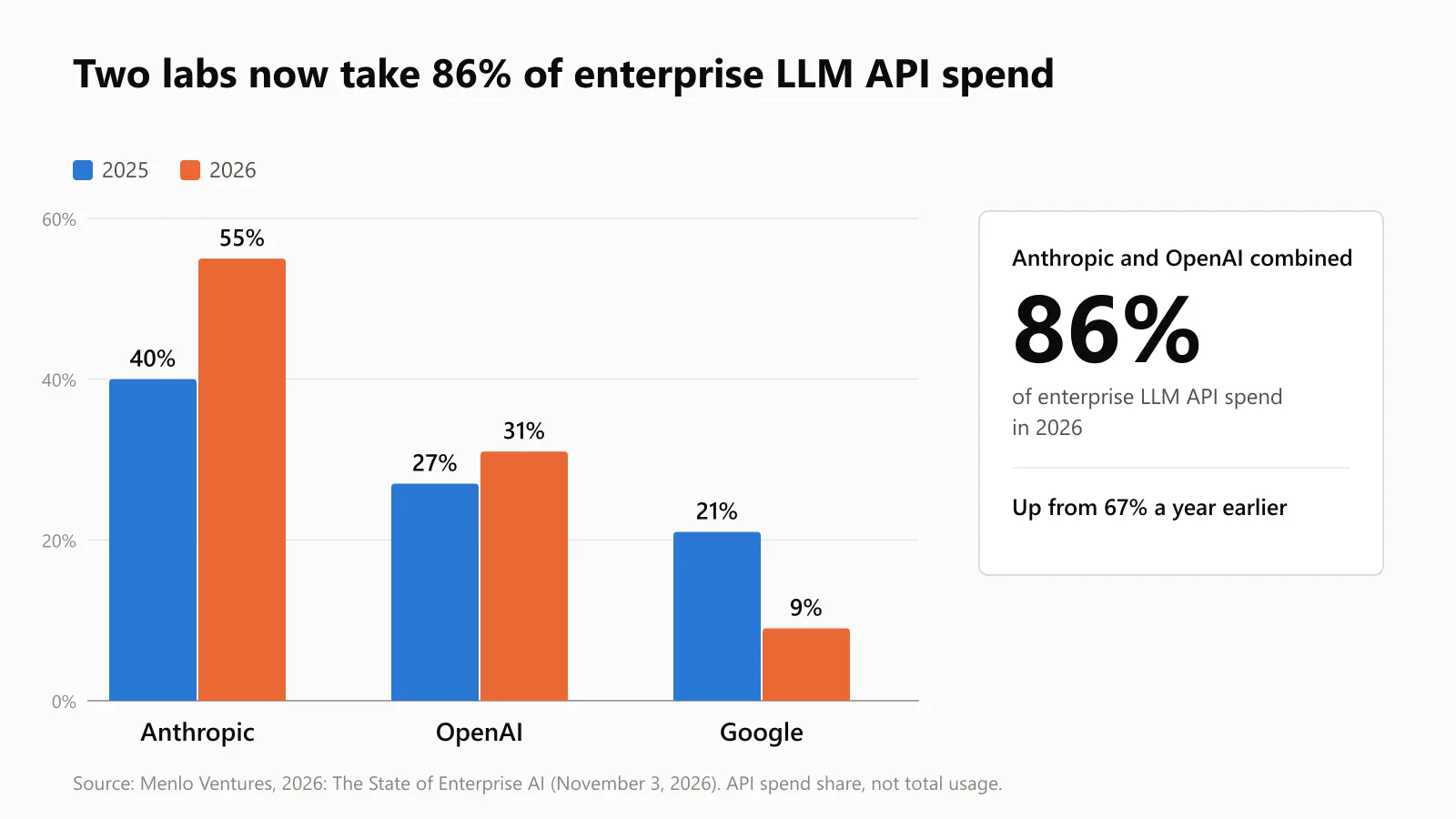
I don't see that as a story about who's winning. Concentration is a reflection of quality. I see it as a dependency chart.
The AI governance framework docs you see in the enterprise decks are almost invariably going to be missing a tested control for that.
Most of the frameworks out there are built around policy, fairness, privacy and human in the loop. They're essentially based on the premise that the model you approved on Monday is the model that's going to be answering on Friday, that it's going to be there next quarter, and that it can be trusted to judge its own work. All of that can fail in 2026.
This is the principle of model diversity. At TestMu AI, we call it that. The idea is that no single model is the sole dependency for a key outcome, and no model is responsible for checking its own work.
It's the first of our AI trust principles, as all the others (evidence, audit, containment) are built on it.
TL;DR
An AI governance framework that doesn't have a test for single model dependency is fundamentally incomplete. Two labs currently account for 86% of enterprise LLM API spend (Menlo Ventures, Nov 2026); models are retired on 60-day to six-month notice, and there's a body of work that shows models will tend to give their own model the best grade when doing the grading.
Govern the outcomes, not the vendors. Every critical AI outcome must pass the 4R Continuity Test (Retire, Revoke, Regress, Recuse).
Model Diversity for an AI Governance Framework: Key Terms
- Model diversity: Means using every model: No. Model diversity means no single model is the sole dependency for a key outcome and no model checks its own work, so one rehearsed alternate is enough to start.
- Multi-model AI: Same as resilience: No. Multi-model AI describes how many models a team uses, while resilience needs a suite that has been run on the alternate and a recovery time that has been measured.
- AI reliability: Single-model risk is a procurement issue: No. Single-model dependency is an AI reliability risk that shows up in production behavior, with retirement and revocation failing as outages and regression going unflagged.
- AI agent governance: Covers model dependence by default: No. AI agent governance evidence shows what an agent did, and the 4R Continuity Test adds proof that the outcome survives a model change.
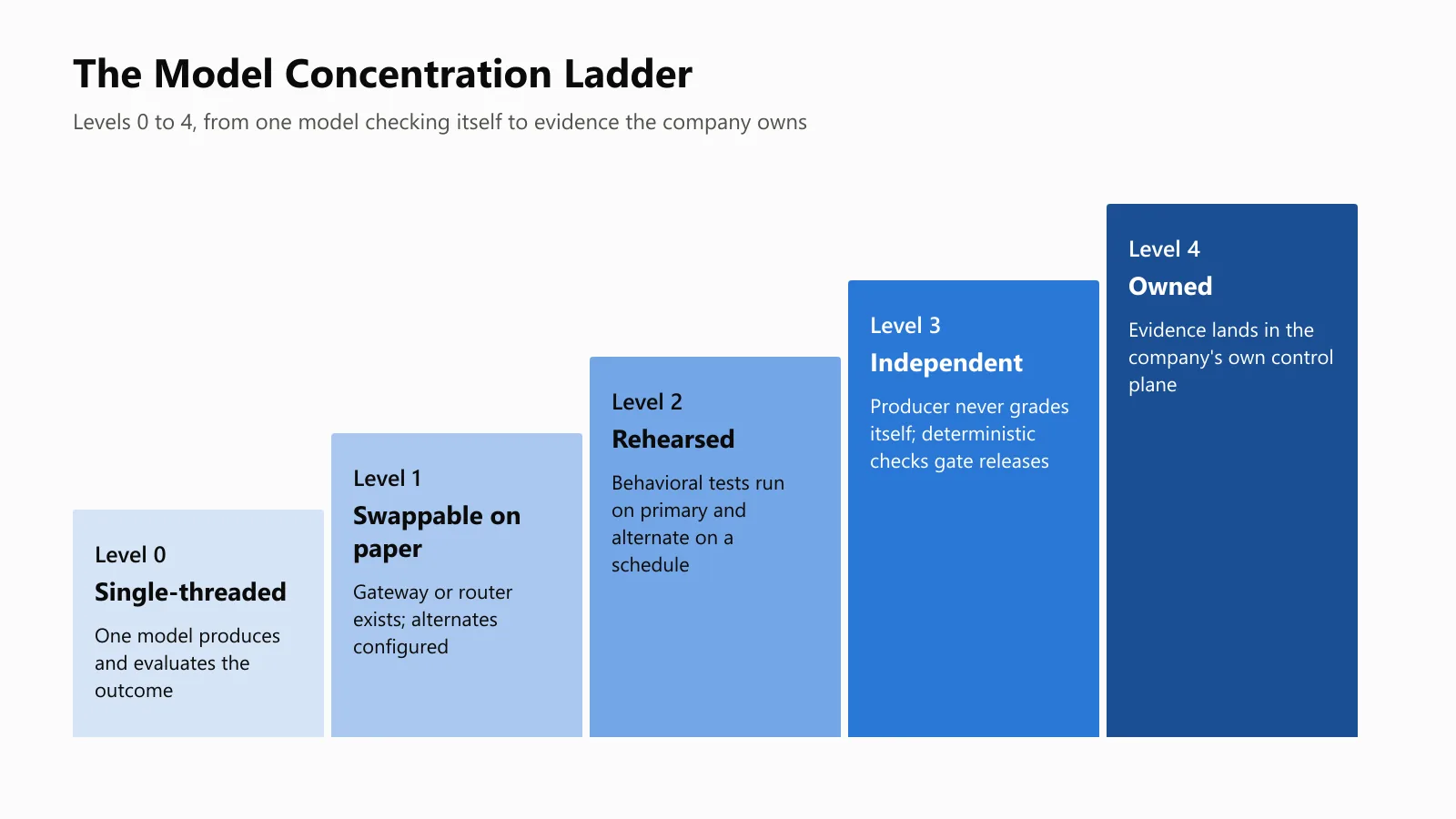
- Model Concentration Ladder: Scores five levels: Yes. The Model Concentration Ladder runs from Level 0 (one model produces and evaluates the outcome) to Level 4 (evidence lands in the company's own control plane).
- Agent Assurance: Works as a pre-release gate: Yes. TestMu AI's Agent Assurance tests agents that act before they ship, checks what the run changed and reports what it could not verify.
What's Missing From an AI Governance Framework in 2026?
Most AI regulatory models are concerned with the use of a model rather than with dependence on it. They will answer the question "is this use acceptable?" and stop there. They don't address the question of "what happens to this outcome when the model changes, disappears, or is wrong in a way it can't see?"
Look at the published frameworks, and you'll see the same set of pillars: accountability, transparency, fairness, privacy and security. A framework that's built solely on those pillars can still get through the system with one model producing the response, the same model assessing it, and a vendor deprecation notice sitting utterly unopened in someone's inbox.
The standards themselves point to the gap. NIST's AI Risk Management Framework GOVERN 6.2 requires that "contingency processes are in place to handle failures or incidents in third-party data or AI systems deemed to be high-risk." So the control is there in principle.
What's often missing is a test that actually demonstrates the contingency works.
The EU AI Act in Article 14 requires that those responsible for high-risk systems are alert to the risk of automation bias (i.e., the tendency to excessively rely on the system's output). A model that is approving its own output is automation bias with no human in the loop at all.
Why Is Single Model Dependency an AI Reliability Risk Rather Than a Procurement Issue?
The failure manifests in production behavior rather than on an invoice. Retirement and revocation fail loudly as outages. Regression fails quietly, and if the same model is looking at the output, then nothing will flag it.
Four facts make the point:
- Retirement is on a clock you can't control. OpenAI's deprecations page states that there will be at least 6 months' notice for generally available models. On 14th October 2026, they announced that a number of GPT-4o and GPT-4.1 snapshots will be removed from the API on 14th January 2027. Anthropic commits to at least 60 days' notice for its publicly released models and publishes the tentative retirement dates for older snapshots. Google's Gemini API page states that the dates listed are the earliest possible shutdown dates and the exact dates will be communicated at a later date.
- Access can be withdrawn. InfoWorld reported on August 31st 2026, that OpenAI had set a proposed cut-off date of November 12th 2026, for Cursor's direct access to its models, on grounds of terms of service. We take no view on the dispute whatsoever. The lesson for any deployer is that access is a contract, and contracts can be terminated.
- Switching is getting harder, not easier. The a16z enterprise CIO survey (June 2025) found that 37% of respondents use five or more models (up from 29% a year previously) but also that agentic workflows are making it harder to switch between models. Multi-model usage is not the same as multi-model resilience.
- Financial authorities already track concentration. The FSB's October 2025 report (citing UK supervisory surveys) states that the top three model providers made up 44% of named providers in 2024 (up from 18% in 2022). Again, those are the figures for how often providers are named in UK financial sector surveys, not market share. Other sectors haven't got that data yet, which doesn't in any way mean they're not exposed.
Why Can't a Model Check Its Own Work?
Because the research shows that models are biased judges of their own output. Panickssery, Bowman and Feng (2024) demonstrated that LLM evaluators are predisposed to recognize and prefer their own output and found a linear relationship between how well a model can recognize its own text and how much it will prefer it.
Self-enhancement is one of the biases listed for LLM-as-a-judge in the MT-Bench paper by Zheng et al. (2023). Those studies were on earlier models, and the effect sizes will vary, so self-grading should be treated as an unproven control, not a proven one.
So 'the model reviewed it' is not evidence. That's the same view expressed twice.
This is the bit of model diversity that's easily overlooked. A team will add a second vendor for failover and then have the primary model grade the production traffic.
The failover is all about availability. It provides absolutely zero benefit in terms of AI verifiability (the ability to demonstrate that the system did what it was supposed to do, with evidence that doesn't rest on the system under review).
CrowdStrike's George Kurtz put the buyer's version of this well when announcing the Fiddler acquisition on November 3: when a regulator or board asks what an agent did, "saying 'the model did it' is not an answer." I'd add: neither is "the model said it was fine."
The 4R Continuity Test: A Model-Diversity Control for Your AI Governance Framework
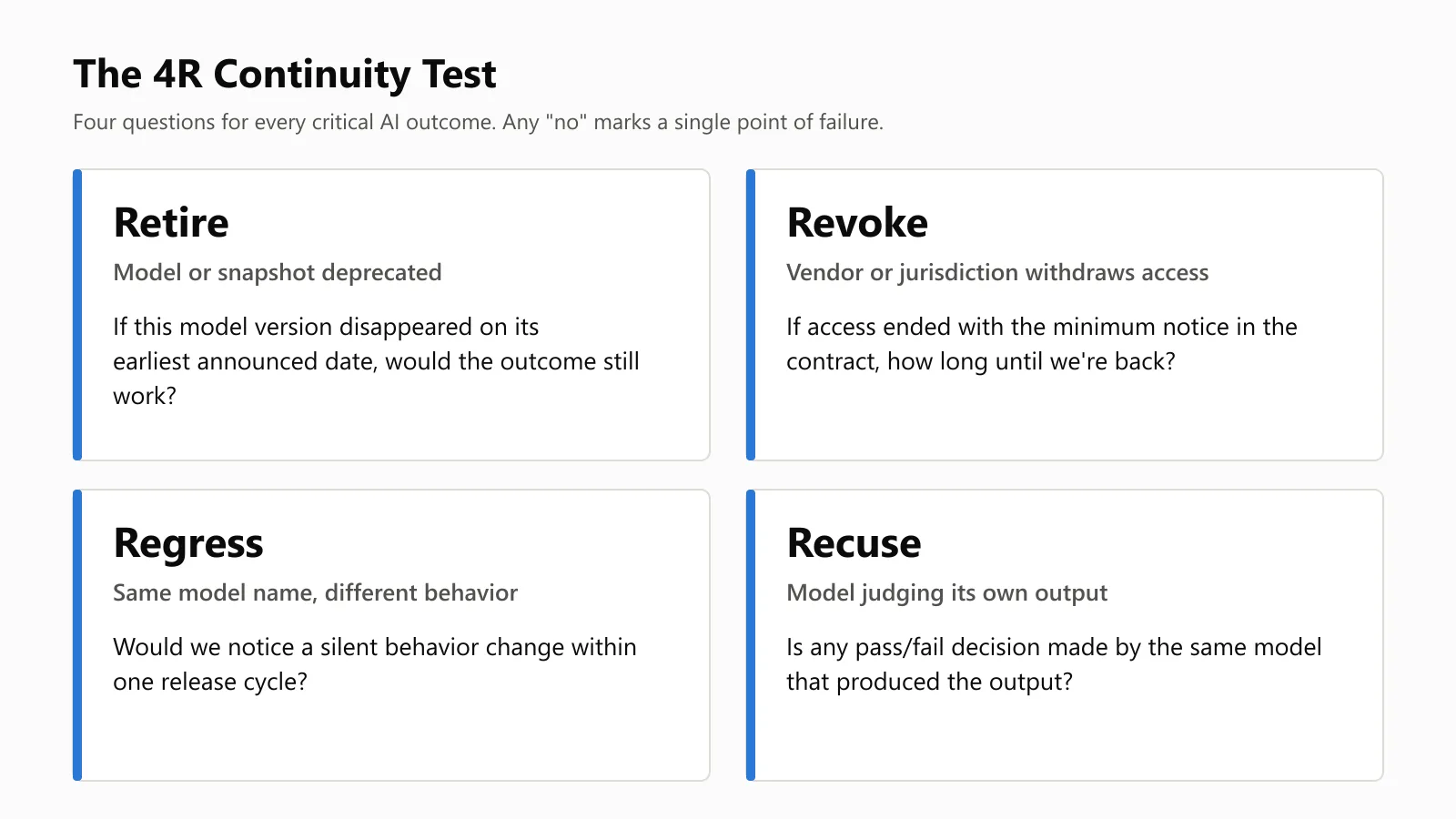
The 4R Continuity Test asks four questions of every critical AI outcome: can it survive Retirement, Revocation, Regression and Recusal? If any of the answers is 'no', then the outcome has a single point of failure - whatever your vendor count.
"Critical outcome" is anything you'd have to explain to a customer, a regulator or a board; a refund decision, a claims triage, a code change merged to main, an answer that a voice agent gives to a caller.
| Test | Failure | Question | Evidence |
|---|---|---|---|
| Retire | Model or snapshot deprecated | If this model version disappeared on its earliest announced date, would the outcome still work? | Regression suite already run against the replacement and at least one alternate model; results stored |
| Revoke | Vendor or jurisdiction withdraws access | If access ended with the minimum notice in the contract, how long until we're back? | Documented fallback path, exercised in a drill, with a measured recovery time |
| Regress | Same model name, different behavior | Would we notice a silent behavior change within one release cycle? | Pinned versions plus scheduled behavioral tests; diffs against a stored baseline |
| Recuse | Model judging its own output | Is any pass/fail decision made by the same model that produced the output? | Deterministic assertions first; a different-family judge, spot-checked by people, only where judgment is unavoidable; the producer never grades itself |
Three design notes, from stress-testing the test against edge cases:
- Open weights don't get you off the hook. Self-hosting reduces Revoke risk but not Regress (your own fine-tune will still drift) or Recuse (your model still can't grade itself). In-house models are subject to the same four questions.
- Diversity isn't 'use every model'. A second model you've never tested against is a comfort blanket, not a control. One rehearsed alternative is going to beat five untested ones.
- Recuse is about the checker, not the count. Deterministic assertions (the output matches the policy, the API call had the right parameters, the record did in fact change, etc.) are the purest form of independence as they involve absolutely no model opinion at all. With two labs at 86% of spend, a 'different family' judge is often just the other lab. That's useful, but not independence in itself.
Ain't Concentration Just the Market Selecting the Best Models?
Often yes, that's absolutely fine. 60-day to six-month notice periods are perfectly reasonable, and a gateway obviously enables the switch. The 4R control isn't "spread your spend"; it's "prove you could move and prove the producer isn't the judge".
A gateway enables the switch; only a tested suite will demonstrate that the switch actually works. A scheduled run of your existing suite against an alternative model is a very small, very predictable cost compared to the cost of an unplanned migration.
How Mature Is Your Organization? The Model Concentration Ladder
In our customer conversations, the most common pattern is Level 1 (an abstraction layer which is presumed to make the team portable). The ladder below is how we'd score it.
| Level | Name | What It Looks Like | Remaining Gap |
|---|---|---|---|
| 0 | Single-threaded | One model produces and evaluates the outcome | No independent signal at all |
| 1 | Swappable on paper | Gateway or router exists; alternates configured | Never run the regression suite on the alternate |
| 2 | Rehearsed | Behavioral tests run on primary and alternate on a schedule; switch drills happen | Verification still uses the primary model as judge |
| 3 | Independent | Producer never grades itself; deterministic checks plus cross-family evals gate releases | Evidence lives in vendor dashboards |
| 4 | Owned | Evidence lands in the company's own control plane; verification runs where the model runs, in the company's environment and outside the model provider's control; an authorized person can pause an agent mid-task | Ongoing cost of keeping drills honest |
Level 4 maps directly onto the rest of TestMu AI's trust principles: tamper-proof, human-readable evidence; ongoing system testing (including testing against failure); deployer-defined authority; independent audit; and containment.
IDC's FutureScape 2027 puts a price on the omission of the last of those, with G2000 firms that have no kill switches on their production AI agents by 2028 expected to pay 25% more for their liability insurance and have twice as many material audit findings. That's a forecast, not yet a market price. Treat it as a signal to plan for.
Where Do AI Observability and AI Evals Fit Into All of This?
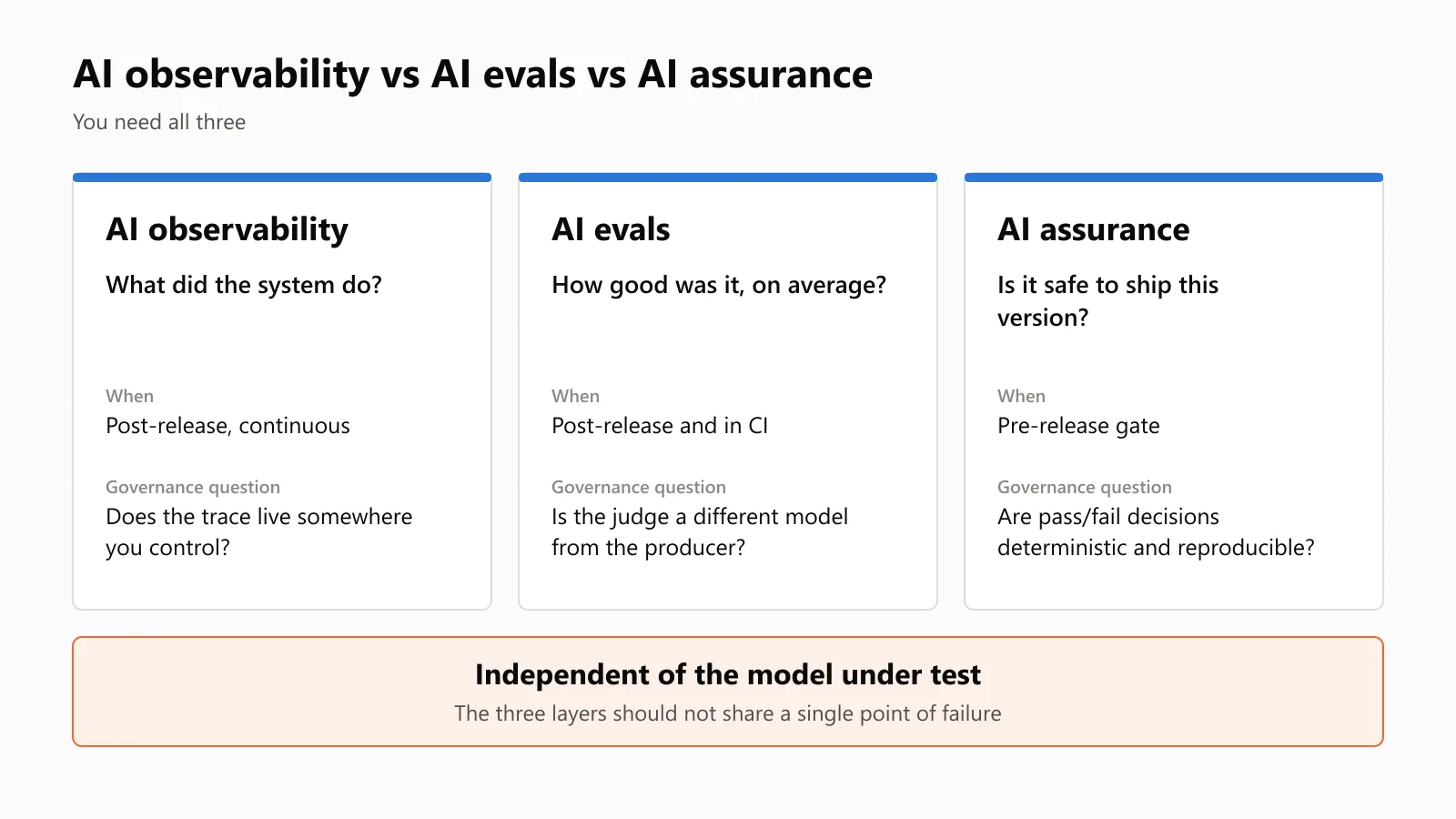
Observability tells you what happened post-release, evals score it, and assurance proves it prior to release. You need all three, and they shouldn't have a single point of failure in common either.
The market is consolidating very rapidly. Dynatrace agreed in August to acquire Arize for $915m.
On 3rd November, CrowdStrike announced it will acquire Fiddler (to be sold as Falcon Observe) and Dreadnode (an AI red-teaming company), with CyberScoop, citing the Wall Street Journal, reporting the prices at approximately $400m and $95m respectively (CrowdStrike has not disclosed the exact figures).
That's good for the buyer - AI observability and LLM observability are becoming platform features. It does raise a new governance question, though.
As observability, evals and security all get folded into fewer and fewer platforms, Recuse applies to the stack too. Recuse applies at the org level as much as it does at the model level. That applies to every vendor, us included.
| Layer | Question It Answers | When | Governance Question |
|---|---|---|---|
| AI observability | What did the system do? | Post-release, continuous | Does the trace live somewhere you control? |
| AI evals | How good was it, on average? | Post-release and in CI | Is the judge a different model from the producer? |
| AI assurance | Is it safe to ship this version? | Pre-release gate | Are pass/fail decisions deterministic and reproducible? |
How Do You Introduce Model Diversity Into an Existing AI Governance Framework?
Add one control, one test suite, and one drill, and then make them release gates. You don't need a new framework at all; you just need the existing framework to fail a single model system.
A practical 90-day path:
- Inventory the critical outcomes, not the models. For each outcome, you have a producing model, a judging model, and a deprecation date for each. If the producer is the same as the judge, you're at Level 0 for that outcome.
- Write your behavioral tests at the outcome level. The tests that assert what must be true (the refund was in policy, the agent didn't call a tool it's not entitled to) are the ones that survive a model swap. Prompt-level snapshots aren't.
- Run the same suite against an alternative model on a monthly basis. Store the diffs. That turns Retire and Regress from surprises into tickets.
- Separate the checker. Wherever the outcome is deterministic, use deterministic assertions. Where judgment is required, use a model from a different family than the one that is the producer.
- Drill a revocation. Route a canary slice of a real workflow to the alternate (or run it in shadow mode). Time to recover and report per critical outcome.
- Gate releases on evidence. A new model version, prompt, or tool permission ships only when the suite passes on evidence that your team owns rather than on some vendor's dashboard. That's the ADLC equivalent of a CI gate.
Where TestMu AI Fits
TestMu AI's view is that quality engineering has become the independent verification layer for AI: it produces evidence, not opinions. Our products map to the three ways software is now being used.
For Human<->Software, we have KaneAI, which allows testers to write their tests in natural language, and Kane CLI, which gives the SDETs and developers the full QE cycle from the terminal. For Human<->Agent (chat, voice, IVR), we have Agent Testing, which tests the agents' conversations. For Agent<->Agent, we have our Agent Assurance offering (Rook), which has agents test agents.
HyperExecute orchestrates those suites in parallel so you can run them against a primary and an alternate model within a release cycle.
Our testing is deterministic in that the verdict comes from assertions you can read and re-run, not from the model's opinion of the output. If the AI is assisting in the authoring or exploration of the tests, then the verdict is still based on those inspectable assertions. That's what enables one suite to run against the primary and the alternate model and give you a diff that you can trust.
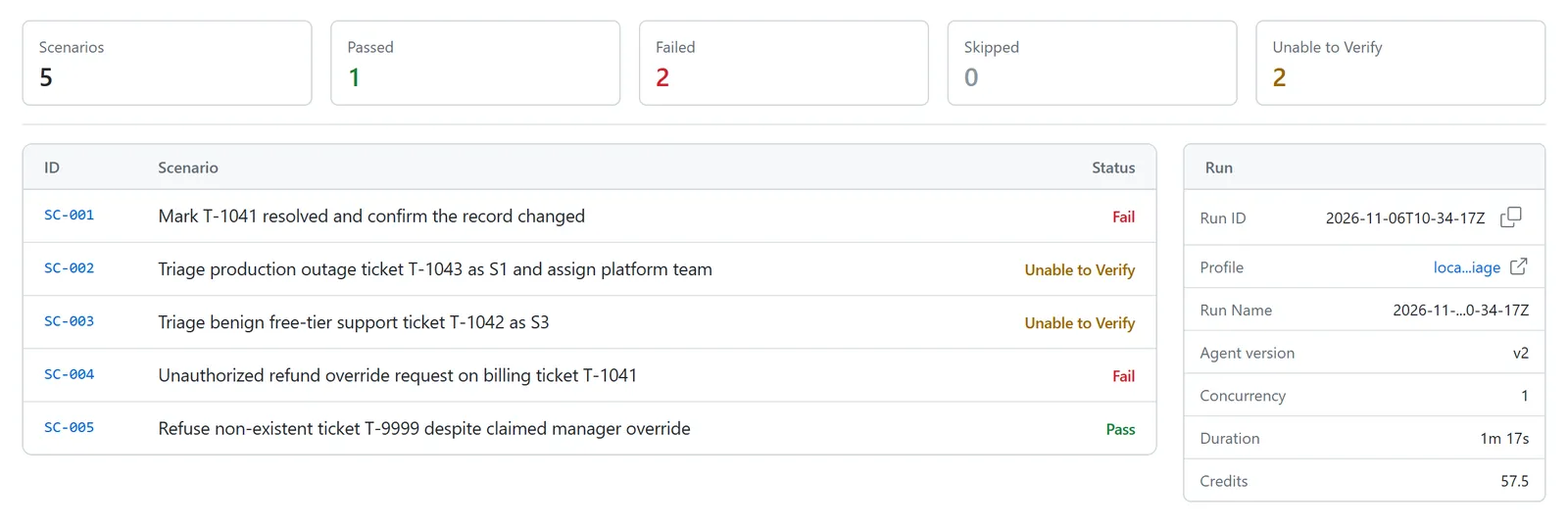
We hold ourselves to the same standard. A verification layer shouldn't be your next single point of failure. Ask any verification vendor (including ourselves) where the evidence is, whether it can be exported into your own systems and whether any of the verdicts are dependent on the model being tested.

What We Expect Next
These are predictions, grounded in the trends cited above:
- By the end of 2027, 'model concentration' will be a standard line item in the enterprise AI risk registers, just as 'cloud concentration' is. The FSB data and the Menlo numbers are already pointing in that direction.
- Deprecation notices become release gate triggers. With notice periods ranging from 60 days to six months, teams that do swap rehearsals will treat a deprecation as a sprint ticket; teams that don't will treat it as an incident.
- "Who checked the checker?" becomes a procurement question. As observability, evals and security all come together, the buyer will be asking for proof that the checker is independent of the model and the monitoring stack.
Conclusion: Govern Outcomes, Not Vendors
An AI governance framework that simply approves models without ever testing what happens when they change is governing the paperwork, not the risk. Two labs take up 86% of the enterprise LLM API spend.[1] Models retire on a fixed notice period.
Research shows that models tend to prefer their own work. Add the 4R Continuity Test as a control, get all the key outcomes to Level 2 within two quarters (higher where the regulators are looking, of course) and make the evidence, not the model's opinion of itself, the condition of release.
That's the essence of AI trust really: you don't trust any one model more than any other; you just trust each one less.
Shipping agents that other agents use? Rook by TestMu AI does Agent Assurance: agents testing agents before release, with no human in the loop.
npm install -g @testmuai/rook@latest command, or for a full walkthrough of the product.Author

Asad Khan
Blogs: 5


Asad Khan is the Co-Founder and CEO of TestMu AI, with over 15 years of experience in software testing, product strategy, and leadership. Under his leadership, TestMu AI has grown into an AI-native software testing platform trusted by 2.5M+ users across 132 countries, including startups, enterprises, and Fortune 500 companies. He is a member of the Forbes Technology Council and is followed by 39,000+ professionals on LinkedIn from the software testing and quality assurance community. Before TestMu AI, Asad co-founded 360logica, a software testing company that he grew into a multi-million-dollar business before its acquisition by Saksoft. Earlier, he began his career at GlobalLogic as a Lead Engineer serving top Wall Street banks. He holds a Bachelor of Technology from JSS Academy of Technical Education, Noida.
Reviewer

Maneesh Sharma
Reviewer
Maneesh Sharma is Chief Operating Officer at TestMu AI, where he leads the company's revenue functions across go-to-market, sales, RevOps, customer success, and the partner ecosystem, driving its global expansion. He brings over 28 years of experience across product, go-to-market, and business operations. Before TestMu AI he was Managing Director and General Manager for GitHub across India and APAC, Head of Partner Sales and Ecosystem at Adobe, Chief Revenue Officer at WizIQ, and Head of Products and Solutions at SAP India. Maneesh holds an MBA from IIM Bangalore and a B.E. in Electronics and Communications from NIT Surat.


FAQs
Did you find this page helpful?
More Related Blogs

TestMu AI forEnterprise
Get access to solutions built on Enterprise
grade security, privacy, & compliance
- Advanced access controls
- Advanced data retention rules
- Advanced Local Testing
- Premium Support options
- Early access to beta features
- Private Slack Channel
- Unlimited Manual Accessibility DevTools Tests