
E2E Testing for Chat, Voice, Phone and Video AI Agents
Run Thousands of Test Scenarios against Your Agent and Catch Hallucinations, Bias, and Toxicity Before Users Do.

Independent Verification and Validation (IV&V): What It Is and How to Apply It to AI Agents
IV&V is testing by a team independent of the builder. Learn the IEEE 1012 definition, the three types of independence, and how to apply IV&V to AI agents.
Published on:
Independent Verification and Validation (IV&V) is software testing carried out by a team that is technically, managerially, and financially independent of the team that built it (as per IEEE 1012). Verification is about checking that the product was built right; validation is about checking that it is the right product. For AI agents, this means testing the agent outside of its own platform against your requirements.
TL;DR
IV&V means a team that is independent of the builders checks that software was built right and that it is the right software. Independent verification and validation testing of an AI agent calls the deployed voice agent, chatbot or IVR from outside its own platform, against requirements the builder did not write, and keeps evidence a reviewer can audit.
What Does IV&V Stand For?
- IV&V meaning: Independent verification and validation, sometimes written as independent validation and verification. Verification checks that each build meets the requirements set for it, and validation checks that the finished product meets the mission and the user's real needs.
- IEEE 1012: The IEEE standard for system, software and hardware verification and validation. Its 2024 edition defines IV&V as verification and validation done by an organization that is independent of the developers in technical approach, management and budget.
- Independent verification: The checking team, not the builder, decides what to test, how to test it and when, then reports results the builder cannot edit, on a budget the developers do not control.
How Is IV&V for AI Agents Any Different From Evals?
- Platform evals: Testing tools built into an agent platform run and grade the agent on the same platform that hosts it, often at the text level. The Cognigy Simulator, for example, supports text-based conversations only.
- IV&V testing for AI agents: An external test layer calls the deployed agent over real phone lines, SIP endpoints or chat, runs one fixed suite across every platform and keeps recordings, transcripts and a pass/fail verdict. TestMu AI's Agent Testing works this way.
What Is Independent Verification and Validation (IV&V)?
Independent Verification and Validation (IV&V) is the practice of having a separate organization check that the software has been built correctly and that it is the right software. The IEEE 1012 standard defines IV&V as verification and validation "performed by an organization that is technically, managerially, and financially independent" of the development organization.
The two halves answer two different questions. NASA's IV&V Program puts it this way:
- Verification asks "Are we building the product right?" It's a check that what you've produced in each phase actually meets the requirements for that phase.
- Validation is all about 'Are we building the right product?' It's about making sure the product is in fact meeting the mission and the customer's needs.
IV&V puts the word 'independent' in front of both. The independent team decides what to test, how to test it, and when, and then reports what it finds without the builder having any opportunity to edit the result.
What Are the Three Types of Independence in an IV&V?
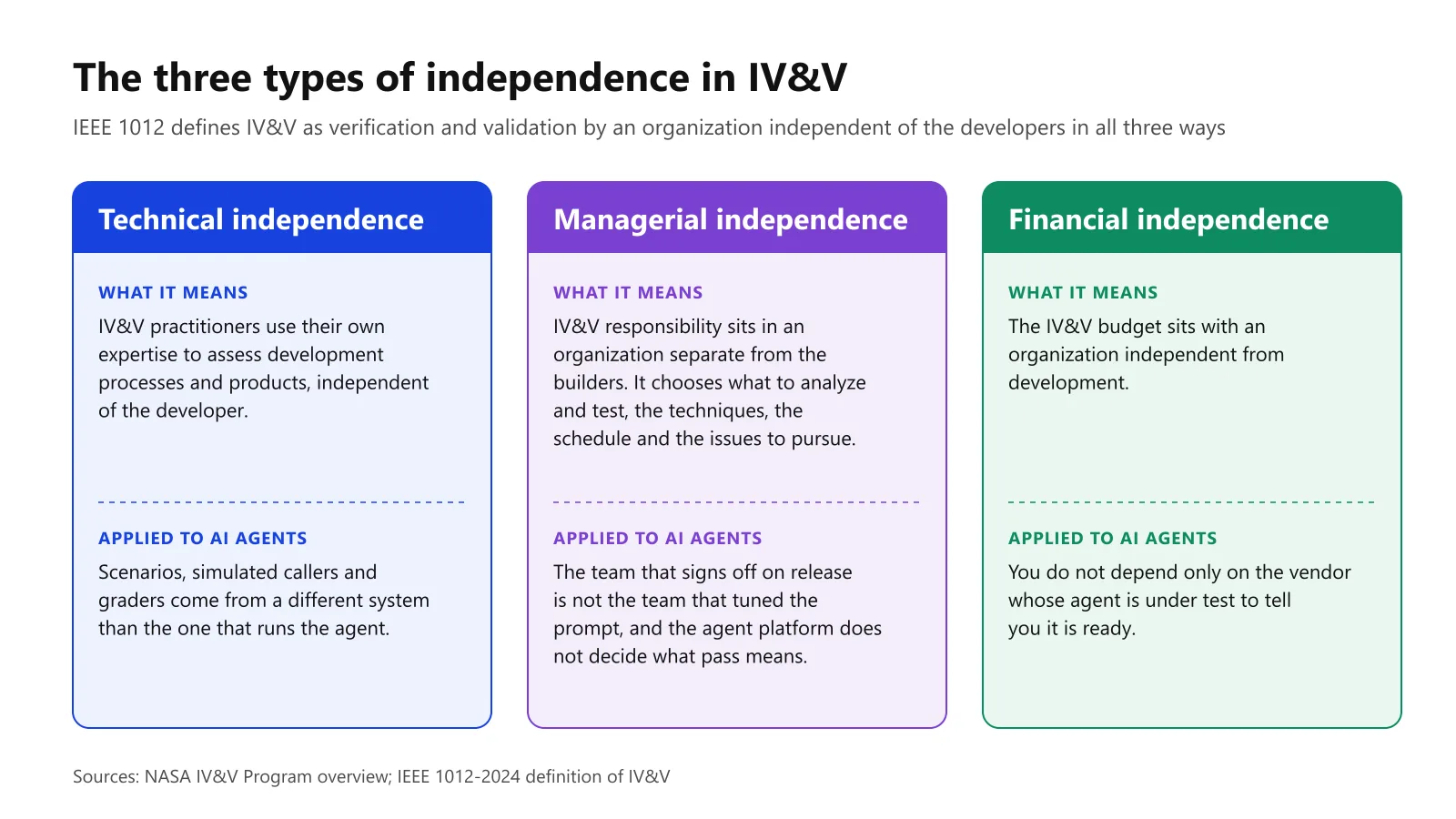
IEEE defines independence along three parameters. NASA describes each one:
| Type of independence | What NASA describes | What it means for AI agents |
|---|---|---|
| Technical | IV&V staff assesses development processes and products with their own expertise, independent of the developer. | Test scenarios, simulated callers, and graders come from a different system than the one that runs the agent. |
| Managerial | Responsibility for IV&V sits in an organization separate from the team that builds the system; the IV&V team chooses what to analyze, which techniques, the schedule and which issues to pursue. | The team that signs off on release is not the team that tuned the prompt, and the agent's platform does not decide what "pass" means. |
| Financial | The IV&V budget sits with an organization independent from development. | You do not depend only on the vendor whose agent is under test to tell you whether it is ready. |
How Is IV&V Any Different From V&V and In-House QA?
| Question | In-house QA | V&V | IV&V |
|---|---|---|---|
| Who does the work | The delivery team's own testers | Anyone, often the development organization | An organization separate from the developers |
| Who decides what to test | The delivery team | The development organization | The independent team |
| Who funds it | The project budget | The project budget | A budget the developers do not control |
| Main value | Fast feedback while building | Confirms the product meets requirements and needs | Removes the builder's blind spots and gives sponsors an unfiltered view |
Where Is IV&V Used?
IV&V is most prevalent in the space of applications where the cost of failure is very high indeed: space and defense software, large government IT programs and safety-critical systems. NASA has a dedicated IV&V program, and US agencies such as the Administration for Children and Families (ACF) will publish IV&V guidance for the systems that they fund. The same principle applies to AI agents that are talking to customers, as the platform that builds the agent is increasingly going to be the platform that tests it.
For a bit more on the two halves, see TestMu AI's guide to verification vs validation.
Why Is IV&V Relevant for AI Voice Agents and Chatbots at This Point in Time?
AI agent platforms now ship their own testing. That's good news for the builders, and it does raise a fairly legitimate question: if the platform that runs your agent also plays the caller, scores the call, and reports the score, who actually checks the platform?
Here is what four major platforms deliver as of 14 November 2026:
- Vapi offers Evals (text-based mock conversations which are checked by exact match, regex, an AI judge or tool call checks) and Simulations (an AI tester acts as the caller in chat or voice mode and is scored against success criteria). Vapi's own documentation states that Evals "do not test the voice, transcriber, audio quality, or turn-taking behavior". (Vapi Evals, Vapi Simulations)
- Retell AI offers simulation testing (scenarios saved as graded test cases), batch testing after every change, and Conductor, which will draft test cases, run batches, and report failures. You can hear the real audio via web and phone calls, but the Retell docs state "Only simulation testing grades a run" and "custom LLM agents can only be tested with a web or phone call." (Retell testing overview)
- NiCE Cognigy launched the Cognigy Simulator in January 2026, described as an 'AI performance lab' which runs synthetic customers against an agent and scores on task completion, guardrail adherence, integration reliability and experience quality. The Cognigy docs state that "The Simulator only supports text-based conversations". (NiCE press release, Cognigy docs)
- Genesys Cloud enables teams to test agentic virtual agents via the AI Studio preview widget, the Architect bot flow simulator for digital bot flows, and flow execution history with replay mode. (Genesys Cloud help)
Each of those tools is useful as you're building. None of them is in any way independent of the platform under test, and none of them purports to be.
That's precisely where IV&V fills the gap. It's a check that doesn't share the builder's runtime, simulator, or grader.
There's a second reason. Many organizations run multiple agent platforms. A contact center might have IVR on Genesys, a chat agent on Cognigy, and an outbound voice agent on Vapi or Retell.
You get four built-in test tools, which give you four different scoring systems that are very difficult to compare. An independent test layer can take the same set of requirements and run them against all of them.
How Do the Built-In Platform Testing Tools Stack Up?
This table sets out what each platform's own documentation states (checked 14th November 2026). "Not stated" means it's not mentioned on the public page, not that the feature is absent.
| Platform | Built-in testing tools | Channels tested | Tests agents on other platforms | Stated limits |
|---|---|---|---|---|
| Vapi | Evals, Simulations | Evals: text. Simulations: chat or voice | Not stated (suites run against Vapi "assistants or squads") | Evals "do not test the voice, transcriber, audio quality, or turn-taking behavior" |
| Retell AI | Simulation testing, batch testing, Conductor, LLM Playground | Simulation is graded. Web and phone calls give real audio but are not graded | Not stated | Custom LLM agents can only be tested with a web or phone call |
| NiCE Cognigy | Cognigy Simulator | Text only | Not stated (designed for agents in a Cognigy Project) | No voice; simulations support handoff to a flow only |
| Genesys Cloud | AI Studio preview widget, Architect bot flow simulator, replay mode | Digital bot flows | Not stated | Voice testing not described in the help article |
When Is a Platform's Own Built-In Testing Sufficient?
Built-in testing is the right tool for a lot of the work. Use it and add independent testing when you need to.
Built-in testing is usually enough when:
- You're prototyping one agent on one platform, and you just want some fast feedback as you're playing with the prompts.
- You need to check the exact tool call and its arguments at that one point. Vapi Evals are for that.
- You want to test how your Cognigy agent deals with third-party API failures. NiCE states that the Cognigy Simulator will emulate "the full range of third-party API responses, from clean paths to rare error conditions".
- The agent is internal, low risk, and not yet talking to any customers.
Add independent verification and validation when:
- The agent talks to the customer on the phone, and you need proof of how it actually sounds on the phone: the latency, the interruptions, the accents, the background noise, the keypad (DTMF) input and the transfers.
- You run agents across more than one platform and require a single scorecard.
- A release needs sign-off from someone other than the team that built it (QA, compliance, risk or a client).
- You switch models/prompt/platform and need the same tests before and after to see what's changed.
- You need evidence that a reviewer can open months down the line without having to log into the agent vendor's console.
What Does Independent Testing Add on Top of the Built-In Tools?
Independent testing for AI agents delivers five things that a platform's own toolset isn't set up to provide.
- A separate runtime. The test system makes the call/chat to the agent in the same way a customer would, from outside the platform. A built-in simulator that talks to the agent from inside the platform can bypass the phone number/carrier/routing layer where so many of the real call failures occur.
- One test suite across platforms. The same scenarios, personas and pass/fail rules can be run against a Vapi agent, a Retell agent, a Cognigy agent and a Genesys flow so the results are comparable.
- Real channels. Real phone calls through a phone number or SIP endpoint. Real audio. Real DTMF tones. Text-only simulators cannot tell you anything about how speech recognition will handle a caller on a noisy street.
- Requirements you own. Test specs are taken from your PRDs, your tickets and your policies, not from the agent config. That's the essence of technical independence: the test doesn't inherit the builder's assumptions.
- Evidence and a release gate. Each run concludes with recordings, transcripts and a pass/fail result, which can in turn block a deploy in CI (just as a failing unit test would block a code merge).
Isn't Every Testing Vendor "Independent"? How to Judge IV&V Providers
Being a third party is the starting point rather than the end point. A number of test vendors have already made the case.
Klearcom talks about "Independent voice assurance" and points out that an AI provider testing its own agent is "marking its own homework". Cyara refers to its new AI Trust Observability as a "vendor-neutral layer". Cekura states that you can "run the same scenarios across platforms and models".
So "we're neutral" does not separate one IV&V provider from another. These questions do:
| Question to ask | Why it matters |
|---|---|
| Does it cover every channel you run: voice, phone, IVR, chat, video, and your web and mobile apps? | One provider per channel means separate scorecards again. |
| Can the same test suite run unchanged against agents on different platforms? | That is what makes platform results comparable. |
| Where do test specs come from: your requirements, or the agent's own config? | Specs built from your documents keep technical independence. |
| Are tests repeatable, with fixed pass/fail criteria? | You need the same test on every release to see what changed. |
| What evidence does each run leave: recordings, transcripts, timestamps? | Evidence is what a reviewer, auditor or client can check. |
| Can the verdict block a release in CI? | IV&V that runs after launch only finds problems customers already hit. |
| What is its carrier and country reach? | Matters if your callers are spread across many countries. |
How Do TestMu AI, Cyara, Klearcom and Cekura Stack Up?
Based on the vendors' public pages as at 14th November 2026. TestMu AI publishes this guide, so read their entry with that in mind.
| Criterion | TestMu AI | Cyara | Klearcom | Cekura |
|---|---|---|---|---|
| Independence / cross-platform claim | Separate test platform; lists 25 voice and IVR platforms and 22 chat platforms it tests | "Vendor-neutral layer"; works across "any vendor's agents, including homegrown ones" | "Independent of any carrier, CCaaS or AI vendor" | Cross-platform benchmarks; partners include Vapi, Retell AI, ElevenLabs |
| Channels named | Chat, voice, phone (inbound and outbound), IVR, video and image agents | Voice, digital, messaging and conversational AI channels | AI voice agents, IVRs and phone numbers | Voice agents; also chat agents |
| Web and mobile app testing in the same platform | Yes (KaneAI, Real Device Cloud) | Not stated in sources checked | Not stated | Not stated |
| Where test specs come from | Auto-generates 60-100+ scenarios from PRDs, PDFs, DOCX, images, audio, video, or connected Jira and Confluence | Not stated in sources checked | Agents scored against the customer's own rules | Synthetic conversations; source not stated |
| Evidence per run | Downloadable recording and turn-labelled transcript with timestamped evidence | Each verdict tied to a conversation turn, with reasoning and timestamp | Not stated | Dashboards; detail not stated |
| Release gate | Go-Live Assessment (Green/Yellow/Red); continuous testing in CI | Material production failures become regression tests agents must pass before the next release | Conversations scored before launch and on a schedule after | Pre-release testing and regression checks (per customer testimonials) |
| Global carrier reach | Outbound Number Pool with masked numbers across 20+ country codes | Journey monitoring on 430+ carriers in 145+ countries | Local calls on 340+ carriers in 100+ countries | Not stated |
Sources:
- TestMu AI's Agent Testing
- TestMu AI agent platforms
- TestMu AI voice agent testing
- CMSWire on Cyara
- Klearcom
- Cekura
Where another vendor may be the better fit: if your primary requirement is in-country call testing across a large number of countries and carriers, then Klearcom and Cyara have a broader carrier footprint. If your requirement is for compliance scorecards mapped to the EU AI Act, HIPAA, PCI DSS and GDPR on 100% of live conversations, then Cyara has just announced that.
If you're in the market for a voice platform and you want provider benchmarks, then Cekura has those. TestMu AI's case is strongest when you want a single platform to cover voice, chat, IVR, and your web and mobile apps, with tests built from your own requirements and a verdict that gates your releases.
How Do You Do IV&V on an AI Voice Agent, a Chatbot or an IVR?
Independent verification and validation of an AI agent is exactly the same as IV&V of any other software: separate requirements, separate execution, separate verdict. The seven steps work regardless of whether the agent is running on Vapi, Retell, Cognigy, Genesys or a custom stack.
- What "correct" means is to write it down outside the platform. Get the PRD, the call scripts, the policy docs, the escalation rules, and the Jira tickets for the release. That's the source of truth. Not the agent's prompt.
- Turn requirements into fixed test scenarios. Each scenario should name the caller's goal, the persona, and the expected outcome (e.g., "caller asks to reschedule a delivery; agent confirms the new date and sends a confirmation"). Keep the scenarios and pass/fail rules exactly the same from release to release.
- Set your validation criteria before you do anything. Work out the rules up front: what disclosures are required, when you hand off to a human, what's the maximum latency, which routes the IVR menu must get to. That's how bias creeps in if you're deciding your pass criteria after you've seen the results.
- Get to the agent the way the customer does. Make real calls to the number or SIP endpoint, send real chat messages, press the real keypad tones. Vary the accents and background noise.
- Run the same suite on every platform that you use. If you're comparing Vapi against Retell, or moving an IVR from one CCaaS to another, the suite should be exactly the same.
- Keep the evidence. Keep the recording, the transcript with the timestamps, and the verdict for each scenario. Someone outside the build team should be able to go and look at a failure without having access to the agent vendor's console.
- Make the verdict a release gate. Run the suite in CI on every prompt, model, or flow change and block the release if it fails. Post-launch, do an analysis of the production recordings against the same criteria.
How Does TestMu AI's Agent Testing Support Independent Verification and Validation?
TestMu AI's Agent Testing tests chat, voice, phone, IVR and video agents that are running on a platform outside of TestMu. It can therefore act as an independent check. The feature names below are as they appear on the TestMu AI product pages.
- Scenarios from your requirements. Agent Testing automatically generates 60-100+ test scenarios from your uploaded PRDs, PDFs, DOCXs, images, audio and video, as well as from connected Jira and Confluence. Test Profiles and Personas contain reusable test data.
- Fixed pass/fail rules. Validation Criteria define the rules that each conversation is assessed against, with configurable pass/fail thresholds so the same criteria can be applied to every release.
- Real calls, real conditions. Live test calls will simulate inbound and outbound traffic with 200+ voice profiles covering 50+ accents and dialects, 15 background noise presets and DTMF keypad detection. IVR tests will check menus, routing, queues, and transfers and will return Pass, Fail or Unable to Verify for each expected route.
- Metrics for the words and the call. Chat and voice agents are scored on 9 Quality Metrics; phone agents on 30+ Call Metrics (e.g. First Call Resolution (FCR), intent recognition, containment rate, voice quality, speech-to-text accuracy).
- Evidence for every session. A downloadable recording and a turn-labeled transcript with timestamped evidence.
- A release gate. The Go-Live Assessment produces a Green, Yellow, or Red verdict. Continuous agent testing in CI compares each run against the previous one, and runs can be scheduled using cron expressions.
- Cross-platform coverage. TestMu AI's agent platforms page lists 25 voice and IVR platforms and 22 chat platforms. These include Vapi, Retell AI, Cognigy (chat scoring and live calls into a Cognigy Voice Gateway SIP endpoint), and Genesys Cloud CX.
- After launch, Production Recording Analysis will check the uploaded call recordings against the same criteria.
- One vendor for the rest of the stack. The same company provides the web and mobile app testing via KaneAI and the Real Device Cloud, so you don't need separate vendors for agent testing and app testing.

For channel details, see voice agent testing and IVR testing with real phone calls.
Conclusion
Pick one customer-facing agent, usually the one on your main phone line, and write its pass/fail rules from your PRD, policies and tickets before the first run. Keep the platform's built-in tests for fast feedback while you build, and run one independent suite against the deployed agent before each release.
The guide to testing your first AI agent shows how to connect an agent to Agent Testing.
Testing an AI agent? TestMu AI's Agent Testing validates chat, voice and IVR agents before your customers talk to them.
Author

Chaitanya Sharma
Blogs: 23

Chaitanya Sharma is an AI Product Manager at TestMu AI, where he builds agentic AI capabilities focused on computer vision and multi-modality, moving testing beyond static script execution toward autonomous, agent-driven workflows. Before TestMu AI he shipped 135+ features at Sprinklr for a no-code community and website builder used by Fortune 500 enterprises including Dell, Samsung, and Polestar. At Policybazaar he led the zero-to-one launch of a digital lending and insurance marketplace embedded in Bahrain's dominant payments app, building a risk-intelligence engine that compressed loan-approval times by 80%. He explored machine learning and NLP through research at the University of Cambridge, and holds a B.Tech from Delhi Technological University.
Reviewer

Sirajuddin Khan
Reviewer
Sirajuddin Khan is Vice President of Product Management at TestMu AI, where he drives the company's agentic AI product strategy, building a suite of autonomous agents that includes Agentic Browsers and Agentic Visual Testing and shifting the unit of work from test execution to autonomous outcomes. One of the company's earliest product leaders, he has owned the roadmap for the high-performance execution cloud and grew the cross-browser testing products from early adoption to market leadership. He brings over a decade of experience across SaaS, B2B, and eCommerce, with earlier product roles at Wydr and ShopClues, where his catalog and search work cut delivery SLAs and lifted seller activity. Sirajuddin holds an MBA in Information Technology from Sikkim Manipal University and a B.Tech in Computer Science Engineering from Maharshi Dayanand University.


IV&V FAQs
Did you find this page helpful?
More Related Learning Hubs

TestMu AI forEnterprise
Get access to solutions built on Enterprise
grade security, privacy, & compliance
- Advanced access controls
- Advanced data retention rules
- Advanced Local Testing
- Premium Support options
- Early access to beta features
- Private Slack Channel
- Unlimited Manual Accessibility DevTools Tests