

Power Your Software Testing with AI Agents and Cloud
The Native AI-Agentic Cloud Platform to Supercharge Quality Engineering. Test Intelligently and Ship Faster.


- TestMu AI (Formerly LambdaTest)
- /
- Learning Hub
- /
- Crowdsourced Testing
Crowdsourced Testing: What It Is, How It Works, and When to Use It (2026)
Crowdsourced testing distributes quality assurance across real users, real devices, and real network conditions worldwide. It extends your QA capacity without adding headcount.
Last Updated on:
Crowdsourced testing distributes quality assurance across real users, real devices, and real network conditions worldwide. It extends your QA capacity without adding headcount. You will also see it called crowdtesting, crowd testing, crowd-sourced testing, or crowdsourced QA: these are the same practice under different names, and this guide uses them interchangeably. This guide covers what crowdsourced testing is, how the process works, its types, top platforms, benefits, challenges, and how it fits into a modern quality engineering strategy.
Overview
To validate software under real-world conditions, use crowdsourced testing platforms like Applause for managed enterprise QA or TestMu AI for automated cross-browser and real device cloud testing. These platforms distribute functional, usability, and localization testing to global networks of vetted testers using their own physical devices.
- Best for managed enterprise QA: Applause matches companies with vetted global testers, handles testing logistics, and provides managed QA services that evolved from uTest's original crowdsourced marketplace.
- Best for on-demand functional testing: test IO connects organizations with a vetted network of external testers to execute exploratory and functional test cycles on real devices under real-world conditions.
- Best for device and demographic variety: Testbirds matches companies with a curated global tester pool to run usability and compatibility tests across thousands of manufacturer, chipset, and OS combinations.
- Best for mobile and web app testing: Testlio provides access to a vetted network of freelance QA professionals who execute structured and exploratory test cycles on their personal devices.
- Best for global localization and usability: Ubertesters matches companies with vetted international testers to validate regional formatting, language accuracy, and real-world network performance across different locations.
- Best for automated real device testing: TestMu AI offers a Real Device Cloud with access to 10,000+ real Android and iOS devices and 3,000+ browser combinations, featuring network simulation and geolocation testing.
- Best for crowdsourced security testing: Bugcrowd operates a bug bounty model where vetted security researchers are paid per validated vulnerability to identify security risks and compliance flaws.
What Is Crowdsourced Testing?
Crowdsourced testing is a QA method that uses a distributed global network of testers to evaluate software under real-world conditions.
Crowdsourced testing (also called crowd testing or crowdtesting) relies on external testers who bring their own devices, operating systems, browsers, and network environments. A crowdsourced testing platform connects organizations with this distributed workforce, assigns test cycles, and consolidates results into actionable reports. Crowd Testing is a manual testing effort.
Testers are typically freelance QA professionals or domain-specific users recruited through a third-party vendor. They execute test scenarios that mirror actual end-user behavior across real-world conditions.
Companies like Microsoft, Airbnb, PayPal, and Netflix actively use crowdsourced testing to validate their products across global markets.
The global crowdsourced testing market reached $1.76 billion in 2025 and is projected to grow to $3.6 billion by 2032 at a CAGR of 10.8%, according to Fortune Business Insights.
How Crowdtesting Evolved
Crowdtesting is the commercial form of something software companies did informally for decades, and the history explains why modern platforms look the way they do.
From Beta Programs to a Named Business Model
The original crowd was a beta program. Software shipped on disks, so companies mailed media to volunteers and collected reports by post or phone. It was slow, but the insight was already there: people outside the building, on their own hardware, find problems the team cannot. Microsoft's Windows 95 preview program proved it at scale, distributing pre-release builds to hundreds of thousands of outside testers.
Broadband made it practical, collapsing distribution and feedback from weeks to hours, and in June 2006 journalist Jeff Howe gave the pattern a name in Wired: crowdsourcing, distributing work to an undefined network rather than a designated employee. The naming mattered, because once the pattern had a label, businesses could be built on it explicitly. uTest launched in 2007 as a marketplace connecting companies with paid external testers, rebranding to Applause in 2013 as the model matured into managed enterprise QA, while organizations such as Crowdsourcing Week formalised the wider movement.
Mobile Made It Necessary, and Curation Made It Usable
Crowdtesting became necessary rather than clever when smartphones fragmented the device landscape. A web app had to work on a handful of browsers; a mobile app had to work across thousands of combinations of manufacturer, chipset, OS version, and carrier network that no internal device lab could own or keep current. This is the decade the specialists arrived, Testbirds, Testlio, and Ubertesters among them, with a simple pitch: your users already own every device you cannot afford to buy.
The open crowd then largely gave way to the vetted network. Anyone-can-join marketplaces produced volume, duplicates, and uneven reports, so leading platforms now screen, score, and match testers, which is closer to an on-demand global QA department than a crowd in the original sense. The tooling matured with it: SDK integration pulls bug reports straight from inside the app with session and device data attached, and platforms feed Jira and CI/CD directly. The word survives, but what enterprises buy today is a managed, vetted, instrumented network.
How Does the Crowdsourced Testing Process Work?
The process follows five stages: scope definition, tester recruitment, test execution, bug reporting, and iterative analysis.
1. Define Testing Scope and Objectives
The process begins with clearly defined goals. Teams specify which features, platforms, device types, geographies, and testing types (functional, usability, localization) they need coverage for. Clear scope prevents unfocused testing and ensures the results are actionable.
2. Recruit and Match Testers
The platform selects testers from its global pool based on device ownership, geographic location, language fluency, domain expertise, and past performance ratings. Leading platforms vet testers through skills assessments and maintain quality scores to ensure consistency across test cycles.
3. Execute Test Cycles
Testers run predefined test scenarios and conduct exploratory testing on their personal devices. Because they operate from actual environments (home networks, carrier connections, real hardware), they encounter issues that controlled lab setups typically miss. Tests run across multiple time zones simultaneously, which compresses timelines significantly.
4. Report and Triage Bugs
Testers submit structured bug reports with reproduction steps, screenshots, screen recordings, device metadata, and severity classifications. Duplicate detection and triage happen at the platform level to reduce noise before results reach the development team.
5. Analyze, Fix, and Iterate
Development teams prioritize fixes based on severity and frequency. A regression testing cycle confirms that fixes resolve reported issues without introducing new defects. This loop repeats until the product meets release quality standards.
What Are the Different Types of Crowdsourced Testing?
Crowdsourced testing covers functional, usability, security, localization, compatibility, accessibility, and performance testing.
The type of crowd testing you need depends on your product stage, target audience, and release goals.
| Testing Type | What It Validates | When to Use It |
|---|---|---|
| Functional | Core features work as specified across environments | Pre-release validation of new features or updates |
| Usability | Navigation flows, UX clarity, and task completion rates | Before major redesigns or new user journeys |
| Compatibility | Consistent behavior across browsers, devices, and OS versions | Expanding to new platforms or device categories |
| Localization | Language accuracy, cultural relevance, regional formatting | International launches or multilingual rollouts |
| Security | Vulnerabilities, data exposure risks, access control flaws | Post-development audits or compliance checks |
| Accessibility | WCAG compliance, screen reader support, keyboard navigation | Before public launch or regulatory deadlines (EAA, ADA) |
| Performance | Load times, responsiveness, stability under varied conditions | Pre-launch stress testing or post-update validation |
| Exploratory | Unpredictable edge cases and undocumented behavior | Supplement scripted tests with unscripted real-world usage |
For teams that need browser-specific validation at scale, cross browser testing on a cloud platform like TestMu AI provides access to 3,000+ browser and OS combinations.
Crowdsourced Testing Use Cases by Industry
The case for crowd testing is usually industry-specific, because the reason you cannot test something in-house differs by vertical. In each case below the blocker is the same: the condition you need to test does not exist in your office.
E-commerce: Payment and Checkout Flows
Checkout is where e-commerce testing gets hard, because the payment stack changes by country. A flow built against a global gateway such as Stripe can work perfectly in the United States and fail where shoppers expect a local method: iDEAL in the Netherlands, UPI in India, Pix in Brazil, Alipay in China. You cannot validate that from one office, because it needs a real bank account, a real card, and a real phone number in that country. Crowd testers already have all three, which is the whole argument.
- Localized payment methods: Confirm regional gateways and wallets complete a real transaction end to end, not just that the API returned a success code.
- Regional formatting: Currency, tax, address validation, and date ordering that match local expectations rather than your default locale.
- Checkout abandonment triggers: Real shoppers reveal where a flow becomes annoying enough to quit, which no assertion measures.
Gaming: Device Performance and Multiplayer Load
Games fail on real hardware in ways a lab cannot reproduce. A title that runs smoothly on the flagship phones in your office will thermally throttle on a mid-range Android after fifteen minutes, dropping frame rates exactly when a session gets interesting, and that defect is invisible to any test not involving a real chassis getting genuinely hot. Multiplayer compounds it: matchmaking and synchronisation only behave realistically when actual players connect from actual networks in different regions at once.
- Device-specific performance: Frame rates, thermal throttling, battery drain, and GPU quirks across the long tail of real hardware.
- Multiplayer load and latency: Concurrent players across regions exercising matchmaking under genuine network conditions.
- Localization and store compliance: Translated UI in constrained layouts, plus age-rating rules that differ by market.
FinTech: Compliance and Regional Banking Rules
FinTech carries a constraint the others do not: getting it wrong is a regulatory event, not a bad review. Strong Customer Authentication under PSD2 changes what a compliant payment flow looks like in the European Union, and KYC onboarding depends on identity documents and bank integrations a tester outside that country cannot supply. This is where vetted crowds matter more than large ones, because testing a banking flow means handling real financial credentials, so tester screening, NDAs, and certifications stop being procurement box-ticking.
- Regional regulatory flows: SCA and 3-D Secure step-ups, consent screens, and disclosures as a local user actually sees them.
- KYC and onboarding: Identity verification against real local documents and national ID formats.
- Local bank integrations: Account linking and transfers against banks that only exist in that market.
One clarification, since the categories get conflated: crowdsourced security testing is a separate discipline with its own platforms, such as Bugcrowd, where security researchers are paid per validated vulnerability under a bug bounty. Different contract, different skill set, different risk model from the functional and usability crowd testing covered here.
What Are the Benefits of Crowdsourced Testing?
Crowdsourced testing delivers real-world coverage, faster bug detection, cost efficiency, and scalable global test capacity.
1. Real-World Device and Environment Coverage
Crowd testers use their personal devices on their actual networks. This produces test coverage that mirrors production conditions.
But individual testers cannot cover every device and OS combination your users depend on. To increase device coverage without increasing cost, platforms like TestMu AI offer Real Device Cloud with access to 10,000+ real Android and iOS devices for both manual and automated testing.
It comes with the following Capabilities:
- Network Condition Testing: Simulate 2G/3G/4G/5G, offline mode, and custom bandwidth configurations to validate app behavior under real network constraints.
- Geolocation Testing: Test from 170+ countries with IP-based geolocation and GPS coordinate injection to validate language, currency, and region-specific content.
- Device Security: SOC 2 Type II certified with fully isolated sessions, automatic device wipe between tests, and TLS 1.3 encryption in transit.

2. Faster Parallel Execution
Hundreds of testers working simultaneously across time zones compress test cycles from weeks to hours. A feature that would take a 5-person in-house team two weeks to validate across 50 device configurations can be covered by 100 crowd testers in a single day.
3. Cost Efficiency at Scale
Organizations pay for testing output (bugs found, test cycles completed) rather than maintaining headcount. This eliminates recruitment, training, device procurement, and infrastructure costs. Crowd testing scales up for major releases and scales down during quieter phases.
4. Unbiased User Perspective
External testers have no internal assumptions or familiarity bias. They navigate the product as first-time users, which surfaces usability issues, confusing workflows, and broken edge cases that in-house teams consistently overlook.
5. Global Localization Validation
Testers in specific regions validate that language, currency, date formats, and cultural elements render correctly in their local context. This is significantly more reliable than centralized localization QA performed by a single team from one geography.
Why Automation Alone Is Not Enough
Automation is not weak here; it is aimed elsewhere. An automated test asserts what somebody told it to assert, which makes it excellent at proving the product still does what you said it should, and structurally incapable of noticing that what you said was a bad idea. Automation answers "does this match the spec?" A human answers "is the spec any good?" No amount of coverage converts the first question into the second, and the defects that gap leaves behind all share a signature: every test is green and the experience is still wrong.
- Visual regressions that pass every assertion: A button shifted forty pixels, a font fell back, a modal renders behind the header. The element is present, the handler fires, the test passes. Pixel-diffing detects that something changed, not whether the change is bad, and a human still decides whether the diff is a defect or the redesign you asked for.
- Confusing journeys that complete successfully: A script finds the checkout button by selector in milliseconds and proves nothing about whether a person can find it. Task success is guaranteed by construction, because the test was written by someone who already knew the answer.
- Real-world interference: A call arrives mid-payment, battery saver throttles the CPU, a notification covers the confirm button, the keyboard hides the field being typed into. These are the conditions your users are in and your CI environment never is.
- Judgment calls with no assertable answer: Whether a translation is accurate but reads as rude, whether an error message tells a frightened user what to do next, whether a loading state feels broken at three seconds. There is no selector for insulting.
The Gap Widens in the Age of AI
AI-assisted development sharpens this rather than solving it. Teams now generate code faster than they can reason about it, so more surface area reaches users per sprint while the number of humans who have actually looked at the result stays flat. The failure mode of generated output is also precisely the one automation is worst at catching: AI produces plausible work, an interface that looks right, uses the correct components, and passes type checks while quietly making no sense for the task. That is not a crash and not a failed assertion. It is a judgment defect, and it is invisible to a check generated from the same misunderstanding, which is the trap in having AI write the tests for AI-written code: both encode the same wrong assumption and agree with each other.
So human intuition has become more valuable as generation has become cheaper, not less. When producing a plausible-looking feature costs almost nothing, the scarce thing is somebody noticing it is wrong. A crowd supplies that before release, from the devices and contexts your users occupy. For how this layer sits alongside your automated suite rather than competing with it, see the QA strategy section below.
What Are the Challenges of Crowdsourced Testing?
Key challenges include tester quality variance, IP security risks, communication overhead, and inconsistent bug reports.
1. Tester Quality Variance
Not all testers deliver the same quality. Platforms that rely on unvetted, open-access crowds risk low-value reports. Choose a vendor with rigorous vetting, skill assessments, and ongoing performance ratings to mitigate this.
2. Intellectual Property and Data Security
Sharing pre-release software with external testers introduces IP exposure risk. Leading platforms address this through NDA enforcement, device-level security controls, watermarked builds, and restricted distribution channels. Evaluate the vendor's security posture before onboarding.
3. Communication and Coordination Overhead
Managing distributed testers across time zones requires clear documentation, structured test plans, and responsive project management. Without well-defined scope and acceptance criteria, teams receive unfocused results that consume more time to triage than they save.
4. Duplicate and Low-Signal Bug Reports
Large tester pools can generate duplicate submissions and reports that lack reproduction detail. Effective platforms implement deduplication logic, mandatory structured fields (steps to reproduce, expected vs actual behavior, device info), and tester ranking systems to filter noise.
How Does Crowdsourced Testing Compare to In-House and Outsourced Testing?
Crowdsourced, in-house, and outsourced testing differ in scale, cost, control, and real-world coverage.
| Factor | In-House Testing | Outsourced Testing | Crowdsourced Testing |
|---|---|---|---|
| Team | Internal FTEs with deep product knowledge | Dedicated external teams under contract | Distributed global freelancers on-demand |
| Scalability | Limited by headcount and budget | Scales with contract scope | Highly elastic, instant scale up/down |
| Device Coverage | Restricted to device lab inventory | Dependent on vendor's lab | Thousands of real personal devices |
| Cost Model | Fixed (salaries, infrastructure) | Contract-based (T&M or fixed bid) | Pay-per-use (bugs, cycles, hours) |
| Speed | Sequential, limited parallelism | Moderate, depends on team size | High parallelism across time zones |
| Control | Full direct control | SLA-governed, moderate | Platform-mediated, less direct |
| Real-World Accuracy | Low (lab conditions) | Low to moderate | High (real users, real environments) |
| Best For | Core product logic, security-sensitive | Specialized testing, compliance audits | Device coverage, localization, UX |
The most effective QA organizations combine all three: in-house depth for business-critical logic, outsourced specialists for compliance, and crowdsourced testing for breadth, speed, and real-world coverage.
Which Are the Top Crowdsourced Testing Platforms?
Leading crowd testing platforms include Applause, test IO, Testbirds, Global App Testing, Testlio, and Ubertesters.
The crowdsourced testing market includes both fully managed platforms and self-service models. Each platform differs in tester pool size, vetting rigor, supported testing types, and pricing. Here are six established platforms actively used by enterprises.
1. Applause (formerly uTest)
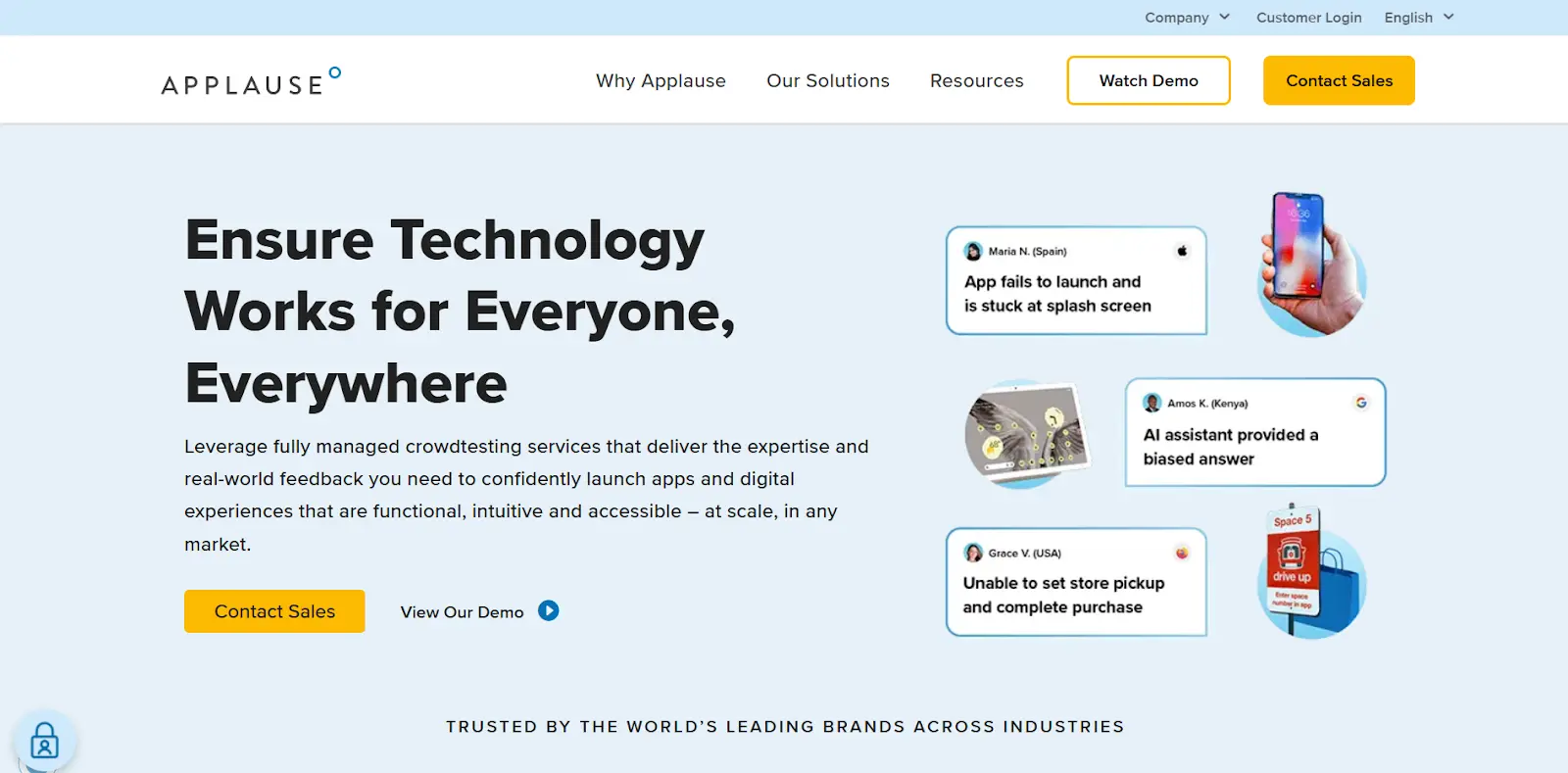
Applause is the largest crowd testing platform with over one million testers across 200+ countries. Fully managed model with dedicated project managers.
- Testing Coverage: Functional, payment, accessibility, localization, and IoT testing across web and mobile.
- Security Controls: Enterprise-grade NDA enforcement, SOC 2 compliance, restricted build distribution.
- Integrations: Jira, Slack, and CI/CD pipelines.
- Clients: Google, Ford, Fox, Dow Jones.
2. test IO (by EPAM)
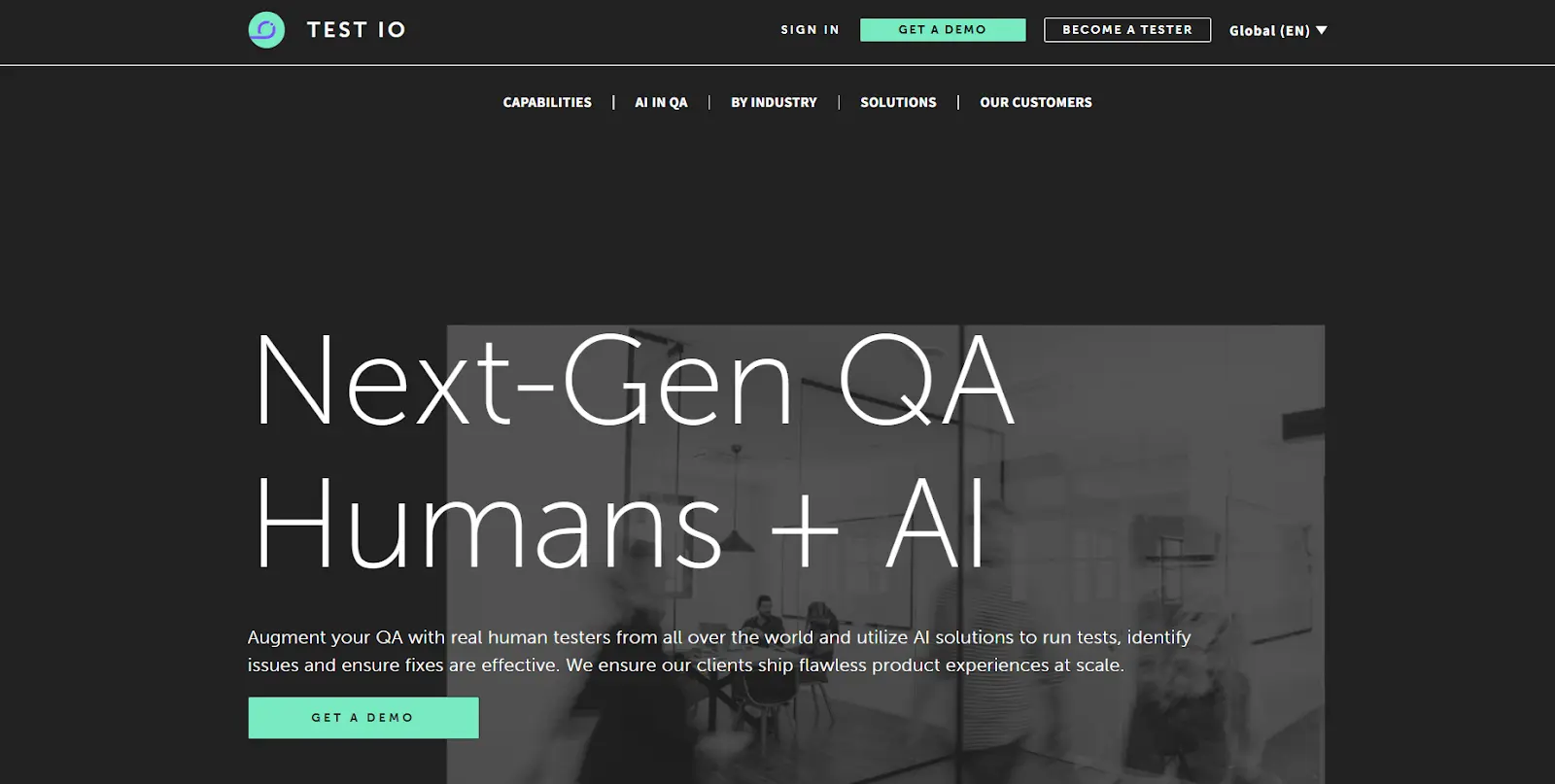
test IO focuses on rapid, on-demand bug detection with fast turnaround. Built for Agile and DevOps teams that need crowd testing inside sprint workflows.
- Tester Quality: Performance-rated testers auto-assigned to each engagement based on quality scores.
- Integrations: Native Jira, GitHub, and CI/CD integration for direct bug-to-backlog workflows.
- Bug Reporting: Structured exploratory testing with dev-ready bug reports, screenshots, and device metadata.
3. Testbirds
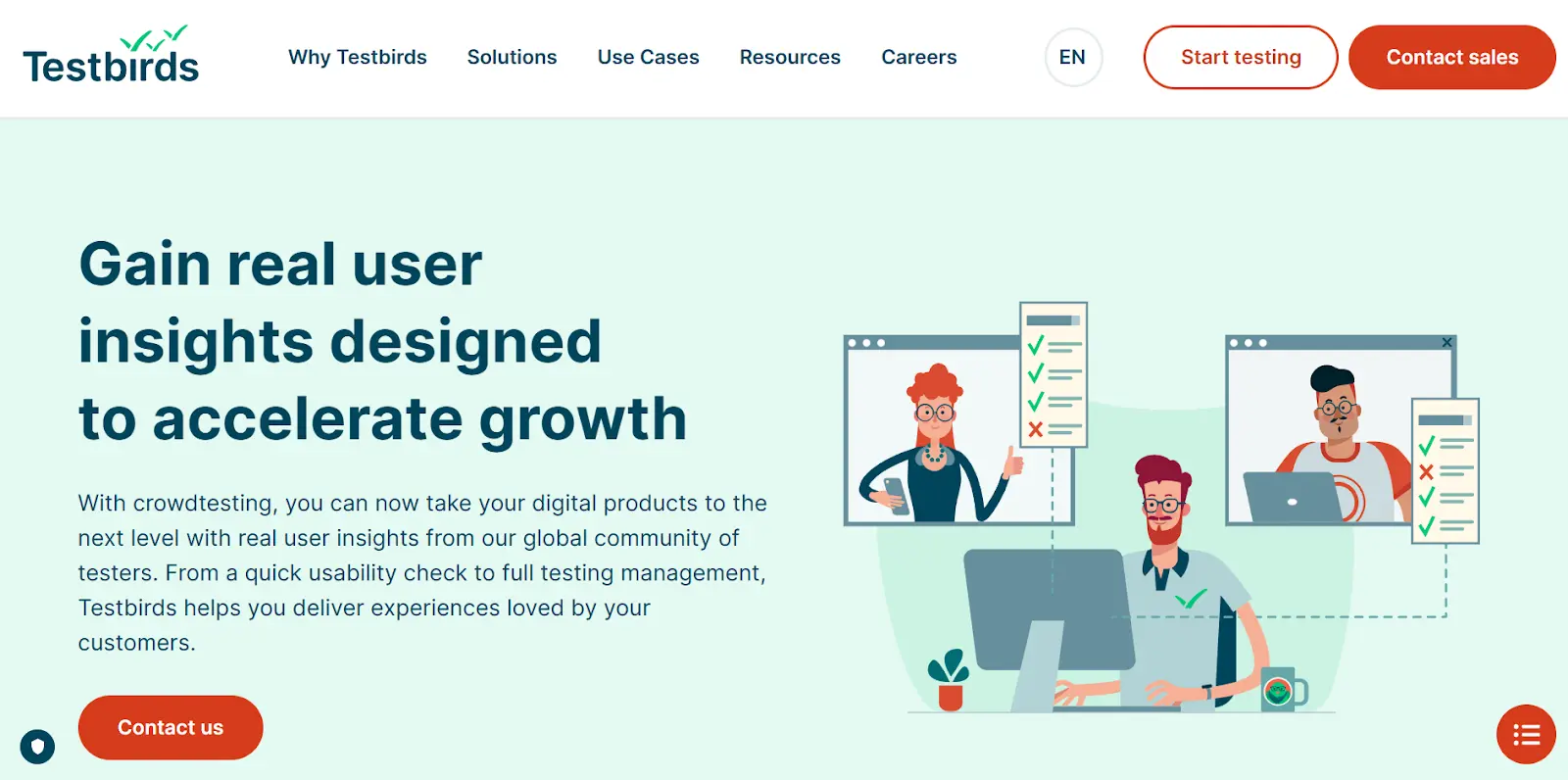
Testbirds is a Munich-based platform with a strong European footprint, focused on customer experience and journey testing rather than defect counts alone. Useful when your priority is EU market coverage and compliance.
- Journey Testing: Customer Journey Testing across online and offline touchpoints.
- Accessibility: European Accessibility Act (EAA) compliance testing.
- Language Testing: Chatbots, voice assistants, and conversational AI.
- Clients: BMW, Audi, Deutsche Telekom, Allianz.
4. Global App Testing
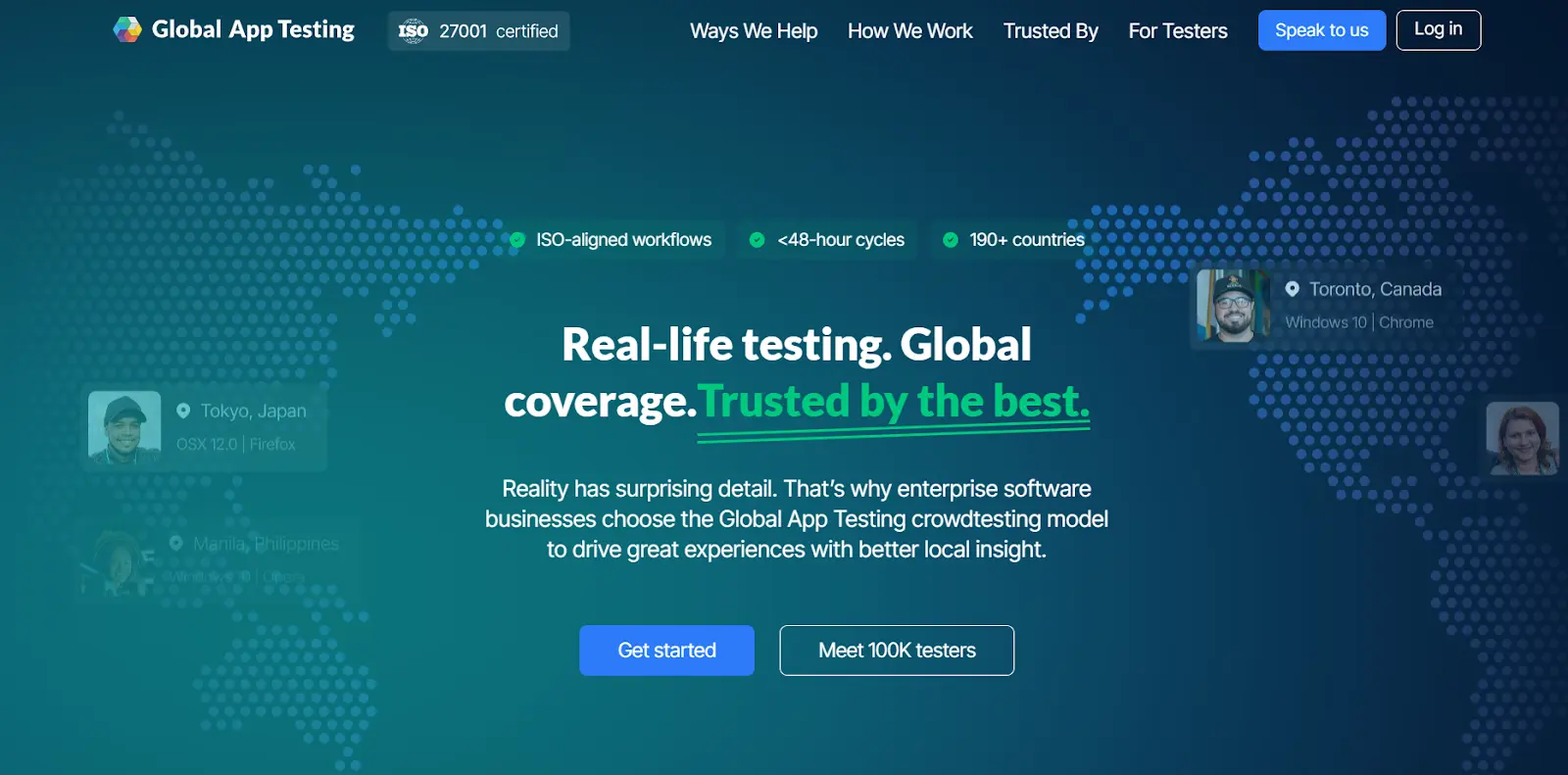
Global App Testing operates in 190 countries, blending autonomous technology with human testers. Built for speed with direct CI/CD integration.
- Delivery Models: Fully managed and co-managed models for flexible oversight.
- Autonomous Layer: Autonomous testing augments human testers for faster issue detection.
- Focus: Real-world mobile and web application testing.
- Clients: Microsoft, Meta, Google, Canva.
5. Testlio
Testlio built its model on the opposite instinct to the open crowd. Rather than opening engagements to anyone who signs up, it runs a vetted, curated network of testers who are screened and matched to work, an approach it describes as networked testing. The pitch is signal over volume: fewer testers, known quality, consistent people returning across cycles rather than a fresh anonymous crowd each time.
- Vetted Network: Curated and screened testers matched to engagements, which suits products where report quality and tester consistency matter more than raw headcount.
- Fused Delivery: Combines manual crowd testing with automation in a single managed engagement rather than treating them as separate purchases.
- Testing Coverage: Payments, localization, streaming and media, and accessibility across web and mobile.
- Best For: Teams that tried an open crowd, drowned in duplicates, and want a managed alternative.
6. Ubertesters
Ubertesters combines a global tester community with an SDK integration you embed directly in your build, which is its main differentiator. Instead of asking testers to describe a bug in prose and attach a screenshot, the SDK captures the report inside the app, along with session data, device metadata, and annotated screenshots, at the moment the bug happens.
- SDK Integration: In-app bug reporting with automatic session and device context, which raises report quality and removes the reproduction guesswork that makes crowd bugs expensive to triage.
- Delivery Models: Self-service and managed options, so smaller QA teams can run cycles without a dedicated vendor manager.
- Project Management: Built-in dashboard for building test cycles, assigning testers, and tracking coverage.
- Best For: Mobile-first teams that want structured reports arriving straight from inside the app.
The right platform depends on your team size, release cadence, and how much vendor management you need.
How Does Crowdsourced Testing Fit into a Modern QA Strategy?
Crowdsourced testing is the real-world validation layer between automated regression and production release. It does not replace automation or in-house QA. Each layer covers a different failure type.
What Does Each Testing Layer Own?
A modern QA strategy operates across three layers: in-house QA for product logic, automated regression for build stability, and crowd testing for real-world validation.
- In-House QA: It owns test strategy, product logic, security-sensitive flows, and the automation suite. This team defines release criteria, writes regression scripts, and makes the final call on whether a build ships.
- Automated Regression: It owns speed and consistency. It runs thousands of test cases across browser and OS combinations on every build and returns a pass/fail signal within the CI/CD pipeline. It only validates what it has been scripted to check.
- Crowd Testing: It owns real-world unpredictability. Real testers on real devices catch what scripted tests cannot, such as gestures that fail on specific screen sizes, payment flows that break in specific regions, and localization errors only a native speaker would catch.
Where Does Crowd Testing Sit in the Pipeline?
Crowd testing starts after automated regression confirms build stability and runs as the last validation step before the release decision.
- Unit and Integration Tests: These run on every commit. They validate individual components and module interactions at the code level.
- Automated Regression: It runs after unit and integration tests pass. It confirms existing features work across supported browsers, OS versions, and device configurations.
- Crowd Testing: It runs after regression tests pass. It distributes the build to real testers across geographies, devices, and network conditions to surface issues that lab environments miss.
- Release Decision: It is the final gate. If crowd testing surfaces critical defects, the cycle loops back to fix, regress, and re-validate.
How Does Regression Validation Work After Crowd Testing?
After a crowd testing cycle, the development team receives a high volume of bug reports that need triage, prioritization, and fixes. Each fix then requires regression tests to confirm it resolves the reported issue without breaking existing functionality. The speed of this regression loop determines whether the next release ships on schedule.
- Sequential Execution on Traditional Grids: It runs regression tests one after another across shared grid infrastructure. Network latency, queue wait times, and resource contention add days to the post-fix validation loop.
- Parallel Test Orchestration: It distributes regression tests across isolated environments simultaneously. Results return in hours instead of days.
Running regression tests sequentially on traditional grids after a crowd testing cycle is the most common bottleneck in pre-release QA workflows.
This delays fix validation, pushes release timelines, and reduces the overall ROI of crowd testing. To solve this, TestMu AI offers HyperExecute, an AI-native test orchestration platform that accelerates test execution by up to 70% faster than traditional testing grids.
It runs tests in isolated, unified environments that place test scripts and all components together, eliminating network latency and matching local execution speeds. Key capabilities include:
- Smart Test Distribution: Matrix and Auto-Split strategies intelligently distribute tests across available resources, maximizing parallel execution and minimizing idle time.
- Flaky Test Detection: It identifies flaky tests with failure frequency analysis and retries failed tests automatically with configurable retry logic, so teams debug actual bugs instead of infrastructure noise.
- CI/CD Integration: Native integration with Jenkins, GitHub Actions, GitLab CI, Azure DevOps, CircleCI, and 14+ tools with real-time status updates to dashboards and pull requests.
To better understand how to set parallel regressions for your pipeline, you can explore our documentation guide on getting started with HyperExecute.

What Should You Look for When Choosing a Crowd Testing Vendor?
Evaluate vendors on tester vetting, device reach, security controls, report quality, and tool integration.
The difference between a high-signal testing partner and a noisy, unmanaged crowd comes down to how the platform recruits, manages, and maintains its tester community.
1. Tester Vetting and Quality Control
Look for platforms that screen testers through technical assessments, maintain ongoing quality scores, and have low acceptance rates. Under 10% acceptance is a strong indicator. Vetted communities produce significantly higher signal-to-noise ratios than open-access crowds.
2. Device and Geographic Reach
Confirm the platform can match your target audience in device types, OS versions, and geographic regions. If your users are primarily in Southeast Asia on mid-range Android devices, a platform skewed toward North American iOS testers will not serve your needs.
3. Security and Compliance
Evaluate NDA enforcement, data handling practices, build distribution controls, and certifications (ISO 27001 is a strong baseline). For regulated industries like finance or healthcare, verify the platform supports your specific compliance requirements.
4. Reporting and Integration
Bug reports should include structured fields: steps to reproduce, expected vs actual behavior, device metadata, screenshots, and video. The platform should integrate with your existing tools (Jira, Slack, CI/CD).
5. Managed vs Self-Service Models
Some platforms offer fully managed services with dedicated project managers handling tester coordination, scope refinement, and result curation. Others provide self-service crowd access. If your QA team is small, a managed model reduces operational burden significantly.
Conclusion
Crowdsourced testing extends your QA reach across real devices, real networks, and real users without scaling your team. It works best when paired with a defined scope, a vetted platform, and a structured bug review process. Use it to close the coverage gaps your in-house team cannot reach alone.
Author

Prince Dewani
Blogs: 30

Prince Dewani is a Community Contributor at TestMu AI specializing in AI agents, software testing, QA, and SEO. He is certified in Selenium, Cypress, Playwright, Appium, Automation Testing, and KaneAI, and presented academic research on AI agents at PBCON-01. At TestMu AI, he has also carried out extensive cross-browser research on the support of modern web technologies such as WebGPU, WebAssembly, WebXR, WebGL2 and other web technologies, validating their compatibility and feature parity across major browsers and rendering engines through rigorous hands-on testing. Prince has hands-on experience building AI agent workflows using Anthropic Claude, Google Antigravity, n8n, LangChain, and other agentic frameworks, and works regularly with MCP and A2A protocols. He shares his work with 5,500+ QA engineers, developers, DevOps experts, tech leaders, and AI agent practitioners on LinkedIn.


Frequently asked questions
Did you find this page helpful?
More Related Learning Hubs
TestMu AI forEnterprise
Get access to solutions built on Enterprise
grade security, privacy, & compliance
- Advanced access controls
- Advanced data retention rules
- Advanced Local Testing
- Premium Support options
- Early access to beta features
- Private Slack Channel
- Unlimited Manual Accessibility DevTools Tests