

Power Your Software Testing with AI Agents and Cloud
The Native AI-Agentic Cloud Platform to Supercharge Quality Engineering. Test Intelligently and Ship Faster.


- TestMu AI (Formerly LambdaTest)
- /
- Blog
- /
- Unifying Test Execution Across Diverse Technologies with HyperExecute
HyperExecute: Unifying Test Execution Across Diverse Technologies
Discover how HyperExecute transformed testing for a Fortune 100 company, cutting execution time by 50%, saving 30% in costs, and boosting quality.
Last Updated on:
Unifying test execution across diverse technology stacks means running web, mobile, legacy, and mainframe tests from one execution layer instead of a separate tool and pipeline for each stack.
A Fortune 100 apparel and home fashion retailer cut its test execution time by up to 50 percent and its testing costs by 30 percent after moving five separate tools onto one cloud execution layer.
This guide covers how a unified execution layer handled web application, legacy system, mainframe, remote SSH, and test-management testing for that retailer, and how agentic AI extends the same unified model.
Key Takeaways
- A Fortune 100 apparel and home fashion retailer ran web, mobile, legacy, and mainframe tests through five disconnected tools before consolidating them onto one execution layer.
- Running Selenium and Cucumber tests in parallel across multiple browsers and operating systems cut this retailer's web testing time by up to 40 percent.
- Connecting Tosca Dex to a cloud execution layer freed local machines that Tosca Dex previously monopolized during mainframe and legacy test runs.
- Automating mainframe testing through Micro Focus Rumba+ and Tosca Dex cut manual testing effort by up to 50 percent.
- Automating the Putty SSH client removed the security risk of manually accessing remote servers for command-line interface testing.
- Integrating Zephyr Enterprise with a single execution layer let the QA team trigger tests, run them, and see results without switching between disconnected tools.

Austin Siewert
Co-Founder, Steadfast Systems
Discovered @TestMu AI yesterday. Best browser testing tool I've found for my use case. Great pricing model for the limited testing I do 👏
2M+ Devs and QAs rely on TestMu AI
Deliver immersive digital experiences with Next-Generation Mobile Apps and Cross Browser Testing Cloud

HyperExecute: The Unified Solution
Let’s explore each of their unique requirements across multiple dimensions and how HyperExecute streamlined their entire scattered testing ecosystem:

1. Accelerating Web Application Testing with Parallel Execution
The company’s QA team needed to improve their web application testing strategy. They relied on Selenium Grid for browser testing, Cucumber for Behavior-Driven Development (BDD), and Jenkins for CI/CD. This setup led to slow, sequential test executions, where each browser and device combination required separate configurations. This limited browser coverage and increased execution times.
However, after deploying their tests on HyperExecute, they were able to run the tests in parallel across multiple browsers, operating systems, and versions. HyperExecute provided pre-configured environments that reduced setup time and eliminated redundant configurations. This approach cut execution times by up to 40%, expanded test coverage, accelerated the feedback loop and improved the overall quality of their web applications.
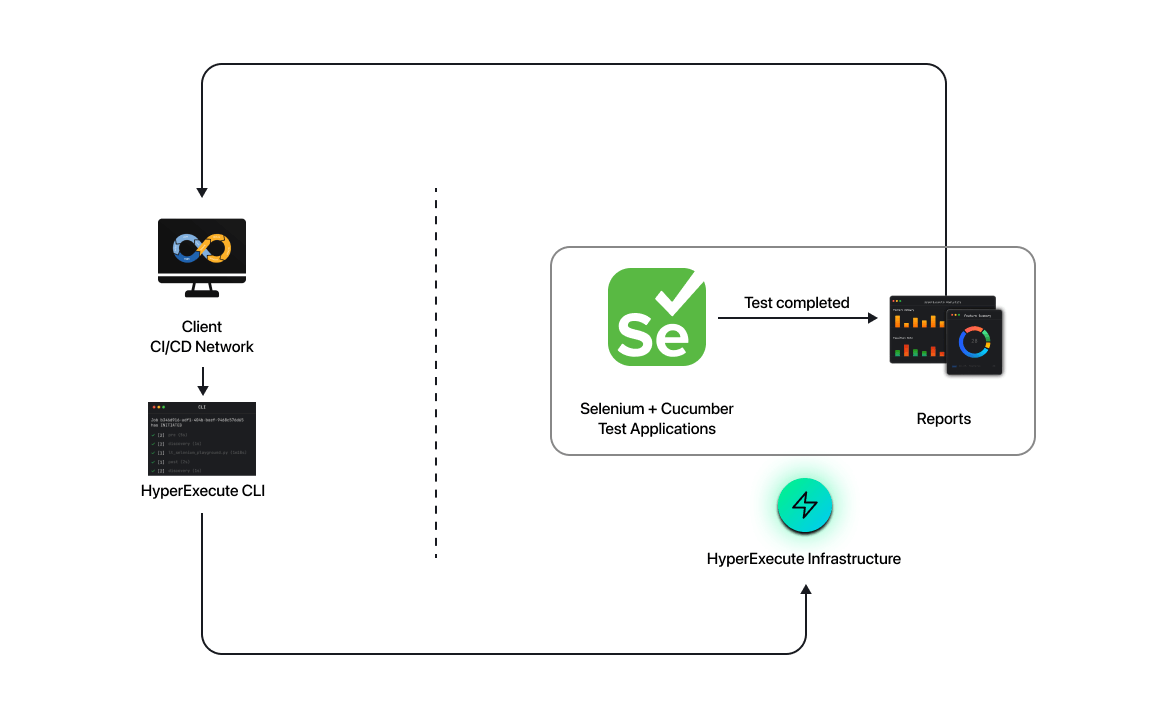
Teams evaluating what is parallel testing and why to adopt it for their own browser matrix can use this result as a reference point.
2. Integrating Legacy Systems with Modern Testing Frameworks
The team used Tosca Dex to trigger Selenium and Cucumber tests. However, the setup was complex and required specialized expertise to manage agents, configure networks, and maintain communication between servers and agents. Tosca Dex also monopolized local machine resources during test execution, which disrupted productivity.
HyperExecute integrated directly with Tosca Dex and the team was able to trigger the test events from Tosca Dex and execute them on HyperExecute’s cloud infrastructure. This eliminated complex local setups and reduced dependence on network stability. It also freed up local machines, enabling uninterrupted work. HyperExecute’s cloud-based execution managed scalability and resources automatically, which improved test reliability and reduced overhead.
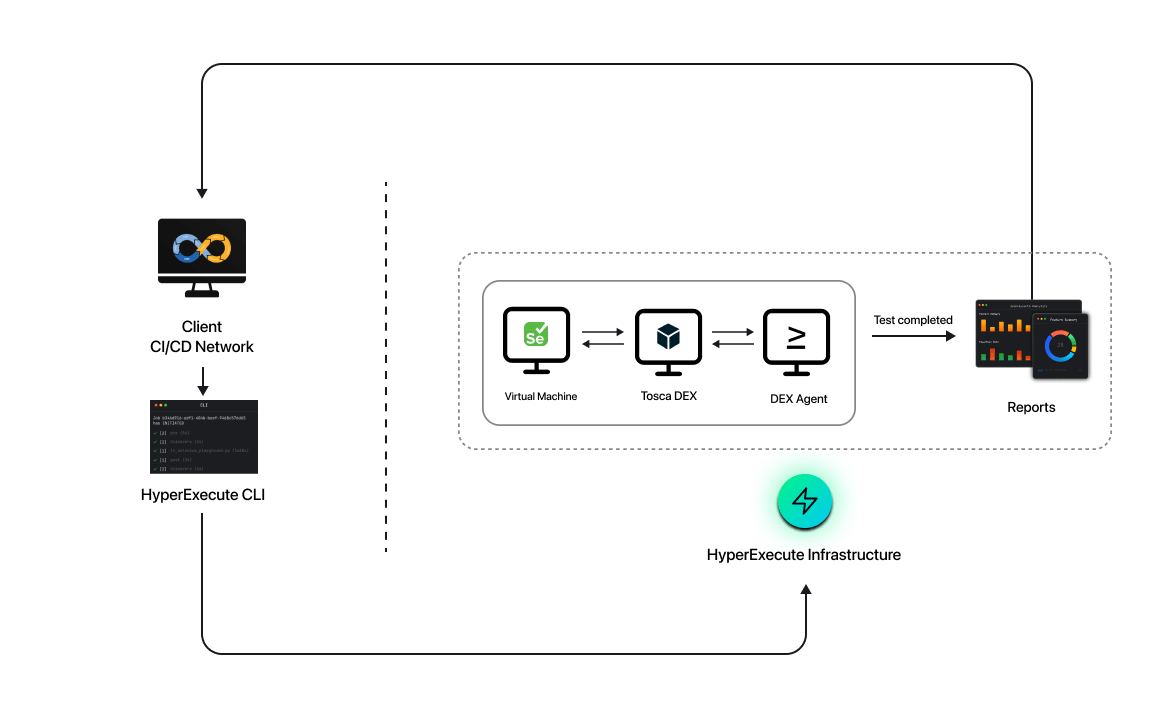
This shift is part of a broader move in legacy vs autonomous qa, where testing manages its own agents and infrastructure instead of a person doing it by hand.
3. Automating Mainframe Application Testing
The company’s mainframe application testing was a time-consuming and error-prone process, heavily reliant on manual scripting and execution using Micro Focus Rumba+ for terminal emulation. This approach was slow, error-prone, and required extensive manual effort.
HyperExecute automated mainframe testing by connecting Tosca Dex with Micro Focus Rumba+. This allowed automated test execution within the Jenkins pipeline to achieve continuous testing and reduce manual intervention. HyperExecute’s cloud infrastructure replaced on-premises setups which reduced the manual efforts by up to 50% and aligned the mainframe testing with the overall automated strategy. This led to faster and more reliable test cycles.
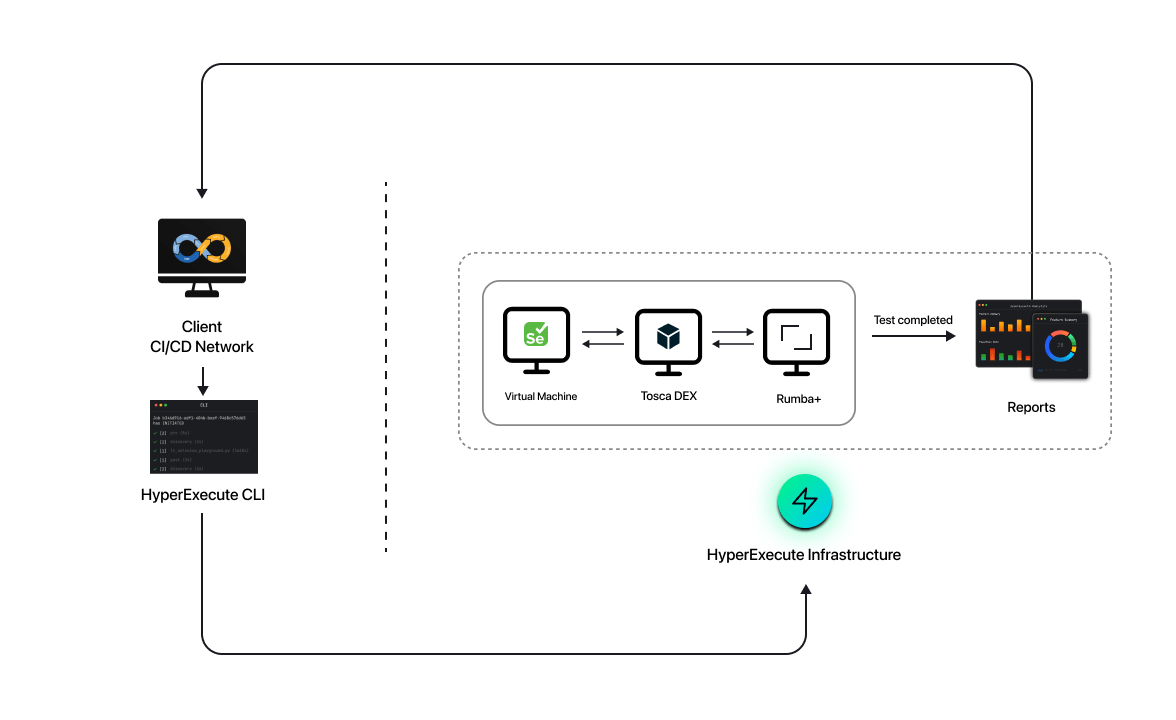
The same approach applies broadly to mainframe testing wherever a terminal emulator such as Micro Focus Rumba+ needs to run inside a modern CI/CD pipeline.
4. Secure Remote Testing: Automating Putty SSH Client
The QA team needed a secure solution for testing remote systems. They were manually using the Putty SSH client to access remote servers for testing, which was time-consuming and risky due to potential security breaches. Additionally, the lack of automation led to inconsistent test execution and errors in command-line interface testing.
HyperExecute automated SSH access by integrating the Putty client with Tosca Dex. This ensured secure, automated testing of remote systems and consistent and repeatable test executions for both GUI and CLI interfaces. HyperExecute managed SSH connections securely, which eliminated security risks and provided comprehensive coverage for remote system testing.
A related option, testmu releases ssh tunnel to let you test your locally hosted applications, covers the same need for a locally hosted application without a manual Putty session.
5. End-to-End Test Management with Zephyr Enterprise Integration
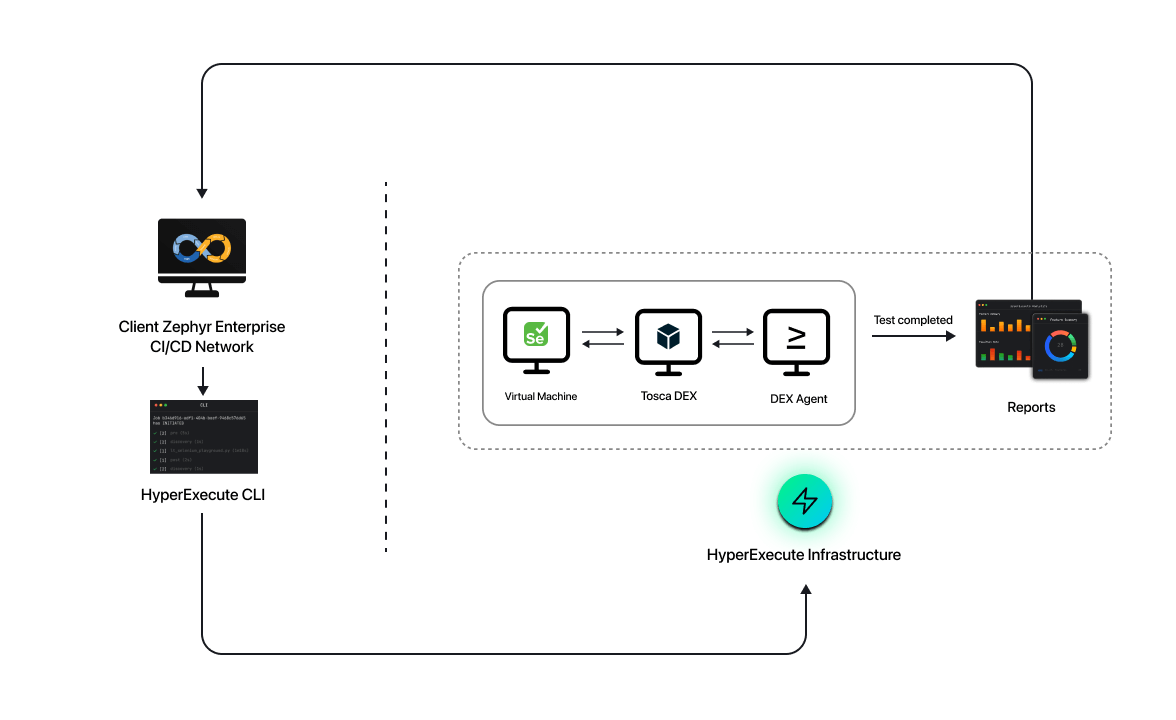
Their existing test management workflow faced inefficiencies due to disconnected tools for managing test cases, executing tests, and reporting results. This fragmentation caused delays and gaps in the process.
HyperExecute integrated seamlessly with Zephyr Enterprise, automating the entire testing workflow. The team triggered test events directly from Zephyr, executed suites on HyperExecute, and received immediate feedback on test results. This streamlined the process, improved visibility, reduced manual errors, and sped up decision-making.
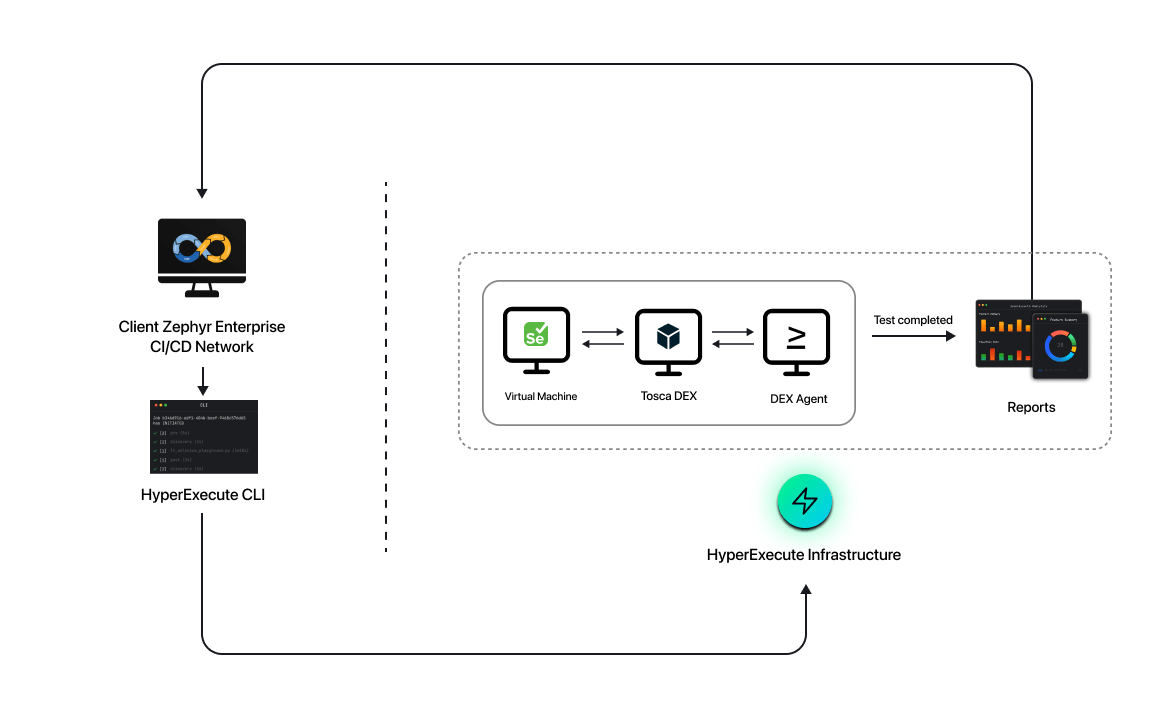
Connecting test management, execution, and reporting this way is a core part of continuous testing for any large QA organization.
How Does Agentic AI Extend This Unified Execution Model?
Agentic AI adds a decision-making layer on top of the unified execution model described in the five integrations above. GPT-powered root cause analysis already groups a failure by cause instead of leaving a QA engineer to read every log line, and an agentic layer takes that one step further by deciding what to run next.
- Autonomous triage: an agent classifies a failure as a real defect, a flaky test, or an environment issue, and routes it to the right owner without a manual log review.
- Cross-stack correlation: because web, mobile, legacy, and mainframe results already sit in one execution layer, an agent can link a failure in a Tosca Dex mainframe run to a related failure in a Selenium web run instead of treating them as unrelated incidents.
- Pipeline-level orchestration: accelerating jenkins pipeline through intelligent test orchestration shows the same agentic approach reordering and rerunning a Jenkins pipeline based on what previous test runs found.
None of this replaces the tool-by-tool integrations covered above. It sits on top of them, using the same unified execution layer as its data source.
Conclusion
By consolidating their testing tools and infrastructure under HyperExecute, the client reduced operational costs, improved test coverage, and accelerated release cycles. HyperExecute provided a unified platform that integrated seamlessly across different technologies and frameworks, making their testing strategy more efficient and scalable. If your organization faces similar challenges, HyperExecute can help you unify and optimize your testing processes.

Author

Aman Chopra
Blogs: 15


Aman Chopra is a DevOps Engineer and Community Contributor with over 7 years of experience in cloud technologies, software development, and software testing. Currently working at TestMu AI, Aman specializes in optimizing Azure cloud infrastructure, enhancing API accessibility, and integrating cloud platforms like AWS and GCP. With expertise in Git, Docker, Kubernetes, and CI/CD practices, Aman has contributed to various open-source projects and authored guides on cloud computing, containers, and CI/CD. He holds a B.Tech in Computer Science.


HyperExecute Unified Test Execution FAQs
Did you find this page helpful?
More Related Blogs
TestMu AI forEnterprise
Get access to solutions built on Enterprise
grade security, privacy, & compliance
- Advanced access controls
- Advanced data retention rules
- Advanced Local Testing
- Premium Support options
- Early access to beta features
- Private Slack Channel
- Unlimited Manual Accessibility DevTools Tests