

Power Your Software Testing with AI Agents and Cloud
The Native AI-Agentic Cloud Platform to Supercharge Quality Engineering. Test Intelligently and Ship Faster.


- TestMu AI (Formerly LambdaTest)
- /
- Blog
- /
- UiPath Test Suite: Components, Limits, and QA Use Cases
UiPath Test Suite: Components, Limits, and QA Use Cases
What UiPath Test Suite covers, why the name was retired, and how to decide where RPA-native testing fits alongside a dedicated test automation stack.
Last Updated on:
An RPA team gets handed application testing because they already automate the same screens.
They search for the UiPath Test Suite documentation, follow a tutorial written two years ago, and find that half the interface names no longer match the screen.
There is a reason for that mismatch, and almost nothing written about UiPath Test Suite mentions it.
This guide covers what the bundle contained, what UiPath renamed it to, which testing it does well, where it runs short, and how teams add browser and device coverage.
Overview
UiPath Test Suite was UiPath's bundle of testing tools for validating RPA workflows and enterprise applications. UiPath has folded those capabilities into UiPath Test Cloud, and the old Test Suite documentation now redirects there. The components still do the same jobs under new packaging.
What Does Each Piece Do?
Four components carry the platform, plus one gap worth knowing up front.
- Test Manager: the control plane holding requirements, test cases, runs, and defects, and the piece that syncs results into existing ALM tools.
- UiPath Studio: the authoring canvas, where tests reuse the same selectors and object repository already built for RPA workflows, not a new framework.
- Orchestrator and Robots: Orchestrator schedules and distributes test sets across machines; Robots are the same workers that execute production RPA processes.
- Enterprise application reach: UiPath lists desktop, mainframe, SAP, Oracle, Workday, and Salesforce as test targets, which browser-only frameworks cannot address.
- Physical handsets and wide browser coverage are not part of the platform. Studio's mobile device manager expects an external Appium endpoint.
How Do You Cover Browsers and Real Devices?
Point Studio's mobile device manager at a hosted grid instead of a cabled phone. TestMu AI's real device cloud exposes an Appium endpoint over 10,000+ real Android and iOS devices, plus 3,000+ browser and OS combinations.
What Is UiPath Test Suite?
UiPath Test Suite is the name UiPath used for its bundle of testing products: Test Manager for planning, Studio for authoring, and Orchestrator with Robots for running tests at scale.
Its purpose was twofold. Test the RPA robots themselves, and reuse the same automation technology to test the business applications those robots operate.
That second purpose is why the keyword still gets searched.
A team that spent three years building selectors for an SAP or Oracle front end already solved the hardest part, so turning those assets into regression tests is a short step.
Worth separating two terms that share a name here. A UiPath test set is a platform object you schedule, narrower than the general grouping covered in test suite and test case fundamentals.
Timing matters here, because enterprise QA is mid-way through an agentic buying wave that has not yet reached working practice.
Capgemini's World Quality Report 2025-26 found that 89% of responding organizations are piloting or deploying Gen AI-augmented workflows, yet only 15% have achieved enterprise-wide implementation.
Read that gap before you evaluate any agentic testing platform. The platform is rarely the constraint; scaling it past a pilot is.
Why Did UiPath Retire the Test Suite Name?
Because UiPath repackaged the bundle. Its own documentation states that automation testing capabilities are no longer grouped under the Test Suite umbrella, and that the guide is no longer maintained.
The redirect is easy to confirm. I requested the old Test Suite introduction page on August 6, 2026 and landed on the Test Cloud documentation instead, carrying this notice:
"You have been redirected to the landing page of the Test Cloud documentation."
The current product is UiPath Test Cloud, positioned around agentic testing. Its product page describes designing, automating, and orchestrating testing across web, mobile, desktop, API, and enterprise applications.
Three practical consequences follow from the rename, and each one costs time if you miss it:
- Tutorials predating the change show an interface that moved. A Studio Pro window is the tell, since that name folded into Studio.
- Pages ranking for the old name never mention Test Cloud, so you can research thoroughly and still miss the current name.
- License questions must be asked against Test Cloud packaging, not the old bundle, because deployment tier now determines which pieces you get.
Nothing you built disappeared. The naming changed and the agentic layer grew around it.
What Are the Components of UiPath Test Suite?
Four components carried the original bundle, and knowing which one owns which job is what lets you map an old tutorial onto the current product.
- Test Manager is the test management layer. Requirements, cases, test sets, executions, and defects live here, syncing with existing ALM tools.
- UiPath Studio is where tests are authored. Activities drag onto a canvas, selectors come from the shared object repository, data feeds externally.
- Orchestrator schedules and distributes execution. It decides which machine runs which test set and when, scaling a suite past one desktop.
- Robots perform the runs. They are the same workers executing production RPA processes, pointed at a test set instead.
Under Test Cloud packaging, Test Manager and Studio survive as named components.
UiPath's product page adds an agentic layer around them: Maestro coordinates agents and humans, Autopilot assists across the lifecycle, a healing agent repairs broken selectors during execution, and Agent Builder creates custom testing agents.
That agentic layer is where the platform stops being deterministic, which changes how you validate it.
A rules-based robot either follows its steps or fails visibly, while a model-driven agent can take a different valid path each run. Read RPA vs AI before trusting an agent with a release gate.
The page also names performance testing, accessibility checks, and a dedicated SAP testing capability covering S/4HANA and Fiori. That SAP depth is the clearest signal of who the product is built for.
One caveat worth carrying into any vendor conversation: UiPath states that capabilities vary by deployment option, release, and platform tier. Confirm a specific component is in your tier before designing a strategy around it.
How Does Testing Actually Work in UiPath?
The flow is worth walking end to end, because it differs from a scripted framework in ways that decide whether your team will like it.
Requirement to result runs in six steps:
- A requirement arrives in Test Manager, synced from the ALM tool where the story lives. It anchors test cases and results.
- A test case is created against that requirement and linked to an automation. Manual and automated cases share one hierarchy.
- The automation is built in Studio as a test case project. Activities describe the interaction, selectors resolve elements, assertions verify state.
- Data-driven variants attach rather than duplicate. One case runs across many input rows, which matters for enterprise forms with dozens of permutations.
- The project is published to Orchestrator, grouped into test sets, and scheduled or triggered from a pipeline.
- Robots execute, and results flow back to Test Manager against the original requirement, producing traceability rather than a pass list.
Requirement-to-result traceability is native here, not assembled from a reporting plugin.
For a regulated enterprise that must evidence what was tested against which requirement, that traceability is the feature justifying the platform.
The cost is that your tests now live inside a proprietary project format. Exporting a Studio test case into Selenium or Playwright is not a supported one-click path.
Teams that hit this in adjacent platforms will recognize the pattern from Pega testing, where native tooling is convenient until you need coverage it was never built for.
One distinction inside this flow decides whether the platform does what you want at all, and it is often missed.
UiPath's Test Manager documentation states that the native Automation Cloud interface allows you to perform RPA testing, while the Test Cloud interface allows you to perform both Application and RPA testing.
So if your goal is testing business applications rather than your robots, the Automation Cloud entry point alone does not cover it.
That documentation also gates access behind named-user and platform licenses, and states that feature availability depends on the cloud platform you use.
Ask which interface and which license tier a quote covers before you scope anything. That one question separates a working evaluation from a stalled one.

Note: Enterprise suites stall when the grid runs out before the test cases do. TestMu AI runs UiPath-adjacent web and mobile coverage on 10,000+ real devices without a device lab to maintain. Try TestMu AI free!
Can UiPath Be Used for Test Automation?
Yes, but narrower than the marketing suggests. UiPath is a strong choice when the applications under test are packaged enterprise systems, and a poor default for a consumer web or mobile product.
It fits well when three conditions hold together. The organization already runs UiPath in production, and the applications under test are packaged enterprise systems.
Third, traceability from requirement to result is a compliance obligation rather than a preference.
Where it earns its place most clearly:
- Packaged enterprise applications. SAP, Oracle, Workday, and Salesforce front ends are where browser-only frameworks produce brittle selectors and unstable waits.
- Desktop and mainframe applications, which sit entirely outside what Selenium, Cypress, or Playwright can reach.
- Testing the robots themselves. An RPA process touching payroll or claims needs its own regression coverage, and the same platform provides it.
- Cross-application business flows, where one journey crosses a web portal, a desktop client, and a back-office system in a single sequence.
The reuse argument is the real commercial case. Selectors, credentials, and object repositories built for RPA are the expensive artifacts, and a testing layer consuming them starts far ahead.
That same logic drives platform choices across ERP testing tools.
Where it fits poorly is equally clear. A product team shipping a consumer web or mobile app, with no RPA estate and no mainframe, buys enterprise breadth it will never use.
They also inherit a license model and a proprietary project format they did not need.
Where Does RPA-Native Testing Run Short?
Four gaps show up consistently once a suite moves past its pilot, and none of them are secrets. They are consequences of what the platform was designed to do.
Browser and OS breadth
An RPA robot runs on a controlled machine with a known browser, which is the opposite of the problem cross-browser testing solves.
Web regression coverage needs the same journey verified across browser engines and OS versions, and that matrix is not what a robot fleet is provisioned for.
Teams filling this gap add a browser-first framework alongside the RPA platform. The trade-offs are laid out in this roundup of web automation tools.
Physical mobile devices
Studio ships a Mobile Automation module, but a module is not a device fleet.
Biometrics, camera behavior, real radio conditions, thermal throttling, and manufacturer OS skins only appear on real hardware, and someone has to supply it.
Parallel scale for large web suites
Robot-based execution scales with provisioned robots. A dedicated cloud grid scales with available sessions, which is a materially different cost curve when a nightly suite needs hundreds of concurrent browsers.
Portability and lock-in
Studio test cases are platform artifacts. Compare that with a tool that exports to Selenium, Playwright, Cypress, or Appium, and the difference is who owns the tests if the contract ends.
These gaps are why the Capgemini research is worth rereading. Alongside the 15% enterprise-wide figure, it reports that 67% of organizations experience data privacy risks and 64% face integration complexity.
Where Gen AI in quality engineering does work, the same report puts the average productivity boost at 19%.
Integration complexity is the line item that matters here. These gaps close by connecting a second system, not by buying a bigger license, and that connection is the work.
None of this is unique to testing. The limits that make RPA bots brittle in production are catalogued in common RPA challenges, and a test layer inherits most of them.
How Do You Add Real Device Coverage to UiPath Tests?
By pointing Studio's mobile device manager at a hosted Appium endpoint instead of a phone on your desk.
This is the part of the workflow almost nothing written about UiPath testing covers, and it is documented rather than theoretical.
TestMu AI publishes the setup in its UiPath integration documentation, which walks the flow from installing Studio to running an app on a selected cloud device.
The sequence is short. Create a project from Studio's Mobile Testing template, open the mobile device manager, and add a device by supplying an Appium URL, a platform, and a device name.
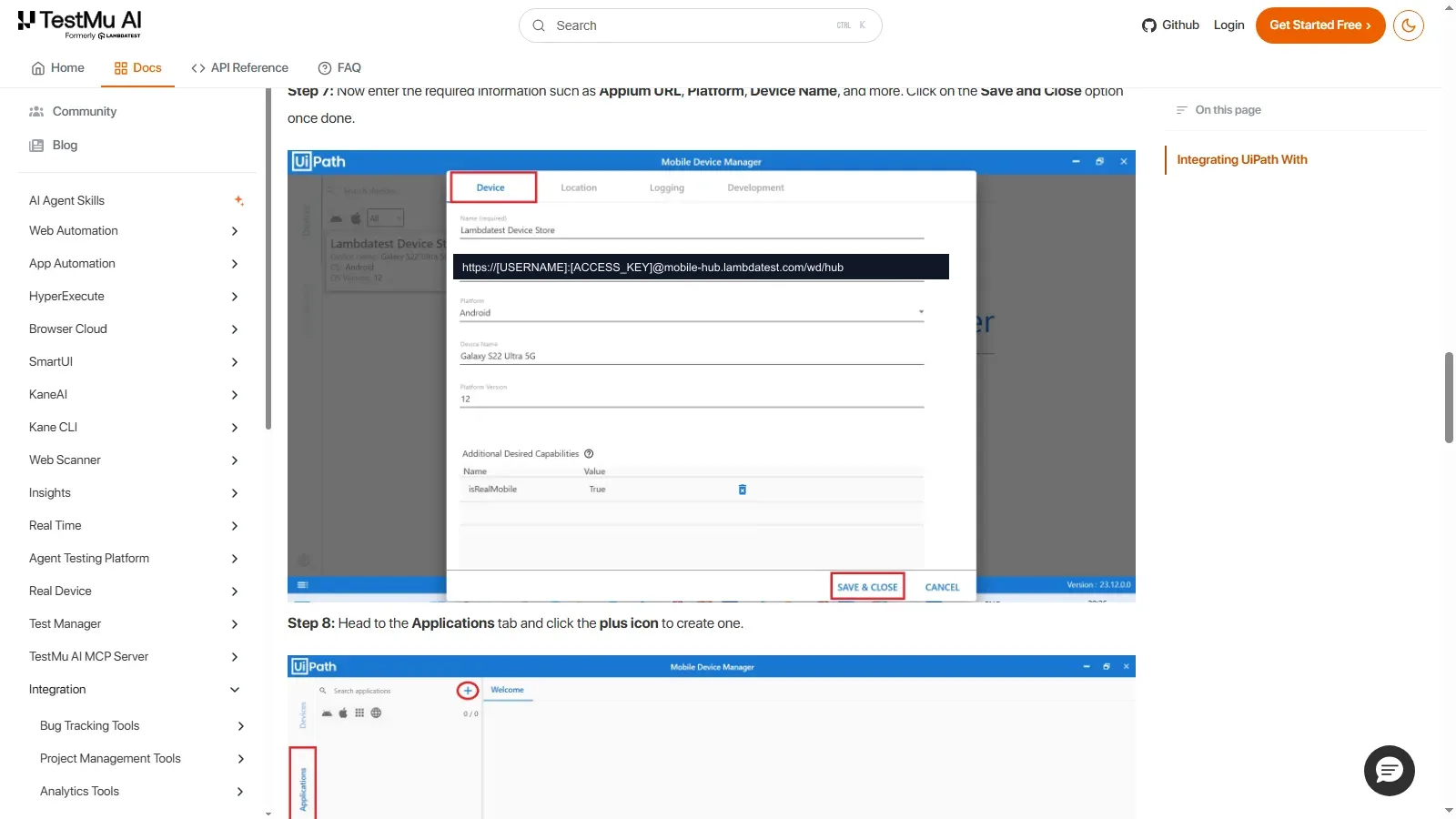
That Appium URL field is the whole reason this works. The Appium project documentation describes Appium as an open-source project for UI automation across mobile, browser, desktop, and TV platforms.
Because Studio speaks to it over a network endpoint, that endpoint does not have to sit on your machine.
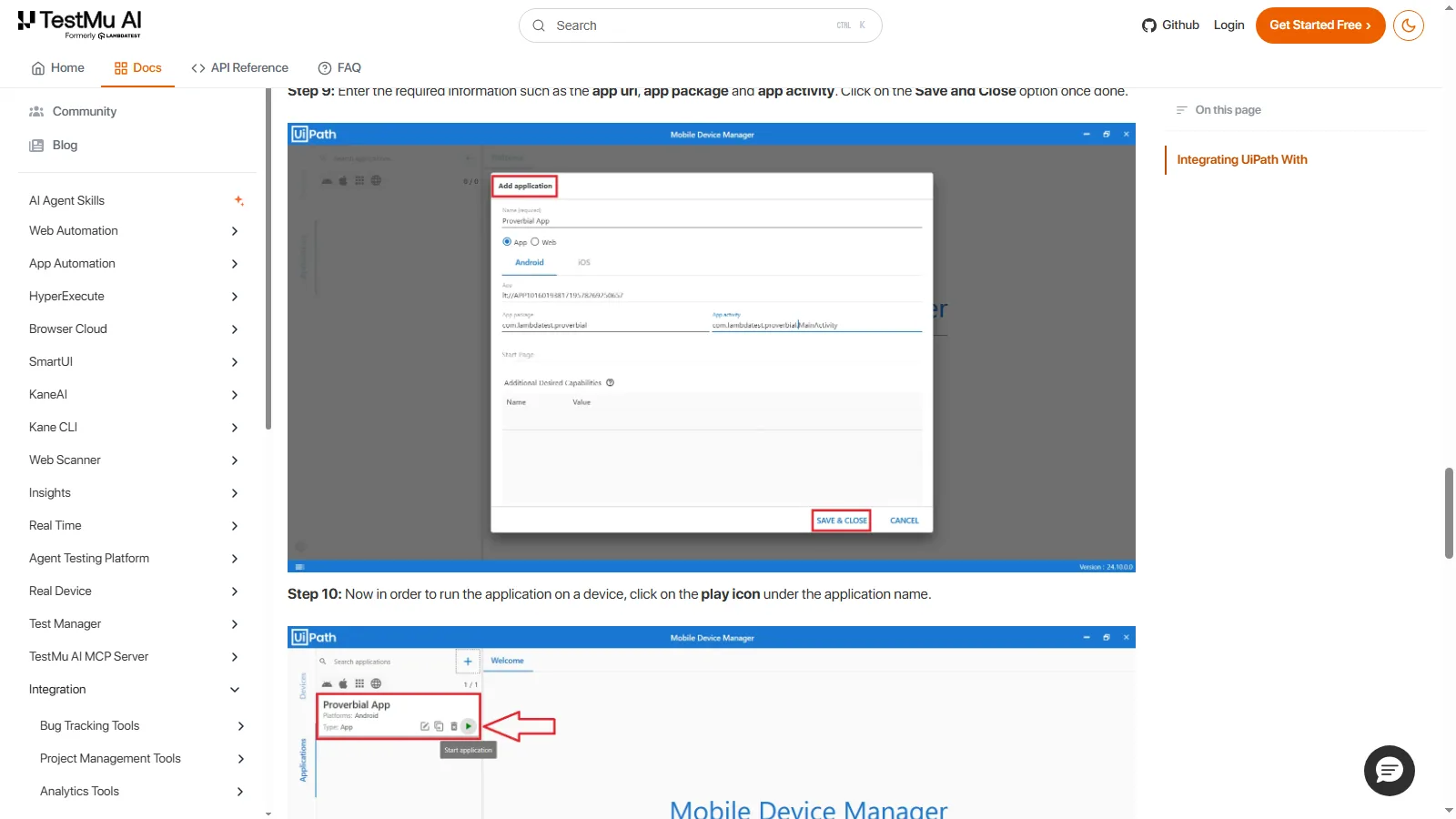
Then register the application under test on the Applications tab with its app url, app package, and app activity, and connect.
From that point Studio drives a cloud device exactly as it would drive a cabled one.
The web layer connects the same way, through a standard remote WebDriver endpoint. A Selenium-based test in any language reaches the grid by changing the server URL and adding a capabilities block:
// Point an existing Selenium test at the TestMu AI cloud grid
const capabilities = {
  browserName: "Chrome",
  browserVersion: "latest",
  "LT:Options": {
    platform: "Windows 11",
    build: "UiPath Web Regression",
    name: "Checkout flow - Chrome on Windows 11"
  }
};

const driver = new webdriver.Builder()
  .usingServer("https://hub.lambdatest.com/wd/hub")
  .withCapabilities(capabilities)
  .build();

await driver.get("https://www.testmuai.com/selenium-playground/");
I ran that endpoint check on August 6, 2026, and the session came back on Chrome 150 under Windows, logged to build 99931145 in the TestMu AI dashboard:
SESSION_ID=session_1786020652865_3b4zvj
TITLE=Selenium Grid Online | Run Selenium Test On Cloud
UA=Mozilla/5.0 (Windows NT 10.0; Win64; x64) AppleWebKit/537.36 (KHTML, like Gecko) Chrome/150.0.0.0 Safari/537.36
RELEASED
The split that results is clean. UiPath keeps the enterprise application and desktop flows it is genuinely good at.
Browser and device coverage moves to a real device cloud built for breadth: 3,000+ browser and OS combinations and 10,000+ real Android and iOS devices, with no handsets to buy.
Should You Choose RPA-Native or Dedicated Test Automation?
Map your situation to a row rather than picking a winner. Most enterprises that get this right end up running both, with a deliberate boundary between them.
| Your situation | RPA-native testing | Dedicated test automation |
|---|---|---|
| SAP, Oracle, or mainframe under test | Strong fit. Packaged and terminal applications are the surfaces the platform was designed to reach. | Weak. Browser frameworks cannot address desktop or mainframe layers at all. |
| Consumer web app across many browsers | Weak. Robots run on controlled machines, so the browser matrix is not what they are provisioned for. | Strong fit. Grid execution across 3,000+ browser and OS combinations is the core use case. |
| Native mobile app on real hardware | Partial. Studio automates mobile, but the devices come from an external Appium endpoint. | Strong fit. 10,000+ real devices with sensors, radios, and manufacturer OS builds. |
| Regression coverage for RPA robots | Strong fit, and effectively the only sensible option, since the robots are the thing under test. | Not applicable to robot workflows themselves. |
| Requirement-to-defect traceability for audit | Strong fit. Test Manager links requirements, cases, runs, and defects natively. | Strong fit with a test management layer such as TestMu AI Test Manager alongside execution. |
| Team must own portable test code | Weak. Studio test cases are platform artifacts with no supported export to open frameworks. | Strong fit when the tool exports to Selenium, Playwright, Cypress, or Appium. |
On the authoring question, the trade-off has shifted. Canvas-based authoring lowered the barrier compared with scripting, but natural-language authoring lowers it further while keeping the code.
That is the argument running through no-code test automation today.
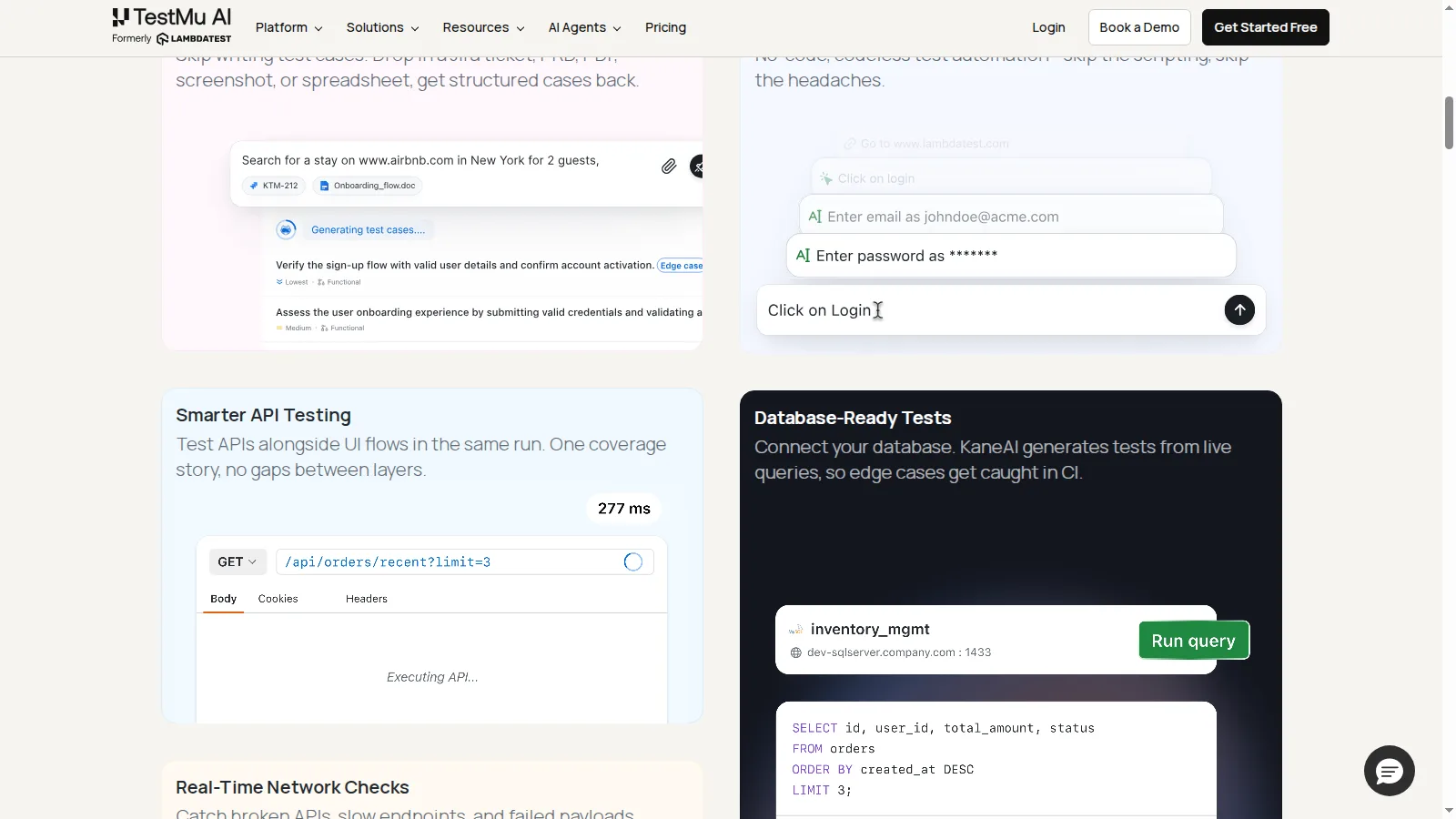
TestMu AI's KaneAI takes that position for the application layer. Tests are authored from plain-English prompts, Jira tickets, PRDs, or a screen recording.
Smart element detection resolves targets by intent instead of a brittle selector, and self-healing re-anchors steps when the UI shifts, so maintenance becomes a review rather than a rewrite.
For an enterprise wary of lock-in, the export is what matters. Tests built with the KaneAI test automation agent export to Selenium, Playwright, Cypress, and Appium.
Coverage stays portable, and it spans web, native mobile, API, database, network, and accessibility checks in one connected run.
Neither approach removes the need for judgment about what to test. Both reduce how much of your week goes into keeping selectors alive, and that is the honest scope of the improvement.
Note: Authoring tests from plain English and exporting them to Selenium, Playwright, Cypress, or Appium keeps enterprise coverage portable. Get started with KaneAI documentation
Conclusion
Start by checking which product you are actually evaluating. Open the Test Cloud documentation rather than a Test Suite tutorial, then ask your vendor contact to confirm, in writing, which components your deployment tier includes.
Then draw the boundary. Keep the packaged enterprise, desktop, and mainframe flows where the selector work already exists, and move the browser matrix and the physical device matrix to infrastructure built for breadth.
For the layer you are moving out, connect one suite first and measure the cycle time before migrating the rest.
TestMu AI's test automation cloud runs Selenium, Cypress, Playwright, and Appium suites on the same grid. The getting started with Appium testing guide covers the endpoint your first run needs.
Author

Abhishek Mishra
Blogs: 10

Abhishek Mishra is a Technical Product Manager at TestMu AI (formerly LambdaTest), where he owns Test Manager, the test management product. He has over 8 years of experience in product management and market analysis, spanning AI-native software testing, product strategy, and analytics. On TestMu AI, he authored guides on test management and test case management. Previously, he served as the Product Lead at IndiaClan and co-founded Gartley618 Technologies, a firm focused on quantitative trading and blockchain. He holds a B.Tech degree.
Reviewer

Srinivasan Sekar
Reviewer
Srinivasan Sekar is Director of Engineering at TestMu AI (formerly LambdaTest), where he leads engineering and open-source initiatives behind the Selenium and Appium automation grid and owns TestMu AI's MCP Server. A committer to Appium and a contributor to Selenium, WebdriverIO, Taiko, and AppiumTestDistribution, he brings over 15 years of experience in quality engineering and open-source technologies. He is the author of the Apress book 'The MCP Standard: A Developer's Guide to Building Universal AI Tools with the Model Context Protocol,' a Certified Kubernetes and Cloud Native Associate, and an international conference speaker. Before TestMu AI he spent over eight years at Thoughtworks as a Principal Consultant and Quality Architect. Srinivasan holds a B.Tech in Information Technology from Anna University.


UiPath Test Suite FAQs
Did you find this page helpful?
More Related Blogs
TestMu AI forEnterprise
Get access to solutions built on Enterprise
grade security, privacy, & compliance
- Advanced access controls
- Advanced data retention rules
- Advanced Local Testing
- Premium Support options
- Early access to beta features
- Private Slack Channel
- Unlimited Manual Accessibility DevTools Tests