

Power Your Software Testing with AI Agents and Cloud
The Native AI-Agentic Cloud Platform to Supercharge Quality Engineering. Test Intelligently and Ship Faster.


- TestMu AI (Formerly LambdaTest)
- /
- Blog
- /
- 9 Common RPA Challenges and How to Solve Them
9 Common RPA Challenges and How to Solve Them
Discover 9 common RPA challenges, from brittle bots to weak governance, with proven fixes, a bot testing workflow, and a scoring framework for what to automate.
Last Updated on:
74% of organizations surveyed are already implementing RPA, according to Deloitte's Global Intelligent Automation survey. The same survey shows how little of that adoption matures: organizations rate their own automation transformation at an average of 5.04 out of 10.
That gap between adopting Robotic Process Automation (RPA) and scaling it is where most programs stall. Bots that worked in the pilot break on the next UI update, exceptions pile up in someone's inbox, and the maintenance bill quietly eats the savings.
This guide covers the 9 challenges of RPA that surface most often in real deployments, the fix for each, how to test bots before they break production, and a scoring framework for deciding what to automate in the first place.
Overview
To solve common RPA challenges like brittle bots and high maintenance, teams must treat bots like software by implementing version control, structured process scoring, and automated regression testing. TestMu AI helps keep bots reliable by validating them against application releases in production-like environments.
What Are the Main Challenges of RPA?
- Brittle bots: Solve this challenge by preferring APIs, resilient locators, and self-healing automation instead of relying on fragile UI selectors and pixel positions.
- Wrong processes: Solve this challenge by scoring candidates on volume, stability, and exception rates using a structured framework before building any bot steps.
- Unrealistic ROI: Solve this challenge by modeling the total cost of ownership, including maintenance and exception labor, rather than just counting license costs.
- Maintenance overhead: Solve this challenge by keeping bots in version control, building reusable modules, and running scheduled regression tests against staging environments.
- Exception handling: Solve this challenge by mapping edge cases before go-live and routing failed records to a reviewed exception queue with human oversight.
- Credential sprawl: Solve this challenge by securing bots with vaulted secrets, applying least privilege, and maintaining unique per-bot audit trails.
- Employee resistance: Solve this challenge by reskilling operators into bot owners and exception reviewers to reduce fears of job reduction.
- Governance gaps: Solve this challenge by maintaining a central bot registry with named owners, review dates, and standardized build rules.
- No testing strategy: Solve this challenge by running outcome-asserting regression tests on every application release to prevent production failures.
How Do You Keep Bots Reliable?
- TestMu AI: Use this web automation cloud to run regression checks on 3,000+ browser and OS combinations to validate bots before they deploy.
- KaneAI: Use this GenAI-native testing agent from TestMu AI to author tests in plain English and automatically self-heal steps when application UIs change.
Why RPA Projects Stall After the Pilot
A pilot bot automates one happy path in a controlled environment. Production adds application updates, malformed inputs, credential rotations, and dozens of edge cases the pilot never saw.
The failure pattern is consistent across the challenges below: RPA gets deployed as a business tool but is rarely engineered like software. No version control, no test suite, no release process. Each challenge in the next section is a symptom of that root cause, and each fix reintroduces an engineering discipline.
The technology itself is also shifting: rule-based bots are converging with AI agents that interpret intent instead of replaying recorded clicks. If you are weighing the two approaches, this comparison of RPA vs AI breaks down where each fits.
9 Common RPA Challenges and Their Solutions
Each challenge below names the root cause and the fix, so you can diagnose which ones your program has and act on them directly.
| Challenge | Root Cause | Fix |
|---|---|---|
| Brittle bots | Bots bind to selectors and pixel positions instead of intent | Prefer APIs, resilient locators, and self-healing automation |
| Wrong processes | Candidates picked by enthusiasm, not by stability and volume | Score candidates before building (framework below) |
| Unrealistic ROI | Business case ignores maintenance and exception labor | Model total cost of ownership per bot, not license cost |
| Maintenance overhead | Every app release breaks recorded flows | Version control, reusable modules, scheduled regression runs |
| Exception handling | Happy-path design; edge cases were never mapped | Design exception queues and alerting before go-live |
| Credential sprawl | Bots hold broad, static access across systems | Vaulted secrets, least privilege, per-bot audit trails |
| Employee resistance | Automation announced as headcount reduction | Reskill operators into bot owners and exception reviewers |
| Governance gaps | No inventory, no owner, no standards per bot | Central bot registry with named owners and review dates |
| No testing strategy | Bots ship without regression coverage | Test bots on every application release (workflow below) |
1. Brittle Bots That Break on UI Changes
Most bots interact with applications the way a user does: they locate a button by its position, label, or DOM selector and click it. Many rely on screen scraping to read data off rendered interfaces because no API exists.
That coupling is the single biggest source of RPA fragility. A renamed field, a restructured layout, or a vendor's routine SaaS update can stop a bot that ran fine yesterday, and nobody finds out until the queue backs up.
- Use APIs where they exist: an API contract changes far less often than a UI, and our RPA vs API integration benchmark measured the gap on a live workflow. Reserve surface-level automation for systems with no integration path.
- Anchor to stable attributes: IDs and accessibility labels survive redesigns better than XPath chains or coordinates.
- Adopt self-healing automation: tools with smart element detection re-anchor a step when the UI shifts instead of failing on the old selector.
2. Automating the Wrong Processes
An unstable, exception-heavy process does not become stable because a bot runs it. It becomes an unstable process that now fails at machine speed.
- Standardize before you automate: if two operators run the task differently, document the single agreed path first.
- Demand structured inputs: free-form emails and scanned PDFs need an extraction layer before a rule-based bot can touch them.
- Score every candidate: volume, stability, and exception rate decide automation fit. Use the scoring framework later in this article before writing a single bot step.
3. Unrealistic ROI Expectations
RPA business cases usually count license costs and saved hours. They rarely count bot development, infrastructure, exception labor, and the recurring maintenance that every application release triggers.
- Model total cost of ownership: include build time, run infrastructure, monitoring, exception handling, and an explicit maintenance budget per bot per quarter.
- Measure returned hours, not deployed bots: bot count is a vanity metric. Hours given back to the business and error-rate reduction are the real ledger.
- Kill underperformers: a bot whose exception and maintenance load exceeds its savings should be retired or redesigned, not kept alive for the dashboard.
4. Rising Bot Maintenance Overhead
Maintenance is the compounding cost of every challenge above. Ten bots across three applications means every release of any of those applications is a potential breakage event, and the team that should be automating new processes spends its sprint re-pointing selectors.
- Keep bots in version control: diffable definitions, code review, and rollback turn a mystery breakage into a traceable change.
- Build reusable modules: author shared steps like logins once. One fix then propagates to every bot that uses the module.
- Subscribe to application release calendars: most breakage is predictable. Run bots against staging before the release ships, not after the queue stops.
5. Weak Exception Handling
Real inputs are messy: a missing invoice number, an unexpected pop-up, a date in the wrong format. A bot designed only for the happy path either crashes or, worse, processes the bad record silently.
- Map exceptions before go-live: shadow the manual process and log every deviation for two weeks. Those deviations are your exception spec.
- Route, don't retry blindly: failed records go to a reviewed exception queue with the context a human needs to resolve them.
- Track exception rate per run: a rising rate is the earliest signal that the underlying process or application changed.

6. Bot Security and Credential Sprawl
A bot that spans four systems holds credentials for four systems, often stored in plain configuration and shared across bots. Each bot is effectively a privileged service account, and few RPA programs manage them that way.
- Vault every secret: bots fetch credentials at runtime from a secrets manager. No passwords in bot definitions, scripts, or logs.
- Apply least privilege: a bot that reads invoices does not need write access to the ERP. Scope each bot's account to its task.
- Audit per bot, not per team: unique identities per bot make access reviews and incident forensics possible.
7. Employee Resistance to Change
The fear is not irrational: the World Economic Forum's Future of Jobs Report 2025 found that 41% of employers plan to reduce their workforce as AI automates certain tasks. Operators who see bots absorbing their tasks will not volunteer the process knowledge those bots depend on.
The same report points at the fix: 77% of employers plan to upskill their workers in response to automation. Programs that reskill operators into automation roles get better bots and less resistance.
- Make operators bot owners: the person who ran the process best becomes its exception reviewer and improvement owner.
- Automate tasks, not jobs: target the repetitive 30% of a role first and publish what happens to the freed time.
- Involve operators at design time: they know the edge cases no process document captures, which feeds directly into challenge 5.
8. Missing Governance and Bot Sprawl
Early RPA wins invite copies. Two years in, many organizations cannot answer basic questions: how many bots run, who owns each one, what credentials they hold, and which have not been reviewed since their developer left.
- Maintain a bot registry: every bot gets an entry with owner, purpose, systems touched, credentials held, and last review date.
- Set build standards: naming, logging, error handling, and documentation requirements apply to every bot, including citizen-developer bots.
- Run a lightweight CoE: a small center of excellence reviews new candidates against the scoring framework and retires bots that no longer earn their keep.
9. No Testing Strategy for the Bots Themselves
Teams that would never ship application code without a regression suite routinely ship bots with no tests at all. The result is that production becomes the test environment, and the first alert is a stopped business process.
Bots deserve the same discipline as any automation code, and the same pitfalls apply. Many of the challenges in automation testing, flaky waits, environment drift, and poor reporting, show up in bot suites too. The next section shows a concrete workflow.
Teams already standardized on UiPath usually start with its own testing stack, which is worth understanding before you commit, in UiPath Test Suite: components, limits, and QA use cases.
How to Test RPA Bots Before They Break Production
A bot regression test re-runs the bot's critical flows against a staging environment and asserts on outcomes: the record was created, the total matches, the confirmation appeared. Run it on every application release and every bot change.
Here is a minimal example we ran for this article: an RPA-style data-entry task, filling and submitting a customer form the way an attended bot would, executed on a real cloud browser using TestMu AI's Browser Cloud SDK.
import { Browser } from '@testmuai/browser-cloud';

const client = new Browser();
const session = await client.sessions.create({
  adapter: 'playwright',
  lambdatestOptions: {
    browserName: 'Chrome',
    browserVersion: 'latest',
    'LT:Options': {
      username: 'YOUR_USERNAME',
      accessKey: 'YOUR_ACCESS_KEY',
      build: 'RPA Bot Regression Demo',
      name: 'RPA-style data entry task - Selenium Playground'
    }
  }
});

const { browser, page } = await client.playwright.connect(session);

// RPA-style task: fill a data-entry form like an attended bot
await page.goto('https://www.testmuai.com/selenium-playground/input-form-demo/');
await page.fill('#name', 'Priya Sharma');
await page.fill('#inputEmail4', 'priya.sharma@example.com');
await page.fill('#company', 'Acme Insurance');
await page.selectOption('select[name="country"]', 'United States');
await page.fill('#inputCity', 'Chicago');
await page.fill('#inputZip', '60606');
await page.click('button.selenium_btn');

// Assert on the OUTCOME, not the click
const msg = await page.textContent('.success-msg');
console.log('[bot] submit result:', msg.trim());

await browser.close();
await client.sessions.release(session.id);
The run completed against a real Chrome browser on the cloud grid. This is the actual console output from our session:
[bot] session created: session_1783482739688_180n2e
[bot] opened Input Form Demo page
[bot] filled 11 form fields (typical invoice/customer data-entry task)
[bot] submit result: Thanks for contacting us, we will get back to you shortly.
[bot] screenshot captured
[bot] session released: session_1783482739688_180n2e
[bot] task complete: PASS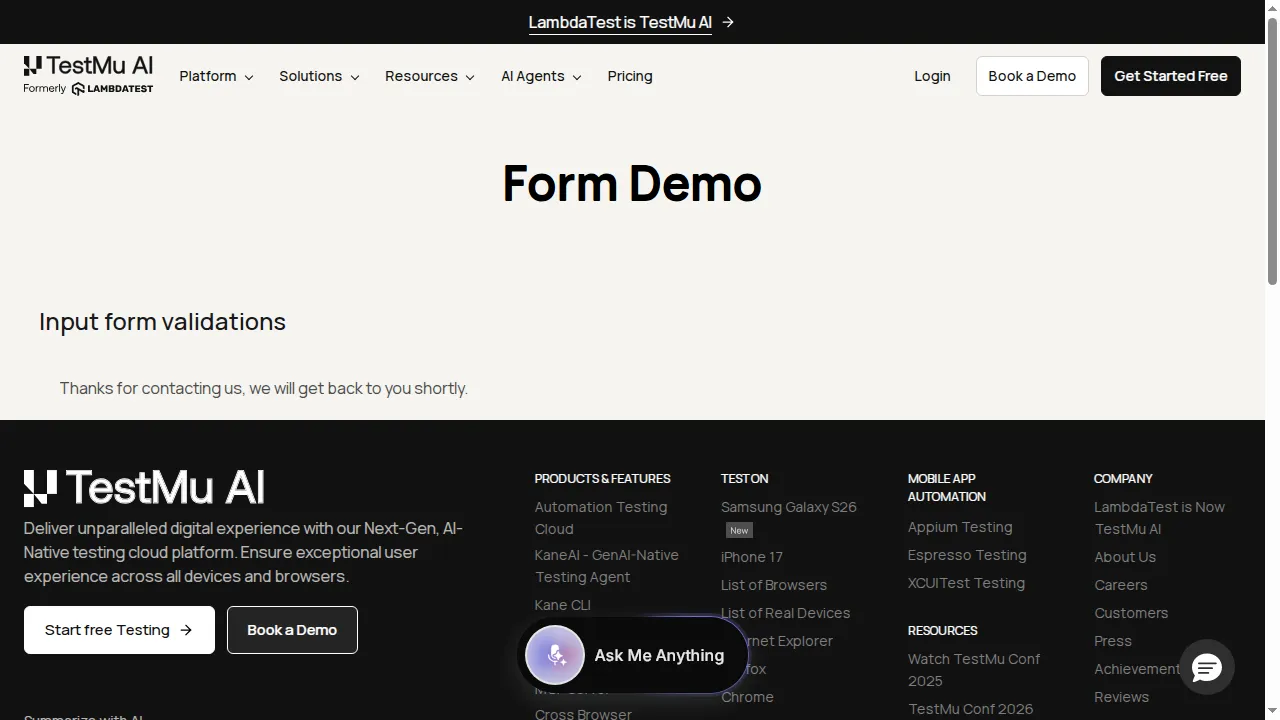
To scale this beyond one script, KaneAI, TestMu AI's GenAI-native testing agent, removes the two costs that make bot testing feel unaffordable. Tests are authored in plain English, so the operator who owns the process can write the regression check without coding. And when the application UI changes, smart element detection and self-healing re-anchor the affected steps and surface the change for review, which significantly reduces the maintenance work that selector breakage creates for both tests and bots.
A practical cadence for a bot portfolio:
- Write one outcome-asserting regression test per critical bot flow.
- Run the suite against staging on every release of every application your bots touch.
- Gate bot deployment on a green run, exactly like a software release.
- Review the video and logs of failed runs before touching the bot, so you fix the cause, not the symptom.

Note: Catch broken automation before your business process stops. Run bot and test flows on real cloud browsers with TestMu AI. Sign up free!
Which Processes Should You Automate? A Scoring Framework
Most of the challenges above are cheaper to prevent than to fix, and prevention happens at selection time. Score each candidate process from 1 to 5 on the six criteria below; automate the highest totals first.
| Criterion | Score 5 Looks Like | Score 1 Looks Like |
|---|---|---|
| Rule clarity | Every decision follows a documented rule | Operators use judgment case by case |
| Input structure | Structured fields from a system or form | Free-form emails, scans, phone calls |
| Process stability | Unchanged for 12+ months | Steps changed within the last quarter |
| Application stability | Stable UI or a documented API | Frequent redesigns, no API |
| Volume | Runs many times daily | Runs a few times a month |
| Exception rate | Under 5% of runs need a human | Over 20% of runs need a human |
Read the total as a decision, not a ranking: 25 to 30 means automate now; 18 to 24 means fix the weak criterion first, usually input structure or stability; below 18 means leave it manual or redesign the process, because a bot will amplify the instability rather than absorb it.

Conclusion
Start with an audit, not a build: list your bots, score their processes with the framework above, and add an outcome-asserting regression test to the one bot whose failure hurts most. That single test usually surfaces the brittleness, exception, and governance gaps described here before they surface themselves in production.
The common thread across all 9 challenges of RPA is treating bots as software: versioned, tested, secured, and owned. Teams that add that discipline keep their automation savings; teams that skip it hand the savings back as maintenance. To put the testing piece in place first, the KaneAI getting started guide walks through authoring your first natural-language test against a real flow in a few minutes.
Author

Sonali
Blogs: 4


Sonali is a QA Automation Tester with 4+ years of experience in designing automation frameworks and script coding using Selenium-BDD and Data-Driven frameworks, UFT, RPA, Appium, and API testing with Postman and Rest Assured. Skilled in Java, Python, Oracle, and SQL, she has delivered projects for clients including SBI, Aditya Birla Sun Life Insurance, and BNP Paribas. She holds certifications in MongoDB and Python.
Reviewer

Salman Khan
Reviewer
Salman is a Test Automation Evangelist and Community Contributor at TestMu AI, with over 6 years of hands-on experience in software testing and automation. He has completed his Master of Technology in Computer Science and Engineering, demonstrating strong technical expertise in software development, testing, AI agents and LLMs. He is certified in KaneAI, Automation Testing, Selenium, Cypress, Playwright, and Appium, with deep experience in CI/CD pipelines, cross-browser testing, AI in testing, and mobile automation. Salman works closely with engineering teams to convert complex testing concepts into actionable, developer-first content. Salman has authored 120+ technical tutorials, guides, and documentation on test automation, web development, and related domains, making him a strong voice in the QA and testing community.


RPA Challenges FAQs
Did you find this page helpful?
More Related Blogs
TestMu AI forEnterprise
Get access to solutions built on Enterprise
grade security, privacy, & compliance
- Advanced access controls
- Advanced data retention rules
- Advanced Local Testing
- Premium Support options
- Early access to beta features
- Private Slack Channel
- Unlimited Manual Accessibility DevTools Tests