
Agent Assurance for your AI Deployment
Test how your agents actually behave across workflows, tools, and actions. Catch failures and vulnerabilities before they ship.
npm install -g @testmuai/rook
- TestMu AI (Formerly LambdaTest)
- /
- Blog
- /
- 9 Best RAG Evaluation Tools for 2026
9 Best RAG Evaluation Tools for 2026
Compare the 9 best RAG evaluation tools for running RAG evals in 2026, with GitHub repository health re-checked in October, metric depth and CI integration.
Last Updated on:
A RAG system fails in two places. The retrieval step can fetch the wrong document, or the model can invent details the document never contained. RAG evaluation tools score these two steps separately, so you know which one to fix.
Both scores are built like any other AI eval: a dataset of inputs, a grader that marks each output, and a pass threshold that decides whether the result ships. LLM benchmarks share that shape, but they compare models on a fixed question set and cannot clear your own pipeline for release.
A single overall score hides which step failed. A support bot can quote a refund policy that expired last year, sound perfectly fluent, and pass every latency and error check; an end-to-end score may flag the answer as wrong, but only a retrieval score shows that the wrong document caused it.
Many teams run no offline evaluation at all. LangChain's State of Agent Engineering survey (1,340 responses, collected from 18 November to 2 December 2025) found 57.3% of respondents running agents in production and 32% citing quality as a top barrier, yet only 52.4% running offline evaluations on test sets. This guide compares nine tools against stated criteria, with repository health pulled from GitHub on 16 October 2026 for the eight that are open source.
Key Takeaways
To run RAG evals on a retrieval-augmented generation pipeline, use DeepEval for automated quality checks inside your CI/CD pipelines, or Langfuse to trace and analyze evaluation history over time. These tools score retrieval and generation separately to pinpoint where your RAG system fails.
- Best for RAG metric breadth: Ragas - Ragas documents eight RAG-specific metrics and needs little setup code, though its last default-branch commit was on 24 February 2026 and its last PyPI release, 0.4.3, came out on 13 January 2026.
- Best for CI/CD integration: DeepEval - DeepEval runs evaluations as pytest-style assertions that fail a build when quality thresholds are missed, making it the strongest fit for gating merges in CI pipelines.
- Best for debugging traces: Arize Phoenix - Arize Phoenix instruments RAG applications through OpenTelemetry to capture execution spans, allowing teams to inspect specific retrieved chunks and explain why a particular answer was incorrect.
- Best for tracking evaluation history: Langfuse - Langfuse provides trace storage, dataset management, and prompt versioning, allowing teams to compare dataset runs over time and track how pipeline changes affect overall performance.
- Best for configuration-driven testing: promptfoo - promptfoo uses declarative YAML files to define test cases and assertions, and includes built-in red-teaming capabilities to probe RAG systems for prompt injection and data leakage.
- Best for small teams: TruLens - TruLens focuses narrowly on the RAG triad of context relevance, groundedness, and answer relevance, offering a compact, easy-to-understand feedback-function model without complex platform overhead.
- Best for LlamaIndex pipelines: LlamaIndex - LlamaIndex evaluates pipelines built within its own framework directly, offering clear retrieval-ranking metrics like hit-rate and mean reciprocal rank alongside synthetic question generation.
- Best for self-hosted platforms: Opik - Opik combines trace storage, dashboards, and LLM-as-judge scoring in a self-hostable Apache 2.0 platform, and its Test Suites turn failing production traces into regression cases with natural-language assertions.
- Best for deployed agents: TestMu AI - TestMu AI Agent Testing scores the deployed agent that sits above the RAG pipeline, across chat, voice, phone, video and image, building 60 to 100+ scenarios from your documents and grading chat and voice replies on metrics such as hallucination detection and context awareness.
What Is RAG Evaluation and What Does It Measure?
RAG evaluation, or RAG evals for short, scores a retrieval-augmented generation system in two halves against a fixed set of test questions: the retriever, on whether it fetched the context the question needs, and the generator, on whether its response stays faithful to that context and addresses what was asked.
Each half needs its own score because the failures are independent. A faithful summary of the wrong documents still scores well on faithfulness, and perfect retrieval does not stop a model from inventing details the sources never contained. Models do this for several reasons, and the guide to what causes AI hallucinations pairs each one with the fix that targets it.
Most tools in this list score some version of these metrics:
- Context precision checks whether relevant retrieved chunks were ranked above irrelevant ones. A low score means your reranker is burying good sources.
- Context recall checks whether the retriever found everything needed to answer. A low score points at chunking strategy or embedding choice, which is where the fix belongs.
- Faithfulness tests every claim the answer makes against the retrieved context, so it is the metric that catches confidently invented policy details.
- Answer relevancy checks whether the response addresses the question actually asked, catching answers that are true and grounded but beside the point.
Most implementations score these with an LLM acting as judge, and the same LangChain survey found both review methods in wide use, reporting human review at 59.8% and LLM-as-judge approaches at 53.3%. The judge model is itself a dependency, and swapping it changes your scores without any change to the pipeline being measured. For the formula behind each score, and the places where frameworks define the same metric differently, see the learning hub on RAG evaluation metrics.
For a broader treatment of scoring non-deterministic systems beyond retrieval, the article on AI agent evaluation covers the metric families that apply once an agent takes actions as well as answering questions, and the roundup of the best AI agent evaluation tools compares the platforms that run those checks.
How We Chose the 9 RAG Evaluation Tools
Tool roundups in this category usually rank the publisher's own product first. This list states its criteria up front, so you can disagree with the weighting instead of guessing at it.
- Documented evaluation logic. Every entry publishes how its metrics are computed, whether as open source or as documented method, because a score you cannot audit is hard to defend to a stakeholder. Eight of the nine are open-source AI testing tools; the ninth is TestMu AI's own commercial platform, included for the deployed-agent layer and flagged as ours wherever it appears.
- Genuine RAG-specific metrics. The tool must score retrieval quality, which generic text scoring leaves untouched.
- Verified repository health. Star counts, most recent commit, and license all come from the GitHub API, with the capture date stated in the maintenance table so you can re-run it.
- A path into CI. Evaluation that only runs in a notebook does not prevent regressions.
The entries below run from retrieval-pipeline metrics through to AI agent validation, so the ordering reflects evaluation layer rather than a quality ranking. TestMu AI appears at the end because it addresses the last layer; its position says nothing about its strength.
What this comparison does not do, so you know where to look elsewhere: it runs no latency or throughput benchmarks, models no cost of ownership at scale, and scores no accuracy comparison between the tools' judge implementations. Repository figures are a snapshot taken on 16 October 2026. Anyone choosing on speed or spend should benchmark against their own corpus, because those results depend on your documents and judge model more than on the tool.
9 Best RAG Evaluation Tools for 2026
1. Ragas
The Ragas documentation lists eight metrics in its retrieval-augmented generation group, among them faithfulness, response relevancy, context precision, context recall, and noise sensitivity. Faithfulness needs only the question, the response, and the retrieved contexts, so a pipeline can be scored without a hand-labelled ground-truth answer for every question, which lowers the cost of getting a first measurement in place. Each metric's formula, and how the names changed between versions, are in the guide to Ragas metrics.
Its maintenance signal has weakened, though. The original explodinggradients/ragas repository on GitHub now redirects to vibrantlabsai/ragas, where the tracker shows 384 open issues and 254 open pull requests and the last default-branch commit is dated 24 February 2026. The latest Ragas release on PyPI, 0.4.3, dates from 13 January 2026, while the other seven repositories in the table below have all committed on or after 13 October 2026.
- Best for teams that want broad RAG metric coverage with minimal setup code.
- Apache 2.0 licensed, so vendoring or forking is straightforward if maintenance stalls further.
- Weakest on CI ergonomics; you write the harness around it yourself.
2. DeepEval
DeepEval treats an evaluation as a unit test. You define a test case with an input, the retrieved context, and an expected output, then assert that a metric clears a threshold. Anyone who has written pytest assertions can read a DeepEval suite without learning a new mental model.
That framing is what makes it the strongest CI fit in this list. DeepEval's CI guide says a metric that falls below its threshold fails the assertion and turns the build red, which makes evaluation a merge gate instead of a report someone reads later. The project ships under Apache 2.0 and keeps releasing: DeepEval 4.3.0 on PyPI was published on 15 October 2026.
- Best for teams that already gate merges on tests and want RAG quality in the same gate.
- Custom criteria via G-Eval cover requirements the built-in metrics miss.
- Requires a judge model budget per run, which grows with suite size.
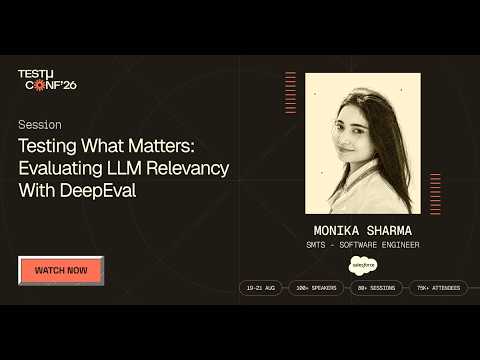
In this TestMu Conf 2026 session, Testing What Matters: Evaluating LLM Relevancy with DeepEval, Monika Sharma goes under the hood of those metrics, separating answer relevancy, contextual relevancy, and faithfulness as distinct failure axes, and covering how DeepEval scores each one, where those scores break down, and when a model-graded judge can be trusted.
3. Arize Phoenix
Phoenix starts from tracing rather than scoring. Built by Arize as an open-source project, it instruments a RAG application through OpenTelemetry, captures each span across retrieval and generation, then layers evaluation on the collected traces. When a score drops, you can open the specific trace and read which chunks were retrieved for that query.
That ordering suits debugging far better than a scoreboard does. Phoenix runs in a notebook, from the command line, in a Docker container, or on Kubernetes, and its last commit before the pull below was dated 16 October 2026. Arize itself now belongs to Dynatrace, which completed the acquisition on 1 October 2026 and said in its press release that Arize will keep supporting Phoenix as its open-source platform alongside the enterprise AX product.
- Best when you need to explain why one specific answer was wrong, beyond how often answers go wrong.
- OpenTelemetry compatibility means traces can flow into observability tooling you already run. OpenTelemetry's GenAI semantic conventions also define metrics for model call duration and token usage, set out in our guide to OpenTelemetry LLM metrics.
- Ships under the Elastic License 2.0, which permits internal use but restricts offering the software itself as a managed service. Worth a legal read if you resell tooling.
4. Langfuse
Langfuse has the largest community of the dedicated evaluation and tracing projects here, at 35,918 GitHub stars in the pull below; only LlamaIndex, a full RAG framework, has more. The Langfuse documentation covers observability, prompt management, and evaluation, and its LLM-as-a-judge evaluators score recorded operations or dataset experiments inside the platform instead of running as a standalone scoring library. ClickHouse acquired Langfuse in January 2026, and its announcement says the core features stay open source under the MIT license.
The practical consequence is that Langfuse answers questions across time. Every change to a dataset's items creates a new dataset version, so you can rerun an experiment against the same version after tuning embeddings or chunking and see which change moved the numbers.
- Best for teams that need durable evaluation history and self-hosting. Teams also weighing Braintrust can compare open-source status, self-hosting, and evals in our Braintrust vs Langfuse guide.
- Dataset versioning makes regression comparisons reproducible across releases.
- For specialised RAG metrics, its documentation points to an integration with Ragas, so expect to pair it with a scoring library.

Note: A sound RAG score cannot confirm that the deployed chatbot quotes a customer's real order status or today's price. TestMu AI Agent Testing's Data Validation compares each fact a chat agent states with the value your own API returns, using read-only lookups, and reports a verdict for every fact. Try TestMu AI free!
5. promptfoo
promptfoo replaces Python test files with declarative YAML. In a promptfoo configuration file you list prompts, providers, and test cases with their assertions, then run the suite from the command line, which suits teams who want evaluation owned by people who do not write Python daily.
Its second capability is adversarial: promptfoo's red-team plugins test for indirect prompt injection, personal data exposure, and RAG document exfiltration, so the same tool that scores retrieval quality can also attack the system. The project's GitHub README now states that promptfoo is part of OpenAI and remains open source and MIT-licensed, and its last commit before the pull below was dated 15 October 2026.
- Best for config-driven evaluation that non-Python contributors can maintain.
- MIT licensing puts few conditions on using or modifying the code.
- Its context-based RAG assertions (context-faithfulness, context-recall, context-relevance) are fewer than the eight RAG metrics Ragas documents, so complex retrieval scoring needs custom assertions.
6. TruLens
TruLens is built around the RAG triad: context relevance, groundedness, and answer relevance, the three evaluations the TruLens documentation treats as its core. It is the smallest project here by community size, at 3,602 stars, and it is deliberately narrow, which makes it readable end to end. That compactness makes it a good way to learn what the triad means before adopting something larger.
Feedback functions are its unit of evaluation, and selectors let you point one at any component of an instrumented app, such as the retriever's output, so instrumentation is granular without much ceremony. Its last commit before the pull below was dated 13 October 2026, under an MIT license.
- Best for small teams wanting the triad without a platform to operate.
- Compact enough to read end to end, which helps when explaining scores internally.
- Smallest community here, so expect fewer worked examples for unusual stacks.
7. LlamaIndex
LlamaIndex is the odd one out here: it is a RAG framework first and an evaluation tool second. For a pipeline already built in LlamaIndex, its built-in evaluation modules score the objects the pipeline produces, with no separate harness to wire up.
Scoring splits cleanly across the two layers. Response evaluators cover faithfulness, answer relevancy, context relevancy, and correctness against a reference, while retrieval is scored by ranking position with hit-rate and mean reciprocal rank. The repository is MIT licensed, had 52,522 stars in the pull below, and its last commit was dated 14 October 2026.
- Best for teams already building on LlamaIndex who want evaluation without adopting a second framework.
- The clearest retrieval-ranking metrics in this list, since hit-rate records whether the right chunk made the top results and mean reciprocal rank scores how high it ranked.
- Synthetic question generation builds an evaluation set from your own documents when you have no labelled test data.
8. Opik
Opik, from Comet, is the open-source answer to hosted evaluation platforms. Its tracing and evaluation stack runs self-hosted under Apache 2.0, through Docker Compose for local use or a Helm chart on Kubernetes for production, combining trace capture with LLM-as-judge scoring in one tool rather than splitting the two across separate services.
For RAG it ships LLM-as-a-judge metrics for Hallucination, Answer Relevance, Context Precision, and Context Recall, and its Test Suites turn a failing production trace into a regression case with a natural-language assertion. That combination puts it between DeepEval and Langfuse: judge-scored checks sitting on top of stored traces. It had 22,654 stars in the pull below and a last commit dated 16 October 2026.
- Best for teams that want hosted-platform features like trace storage and dashboards without sending data to a vendor.
- Built-in RAG metrics mean you score context precision and hallucination without writing the judge prompts yourself.
- Test Suites grow from real production failures, so a regression you have already seen stays covered after the fix.
9. TestMu AI Agent Testing (Formerly LambdaTest)
TestMu AI Agent Testing does not compute context precision on your retriever, and it will not replace Ragas or DeepEval for scoring a retrieval pipeline. Its AI agent testing platform evaluates the layer above, the agent your RAG pipeline ships inside, and it covers chat, voice, phone, video and image agents. This is the publisher's own product, built by TestMu AI (formerly LambdaTest), so weigh this entry with that interest in mind.
It turns a PRD, knowledge base, or policy document you upload into 60 to 100+ test scenarios, then sends 15+ specialist evaluators at the live agent. Chat and voice agents are scored from 0 to 100% on nine quality metrics, among them Hallucination Detection, Context Awareness, Completeness, and Conversation Flow, while phone agents are measured on 30+ call metrics. Each result carries a confidence level, so a passing score backed by thin scenario volume is visibly different from one backed by broad coverage.
Results roll up to one of three readiness verdicts, Green, Yellow, or Red, and the same evaluations can start from CI through the Agent Testing CLI. A chat agent's CI command needs three IDs, for the project, the workflow, and the suite:
pip install agent-testing-cli

agent-testing-cli --project "$TESTMU_PROJECT_ID" \
  --json run \
  --workflow "$TESTMU_WORKFLOW_ID" \
  --suite "$TESTMU_SUITE_ID" \
  --yes
In CI the CLI takes its credentials from the environment variables LT_USERNAME and LT_ACCESS_KEY, and --json prints machine-readable output for the next pipeline step. Chat evaluations run asynchronously, so the docs advise against --wait on a chat run; a Phone Caller suite can wait for its result, and exit code 1 then means a completed test failed. The Agent Testing CLI documentation lists every exit code from 0 to 5.
- Ten prebuilt personas probe behaviour that a fixed test set never exercises, including confused, angry, and off-script users.
- The phone metrics include first call resolution and containment rate.
- Credits are consumed per evaluation cycle, so broad persona sweeps cost more than a narrow regression run.
Maintenance and Licensing of Open-Source RAG Evaluation Tools
Feature tables age badly. Repository health tells you whether a tool will still be maintained when your evaluation suite depends on it. Every figure below comes from the GitHub repository API for the eight open source entries, pulled on 16 October 2026 with the script after the table, rather than quoted from vendor pages.
| Tool | Stars | Last commit | License | Strongest at |
|---|---|---|---|---|
| LlamaIndex | 52,522 | 14 Oct 2026 | MIT | Framework-native retrieval and response evaluation |
| Langfuse | 35,918 | 16 Oct 2026 | MIT core, enterprise directories licensed separately | Trace history and dataset versioning across releases |
| promptfoo | 26,056 | 15 Oct 2026 | MIT | Declarative YAML suites plus adversarial red-teaming |
| Opik | 22,654 | 16 Oct 2026 | Apache 2.0 | Open-source tracing with built-in RAG judge metrics |
| DeepEval | 18,905 | 16 Oct 2026 | Apache 2.0 | Pytest-style assertions that gate a CI merge |
| Ragas | 16,039 | 24 Feb 2026 | Apache 2.0 | Eight documented RAG metrics |
| Arize Phoenix | 11,873 | 16 Oct 2026 | Elastic License 2.0 | OpenTelemetry tracing for per-query debugging |
| TruLens | 3,602 | 13 Oct 2026 | MIT | Compact RAG triad reference implementation |
GitHub's API reports the license of Phoenix and Langfuse as NOASSERTION, because GitHub's license detection compares each LICENSE file with a short list of known licenses and matched neither; the table gives what each file states. These figures will drift. The script below needs only Node 18 or newer and makes two unauthenticated GitHub API calls per repository, so you can rerun it and judge against current numbers instead of these:
// repo-health.mjs: Node 18 or newer, nothing to install
const repos = [
  "vibrantlabsai/ragas", "confident-ai/deepeval",
  "Arize-ai/phoenix", "langfuse/langfuse",
  "promptfoo/promptfoo", "truera/trulens",
  "run-llama/llama_index", "comet-ml/opik",
];
const api = "https://api.github.com/repos/";
const get = async (url) => (await fetch(url)).json();
for (const r of repos) {
  const repo = await get(api + r);
  const [c] = await get(api + r + "/commits?per_page=1");
  console.log(repo.full_name, repo.stargazers_count,
    repo.license?.spdx_id,
    c.commit.committer.date.slice(0, 10));
}
Its output on 16 October 2026 gives each repository, its stars, its license, and the date of its last default-branch commit:
vibrantlabsai/ragas 16039 Apache-2.0 2026-02-24
confident-ai/deepeval 18905 Apache-2.0 2026-10-16
Arize-ai/phoenix 11873 NOASSERTION 2026-10-16
langfuse/langfuse 35918 NOASSERTION 2026-10-16
promptfoo/promptfoo 26056 MIT 2026-10-15
truera/trulens 3602 MIT 2026-10-13
run-llama/llama_index 52522 MIT 2026-10-14
comet-ml/opik 22654 Apache-2.0 2026-10-16
One caveat if you compare against the GitHub web UI: the API's open_issues_count field bundles pull requests in with issues. For Ragas it reads 638, which GitHub's search API splits into the 384 open issues and 254 open pull requests quoted above.
The Ragas row carries the most risk. The repository is not archived, but almost eight months without a commit, no PyPI release since January 2026, 254 open pull requests, and a change of repository owner add up to a supply-chain question for a dependency that gates your releases. Apache 2.0 licensing keeps a fork open to you if the gap widens.

How to Choose a RAG Evaluation Tool
Start from the question you cannot currently answer, and let that pick the tool. If that question is not about retrieval at all, a wider list of the best LLM evaluation tools is the better starting point.
- You have no retrieval scores at all, and want them fastest. Start with Ragas for metric breadth, and budget for the maintenance risk in the table above.
- You want a bad retrieval change to fail a pull request. DeepEval, because thresholds map directly onto assertions and exit codes.
- You need to explain one specific wrong answer to a stakeholder. Arize Phoenix, because the trace shows which chunks were retrieved for that exact query.
- You are tuning embeddings and chunking over weeks and need comparisons across runs. Langfuse, for dataset versioning and durable history. If both Phoenix and Langfuse fit, our guide to Langfuse vs Phoenix weighs their licenses, deployment footprint, and where evaluation runs in each.
- Your evaluation owners are not Python engineers, or you need red-teaming in the same tool. promptfoo, for YAML configuration and adversarial probes under MIT licensing.
- You want to learn the RAG triad before committing to a platform. TruLens, for a small readable implementation.
- Your pipeline scores well but users still complain. The failure has moved downstream to the agent, and TestMu AI Agent Testing scores that surface.
If you need both views, run two tools: a metrics library gating the pipeline in CI, and an agent-level evaluation gating the deployed experience. Pass thresholds and the CI gate itself get a full treatment in the guide to RAG testing, while the walkthrough on how to scalably test LLMs covers running these suites at volume.
Testing Retrieval-Driven Actions With Agent Assurance
Every RAG metric in this guide grades text: what the retriever returned and what the model wrote about it. Give the support bot from the introduction a refund tool, and the expired policy it retrieves can now trigger a refund the current policy forbids, an outcome none of those scores can see, because the refund is written to the payments system rather than stated in the answer.
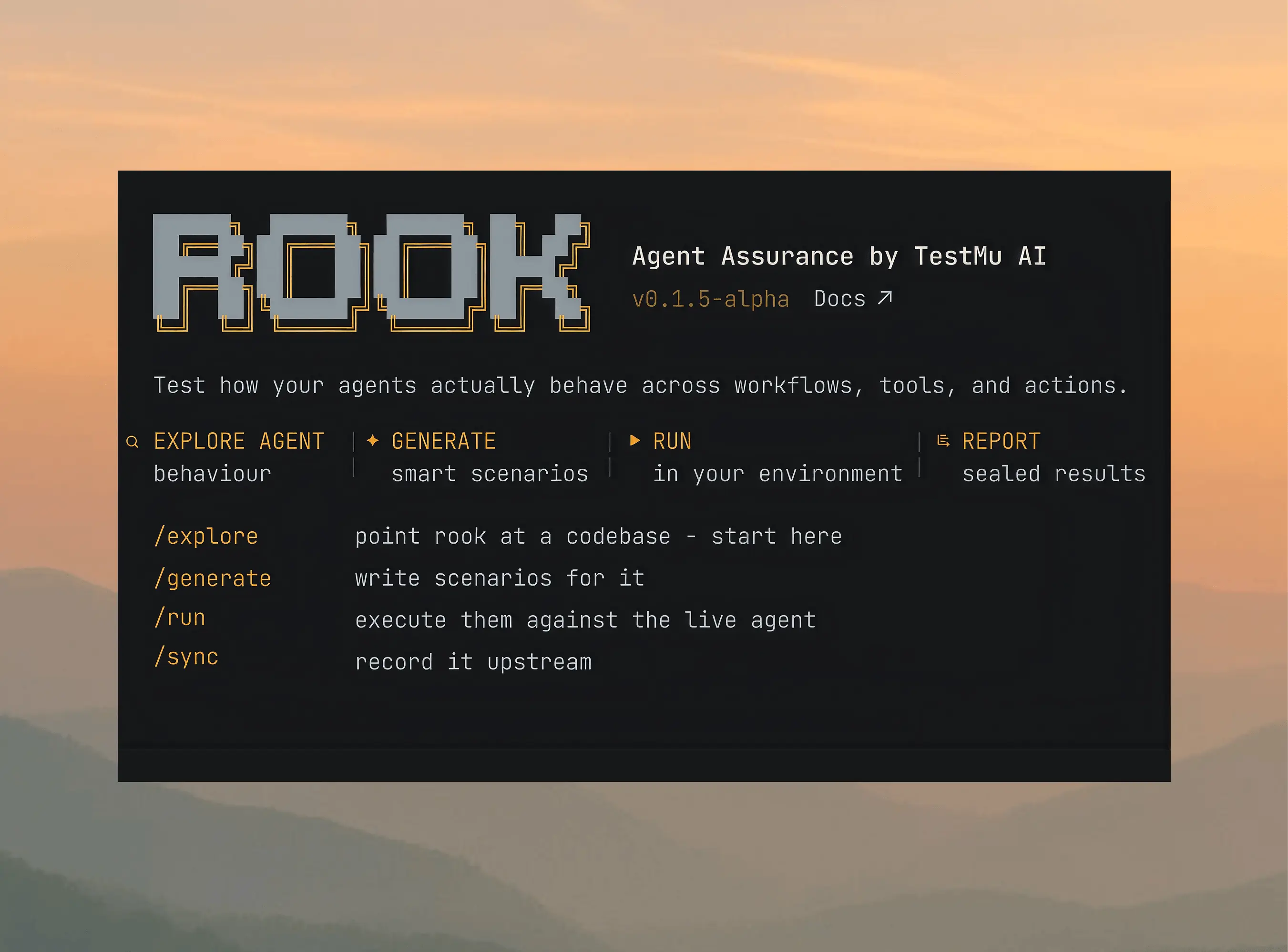
TestMu AI's Agent Assurance, currently pre-alpha and publicly installable, puts an agent like this one through real runs before release and inspects their effects. From the agent's code or a written spec it derives functional and adversarial scenarios (plus non-functional ones when you ask for them), calls the actual agent in a staging environment or a CI job, and grades every acceptance criterion against evidence collected from the run:
- Evidence over the agent's account - criteria are graded from what the run left behind: modified files, generated artifacts, and each tool call checked against the agent's declared tool list. A reply saying the refund went through is a claim to check against those records.
- Record checks that change nothing - to confirm what happened to the refund, Rook CLI reads the record with a read-only tool that you have approved, for example a refund-status lookup served by a separate MCP server. Its docs warn that checking with the agent's own issue_refund tool would create the very refund it is meant to observe.
- A verdict per criterion - Pass and Fail are the decided verdicts; Unable to Verify is the third, used when the run left too little evidence to settle a criterion either way. Those undecided results get their own count, and the pass rate covers decided scenarios only.
- Attacks mapped to published lists - adversarial scenarios are mapped to MITRE ATLAS and to OWASP's Top 10 lists for Agentic Applications (2026) and for LLM Applications (2025).
- Changes between runs - after a retrieval or prompt change, rerun the suite; the report shows how the pass rate moved since the previous run and which scenarios now fail after passing last time, alongside those that were fixed.
Rook CLI is the command-line form of Agent Assurance. Install it from npm and check the version:
npm install -g @testmuai/rook
rook --version
Rook CLI targets macOS and Linux, and 64-bit Windows through npm or WSL, and Node.js 20 or newer is required when you install through npm. The Rook CLI installation guide also documents Homebrew and a shell script for macOS and Linux. Point every run at a staging environment, because runs call the real agent and its tools can write real data.
A CI job should decide pass or fail from the output of rook run --json, checking its ok and halted values and the report totals, not from the exit code, which can be 0 for a finished run whose scenarios failed. The docs page on running Agent Assurance in CI/CD has a gate script that fails closed when those totals are missing.
Claude Code users can add the rook skill with one more command. That installer requires Node.js 22 or newer and adds the skill alone, so set up Rook CLI first; the guide to using Rook CLI with Claude Code walks through both.
npx @testmuai/rook-skill@latest \
  install --agent claude-code
For the support bot from the introduction, a scoped first request might read:
/rook Check the billing support agent in this repo.
It reads refund policy from the knowledge base and
can issue refunds through a tool. With the staging
profile, suggest at most three scenarios in which
an outdated or stricter policy should stop a refund,
and list the writes the agent could make before any run.
Conclusion
Pick the one metric you are not measuring today, faithfulness if you score nothing yet, and run it with a pass threshold in the pipeline that ships your retrieval changes. Then test the deployed agent above that pipeline: the Agent Testing features and metrics guide lists the nine scores TestMu AI gives chat and voice agents and the call metrics it applies to phone agents.
Author

Anubhav Singhmaar
Blogs: 46

Anubhav Singhmaar is an AI Product Manager at TestMu AI driving Kane CLI, the command-line tool that brings browser automation to the terminal, turning natural-language flows into runs in a real Chrome browser that return pass or fail with shareable proof. He owns the roadmap and prioritization and works with engineering to ship developer-facing features. Before TestMu AI, he spent over four years at Sprinklr owning enterprise voice AI across APAC and EMEA. A mechanical engineer turned product manager, he grounds guidance in real QA workflows.
Reviewer

Srinivasan Sekar
Reviewer
Srinivasan Sekar is Director of Engineering at TestMu AI, where he leads engineering and open-source initiatives behind the Selenium and Appium automation grid and owns TestMu AI's MCP Server. A committer to Appium and a contributor to Selenium, WebdriverIO, Taiko, and AppiumTestDistribution, he brings over 15 years of experience in quality engineering and open-source technologies. He is the author of the Apress book 'The MCP Standard: A Developer's Guide to Building Universal AI Tools with the Model Context Protocol,' a Certified Kubernetes and Cloud Native Associate, and an international conference speaker. Before TestMu AI he spent over eight years at Thoughtworks as a Principal Consultant and Quality Architect. Srinivasan holds a B.Tech in Information Technology from Anna University.


RAG Evaluation FAQs
Did you find this page helpful?
More Related Blogs

TestMu AI forEnterprise
Get access to solutions built on Enterprise
grade security, privacy, & compliance
- Advanced access controls
- Advanced data retention rules
- Advanced Local Testing
- Premium Support options
- Early access to beta features
- Private Slack Channel
- Unlimited Manual Accessibility DevTools Tests