
Agent Assurance for your AI Deployment
Test how your agents actually behave across workflows, tools, and actions. Catch failures and vulnerabilities before they ship.
npm install -g @testmuai/rook
- TestMu AI (Formerly LambdaTest)
- /
- Blog
- /
- Braintrust vs Langfuse: Open Source, Self-Hosting and Evals
Braintrust vs Langfuse: Open Source, Self-Hosting and Evals
Braintrust vs Langfuse, compared from their public code: what each license covers, what self-hosting each takes, Brainstore vs ClickHouse, evals and CI gates.
Published on:
Put Braintrust and Langfuse side by side and the feature lists look alike: tracing, datasets, LLM-as-a-judge scorers, prompt versions and a playground. The choice that is hard to reverse sits underneath, in who owns the code, where your trace data lives, and how much infrastructure you take on if that data has to stay in your own cloud.
This Braintrust vs Langfuse comparison measures that layer from the projects' public files rather than from either vendor's comparison page. A script read Langfuse's license and Docker Compose file and Braintrust's AWS Terraform module straight from GitHub, without installing or starting anything, and its output is quoted in the sections below.
Overview
Braintrust vs Langfuse comes down to license and hosting. Langfuse is MIT-licensed outside its ee folders and self-hosts free from a six-service Docker Compose file. Braintrust is a proprietary platform whose self-hosting, on the Enterprise plan only, puts a data plane with its Brainstore database in your cloud while Braintrust hosts the control plane.
What the Comparison Found
- Is Langfuse open source?: Yes. Langfuse's LICENSE file puts Langfuse's own code outside the ee/, web/src/ee/ and worker/src/ee/ folders under the MIT license, and those folders hold under two percent of the repository's files.
- Is Braintrust open source?: No. Braintrust publishes its SDKs, the autoevals library and its Terraform modules on GitHub, but the platform and the Brainstore database are not public, and Brainstore runs only with a license key.
- Can you self-host Braintrust on a free plan?: No. Braintrust's self-hosting documentation limits self-hosting to the Enterprise plan, and Braintrust keeps running the control plane for the web UI, login and metadata.
- Langfuse self-hosting: The Langfuse Docker Compose file starts a web app, a worker, ClickHouse, PostgreSQL, Redis and MinIO, and the Langfuse README names Kubernetes with Helm as the preferred production deployment.
- Braintrust data plane: The Braintrust AWS Terraform module builds a VPC, PostgreSQL on RDS, Redis, S3 buckets, ECS services, Lambda functions and fleets of Brainstore reader and writer nodes inside your AWS account.
- Storage engines: Langfuse keeps traces, observations and scores in ClickHouse, whose maker acquired Langfuse in January 2026, while Brainstore appends every write to a log on object storage and runs stateless nodes.
- CI regression gates: The Langfuse experiment action for GitHub can fail a pull request when an experiment raises a regression, while the Braintrust eval action posts a comment listing each score's improvements and regressions.
- Pricing meters: Braintrust Cloud meters processed data and scores with no limit on users, while Langfuse Cloud meters units, meaning traces, observations and scores, and caps users only on its free Hobby plan.
- Agent Assurance: TestMu AI's Agent Assurance runs your agent in staging before release, compares its tool calls with the declared list, reads the files and records the run changed, and reports Pass, Fail or Unable to Verify against every acceptance criterion.
Braintrust vs Langfuse: License, Hosting, Evals and Pricing at a Glance
Every cell below comes from the Langfuse GitHub organization, the Braintrust GitHub organization or the two vendors' documentation and pricing pages, read on 2026-10-19 (UTC). The sections after the table name the file or page behind each row.
| Criterion | Braintrust | Langfuse |
|---|---|---|
| License | Proprietary platform; SDKs, autoevals and Terraform modules public | MIT outside the ee folders; ee code under an enterprise license |
| Owner | Braintrust | ClickHouse, since January 2026 |
| Self-hosting | Enterprise plan only; Braintrust hosts the control plane | MIT core free to run; the whole application runs in your environment |
| Deployment tooling | Terraform modules for AWS, GCP and Azure; Helm chart | Docker Compose, Helm, Terraform templates for AWS, Azure and GCP |
| Services you run | API, PostgreSQL, Redis, object storage, Brainstore | Web, worker, ClickHouse, PostgreSQL, Redis, S3-compatible storage |
| Trace store | Brainstore: write-ahead log and segments on object storage | ClickHouse |
| OpenTelemetry | OTLP endpoint; braintrust[otel] extra for Python | Python SDK built on OpenTelemetry |
| Evals | Eval() with autoevals and custom scorers | Datasets, experiments, LLM-as-a-judge, custom scores |
| CI action | Posts a pull request summary of improvements and regressions | Can fail the job when an experiment raises a regression |
| Prompts | Versions pinned or assigned to environments; loaded in code | Versions and labels; cached client-side by the SDK |
| Cloud pricing meter | Processed data and scores; users unlimited | Units (traces, observations, scores); user cap on Hobby only |
The same questions for other pairs are covered in LangSmith vs Langfuse, LangSmith vs Braintrust and Langfuse vs Phoenix.
Open Source Status: Langfuse's MIT Core and Braintrust's Proprietary Platform
Langfuse is open core. Its LICENSE file says content outside the "ee/", "web/src/ee/" and "worker/src/ee/" directories is under the MIT Expat license, while content inside them falls under the license in "ee/LICENSE". The same file now reads "Copyright (c) 2023-2026 ClickHouse, Inc."
GitHub's license detection does not match that file to a single license, so its API returns NOASSERTION for the repository. A script run on 2026-10-19 downloaded the main branch and counted files per folder; this excerpt of its output shows how much of the code the carve-out covers:
langfuse/langfuse @ bde307305a1b
GitHub licence (spdx_id): NOASSERTION
LICENSE: MIT except 3 ee dirs named
  files in repository             7216
  in the 3 ee dirs LICENSE names   128  1.8%
  in other ee dirs                  12  0.2%
  outside any ee dir              7076  98.1%
    ee/                                             9
    web/src/ee/                                   102
    worker/src/ee/                                 17
    packages/shared/src/server/ee/ (not named)     12
In the script's output, the three folders the LICENSE names hold 128 of 7,216 files (1.8%), most of them in web/src/ee/. A fourth folder, packages/shared/src/server/ee/, holds 12 more files, but the LICENSE text, read on 2026-10-19, does not name it, so check with Langfuse before relying on how those files are licensed.
Braintrust publishes its SDKs, scorers and deployment code, while the platform itself stays closed. The braintrust-sdk-python LICENSE is the Apache License 2.0, as is the AWS Terraform module. The package metadata in the same repository's py/pyproject.toml sets MIT, and the braintrust package on PyPI shows that value, so the LICENSE file and the package disagree.
- Public - the Python, JavaScript, Go and other SDKs, the autoevals scorer library, the GitHub eval action, the Helm chart and the Terraform modules for AWS, GCP and Azure.
- Not public - the web application, the control plane and Brainstore, which the AWS example will not deploy without a brainstore_license_key from the Braintrust UI.
- Vendor framing - Braintrust's own Langfuse comparison article, dated 27 October 2025, lists Braintrust as proprietary and Langfuse as MIT-licensed.
How to Self-Host Langfuse Step by Step
The langfuse/langfuse repository README gives a local start that needs Git and Docker:
git clone --depth=1 \
  https://github.com/langfuse/langfuse.git
cd langfuse
docker compose up
That command reads the docker-compose.yml at the repository root. The same script parsed it on 2026-10-19 and printed each service, its image and whether its ports are published on all interfaces or bound to localhost:
langfuse/langfuse @ bde307305a1b
docker-compose.yml services:
  langfuse-worker  langfuse-worker:4        localhost
  langfuse-web     langfuse:4               public
  clickhouse       clickhouse-server:25.12  localhost
  minio            minio                    public
  redis            redis:7                  localhost
  postgres         postgres:17              localhost
  named volumes: 5   CHANGEME markers: 14
TELEMETRY_ENABLED default: true- Replace the defaults - the word CHANGEME appears 14 times in the file: once in the header note that explains it, and 13 more times beside a default password, secret, salt, encryption key or connection string.
- Limit what is reachable - only langfuse-web on port 3000 and MinIO on port 9090 listen beyond localhost, and the file's header recommends restricting inbound traffic on the host to those two.
- Decide on telemetry - TELEMETRY_ENABLED defaults to true, and the README says self-hosted instances report basic usage statistics to PostHog unless you set it to false; it states raw traces, prompts and scores are not included.
- Move to a production layout - Langfuse's self-hosting documentation describes the Compose setup as a "Single VM without high availability, scaling, or backups", and the README calls Kubernetes with Helm the preferred production deployment, with Terraform templates for AWS, Azure and GCP.
No license key is needed for any of this. Langfuse's license-key page, read on 2026-10-19, says "All core Langfuse features and APIs are available in Langfuse OSS (MIT licensed) without any limits" and lists the Enterprise features that do need a key, among them protected prompt labels, data retention policies and the Instance Management API.
How to Self-Host the Braintrust Data Plane Step by Step
Self-hosting Braintrust starts with a contract: Braintrust's self-hosting documentation, read on 2026-10-19, limits self-hosting to the Enterprise plan. Under that plan the customer operates the data plane, which the same page says "consists of the Braintrust API, a PostgreSQL database, Redis cache, object storage, and Brainstore", while Braintrust keeps hosting the control plane that supplies the UI, authentication and metadata.
The documentation says the SDKs and the browser send trace data straight to your data plane, and that the two planes "communicate only for authentication and metadata synchronization." Braintrust's own Langfuse comparison article says "Hybrid deployment is available for enterprise customers"; the current documentation does not use that word and offers a separate BYOC option, "where Braintrust operates the deployment."
On AWS, the work runs through the terraform-aws-braintrust-data-plane module. The production example's README sets out the order:
- Copy the example - put examples/braintrust-data-plane in your own repository and point provider.tf at your account and terraform.tf at your state backend.
- Fetch the license key - copy the Brainstore key from Settings, then Data Plane, in the Braintrust UI, ideally into AWS Secrets Manager.
- Prepare a new account - on a fresh AWS account, run scripts/create-service-linked-roles.sh once.
- Apply and connect - run terraform apply, read api_url from terraform output, and paste it into the same Data Plane settings page; for a trial, the README recommends a new Braintrust organization so live users are not affected.
# sketch of the steps in the module's README
cp -r examples/braintrust-data-plane ../bt-plane
cd ../bt-plane
# edit provider.tf, terraform.tf and main.tf
terraform init
terraform apply
terraform output api_url
The script that read Langfuse's files also downloaded this module's main branch on 2026-10-19 and counted what it declares. Its output, unedited:
braintrustdata/terraform-aws-
  braintrust-data-plane @ a96de1d766b1
GitHub licence (spdx_id): Apache-2.0
  .tf files (no examples): 147   submodules: 21
  resource blocks: 371 of 86 types
    EC2 Auto Scaling groups          4
    ECS services                     5
    Lambda functions                 8
    Load balancers                   9
    S3 buckets                       4
    RDS instances (Postgres)         1
    ElastiCache (Redis)              2
    VPCs                             2
    IAM roles                       21
    Security groups                 21
  examples/*/main.tf  production       sandbox
    Brainstore nodes
      readers       2 x c8gd.4xlarge  1 x c8gd.xlarge
      fast readers  2 x c8gd.4xlarge  none
      writers       1 x c8gd.8xlarge  1 x c8gd.xlarge
    Postgres (RDS)  db.r8g.2xlarge    db.r8g.large
    Postgres GB     1000              100
    Redis           cache.r7g.large   cache.t4g.small
  example requires brainstore_license_key: yes
The 371 resource blocks in the script's output include optional ones that flags switch on, such as the Redis replication group, so one deployment need not create all of them. The module's README calls the default configuration "a large production-sized deployment", and the sandbox example trims Brainstore to one reader and one writer, which the sandbox example's README calls "not suitable for workload testing or performance evaluation".
Trace Storage: Brainstore in Braintrust, ClickHouse in Langfuse
Langfuse writes traces, observations and scores to ClickHouse, keeps transactional data in PostgreSQL, uses Redis for queues and cache, and persists incoming events and exports in S3-compatible storage, per its self-hosting documentation. ClickHouse's own acquisition post adds that "Langfuse's architecture runs entirely on ClickHouse, both in the cloud offering and for self-hosted deployments."
Langfuse's maintainers posted the "ClickHouse acquires Langfuse" announcement on GitHub on January 16, 2026, saying "Langfuse is joining ClickHouse", and ClickHouse's post says Langfuse stays "open-source under its existing MIT license for core features" and that "Langfuse Cloud continues operating as a standalone service". If you self-host, the database under your traces is now made by the company that owns the application.
Brainstore is Braintrust's own engine. Braintrust's architecture documentation describes it this way:
- Write path - "Every write appends to a WAL on object storage", and processing then assigns records to time-ordered segments.
- Stateless nodes - because object storage is the source of truth, Brainstore nodes "can be replaced without data loss."
- Node roles - writers ingest spans, readers serve API and BTQL queries, and fast readers serve predictable UI queries, which matches the three Brainstore pools in the module output above.
- PostgreSQL - stores the metadata the platform needs and "is not the primary store for your AI data."
The practical difference for an operator: Langfuse asks you to run and back up a ClickHouse server, while on AWS Braintrust asks you to run EC2 fleets that keep their durable state in S3.
Tracing and OpenTelemetry Support in Braintrust and Langfuse
Both platforms accept OpenTelemetry, from different starting points. The langfuse-python repository calls its SDK OpenTelemetry-based and marks the older v2 client API as deprecated.
Braintrust ships its own SDK and adds OpenTelemetry as an option. The braintrust pyproject.toml defines an otel extra that pulls in the OpenTelemetry API, SDK and OTLP HTTP exporter, and Braintrust's OpenTelemetry documentation gives an /otel/v1/traces endpoint that takes an x-bt-parent header naming the project or experiment.
- Instrumentation already on OpenTelemetry - both accept OTLP, so the choice of backend does not force a rewrite of your spans. Beyond spans, the OpenTelemetry GenAI metrics define histograms and counters for operation duration and token usage.
- Self-hosted Braintrust - the same endpoint path sits on your own data plane URL, per Braintrust's documentation.
- Agent traces - for which spans and attributes to record on tool calls and model calls, see AI agent tracing.
Evals, CI Gates and Prompt Management in Braintrust vs Langfuse
Braintrust's SDK quickstart opens with an eval, and the Langfuse Python SDK README lists tracing first, yet both now cover the other's ground. What still differs is how an eval is written and what happens to a pull request when scores drop.
Running Evals in Braintrust and Langfuse
In Braintrust, an eval is code: the SDK quickstart calls Eval() with data, a task and scorers such as LevenshteinScorer from autoevals, Braintrust's MIT-licensed scorer library. In Langfuse, the same Python SDK that traces also runs datasets and experiments, LLM-as-a-judge evaluations and custom scores.
- Model-graded scores - both offer judge-based scoring; how to write and check such a judge is covered in LLM-as-a-judge.
- Test data - both build datasets from logged traces; a golden dataset explains what to keep fixed between runs.
Blocking a Pull Request When Braintrust or Langfuse Scores Drop
The langfuse/experiment-action README lists a should_fail_on_regression input that defaults to true: the experiment script raises RegressionError, and the job fails. The braintrustdata/eval-action README runs evals for node, python or go and posts a live comment with each score's average, improvements and regressions.
Braintrust's action input table, read on 2026-10-19, has terminate_on_failure for errors but no input that fails the job on a score drop. To block a merge on Braintrust scores, add your own check step after the action.
Prompt Versioning in Braintrust and Langfuse
- Braintrust - its prompt documentation describes pinning a version or loading "the version assigned to an environment"; load_prompt fetches the configuration and build() returns the compiled messages, model and parameters without calling the model.
- Langfuse - prompts carry versions and labels, and its documentation says they are "cached client-side by the SDK" and can be linked to traces to compare results by prompt version.
How Braintrust and Langfuse Pricing Models Differ
The two clouds bill on different units, and neither pricing page, read on 2026-10-19, lists a per-seat price. What each one meters:
- Braintrust - Starter and Pro meter processed data in gigabytes, scores in thousands and model credits, with users, projects, experiments and datasets unlimited; Enterprise terms are custom.
- Langfuse Cloud - Hobby, Core, Pro and Enterprise meter units, and Langfuse's billable-units documentation says "Units are either traces, observations or scores". Only Hobby limits users.
- Self-hosting - the same documentation says self-hosted Langfuse OSS has no usage-based billing, while self-hosted Langfuse Enterprise uses billable units as one component of its price; Braintrust self-hosting sits inside an Enterprise contract on top of the cloud resources the data plane runs on.
Self-hosted Langfuse turns paid only for the ee features: the ee/LICENSE says that software "may only be used" with a valid Langfuse Enterprise License. Estimate trace volume first, because an agent run that logs many spans grows the Langfuse unit count and the Braintrust processed-data figure at different rates.
Braintrust and Langfuse Strengths by Area
Both ship Kubernetes charts for production, in the langfuse-k8s repository and the braintrustdata/helm repository.
| Area | Stronger in Braintrust | Stronger in Langfuse |
|---|---|---|
| Code ownership | Public SDKs for Python, JavaScript, Go, Java, Ruby, .NET and Rust | MIT application code you can read and fork |
| Small self-host | Sandbox example for testing the module | One Compose file on one machine, no license key |
| Large self-host | Module sizes and scales API and Brainstore fleets | Helm and Terraform paths with no vendor control plane |
| Evals in CI | Per-score improvement and regression counts in the PR comment | Built-in job failure on a regression |
| Billing shape | No per-user limits on any plan | Free self-hosting of the full MIT core |
Checking Agent Actions Beyond Braintrust and Langfuse Traces
A Braintrust score or a Langfuse trace describes the output an agent produced and the spans its code emitted. When the agent edits files, opens tickets or issues refunds, those records alone do not show whether the ticket system or the ledger really changed as reported.
TestMu AI's Agent Assurance is built for that question and runs before release. Given the agent's code, its PRD or spec, or an API spec for an agent whose code you cannot open, it drafts functional and adversarial scenarios, attaches acceptance criteria to each, and calls the real agent in a staging environment.
- Declared tools - the tool calls observed in a run are matched against the agent's declared tool list, so a call that a scenario rules out is caught.
- Profile paths - files written under the paths your profile names, plus any artifacts the run produced, count as evidence.
- Record checks - an MCP tool that you provide and approve, a status endpoint or a collect hook reads the affected record without changing it.
- Outcome per criterion - each criterion gets Pass or Fail, or Unable to Verify when it could not be checked; model judges handle the scoring for some of them, and the agent's own report of an action never counts as proof.
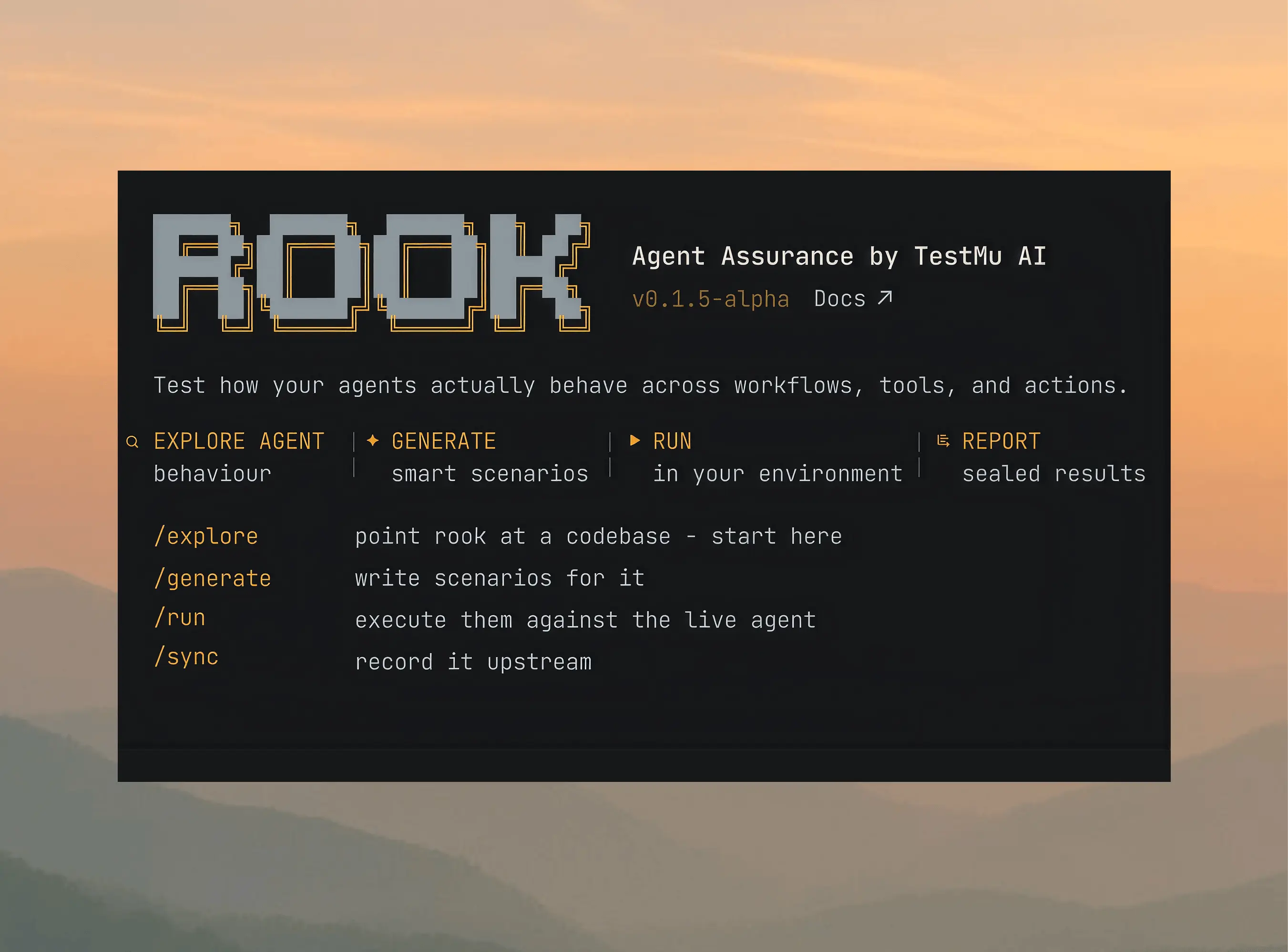
Agent Assurance reaches your terminal as Rook CLI. It is pre-alpha and publicly installable, with npm as the main route:
npm install -g @testmuai/rookNode.js 20 or newer is required for the npm install, and the Rook CLI installation guide adds Homebrew and a shell installer, both limited to macOS and Linux. Taken together, the routes reach macOS and Linux, and 64-bit Windows through npm or WSL.
Only scenarios with a decided verdict enter the scenario pass rate, and the rook release repository README says anything it "could not verify is reported as unverifiable", with a count of its own. Point every run at staging, because anything the agent writes in a run stays written, and keep Braintrust or Langfuse for your traces and scores.
Questions to Answer Before a Braintrust or Langfuse Trial
Answer these in order before starting a Langfuse vs Braintrust trial.
- Data location - decide whether only trace data or every component must stay in your network; self-hosted Langfuse runs every component there, while Braintrust keeps the UI, login and metadata in its own control plane.
- License - if you need to read, patch or fork the application, check whether the features you need sit outside the ee folders, the largest being Langfuse's web/src/ee folder.
- Operations - price the Braintrust module's default fleets in your cloud, or the ClickHouse, PostgreSQL and Redis upkeep a Langfuse install brings.
- CI behavior - decide whether a score regression should fail the build or only be reported on the pull request.
- Billing unit - estimate monthly spans and scores, then compare Langfuse units with Braintrust processed data on the same volume.
- Actions - list the tools and records your agent touches, and decide how a release proves those changes happened.
For the last item, write the acceptance criteria for one tool-calling flow and run them on staging; run Agent Assurance in CI/CD shows how to gate a release on the JSON report.
Author

Anubhav Singhmaar
Blogs: 46

Anubhav Singhmaar is an AI Product Manager at TestMu AI driving Kane CLI, the command-line tool that brings browser automation to the terminal, turning natural-language flows into runs in a real Chrome browser that return pass or fail with shareable proof. He owns the roadmap and prioritization and works with engineering to ship developer-facing features. Before TestMu AI, he spent over four years at Sprinklr owning enterprise voice AI across APAC and EMEA. A mechanical engineer turned product manager, he grounds guidance in real QA workflows.
Reviewer

Saurabh Prakash
Reviewer
Saurabh Prakash is an Engineering Manager at TestMu AI, where he leads engineering on agentic AI development and scalable system architecture for the quality engineering platform. He has also contributed to Test at Scale, the company's open-source test intelligence platform. He brings over 9 years of experience across Node.js, Java, Spring, MVC, data structures, algorithms, and scalable system design, with earlier roles as SDE 2 at Zomato, Senior Software Engineer at LogicHub, and Software Development Engineer at Directi. Saurabh holds a B.Tech in Computer Science and Engineering from Delhi Technological University.


Braintrust vs Langfuse FAQs
Did you find this page helpful?
More Related Blogs

TestMu AI forEnterprise
Get access to solutions built on Enterprise
grade security, privacy, & compliance
- Advanced access controls
- Advanced data retention rules
- Advanced Local Testing
- Premium Support options
- Early access to beta features
- Private Slack Channel
- Unlimited Manual Accessibility DevTools Tests