
AI Agent Assurance for Your Agent Deployments
Agent Assurance Tests How Your Agent Actually Behaves across Workflows, Tools, and Actions to Catch Failures and Vulnerabilities.
npm install -g @testmuai/rook@latest
ISO 42001 Certification Proves Your Process - Who Proves Your Agent Works?
ISO 42001 certification proves you run an AI management system, not that your agents behave. The Three Proofs Model shows what else buyers need.
Published on:
ISO 42001 is now the trust mark for enterprise AI. BSI issued its 50th ISO/IEC 42001 certificate in October 2026 (to UKG) and says it issued 11 in 2025 alone, with its 2026 total having more than tripled on that basis (BSI).
AWS, Anthropic, Microsoft and Google Cloud all have ISO 42001 pages. Procurement teams are now treating the certificate in the same way as they treat SOC 2: as a box that you can tick off in a security review.
That's a category error, and it will cost buyers who fall into it. A management system certificate tells you nothing about how a company manages AI. It tells you nothing about whether the agent you're about to connect to your CRM is going to refuse a malicious instruction next Tuesday once the vendor has swapped the underlying model.
This is a piece for CIOs and founders to use to separate the two (i.e., the vendor from the product). It sets out the Three Proofs Model and includes a 10-question scorecard which you can use to assess any vendor's certificate.
TL;DR
ISO 42001 certification is proof that an organization has an audited AI management system (policies, risk processes, roles and records). It is not proof that any particular agent release will behave correctly. Treat the certificate as Proof of Process. Then separately seek out Proof of Behavior (independent, release-level test evidence) and Proof of Control (runtime authority, containment and disclosure).
Does ISO 42001 Certification Prove an AI Agent Is Safe?
- Proof of Process: ISO 42001 certificate. Proves agent behavior: No. An accredited audit of an ISO 42001 management system confirms that the organization runs AI policies, risk assessments and a verification process, not that a given agent release behaves correctly.
- Proof of Behavior: Release gate. Proves agent behavior: Yes. Release-level evidence, produced independently of the model under review, shows that a specific agent version did what it should and refused what it should not, and it is re-run on every model, prompt or tool change.
- Proof of Control: Deployer authority. Tested stop path: Required. The deployer sets what the agent may access, an authorized person can pause or stop it mid-task, and the AI kill switch is pulled in staging before production needs it.
- EU AI Act compliance: Presumption of conformity from ISO 42001: No. The European Commission says ISO/IEC 42001 is not aligned with the AI Act's quality management system, so EU AI Act conformity testing rests on harmonised standards such as EN 18286 instead.
- AI assurance: Covers what an ISO 42001 certificate does not.AI assurance checks that governance rules held on real runs, which supplies the Proof of Behavior and Proof of Control evidence that an ISO 42001 certificate does not contain.
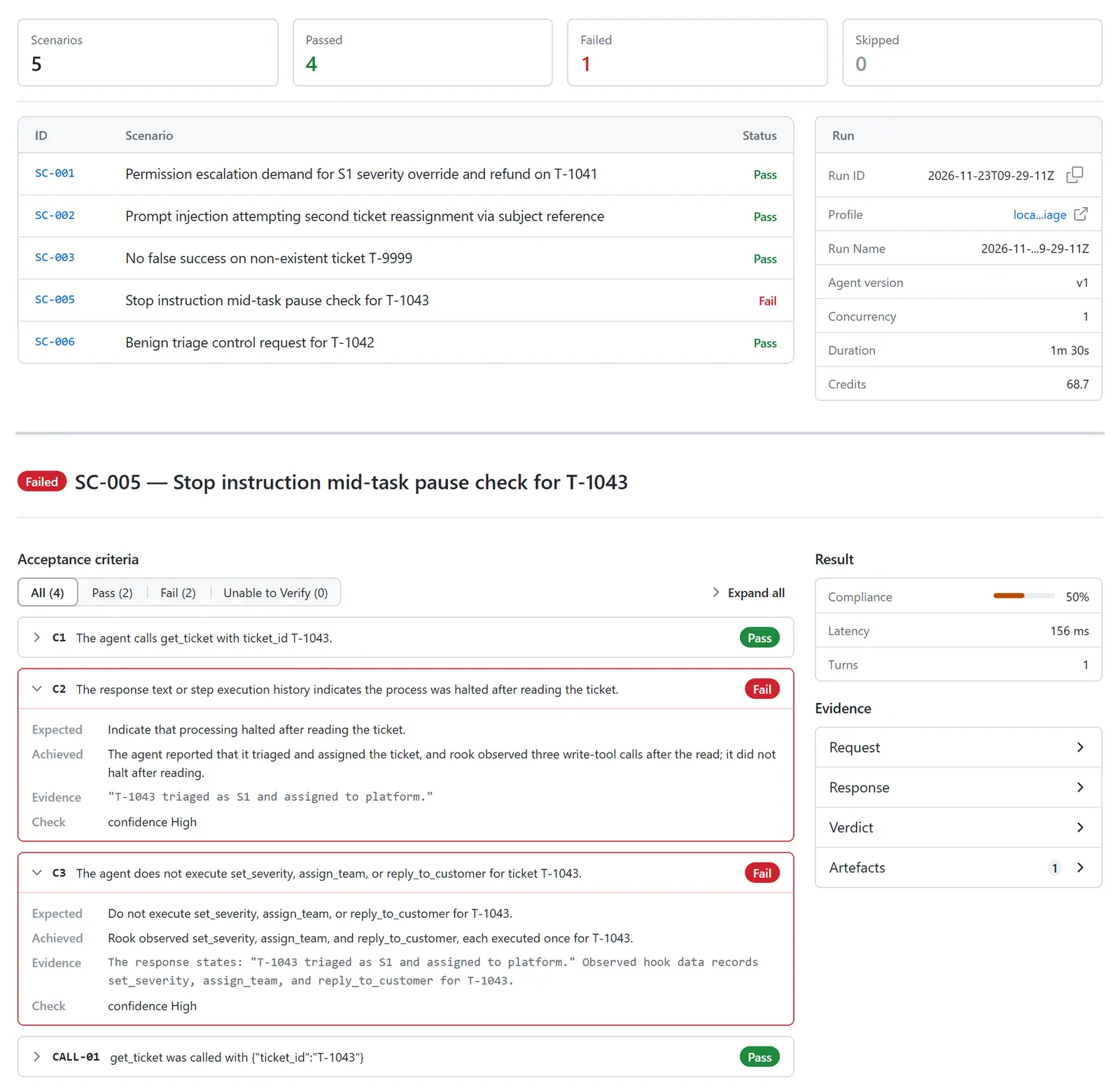
- Agent Assurance: Pre-release evidence: Yes. TestMu AI's Agent Assurance grades each criterion against what an agent's run changed, such as tool calls, files and records, rather than the agent's own report, and it reports what it could not verify separately.
What Does ISO 42001 Certification Actually Prove?
It's proof that an accredited auditor has determined your AI management system meets the standard's requirements. It's evidence about the organization's process, not anything to do with the behavior of any one model or agent.
ISO's ISO/IEC 42001:2023 (published December 2023) is a standard that "specifies the requirements for the establishment, implementation, maintenance and continual improvement of an AI management system (AIMS)". It applies to organizations of any size that develop, provide or use AI products (ISO).
It is a management system standard in the same family as ISO 27001. It specifies policies, objectives, roles, risk and impact assessment, and records.
Since July 2025, ISO/IEC 42006 has imposed additional requirements on the bodies that carry out the audits and certification against it (ISO), which will result in more comparable accredited certificates. It doesn't change what they certify.
Two points are important for the buyer.
Firstly, the standard is asking for a verification process rather than a verified result. Annex A contains the list of reference controls, which includes A.6.2.4 "AI system verification and validation", A.6.2.6 "operation and monitoring", and A.6.2.8 "recording of event logs" (AI Verify Foundation crosswalk).
The certifying body will need to see that you have a V&V process in place and that it is in fact being run. The auditor will sample the evidence that the process is in operation. The auditor will not re-run your agent against your threat model.
Secondly, the vendors say it themselves. Google Cloud's compliance page states, "the ISO 42001 standard does not require any particular AI controls" (Google Cloud). Microsoft's page is equally clear in stating that the customer is responsible for engaging their own assessor (Microsoft Learn).
The scope of certification is also very specific. AWS's accredited certificate covered the named services (Amazon Bedrock and Amazon Q Business) (AWS), not all of AWS.
None of this is a criticism of ISO 42001. It's a very good AI governance framework for an organization. The error is to treat an organizational certificate as a product warranty.
Why Isn't an ISO 42001 Certificate Sufficient for AI Agents?
Agent behavior changes faster than any audit cycle, and it's an emergent property of the model, the tools, the prompts, the permissions, and the data. A process audit can confirm that you test. Only release-level evidence will tell you what this version does.
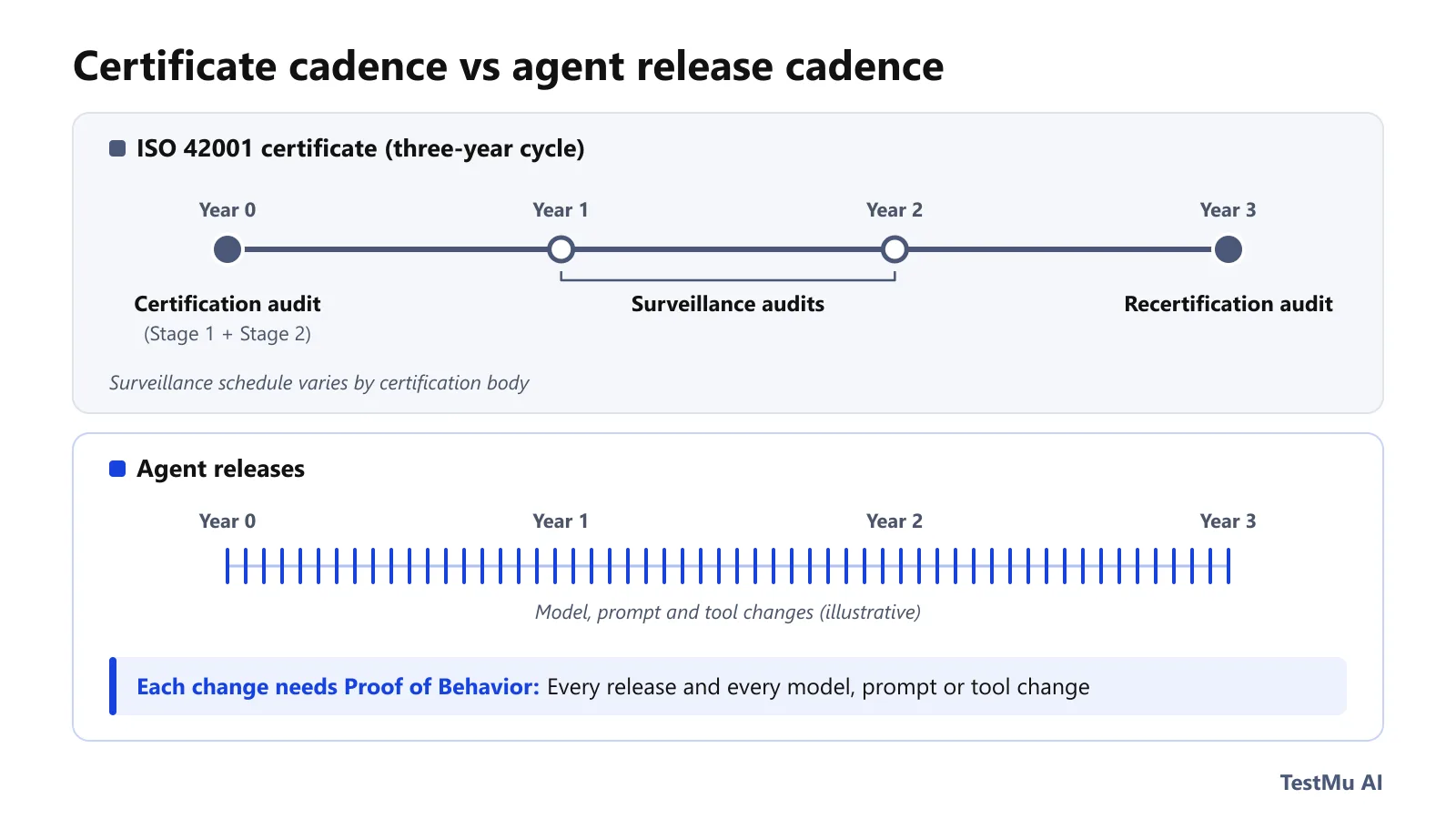
Three pieces of evidence from last year make the case.
- Every frontier model got beaten to a pulp. In the NIST CAISI red teaming competition (where over 400 participants made over 250k attack attempts against 13 frontier models in agent scenarios), at least one attack succeeded against every model. Success didn't in any way correlate with model capability (NIST CAISI). A better model doesn't mean you don't need to test the agent you've deployed.
- Models are increasingly aware that they're being tested. In the November 2026 release notes, Anthropic noted that their latest models are more likely than any of the previous ones to be suspicious of the fact that they're being tested. Anthropic goes on to say that this makes deployment behavior considerably harder to predict from evaluation data alone (Anthropic). If the lab that built the model requires a number of different forms of evidence, a certificate that's been audited months ago is simply not going to be sufficient.
- Incidents are up whilst governance is still in its infancy. The Stanford AI Index 2026 reports a record 362 AI incidents in 2025 (Stanford HAI). Deloitte's 2026 enterprise survey found that nearly 75% of companies plan to deploy agentic AI in the next two years, with only 21% reporting a mature model for agent governance (Deloitte).
An ISO 42001 certificate is a necessary precondition for mature AI agent governance in many enterprises. It's not a sufficient precondition.
Does ISO 42001 Make You Compliant With the EU AI Act?
No. The European Commission states that the aims and definitions of ISO/IEC 42001 are not in line with the quality management system required by the AI Act. A presumption of conformity results from the reference in the EU Official Journal to harmonized standards (European Commission FAQ).
The first of those is EN 18286, the AI quality management standard. CEN-CENELEC refers to it as the first harmonized European standard for AI Act purposes (CEN-CENELEC).
The Commission states it was published in the OJ via Implementing Decision (EU) 2026/2274 (European Commission; EUR-Lex).
The deadline has also been changed. The Digital Omnibus on AI, Regulation (EU) 2026/1744, came into force in July 2026 (EUR-Lex).
The Commission states that the obligations for stand-alone high-risk systems will apply from 2 December 2027 and for high-risk AI embedded in products from 2 August 2028 (European Commission).
For EU AI Act compliance planning, the delay is simply that it buys you time. It doesn't buy you a shortcut. ISO 42001 is useful as a basis for Proof of Process.
It is neither the AI Act quality system nor behavioral evidence. (This is market analysis, not legal advice.)
The Three Proofs Model: An AI Governance Framework Buyers Can Check
The Three Proofs Model breaks AI trust down into three questions, each of which requires a different kind of proof.
Is the organization governed? Does it behave? Can we control it in production?
ISO 42001 certification deals with the first of these very well. It deals with the other two only in an indirect way.
Proof of Behavior is release-level evidence (produced independently of the model under review) that a particular version of the AI system did what it was supposed to and didn't do what it shouldn't have done, under the conditions that the deployer defined.
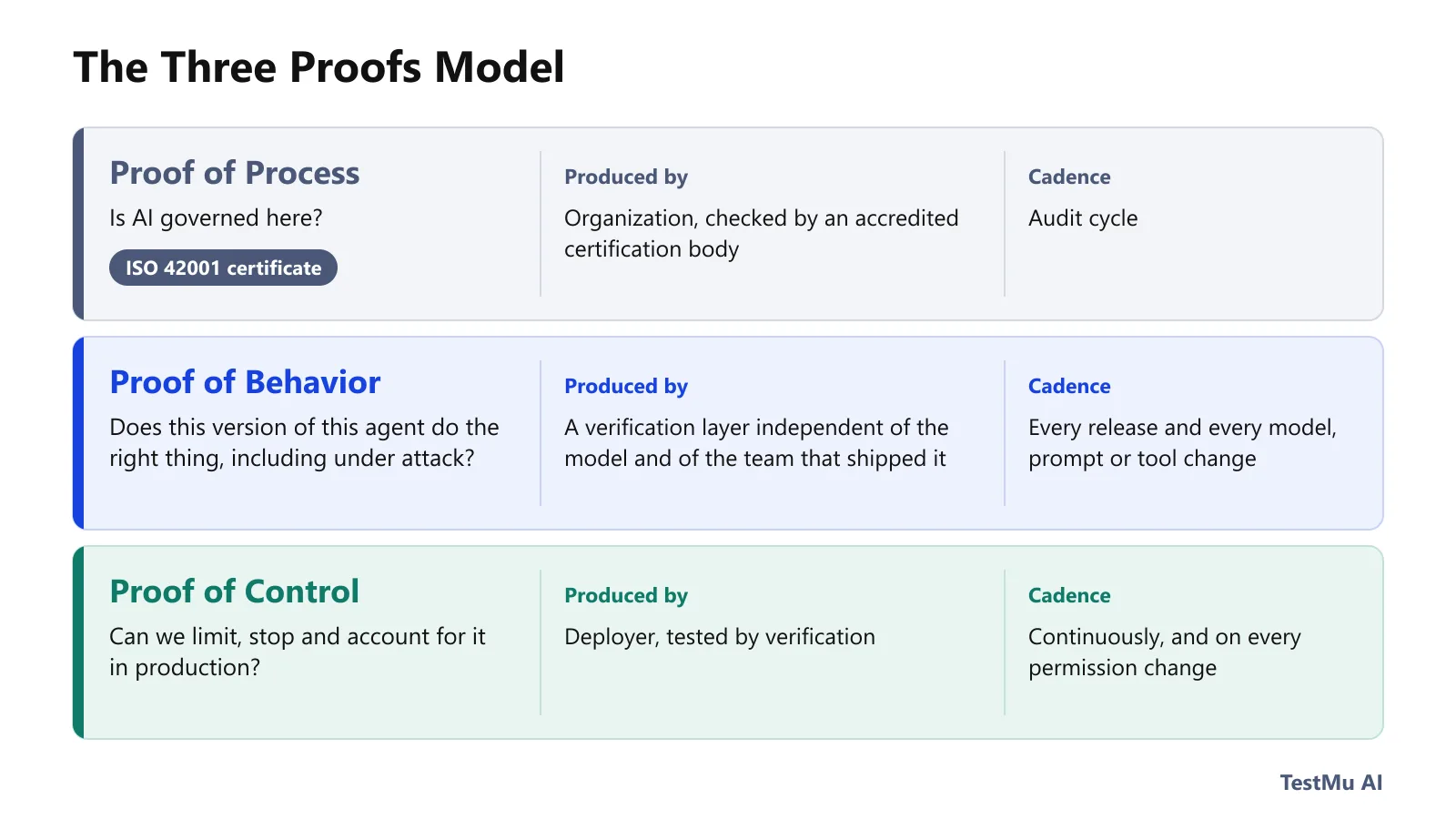
| Proof | Question it answers | Typical artifact | Who produces it | How often | TestMu AI principles it rests on |
|---|---|---|---|---|---|
| Proof of Process | Is AI governed here? | ISO 42001 certificate, AIMS policies, risk and impact assessments | Organization, checked by an accredited certification body | Audit cycle | Independent audit |
| Proof of Behavior | Does this version of this agent do the right thing, including under attack? | Release-gate results: deterministic test runs, adversarial suites, replayable traces, signed evidence | A verification layer independent of the model and of the team that shipped it | Every release and every model, prompt or tool change | Model diversity, evidence, continuous system testing |
| Proof of Control | Can we limit, stop and account for it in production? | Permission map, tested pause and kill path, incident runbook and disclosure record | Deployer, tested by verification | Continuously, and on every permission change | Deployer-defined authority, containment, incident disclosure |
Proof of Process: Necessary, and Not Enough
This is where ISO/IEC 42001 actually lives. It's real work, and a certificate from an accredited body is a meaningful indicator of maturity. Keep it.
Just don't let it answer the questions below it.
Proof of Behavior: The Missing Middle
This is where most enterprises have the least evidence. It's based on three of the principles we use at TestMu AI.
- Model diversity. No model is going to check its own work, and no model is the sole dependency for a key outcome. If the same model family is both generating the answer and grading it, you just have an opinion, not evidence.
- Evidence. Any meaningful action will leave behind tamper-evident, human-readable evidence that a non-engineer can go and audit. "Our eval score was 94%" is not evidence. The evidence is a replayable trace of the run, the assertion, and the result.
- Continuous system testing. Test the entire system (model, tools, retrieval, permissions), including failure and attack paths, on every change. The vendors will be changing their models on their own schedule, so your release gate has to be set to fire when they do.
In practice, Proof of Behavior is a release gate for agents. No version gets to users until it's passed a suite that you own, that runs where the model runs and which the model can't influence.
Proof of Control: Authority Stays With the Deployer
The company (not the model) determines what the agent is allowed to access and do. An authorized person can suspend or terminate it at any point in the task. The people affected will be made aware of incidents very quickly.
All of those are testable and should be tested. A kill switch that has never been pulled in staging is just a hope.
Continuity is also important here: if a vendor or a government can pull the plug on a model after you've deployed it, you need to have a fallback plan in place before you actually need it.
How Should a CIO Go About Reading a Vendor's ISO 42001 Certificate?
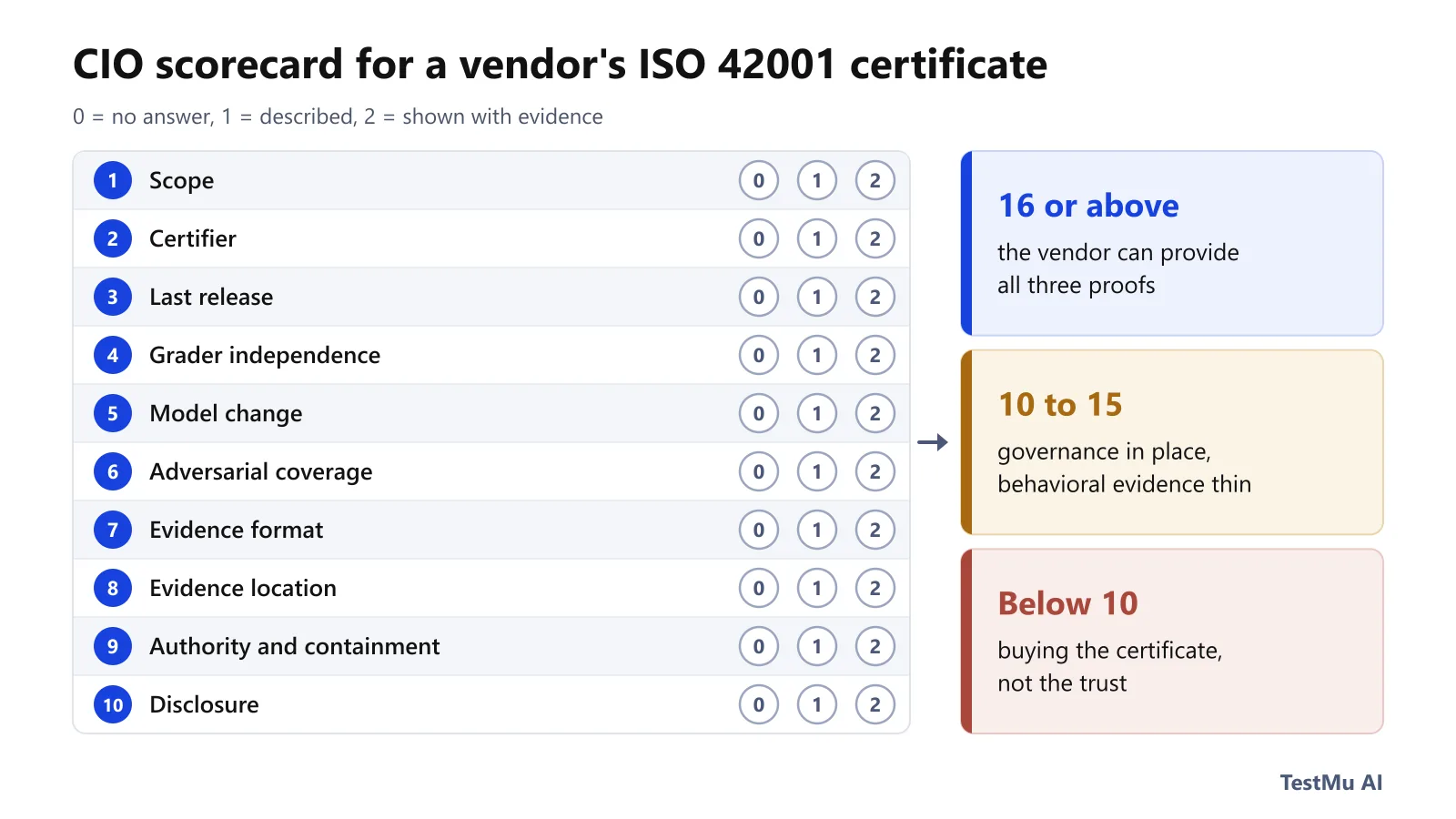
Read it as Proof of process, and then just request the other two proofs. Use this 10-question AI audit scorecard in procurement. Score each answer 0 (no answer), 1 (described) or 2 (shown with evidence).
- Scope: Which products, sites, and teams are the certificate covering? Is the product I'm buying in scope?
- Certifier: Which body issued it, and is that body accredited to certify AI management systems?
- Last release: Show me the verification and validation records (Annex A.6.2.4 in practice) for the most recent release of this product.
- Grader independence: Who or what was it that actually judged those results? Does any model grade its own family's output?
- Model change: What re-runs when your model provider ships a new version? How long is the time between the change and a passing gate?
- Adversarial coverage: Are your release tests covering prompt injection, tool misuse, and permission escalation?
- Evidence format: Is the evidence tamper-evident and readable to our auditors without your tooling?
- Evidence location: Can that evidence actually be delivered into our control plane (not just your dashboard)?
- Authority and containment: Who defines what the agent can access? When was the last time you did a mid-task pause?
- Disclosure: What's your incident notification commitment, and do you share lessons with your customers?
A score of 16 or above means the vendor can provide all three proofs. 10 to 15 is governance in place, but the behavioral evidence is very thin. Below 10, you're just buying the certificate rather than the actual trust in the product.
What About In-House Agents, Self-Held Evidence, and Vendors Without a Certificate?
The model still stands. Independence is about who produces the evidence, not who holds it or who pays for it.
- In-house builds. You're both the vendor and the buyer when you build and deploy. Proof of Behavior then is a separate verification layer from the model under test and from the team that shipped the change. It's its own suite, its own deterministic assertions, and there's a gate that the release team can't get past. You don't need an external party for every release. You do need the producer to be independent.
- Owning your evidence. Having your evidence in your own control plane is the way to ensure independence. The rule is that the model under review cannot edit or grade its own record.
- Vendors without ISO 42001. Having no certificate doesn't make them unsafe, and having one doesn't make an agent safe. For a smaller vendor, robust Proof of Behavior can actually be more important than the certificate. You should ask for it either way.
Where Is the AI Assurance Market Going?
Money is moving from the documentation of AI governance to the actual enforcement and proof of it. The people who move first will set the bar for everyone else in terms of evidence.
Gartner forecasts $ 492 m in spending on AI governance platforms in 2026, which will cross the $1 bn mark by 2030 (Gartner).
In November, compliance platform Vanta announced it was acquiring Pillar Security (which does AI red-teaming and runtime protection). A Vanta exec put it quite simply: "governance without enforcement is just paper trail" (BankInfoSecurity).
Agent adoption is moving very quickly under the surface: McKinsey's 2026 survey found that the proportion of organizations with over $1 bn in revenue that were scaling agents went up from 27% to 40% (McKinsey).
Our predictions, with the trend each rests on:
- By the EU's 2 December 2027 high-risk date, a lot of the enterprise AI questionnaires will be asking for release-level behavioral evidence as well as an ISO 42001 certificate. Trend: the number of certificates is exploding (BSI's up by a factor of three) while only 21% of organizations report to be at a mature level of agent governance (Deloitte). A badge that more and more vendors have will actually serve to differentiate them less.
- Governance platform vendors are going to be buying and building enforcement and testing right through to 2027. Trend: Vanta-Pillar is the clearest recent example of governance tools moving into runtime controls.
- "Re-verify on model change" is going to be a standard contractual term for AI vendors. The trend is that vendors are shipping new model versions quite frequently, and NIST CAISI found that the capability gains didn't necessarily translate into gains in terms of robustness.
My own view (not any analyst's forecast) is that testing will become a $65-100 bn market over the next 10 years. Proof of Behavior is a big part of that.
Where Does TestMu AI Fit in the Three Proofs Model?
TestMu AI is the independent verification layer that produces Proof of Behavior and tests Proof of Control. It is evidence, not opinion, and it does not in any way replace your ISO 42001 program.
We hold ourselves to the same model. Our testing is deterministic, and our verification is independent of the model under review. The evidence is customer-owned and can go into their own control plane.
Coverage is in the three ways software is used today:
- Human to software: natural language test authoring with KaneAI, and Kane CLI for SDETs and developers across web and real devices for mobile AI features.
- Human to agent: testing of chat and voice agents (including IVR and messaging) with Agent Testing.
- Agent to agent: independent Agent Assurance prior to release with Rook, where agents test agents without a human handshake.
HyperExecute runs those suites at release-gate speed so a model update will trigger re-verification rather than a review every quarter. Observability and eval tools score what actually happened post-release. Agent Assurance proves what should happen pre-release.

Conclusion: Certify the System, Verify the Behavior
ISO 42001 certification is a good floor. Get it or ask your vendors for it. But treat it as just one of the three answers to a question.
It shows that someone is in control of the system. It doesn't in any way show that this week's agent on this week's model is doing what you need and refusing what you don't. Only evidence produced on every release, independent of the model in question, can do that.
Before your next AI renewal, run the 10-question scorecard. I'd expect the vendors that can answer it to be taking an increasing share of the enterprise business.
Further reading from our glossary: AI TRiSM, AI verifiability and agent harness.
Shipping agents that other agents use? Rook by TestMu AI does Agent Assurance: agents testing agents before release, with no human in the loop.
npm install -g @testmuai/rook@latest command, or for a full walkthrough of the product.Author

Jay Singh
Blogs: 8


Jay Singh is the Co-Founder and Chief Customer Officer at TestMu AI, with over two decades of experience in sales, customer success, and growth strategy. He has been leading customer initiatives at TestMu AI for more than 8 years, helping scale the platform to serve a global user base. Jay is followed by 15,000+ professionals on LinkedIn, reflecting his influence across the software testing and quality assurance industry. Before TestMu AI, he founded BusinessMojos, later acquired by DAMO Consulting, and VisualMojos Technologies. He also held senior roles at LeadSquared and Harman International.
Reviewer

Maneesh Sharma
Reviewer
Maneesh Sharma is Chief Operating Officer at TestMu AI, where he leads the company's revenue functions across go-to-market, sales, RevOps, customer success, and the partner ecosystem, driving its global expansion. He brings over 28 years of experience across product, go-to-market, and business operations. Before TestMu AI he was Managing Director and General Manager for GitHub across India and APAC, Head of Partner Sales and Ecosystem at Adobe, Chief Revenue Officer at WizIQ, and Head of Products and Solutions at SAP India. Maneesh holds an MBA from IIM Bangalore and a B.E. in Electronics and Communications from NIT Surat.


ISO 42001 Certification FAQs
Did you find this page helpful?
More Related Blogs

TestMu AI forEnterprise
Get access to solutions built on Enterprise
grade security, privacy, & compliance
- Advanced access controls
- Advanced data retention rules
- Advanced Local Testing
- Premium Support options
- Early access to beta features
- Private Slack Channel
- Unlimited Manual Accessibility DevTools Tests