
E2E Testing for Chat, Voice, Phone and Video AI Agents
Run Thousands of Test Scenarios against Your Agent and Catch Hallucinations, Bias, and Toxicity Before Users Do.

How to Build an Eval Set for AI Agents You Can Trust
Build an eval set (evaluation dataset) for AI agents from real work, check your LLM judge against human labels, and turn corrections into new items.
An eval set is a fixed set of tasks (each of which has a way of scoring the result) that you run your agent against prior to every release. An eval set (also known as an evaluation dataset) is only valid if the tasks are drawn from real work and the graders have been validated against human experts.
Teams often just stop after they've collected their tasks. That's how you end up with a team saying their agent has "passed 88% of evals" when in fact no one's looked at whether the grader that produced that 88% actually agrees with a human expert. Ashton Chew made that point on 24 Nov 2026 in that an eval score is only as good as the answer key and the LLM judge that produced it.
On how to win internal evals.
- Ashton Chew (@ashtonchew) November 24, 2026
I used to think evals measure the agent. But now the agent measures the eval. The simplest way to tell if a team's evals are any good? Ask how they handle task realism, grader agreement with humans, and metagraders. This doc is the checklist for building internal evals in 2027.
Your blog might say the agent passes 88% of internal evals, but the grader behind that number is some person's answer key and an LLM judge never calibrated against human judgement. Tasks must come from real work. Expert corrections must become new evals.
If you're cutting costs or pushing the frontier in your domain, your success depends on your eval quality. Use more agents to build and refresh evals, and keep humans grading the graders.
Below: where the tasks come from, how to check an LLM judge against the human labels, how to audit the graders over time and how to keep the set fresh. For the big picture, start with our guide to AI evals.
TL;DR
An eval set (or evaluation dataset) is a fixed list of tasks, each with pass criteria and a grader, that an AI agent must pass before every release. Build it from real user requests, give each item the most objective grader available, and check any LLM judge against human expert labels with Cohen's kappa and fail recall.
How Do You Build an Eval Set for AI Agents?
- Task sourcing: Eval set tasks come first from production traces, support escalations and product docs, then from synthetic variations, and every item carries a source field so synthetic items stay a minority of the evaluation dataset.
- Grader order: Each eval item gets the most objective grader that fits. A state check in code comes first when the result is visible in a system, then an exact or rule match, then an LLM judge for subjective quality such as tone, and human review for high-stakes items.
- Expert corrections: Every case where a human overrules the agent or the grader becomes a new eval item, so the eval set grows out of its own misses between releases instead of staying frozen at launch.
How Does LLM Judge Calibration Against Human Labels Work?
- Cohen's kappa: Cohen's kappa measures how often an LLM judge agrees with human labels beyond chance. When 90 of 100 items pass for both the humans and the judge, 90% raw agreement comes out at a kappa of only 0.44.
- Fail recall: Fail recall is the share of human-verified fails that the LLM judge also fails. A judge that agrees with humans on 90 of 100 items can still catch only 5 of 10 failures, so half of them ship.
- Metagrader routine: Experts blind re-label a random 5-10% of judged items every release, grader disagreements go to a human, and the judge leaves the release gate when kappa or fail recall falls below the agreed floor.
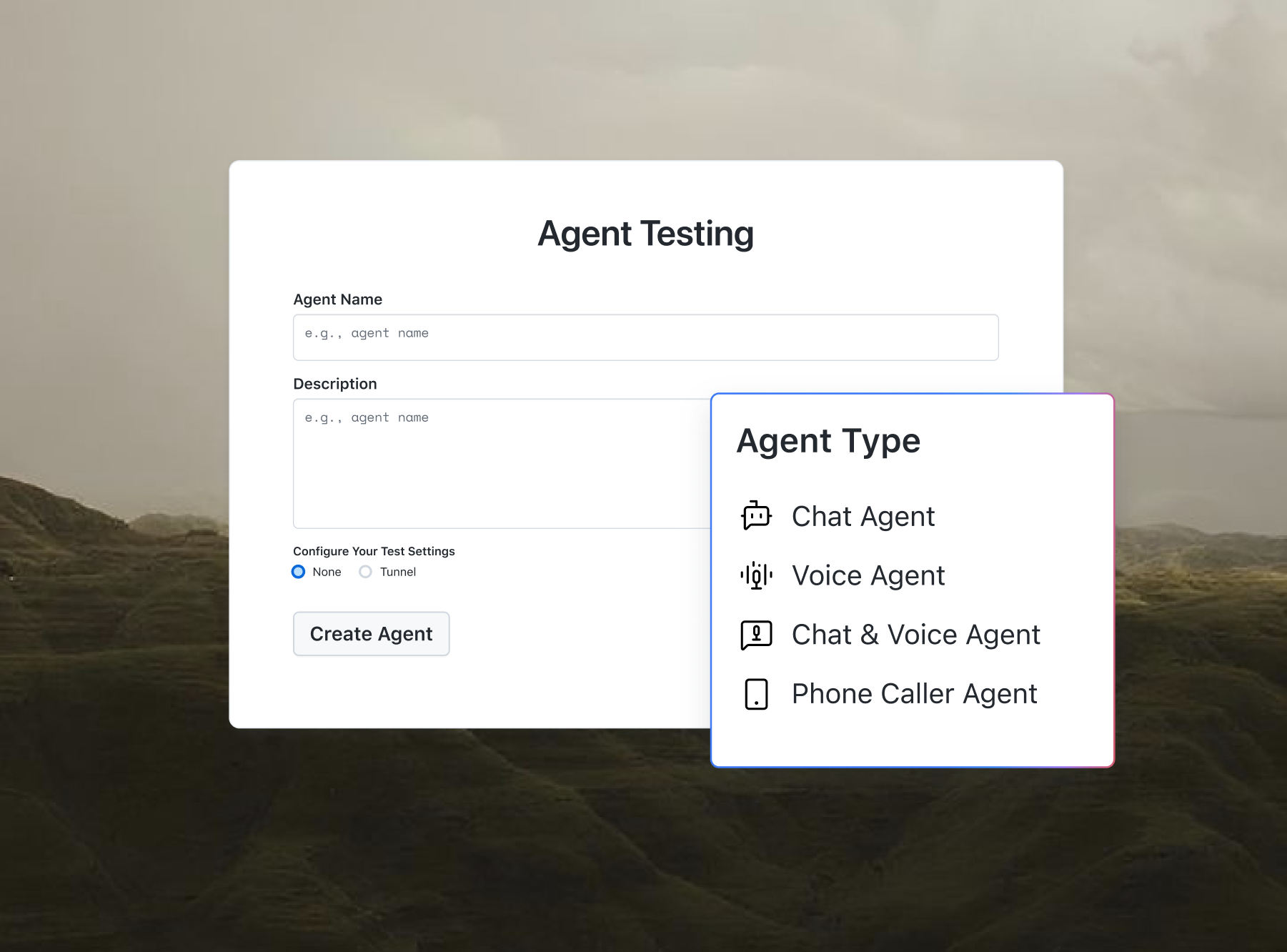
- Agent Testing: TestMu AI's Agent Testing runs eval sets against live chat, voice and phone agents and backs each Green, Yellow or Red go-live verdict with the transcript, the audio and the metric scores a reviewer can open. SDK required: No.
What Is an Eval Set?
An eval set is the scored list of test cases that an AI system has to pass before a change ships. Each item has three parts:
| Part | What it is | Example |
|---|---|---|
| Task | The input or starting state | "Cancel my order #4471 and refund it to my card" |
| Pass criteria | What a correct result looks like | Order state is canceled, refund issued once, agent confirms both |
| Grader | Who or what decides pass or fail | A state check on the order system plus an LLM judge for the reply's tone |
An eval set is not a public benchmark. A benchmark is a way of scoring a general model on a shared dataset. An eval set is a way of scoring your agent on your users' actual jobs.
For how an eval set can become a versioned golden dataset, see what a golden dataset is and how to version one.
For a quick visual walkthrough of this concept, watch the video below from TestMu AI.

Subscribe to the TestMu AI YouTube channel for more tutorials on testing and automation.
Step 1: Take Eval Set Tasks From Real User Requests
Eval set tasks must be drawn from actual requests that users have sent to your agent. Tasks that are written at a desk are going to be clean, single intent and will reflect the blind spots of one writer. Real requests are all sorts of messy: two intents in one message, an error in the order number, a customer who changes their mind partway through.
Good sources for eval set tasks, from most to least realistic:
- Production traces and transcripts. Sample real conversations (some of which went rather badly). Product Talk's guide is very clear on this: you can't possibly know what the production inputs are going to look like at launch, so the set has to be evolving after launch.
- Support tickets and escalations. Each escalation is a task that the agent (or the human before them) has failed at.
- Product docs, PRDs and Jira tickets. These are the ones that give you the edge cases the business cares about prior to any user even encountering them.
- Synthetic variations. Have an agent go in and rewrite the real tasks with different names, accents, noise and phrasing to broaden the coverage. A human has to go through each one and approve it before it gets into the set.
Keep a source field on every item (production, ticket, document, synthetic). Keep the synthetic items a minority, or your pass rate is going to start measuring the generator. Our golden dataset guide goes into much more depth on sourcing, sizing and versioning.
For voice and chat agents, realism also means the caller. TestMu AI Agent Testing builds scenarios from the edge cases in your docs and plays them with simulated callers that have 200+ voices, 50+ accents and 15 background noise presets so your eval set actually reflects the callers you'll get.
Step 2: Pick a Grader for Each Item, and Check the Eval Set's LLM Judge Against Humans
Every item in an eval set needs a grader, and the grader should be the most objective one that can answer the question. The order to be used is:
| Grader | Use it when | Limit |
|---|---|---|
| State check (code) | The result is visible in a system: order canceled, ticket created, refund issued once | Can't judge tone or helpfulness |
| Exact or rule match (code) | The answer has one right form: an ID, a date, a required phrase | Brittle when wording varies |
| LLM judge | The quality is subjective: tone, empathy, clarity | Can disagree with humans without anyone noticing |
| Human review | High-stakes or ambiguous items, and calibrating the judge | Slow and expensive |
An LLM judge is only going to be trustworthy once you've looked at the percentage of agreement with human experts on the same items. Raw % agreement can be very misleading if most of the items are going to pass.
Chrome's eval guide makes this very clear: if 90% of your test data is going to pass, your judge can appear very accurate simply by saying "pass" the majority of the time. They recommend Cohen's Kappa for two labelers and Fleiss' Kappa for three or more.
Worked example (illustrative numbers). Two experts and an LLM judge each grade the same 100 agent replies:
| Judge: pass | Judge: fail | |
|---|---|---|
| Human: pass | 85 | 5 |
| Human: fail | 5 | 5 |
The judge is in agreement with the humans on 90 of the 100 items, which is all very well. Cohen's kappa is 0.44 (chance alone would give 82% agreement on this many passes).
The humans missed 10, and the judge only caught 5 of those. Half the failures that your experts would have blocked would actually ship.
from sklearn.metrics import cohen_kappa_score, confusion_matrix

human = ["pass"] * 85 + ["pass"] * 5 + ["fail"] * 5 + ["fail"] * 5
judge = ["pass"] * 85 + ["fail"] * 5 + ["pass"] * 5 + ["fail"] * 5

print(cohen_kappa_score(human, judge))   # 0.444
print(confusion_matrix(human, judge, labels=["pass", "fail"]))
Three rules keep judge calibration honest:
- Measure human-human agreement first. A judge can't agree with your labelers any more than they can agree with each other (MLflow).
- Report a fail recall, not just an agreement. The figure that really matters for a release gate is how many human-verified fails the judge actually picks up.
- Recalibrate on every change. A new judge model, judge prompt, task type or change to the agent itself will require a new calibration run (in MLflow). If labels are missing or the number of raters is variable, then use Krippendorff's alpha rather than kappa (Arize).
For the judge techniques themselves (rubrics, pairwise scoring, known biases), see our practical guide to LLM-as-a-judge.
Step 3: Grade the Graders With a Metagrader and an Evidence Trail
A metagrader is just a regular check that the graders in your eval set are still grading correctly. A single calibration at launch is not sufficient. The prompts change, the agent changes, and a grader that was matching humans in March can quite easily drift by June.
An unaudited judge can miss the failures that a human would catch. Zhang, Wang and Lei looked at a deployed multi-turn ordering agent and found that its built-in LLM judge only caught 2 of the 9 problem patterns that humans had identified in that one batch (the 9 patterns are summarised in our AI agent testing methodology guide).
A workable metagrader routine:
- Re-label a sample on every release. In each cycle, a random 5-10% of the judged items are blind graded by the experts. Kappa is recomputed, and fail recall is assessed against the judge.
- Oversample the disagreements. Send everything where there's a disagreement between two graders (state check vs judge, judge vs last release's verdict) to a human.
- Set a floor. If either kappa or fail recall drops below the floor your team has agreed on, the judge is pulled from the release gate until it's fixed.
- Keep the grader away from the agent. A grader that the agent can read or influence can be gamed (that's reward hacking). Our Grader Independence Ladder tells you which graders are safe to gate a release on.
Every verdict has to be backed up by evidence that a human can check. A bare 'pass' is not verifiable. A 'pass' that has a link to the transcript, the audio, the metric scores and the exact failing turn is.
That's how TestMu AI Agent Testing reports the runs. Each suite gets a Green, Yellow or Red go-live verdict, and each run will show the transcript, the audio and the 9 metric scores, with the failing turns linked from the suite. A reviewer can open up any verdict and then decide whether the grader was correct.
Step 4: Turn Every Expert Correction Into a New Eval Item
An eval set is only going to be useful if it's growing out of its own misses. Every time a human overrules the agent or the grader, that case becomes a new eval item.
The usual triggers are a support lead correcting a wrong refund, a QA reviewer flipping a judge's pass to a fail, or a customer escalation. Product Talk describes the same thing: error analysis on production traces tells you what "bad" looks like, and the fixes are then added to the dataset.
Let the agents do the volume work (cluster the new failures, write up the candidate items, write the variations). Keep the final call with people who are going to decide what actually gets into the set and who are going to label the calibration sample.
Eval Set Checklist
Run this checklist prior to each release to ensure the eval set is still trustworthy.
- Every item has a source field, and most items come from production, tickets or docs
- Every item has a grader, and state checks are used wherever the result is visible in a system
- The LLM judge has a kappa and a fail-recall score against human labels, recomputed this release
- Human-human agreement was measured before judge agreement
- A 5-10% blind re-label sample runs every release
- Graders can't be read or influenced by the agent under test
- Every verdict links to evidence: transcript, state diff, scores
- Every expert correction since the last release is now an eval item
Where TestMu AI Fits
TestMu AI Agent Testing runs your eval sets against live chat, voice and phone agents. You just connect to a chat endpoint, a phone number or a video URL (no SDK required) and subsequently generate your scenarios from your docs. Every suite gets a Green, Yellow or Red go-live verdict with a transcript and metric scores behind each run (9 metrics for chat and voice, 30+ for phone calls).
It doesn't in any way replace your offline evals or your eval harness that runs those. It's the independent check prior to go-live.
Conclusion
Start with the judge your release gate already relies on. Have two experts blind-label a sample of last release's judged items, then run the kappa snippet from Step 2 on their labels and the judge's verdicts and record fail recall beside kappa.
If either number sits below your floor, take the judge out of the gate and add the cases it missed to the eval set before the next run. To run the same eval set against a live chat agent, follow the chat agent testing docs.
Testing an AI agent? TestMu AI's Agent Testing validates chat, voice and IVR agents before your customers talk to them.
Was this helpful?
Authors

Mudit Singh
Author · 8 posts
Mudit Singh is Co-Founder and Head of Growth at TestMu AI, and a member of the founding team that has grown the platform to 2.8M+ users across 132 countries. He drives growth and go-to-market across the full product portfolio, including KaneAI, Kane CLI, the Real Device Cloud, SmartUI, accessibility testing, and HyperExecute. Over more than eight years on the founding team he has helped build and bring these testing products to market from scratch, scaling the company from cross-browser testing into a full-stack agentic AI quality engineering cloud backed by Sequoia, Qualcomm Ventures, and Premji Invest. He brings over 15 years of experience building and marketing software products and holds a B.Tech in Computer Science from Jaypee Institute of Information Technology.


Mayank Bhola
Reviewer
Mayank Bhola is Co-Founder and Head of Products at TestMu AI, where he leads the entire product portfolio across KaneAI, Kane CLI, HyperExecute, SmartUI, the Real Device Cloud, Accessibility, and other software testing product lines. As an early Lead Architect he designed and built the company's flagship Tunnel technology from scratch, created the React-based automation platform, and architected the data-intensive pipelines and FAAS services that scale it. He brings more than 10 years of experience in software development and product engineering, with earlier roles as Head of Technology at Juggernaut Books and Senior Software Engineer at PressPlay TV and Zomato. Mayank holds a B.Tech in Computer Engineering from JIIT Noida.
Eval Set FAQs

TestMu AI forEnterprise
Get access to solutions built on Enterprise
grade security, privacy, & compliance
- Advanced access controls
- Advanced data retention rules
- Advanced Local Testing
- Premium Support options
- Early access to beta features
- Private Slack Channel
- Unlimited Manual Accessibility DevTools Tests