
Run End-to-End Tests from Your Terminal with Kane CLI
Author and Run Tests Right from the Terminal in Natural Language, with an Evidence-Backed Pass or Fail from a Real Browser.
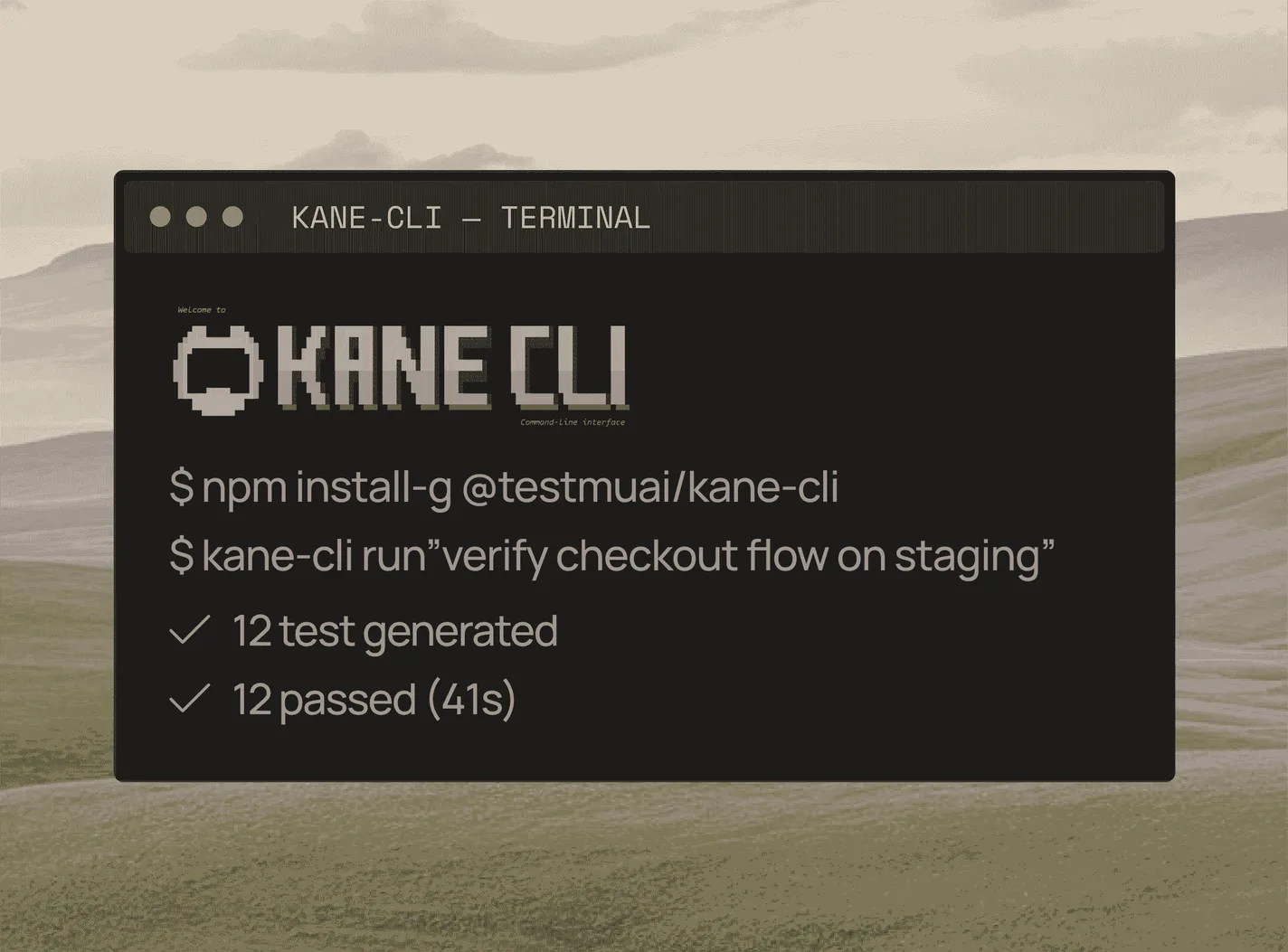
npm install -g @testmuai/kane-cli
Claude Code Review and Claude Ship: Why You Still Need a Test Gate
Claude Code Review reads the diff but never runs your app. Add an end-to-end test gate beside Claude Ship approvals, with a config you can copy.
Published on:
Claude Ship is Anthropic's beta (launched 23 Nov 2026) which takes GitHub PRs through review, fixes and an approval decision. Claude Code Review will read the diff but will never build or run your app. It's designed to speed up the review, fix and approval process (not proof that the app actually works), so teams still need to have an end-to-end test as a required check.
TL;DR
Claude Code Review is Anthropic's pull request reviewer for GitHub: several agents read the diff and the surrounding code, verify each finding, and post inline comments ranked by severity. It never builds or runs your app, so a passing review does not prove that checkout works. Pair it with a required end-to-end check.
How Claude Code Review Works
- Claude Code PR review: Builds or runs your app: No. Blocks a merge on its own: No, because its check run never concludes as a failure. Review levels: Quick, Standard and Deep. Plans: Claude Team and Enterprise.
- Claude Code review GitHub setup: An organization Owner turns it on under Organization settings > Claude Ship. A GitHub organization owner installs the Claude GitHub App. Anyone with write access can then comment @claude review on a pull request.
- Claude Code review pricing: Flat per-review price: No. Reviews are billed on token usage through usage credits. Your bill is the average cost per review times the number of reviews your Review runs setting produces.
Claude Ship and the Test Gate
- Claude Ship: Anthropic's three-agent pull request system, in beta since 23 November 2026. Code Review reads the diff, PR Steward works on failing checks, and Claude Approvals applies your .claude/approvals.yml policy. GitHub only: Yes.
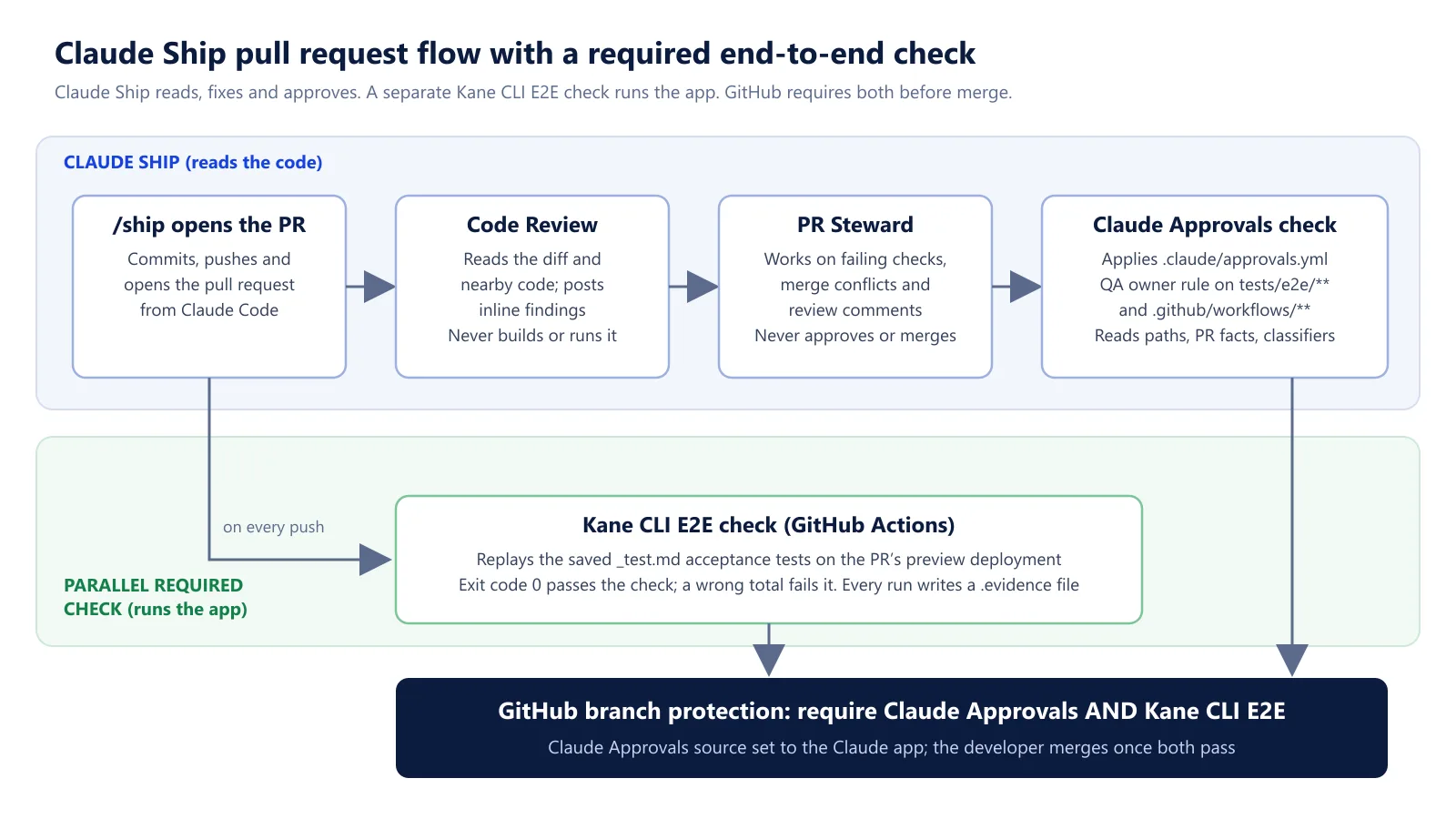
- Kane CLI by TestMu AI: The end-to-end test gate beside Claude Approvals. It replays saved _test.md acceptance tests on the pull request's preview deployment as a required GitHub check. Runs the app: Yes. A broken checkout fails the check and blocks the merge.
What Is Claude Ship?
Claude Ship is three Anthropic agents that take a GitHub pull request from review to an approval decision. Anthropic announced it on 23 November 2026; its launch post on X put the goal plainly: "help you ship code as fast as you can write it."
Introducing Claude Ship (beta): Claude can review your pull requests, work on fixes, and approve the ones your team's policy allows.
- ClaudeDevs (@ClaudeDevs) November 23, 2026
The goal is to help you ship code as fast as you can write it.
| Agent | Status | What it does | What it doesn't do |
|---|---|---|---|
| Code Review | Generally available | Agents read the diff and nearby code, verify findings, and post inline comments by severity (Quick, Standard, or Deep) | Approve or block a PR, or run your code |
| PR Steward | Public beta | Fixes failing checks, merge conflicts and review comments, and says how to revert. @claude stop halts it. | Approve or merge a PR |
| Claude Approvals | Public beta | A check that applies your policy file, .claude/approvals.yml, and approves routine changes or asks for people. Anthropic compares it to a smarter CODEOWNERS file. | Block a merge unless GitHub requires the check |
The /ship flow. A dev types /ship into the Claude Code CLI (v2.1.330 and later). Claude commits, pushes, opens and reviews the PR and then pushes the fixes as the checks and comments come in. Dev then merges.
Observe mode comes first. Anthropic recommends starting off with mode: observe in Claude Approvals. The check then shows what the policy would have decided, and Claude doesn't approve.
Limits and billing. Claude Ship is GitHub only and is not available with Zero Data Retention, the HIPAA configuration, or customer-managed keys. Anthropic's warning is clear: "Claude Ship uses AI and may miss bugs, security vulnerabilities or other issues."
The headline figure. Merged PRs on the Claude Code team more than doubled from June to September 2026. The proportion of PRs that were reverted dropped by over 40% over the same period (Claude Ship announcement, 23 Nov 2026). Anthropic presents Code Review as one element of a wider process.
For a quick visual walkthrough of this concept, watch the video below from TestMu AI.
Subscribe to the TestMu AI YouTube channel for more tutorials on testing and automation.
Does Claude Code Review Run Your Tests?
No. The Anthropic Code Review docs state that a review is done by reading the diff "without building or running your code".
By default, Claude Code Review is looking for production-breaking bugs rather than missing test coverage, and its check run will never be a failure.
PR Steward will respond to your CI checks, and a /ship watch can run your current tests. Claude Ship brings no end-to-end tests, no browsers, and no devices of its own. If your suite doesn't cover checkout on Safari, then nothing in the loop will.
How to Turn On Claude Code Review on GitHub
Claude Code Review runs on GitHub repos (including GitHub Enterprise Server) for Claude Team and Enterprise organizations.
- An Owner opens Organization settings > Claude Ship (older docs call it Admin settings > Claude Code) and turns on Code Review.
- Connect GitHub and install the Claude GitHub App on the repos you want. A GitHub org owner is the one who installs it.
- Pick a review level: Quick, Standard (default), or Deep.
- Pick when reviews run: Once after PR creation, after every push (default for new repos) or Manual (@claude review).
- Set a monthly spend limit and then open a non-draft test PR. A Claude Code Review check run will appear within a few minutes.
Anyone with write access can then comment @claude review on a PR.
How Much Does Claude Code Review Cost?
Claude Code Review has no flat rate per review. Your cost is simply your average cost per review multiplied by the number of reviews, billed on tokens via your usage credits.
- Review count: the Review runs setting decides it. A repo with 200 PRs a month and about 4 pushes each can end up with 800 reviews. That's either 200 on each push (after each push) or about 200 once after PR creation.
- Cost per review: scales with review level, change size and the complexity of the surrounding code. Your real average cost will be in the 'Average cost' column after you've done a short pilot.
- Your own
/code-reviewand /ship runs count as normal Claude Code usage. - Claude approvals: custom classifiers are billed per run. Each run has a $10 budget by default and will stop near that. The bill can go slightly over. Observe mode is also billed.
"Claude Checking Claude's Work": The Gap Developers Spotted
A fairly common concern in the replies to the launch was that Claude could write, review, fix, and approve the same change. The replies included "Claude checking Claude's work" and "lgtm finally comes from someone who actually read the diff."
The second one is a pretty fair comment really (reading every diff in detail is genuine value). The first one identifies the loop. Each step involves reading the code, and no single step on its own is sufficient to prove that the running app does what the ticket required.
The Claude Code team's own verification guide is in exactly the same camp. In How the Claude Code team thinks about verification (Addy Osmani, 16 Nov 2026), the team explicitly states that end-to-end is the test type they want to focus on and flags: "If a change can alter the check that assesses it, the check is broken."
TestMu AI builds on four rules for AI-written software:
- The writer never marks its own work. The pass/fail is something that the coding agent cannot edit or negotiate their way past.
- Every meaningful action will leave you with evidence that your team has been in control.
- Agents need a release gate, not just a reviewer.
- Verification runs where the model runs: in Claude Code and in CI.
Claude Code Review vs End-to-End Tests: What Each Proves
Code review picks up the issues that are obvious in the code. In the launch video, Code Review picks up webhooks/send.ts:20: "The retry loop has no upper limit". The fix (if (attempt === 5) throw new DeliveryFailed(event);) is precisely the sort of thing a careful reader would spot.
Runtime behavior is a different can of worms. The "Fix flaky checkout test" PR in the video is actually just making the test wait for the cart total, which is the correct fix for a timing flake.
A stable test only proves what it's asserting. Whether the total is correct and checkout actually completes on Safari on a real iPhone is down to what the test is actually testing and where it's running.
| Claude Code Review | Your existing CI tests | Kane CLI E2E check | |
|---|---|---|---|
| Catches | Logic errors, missing bounds, security patterns | Regressions in covered paths | Broken user flows, wrong totals, browser and device issues |
| Runs the app? | No | Yes, where tests exist | Yes, every run |
| Who defines "pass"? | The reviewer's judgment | Test authors | Acceptance criteria written before the run |
| Can a fixer change the verdict? | People your policy names can resolve findings | Yes, by editing the test | No. Healing changes the path, never the acceptance criteria |

Try it in Claude Code
Note: Kane CLI is an end-to-end testing agent for Claude Code, Cursor, Codex and Gemini CLI. Install it via npm install -g @testmuai/kane-cli and then just ask Claude to run 'kane-cli run "verify checkout flow on staging"'. New accounts get 10k credits for 30 days. Start with Kane CLI.
Where TestMu AI Fits in Each Claude Ship Stage
Claude Approvals decides who has to approve. A Kane CLI check decides whether the app works. Require both. TestMu AI adds that runtime check at each Claude Ship stage.
| Claude Ship stage | What it does | What it doesn't prove | What TestMu AI adds |
|---|---|---|---|
| /ship opens the PR | Commits, pushes, opens the PR | That the flow works in a browser | Kane CLI runs in the same Claude Code session before /ship, then replays in CI |
| Code Review | Reads the diff | That the running app behaves | Kane CLI E2E check result, with the .evidence file linked from the PR's checks |
| PR Steward | Fixes failing checks | That a fix didn't redefine "pass" | Kane CLI heals the path only: "A wrong total is reported as a bug and is never healed into a pass." |
| Claude Approvals | Applies .claude/approvals.yml | Run-time results: its rules read only paths, PR facts and classifiers | Kane CLI E2E as a required check, plus a QA-owner rule on test files |
| CI at scale | Not in scope | Speed across large suites | HyperExecute AI test orchestration, "up to 70% faster than a traditional grid" |
| Browsers and devices | Not in scope | Safari, real iPhones, Android | 3,000+ browsers for cross-browser runs and 50,000+ real iOS and Android devices on Real Device Cloud |
| PR changes a chatbot or voice agent | Reviews the code | What the agent says in a conversation | Agent Testing for chat and voice agents with a Green, Yellow or Red go-live verdict |
| Acceptance criteria | Not in scope | What "done" means for the ticket | KaneAI test generation from Jira tickets for PMs and manual testers |
Kane CLI's lifecycle is Author, Replay, Heal. After the first run, unchanged steps replay from cache with no agent and no LLM cost.
A _test.md test makes the same checks every time. Healing starts only when replay cannot find its target, and it re-reasons the path, never the acceptance criteria.
Claude can kick off a Kane CLI run but doesn't decide the outcome. There's a separate Kane CLI verification stage that determines the verdict, and the test will replay in CI.
A PR that changes the test or the workflow will require a QA owner's approval under the Step 2 rule so that the change can't just quietly rewrite its own check. If a button retains the same label but now does something different, then Kane CLI is built to fail the step rather than just adapt (which is what a gate should do).
Every Kane CLI run creates a .evidence file which contains the steps, screenshots, console and network logs as well as the verdict. You can open it up at evidence.lambdatest.com (which uploads nothing) or in TestMu AI Test Manager, where runs upload by default.
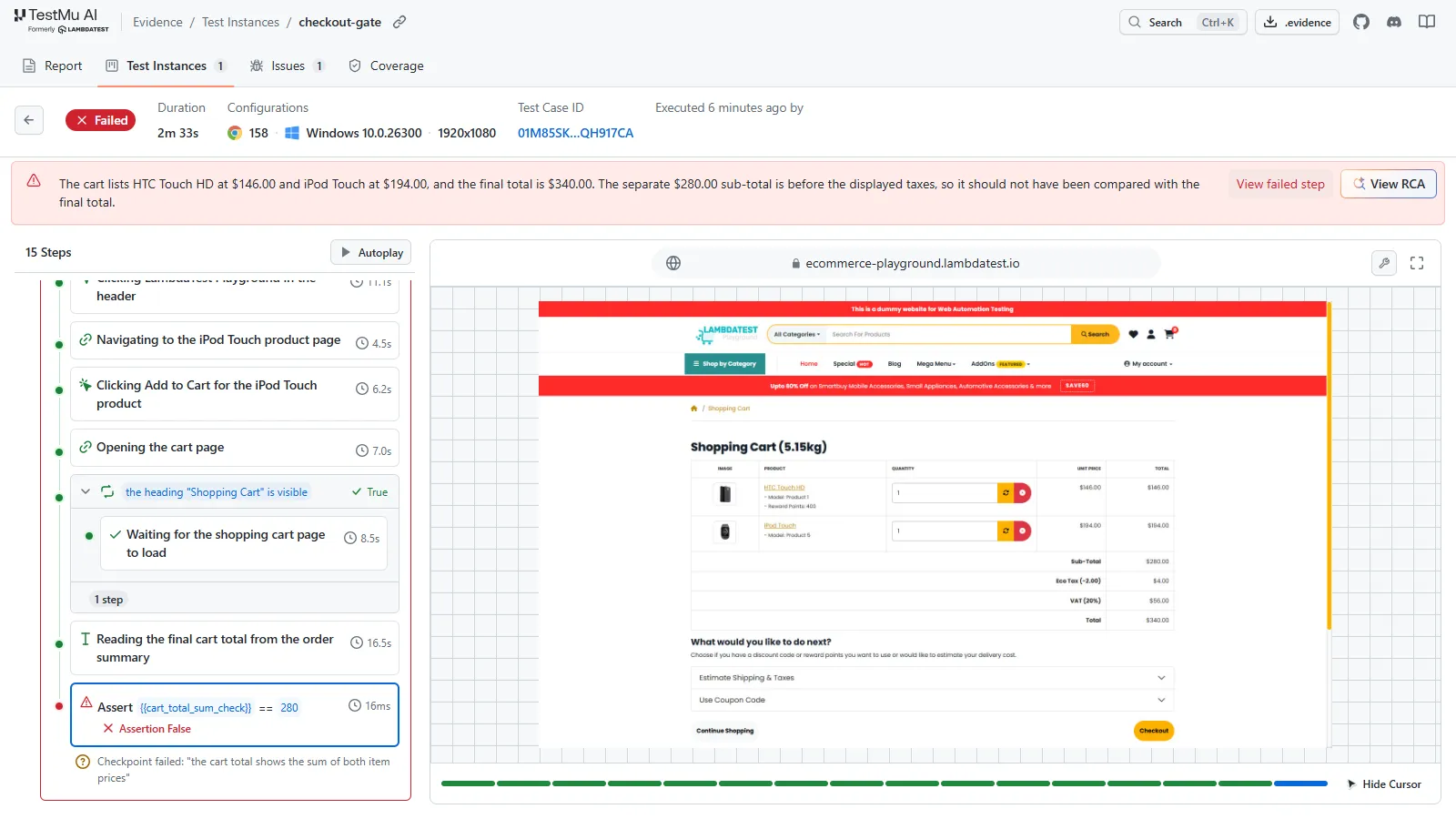
TestMu AI's scale. TestMu AI serves 3M+ users and 18,000+ enterprises across 132 countries and has run 1.5B+ tests (testmuai.com, Nov 2026). TestMu AI is "A Leader in the 2026 Gartner® Magic Quadrant™ for Agentic Software Quality Assurance Platforms."
More on the concept of what AI code review catches versus what it can verify.
How to Add a Required Test Check Next to Claude Approvals
A test gate is a mandatory status check that runs the app end to end and will block the merge if the flow fails. The test gate is in GitHub branch protection, not in the Claude Approvals policy file, as the Approvals rules look at paths, PR facts, and classifiers rather than CI results.
Step 1: Run Kane CLI as a GitHub Actions Job
The Kane CLI E2E check replays the saved checkout tests on every PR. It fails if the Kane CLI exits with a non-zero code (1 = a test failed or broke, 2 = nothing ran, 3 = canceled).
# .github/workflows/kane-e2e.yml
# Commands and flags from the Kane CLI AGENTS.md and the kane-cli CI guide (checked 24 Nov 2026)
name: kane-e2e
on:
  pull_request:
jobs:
  kane-e2e:
    name: Kane CLI E2E
    runs-on: ubuntu-latest
    timeout-minutes: 15
    env:
      LT_USERNAME: ${{ secrets.LT_USERNAME }}
      LT_ACCESS_KEY: ${{ secrets.LT_ACCESS_KEY }}
    steps:
      - uses: actions/checkout@v4
      - uses: actions/setup-node@v4
        with:
          node-version: 20
      - uses: browser-actions/setup-chrome@v1
      - run: npm install -g @testmuai/kane-cli
      - name: Replay the checkout acceptance tests
        run: kane-cli testrun run --tags checkout --headless --agent --username "$LT_USERNAME" --access-key "$LT_ACCESS_KEY"
      - name: Keep the evidence
        if: always()
        uses: actions/upload-artifact@v4
        with:
          name: kane-evidence
          path: .testmuai/evidence/
In CI, Kane CLI gets its credentials from your secret store rather than you logging in. Your username and access key are under Profile > Account Settings > Password & Security.
Add --no-adaptive-heal if any replay miss should fail rather than heal. Commit each test's output-<stem>/ cache folder rather than the evidence. The Kane CLI's GitHub Action can also be used to post a PR comment with the verdict and an evidence link.
Point the test at the build for this PR (e.g., a preview deployment), not at shared staging. Otherwise, the check will prove what's already been deployed rather than the change that Claude is about to approve.
The test file contains the acceptance criteria in Kane CLI format (frontmatter, one heading per step, a check per step). The content is an example.
---
mode: testing
tags: [checkout]
---

## Open the cart
Go to https://pr-preview.example.com/cart with two items in it.
Verify the cart total shows the sum of both item prices.

## Apply the coupon
Enter coupon code SAVE10 and apply it.
Verify the total drops by 10% and the discount line is shown.

## Place the order
Complete checkout with the test card.
Verify the confirmation page shows an order number and the discounted total.
Step 2: Put Your Tests Under a QA Owner in .claude/approvals.yml
The first and final rules are Anthropic's starter policy (copied directly from the Claude Approvals docs). The middle rule is ours: a QA owner who is not the PR author must approve any changes to end-to-end tests, CI workflows, or the PR Steward's house rules.
Replace acme/qa with your team. Name at least two people on that team, or your QA member's own PR can simply sit and wait.
# .claude/approvals.yml
version: 1
mode: observe
rules:
  - purpose: "A change takes two people. When Claude's review passes, one is enough and Claude approves."
    paths: ["**"]
    verdict: { claude: comments, seats: 2 }
    override:
      - { if: "claude/code_review = pass", verdict: { claude: approves, seats: 1 } }
  - purpose: "Tests and CI define done. A QA owner who isn't an author approves changes to them."
    paths: ["tests/e2e/**", ".github/workflows/**", ".claude/skills/steward/**"]
    nested: inherit
    verdict:
      claude: comments
      seats: [{ count: 1, from: [acme/qa, "!pr/authors"] }]
  - purpose: "A change to the review rules takes two people."
    paths: ["**/.claude/**"]
    nested: inherit
    verdict: { claude: comments, seats: 2 }
Claude Approvals take the most stringent verdict that applies. An app-only PR can still get a Claude approval if the review passes.
A PR that edits tests/e2e/ (including a healed cache folder) will require a QA owner. Anthropic's docs make the exact same point about files outside of the built-in protected list: write a rule for the ones that actually matter to you.
Step 3: Tell PR Steward How to Treat a Red Test
PR Steward reads the house rules from .claude/skills/steward/SKILL.md. That's Anthropic's format. Our rules are in there.
---
name: steward
description: House rules for PR Steward in this repository
user-invocable: false
disable-model-invocation: true
---

- When the Kane CLI E2E check fails, fix the app code. Do not edit files under tests/e2e/ to make it pass.
- Treat a wrong total or a missing confirmation in the Kane CLI evidence as a product bug.
- If the check still fails after your fix, reply on the PR and leave it for a person.
SKILL.md is an instruction, not a lock. The lock is Step 2 plus Step 4.
The lock holds only once you delete mode: observe. Until then, review changes to tests/e2e/ by hand.
Step 4: Require Both Checks in GitHub
For branch protection on your default branch, require both the Kane CLI E2E and Claude Approvals. Set the source of the Claude Approvals to the Claude app (ID 1236702) so that a check with the same name from somewhere else won't pass. See GitHub's documentation on required status checks.
For the general pattern, see how to set up a quality gate for AI-generated pull requests.
Why Testing and Development Teams Need This
Testing and development teams need a test gate, as faster merges mean there's more change in front of the users every day.
Developers and SDETs get speed without having to take on a second job. Claude runs the Kane CLI in the session that wrote the change, reads the --agent NDJSON result, and then fixes the app prior to /ship. See the setup section on how to use Claude Code for testing with Kane CLI.
QA leads will of course have the final say on what 'done' means. By default, PR Steward will only re-run a failed job once and only if it had failed previously either before any test ran or had previously passed on the same commit so that flaky tests remain visible.
Engineering managers and CTOs need an audit trail. A review comment tells you that someone has looked at the code. A .evidence file tells you that the flow has run, where it has run, and what the result of that run was.
The cost of skipping a test gate is that the changes which look good on paper and still break checkout get through, and then the users are the ones who become the first real test.
What Claude Ship Already Covers (and Where You Don't Need TestMu AI)
Claude Ship on its own is sufficient for PRs that don't in any way change a user-facing flow.
- Logic and security bugs in the diff. Claude Code Review was built for this.
- Routine fixes. PR Steward deals with lint, merge conflicts, lockfiles, and the like.
- Teams with strong E2E suites. A Playwright or Cypress suite running on real browsers can be the required check (with the paths falling under the Step 2 rule).
Use this table to decide which checks a PR needs:
| PR type | Code Review | Claude Approvals | Kane CLI E2E check |
|---|---|---|---|
| Docs, comments, internal tooling | Yes | Starter policy | Not needed |
| Backend logic with unit tests | Yes | Starter policy | Optional |
| A user-facing flow (checkout, sign-up, login) | Yes | Starter policy | Yes |
| Test files or CI workflows | Yes | QA owner, not an author | Yes |
| Policy files, .claude/, steward rules | Yes | Two people (starter **/.claude/** rule), plus QA owner for steward rules | Yes, if tests are affected |
| A chatbot or voice agent | Yes | Starter policy | Agent Testing run instead |
Rollout Checklist: Claude Ship with a Test Gate
Teams using Claude Ship should be rolling out one agent at a time, one repo at a time, with the test gate in place prior to enforcing anything.
- Pick one repo with a key user flow (e.g., checkout) and write 3-5 Kane CLI _test.md tests owned by QA or the PM.
- Add the Kane CLI E2E check on the PR's preview deployment and make that a requirement.
- Turn on Code Review with a review level, review timing, and spend limit.
- Turn PR Steward on in Manual (@claude steward) mode with the SKILL.md house rules.
- Merge
.claude/approvals.ymlwithmode: observeand the Step 2 rule (observe mode is billed). - For two weeks, we'll be comparing the observe mode verdicts with the reviewers' decisions and the Kane CLI evidence.
- Delete
mode: observe(requires two people with write access), comment @claude on approvals to rerun on open PRs, then require Claude Approvals via the Claude app as the source. - Track the reverts and the escaped bugs on a monthly basis and add the flows as the numbers hold.
Conclusion
Claude Approvals decides who has to approve. A Kane CLI check decides whether the app works. Require both. Run npm install -g @testmuai/kane-cli and get started with Kane CLI (10,000 free credits for 30 days).
Testing from the terminal? Kane CLI by TestMu AI lets SDETs and developers plan, write, run and debug tests from the command line.
Author

Mayank Bhola
Blogs: 11


Mayank Bhola is Co-Founder and Head of Products at TestMu AI, where he leads the entire product portfolio across KaneAI, Kane CLI, HyperExecute, SmartUI, the Real Device Cloud, Accessibility, and other software testing product lines. As an early Lead Architect he designed and built the company's flagship Tunnel technology from scratch, created the React-based automation platform, and architected the data-intensive pipelines and FAAS services that scale it. He brings more than 10 years of experience in software development and product engineering, with earlier roles as Head of Technology at Juggernaut Books and Senior Software Engineer at PressPlay TV and Zomato. Mayank holds a B.Tech in Computer Engineering from JIIT Noida.
Reviewer

Srinivasan Sekar
Reviewer
Srinivasan Sekar is Director of Engineering at TestMu AI, where he leads engineering and open-source initiatives behind the Selenium and Appium automation grid and owns TestMu AI's MCP Server. A committer to Appium and a contributor to Selenium, WebdriverIO, Taiko, and AppiumTestDistribution, he brings over 15 years of experience in quality engineering and open-source technologies. He is the author of the Apress book 'The MCP Standard: A Developer's Guide to Building Universal AI Tools with the Model Context Protocol,' a Certified Kubernetes and Cloud Native Associate, and an international conference speaker. Before TestMu AI he spent over eight years at Thoughtworks as a Principal Consultant and Quality Architect. Srinivasan holds a B.Tech in Information Technology from Anna University.


Claude Code Review FAQs
Did you find this page helpful?
More Related Blogs

TestMu AI forEnterprise
Get access to solutions built on Enterprise
grade security, privacy, & compliance
- Advanced access controls
- Advanced data retention rules
- Advanced Local Testing
- Premium Support options
- Early access to beta features
- Private Slack Channel
- Unlimited Manual Accessibility DevTools Tests