
Power Your Software Testing with AI Agents and Cloud
The Native AI-Agentic Cloud Platform to Supercharge Quality Engineering. Test Intelligently and Ship Faster.


- TestMu AI (Formerly LambdaTest)
- /
- Blog
- /
- 9 Best Eigent Alternatives in 2026 (and How to Test Them)
9 Best Eigent Alternatives in 2026 (and How to Test Them)
Compare 9 Eigent alternatives for 2026, from open-source OpenWork and Cline to Claude Cowork and Devin, and see how to test a cowork agent before you switch.
Published on:
On This Page
Eigent's pricing page offers a Free plan with 1,000 registration credits and free use with your own API keys or local models, and paid Plus and Pro plans with 2,000 and 10,000 monthly task credits. Its Teams plan, which adds a shared library and centralized billing, is still marked Coming Soon.
If those plans or Eigent's desktop-first design do not fit your team, this list ranks nine Eigent alternatives against what Eigent itself does, with every capability checked against the vendor's own documentation, then shows how to test a cowork agent with TestMu AI before it touches real files.
TL;DR
The closest Eigent alternatives in 2026 are OpenWork and goose: open-source desktop agents that run on your machine, accept your own model keys or local models, and work directly on your files. Proprietary options and chat-first assistants trade some of that control for a vendor-run cloud, bigger agent swarms, or messaging-app access.
Which Eigent alternative fits which team?
- Best open-source desktop match: OpenWork - an MIT-licensed desktop app for macOS, Windows, and Linux that works on your own files, with 50+ model providers, local models, and a built-in browser that asks before it clicks.
- Best for desktop plus CLI and API: goose - an Apache-2.0 agent under the Linux Foundation's Agentic AI Foundation, with a desktop app, a CLI, an API, parallel subagents, and 70+ MCP extensions.
- Best proprietary match: Claude Cowork - runs in the Claude desktop app on your local files, splits work into parallel workstreams, and schedules tasks, but uses Claude models only.
- Best for chat-app access with local models: Hermes Agent - an MIT-licensed agent from Nous Research with a desktop app, a CLI, one gateway for Telegram, Slack, and WhatsApp, and parallel subagents.
- Best for messaging-first assistants: OpenClaw - an MIT-licensed assistant run by the OpenClaw Foundation that reaches you in WhatsApp, Telegram, Slack, and 20+ more channels and can attach to your signed-in Chrome.
- Best for coding with approvals: Cline - an Apache 2.0 coding agent for IDEs, the terminal, and desktop apps that asks before every action by default, with parallel sessions and scheduled tasks in its desktop app.
- Best for large parallel jobs: Kimi Work - a proprietary desktop agent from Moonshot AI that can run 300 agents in parallel and operate a signed-in browser through its WebBridge extension.
- Best managed coding agent: Devin - Cognition's AI software engineer manages local and cloud agents from the Devin Desktop command center. Devin Cloud runs long tasks on its own machine in the cloud.
- Best for terminal pair programming: Aider - an Apache 2.0 pair programmer for the terminal that can run your test suite after each edit and try to fix failures, with most LLMs, including local models through Ollama.
Whichever agent you shortlist, TestMu AI's Agent Assurance can list what it is able to do before it runs and grade what a run changed on disk, and Kane CLI can check what it built in a real Chrome browser, so the switch rests on evidence rather than a demo.
What Is Eigent?
Eigent is an open-source cowork desktop app that turns a task into work for a team of AI agents. It is built on the CAMEL-AI multi-agent framework, licensed under Apache 2.0, and its local deployment needs no cloud account. The GitHub repository has about 15.5k stars.
Eigent's releases page lists v1.0.5 as the latest release, published on September 25, 2026.
Its workforce mode is what sets it apart from a single chat agent:
| Eigent agent | What it does |
|---|---|
| Coordinator | Acts as the project manager, assigning subtasks that workers pick up from a shared task channel |
| Task planner | Acts as the strategy lead, breaking the job into subtasks |
| Developer Agent | Writes and runs code, runs terminal commands, and verifies solutions |
| Browser Agent | Searches the web, extracts page content, and simulates browser actions |
| Document Agent | Creates, modifies, and manages documents, including presentations |
| Multi-Modal Agent | Analyzes and generates media such as audio and images |
| Custom worker | Runs your own system prompt with any MCP-supported toolkit |
Any agent can call a Human Toolkit to pause and ask you for help when a task stalls. The coordinator-and-workers design is the pattern covered in multi-agent AI systems.
Eigent's local model setup accepts any model served as an OpenAI-compatible server, such as vLLM, SGLang, Ollama, or llama.cpp.
CAMEL-AI also maintains OWL, an open-source framework for multi-agent collaboration that runs from Python scripts and a web UI.
OWL has no desktop app, so it is not on this list.
Eigent Alternatives Compared
The table maps each alternative against Eigent on where it runs, parallel agents, license, and model choice; the ranked entries below explain each row.
| Agent | Where it runs | Parallel agents | Open source | Models |
|---|---|---|---|---|
| Eigent (reference) | Desktop app for macOS, Windows, Linux | Yes, coordinator plus worker agents | Yes (Apache 2.0) | Your keys or local models |
| OpenWork | Desktop app for macOS, Windows, Linux | Not documented | Yes (MIT core) | 50+ providers, Ollama |
| goose | Desktop app, CLI, API | Yes, subagents | Yes (Apache-2.0) | 15+ providers, Ollama |
| Claude Cowork | Claude Desktop, web, mobile | Yes, parallel workstreams | No | Claude only |
| Hermes Agent | CLI, desktop app, chat gateway | Yes, subagents | Yes (MIT) | Any, including local |
| OpenClaw | Local gateway and chat apps | Yes, background subagents | Yes (MIT) | Swappable, including local |
| Cline | IDEs, CLI, desktop app for macOS and Windows | Yes, parallel sessions and Kanban agents | Yes (Apache 2.0) | Your keys, cloud or local runtimes |
| Kimi Work | Desktop app for Windows and Apple silicon Macs | Yes, up to 300 | No | Kimi platform |
| Devin | Devin Desktop, Devin Cloud, Devin CLI | Yes, local and cloud agents | No | SWE-2 plus frontier models |
| Aider | Terminal | No, one agent | Yes (Apache 2.0) | Most LLMs, Ollama |
Kimi Work, OpenClaw's attach mode, and Eigent's browser connections can all drive a browser that already holds your logins, which is the same exposure covered in computer use agents.

Note: When you build browser tasks for your own agents, TestMu AI's Browser Cloud runs them in isolated, real Chrome sessions instead of your signed-in browser, with a built-in tunnel to staging and video, console, network, and command replay for every session. Try TestMu AI free!
Why Do Teams Look for an Eigent Alternative?
The reasons to look elsewhere are usually about fit:
- Team rollout - shared libraries and centralized billing wait on the Teams plan, and Telegram, Lark, and WhatsApp channels for Dispatch are still listed as coming soon.
- Model hosting - running locally means serving your own model behind an OpenAI-compatible endpoint, which some teams would rather hand to a vendor.
- Where work starts - Eigent centers on its desktop app, while OpenClaw and Hermes Agent take tasks from the chat apps a team already uses.
- One bill - teams already paying for Claude or ChatGPT can get a cowork agent inside that plan instead of adding another.
How These Alternatives Were Ranked
I ranked each agent on how well it replaces Eigent, checking every capability against the vendor's own documentation or repository. The criteria, in order of weight:
- Local work - does it run on your machine and act on your own files and apps?
- Openness - license, your own model keys, and local model support.
- Parallel agents - can it split a job across subagents or workstreams, the way Eigent's workforce does?
- Controls - approval prompts, folder scoping, and a way to take over the browser.
Prices change too often to compare as dollar figures, so each entry describes the billing model instead. Coding agents are in scope because Eigent pitches itself as a local alternative to Claude Cowork and Codex, and its Developer Agent does software work. TestMu AI's Agent Assurance is not ranked because it tests cowork agents rather than doing their work.
Microsoft Copilot Cowork was left off because it cannot access or edit files stored locally on your device; it works with files in OneDrive and SharePoint.
Manus, Perplexity Computer, and ChatGPT Work were also considered. Each can reach your local files from a desktop app, but all three are proprietary services billed in credits or plan usage and built around their vendors' clouds. How Manus's approval step can trail the action is covered in Manus prompt injection.
9 Best Eigent Alternatives in 2026
1. OpenWork
OpenWork is the closest open-source match to Eigent's pitch.
OpenWork describes itself as a free, open-source alternative to Claude Cowork and Codex: a desktop app for macOS, Windows, and Linux where AI agents do real work on your own files. It is built on OpenCode.
- License - MIT for everything outside the ee folder, which holds a source-available enterprise control plane; about 24k GitHub stars.
- Models - 50+ providers through OpenCode, your own keys, ChatGPT sign-in, and local models through Ollama or any OpenAI-compatible server.
- Browser - a built-in, desktop-only browser that asks "Allow browser action?" before clicks and typing, with a Take over control.
- Pricing - the desktop app is free; a Team cloud plan and an Enterprise plan with your own inference cover organizations.
- Watch for - scheduled tasks are in alpha, the version line is still 0.x, and the docs do not describe parallel subagents the way Eigent's workforce works.
2. goose
goose is a native open-source AI agent with a desktop app, a CLI, and an API, for code, workflows, and everything in between. It is part of the Agentic AI Foundation at the Linux Foundation.
- License - Apache-2.0, with about 55k GitHub stars.
- Runs in - desktop apps for macOS, Linux, and Windows, plus the CLI and API, which make it the easiest pick to script.
- Models - 15+ providers, including Ollama, OpenRouter, and Bedrock, and existing Claude, ChatGPT, or Gemini subscriptions through ACP.
- Tools - 70+ extensions over MCP.
- Controls - an opt-in adversary mode adds a silent reviewer agent that checks each tool call before it runs and returns ALLOW or BLOCK.
- Pricing - free; you pay your model provider.
goose's subagents run in parallel, with a default 5-minute timeout and 25 maximum turns, and they cannot spawn further subagents.
That covers Eigent's coordinator-and-workers pattern one level deep.
3. Claude Cowork
Claude Cowork is the product Eigent positions itself against, and the closest proprietary match.
Claude Cowork uses the same agentic architecture that powers Claude Code, with no terminal required. On the desktop, Claude can read and write your local files, and Cowork breaks complex work into smaller tasks and coordinates parallel workstreams.
- Runs in - Claude Desktop for macOS and Windows, the web, the mobile apps, and a Chrome side panel; cloud tasks are in beta on Team and Enterprise plans.
- Browser - a built-in browser, or Claude in Chrome.
- Extensions - MCP connectors and plugins that bundle skills, connectors, and sub-agents, plus scheduled tasks through /schedule.
- Controls - manual approval, automatic approval, or skipping approvals entirely.
- Models - Claude only, with no local model option.
- Pricing - included in Pro, Max, Team, and Enterprise plans, and each step draws on your plan's usage.
- Watch for - computer use is still a research preview, and sessions cannot be shared.
4. Hermes Agent
Hermes Agent is Nous Research's self-improving agent, built around a learning loop. It can spawn isolated subagents for parallel workstreams and run on a schedule with its built-in cron.
- Runs in - a CLI and terminal UI, a desktop app for Apple silicon Macs and Windows, and one gateway process for Telegram, Discord, Slack, WhatsApp, and Signal.
- Models - any model, from Nous Portal or OpenRouter to your own endpoint, including local servers such as Ollama and vLLM, switched with the hermes model command.
- Controls - command approval, DM pairing, and container isolation.
- License - MIT, with about 253k GitHub stars.
- Pricing - free; an optional Nous Portal subscription bundles models and tools.
5. OpenClaw
OpenClaw is an open-source AI assistant that runs on your own computer and meets you in the channels you already use, from WhatsApp and Telegram to Slack, Teams, and iMessage. It is stewarded by the OpenClaw Foundation, has no paid tier or hosted service, and its GitHub repository has more than 390k stars.
- Parallel work - background subagents spawned from a running agent split research and long tasks.
- Browser - a dedicated browser profile, or an attach mode that drives your real signed-in Chrome through Chrome DevTools MCP.
- Models - models and agent harnesses, including Claude, Codex, and local models, are plugins you can swap.
- License - MIT, with a local gateway and apps for macOS, Windows, Linux, iOS, and Android.
- Watch for - the README tells you to treat inbound messages as untrusted input, because anyone who can message the assistant can try to steer it.
Setup and channels are covered in what is OpenClaw.
6. Cline
Cline is the coding-first pick: it covers the work of Eigent's Developer Agent with open-source code and step-by-step approvals.
Cline is an AI coding agent that lives in your editor and your terminal, and its docs state that every action requires your explicit approval. Its desktop app adds parallel sessions, scheduled tasks, and flexible model choice.
- Runs in - VS Code, JetBrains, Cursor, Windsurf, Antigravity, and Zed, a CLI for interactive chat or fully headless CI/CD runs, and desktop apps for macOS and Windows.
- Parallel work - a Kanban app runs many agents in parallel from a web task board, with a worktree per card.
- Models - your own provider credentials for cloud providers or local runtimes, or Cline's usage-billed provider.
- License - Apache 2.0, with about 70k GitHub stars.
- Pricing - the agent is free and open source; a ClinePass subscription adds usage on popular open coding models, and Enterprise adds security, observability, and team management.
- Watch for - Cline is built for software work, so it has no dedicated document or media agent like Eigent's.
Other options for this workflow are covered in Cline alternatives.
7. Kimi Work
Kimi Work is a local AI agent that lives on your desktop and can run 300 agents in parallel, operate your browser, and turn live data into finished reports.
Of the proprietary tools here, Kimi Work is the closest to Eigent's workforce pitch, at a much larger scale.
- Local work - reads local files, runs code on your machine, and returns the finished deliverable.
- Browser - the Kimi WebBridge extension operates a signed-in browser, filling forms and downloading files.
- Controls - Full access runs without interruption, and Ask permission pauses at sensitive steps.
- Platforms - Windows and Apple silicon Macs; on Intel Macs the desktop app offers Kimi Chat only.
- Pricing - all Kimi products share one credit pool, and the free plan allows up to 2 scheduled tasks.
- Watch for - it is proprietary, and the docs do not offer your own model keys or local models.
8. Devin
Devin is the managed choice for software teams that want cloud agents working on their own machines while a desktop app keeps every agent in one view.
Cognition renamed Windsurf to Devin Desktop on June 2, 2026: a full IDE whose Agent Command Center manages every local and cloud agent from a single Kanban view. Devin Local, the successor to Cascade, supports subagents, and Devin Cloud runs the long-running Devin agent on its own machine in the cloud.
- Other agents - Devin Desktop runs Codex, Claude Agent, OpenCode, and other agents through the Agent Client Protocol, and Spaces share context between them.
- Scope - Cognition's rule of thumb is that if you can do a task in three hours, Devin can most likely do it.
- Self-hosting - Devin Outposts runs sessions on your own infrastructure through self-hosted workers.
- Models - Cognition's SWE-2 model, plus frontier models from OpenAI, Claude, Gemini, and SpaceXAI on paid plans.
- Pricing - Free, Pro, Max, Teams, and Enterprise plans, with Devin Cloud included from Pro upward.
- Watch for - it is proprietary and built for software engineering, not general office work.
Other options for this workflow are covered in Devin alternatives.
9. Aider
Aider is AI pair programming in your terminal. With --test-cmd and --auto-test it runs your test suite after each edit, and it tries to fix any errors when the command returns a non-zero exit code.
- Scripting - a --message run does one thing, applies the edits, and exits, and --yes answers every confirmation.
- Models - most LLMs, including local models through Ollama, though it may not work well with less capable models.
- License - Apache 2.0, with about 49k GitHub stars.
- Pricing - free; you pay your model provider.
- Watch for - one agent with no background or cloud mode, and the last tagged release, v0.86.0, dates from August 2025.
Other options for this workflow are covered in Aider alternatives.
How to Test a Cowork Agent Before You Switch
A cowork agent's demo shows the deliverable, not the commands it ran or the files it touched on the way. Before an agent gets your real folders and logins, check what it is able to do and what a run actually changed. For agents that build software, also check that what they built works in a browser.
Map What the Agent Can Do With Agent Assurance
Agent Assurance tests how your agents actually behave across workflows, tools, and actions, and it runs from your terminal as rook. Its discovery step reads an agent's source, prompts, tool registries, and MCP declarations, then lists everything the agent can reach and which of those calls write, before a single test runs.
Eigent's backend is public, so discovery can read it directly. Clone the repository, create a project, and scope the read to the agent folder with a read-only permission rule, as described in connect and explore agents:
git clone https://github.com/eigent-ai/eigent.git
cd eigent
rook project create eigent-trial
rook explore backend/app/agent --allow 'read_file(.)@explore'
On that folder, discovery identifies 11 agents, from the Single Agent and the browser, developer, and document workers to the coordinator and planner roles of the workforce. For the Single Agent it maps 18 outbound calls and 9 testable features, including file edits inside the authorized workspace, terminal commands behind Eigent's permission checkpoint, browser actions through a configured CDP endpoint, and delegation one level deep. On a codebase this size, explore one agent folder at a time, because a whole-repository pass can run out of turns before it finishes.
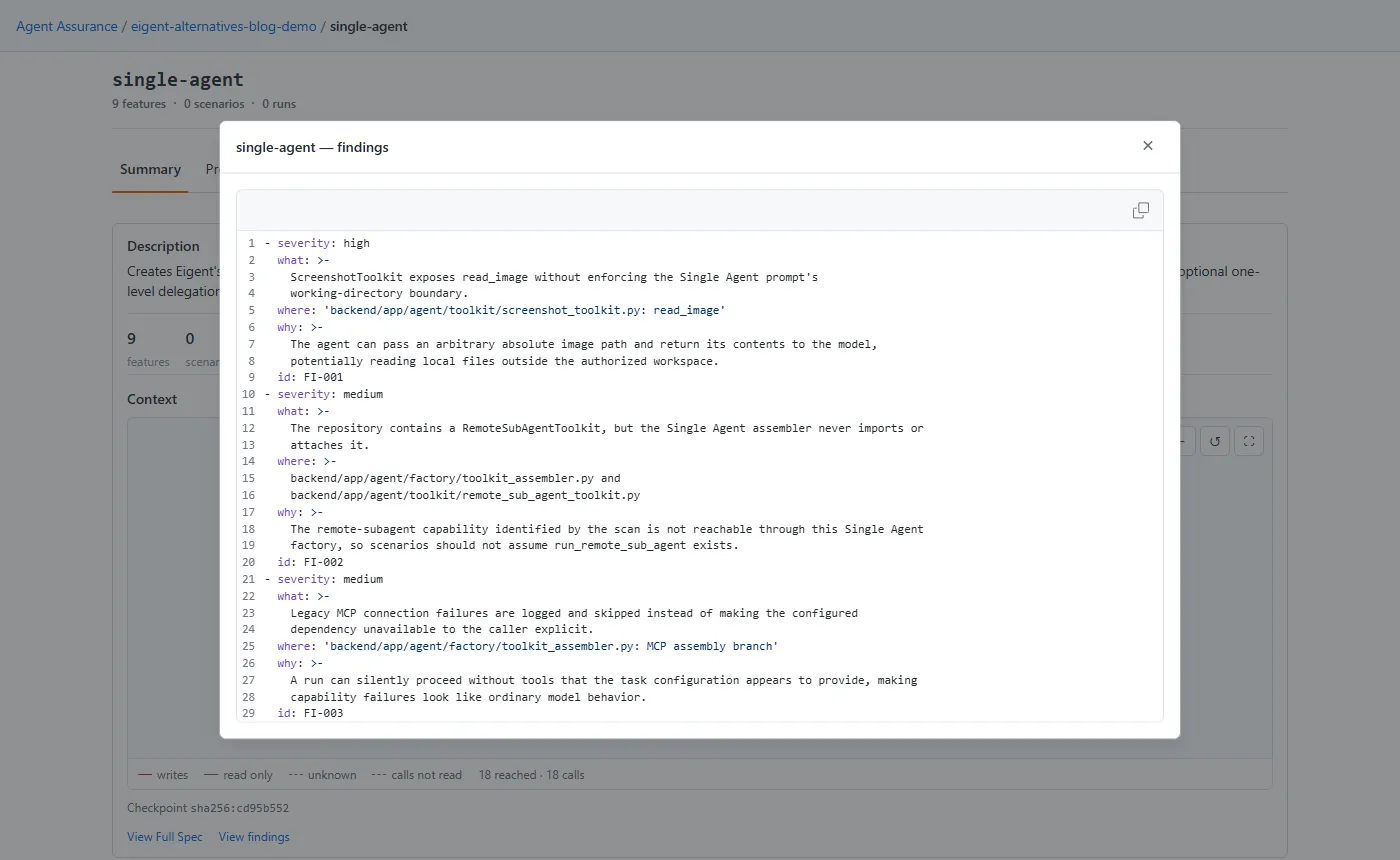
- High - read_image in Eigent's ScreenshotToolkit accepts any absolute image path, so the working-directory boundary in the Single Agent's prompt does not cover images it is asked to read.
- Medium - the repository contains a RemoteSubAgentToolkit that the Single Agent assembler never attaches, so a test should not assume remote delegation exists.
- Medium - failed legacy MCP connections are logged and skipped, so a run can continue without tools its configuration appears to provide.
Treat each finding as the first scenario to run, not as a confirmed exploit. The same pass works on OpenWork, goose, Hermes Agent, OpenClaw, Cline, and Aider, because all six publish their source.
Grade What a Run Changed
Discovery shows what an agent could do; a run shows what it did. A profile tells rook how to invoke the candidate, whether through a CLI such as goose, Cline, or Aider or through an HTTP endpoint such as the ones Eigent's event automations create, and each scenario is then graded against evidence from the run instead of the agent's own summary.
- Point the candidate at a staging folder holding copies of real files, never at your working directories.
- Add a profile for its command, for example rook profile add local --command 'your-agent --test-mode', and approve only the actions the integration needs.
- Run rook generate for functional, non-functional, and adversarial scenarios, then turn each discovery finding into a scenario of its own.
- Run rook run, then read rook report, where every criterion comes back as Pass, Fail, or Unable to Verify and the third never counts toward the pass rate.
Agent Assurance is pre-alpha, so its commands and stored file formats can still change, and the agent's writes during a run are real. Rook permissions and safety covers how to scope them, and AI agent permission testing covers the scenarios that check an agent stays inside its grants.
Test What the Agent Built With Kane CLI
Kane CLI checks the other half: whatever the agent shipped. It is a browser agent for developers, AI coding agents, and CI pipelines that validates rendered UI in a real Chrome browser from a plain-English objective, which fits the forms, pages, and dashboards that Cline, Devin, Aider, or Eigent's Developer Agent produce.
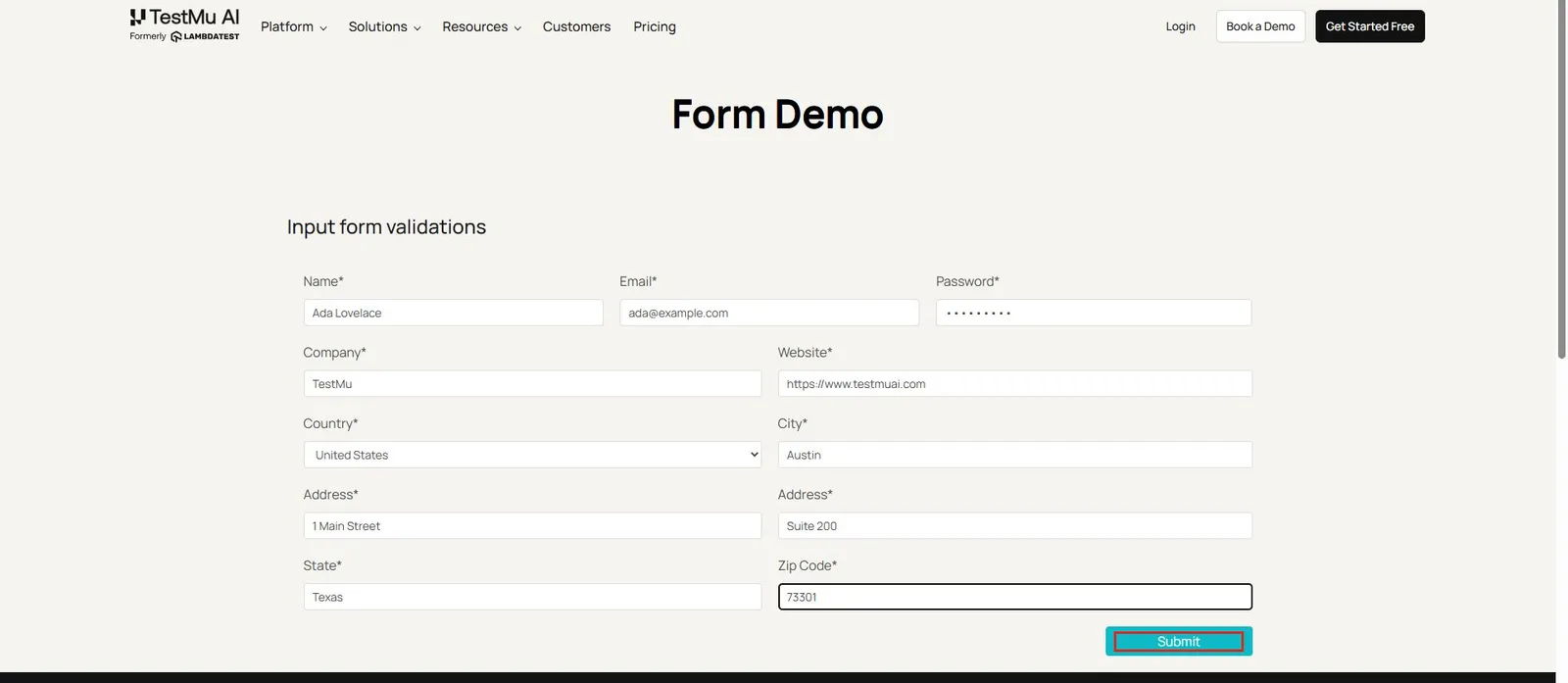
Point it at a form an agent just wired up. Against the TestMu AI Selenium Playground input form, this objective fills every field, submits, and asserts the confirmation:
kane-cli run "Go to https://www.testmuai.com/selenium-playground/input-form-demo/, fill the form with name 'Ada Lovelace', email 'ada@example.com', password 'Test@1234', company 'TestMu', website 'https://www.testmuai.com', country 'United States', city 'Austin', address 1 '1 Main Street', address 2 'Suite 200', state 'Texas', and zip code '73301', click the Submit button, store the confirmation message shown on the page as 'confirmation', then verify the page shows the message 'Thanks for contacting us, we will get back to you shortly.'" --agent --headlessThe run passes in 17 steps, from navigation through the 11 fields to the final assertion, and the closing run_end event carries the stored value:
{
  "type": "run_end",
  "status": "passed",
  "one_liner": "submitted a contact form on the TestMu AI Selenium Playground",
  "final_state": {
    "url": "https://www.testmuai.com/selenium-playground/input-form-demo/",
    "confirmation": "Thanks for contacting us, we will get back to you shortly."
  }
}
- Exit codes - 0 for a pass, 1 for an assertion failure, 2 for an environment error, and 3 for a timeout, so a CI job or a coding agent can act on the result without parsing prose.
- Agent skills - a skill file teaches Claude Code, Codex CLI, and Gemini CLI to call Kane CLI on their own changes and read its NDJSON output in agent mode.
- Evidence - each run seals an evidence pack with per-step screenshots, annotated copies, a HAR network log, and console logs.
- Saved tests - a named run is recorded as a _test.md file you can commit and replay with kane-cli testmd run.
Which Eigent Alternative Should You Choose?
Match the agent to how your team hands off work:
- Open source on the desktop - OpenWork, or goose if you also want a CLI and an API to script it.
- Tasks from chat apps - Hermes Agent, or OpenClaw if you want a foundation-run project with no paid tier.
- Coding work with approvals - Cline in the IDE or its desktop app, or Aider in the terminal.
- A managed agent and one bill - Claude Cowork for general work on a Claude plan, or Devin for software engineering.
- Hundreds of parallel agents - Kimi Work.
Shortlist two agents, give each the same task in the same staging folder, and decide on what changed rather than on the demo. Install Agent Assurance with npm install -g @testmuai/rook, then follow the Agent Assurance quickstart to explore each candidate before it gets your real files. For agents that build software, install Kane CLI with npm install -g @testmuai/kane-cli and follow Kane CLI getting started to check what they ship in a real browser.
Author

Samyak Goyal
Blogs: 31

Samyak Goyal is a Senior Member of Technical Staff at TestMu AI engineering Kane CLI, the command-line tool that runs browser automation from the terminal, where a flow described in natural language executes in a real Chrome browser and returns pass or fail with shareable proof. He is a backend engineer with 4+ years of experience, previously an SDE at Innovaccer, where he built APIs, introduced Kafka, and cut deployment from weeks to hours. Samyak also builds multi-agent systems, skill-orchestration frameworks, and a personal copilot that indexes 200+ microservice repositories.
Reviewer

Anubhav Singhmaar
Reviewer
Anubhav Singhmaar is an AI Product Manager at TestMu AI driving Kane CLI, the command-line tool that brings browser automation to the terminal, turning natural-language flows into runs in a real Chrome browser that return pass or fail with shareable proof. He owns the roadmap and prioritization and works with engineering to ship developer-facing features. Before TestMu AI, he spent over four years at Sprinklr owning enterprise voice AI across APAC and EMEA. A mechanical engineer turned product manager, he grounds guidance in real QA workflows.


Eigent Alternatives FAQs
Did you find this page helpful?
More Related Blogs
TestMu AI forEnterprise
Get access to solutions built on Enterprise
grade security, privacy, & compliance
- Advanced access controls
- Advanced data retention rules
- Advanced Local Testing
- Premium Support options
- Early access to beta features
- Private Slack Channel
- Unlimited Manual Accessibility DevTools Tests