

Next-Gen App & Browser Testing Cloud
Trusted by 2 Mn+ QAs & Devs to accelerate their release cycles


Top 19 Benefits Of Automation Testing For Web And Mobile Apps In 2024
Automation testing for web and mobile apps improves efficiency, accelerates testing cycles, and ensures better software quality. Read more now and elevate testing!

Tanay Kumar Deo
February 19, 2026
With the increasing pace of technology, it becomes challenging for organizations to manage the quality of their web applications. Unfortunately, due to the limited time window in agile development and cost factors, testing often misses the attention it deserves.
Automation testing aims to enhance testing efficiency, precision, and speed. It automates repetitive manual testing tasks, allowing faster and more accurate results. Utilizing automated testing tools allows software applications to be tested swiftly and effectively, ensuring consistent performance and quality without continuous human oversight.
Lack of proper testing leads to fewer quality products, delayed delivery, unsatisfied custom service, and increased costs. Such issues can be an unplanned test management strategy, delay in development, and underestimation of the effort of creating a test case.
The test engineers undoubtedly try to catch bugs or errors before releasing the product. However, bitter truth be told, you can’t catch every bug! So you deploy a quick fix post your migration to production, and then regression testing comes into play. Regression testing is very time-consuming but relevant to maintaining product stability. In such scenarios, you will find yourself stuck in a vicious cycle where your deployment window will grow narrow. How do we cope with such scenarios? The answer would be Automation testing!
Automation testing is here to stay in the long run! As per GM insights, the size of the automation testing market has reached USD 15 billion as of 2020. Moreover, the expected growth is at a CAGR of around 16% from 2021 to 2027.

In contrast to manual testing, automation testing is an effective way to improve the effectiveness and coverage of the testing process. It began to speed up execution cycles, exempt testers from repetitive tasks, reduce human efforts and provide instant feedback.
In this article on the benefits of automation testing, we shall discuss what automation testing is and why automation testing is the right call for your software development life cycle (SDLC).
If you’re looking to improve your Automation Testing interview skills, check out our curated list of Automation Testing interview questions and answers.
What is Automation Testing?
Automation testing refers to using automation tools and scripts to automate the execution of test cases in software development and quality assurance processes.
It involves writing scripts or test cases that can run automatically instead of requiring manual effort. The benefits of automation testing involve boosting the effectiveness and efficiency of testing by diminishing human mistakes, saving time, and enhancing test coverage.
Why is Automation Testing important?
Automation testing is important for the following reasons:
- Faster Execution:Automation Testing significantly speeds up the testing process compared to manual testing. Automated tests can run anytime, including nights and weekends, allowing for continuous testing and faster development cycles. Testers can save a significant amount of time required in repetitive testing like regression testing and smoke testing.
- Cost-Efficiency:While there’s an initial investment in setting up automated tests, the long-term benefits include reduced testing time and labor costs, making it a cost-effective approach in the long run.
- Consistency and Accuracy:Automated tests execute the same steps precisely every time they run, eliminating human errors and ensuring consistent and accurate testing results.
- Improved Test Coverage:Automation allows for executing complex test cases during every test run, providing broader test coverage and ensuring the software’s reliability and stability.
- Early Bug Detection:With automation, issues, and defects in the software can be identified early in the development process, making fixing them easier and less expensive.
- Reusability of Test Scripts:Automated test scripts are reusable and can be utilized through different phases of development, even if there are changes in the software’s user interface.
- Supports Agile and Continuous Integration:Automation Testing is essential for supporting Agile development practices and Continuous Integration/Continuous Deployment (CI/CD) pipelines, facilitating frequent and reliable software releases.
19 Core Benefits of Automation Testing
The above section states the importance of automation testing, but there are tons of benefits of automation testing. Let’s explore the 19 core benefits of automation testing to eradicate the ambiguity on whether automation testing is the perfect choice for your organization.
1. Guarantees Higher Accuracy
Even the most conscious tester can make errors during monotonous manual testing. Automation testing completes the defined steps precisely every time they are executed but never fails to record detailed results. Hence, testers and developers freed from repetitious manual tests will have more time to create new automated test scripts and test the complex features. It is considered one of the most important benefits of automation testing.
2. Reduces testing cost and time
Undoubtedly, the initial cost and time investment for setup can be higher, but organizations save a lot of extra expenses with automation testing by utilizing resources effectively.
Manual testing cannot execute repetitive tests (like regression testing). As the software grows, additional features must be tested, increasing pressure and working hours for manual testers. The benefits of automation testing permit testers to not invest time in repetitive testing and hence can focus on more important tasks like designing new test cases and test scripts.
3. Faster feedback loop
Getting feedback for newly created features can take time without test automation. Automation testing helps us reduce the feedback cycle and get faster validation at every step in the product’s development cycle.
It is especially useful because it helps us detect bugs and errors early during development, increasing the team’s efficiency. These key benefits of automation testing can be achieved using frameworks like Selenium, Cypress, Appium, etc. that accelerate test case execution.
4. Ability to perform Parallel testing
One of the most important benefits of automation testing is its ability to run multiple test cases in parallel. It is achieved through parallel testing.
Parallel Testing is a process that allows the execution of various tests simultaneously in multiple environments, browser configurations, and real device combinations. The primary goal of parallel testing is to decrease time and resource constraints. Unlike distributed testing, where different test components run in a distributed manner and interact with each other, the parallel testing approach is free from any such interaction.
This method is invaluable for effectively testing complex systems or large applications, as it minimizes testing time and optimizes resource utilization.
5. Provides cross browser testing
Manual cross browser testing may lead to numerous challenges and problems. In the case of manual testing, testers first need to identify the browser their web app must support. After preparing a checklist of all the browsers, they execute a single test on different browsers + versions + OS arrangements to measure how well their web apps perform.
Achieving sufficient test coverage may look like a nightmare if you have a wide audience to attend.
Automated cross browser testing platforms like TestMu AI can reduce the struggles by running the same test cases multiple times on various browser configurations in parallel.

Get relevant test automation support for 3000+ browsers, OS, and devices to get the benefits of automation testing for web and mobile apps. Stay a step ahead of your competitors and remain bugless across different browsers.
6. Reusability of Test Scripts
One of the key benefits of automation testing is the ability to reuse the test scripts. Writing effective test cases demands a lot of time & effort, and repeatedly writing the same test cases can exhaust the testers. But, with automation testing, testers write a test script once and can reuse it as many times as they need.
Let’s look at an illustration of cross browser testing. When conducting cross-browser testing, testers might have to create test scripts each time to run the same application across various operating systems and hardware. Doesn’t that sound exhausting?
However, the automated test scripts are reusable; testers don’t always require new scripts, even if the OS or target device changes. With automated testing tools, test scripts can be reused as often as needed. This ultimately saves both the time and effort of the testers. This is one of the best benefits of automation testing we need to consider.
7. Maximize Test Coverage
Among the many benefits of automation testing, this one stands out. With automation testing, testers can execute a much larger number of test cases rapidly. More test cases ensure maximum test coverage of requirements and features in every test cycle.
Increased test coverage increases the possibility of determining bugs, which prevents avoidable issues and errors in production, and hence, the overall performance of the application increases.
With better test coverage, testers would be in a position to:
- Understand more and less critical test cases for every application.
- Get better traceability between the needed requirements and test cases generated so far.
- Analyze the previous release and the current one.
- Track every build cycle and project fixes.
- Determine the EXIT criteria.
- Improve the multitasking ability of every tester.
8. Earlier bug detection
With automation testing, developers and testers can run unit tests on their local system before pushing code to the version control system. Subsequently, integration and regression testing are also run automatically. With this, every functionality and line of code is tested extensively. Hence, bugs are detected at an earlier stage.
Earlier bug detection leads to early and easier debugging before the actual production of the application. It increases the overall performance of the application on the production.
9. Shift-left testing done better!
One of the key benefits of automation testing is Shift-left testing. Shift-left testing is a part of continuous testing that conveys that the testing phase should be incorporated into the SDLC (Software Development Life Cycle), right from the requirement gathering phase to find bugs at an early stage. Shift-left testing can improve your product quality since it can let you:
- Resolve bugs efficiently
- Improve test coverage
- Track everything on the go
- Automate repetitive tasks
- Improve the tester-developer relationship
The core benefits of automation testing include that it can be performed as soon as the development starts, thereby detecting the bugs or defects earlier, helping you shift left faster.
10. Easy regression testing
Regression testing is performed for every new feature deployed in production to ensure the bug has been removed. Performing regression testing manually consumes a lot of time and is often repetitive. Automation testing is an ideal way to perform regression testing because:
- In regression testing, test cases change very rarely. This same test script can be executed again and again.
- Automated regression testing can be executed automatically on every new functionality release without requiring manual interventions.
- In manual testing, testers may miss some steps, sometimes leading to less accurate results.
With automation testing, testers only need to put one-time effort into designing the test scripts to run regression testing. This is one of the core benefits of automation testing that saves the testers a lot of time and effort by reducing repetitive tasks. It also increases the test accuracy.
11. Better smoke testing
Smoke testing allows testers to evaluate if all important software functionalities work correctly quickly.
Regular smoke testing can help testers find critical failures and is recommended as a best practice. However, many organizations avoid it as they feel that doing so will squeeze the tester’s bandwidth. This is where automation testing comes into play. The best benefits of automation testing include evaluating the stability of a software build by running automated smoke testing for a successful build validation. The datasets required to perform smoke tests are rendered automatically, thus enabling the stability of software builds to be determined faster.
These are the benefits of automated smoke testing:
- Test easily
- Improves the system quality
- Identify defects in the early stages
- Bring down the overall failure risk
- Reduce integration risks
12. Accessible Data Driven Testing
Data driven testing is one of the critical benefits of automation testing. It permits testers to evaluate all functionalities that involve multiple data sets. To perform data driven testing we provide various data sets in multiple input fields of the software and test its accuracy.
With automation testing performing data driven becomes easy, as we can connect external data sources (like Excel files, CSV files, text files, XMLs, MS Access Tables, etc.) as the data set. Using our automated test script, we can store the result in the same or different file. This saves the testers time and effort by automatically taking inputs through the connected data source.
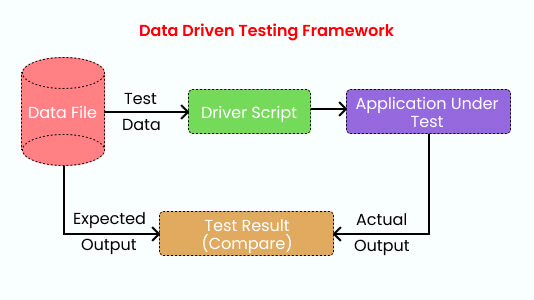
Advantages of Data-driven Testing:
- Test any application with multiple data sets when performing regression testing.
- Organize and store validation and test data in a single file and separate them from the test case logic.
- Store test scripts under one repository.
- Reduce the number of test cases and scripts.
- No test script changes are required when changing test data.
13. Better analysis with a powerful test report
In manual testing, testers must report to each other manually to inform how many tests have been executed and what bugs have been found. The whole process is time-consuming and leads to reliance on each other.
On the other hand, automation testing engineers can track what other engineers have worked on, what test scripts have been executed, what tests others have performed, and what bugs were found and fixed with the help of clear and detailed test reports.
14. Schedule 24 X 7 Test Execution
Compared to manual testing, the core benefits of test automation include the flexibility to run testing at any time of the day. In manual testing, human effort is needed; hence, executing tests 24 X 7 is impossible.
Automated testing allows testers to prepare automated test execution remotely at any time of the day. With automation testing tools, testers can even generate detailed reports on the scheduled test to analyze the software at any time of the day at their convenience.
15. Scalability
Even the largest manual testing teams in the world can’t match the test coverage, speed, and accuracy of an automation testing framework. For example, automation testing can be used to simulate a thousand visitors on the site for load testing. Unless the team has a thousand members to visit the website together (a completely unrealistic scenario), manual testing cannot achieve this.
Similarly, performing cross browser testing on multiple browsers + versions + OS configurations may not suffice. Automated testing can be used to make the testing scalable to a large extent.
With automation testing supporting parallel testing, testers can also run different tests simultaneously. This helps them test at scale and speed.
16. Maximize ROI
Faster tests with automated tests lead to faster results. This, in turn, reduces product release time without compromising the software quality. Accelerated production time maximizes a business’s Return on Investment (ROI).
These are the factors that may influence the automation testing ROI:
- The license cost of the test automation tool.
- The number of releases/builds in a single year.
- Initial cost and time taken to manage automation framework setup, team reskilling, and feasibility.
- The average number of automated test cases in every build.
- Regression cycle and configuration of every build.
- Salary of a test automation engineer.
- Stability of the product.
The benefits of automation testing can be best utilized by choosing a cloud-based automation testing platform like TestMu AI. It can maximize your return on investment to a large extent by reducing the burden of the initial setup. Also, it has a very user-friendly interface; thus, a testing team can use it without requiring much reskilling. Explore the pricing now!
17. Distributed Test Execution
Distributing test cases over multiple browsers, OSs, and devices is not feasible in manual testing. Instead, manual testers can only perform testing on a single device at a time to test the performance of an application.
Automation testing tools permit distributed test execution by running various tests simultaneously on different browsers, OSs, and devices.

18. Execute Complex and Lengthy Test Scenarios Effectively
Testing complex, error-prone, and lengthy test scenarios requires dozens of reproducible steps. Performing such tests manually may lead to a faulty result, even by distraction. However, the benefits of automation testing include executing such complex and lengthy test scenarios efficiently.
With automation testing, testers only need to develop a robust and reliable test script once. These test scripts are used by automation testing tools like Selenium, Appium, Cypress, etc. to ensure complex test efficiency.
19. Supports CI/CD Testing
CI/CD (Continuous Integration and Continuous Delivery) have become important practices for organizations to deliver high-quality software and stay competitive. CI/CD simplifies the software delivery process by automating integration and deployment of the product.
By leveraging the benefits of automation testing, testers can ensure the efficiency, effectiveness, and reliability of the entire CI/CD workflow. CI/CD encourages incorporating code changes numerous times throughout the day. Testers can schedule automated tests triggered after each integration and deployment, offering immediate feedback on probable bugs or issues.
Automated tests act as a security net on every code change, ensuring that new components and features do not fail existing functionalities. Whenever a test fails, it starts an immediate examination, leading to immediate bug fixes and continuous advancement in the software’s quality.
Benefits of Cloud-Based Automation Testing
The benefits of automation testing are fine when running on various browsers on a local machine. However, cloud-based automation testing is necessary to leverage the full potential of automation testing and test your web and mobile app with numerous browser and platform combinations.
On a cloud-based platform like TestMu AI, Automated tests can leverage the cloud grid’s capabilities to run tests on multiple browser and platform combinations. The full potential of cross browser and parallel testing can only be achieved using a cloud-based grid. Such tests will help achieve great test coverage, thus ensuring more trust in their product.
To get started, you can create a free TestMu AI account. After creating an account, note your username & access key in the TestMu AI Password & Security Section for future reference. The TestMu AI Dashboard has the necessary information about the real-time sessions, tests, and logs and will indicate the status of the tests running. You can use the TestMu AI Capabilities Generator to generate the desired capabilities for the browser configuration on which you need to perform automated cross-browser testing.
Conclusion
Automation testing could have more benefits as the industry is advancing immensely around automation. However, the above-presented points are the most critical benefits of automation testing, in my opinion. Feel free to share how automation testing has benefited your test cycles.
Also, remember that automation testing alone can’t always outperform manual testing. Hence, organizations are moving towards a hybrid testing environment to leverage the benefits of automated testing, like automated repetitive tasks, faster releases, reduced time for regression testing, cross browser testing, parallel testing, enhanced test coverage, and ensures 24×7 availability. These core benefits of automation testing give management, developers, and customers confidence.
To further strengthen your expertise in mobile app development and mobile testing, be sure to check out our comprehensive guide on top asked mobile testing interview questions. This resource will equip you with the knowledge needed to excel in this dynamic field.


Frequently asked questions
Did you find this page helpful?
More Related Hubs
TestMu AI forEnterprise
Get access to solutions built on Enterprise
grade security, privacy, & compliance
- Advanced access controls
- Advanced data retention rules
- Advanced Local Testing
- Premium Support options
- Early access to beta features
- Private Slack Channel
- Unlimited Manual Accessibility DevTools Tests