

Power Your Software Testing with AI Agents and Cloud
The Native AI-Agentic Cloud Platform to Supercharge Quality Engineering. Test Intelligently and Ship Faster.


- TestMu AI (Formerly LambdaTest)
- /
- Learning Hub
- /
- Data Flow Testing: Types, Examples & Techniques
Data Flow Testing: Types, Examples & Techniques
Data flow testing focuses on one thing: making sure your data behaves as expected. By tracing how variables are defined and used, it helps find silent bugs that traditional path testing often misses. Let's take a closer look at exactly what it is.
Last Updated on:
On This Page
- What Is Data Flow Testing?
- What Are Data Flow Anomalies (ur, dd, and du)?
- How Do You Use Data Flow Testing?
- What Does a Data Flow Testing Example Look Like?
- What Are the Data Flow Testing Strategies and Coverage Criteria?
- What Are the Advantages of Data Flow Testing?
- What Are the Disadvantages of Data Flow Testing?
- How Does Control Flow Testing Differ From Data Flow Testing?
- Where Is Data Flow Testing Used in Software Engineering?
- How Is AI Changing Data Flow Testing?
- How Do You Run Data Flow Testing With TestMu AI?
Data flow testing (DFT) is a white box testing technique that examines how variables are defined and used throughout your code. It's a powerful method for uncovering bugs by tracing the path of data as it moves through your program.
Unlike black box testing, which only looks at inputs and outputs, data flow testing gives you visibility into the internal logic and code structure.
DFT has become vital because it can discover hidden problems and weaknesses in how data moves through software programs. Numbers show that issues related to data flow are still a big worry for developers and organizations.
One distinction is worth settling upfront, because the two terms get used interchangeably and are not the same thing. Data flow analysis is a static technique: a compiler or analyzer walks your code without running it and works out how values propagate, which definitions reach which statements, and which variables are live at each point. Data flow testing is what you do with that information. It takes the definition-use pairs the analysis produces and designs test cases that execute those paths for real. The analysis tells you where the data goes; the testing proves what happens when it gets there.
Overview
To perform data flow testing, developers track how variables are defined, modified, and used throughout a program's control flow paths. This white-box testing technique uncovers hidden data-related defects, such as uninitialized variables or unused assignments, by validating definition-use relationships to ensure correct data movement.
- Data Flow Testing: This white-box testing technique tracks how variables are defined, modified, and used to ensure data moves correctly through code without errors.
- Definition-use (def-use) chains: These chains trace the path from where a variable is defined to where it is used without redefinition, helping design targeted test cases.
- Data flow graphs: These visual maps represent where variables are defined or used as nodes, and the execution paths between them as edges.
- All-Uses criterion: This coverage strategy is the standard target for mid-complexity modules, requiring every variable definition to reach all computational and predicate uses.
- All-DU-Paths criterion: This exhaustive coverage strategy is reserved for safety-critical modules, requiring every loop-free path from each definition to its uses to be tested.
- ur-anomaly: This critical defect occurs when an uninitialized variable is read, leading to unpredictable behavior depending on memory state.
What Is Data Flow Testing?
Think of it as tracking a package from warehouse to doorstep, but instead of a package, you're following your data through every line of code.
The core objective of data flow testing is to detect anomalies such as incorrect definitions or unused variables, ensuring that every variable is properly handled throughout the program.
Data flow testing is solely concerned with the points in your code where variables receive values and where those values are referenced. It maps the relationship between variable definitions and their usage to derive meaningful test paths.
When variables and their values interact within a program, data flow testing helps uncover three common issues:
- A variable is defined but never used or referenced anywhere in the code.
- A variable is used before it has been defined.
- A variable is defined more than once before it is ever used.
By generating test cases that cover the control flow paths around these definition-use pairs, data flow testing ensures that data moves through your modules exactly as intended.
Key Takeaway: Data Flow Testing focuses on how variables are defined, used, and managed throughout a program. By tracing definition-use pairs, it helps uncover hidden data-related defects that traditional logic-based testing may overlook.
What Are Data Flow Anomalies (ur, dd, and du)?
The three problems listed above are not just a loose collection of bad habits. They have formal names, and knowing them makes the rest of data flow testing much easier to reason about, because every static analyzer warning you will ever read is describing one of them.
Start with the variable states. At any point in a program, a variable is in exactly one of three states:
- Defined (d): The variable has been assigned a value.
x = 5defines x, and so does reading a value into it from input. - Referenced (r): The variable's value is read, either in a calculation (a computational use) or in a condition (a predicate use).
- Undefined (u): The variable holds no meaningful value. It has been declared but not yet assigned, or it has gone out of scope and been killed.
A data flow anomaly is a suspicious sequence of two of these states, written as a two-letter pair read left to right in execution order. Three sequences are worth memorizing:
- ur-anomaly (undefined, then referenced): The variable is read while it still holds nothing. This is the uninitialized variable read, and it is the most dangerous of the three because the behavior depends on whatever happened to be in memory. It may pass every test on your machine and fail in production. In C this is undefined behavior outright; in most managed languages the compiler rejects it.
- dd-anomaly (defined, then defined again): The variable is assigned twice with no reference in between, so the first value is never read by anything. The code still runs correctly, which is exactly why this one survives review. It usually means a line was left behind during a refactor, or that an assignment meant for a different variable landed here.
- du-anomaly (defined, then undefined): The variable is assigned and then killed, going out of scope before its value is ever referenced. The work of computing it was wasted. Like a dd-anomaly it is harmless at runtime, but it is a reliable signal that the code does not do what the author thought it did.
Only the ur-anomaly is a defect on its own. The other two are what Beizer called suspicious rather than wrong: the program produces the right answer, but the pattern points at a mistake nearby. That is the real argument for data flow testing. A dd-anomaly is not a bug you can file, it is evidence that someone's intent and the code have come apart, and that gap is usually where the actual bug is hiding.
Not every two-letter pair is an anomaly. dr (define then reference) is the normal, healthy pattern you want to see, and rd (reference then redefine) is ordinary too, as in a counter that is read and then updated.
Key Takeaway: Variables move between three states: defined (d), referenced (r), and undefined (u). A ur-anomaly reads an uninitialized variable and is a genuine bug. A dd-anomaly overwrites a value nobody read, and a du-anomaly discards a value nobody read. Neither breaks the program, but both mark the spot where intent and code diverged.
How Do You Use Data Flow Testing?
Step 1: Analyze the Program Code
Start by going through the source code to identify every point where a variable is defined (assigned a value) and where it is used. You can do this manually by reading through the code, or speed things up using static analysis tools like SonarQube, SpotBugs, PMD, or CodeClimate. These tools scan your codebase and generate detailed reports showing exactly where variables are declared, assigned, and referenced.
Step 2: Build a Data Flow Graph
Once you've mapped out the definitions and uses, create a data flow graph to visualize how data moves through the program. Each node in the graph represents a point where a variable is defined or used, and each edge represents the path between them. This makes it much easier to spot potential problem areas. You can build these graphs manually or use tools like CFG generators, Visual Paradigm, or yEd Graph Editor.
Step 3: Identify Def-Use (DU) Chains
This is the most critical step. A DU chain traces the path from where a variable is defined to where it is used, without being redefined in between. Walk through each chain carefully to confirm that every variable definition reaches its intended use correctly. Tools like FlowDroid and CodeSonar can help automate this analysis, especially in larger codebases.
Step 4: Create and Run Test Cases
Finally, use the DU chains to design test cases that cover every possible path a variable takes through the program. Each test should verify that the variable behaves as expected from the definition to use. Frameworks like JUnit (Java), NUnit (.NET), or TestNG help you automate and execute these tests efficiently.
Key takeaways: Applying Data Flow Testing involves analyzing variable definitions, mapping their flow, identifying def-use chains, and designing targeted test cases. This structured approach ensures data moves correctly through your application and prevents subtle runtime errors.
What Does a Data Flow Testing Example Look Like?
A data flow testing example takes a small block of code, draws its control flow graph, and traces where each variable is defined and used along every path.
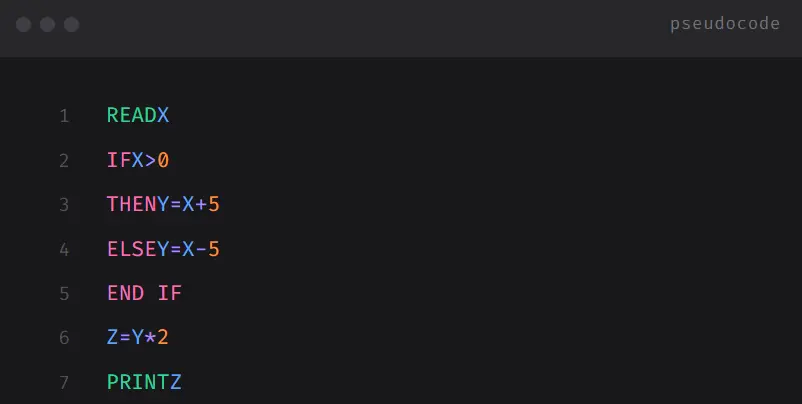
Take the block of code below as an example, from where we would create the control flow graph and then evaluate data flow testing.
The control flow graph of the above lines of code has been described below -
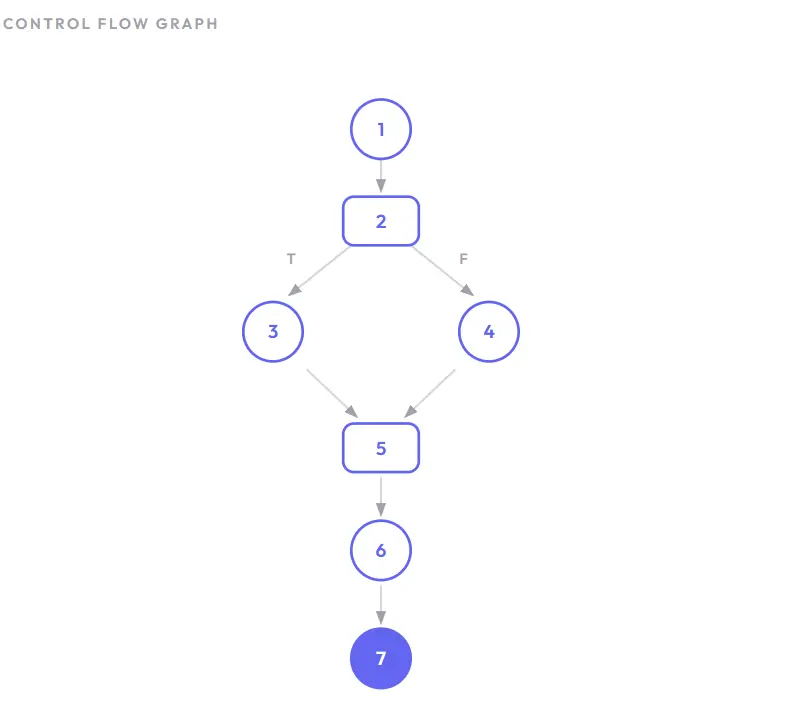
The use and definition of variables at the various nodes in the control flow graph for the above example are illustrated in the below table:
| Node | Statement | Defined (d) | Referenced (r) |
|---|---|---|---|
| 1 | READ X | X | None |
| 2 | IF X > 0 | None | X (p-use) |
| 3 | THEN Y = X + 5 | Y | X (c-use) |
| 4 | ELSE Y = X - 5 | Y | X (c-use) |
| 5 | END IF | None | None |
| 6 | Z = Y * 2 | Z | Y (c-use) |
| 7 | PRINT Z | None | Z (c-use) |
Reading the table against the anomalies above, no variable is referenced while undefined, none is defined twice without an intervening reference, and none is killed before use. The def-use pairs are X from Node 1 to Nodes 2, 3, and 4; Y from Nodes 3 and 4 to Node 6; and Z from Node 6 to Node 7.
From the above table, it is concluded that every variable (X, Y, and Z) has been properly defined before being used. Variable X is defined at Node 1 and used at Nodes 2, 3, and 4. Variable Y is defined at Nodes 3 and 4, and used at Node 6. Variable Z is defined at Node 6 and used at Node 7. This indicates there are no data flow anomalies in this program.
What Are the Data Flow Testing Strategies and Coverage Criteria?
The main data flow coverage criteria are All-Defs, All-C-Uses, All-P-Uses, All-Uses, and All-DU-Paths, ordered roughly from cheapest to most thorough.
You will see these called strategies in one book and coverage criteria in the next, and the distinction is not worth much: both name a rule that decides which def-use pairs your suite is obliged to exercise. The rule is what turns data flow testing from an idea into a finite list of test cases, and choosing one is a budget decision as much as a technical one.
The Core Criteria
Five criteria do almost all the work in practice. They come from the Rapps-Weyuker family, and they are listed here from cheapest to most demanding:
| Criterion | What It Requires | Relative Cost | Best For |
|---|---|---|---|
| All-Defs | Every definition reaches at least one of its uses | Lowest | A first pass, or legacy code with no data flow coverage at all |
| All-C-Uses | Every definition reaches all of its computational uses | Moderate | Finance, scientific, and billing code, where a wrong number is the failure |
| All-P-Uses | Every definition reaches all of its predicate uses | Moderate | Branch-heavy logic such as permissions, pricing rules, and feature flags |
| All-Uses | Every definition reaches every use, computational and predicate | High | The usual target for mid-complexity modules |
| All-DU-Paths | Every loop-free path from each definition to each of its uses | Highest, and can grow exponentially | Safety-critical modules where the cost is justified |
Two hybrids fill the gap in the middle. All-C-Uses/Some-P-Uses requires every computational use, falling back to a predicate use only for definitions that have no computational use at all, and All-P-Uses/Some-C-Uses is the mirror image. They exist so that a definition is never left untested just because it happens to be used only one way.
How the Criteria Stack Up
These are not independent options; they nest. Satisfying a stronger criterion automatically satisfies the weaker ones beneath it, which is the practical reason to know the hierarchy: you only measure and report the strongest one you meet.
- All-DU-Paths subsumes All-Uses. It demands every path between a definition and a use, where All-Uses is satisfied by any one path per pair.
- All-Uses subsumes All-C-Uses and All-P-Uses. It is simply both of them at once.
- All-Uses subsumes All-Defs. Every definition reaching every use certainly reaches one.
The jump worth watching is the last one. All-DU-Paths sounds like the obvious goal until you meet a loop, where the number of paths can explode combinatorially, which is why it is restricted to loop-free paths and reserved for code that earns the expense. All-Uses is where most teams land.
Targeting Specific Variables
The criteria above treat every variable as equal. These approaches do not, and none of them is a formal criterion. They are risk lenses for when full coverage is not affordable:
- Definition-Use Pair Testing: Isolates specific def-use pairs as individual test cases, chosen for high-risk variables flagged in code review. Effectively a risk-based subset of All-Uses, and the honest choice when the full criterion is out of budget.
- All-I-Uses and All-O-Uses: Slice by where a variable comes from or goes: values arriving from external inputs like forms, APIs, or databases, and values contributing to outputs like UI displays, API responses, or reports. Useful for prioritising the boundaries of your system, which is where untrusted data and visible failures live.
- Use-Definition Path Testing: Works backward, from where a variable is used to where it was defined. This is not a coverage criterion at all but a debugging technique, closer to backward slicing, and it is what you reach for when the output is wrong and you need the root cause.
Key Takeaway: Strategies and coverage criteria are the same idea under two names: a rule fixing which def-use pairs you must test. All-Defs is the cheapest and All-DU-Paths the most exhaustive, with All-Uses the usual landing spot. They nest, so meeting a stronger one means meeting the weaker ones for free. Where full coverage is unaffordable, target by risk instead.
What Are the Advantages of Data Flow Testing?
Data flow testing goes beyond surface-level code inspection, helping uncover critical issues that impact software reliability and performance.
- Detecting Unused Variables: DFT identifies variables that are declared but never used. These clutter the code, reduce readability, and may signal design errors. Flagging them keeps the codebase clean and efficient.
- Uncovering Undeclared Variables: It catches cases where variables are used without proper declaration, a fundamental violation that can lead to runtime errors and ambiguity.
- Managing Variable Redefinition: DFT spots variables defined multiple times before being used, reducing confusion and subtle bugs while promoting code clarity.
- Preventing Premature Deallocation: It ensures variables aren't released from memory before being fully utilized, preventing memory access violations and unpredictable behavior.
Key Takeaway: Data flow testing catches unused variables, undeclared references, redundant definitions, and premature memory deallocation, all issues that surface-level testing typically misses.
What Are the Disadvantages of Data Flow Testing?
Data flow testing is time-consuming and costly, needs strong programming knowledge, covers only data flow rather than functionality, and grows complex in large systems.
- Time-Consuming and Costly: Examining data flow paths, creating test cases, performing test execution, and debugging results demands significant time and resources, which can strain tight budgets and deadlines.
- Requires Programming Proficiency: Testers need deep knowledge of the programming language being tested, including variable declarations, assignments, and usage patterns. This can be a barrier when testers lack domain expertise.
- Limited Scope: DFT focuses strictly on data flow and doesn't cover functional correctness, UI testing, or performance. It works best when combined with other testing techniques.
- Complexity in Large Systems: As software grows, the number of possible data flow paths can become overwhelming, which makes it impractical to achieve full test coverage.
Key Takeaway: Data flow testing can be time-consuming, requires strong programming knowledge, has a limited scope beyond data flow, and becomes impractical in large systems with too many possible paths.
How Does Control Flow Testing Differ From Data Flow Testing?
When testing software, two common white-box techniques are Control Flow Testing (CFT) and Data Flow Testing (DFT). Both analyze the internal structure of code, but they focus on different things.
Here's a clear breakdown.
Control Flow Testing
Control Flow Testing focuses on the execution paths of a program.
It checks:
- Which statements are executed
- Which branches (if/else, switch) are taken
- How loops behave
- Whether all possible paths are covered
The goal is to ensure that every logical path in the code works correctly.
It is based on the Control Flow Graph (CFG), where:
- Nodes = statements or blocks
- Edges = flow of control
Data Flow Testing Defined
Data Flow Testing focuses on how data moves through the program.
It checks:
- Where variables are defined
- Where they are used
- Whether variables are used before being initialized
- Whether unused variables exist
The goal is to ensure that data is handled correctly throughout execution.
Data Flow Testing vs Control Flow Testing (Key Differences)
| Aspect | Data Flow Testing (DFT) | Control Flow Testing (CFT) |
|---|---|---|
| Focus | Variable definition and usage | Execution paths and decisions |
| Based On | Definition-Use Chains | Control Flow Graph (CFG) |
| Detects | Uninitialized or unused variables | Logical errors, missing branches |
| Concern | How data moves through code | How code executes |
| Test Coverage | Def-use coverage | Path and branch coverage |
Key takeaway: Control flow testing checks which execution paths your code takes while Data flow testing checks how variables behave along those paths. One tracks logic flow, the other tracks data movement.
Where Is Data Flow Testing Used in Software Engineering?
Data flow testing has a reputation for being academic, which is odd given that you have almost certainly benefited from it today. It runs inside the compiler you build with and the analyzer in your pull request pipeline. These are the places the technique actually earns its keep.
Safety-Critical Systems
In avionics, medical devices, automotive, and industrial control software, a ur-anomaly is not a code smell. It is a hazard. Reading an uninitialized variable in C yields whatever was in that memory, so a value can be plausible in testing and lethal in the field, and the failure will not reproduce. This is why coding standards for these domains ban the pattern outright rather than discouraging it. MISRA C:2012 Rule 9.1 requires that an object with automatic storage duration is not read before it has been set, which is a ur-anomaly prohibition stated in different words. Compliance is demonstrated by data flow analysis across the codebase, not by hoping a test happens to hit the path.
Compiler Optimization
Optimizing compilers are built on data flow analysis. Dead store elimination removes an assignment whose value is never read, which is a compiler deleting a dd-anomaly for you. Constant propagation substitutes a known value at its uses by following definitions forward. Liveness analysis determines which variables are still needed at each point so registers can be reused.
Most modern compilers, including LLVM and GCC, first convert code into Static Single Assignment (SSA) form, where every variable is assigned exactly once and later assignments become new versions. That property makes def-use chains explicit rather than something you have to reconstruct, so each use points at exactly one definition. It is the same reasoning as data flow testing, applied for speed instead of correctness.
Security Vulnerability Detection and Taint Analysis
Taint analysis is data flow analysis pointed at security. It marks data from untrusted sources as tainted, follows it along def-use chains, and reports when it reaches a sensitive sink without passing through a sanitizer. A request parameter concatenated into a SQL query is SQL injection; the same string written to the DOM is cross-site scripting. In both cases the vulnerability is not a bad line of code but a path between two of them, which is exactly what def-use chains describe and why grep cannot find these.
This is what FlowDroid, mentioned earlier as a def-use tool, actually does: it performs taint analysis on Android applications to determine whether private data reaches a network call.
Automated Static Code Analysis
The everyday application is the static code analysis in your CI pipeline. When SonarQube reports a dead store, or a compiler warns that a variable may be used uninitialized, that is data flow analysis reporting a dd- or ur-anomaly under a friendlier name. Wiring these into pull requests catches the cheap anomalies automatically, which is what makes manual data flow testing affordable: you reserve the expensive path analysis for the modules that warrant it rather than spending it on problems a tool finds for free.
Key Takeaway: Data flow testing shows up in safety-critical standards such as MISRA C, in compiler optimizations like dead store elimination and SSA form, in taint analysis for SQL injection and XSS detection, and in the static analyzers already running in most CI pipelines.
How Is AI Changing Data Flow Testing?
AI is changing data flow testing by tracing variable definitions and uses across large codebases, flagging likely anomalies, and proposing inputs for uncovered def-use paths.
Static analysis tools already find many data flow anomalies automatically. AI adds reasoning about intent: it can explain why a variable is redefined before use, suggest whether that is a bug, and generate a test that proves it.
Treat AI findings as leads, not verdicts: confirm each reported anomaly against the code and requirements, because models can misread framework conventions and flag correct code.
How Do You Run Data Flow Testing With TestMu AI?
To ensure that data flow is seamless and robust, testing scenarios must encompass a wide range of data conditions. This is where synthetic test data generation comes into play, offering a controlled and comprehensive way to assess the software's performance under various data conditions.
To enhance DFT, consider leveraging synthetic test data generation with TestMu AI's integration with the GenRocket platform. This integration offers a potent approach to simulate diverse data scenarios and execute comprehensive tests, ensuring robust software performance.

Austin Siewert
Co-Founder, Steadfast Systems
Discovered @TestMu AI yesterday. Best browser testing tool I've found for my use case. Great pricing model for the limited testing I do 👏
2M+ Devs and QAs rely on TestMu AI
Deliver immersive digital experiences with Next-Generation Mobile Apps and Cross Browser Testing Cloud

Author

Deepak Sharma
Blogs: 15

Deepak Sharma is a B2B SaaS content strategist with 5+ years of experience creating valuable content in the tech space. He has authored 100+ technical articles. At TestMu, he is a content lead, where he develops high-value content for readers. He believes writing isn't about sounding impressive it's about clarity and structure. He holds certifications in Cypress, Appium, Playwright, Selenium, Automation Testing and Kane AI.
Reviewer

Saurabh Prakash
Reviewer
Saurabh Prakash is an Engineering Manager at TestMu AI (formerly LambdaTest), where he leads engineering on agentic AI development and scalable system architecture for the quality engineering platform. He has also contributed to Test at Scale, the company's open-source test intelligence platform. He brings over 9 years of experience across Node.js, Java, Spring, MVC, data structures, algorithms, and scalable system design, with earlier roles as SDE 2 at Zomato, Senior Software Engineer at LogicHub, and Software Development Engineer at Directi. Saurabh holds a B.Tech in Computer Science and Engineering from Delhi Technological University.


Data Flow Testing FAQs
Did you find this page helpful?
More Related Learning Hubs
TestMu AI forEnterprise
Get access to solutions built on Enterprise
grade security, privacy, & compliance
- Advanced access controls
- Advanced data retention rules
- Advanced Local Testing
- Premium Support options
- Early access to beta features
- Private Slack Channel
- Unlimited Manual Accessibility DevTools Tests