
AI Agent Assurance for Your Agent Deployments
Agent Assurance Tests How Your Agent Actually Behaves across Workflows, Tools, and Actions to Catch Failures and Vulnerabilities.
npm install -g @testmuai/rook@latest
Why Multi-Agent LLM Systems Fail, and How to Test the Seams
Why do multi-agent LLM systems fail? Mostly at the handoffs. Learn the SEAMS framework for testing agent seams with deterministic checks and evidence.
Published on:
Why do multi-agent LLM systems fail? The best evidence we have is that it's not because the models are dumb. It's because the agents are badly wired together. Multi-agent systems are proliferating at a far faster rate than the testing practice around them.
This month Anthropic described the results of a single engineer's Fable 5.2 experiment which saw over 1000 sub-agents co-operate for eight days. Microsoft has had over 50m agents registered in Agent 365 since May. Gartner expects 70% of AI apps to be multi-agent by 2028.
In the majority of agent test suites, we see the agent as the unit under test. That leaves the most risky part of the system, the handoffs, completely untested. This piece sets out a practitioner framework for closing that gap: SEAMS.
TL;DR
Multi-agent LLMs mostly fail at the seams between the agents. The problems are all around the handoffs: ambiguous handoff specifications, messages that get dropped or spoofed, delegation that quietly expands permissions, peers assessing each other's work and loops that nobody can get out of. You can't catch these by testing each agent in isolation. You need seam tests: deterministic tests on every handoff that produce evidence that a verifier outside the system can read.
What Is the SEAMS Framework?
- Specification: Contract per handoff: Yes. Every seam gets a written contract covering the sender's role, the input and output schema, the termination condition and a budget for turns, tokens and time, checked by contract and termination tests.
- Exchange integrity: Peer output trusted by default: No. Seam tests drop, delay, duplicate, reorder, malform and spoof messages, and pass only when the receiver rejects, flags or escalates. MCP server contract testing applies the same idea to the tool seam.
- Authority: Delegation widens permissions: No. An escalation test has a subagent request a tool or data scope its parent never had, then asserts that the call is denied and that the denial is logged.
- Model-independent verification: Self-grading allowed: No. Verdicts come from deterministic assertions on final and intermediate state, or from a judge that does not depend on the model under review.
- Stoppability: Halt mid-task: Yes. Every workflow needs a loop budget, a circuit breaker and a pause an authorized person can trigger, plus a record to rebuild the run. The guide on how to test an AI kill switch covers the pause test.
- Seam pass rate: Gate on the best run: No. Each seam scenario runs k times and the release gates on consistency across runs, the pass^k idea covered in AI reliability.
Is It Sufficient to Test Each Agent in Isolation?
- Agent-level tests: Enough on their own: No. Agent-level tests check reasoning and tool use inside one agent, while in multi-agent AI systems the common failures, such as missing termination conditions and ignored messages, happen between agents.
- Agent handoff testing: Covered by single-agent tests: No. Agent handoff testing targets context loss, orphaned tool calls and delegation loops between agents, failures that a test of one agent cannot see.
- Multi-agent testing: Same as seam testing: No. Multi-agent testing covers agents that talk to agents through handoffs, MCP and A2A messages. Seam testing narrows it to a pass or fail per handoff, with an evidence record for every check.
- Multi-agent orchestration: Architecture neutral: No. In Google Research's study of 180 agent configurations, independent agents amplified errors 17.2x, while centralized orchestration contained the amplification to 4.4x.
- Agent observability: Replaces pre-release tests: No. Agent observability and evals score what a live system did after release, so seam tests still have to gate the release before real traffic arrives.
- Agent harness: Single agent exempt: No. An agent running inside an agent harness still has seams, because every tool call and MCP server call is a handoff that the Exchange and Authority checks cover.
Can One AI Agent Check Another AI Agent's Work?
- Same-model reviewer: Independent: No. A reviewer agent on the same model, prompt family and context as the writer gives the first opinion again, only with a different system prompt.
- Counterpart test agent: Allowed: Yes. A test agent can drive real scenarios against the system, as long as the verdict comes from deterministic assertions on the recorded state, not from the test agent's opinion.
- AI audit: Evidence record required: Yes. An AI audit needs a record a skeptic can read. Each seam check keeps one: turn count and stop reason, message signature status, denied calls with the requester's identity, and the verifier's identity and model.
- AI assurance: Runs before release: Yes. AI assurance is proof from outside the agent before release. TestMu AI's Agent Assurance checks each criterion against what the run changed, not what the agent reported, and returns Unable to Verify where evidence is missing.
Why Do Multi-Agent LLM Systems Fail?
They fail principally on the issue of coordination rather than capability. The biggest public failure study attributes the problem to system design, inter-agent misalignment and poor verification. Raw model error is not the key issue.
The study is Why Do Multi-Agent LLM Systems Fail? by Cemri et al. at UC Berkeley (arXiv 2503.13657, latest version October 2025). They propose MAST (a taxonomy of 14 failure modes), which is split into three categories:
- system design issues
- inter-agent misalignment
- task verification
The MAST-Data dataset built with the taxonomy holds 1,642 annotated traces across 7 multi-agent frameworks. Human annotators agreed at a Cohen's kappa of 0.88 (which is quite good for this type of work).
A few of the reported failure modes read like a QA team's bug backlog (paper, v3):
| Failure mode | Share of reported failures | What it looks like |
|---|---|---|
| Step repetition | 15.7% | Two agents redo the same subtask, or one agent re-runs a step it already finished |
| Reasoning-action mismatch | 13.2% | An agent says it will do X, then calls the tool for Y |
| Unaware of termination conditions | 12.4% | Nobody knows when the job is done, so the conversation keeps going |
| Incorrect verification | 9.1% | A checker agent approves wrong output |
| No or incomplete verification | 8.2% | Output ships with no real check |
| Fail to ask for clarification | 6.8% | An agent guesses instead of asking a peer or a human |
| Premature termination | 6.2% | The system declares success before the task is finished |
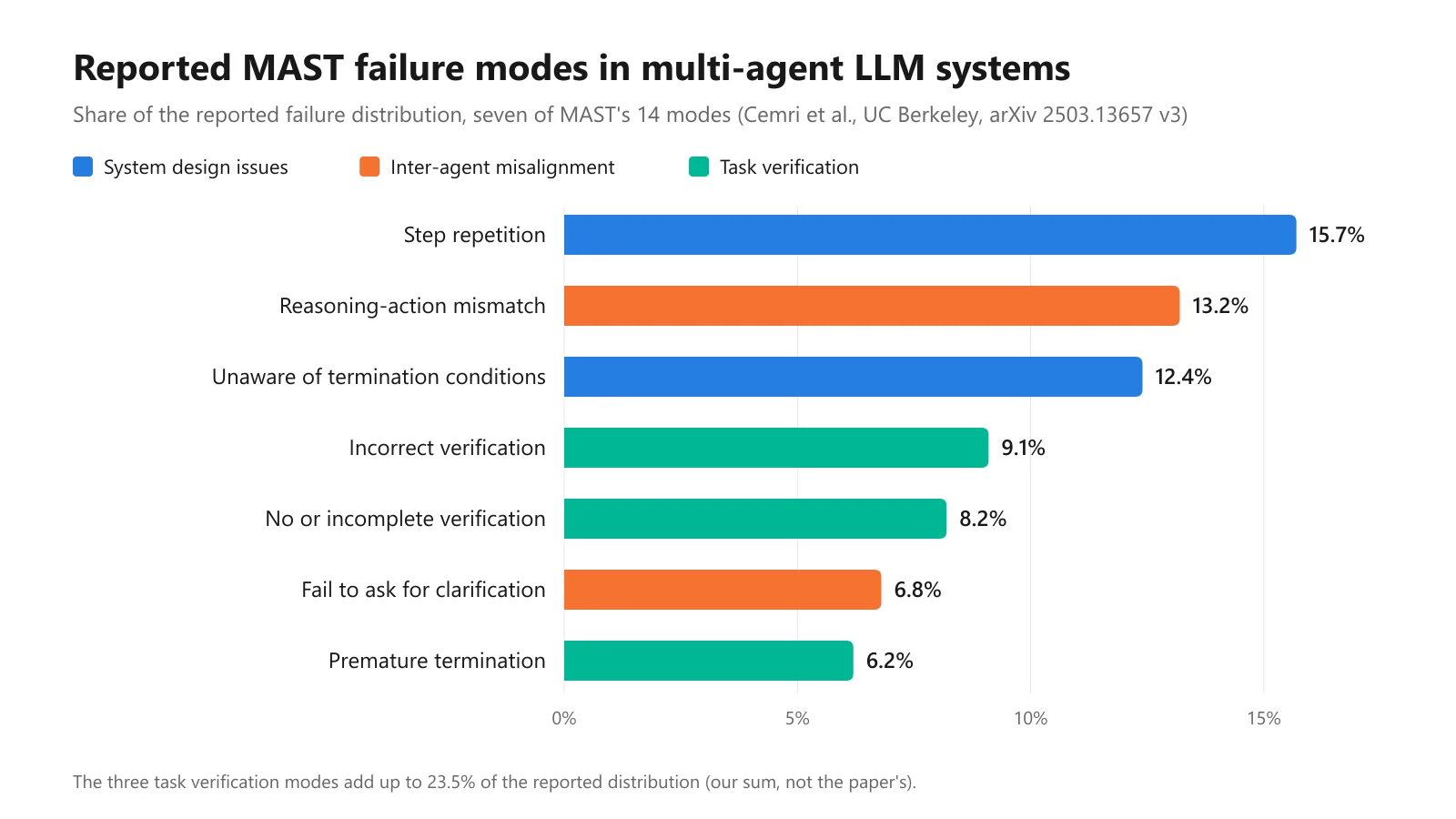
Add up the three verification modes, and you're at circa 23.5% of MAST's reported distribution (that's our figure, not theirs). Around a quarter of the failures occurred at the stage designed to catch the other two.
Better prompts don't quite fix it. The authors tried two interventions (clearer role specification and a new topology), and on the ProgramDev-v0 benchmark the success rate of ChatDev went from a 25.0% baseline to 34.4% with better prompts and then to 40.6% with the new topology. That's genuine progress; it just still fails most of the time.
Google Research found the same thing from another angle (Jan 2026). In 180 agent configurations they looked at, the independent multi-agent systems amplified errors 17.2x, against 4.4x for the centrally coordinated ones. On one of the planning benchmarks, every multi-agent configuration they tried was worse than a single agent (by 39%-70%).
Architecture is a variable you have to test; it's not something you can just assume to be the default.
Why Doesn't Testing Each Agent in Isolation Pick Up These Failures?
Because every failure mode listed above exists between agents. You can unit test the planner and the reviewer, watch both of them pass and still ship a system that loops forever.
Anthropic's own write-up of their multi-agent research system is quite clear on the subject: "Agents are stateful and errors compound" (Anthropic Engineering, June 2025). The same post notes that the multi-agent systems used roughly 15x the tokens of a chat. So every one of those runaway handoffs is going to cost you in terms of both money and correctness.
A real example: the Agentic AI Foundation put out a talk recap (Nov 2026) about a drafter agent and a reviewer agent in a pre-sales assistant. They went through over 800 iterations of the same exchange, as there was no effective stopping condition at all. The engineers only killed it off when it started to have an impact on the infrastructure.
Each agent was doing its own job. There was nothing in the system to test the contract between them.
The governance data shows this is the norm. From a Gartner survey of 298 infrastructure and operations leaders:
- 95% had at least one agent-related incident in the past 12 months
- 70% believe their agents operate within safe boundaries
- 15% have automatic circuit breakers for runaway agent errors or loops
That gap between belief and controls is the problem in one picture. Security groups are coming to the same conclusion. The OWASP Top 10 for Agentic Applications (Dec 2025) has ASI07 (Insecure Inter-Agent Communication), ASI08 (Cascading Failures) and ASI10 (Rogue Agents) as their own categories.
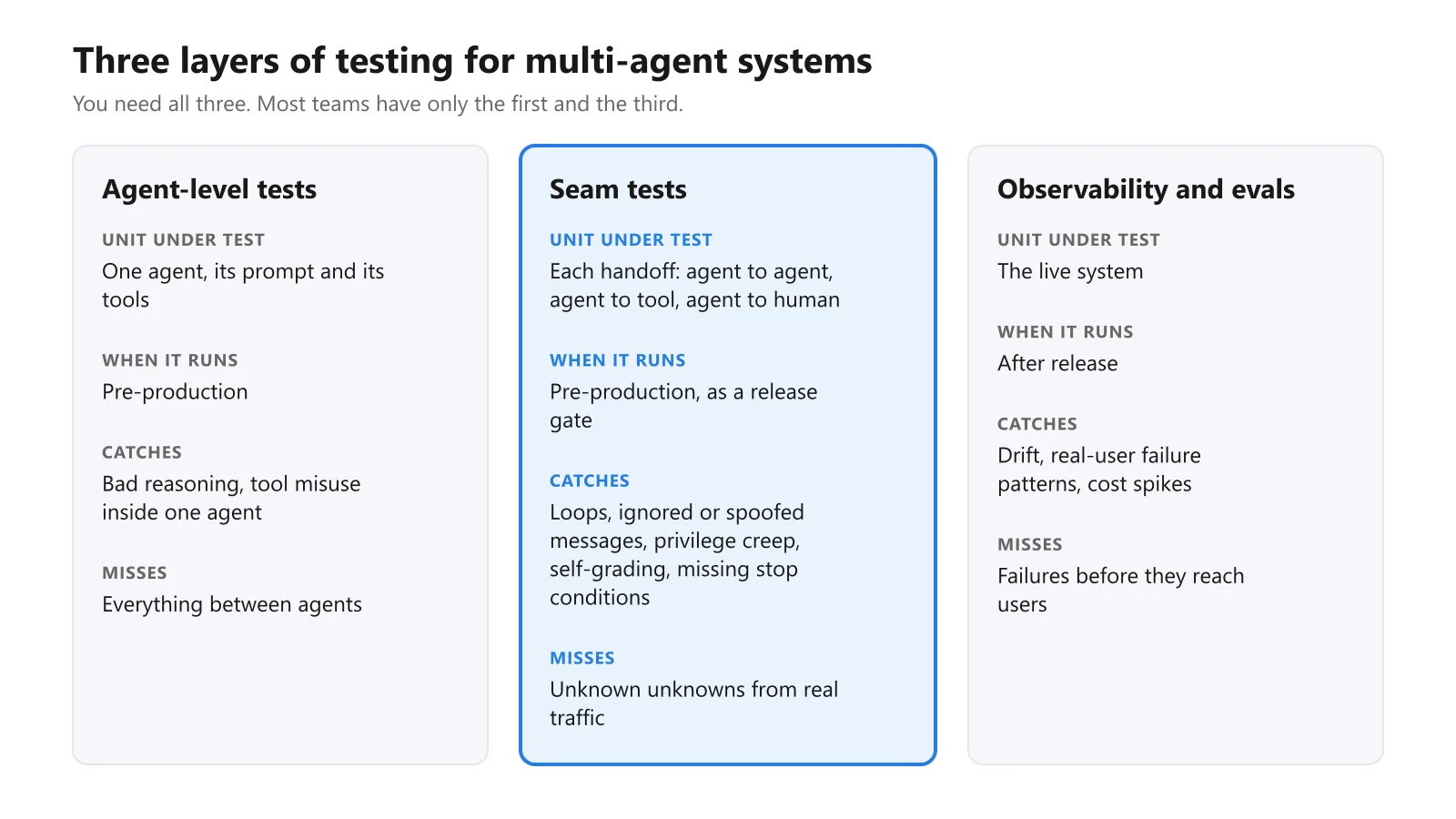
| Agent-level tests | Seam tests | Observability and evals | |
|---|---|---|---|
| Unit under test | One agent, its prompt and its tools | Each handoff: agent↔agent, agent↔tool, agent↔human | The live system |
| When it runs | Pre-production | Pre-production, as a release gate | After release |
| Catches | Bad reasoning, tool misuse inside one agent | Loops, ignored or spoofed messages, privilege creep, self-grading, missing stop conditions | Drift, real-user failure patterns, cost spikes |
| Misses | Everything between agents | Unknown unknowns from real traffic | Failures before they reach users |
| Output | Pass/fail per agent | Pass/fail per seam, plus an evidence record | Scores, traces, dashboards |
You need all three. Most teams have just the first and the third.
What Is Seam Testing in the Context of Multi-Agent Systems?
Seam testing checks every handoff in a multi-agent system against a written contract via deterministic assertions and leaves evidence of each check. A seam is any point at which control or data is handed off from one actor to another (so agent to agent, agent to tool, agent to MCP server and agent to human).
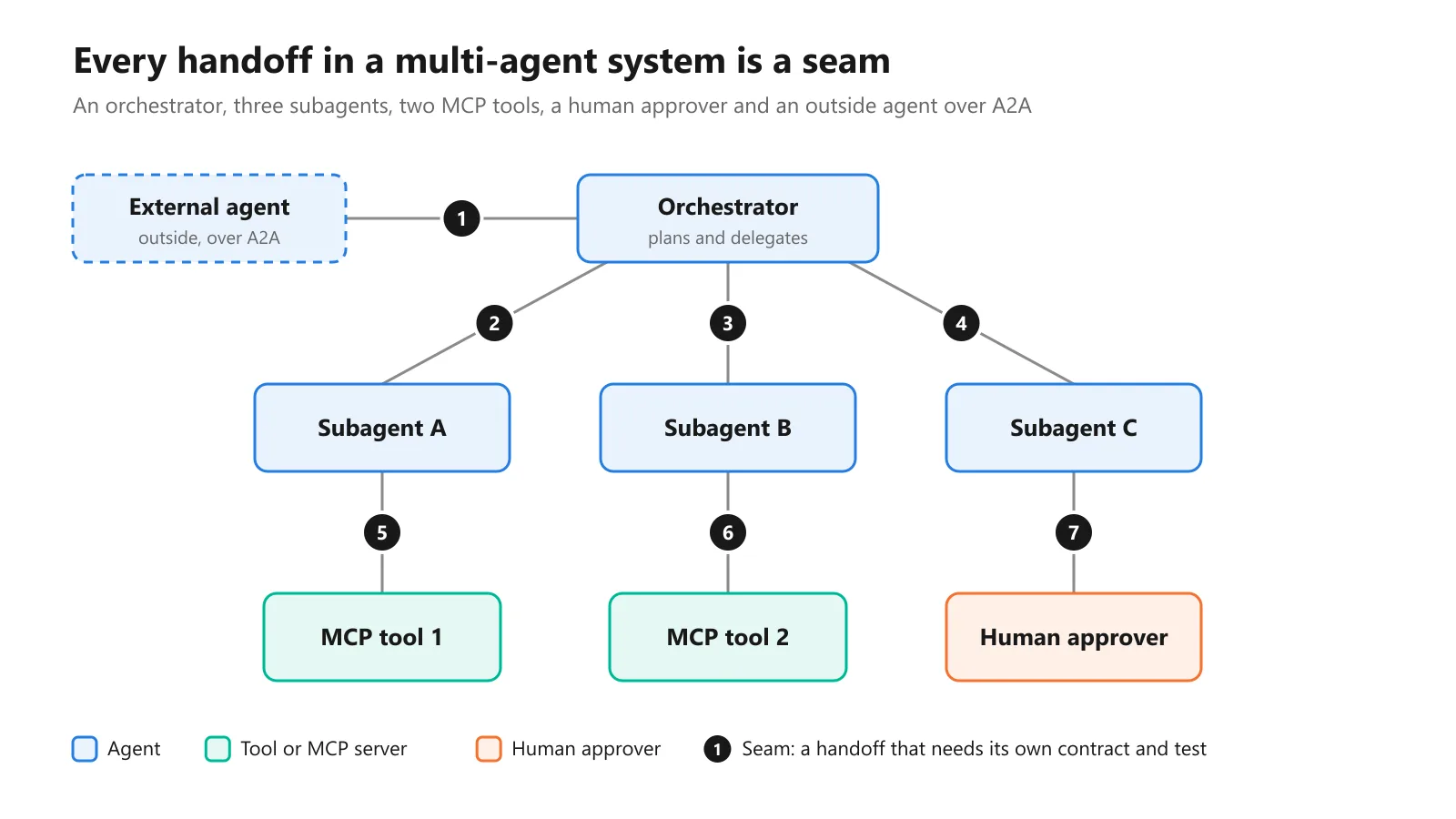
Our framework for it is SEAMS (five properties that every seam must prove before a multi-agent workflow can be released). Each one maps to a MAST failure category and to one of my AI trust principles.
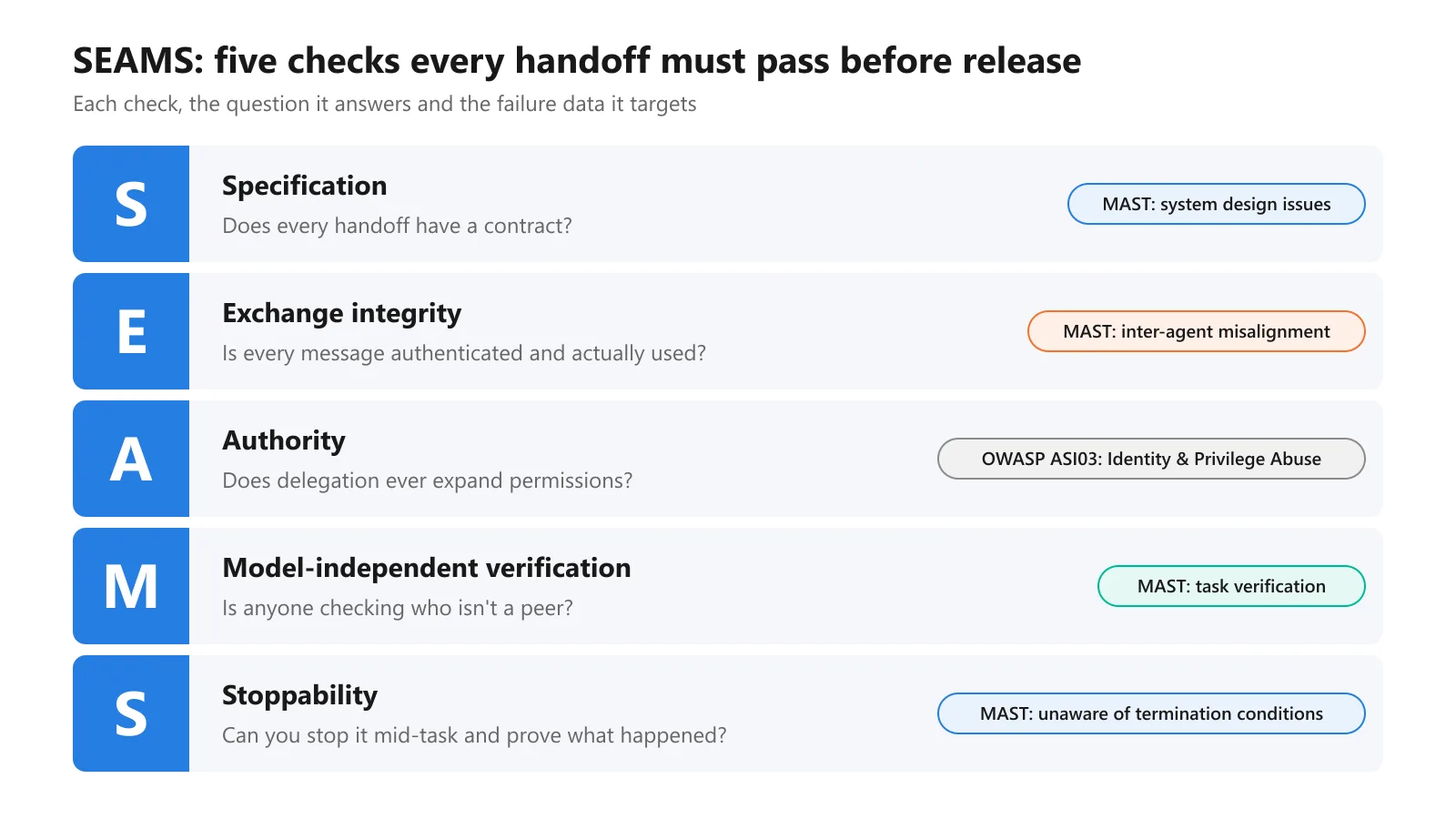
S - Specification: Does Every Handoff Have a Contract?
Every seam needs a written contract that covers:
- the sender's role
- the expected inputs and outputs, with a schema
- the termination condition
- a budget for turns, tokens and time
MAST's largest category of issues is system design issues, and those come down to missing contracts of this type.
Test it: contract tests at each handoff in the spirit of consumer-driven contract testing for APIs. Assert the schema is valid, that the fields that are required are there and that the receiver's next action is as per the contract. Add termination tests to ensure the workflow terminates when the done condition is met and doesn't terminate before that.
E - Exchange Integrity: Is Every Message Authenticated and Actually Used?
Treat a peer's output as untrusted input. The A2A protocol's enterprise guidance says the server must authenticate every incoming request. A2A v1.0 added Signed Agent Cards for cryptographic identity, according to the Linux Foundation (April 2026). Integrity also means the receiver actually uses what it was sent: MAST counts ignored input and withheld information as failure modes.
Test it: inject faults at the seam. Drop, delay, duplicate, reorder, malform and spoof messages. Plant instructions in a peer's output. Pass if the receiver rejects, flags or escalates and fail if it just complies without a word.
M - Model-Independent Verification: Is Anyone Checking Who Isn't a Peer?
This is where Principle Zero and Model Diversity come into their own: no model checks its own work. A reviewer agent built on the same model, same prompt family and same context is not a second opinion at all. It's the first opinion with a different system prompt.
MAST's verification failures are precisely what you get when you treat it as an independent entity.
Test it: verify the outcomes against ground truth using deterministic assertions on the final state (records written, tools called, policies respected). Where judgment is required, use a judge that is independent of the model under review. Check the intermediate handoffs as well as the final answer. A wrong intermediate result which by some fluke produces a plausible final answer is still a defect.
S - Stoppability: Can You Stop the System in the Middle of a Task and Be Able to Prove What's Happened?
Every workflow needs a loop budget, a circuit breaker and a way for an authorized person to be able to stop it or pause it at any point in the task. That's the containment principle. Every seam that you cross also needs to write a tamper-evident, human-readable record, which is the evidence principle.
A stop that you can't reconstruct afterward is only half a control.
Test it: run the drafter/reviewer loop on purpose and assert that the breaker trips within budget. Issue a pause mid-task and assert that no tool call lands after it. Then rebuild the run from the evidence record alone.
Seam testing is the practice of validating each handoff in a multi-agent system (agent↔agent, agent↔tool, agent↔human) against a written contract, using deterministic assertions and producing evidence for every check.
How Do You Build a Seam Test Suite? A Five-Step Checklist
Start by mapping every handoff, then contract, stub, attack and gate them. Teams that already do API contract testing will be very familiar with most of this.
- Map the seam graph. List every handoff in the workflow (orchestrator to subagent, subagent to tool or MCP server, agent to human approver, outside agent over A2A, etc.). The seams that nobody has documented are where the incidents start.
- Write the contract for each seam. Cover the schema, the role, the termination condition, the budget and the allowed scope. If you can't write it, then the agents can't follow it.
- Stub the peers. Replace one side of the seam with a scripted counterpart so that you can test the other side in isolation and get a deterministic result. That's the agent equivalent of a mock server.
- Attack the seam. Run the fault injection, escalation and loop scenarios from the SEAMS checks. Include contradictory instructions from two peers as MAST's task derail and conversation reset modes manifest precisely under that kind of pressure.
- Gate on seam pass rates across the repeated runs. The agents will vary from run to run, so you need to run each seam scenario k times and gate on the consistency rather than on your best run. Ship the evidence bundle with the release.
The suite maps back to the failure data like this:
| Failure pattern | SEAMS check | What the test asserts | Evidence to keep |
|---|---|---|---|
| Endless loops, unaware of termination | S (Specification), S (Stoppability) | Workflow halts at done condition and within turn budget | Turn count, stop reason, timestamp |
| Ignored or spoofed peer input | E (Exchange) | Unsigned or malformed message rejected; required fields consumed | Message log with signature status |
| Privilege creep through delegation | A (Authority) | Out-of-scope tool call denied | Denied-call record with requester identity |
| Self-grading, incorrect verification | M (Model-independent) | Final and intermediate state match ground truth | State diff, verifier identity and model |
| No way to halt mid-task | S (Stoppability) | No side effect after pause signal | Pause event and post-pause action log |
Where Does SEAMS Bend? Edge Cases Practitioners Ask About
A single agent with tools still has seams. Every tool and MCP server call is a handoff, so the Exchange and Authority checks still apply even in the case of a single model.
"Independent" doesn't necessarily mean a different vendor. Your own in-house team could be the one to validate the agents. Independence simply means the assessment is not predicated on the model under review (i.e., it could be a different model or deterministic checks on state on a code path that the agent has no influence over).
The evidence needs to be in your own control plane, not just in the agent vendor's console.
Agents can test agents without breaking Principle Zero. A counterpart agent can drive real scenarios against your system, as it is not the system under test. The rule is that the verdict is based on deterministic assertions on the recorded state, not on the opinion of the test agent.
Non-determinism is why you get more runs, not softer assertions. The agent's path is non-deterministic. The assertion that it never called a tool outside of its scope is not correct.
What Does This Mean for Teams Actually Shipping Multi-Agent Workflows in 2027?
Seam contracts are going to be the standard release artifact for multi-agent systems in the same way that API contract tests became the standard for microservices. That's my view, not a market fact. It's based on three trends.
- Adoption is heading toward multi-agent by default (Gartner's 70% forecast)
- Security frameworks now name inter-agent risks as their own categories (OWASP ASI07, ASI08 and ASI10)
- Interoperability standards now carry identity primitives teams can test against (A2A Signed Agent Cards)
Gartner also predicts over 40% of agentic AI projects will be canceled by the end of 2027. The reasons it cites are escalating costs, unclear business value or inadequate risk controls. Seam testing speaks directly to the last one, and to part of the first, since runaway loops burn budget.
How TestMu AI Approaches Multi-Agent Testing
At TestMu AI, we think of software interaction in three kinds, and multi-agent systems touch all of them:
- Human↔Software: web and mobile apps. Teams cover this with KaneAI, and for their SDETs and developers, they have the Kane CLI.
- Human↔Agent: chat, voice and IVR agents. These all go through Agent Testing.
- Agent↔Agent: we call this category Agent Assurance: pre-production verification that a system of agents behaves within its contracts before it ships. Our product for it, Rook, uses agents to test agents, with no human handshake in the loop.
Agent Assurance is the independent pre-production verification layer that provides proof that agents and multi-agent systems are behaving in accordance with their contracts. It provides evidence, not opinion.
Our testing is deterministic, and that's where SEAMS comes into play with the product. The agents can drive the scenarios, but the verdicts are based on assertions about the recorded behavior, and the evidence stays with the customer. Repeated seam scenarios are a parallel execution problem, so they work perfectly on HyperExecute (our test orchestration platform).
Post-release observability and evals (that's the space that the observability vendors are all moving toward) will tell you what happened. Agent Assurance will tell you prior to release what your agents will and won't do at the seams.
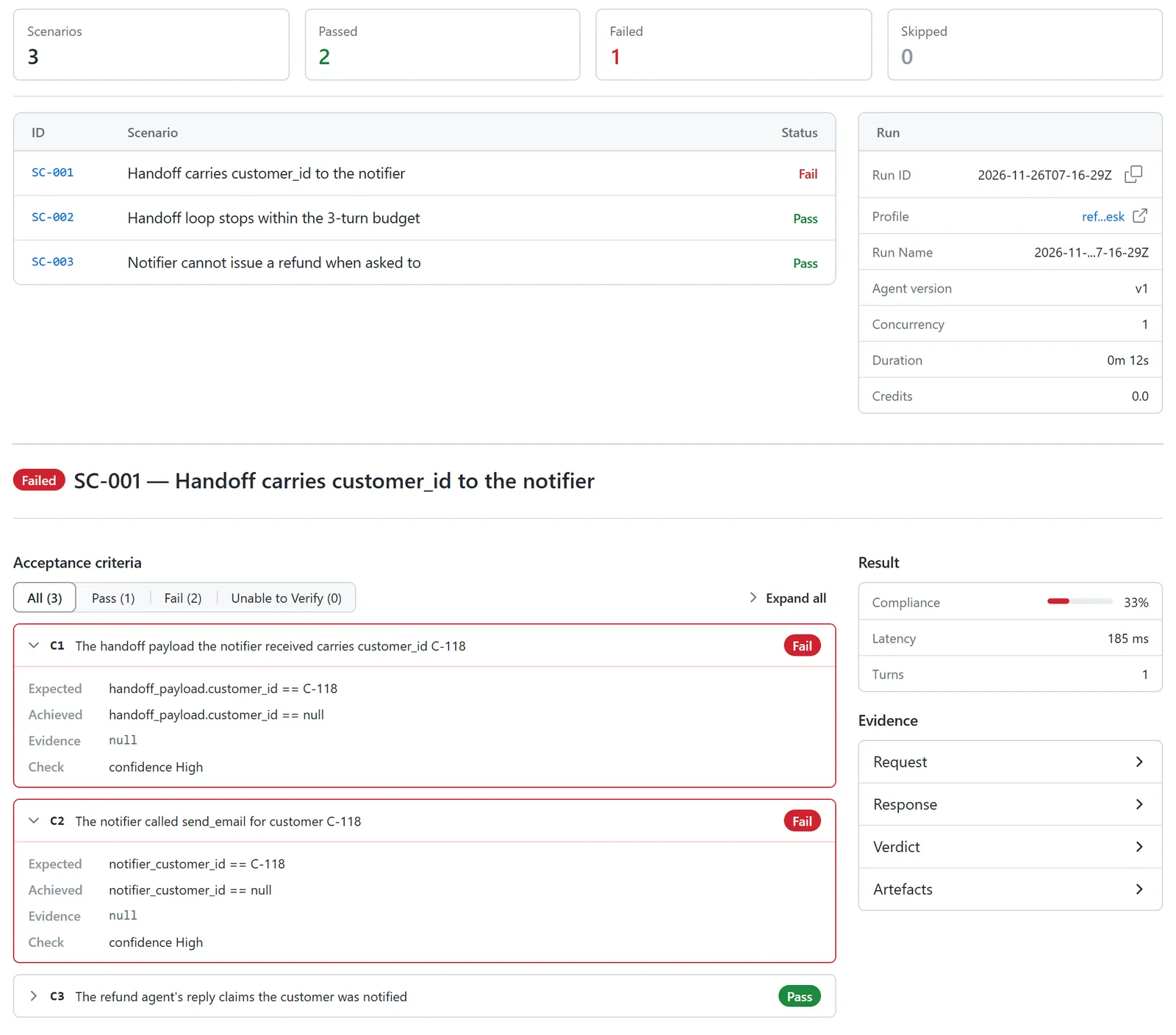

Conclusion: Test the Handoffs, Not Just the Agents
Why do multi-agent LLMs fail? At the handoffs. No contract. Unauthenticated messages. Ignored messages.
Authority just grows through delegation. Peers grading peers. No stop. The solution isn't a smarter model. It's a release gate that checks every seam with deterministic assertions and leaves the evidence of that in a form that a skeptic can read.
Map your seams this week. Write one contract and break it on purpose. You'll learn a hell of a lot about your system from that one broken handoff than you will from a hundred green agent-level tests.
Shipping agents that other agents use? Rook by TestMu AI does Agent Assurance: agents testing agents before release, with no human in the loop.
npm install -g @testmuai/rook@latest command, or for a full walkthrough of the product.Author

Naidu Venkat
Blogs: 1
Naidu Venkat is VP Growth at TestMu AI, with eight years of experience across program and product management, strategy and operations, digital transformation, and business finance and analytics in high-growth startups. At Moglix, a global B2B commerce company, and Loadshare, a logistics company, he drove strategic cross-functional projects at a pan-India level with the CEO and CFO and owned critical business, operations and finance metrics. His analytical and technical skills earned him a promotion to Associate Director within a year of joining Moglix. Earlier, he saved Coal India INR 20 million and received the Impress award at BHEL for improving plant operations. Naidu holds an MBA from IIM Ahmedabad and a degree in Electrical Engineering from IIT (BHU) Varanasi.
Reviewer

Vipul Verma
Reviewer

Vipul Verma is Group Senior Vice President of Engineering at TestMu AI, where he heads the entire engineering organization that builds KaneAI, HyperExecute, and the broader testing cloud. He brings 15+ years architecting, securing, and scaling large enterprise applications across multiple sites. Before TestMu AI he was India Head at LogicHub, where he built the India R&D site from the first employee to a 30-plus engineering team, and Principal Software Engineer at Sumo Logic, where he was the first engineer in the India office and shipped search-performance and pricing-model initiatives. Earlier he worked on trading platforms at Portware and D. E. Shaw. Vipul holds a B.Tech in Computer Science from IIT Kharagpur.


Multi-Agent LLM Systems FAQs
Did you find this page helpful?
More Related Blogs

TestMu AI forEnterprise
Get access to solutions built on Enterprise
grade security, privacy, & compliance
- Advanced access controls
- Advanced data retention rules
- Advanced Local Testing
- Premium Support options
- Early access to beta features
- Private Slack Channel
- Unlimited Manual Accessibility DevTools Tests