

Power Your Software Testing with AI Agents and Cloud
The Native AI-Agentic Cloud Platform to Supercharge Quality Engineering. Test Intelligently and Ship Faster.


- TestMu AI (Formerly LambdaTest)
- /
- Blog
- /
- 9 Best testRigor Alternatives for 2026
9 Best testRigor Alternatives for 2026
A hands-on comparison of nine testRigor alternatives, judged on authoring model, maintenance behaviour, coverage breadth and what it costs to leave.
Published on:
Key Takeaways
testRigor is a generative-AI test automation tool that authors tests in plain English across web, mobile, desktop and API. Nine alternatives replace some part of what it does, and they split into natural-language authoring platforms, codeless and low-code platforms, an open-source agent-driven platform, and a code-first framework.
- Free tier: testRigor requires that all tests and test results are public open source, which rules it out for teams testing unreleased features or anything under NDA.
- Pricing model: testRigor bills for parallel-execution infrastructure rather than seats or executions, so adding users costs nothing while adding CI concurrency is what drives the bill up.
- Coverage limits: testRigor states in its own FAQ that it does not test games, real-time graphs or video content, which is a hard boundary for media and trading interfaces.
- Plain-English authoring: no longer a differentiator, because testRigor, Testsigma, Functionize and TestMu AI's KaneAI all author tests from natural language in 2026.
- Exit cost: the criterion teams check last and regret most, so confirm whether authored tests can leave the platform as code before building hundreds of them.
- Authoring vs execution: these are complements rather than substitutes, because a codeless authoring tool still has to run its tests on some browser and device matrix.
- Self-healing claims: in our own run on the TestMu AI grid, an id-based selector matched three elements where an intent-based selector matched one, which is why self-healing claims need testing against your own DOM.
- Coverage-only objections: teams whose only objection is browser or device coverage may not need to migrate at all, because testRigor-authored tests can execute on an external device grid.
Overview
Which testRigor alternatives support natural language test authoring?
Four platforms lead with plain English as the primary authoring interface: testRigor itself, Testsigma, Functionize and TestMu AI's KaneAI. Testsigma authors plain-English steps you can edit before they are locked in, and drives planning, generation, execution, healing and analysis through its Atto agents. Functionize Studio builds, runs and maintains a test from a written description. KaneAI turns natural-language prompts, PRDs, tickets and recordings into executable tests across web, mobile, API, database, network and accessibility layers, then exports them to Selenium, Playwright, Cypress and Appium. Katalon, mabl, ACCELQ and Testim lead with codeless or low-code authoring and layer natural language on as an agent feature rather than the primary interface. Autonoma is an open-source agent-driven platform that needs no test code, and Playwright is code-first.
How do you evaluate a testRigor alternative before switching?
Score candidates on the four criteria where these products genuinely diverge, rather than on feature-list length. Authoring model decides who on the team can create a test. Maintenance behaviour decides what happens to a passing test when the UI changes underneath it. Coverage breadth decides which of web, mobile, desktop and API you actually get. Exit cost decides how reversible the whole decision is. The fastest practical test is to author your single most complicated existing test first, count how many steps need the tool's code escape hatch, then change a locator on a live page and re-run to see whether the test heals or fails.
Can you expand browser and device coverage without replacing testRigor?
Yes, in the common case where the complaint is execution coverage rather than authoring. Authoring tools and execution grids are separate purchases, so a team can keep writing tests in plain English and run them on a wider matrix instead of migrating the suite. TestMu AI publishes a testRigor integration that executes testRigor-authored tests across its grid of 3,000+ browser and OS combinations and 10,000+ real Android and iOS devices, which resolves a coverage gap without touching how the tests are written. Migration is only warranted when the constraint sits in the authoring layer itself, such as the public-test condition on the free tier or an unsupported interface type.
Why Teams Look Beyond testRigor
Most teams do not go shopping because a tool is bad. They go shopping because one specific constraint started to bite, and testRigor has three that come up repeatedly in evaluations.
The first is the free tier's condition. testRigor's sign-up page describes a plan that is free forever, but states that all tests and test results are public open source. Test steps written in plain English are readable descriptions of your application's flows, so a public suite publishes your checkout logic, your admin paths and your unreleased feature names to anyone who looks.
The second is scope. testRigor's own FAQ states plainly that it does not test games, real-time graphs or video content, adding that even where a business depends heavily on those areas, there is 'a good chance that you also have a lot of UI that we do test well'. That is a fair caveat, and it is also a hard boundary if your product is a trading dashboard or a media player.
The third is the pricing model, which is unusual enough that teams misread it in both directions. According to testRigor's FAQ, the company charges for infrastructure, described as the number of servers that run your tests in parallel, and explicitly does not charge for the number of users or the number of executions. Seats are free and executions are free; concurrency is the meter. For a 200-person manual QA organisation that is generous. For a small team that wants a fast CI pipeline, parallelism is exactly what you want to buy, so the bill scales with the thing you need most.
None of these is a defect. They are design decisions, and the alternatives below make different ones.
How We Evaluated These Alternatives
Capability claims below are drawn from each vendor's own documentation and product pages as published in August 2026. Where a claim could not be confirmed on the vendor's site, it was left out rather than repeated from a directory listing. No pricing figures appear for any third-party tool, because published prices drift faster than articles do.
Tools are scored on four criteria, chosen because they are where these products genuinely diverge:
- Authoring model - how a test gets created, and who on the team can create one.
- Maintenance behaviour - what happens to a passing test when the UI underneath it changes.
- Coverage breadth - which of web, mobile, desktop and API the tool actually handles.
- Exit cost - whether the tests you author can leave the platform in a usable form.
Tools are grouped by authoring model, starting with the platforms closest to testRigor's plain-English approach and ending with code-first. The order is not a ranking, and a tool at position nine is not worse than one at position two.
What the maintenance criterion actually measures
Self-healing is the most-claimed feature in this category and the least-specified. To ground it, we ran a short Playwright session on the TestMu AI cloud grid against the Selenium Playground simple form demo, on Chrome latest and Windows 11, and compared how two selector strategies resolve against the same element.
// Run on the TestMu AI cloud grid, Chrome latest / Windows 11
await page.goto('https://www.testmuai.com/selenium-playground/simple-form-demo');

// A generated, id-based selector
await page.locator('#user-message').count();       // -> 3 elements matched

// An intent-based selector describing what the user sees
await page.locator('input[placeholder="Please enter your Message"]').count();  // -> 1 element matched

// Same session: fill, submit, assert the rendered result
await page.fill('#user-message', 'Evaluating natural-language test authoring');
await page.click('#showInput');
await page.locator('#message').innerText();  // -> "Evaluating natural-language test authoring"
The page loaded in 1,176 ms, and the id-based selector matched three elements where the intent-based selector matched exactly one. That gap is the whole self-healing problem in miniature. Healing only works when whatever the tool captured still identifies exactly one element. Generated selectors fail in both directions, either too broad to disambiguate, as here, or so tied to DOM structure that any reshuffle breaks them. When you evaluate any tool in this list, change a locator on a real page and re-run, rather than trusting the phrase on the pricing page.
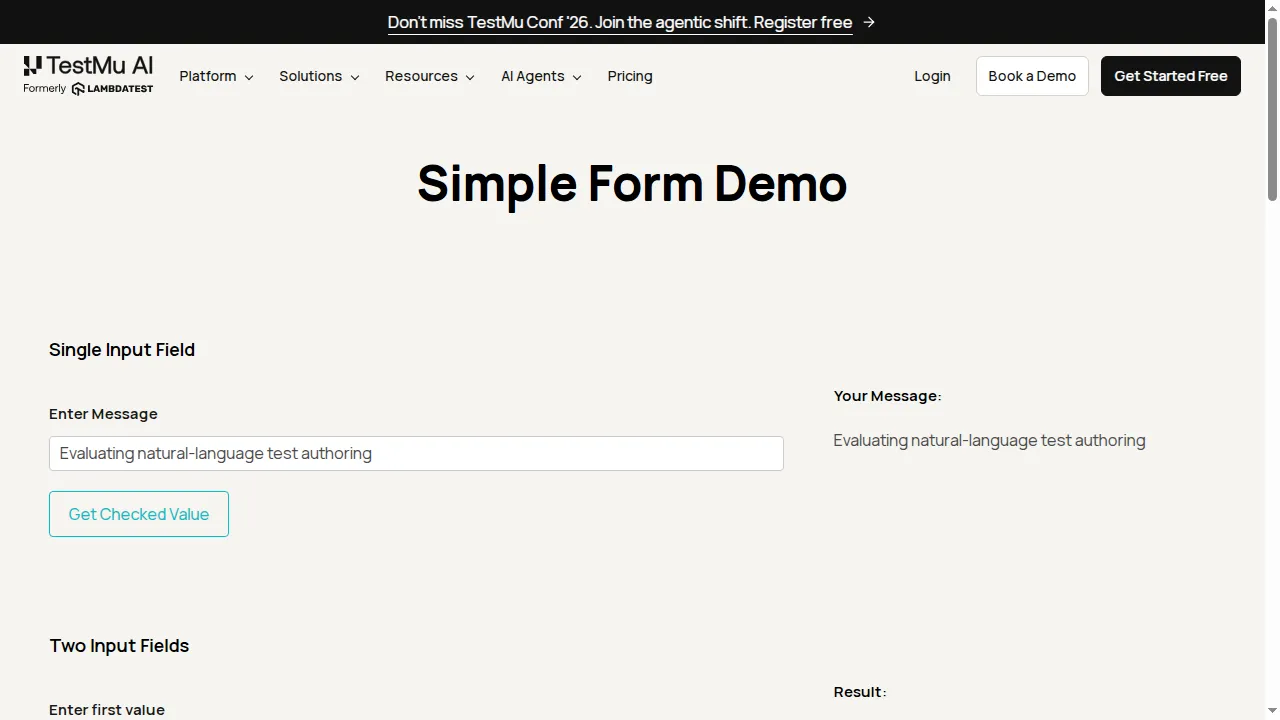
The run is recorded under build 99969685 on the TestMu AI automation dashboard. Reproducing this against your own application is a short exercise, and it tells you more than any feature matrix.

Note: Run the same evaluation on your own application across 3,000+ browser and OS combinations and 10,000+ real devices with TestMu AI. Start free
9 Best testRigor Alternatives for 2026
Nine tools, grouped by how far each sits from testRigor's plain-English authoring model.
1. Testsigma
Testsigma describes itself as a unified agentic test automation platform and is the closest structural match to testRigor in this list. Tests are authored as plain-English steps, which the platform states you can edit before anything is locked in, with no coding required.
Its AI agents, branded Atto, cover planning, generation, execution, healing and analysis, and the platform documents self-healing that updates locators when the UI changes. Stated coverage spans web, mobile, API and Salesforce, plus Windows desktop and SAP, with integrations including Jenkins, Azure DevOps, CircleCI and GitHub Actions.
Best for teams that want to keep plain-English authoring and are switching for reasons other than the authoring model itself.
2. Functionize
Functionize markets Functionize Studio as an AI testing agent positioned as the quality layer for AI-written code. Its authoring pitch is close to testRigor's: describe what to test, and Studio builds it, runs it and keeps it green. It documents an auto-healing feature and covers full web UI workflows plus enterprise applications including Salesforce, ServiceNow, Workday and SAP.
One caveat worth checking before you commit: at the time of writing, the integrations on Functionize's own homepage are labelled as coming soon rather than shipped. If your evaluation depends on a specific CI or issue-tracker connection, confirm its status directly with the vendor.
Best for teams generating application code with AI who want test authoring that operates at the same level of description.
3. TestMu AI KaneAI
KaneAI is a GenAI-native end-to-end testing agent. Teams plan, author, execute and evolve test cases across web, mobile, API, database, network and accessibility layers using natural-language prompts, turning PRDs, tickets and recordings into executable tests.
The capability that separates it from most of this list is what happens on the way out. KaneAI exports authored tests to major automation frameworks including Selenium, Playwright, Cypress and Appium, so the tests leave the platform as code your engineers own. TestMu AI positions it against record-and-replay codeless tools on exactly that basis, and the export path is the part worth exercising in a trial, because it is what keeps the decision reversible.
Execution runs on TestMu AI's grid, which covers 3,000+ browser and OS combinations and 10,000+ real Android and iOS devices, so authoring and the device matrix sit behind one account. Honest limitations: KaneAI is a commercial platform with no open-source edition, its natural-language authoring still needs a human to judge whether the generated assertion tests the right thing, and the platform is vendor-hosted by default, with private-cloud and on-premise deployment available through HyperExecute on Enterprise plans.
Why choose TestMu AI over others? Three of the nine tools here author from natural language, so the authoring model on its own does not separate them. The difference shows up in what you keep afterwards. KaneAI exports authored tests to Selenium, Playwright, Cypress and Appium, so leaving costs a migration rather than rebuilding the suite from nothing. It also executes those tests on 3,000+ browser and OS combinations and 10,000+ real Android and iOS devices, which puts the authoring layer and the execution matrix behind one account instead of two separate purchases. For a team whose main worry is reversibility, that pairing is the argument, and the export path is the part worth exercising during a trial.
Best for teams that want natural-language authoring without accepting permanent lock-in, and that need real-device coverage alongside browser coverage.
4. Katalon
Katalon positions itself as an AI platform for software quality, and describes letting teams plan, author, run and fix tests across web, mobile, API and desktop, from the first test case through to release. Desktop means Windows applications; mobile covers Android and iOS.
Its AI layer markets agents for test generation, autonomous execution of natural-language manual test cases, bug reporting and root-cause analysis. That last capability, turning written manual test cases into executed runs, is the part that most directly overlaps testRigor for teams with a large existing manual suite.
Best for teams that want one vendor across web, mobile, API and Windows desktop, and that already have manual test cases written down and worth converting.
5. mabl
mabl positions itself as an AI-native testing platform and states it has been AI-native since 2017, which is a longer track record in this space than most. Coverage spans web and UI, mobile on iOS and Android, API, performance and cross-browser testing.
On maintenance, mabl states that it uses GenAI to solve complex fixes in real time, updating tests without manual rework. It supports parallel execution triggered from CI and pushes triaged failure insights into Jira and the CLI, which keeps failures in the tools engineers already watch.
Best for teams where test failures need to land in an existing triage workflow rather than a separate dashboard nobody opens.
6. ACCELQ
ACCELQ markets AI-powered codeless test automation with zero coding, covering web, desktop, mobile on iOS and Android, mainframe and API automation. Its API coverage is unusually broad for a codeless tool, extending to REST, SOAP, Kafka, message queues, microservices, SSH and backend testing.
Its clearest differentiator is packaged-application automation. ACCELQ lists purpose-built support for Salesforce, SAP, Oracle, ServiceNow, Workday, MS Dynamics, nCino, Pega and Coupa. Packaged applications render dynamic markup that shifts between releases, which is why vendors sell purpose-built support for them rather than relying on generic locators.
Best for enterprises whose critical business flows run through packaged applications rather than their own front end.
7. Testim
Testim, part of Tricentis, describes AI-driven low-code test automation for Salesforce, web and mobile, with mobile covering native and hybrid applications. Its AI and ML smart locators are documented as automatically self-healing to keep tests working as applications change.
It also offers agentic natural-language test creation alongside the low-code editor, and integrates with Jenkins, CircleCI, GitHub and Jira. The low-code editor is the centre of gravity here rather than the natural-language layer, which suits teams that want to see and adjust test structure directly.
Best for Salesforce-heavy teams that want a visual editor they can reason about, with natural language as an accelerator rather than the only interface.
8. Autonoma
Autonoma describes itself as an open-source testing platform where AI agents navigate your application end to end and catch regressions on every pull request, with no test code required. It states that tests adapt automatically as the frontend evolves, without rewriting selectors.
It works with any web or mobile application reachable by URL or device, listing Flutter, React Native and Swift for mobile, and starts from a single command:
npx @autonoma-ai/planner@latestBest for teams that want AI-driven authoring but need the source available, typically because of procurement rules or data-residency constraints.
9. Playwright
Playwright is the honest answer for teams whose real problem is that they wanted control all along. It offers one API driving Chromium, Firefox and WebKit on Linux, macOS and Windows, headless or headed, with bindings for TypeScript, Python, .NET and Java.
It attacks the main cause of flakiness structurally, with auto-waiting and auto-retrying assertions built into the engine, rather than bolting on a self-healing layer. The Playwright documentation states that it waits for elements to be actionable before performing actions, and that assertions automatically retry until conditions are met. Trace-based debugging captures DOM snapshots, network requests, console logs and screenshots from a failed run.
The trade-off is real: someone has to write and own the code, which is exactly the cost codeless tools exist to remove. Our Playwright tutorial walks through a first test if you want to judge the effort before committing.
Best for teams with engineering capacity whose flows are too complex or too timing-sensitive for a managed authoring layer.

What Plain-English Authoring Actually Costs
Plain English is no longer a differentiator. testRigor, Testsigma, Functionize and KaneAI all author from natural language in 2026, so the question has moved from who offers it to how it behaves at step forty of a complex flow.
Most natural-language tools resolve, underneath, to a bounded set of actions. Simple instructions map cleanly onto actions. The interesting moment is the first step your product needs that the vocabulary does not express, because that is when you reach for the escape hatch and start writing code inside a codeless tool. Most platforms in this category provide one, but confirm it exists, and what language it takes, for the specific tool you are trialling.
Three questions surface that boundary faster than a trial checklist:
- Take your single most complicated existing test and author it first, not your simplest. The simple one always works and tells you nothing.
- Count how many steps need the code escape hatch. That ratio, not the marketing claim, is your real codeless coverage.
- Change a locator on a live page, re-run, and watch whether the test heals or fails. Our run above shows why a vague selector cannot reliably be healed.
We cover the mechanics of how these systems interpret instructions, and where they break down, in more depth in our guide to natural language test automation.
How to Choose Between These Alternatives
Map your reason for leaving to a shortlist rather than evaluating all nine. The reason you started looking is the criterion that should decide it.
| Why you are leaving | Shortlist | What to verify in the trial |
|---|---|---|
| Tests must stay private | Any paid tier, or Autonoma self-hosted | Where test definitions and run artifacts are stored, and who can read them. |
| Coverage gap on your UI | Playwright, or any tool with a code escape hatch | Author one test against the exact surface that failed before, not a demo app. |
| Parallelism costs too much | Any tool not metered on parallel infrastructure | Model your real CI concurrency at peak, and confirm the current billing model with each vendor. |
| Packaged apps break tests | ACCELQ, or Testim if the packaged app is Salesforce | Run against your own Salesforce or SAP sandbox with real customisations. |
| Fear of lock-in | KaneAI, Playwright, Autonoma | Export a real test and run it outside the platform (KaneAI, Playwright), or confirm you can self-host the whole platform (Autonoma). |
| Device coverage too narrow | Any tool plus a device cloud | Check the authoring tool and the execution grid separately; they are different purchases. |
That last row is the distinction most comparison articles miss. Authoring tools and execution grids are complements, not substitutes. A codeless authoring tool still has to run its tests somewhere, and if that somewhere covers four browsers, your coverage is four browsers regardless of how good the authoring is. For a broader view of the category, our roundup of codeless testing tools compares options outside the testRigor-adjacent set, and AI testing tools covers the wider AI-assisted landscape.

Migrating Your Coverage Without Losing It
Migrations fail in a predictable way: the easy tests port quickly, the hard ones stall, and both platforms end up running in parallel far longer than anyone planned. Sequencing avoids that.
- Port your three hardest tests first. If the new tool handles those, the rest follow. If it cannot, you have learned it in week one rather than month six.
- Run both suites against the same build for one full release cycle and compare failures. Disagreements between them are where your real coverage gaps live.
- Rewrite rather than translate. Plain-English steps written for one vocabulary rarely map cleanly onto another, and a literal port carries over workarounds you no longer need.
- Decide the execution grid separately from the authoring tool, so a later authoring change does not force a second migration.
- Retire the old suite deliberately, with a date. Suites that are kept just in case never get switched off.
One option worth knowing before you migrate at all: if your objection is execution coverage rather than authoring, you may not need to leave. TestMu AI publishes a testRigor integration that runs testRigor-authored tests across our browser and device grid, which solves a coverage problem without touching how your tests are written. Teams weighing a straight head-to-head instead can read our testRigor alternative comparison.
Teams migrating away from scripted frameworks rather than codeless ones will find the same sequencing logic in our guide to Selenium alternatives.
Conclusion
Start by writing down the single constraint that made you open this article, then take the two tools from the table above that address it and author your hardest existing test in each. Two days of that tells you more than two weeks of feature comparison, because the failure mode you care about only appears on your own application.
If natural-language authoring is what you want to keep and lock-in is what you want to avoid, KaneAI is the direct swap, since tests export to Selenium, Playwright, Cypress and Appium rather than staying trapped in the platform. The KaneAI end-to-end testing agent walkthrough covers how authoring works in practice.
Whichever authoring tool wins, decide your execution layer on its own merits. Running that layer on automation testing infrastructure that spans 3,000+ browser and OS combinations and 10,000+ real devices means a later change of authoring tool costs you one migration instead of two.
Author

Rohit Mehta
Blogs: 3

Rohit Mehta is the Quality Engineering and Testing Practice Head at Pratham Software (PSI), with 15+ years of experience across enterprise and SaaS platforms. He builds AI-driven QA practices that enable faster releases, lower risk, and predictable quality at scale, leading QA strategy, AI adoption, and governance across programs. His expertise includes intelligent test generation, self-healing automation, regression optimization, predictive analytics, and CI/CD-integrated quality practices. He wrote the book Software Testing Revolution Using AI: The Future of Quality Engineering, and on TestMu AI (formerly LambdaTest) he published a guide on conversational AI testing. He holds an MS in Software Systems from BITS Pilani.
Reviewer

Salman Khan
Reviewer
Salman is a Test Automation Evangelist and Community Contributor at TestMu AI, with over 6 years of hands-on experience in software testing and automation. He has completed his Master of Technology in Computer Science and Engineering, demonstrating strong technical expertise in software development, testing, AI agents and LLMs. He is certified in KaneAI, Automation Testing, Selenium, Cypress, Playwright, and Appium, with deep experience in CI/CD pipelines, cross-browser testing, AI in testing, and mobile automation. Salman works closely with engineering teams to convert complex testing concepts into actionable, developer-first content. Salman has authored 120+ technical tutorials, guides, and documentation on test automation, web development, and related domains, making him a strong voice in the QA and testing community.


testRigor Alternatives FAQs
Did you find this page helpful?
More Related Blogs
TestMu AI forEnterprise
Get access to solutions built on Enterprise
grade security, privacy, & compliance
- Advanced access controls
- Advanced data retention rules
- Advanced Local Testing
- Premium Support options
- Early access to beta features
- Private Slack Channel
- Unlimited Manual Accessibility DevTools Tests