
Power Your Software Testing with AI Agents and Cloud
The Native AI-Agentic Cloud Platform to Supercharge Quality Engineering. Test Intelligently and Ship Faster.


- TestMu AI (Formerly LambdaTest)
- /
- Blog
- /
- Selenium 4.51 Release: What's New and How to Upgrade
Selenium 4.51 Release: What's New and How to Upgrade
Selenium 4.51 shipped on October 9, 2026. See what changed in each binding, what the Guava change breaks in Java, and how to run 4.51 with BiDi on a cloud grid.
Published on:
If your Java suite stores an ExpectedCondition in a variable typed as Guava's com.google.common.base.Function, Selenium 4.51 will not compile it. The fix is a one-line type change, and it is the one change in this release that the Selenium team published a migration guide for.
According to the Selenium 4.51 release post, Selenium 4.51 shipped on October 9, 2026 for Java, JavaScript, Python, .NET, Ruby and the Grid. It also publishes the browser atoms as an npm package, adds Python 3.15 support, and gives Java a BiDi code generator.
It is the last of five releases that began with 4.47 on August 10, 2026, and the four before it removed deprecated Firefox profile, FTP proxy and HttpClient APIs, so a suite that skipped them has more to check than 4.51 alone. If the 4.x line is new to you, start with the Selenium 4 guide.
TL;DR
Selenium 4.51 is the Selenium release published on October 9, 2026 for Java, JavaScript, Python, .NET, Ruby and the Grid. It stops Java's ExpectedCondition from implementing Guava's Function, publishes the browser atoms as @selenium/atoms on npm, adds Python 3.15 support, and supports CDP versions 153 to 155.
- Java upgrade impact: Does Selenium 4.51 break most Java suites? No. Code that passes ExpectedConditions to WebDriverWait.until() or writes conditions as lambdas compiles unchanged; only variables, fields or parameters typed as Guava's Function need a new type.
- Guava dependency: Is Guava gone from selenium-java 4.51.0? No. ExpectedCondition no longer uses it, but the published selenium-remote-driver 4.51.0 POM still declares guava 33.7.2-jre at compile scope, so Maven and Gradle builds still resolve it.
- Selenium 5: Is Selenium 5 released? No. The Selenium 5 release charter is still marked Proposed, and the Selenium downloads page lists 4.51.0 as the latest stable version for every binding.
- WebDriver BiDi on TestMu AI: Can a Selenium 4.51 client use WebDriver BiDi on the TestMu AI grid? Yes. A Selenium 4.51 Python session with enable_bidi set received a webSocketUrl on Chrome 155 and captured browser console messages through driver.script.
What Is New in Selenium 4.51?
The GitHub release notes for 4.51.0 list 37 merged pull requests, and 15 of them are tagged as build or test work.
The rest include the changes that reach test code, listed here by binding.
| Binding | What changed in 4.51 | Who should check |
|---|---|---|
| Java | ExpectedCondition no longer implements Guava's Function; RemoteWebDriver.getClientFactory() added; removal of the deprecated HttpCommandExecutor fields postponed to 4.53; HttpClient no longer leaks when the driver fails to start; new BiDi code generator | Code that types conditions as Guava's Function, and RemoteWebDriver subclasses that read HttpCommandExecutor fields |
| JavaScript | Browser atoms published as @selenium/atoms; WebSQL and AppCache atoms removed; driver methods to install and uninstall web extensions over BiDi with a classic fallback | Projects that load atoms directly or install browser extensions |
| Python | Python 3.15 support; WebSocket response interval validated correctly; BiDi setClientWindowState sends rect members as sibling parameters | Teams moving to Python 3.15 or tuning websocket_interval |
| .NET | No public API changes; the listed items (macOS Edge path escaping, NUnit 5) are in Selenium's own build and test setup | No action needed beyond the version bump |
| Ruby | BiDi generator types field-less synthetic map records as validated maps | Suites that call generated BiDi types |
| Selenium Manager | Falls back to empty metadata when its cache cannot be read instead of failing; configures the Chrome sandbox after unpacking a Chrome for Testing build on Windows | Windows CI agents that download Chrome for Testing |
Every binding's 4.51.0 changelog lists support for CDP versions v153, v154 and v155, and the selenium-java 4.51.0 POM pulls in the matching selenium-devtools-v153 through v155 modules. If your suite calls Chrome DevTools Protocol commands, keep Chrome inside that window when you move to 4.51.
Java: ExpectedCondition Drops Guava's Function
The Selenium team announced this change on September 21, 2026 in a migration notice, before the release shipped. In 4.51, ExpectedCondition extends only the JDK interface:
// Selenium 4.50 and earlier
public interface ExpectedCondition<T extends @Nullable Object>
    extends com.google.common.base.Function<WebDriver, T>,
        java.util.function.Function<WebDriver, T> {}

// Selenium 4.51
public interface ExpectedCondition<T extends @Nullable Object>
extends java.util.function.Function<WebDriver, T> {}- Not affected - code that passes ExpectedConditions factory methods straight to WebDriverWait.until(), and conditions written as lambdas.
- Affected - variables, fields and method parameters declared as com.google.common.base.Function that hold an ExpectedCondition. They stop compiling.
Search the codebase for Guava's Function type before you bump the version, then retype each hit. apply() has the same signature in both interfaces, so the fix is a drop-in type change: java.util.function.Function, ExpectedCondition with its type parameter, or var.
grep -rn "com.google.common.base.Function" --include="*.java" .// Before: fails to compile on Selenium 4.51
com.google.common.base.Function<WebDriver, WebElement> condition =
ExpectedConditions.elementToBeClickable(By.id("submit"));
// After
ExpectedCondition<WebElement> condition =
ExpectedConditions.elementToBeClickable(By.id("submit"));The release post says Guava is no longer a dependency of the client bindings. The POMs published to Maven Central show a narrower change.
The selenium-remote-driver 4.51.0 POM still lists com.google.guava:guava 33.7.2-jre as a dependency, with no test or provided scope.
- selenium-java - depends on selenium-remote-driver at compile scope, so Guava still resolves for every selenium-java project and still appears in mvn dependency:tree.
- selenium-support - declared Guava in 4.50.0 and does not in 4.51.0, which is the dependency change that ships with the ExpectedCondition update.
Tracking issue #12737 is still open, and it says removing Guava from the dependencies should be done with Selenium 5, because client code could rely on it being on the classpath.
If your own code imports Guava, declare it in your build file now rather than relying on Selenium's transitive copy.
- getClientFactory() - RemoteWebDriver gains a protected getClientFactory() so subclasses, such as Appium's AppiumDriver, can create their own HTTP and WebSocket clients without the deprecated HttpCommandExecutor fields.
- HttpCommandExecutor fields - client and httpClientFactory, restored as deprecated in 4.50, are now scheduled for removal in 4.53 instead of 4.52, giving Appium time to switch to the new getter.
- Startup failures - the driver no longer leaks its HttpClient when it fails to start, and Java no longer passes a bare --proxy argument to Selenium Manager.
The @selenium/atoms Package and Other JavaScript Changes
Browser atoms are the JavaScript functions Selenium injects into a page for work that needs the browser's own view, such as the getVisibleText atom that reads an element's visible text. In 4.51 the atoms are written in TypeScript.
They are published on npm as @selenium/atoms 4.51.0, a package described as browser injection atoms for Selenium WebDriver.
- Package name - two pull request titles in the GitHub release notes say @seleniumhq/atoms, but the registry name is @selenium/atoms; @seleniumhq/atoms does not exist on npm.
- Removed atoms - the obsolete WebSQL and AppCache atoms are gone.
- Web extensions - the JavaScript driver can install and uninstall web extensions over BiDi and falls back to classic commands when BiDi is not available. Ruby gained the BiDi version in 4.50.
- BiDi classes - the JavaScript BiDi generator can now produce vendor-specific classes.
- Node.js - selenium-webdriver 4.51.0 declares Node.js 22 or later in its engines field.
Python, .NET and Ruby Changes in Selenium 4.51
Python gets support for Python 3.15. The selenium 4.51.0 release on PyPI requires Python 3.10 or later and lists classifiers for 3.10 through 3.15.
If you are starting a new project, the Selenium Python tutorial covers setup.
- WebSocket interval - Python now validates the WebSocket response interval correctly. ClientConfig exposes it as websocket_interval, with a default of 0.1 seconds.
- BiDi window state - setClientWindowState now sends its rect members as sibling parameters.
- .NET - the release post's .NET items, escaping the Edge path on macOS and moving to NUnit 5, change Selenium's own build and test setup rather than the public API. Selenium.WebDriver 4.51.0 on NuGet targets .NET Framework 4.6.2, .NET Standard 2.0 and .NET 8.0.
- Ruby - the BiDi generator types field-less synthetic map records as validated maps. selenium-webdriver 4.51.0 on RubyGems requires Ruby 3.3 or later.
What Changed Between Selenium 4.47 and 4.51?
A suite pinned to 4.46 or earlier picks up every change below on the jump to 4.51. The table keeps changes that remove an API or change behavior, and each release links to its official post on the Selenium blog.
| Release | Change | Bindings |
|---|---|---|
| 4.47 (August 10, 2026) | Firefox blocks CDP access | .NET, Python, Ruby |
| 4.47 | Deprecated FTP proxy support removed; invalid Firefox profile code deprecated | Java, JavaScript, Ruby, .NET |
| 4.48 (August 27, 2026) | File upload and download work for Kubernetes, Docker and relay sessions | Grid |
| 4.49 (September 9, 2026) | Deprecated GET /session/{sessionId}/se/files/{fileName} endpoint removed | Java, Grid |
| 4.49 | Selenium Manager supports Chrome arm64 on Linux | All |
| 4.50 (September 30, 2026) | Relative locators can be anchored to elements and shadow roots, not only the driver; see the Selenium 4 relative locator guide | Java, .NET |
| 4.50 | Deprecated Firefox profile extension and certificate methods removed | All |
| 4.50 | Deprecated HttpClient interface methods removed; one HttpClient.Factory per RemoteWebDriver | Java |
| 4.50 | ClientConfig user_agent and extra_headers applied per connection | Python |
| 4.51 (October 9, 2026) | ExpectedCondition no longer implements Guava's Function | Java |
The Firefox CDP block is the change most likely to fail at runtime rather than at compile time. In Python 4.51, execute_cdp_cmd on a Firefox session raises a RuntimeError that tells you to switch to WebDriver BiDi, and Ruby no longer exposes its CDP-backed log and network methods on Firefox. For background on the replacement protocol, read WebDriver BiDi.
Three of the Python fixes in this window came from Navin Chandra, a Selenium committer at TestMu AI: no_proxy matching in 4.47, W3C capabilities built from a list of options in 4.48, and per-connection ClientConfig headers in 4.50.

Note: Jumping several Selenium versions at once? Run the upgraded suite on TestMu AI's cloud grid across Chrome, Firefox and Edge before you merge, so removed APIs and Firefox CDP errors surface in one pass. Try TestMu AI free!
Is Selenium 5 Released?
No. The Selenium 5 release charter, owned by the Selenium Technical Leadership Committee, is still marked Proposed. It describes Selenium 5 as a focused alignment release in which the bindings converge on consistent behavior, following the existing policy of deprecating an API before removing it.
The charter lists what must land before Selenium 5 ships:
- BiDi support boundary - where the supported Selenium API ends and internal BiDi implementation begins, settled in ADR 17670.
- Network async/event API - one cross-binding API for adding, removing and clearing request, response and authentication handlers, settled in ADR 17685.
- Script and logging async/event API - pinned scripts plus console-message, JavaScript-error and DOM-mutation handlers. Its ADR is still pending.
- Selenium Manager released API - the interface needed to drop Selenium Manager's Beta label and release it independently of the bindings. Its ADR is still pending.
The charter defers several things without rejecting them: routing every classic command through BiDi, deprecating CDP support, convenience helpers such as mock, block and redirect, and a high-level browser context API. WebdriverIO v10 already exposes tabs and frames as values, which is the kind of API the charter leaves out of Selenium 5's required scope.
How to Run Selenium 4.51 With WebDriver BiDi on TestMu AI
The TestMu AI Selenium grid accepts a 4.51 client without changes, and BiDi turns on through the webSocketUrl capability, which the Selenium BiDi integration docs list for Chrome, Firefox and Edge. Those docs use WebdriverIO. The script below does the same with Selenium 4.51 for Python on the Selenium Playground.
import os
import selenium
from selenium import webdriver
from selenium.webdriver.common.by import By
from selenium.webdriver.remote.client_config import ClientConfig
from selenium.webdriver.support.ui import WebDriverWait
from selenium.webdriver.support import expected_conditions as EC

HUB = "https://hub.lambdatest.com/wd/hub"

options = webdriver.ChromeOptions()
options.browser_version = "latest"
options.platform_name = "Windows 11"
options.enable_bidi = True  # requests webSocketUrl for a BiDi connection
options.set_capability("LT:Options", {
    "username": os.environ["LT_USERNAME"],
    "accessKey": os.environ["LT_ACCESS_KEY"],
    "build": "Selenium 4.51 Release Check",
    "name": "BiDi console capture on Simple Form Demo",
})

# user_agent and extra_headers apply per connection since Selenium 4.50
config = ClientConfig(
    remote_server_addr=HUB,
    user_agent="selenium-4.51-release-check",
    extra_headers={"X-Test-Suite": "selenium-451"},
)

driver = webdriver.Remote(command_executor=HUB, options=options, client_config=config)
console_messages = []
try:
    print("Selenium client:", selenium.__version__)
    print("Browser:", driver.capabilities["browserName"], driver.capabilities["browserVersion"])
    print("BiDi socket:", "yes" if driver.capabilities.get("webSocketUrl") else "no")

    driver.script.add_console_message_handler(lambda entry: console_messages.append(entry.text))

    driver.get("https://www.testmuai.com/selenium-playground/simple-form-demo/")
    wait = WebDriverWait(driver, 15)
    wait.until(lambda d: d.execute_script("return document.readyState") == "complete")
    driver.execute_script("console.log('form ready')")

    field = wait.until(EC.element_to_be_clickable((By.CSS_SELECTOR, "input#user-message")))
    field.send_keys("Selenium 4.51")
    driver.find_element(By.ID, "showInput").click()

    wait.until(EC.text_to_be_present_in_element((By.ID, "message"), "Selenium 4.51"))
    print("Displayed message:", driver.find_element(By.ID, "message").text)

    wait.until(lambda d: "form ready" in console_messages)
    print("BiDi console events captured:", len(console_messages))
    print("First event:", console_messages[0])
    driver.execute_script("lambda-status=passed")
except Exception:
    driver.execute_script("lambda-status=failed")
    raise
finally:
    driver.quit()
Install the client with pip install selenium==4.51.0, export LT_USERNAME and LT_ACCESS_KEY from your TestMu AI account, and run the script. The terminal prints:
Selenium client: 4.51.0
Browser: chrome 155.0.8059.80
BiDi socket: yes
Displayed message: Selenium 4.51
BiDi console events captured: 5
First event: form ready- enable_bidi - sets the webSocketUrl capability. The grid answers with a WebSocket URL in the returned capabilities, which is what the BiDi socket line checks.
- Console capture - driver.script.add_console_message_handler() receives every console message on the page over BiDi, so the count includes the playground's own log lines and varies between runs. The script's own message arrives first.
- readyState wait - the form's script attaches after the document finishes loading. Without the wait, the click can fire before the handler exists and the text assertion times out.
- ClientConfig - since 4.50, Python applies user_agent and extra_headers to every connection the client opens.
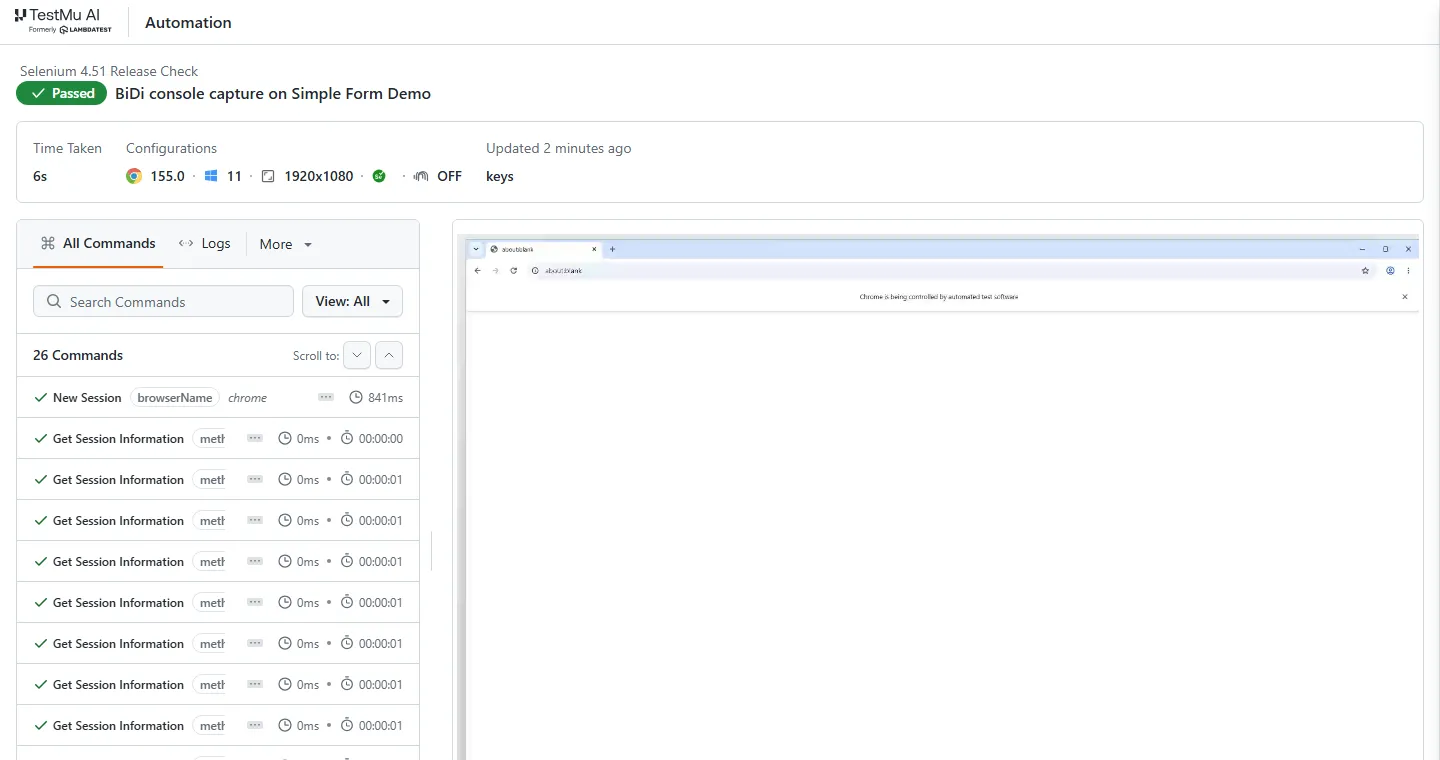
That session ran on TestMu AI's Automation Cloud, which records console logs, network logs, video, screenshots and a command log for each session without extra configuration. When an upgraded test hits a removed API, the failing command and the console output sit next to the video in the same view.
- Browser coverage - 3,000+ browser and OS combinations, enough to check Chrome, Firefox and Edge behavior after the Firefox CDP and profile removals.
- No grid to maintain - browsers and drivers are hosted for you; at the time of writing, Chrome latest on the grid reports 155.0.8059.80, inside the CDP window that 4.51 supports.
- Python setup - the Python with Selenium docs walk through running Python Selenium scripts on the grid.
How to Upgrade to Selenium 4.51
The minimum runtimes below come from each package's 4.51.0 metadata on its registry. For Java, the classes in selenium-api and selenium-remote-driver 4.51.0 are compiled for Java 11.
| Binding | Install 4.51.0 | Minimum runtime |
|---|---|---|
| Java | org.seleniumhq.selenium:selenium-java:4.51.0 | Java 11 |
| Python | pip install -U selenium==4.51.0 | Python 3.10 |
| JavaScript | npm install selenium-webdriver@4.51.0 | Node.js 22 |
| .NET | dotnet add package Selenium.WebDriver --version 4.51.0 | .NET Framework 4.6.2, .NET Standard 2.0 or .NET 8.0 target |
| Ruby | gem install selenium-webdriver -v 4.51.0 | Ruby 3.3 |
Before you merge the version bump, work through these checks:
- Search Java code for com.google.common.base.Function and retype every variable that holds an ExpectedCondition.
- If you subclass RemoteWebDriver, replace reads of the HttpCommandExecutor client and httpClientFactory fields with getClientFactory() before 4.53 removes them.
- Replace CDP calls on Firefox sessions, such as execute_cdp_cmd in Python, with WebDriver BiDi equivalents.
- Move Firefox extension installs off the profile and onto the driver, for example install_addon() in Python, and use the W3C acceptInsecureCerts capability instead of Java's removed profile certificate setting.
- Run the full suite across every browser you support, because the Firefox CDP block only shows up at runtime.
To confirm which version a project resolves after the bump, run the command for its binding. For the release history before 4.47, see the Selenium latest version page.
python -c "import selenium; print(selenium.__version__)"
npm ls selenium-webdriver
mvn dependency:tree -Dincludes=org.seleniumhq.selenium
dotnet list package
gem list selenium-webdriver
The Selenium project's AI agents with Selenium post says coding agents tend to reproduce outdated Selenium 2 and 3 patterns, such as DesiredCapabilities and fixed sleeps. It recommends pointing agents at the curated selenium.dev/llms.txt index and adding a rule to AGENTS.md or CLAUDE.md: if an API cannot be found in the current documentation, it does not exist.
TestMu AI's open-source agent skills include a Selenium skill that generates WebDriver tests for local runs and the TestMu AI cloud.
Skip the setup and install the Selenium Skill for Claude Code, Copilot & Cursor with one command.

Getting Started With Selenium 4.51
Run the Guava search and a search for Firefox CDP calls first, then bump one binding to 4.51.0 in a branch and run the full suite; the failures it prints are your upgrade list. Once it passes locally, follow the getting started with Selenium 4 docs to point the suite at the TestMu AI grid and run it across the browsers your users have.
Author

Himanshu Sheth
Blogs: 140


Himanshu Sheth is the Director of Marketing (Technical Content) at TestMu AI, with over 8 years of hands-on experience in Selenium, Cypress, and other test automation frameworks. He has authored more than 130 technical blogs for TestMu AI, covering software testing, automation strategy, and CI/CD. At TestMu AI, he leads the technical content efforts across blogs, YouTube, and social media, while closely collaborating with contributors to enhance content quality and product feedback loops. He has done his graduation with a B.E. in Computer Engineering from Mumbai University. Before TestMu AI, Himanshu led engineering teams in embedded software domains at companies like Samsung Research, Motorola, and NXP Semiconductors. He is a core member of DZone and has been a speaker at several unconferences focused on technical writing and software quality.
Reviewer

Sri Harsha
Reviewer
Sri Harsha is Engineering Manager of the Open Source Program Office at TestMu AI, where he leads open-source engineering behind the Selenium and Appium automation grid and builds agentic AI systems for quality engineering. He is a member of the Selenium Technical Leadership Committee and a committer to WebdriverIO and Appium, and was recognized with the LambdaTest Delta Award 2023 for Best Contributor in open-source testing. He brings over 10 years of experience in software testing and automation, with earlier roles at EPAM Systems and ZenQ. Sri Harsha holds a B.Tech in Computer Science from Jawaharlal Nehru Technological University.


Selenium 4.51 FAQs
Did you find this page helpful?
More Related Blogs

TestMu AI forEnterprise
Get access to solutions built on Enterprise
grade security, privacy, & compliance
- Advanced access controls
- Advanced data retention rules
- Advanced Local Testing
- Premium Support options
- Early access to beta features
- Private Slack Channel
- Unlimited Manual Accessibility DevTools Tests