

Power Your Software Testing with AI Agents and Cloud
The Native AI-Agentic Cloud Platform to Supercharge Quality Engineering. Test Intelligently and Ship Faster.


- TestMu AI (Formerly LambdaTest)
- /
- Blog
- /
- Prioritizing Precision: Innovative Approaches to QA Test Case Selection
Prioritizing Precision: Innovative Approaches to QA Test Case Selection
Elevate QA with risk-based prioritization, clustering, exploratory testing, machine learning, and continuous testing for efficient and high-quality results.
Last Updated on:
On This Page
When discussing testing, test scenarios or cases establish the foundation for higher testing precision. Some projects proceed without detailed cases, while others demand comprehensive documentation. As testers, we create numerous cases covering requirements, business flows, and data combinations.
By now, you may have realized that the quantity of test cases isn’t crucial for quality software. It’s about the quality of test cases, much like how the number of defects doesn’t define overall product quality. It’s quality over quantity. A good number of high-quality test cases contribute to the overall testing process quality. Given limited resources and time constraints, prioritizing test cases effectively becomes essential. This blog explores innovative QA test case selection approaches focusing on precision and efficiency.
Challenges in Test Case Selection
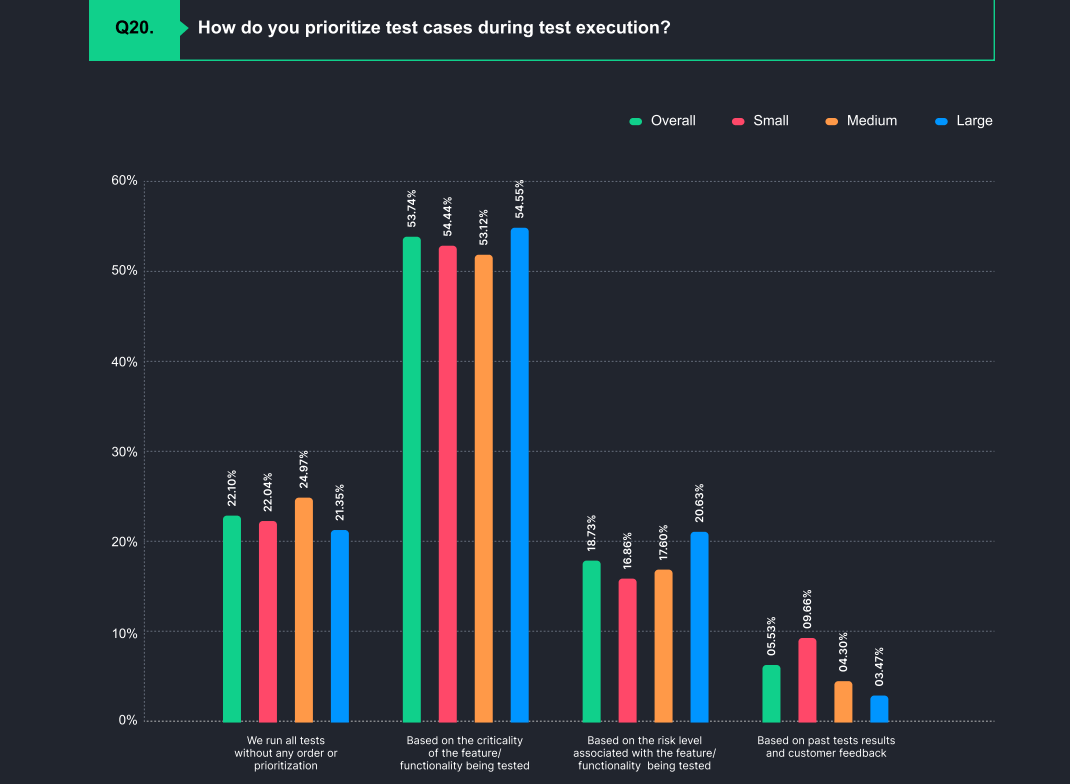
The Future of Quality Assurance Survey reveals that 21.5% of organizations conduct tests without prioritization, suggesting room for optimizing test execution to achieve quicker results and faster developer feedback. Despite our conventional methods and expertise, prioritizing test cases by simply selecting a subset is not a straightforward task. It involves numerous challenges and factors that need careful consideration before determining the order of importance for test cases:
- Identifying critical and high-risk areas: As per the findings of the TestMu AI survey, around 54% of organizations prioritize their testing based on the criticality of the feature or functionality, whereas approximately 19% prioritize them based on the associated risk level. However, test case selection becomes challenging in situations where multiple areas in the software are critical and carry a high risk of failure, making it difficult to prioritize and select the appropriate test cases for these areas.
- Limited time and resources: In today’s fast-paced software development environment, there is constant pressure to quickly release software updates/features. This can lead to time and resource constraints, making it challenging to select and execute a comprehensive set of test cases.
- Understanding user requirements: Test case selection relies heavily on understanding the user’s requirements and expectations from the software. This can be challenging, especially when there are diverse user groups with different needs and varying levels of technical expertise.
- Incorporating changes and updates: Software development is an iterative process, and new features and updates are constantly being introduced. This can make test case selection challenging, as the test cases need to be constantly updated and reviewed to ensure they cover all new and changed functionality.
- Ensuring adequate test coverage: It can be challenging to ensure that all aspects of the software are thoroughly tested, especially when complex interdependencies exist between different components.
- Balancing automation testing: It is a challenge to strike the right balance between automated and functional testing to achieve maximum test coverage.
- Dealing with legacy systems: Test case selection for legacy or traditional systems can be difficult, as there may be limited documentation and understanding.
Traditional Methods of QA Test Case Selection
In traditional QA practices, test cases are often selected based on predetermined criteria such as requirements documentation, and past defects, using formulas and logic. While these methods have been the backbone of QA testing for decades, they can sometimes fall short of capturing all possible scenarios. The rigid nature of these approaches can result in overlooking edge cases and corner scenarios that are crucial for ensuring the robustness of the software.
The Need for Innovation in Test Case Selection
With the rapid evolution of software development methodologies and technologies, there is a growing need for innovative approaches to test case selection that can keep pace with the dynamic nature of modern software projects. By embracing new techniques and tools, QA teams can enhance their testing strategies and adapt to the changing landscape of software development. And this helps to hand-pick the test cases.
Few Innovative Approaches to Test Case Selection
Let’s discuss some methodologies or models that could help us select the test cases for higher efficiency in today’s dynamic software landscape.
1. Risk-Based Selection
Risk-based Selection/prioritization evaluates the potential impact and likelihood of defects to determine which test cases should be executed first. This approach considers factors such as the criticality of the feature, the frequency of use, and the potential consequences of a failure. By focusing on high-risk areas first, testers can ensure that critical components of the software are thoroughly examined before moving on to less critical ones. Based on past experiences, we can decide the impact.
Benefits:
- Focuses testing efforts on areas with the highest potential impact
- Reduces the risk of missing critical defects on critical workflows
Considerations:
- Requires a thorough understanding of the system and its risks
- May require additional effort to assess and quantify risks
- Requires a deeper understanding of past experiences and vulnerabilities
2. Test Case Clustering
Test case clustering groups similar test cases into clusters based on functionality, dependencies, or other criteria. By executing one representative test case from each cluster, QA teams can achieve comprehensive coverage while reducing the overall number of test cases.
Benefits:
- Reduces the number of test cases to be executed
- Ensures that all critical functionality is covered
- Facilitates test case maintenance and updates
Considerations:
- Requires careful analysis to identify appropriate clusters
- It may not be suitable for all types of testing
- Requires a deeper understanding of the application or system
3. Exploratory Testing
Exploratory testing involves dynamically exploring the application without a predefined set of test cases. This approach allows QA engineers to identify unexpected behaviors and defects that might be missed by traditional test case execution.
Benefits:
- Uncovers hidden defects and edge cases
- Encourages creativity and innovation in testing
- Provides valuable insights into the application’s behavior
Considerations:
- Requires skilled and experienced QA engineers
- It may be difficult to manage and document
- It may not be suitable for all types of testing
4. Machine Learning and AI
Machine learning (ML) and artificial intelligence (AI) algorithms can be leveraged to prioritize test cases. In fact, according to the Future of Quality Assurance Survey, test case creation was the most sought-after case of AI, particularly among medium and large organizations (around 48.80% and 48.60%, respectively). These algorithms analyze historical test data, defect reports, and code coverage to identify areas more prone to defects.
Benefits:
- Automates the test case prioritization process
- Improves the accuracy and efficiency of test case selection
- Facilitates data-driven decision-making
Considerations:
- Requires a sufficient amount of historical data
- It may be challenging to implement and maintain
- It may not be suitable for all types of testing
5. Continuous Testing
Continuous testing integrates QA testing into the software development lifecycle, enabling early identification and resolution of defects. By automating test execution and incorporating test results into the continuous integration/continuous delivery (CI/CD) pipeline, QA teams can ensure that the application remains high-quality throughout the development process.
Benefits:
- Reduces the risk of introducing defects into production
- Improves the overall quality of the software
- Facilitates faster and more reliable software releases
Considerations:
- Requires a mature CI/CD pipeline
- May require additional investment in testing infrastructure
- It may be challenging to implement in large and complex systems
6. Model-Based Testing
Model-based testing is an approach that involves creating a model of the software system and using it to generate test cases automatically. The model is based on the system’s specifications, which helps identify potential defects early in the testing process.
Benefits:
- Reduces the risk of introducing defects into production
- Improves the overall quality of the software
- Facilitates faster and more reliable software releases
Considerations:
- Requires a mature CI/CD pipeline
- May require additional investment in testing infrastructure
- It may be challenging to implement in large and complex systems
7. Heuristic Rules Approach:
A heuristic is a rule of thumb or a practical method that helps in solving a problem or simply put as a cognitive shortcut. In software testing, a heuristic approach uses a set of guidelines or principles to guide the selection of test cases. It is a subjective and intuitive approach that is based on the experience and knowledge of the software tester. This approach is often used when there is limited information or resources available for testing.
Benefits:
- Ensures that all critical functionality is covered
- It helps identify high-risk areas
- Encourages creativity and critical thinking
Considerations:
- Requires skilled and experienced QA engineers
- It can be biased sometimes
- Not suitable for all projects or situations
How to Implement the Models
Learning different methodologies or techniques cannot guarantee precise test case selection. Testers and Test Leads must know where and how to implement those learnings and new models. Here are some pointers to help implement the diverse test case selection process efficiently:
1. Setting Clear Objectives and Criteria:
- Establish clear objectives for the testing process, including the goals, scope, and expected outcomes.
- Define specific criteria for selecting test cases, such as risk, coverage, criticality, and usability.
- Align test case selection with business requirements, user needs, and product objectives.
2. Establishing a Structured Process:
- Create a systematic and well-defined process for test case prioritization.
- Use techniques like risk-based testing, use case analysis, and coverage-based selection to prioritize test cases effectively.
- Implement a structured approach to ensure traceability, consistency, and repeatability in test case selection.
3. Leveraging Automation Tools:
- Utilize automation tools to streamline the test case selection and execution process.
- Employ tools that provide features like test case generation, prioritization, and management.
- Automate repetitive and time-consuming tasks to improve efficiency and accuracy.
4. Emphasizing Continuous Feedback and Improvement:
- Establish a feedback loop to gather insights from stakeholders, developers, and end-users.
- Continuously review and refine the test case selection process based on feedback and lessons learned.
- Promote a culture of continuous improvement to ensure the testing process remains effective and efficient.
5. Considering Practical Constraints:
- Acknowledge the practical constraints of time, resources, and budget when selecting test cases.
- Prioritize test cases that deliver maximum value and align with the overall project objectives.
- Make informed decisions and trade-offs based on the specific project context.
6. Involving Stakeholders:
- Engage stakeholders, including developers, product owners, and end-users, in the test case selection process.
- Gather their inputs and perspectives to ensure a comprehensive and relevant set of test cases.
- Foster collaboration and communication to align expectations and achieve better outcomes.
7. Continuous Learning and Adaptation:
- Stay updated with the latest testing methodologies, techniques, and tools.
- Continuously learn and adapt to evolving requirements and industry best practices.
- Embrace a growth mindset to enhance the effectiveness of test case selection and overall testing efforts.
Benefits of Implementing the Innovative Approaches for Test Case Selection Process
Here is how implementing innovative approaches for test selection can impact your overall QA goals:
- Boosting Efficiency: Adopting innovative approaches in selecting test cases doesn’t just enhance efficiency, it also helps testers to concentrate on crucial areas, skipping redundant or less impactful tests.
- Smart Spending: A more efficient testing process translates to saved costs—less time, fewer resources—thanks to early defect spotting and resolution.
- Comprehensive Testing: These inventive approaches ensure better test coverage by pinpointing and prioritizing critical workflows, uncovering potential issues, and delivering a top-notch end product.
- Swift Product Launch: Streamlining testing means quicker development, getting products to market faster for a competitive edge.
- Happy Customers: Prioritizing vital test cases improves product quality, leading to satisfied customers, loyal patrons, and a stellar reputation.
- Better Adaptability: Diverse test case selection methods offer flexibility, letting testers adjust plans on the fly based on evolving requirements or priorities.
- Integrating Agile and DevOps: In the age of Agile and DevOps, a seamless and efficient testing process is paramount for continuous and automated testing.
- Team Collaboration: Creative test case selection fosters better communication between development and quality assurance teams. Early identification of crucial cases prompts effective collaboration to find solutions.
Conclusion
Among the pile of test cases, it’s not an easy task to select a handful of test cases or minimize the number of test cases. Based on the project needs or situations, we might need to select the test cases precisely to optimize the testing process and deliver a high-quality product. By adopting innovative approaches such as risk-based prioritization, test case clustering, exploratory testing, machine learning and AI, and continuous testing, QA teams can allocate their resources more effectively, reduce the time required for testing, and improve the overall quality of the software.
Cloud-based continuous testing platforms such as TestMu AI enable you to do both manual and automated testing for web and mobile applications. You can test on over 3000+ real browsers, devices, and operating system combinations. TestMu AI supports various automation testing frameworks like Selenium, Cypress, Playwright, Appium, and more, along with their integrations, allowing you to write and run test cases efficiently.

Author

Pricilla Bilavendran
Blogs: 11


Pricilla Bilavendran is a QA professional with 15+ years of experience across functional, ETL, automation, and API testing. She specializes in API testing and automation using Postman, Newman, Selenium, and Java, and has led teams delivering quality engineering programs in fintech and enterprise domains. A Postman Supernova and AWS Community Builder, Pricilla is an active speaker, mentor, and blogger, sharing hands-on testing practices through talks, workshops, and community initiatives. She currently leads API-focused QA teams in Malaysia and holds an MBA and a B.Tech in Information Technology.


Did you find this page helpful?
More Related Blogs
TestMu AI forEnterprise
Get access to solutions built on Enterprise
grade security, privacy, & compliance
- Advanced access controls
- Advanced data retention rules
- Advanced Local Testing
- Premium Support options
- Early access to beta features
- Private Slack Channel
- Unlimited Manual Accessibility DevTools Tests