
Power Your Software Testing with AI Agents and Cloud
The Native AI-Agentic Cloud Platform to Supercharge Quality Engineering. Test Intelligently and Ship Faster.

- TestMu AI (Formerly LambdaTest)
- /
- Blog
- /
- How to Do Visual Testing Without Code
How to Do Visual Testing Without Code (2026 Guide)
Catch visual regressions across browsers and real devices in plain English. Test for broken layouts, shifted elements, and style bugs with no code.
Published on:
Visual testing without code means describing a page's expected appearance in plain English instead of writing Playwright screenshot-diff scripts, and KaneAI turns that description into a baseline check that flags a shifted button, an overlapping pricing table, or a modal dropped behind the page. Extra scenarios, like breakpoints, dark mode, or a redesigned component state, take two minutes to add.
Why visual regression is hard to test
A screenshot comparison sounds trivial, but real visual coverage fights against everything that makes a page render differently from one run to the next:
- The same CSS paints differently in Chrome, Safari, and Firefox, so a single baseline is never enough to trust across rendering engines
- Dynamic content such as timestamps, carousels, ads, and avatars changes on every run and flags diffs that are not real bugs
- Fonts and images load late, so a snapshot taken a beat too early captures a fallback font or a blank hero and fails on timing instead of a genuine regression
- Anti-aliasing and sub-pixel rendering vary across GPUs and OS versions, so a raw pixel compare is noisy by default
- Responsive breakpoints multiply the work, because every layout has to hold up at mobile, tablet, and desktop widths, and a fix at one width can break another
- Telling a real change from noise is the hard part, since a one-pixel shift is nothing but a shifted checkout button is a release blocker, and a plain diff tool cannot tell them apart
And that is one page in one theme. Real coverage means light mode vs. dark mode, logged-out vs. logged-in, and every browser your customers actually use. Not every tool handles all of this equally well; see our roundup of the best visual testing tools before you commit to one.
The old way: brittle visual diff scripts
Here is what a single visual check looks like in a typical Playwright setup, capturing a baseline and asserting there is no visual diff:
const { test, expect } = require("@playwright/test");

test("homepage matches its visual baseline", async ({ page }) => {
  await page.goto("https://yourapp.com/");
  await page.waitForLoadState("networkidle");
  await page.evaluate(() => document.fonts.ready);
  // hide the live clock and rotating banner so they never trip a false diff
  await page.addStyleTag({ content: ".live-clock, .rotating-banner { visibility: hidden; }" });
  await expect(page).toHaveScreenshot("homepage.png", {
    maxDiffPixelRatio: 0.01,
    animations: "disabled",
  });
});
It runs, but it is brittle in ways that are unique to visual testing. Every time a font loads a beat late or a banner rotates, the pixel compare fails, and someone has to decide whether the diff is a real regression or just noise, then hand-code masks and wait rules to silence it. Keeping those baselines and masks current is the dominant cost of a large visual suite: engineers spend a large share of every sprint re-pointing selectors and re-approving baselines instead of catching new bugs. And it still needs someone who writes JavaScript to author the check in the first place. That is the core tradeoff behind code-based vs. codeless test automation.
If you are a manual QA engineer, a designer, or a founder without a dedicated automation engineer, the code wall means visual QA gets done by eyeballing the staging site, slowly, inconsistently, and never across every browser before a release.
The no-code way: describe what should not change
With KaneAI, you describe the same check in plain English:
- Go to yourapp.com and wait for the page to fully load
- Take a visual snapshot of the homepage and save it as the baseline
- Hide the live clock and the rotating banner so they do not cause false diffs
- On the next run, compare the page against the baseline
- Flag any layout shift, missing element, or style change for review
That is the whole check. KaneAI reads each step, finds the regions on your live site the way a person would, and runs the comparison. Pixel-level regression is handled by SmartUI paired with KaneAI functional flows, so the same test that clicks through your app also verifies it still looks right. Intelligent noise filtering ignores the timestamps, animations, and anti-aliasing that trip up a raw diff, so you only see the changes that matter. Every run stores the baseline, the new render, and the highlighted visual diff as artifacts you can open and review. And because baselines are captured per browser, one plain-English test gives you cross-browser coverage without a separate script for Chrome, Safari, and Firefox. When your team ships a redesign, self-healing re-anchors the steps and surfaces the change instead of failing outright, which significantly reduces maintenance.

The visual regression scenarios that actually break
Once the baseline is set, more coverage is just more English. Here are the visual scenarios worth adding, each takes about two minutes to write:
Responsive layout at every breakpoint
- Open the page at mobile, tablet, and desktop widths
- Snapshot each width and compare it against its own baseline
- Flag a hero that overflows, a nav that collapses wrong, or a button pushed below the fold
Broken web fonts and missing images
- Load the page and wait for fonts and images to settle
- Verify no fallback font or empty image placeholder appears
- Flag overlapping text or a collapsed layout caused by a font that failed to load
Dark mode and theme switching
- Toggle the app into dark mode
- Snapshot the page and compare it against the dark baseline
- Flag unreadable text, an invisible icon, or a white card that never switched themes
Component states after a redesign
- Open a form and trigger its error, disabled, and hover states
- Compare each state against its baseline
- Flag a misaligned error message, a clipped tooltip, or a control that lost its styling
Run all of them across Chrome, Safari, Firefox, and real mobile devices from the same plain-English steps, with no per-browser rewrites.
Putting it on autopilot
Visual tests earn their keep when they run without you:
- Schedule the suite nightly, so a late CSS merge cannot ship a broken layout to Monday's users
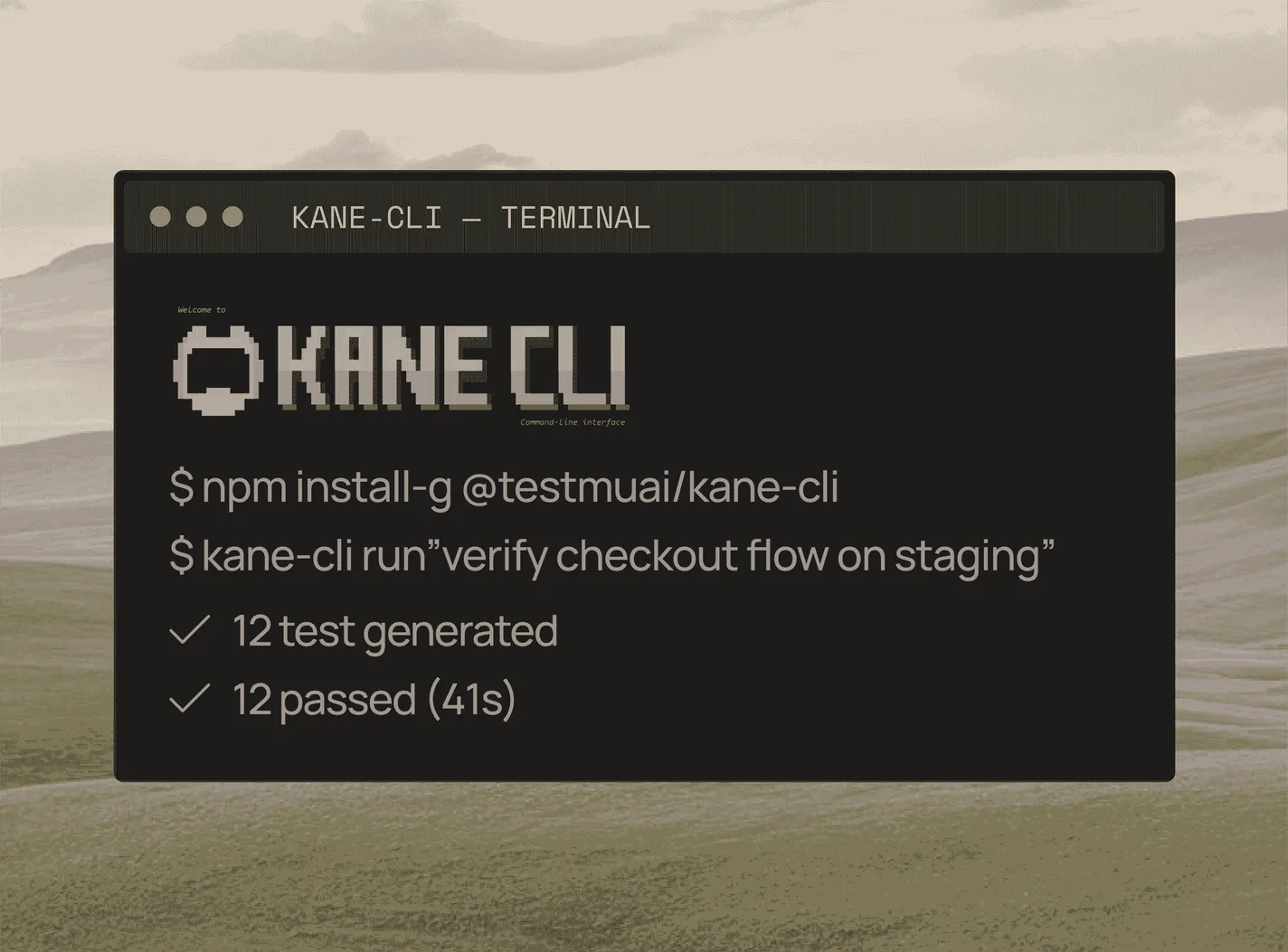
- Trigger on deploy via CI, where Kane CLI runs the same visual checks from your pipeline and returns a clean exit code when nothing shifted
- Alert on failure in Slack, with the baseline, the new render, and the highlighted diff attached, so anyone can see exactly what changed
When a visual test fails, you do not get a cryptic pixel-mismatch count at line 47. You get a plain-English reason for the exact step that failed. Anyone on the team can read it, open the diff, and decide whether it is an intended redesign or a regression to fix.
Try it on your own UI in 10 minutes
- Sign up for KaneAI free, with no credit card
- Paste your app URL
- Write your first visual check in plain English, or let KaneAI suggest one from your site
- Run it and watch KaneAI capture a baseline and flag anything that changes
Your UI is the first thing every user judges, and it is too easy to break to leave to a quick glance before release. Test it in the language you already speak. Once your visuals are covered, read how to test APIs without code to protect the data behind the screen, or how to test apps built with Lovable without code.

Note: Test your UI for visual regressions without writing a line of code. Start with KaneAI free.
Author

Parth Mistry
Blogs: 3

Parth Mistry is a Member of Technical Staff at TestMu AI, building SmartUI, the visual regression testing product. He developed and owns the SmartUI CLI, a modular TypeScript tool built on Playwright for multi-browser automation, and built the Storybook CLI for visual regression of UI components. He maintains cross-language SDKs in Python, Java, Ruby, C#, and Node.js, and engineered a Node-based visual rendering service on Kafka, Redis, MySQL, and S3. His migration of that service to an event-driven, KEDA-autoscaled architecture improved execution speed by 60% and cut annual infrastructure cost by $9,600. He also built the end-to-end SmartUI integration with KaneAI. Parth is a Google Summer of Code 2024 contributor and an alumnus of IIT Jodhpur.
Reviewer

Shahzeb Hoda
Reviewer
Shahzeb Hoda is the Associate Director of Marketing and a Community Contributor at TestMu AI, leading strategic initiatives in developer marketing, content, and community growth. With 10+ years of experience in quality engineering, software testing, automation testing, and e-learning, he has authored and reviewed 70+ technical articles on software testing and automation. Shahzeb holds an M.Tech in Computer Science from BIT, Mesra, and is certified in Selenium, Cypress, Playwright, Appium, and KaneAI. He brings deep expertise in CI/CD pipeline automation, cross-browser testing, AI-driven testing practices, and framework documentation. On LinkedIn, he is followed by 3,700+ engineers, developers, DevOps professionals, tech leaders, and enthusiasts.


Visual Testing FAQs
Did you find this page helpful?
More Related Blogs

TestMu AI forEnterprise
Get access to solutions built on Enterprise
grade security, privacy, & compliance
- Advanced access controls
- Advanced data retention rules
- Advanced Local Testing
- Premium Support options
- Early access to beta features
- Private Slack Channel
- Unlimited Manual Accessibility DevTools Tests