
Power Your Software Testing with AI Agents and Cloud
The Native AI-Agentic Cloud Platform to Supercharge Quality Engineering. Test Intelligently and Ship Faster.

- TestMu AI (Formerly LambdaTest)
- /
- Blog
- /
- Inside Replit's Self-Driving Company [Testμ 2026]
Inside Replit's Self-Driving Company [Testμ 2026]
Replit's CTO on the agentic loops behind a claimed tripling of output, why verification sits inside every one, and what replaces tests outside engineering.
Published on:
Tripling engineering output should have broken code review, quality or stability. That was the expectation, stated plainly by the person who did it.
His account is that none of it broke, and the reason is that review, maintenance, debugging, flake burndown, penetration testing and incident response were each rebuilt as a loop with verification inside it.
In this kenote session of the Testμ Conf 2026, Luis Hector Chavez, CTO of Replit, described seven months of that rebuild.
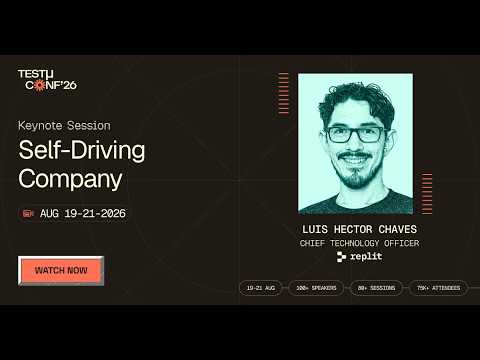
If you couldn’t catch all the sessions live, you can access the recordings at your convenience by visiting the TestMu AI YouTube Channel.
TL;DR
A self-driving company is one where agentic loops gather context, do the legwork and verify their own work before a human sees it, while humans still choose the destination and own the outcome. Verification is what makes it a loop rather than a generator: if the result cannot be checked, the loop has no way to know it is finished.
- What is a self-driving company? - Luis Hector Chavez defines it negatively first: a self-driving company is not one without people, because people still choose the destination. Humans set goals, exercise taste and take responsibility for outcomes, while agents gather context, do most of the work and iterate until their own verification passes.
- How much did Replit’s engineering output change? - Chavez says engineers nearly tripled code output over seven months, later restating it as throughput having tripled. It is a self-reported internal figure with no baseline, unit of measurement or methodology given on stage.
- Did quality collapse when output tripled? - No, on his account. Mean time between failures stayed mostly flat and mean time to mitigation decreased, which he credits partly to other interventions rather than to agents alone. No before-and-after numbers were shown.
- How do you stop code review becoming the bottleneck? - Turn review into a loop as well, which Chavez says kept review latency roughly flat. The coding agent and the reviewing agent get the same rules, and the reviewer is encouraged to find counter-examples whenever it asserts a correctness failure, so humans can see the evidence.
- Can an AI agent approve pull requests on its own? - Yes, under two conditions at Replit: the agent assesses each PR’s risk and may approve when the risk is small and the author already maintains that part of the codebase. Security, authorization and billing always require a second human reviewer.
- How did Replit finish a CSS migration that had failed before? - With one engineer producing 309 pull requests over two months, touching almost every file in the codebase. The agent ran snapshot tests on every PR to check for significant regressions, and Chavez claims no significant regressions rather than none at all.
- Can a loop fix a bug that stumped human engineers? - Chavez says a hard networking bug that had stumped several engineers since the previous year was solved by a loop that proposed multiple hypotheses, added observability where required, and ruled each one out until it found the root cause.
- How can flaky test maintenance be automated? - Replit runs a burndown loop every afternoon once the flake report arrives, producing pull requests already validated before an engineer attends to them. Chavez uses it to make the point that loops need not be one-shot.
- How is AI used for penetration testing at Replit? - Through a capture-the-flag harness giving an agent full control of a tightly locked-down sandbox, with no rules other than the goal of accessing information it should not have. Chavez says it found dozens of vulnerabilities, without naming a class or severity.
- Can an agent improve itself? - Yes, through a daily loop over traces containing an error, a slowdown or a poor human interaction. It clusters them, deep-analyses a few representative traces because analysing all of them would be infeasible, validates proposed prompt or tool changes against a published benchmark, then ships a PR with an A/B test and discards it if production does not show the effect.
- How do you verify agent work outside engineering, where there are no tests? - With a semantic layer, meaning a human-curated ground-truth knowledge base maintained by a team that writes rules and governance and categorises canonical sources. Every entry carries validation guidance, so an agent seeing a metric drop must correlate it with other events rather than jump to a conclusion.
- What is outcome maxing versus token maxing? - Token maxing optimises for AI token usage and treats volume as proof of productivity, which Chavez says Replit is decidedly not doing. Outcome maxing maximises results rather than steps and minimises time to outcome, which he notes correlates with lower spend.
Seven Months, Tripled Output
Chavez opens by saying that in the last seven months Replit drastically changed how engineering is run, crediting AI and coding agents in part for the shift.
He states that engineers have nearly tripled code output so far. That is an internal figure with no baseline, unit of measurement or methodology offered, and his own phrasing drifts later in the talk to a flat claim that throughput tripled.
His framing of the expected failure mode is the interesting part. Intuition said that tripling output should have completely broken down code reviews, quality or stability, and so far none of that has happened.
The two reliability metrics he cites are hedged. Mean time between failures has stayed mostly flat and mean time to mitigation has decreased, and he attributes the result partly to other interventions rather than to the agents alone. No before-and-after values accompany either.
His read on why it worked is about subtraction rather than generation: giving engineers extra capabilities and removing the slow parts of their workflows, so they could focus on delivering value and improving the product.
What Does Self-Driving Mean?
He claims the human role intensifies rather than shrinks, saying people are now more in charge than ever of what matters, and that they exercise taste and take responsibility for the outcomes.
He is careful to bound the coding claim. Agents remove most of the legwork within the realm of coding, and coding is not the only thing engineers do, since they spend most of their time on other activities.
The division of labour he proposes is that humans still set goals while agents gather context, do most of the work, and iterate until the work is done.
Speaking to a testing audience, he calls verification the part everything rests on: one of the most important parts of the setup is checking the results, doing verification at every single human-machine interaction.
Escalation is the safety valve. If the agent cannot solve the problem on its own it should escalate to a human whenever judgment is needed, so humans remain around the loop.
What actually makes a company "self-driving"?
— TestMu AI (@testmuai) August 21, 2026
Luis Hector Chavez (Replit) opened Day 3 of #TestMuConf 2026 with a clear framework: humans still set direction, choose the destination, and own the tradeoffs. Agents do the miles, gathering context, doing the work, checking results,… pic.twitter.com/xe3BXqcvlz
Anatomy Of A Loop
Agentic loops are, in his words, what the whole system is engineered around at Replit, and every example that follows is an instance of the same shape.
The loop starts with a human either posing a question or setting a destination, never with the agent self-initiating.
The agent then uses a combination of company-wide and local semantic layers to explore what is needed to reach the goal and make incremental progress toward it, so context comes from a shared curated substrate rather than from the prompt alone.
The verification strategy is itself treated as context. The semantic layer carries information that helps the agent come up with a good strategy to verify whether the goal has been reached, and the agent iterates until the verification passes.
He characterises the output as the result of a verifiable task, which is the practical test: if it is not verifiable, it is not a loop.
One framing note for anyone comparing this recap with the video’s chapter list. Chavez never numbers his loops and never says there are seven; that numbering is an editorial construct added afterwards.
Code Review As A Loop
Throughput tripled while code review latency stayed roughly flat, he says, because Replit turbocharged the review process with the same loop idea rather than only the coding part.
On tooling he says only that they evaluated multiple vendors and ended up integrating the review process with other internal tools and semantic layers. No vendor is named and no selection criteria are given.
The symmetry is the design point. The agent that codes and the agent that reviews both get the same rules and guidelines, so their expectations align.
One behavioural rule is worth stealing: the reviewing agent is encouraged to find counter-examples every time it asserts a correctness failure, which saves human review time and builds trust because reviewers can see the counter-examples.
Replit went further and let the agent assess the risk of every pull request, approving them where the risk is small and the author already belongs to the group responsible for maintaining that part of the codebase, since they already own the outcome.
He names the carve-outs where a second human reviewer is always required, being security, authorization and billing, where the stakes are significantly higher. He claims no increase in reverts or incidents, without data or a stated window.
The CSS Migration Loop
Broad, mechanical change is his clearest maintenance win, because loops are good for broad changes.
His worked example is a long-stalled CSS system migration that had been attempted a few times and failed due to the sheer amount of work needed. He does not say which CSS system or framework.
He lays out the three traditional funding paths it would have needed: a very large team of engineers, a top-down mandate to fund it, or an advanced tooling system to perform the migration at scale.
The headline is that it was done by a single engineer, producing 309 pull requests over two months, touching almost every file in the codebase.
The verification step is what made it safe in his telling, since the agent performed snapshot tests on every pull request to make sure the change did not cause significant regressions.
Worth noting what he does not claim. He never says zero regressions, only no significant ones, and gives no review or revert statistics for those 309 pull requests.

Note: Put a verification step inside every loop, not just at the end of the pipeline. Try TestMu AI now!
Deep Bugs And Flaky Tests
Loops also help with diving into very deep problems, and he cites a hard networking bug that had stumped several engineers since the previous year, solved by a loop.
The method is hypothesis elimination rather than one-shot fixing. The loop proposed multiple hypotheses about what could have gone wrong, went through each systematically, added observability where required, and ruled them out until it found and fixed the root cause.
He attributes that outcome specifically to self-verification, crediting the agent’s ability to perform validation on its own. The bug, the system and the root cause are all unnamed, so this is an anecdote rather than a case study.
On cadence he is explicit that loops do not need to be one-shot. Replit has been continuously burning down flaky unit and integration test maintenance.
The flake loop runs every afternoon once the flake report arrives, producing pull requests already validated before an engineer needs to attend to them, which automates the whole process. He gives no flake rate, no count of tests retired and no false-positive rate for those generated PRs.
Security And Incident Loops
For penetration testing, Replit built what he calls a very realistic capture-the-flag harness and gave the agent full control over a tightly locked-down sandbox.
The rules of engagement were deliberately minimal: no rules other than the goal to access information the agent should not have access to.
Verification is again the point. Giving the agent the ability to verify it had actually succeeded in breaking a system found dozens of vulnerabilities, which he says were fixed before external attackers attempted them. That second half is not something anyone can verify, and no vulnerability class or severity is described.
On incidents, an agent is automatically dispatched every time one occurs, to look at everything that has changed recently and give engineers suggestions for mitigation.
He credits two context sources for that agent: access to the codebase, and a large corpus of company-wide knowledge.
His comparative claim is that the system matched other vendors’ quality at a tenth of the price. No vendor, benchmark or pricing is named, so it stands as his assertion about unnamed competitors.
The Self-Improving Agent
He calls continual self-improvement the piece that brings everything else together, since Replit put a loop around improving its own agent.
The daily trigger is narrow and behavioural. The loop goes through that day’s agent execution traces that encountered an error, a slowdown or a suboptimal human interaction, which he glosses as the human complaining about something.
It then clusters those traces by facets where commonalities exist and performs deep analysis on a few representative traces, because analysing every production trace would be infeasible and expensive.
He calls the next step the second, harder half of the loop: finding inefficiencies in those traces and proposing improvements to either the prompts or the tools.
Validation runs against a benchmark Replit publishes, whose name is not recoverable from the recording. If there are no regressions, a pull request with an associated A/B test is proposed to run the next day.
The kill criterion is production evidence. If the desired effect appears in production the change is adopted, and otherwise it is discarded and a new run happens.

Beyond Engineering
He frames the expansion as a mission-driven bet, asking why only engineers should have these capabilities.
He concedes engineering was the easy half, since the picture for improving software engineering is significantly easier to imagine, with more well-trodden paths and existing literature.
The gap he names for everyone else is a missing oracle. Engineering teams have traditionally relied on unit and integration tests to ensure the product behaves as intended, and the other functions have no equivalent.
His answer is the semantic layer, a human-curated ground-truth knowledge base for the rest of the company.
It is staffed rather than emergent. A team writes rules and governance for the shared definitions, categorises the canonical sources of truth, and maintains vetted paths for getting data.
He names the failure mode that keeps him honest about quality: the knowledge base is not static, and if the agent starts giving wrong answers, internal users stop using the system.
In-Loop Validation Guidance
His first quality mechanism is immediate validation, which for the semantic layer means guidance on how the agent should validate its own assertions.
That guidance is concrete tooling plus evidence discipline: tools to reach other related data sets, guidance to get the vetted grounding evidence, and reporting that evidence together with the final results.
Coverage is per-entry rather than global, since every item in the semantic layer carries this guidance.
His worked example is a metric drop. If the agent sees a drop in a key metric it should always correlate that drop with other events, so it does not jump to the wrong conclusion.
He enumerates the rival explanations the agent has to consider: the drop may be a data issue and should be reported as such, there may have been an incident, or a product change may have pushed another metric up instead.
The purpose is human judgment rather than autonomy, because all that information is what lets a human contextualise the result.
Humans Around The Loop
He states the constraint plainly: humans cannot be part of each individual loop, because that would be antithetical to a self-driving company, and humans still need to be involved around the loop somehow. That is a claim about not gating every loop, not about removing people.
The middle ground Replit found is a second-order loop, with agents performing a daily sweep of the system’s outputs, much like the agent self-improvement loop.
That sweep proposes corrections from discrepancies between data sources and human feedback, along with escalations to humans for help.
Human effort collapses to review. People now only need to validate the corrections in the form of pull requests against the semantic layer repository, so governance knowledge is version-controlled like code.
He argues the trust effect compounds, since every merged correction compounds trust and employees know errors are quickly corrected.
The distribution argument is his sharpest. In a traditional model, one human knowing about a correction means only that human avoids the issue next time, while a company-wide semantic layer gives every employee the benefit almost immediately, and removes the situation where different people answer the same question differently.
Outcome Maxing
He defines the anti-pattern by name. Token maxing is optimising for AI token usage and treating volume as proof of productivity, and he says Replit is decidedly not doing that internally.
The alternative is outcome maxing, maximising results rather than the steps to get to them, which he argues is better aligned because results drive value rather than the spending needed to reach it.
He explicitly reframes cost as a by-product rather than a target, wanting to minimise time to outcome, which correlates with less spend.
Verification is the precondition for the whole model. The system cannot determine it has reached an outcome without a way to measure it, and measurements used often enough become company-wide guardrails and a way to prevent regressions.

His closing position is that the most effective people are those who help the system come up with validation strategies that can be built quickly and reused. He hedges it too, saying it is not fully automated yet, and that loops designed by people who think in quality produce significantly better results. He ends by saying Replit plans to release this as a product soon, without naming it or giving a date.
This session was part of Testμ Conf 2026, which ran across three days of sessions on agentic engineering and quality. Registrations for the next edition are already open on the Testμ Conference 2027 page.
Author

TestMu AI
Blogs: 292


TestMu AI is World's First Full Stack AI Agentic Quality Engineering platform that empowers teams to test intelligently, smarter, and ship faster. Built for scale, it offers a full-stack testing cloud with 10K+ real devices and 3,000+ browsers. With AI-native test management, MCP servers, and agent-based automation, TestMu AI supports Selenium, Appium, Playwright, and all major frameworks. AI Agents like HyperExecute and KaneAI bring the power of AI and cloud into your software testing workflow, enabling seamless automation testing with 120+ integrations. TestMu AI Agents accelerate your testing throughout the entire SDLC, from test planning and authoring to automation, infrastructure, execution, RCA, and reporting.


Did you find this page helpful?
More Related Blogs

TestMu AI forEnterprise
Get access to solutions built on Enterprise
grade security, privacy, & compliance
- Advanced access controls
- Advanced data retention rules
- Advanced Local Testing
- Premium Support options
- Early access to beta features
- Private Slack Channel
- Unlimited Manual Accessibility DevTools Tests