
Power Your Software Testing with AI Agents and Cloud
The Native AI-Agentic Cloud Platform to Supercharge Quality Engineering. Test Intelligently and Ship Faster.

- TestMu AI (Formerly LambdaTest)
- /
- Blog
- /
- Best AI Mobile App Testing CLI in 2026: Verification vs Automation
Best AI Mobile App Testing CLI in 2026: Verification vs Automation
Compare 6 AI mobile app testing CLIs on what each returns to CI: device state, screenshots, or a pass/fail verdict. Verified commands, real runs, honest limits.
Last Updated on:
The best AI mobile app testing CLI is Kane CLI, and the qualifier that matters is testing. Every coding agent can drive a phone now. Almost none of them can tell you whether the build is correct.
Mobile MCP servers hand any agent an emulator and a simulator. Appium drives every platform worth shipping on through WebDriver. Google made the Android Studio toolchain callable from any terminal. What none of them return is a verdict, and mobile is the worst category in software to be missing one.
The six CLIs below are ranked by how far each one gets past device control, and I checked every command against the vendor’s own live documentation before ranking it.
TL;DR
The best AI mobile app testing CLI depends on whether you need the device driven or the result judged. For a verdict a pipeline can gate on, Kane CLI by TestMu AI exits 0 on pass and 1 on fail against a local simulator or emulator. For deterministic flows a human writes and maintains, Maestro is the cleanest format in mobile.
- Best evidence-backed verdict in CI: Kane CLI by TestMu AI turns a plain-English objective into an exit code, an NDJSON event stream and a sealed evidence pack that records the device model and OS version. Runs mobile tests on Windows or Linux: no, macOS Apple Silicon only.
- Best fit for an existing suite: Appium is the WebDriver-based automation ecosystem most of this category already runs on, spanning iOS, Android, browsers, desktop and TV through swappable drivers. Ships its own assertions or test runner: no.
- Best native toolchain access for agents: Google Android CLI 1.0 lets any agent run semantic analysis, render Compose previews and execute UI tests without opening the IDE. Cross-platform: no, Android only.
- Best local build-test-fix loop: Claude Code paired with a mobile MCP server reads real UI elements and returns structured accessibility snapshots, so a crash found on the emulator gets fixed in the same session. Generates reusable test cases: no.
- Best deterministic reusable flows: Maestro defines user journeys as declarative YAML and drives the device through the accessibility tree, absorbing flakiness with automatic waits so no manual sleep calls are needed. Works on React Native and Flutter: yes.
- Best plain-English Android device agent: ARTEMIS by Google turns one instruction into device actions, reading the accessibility tree, OCR and vision models to locate elements, and installs as an MCP server for Claude Code, Antigravity or Windsurf. Covers iOS: no, Android only.
Scale is where the ranking gets uncomfortable. Kane CLI mobile runs target local virtual devices on one Mac, so real-device breadth comes from TestMu AI App Automation across 10,000+ real Android and iOS devices rather than from the CLI itself.
What Separates Mobile Automation From Mobile Verification?
Automation answers whether the device did the thing. Verification answers whether the app is correct, whether you can prove it, and whether you will catch the same defect when it returns on next week’s build. Every tool in this article automates. One of them verifies.
Mobile widens that gap rather than narrowing it, because there is no single runtime to be right about. Apple runs the tighter of the two ecosystems, and even there the spread is real.
Apple’s own App Store measurement put 79% of all iPhones on iOS 26 as of 7 June 2026.
Android is far looser. Statcounter put the most-used version, Android 16, at 25.99% in August 2026, with six versions still holding meaningful share.
A run that proves nothing on one emulator is thin evidence against a spread like that. Five specific things separate a device-control run from a verification run.
- No verdict - a screenshot of a simulator and a clean logcat are not a pass or a fail. Without an exit code there is nothing for a pipeline to gate on, so a human still has to look and decide.
- Nothing accumulates - the session is ephemeral. Tomorrow the agent re-derives the same taps from scratch, no regression suite forms, and the login flow that broke on last month’s OS point release can break again unnoticed.
- The agent grades its own homework - when the same system writes the Swift or Kotlin, plans the check and reports the outcome, it carries one set of assumptions through all three. An agent that misread the requirement writes a check that misreads it identically.
- Review aids are not audit evidence - screenshots in a chat scroll or a session folder are not tied to a requirement, not addressable, and not something you hand a compliance reviewer six months later. For banking and health apps that gap is disqualifying.
- One machine is the ceiling - one simulator, your Xcode version, your adb. No device matrix, no real hardware, no parallel execution, and no separate dev, staging and production builds.
The same five gaps shape the browser side of this category, which the best AI browser testing CLI comparison ranks on identical criteria.
The Mobile Verification Maturity Ladder
Every tool here sits on one of five rungs. The rung is set by what comes back when the run ends, not by how good the device control is, and it is the heaviest input into the ranking further down.
| Level | What happens at the end of a run | Tools on this rung |
|---|---|---|
| 0 | The agent taps around a simulator and says it looks fine | Any chat agent with a mobile MCP |
| 1 | The device is driven and structured output comes back | mobile-mcp, Android CLI |
| 2 | Artifacts are produced for a human to review | Claude Code with a mobile MCP, ARTEMIS |
| 3 | An independent system returns a verdict with evidence, in CI | Kane CLI |
| 4 | The suite accumulates and reruns on every change | Kane CLI, Maestro, Appium |
Levels 1 and 2 are where the mobile agent ecosystem sits today, and that is not a criticism. Those tools were built to let an agent see and touch a phone, and getting there took years of WebDriverAgent, adb and provisioning-profile work.
Rung 4 is reachable two ways, and the difference is who writes the test. Maestro and Appium get there on assets an engineer authored and maintains. Kane CLI gets there on an objective stated in English, which is the only route that does not spend engineering hours per flow.
How I Evaluated These AI Mobile App Testing CLIs
Every command, flag and capability below was checked against the vendor’s own live documentation in September 2026, not recalled from memory. Where a claim could not be confirmed on the vendor’s pages it was cut instead of softened, which is why no token-efficiency figures appear in the Android CLI entry. The write-ups turn on nine questions.
- Native verdict and exit code - does the tool decide pass or fail, or do you?
- Reusable test asset - does anything survive the session and become a regression suite?
- Independence from the coding agent - is the judge a different system from the author?
- Auditable evidence - can someone reconstruct why it passed, months later?
- Scale - real hardware, an OS matrix and parallel execution beyond one machine.
- Cross-platform authoring - does one test cover iOS and Android, or does every flow live twice?
- Agent-native invocation - an installable skill, an MCP server, or a documented event stream.
- Friction before the first run - what has to exist before the tool does anything useful.
- Portability - what you keep if you stop using the tool.
TestMu AI builds one of the six, so treat that entry as the interested party it is. The honest way to read the ranking is to check it against the table, and the fairest thing I can show first is where Kane CLI refuses to work at all. This is the real output from the Windows machine I wrote this article on, after upgrading to the current release.
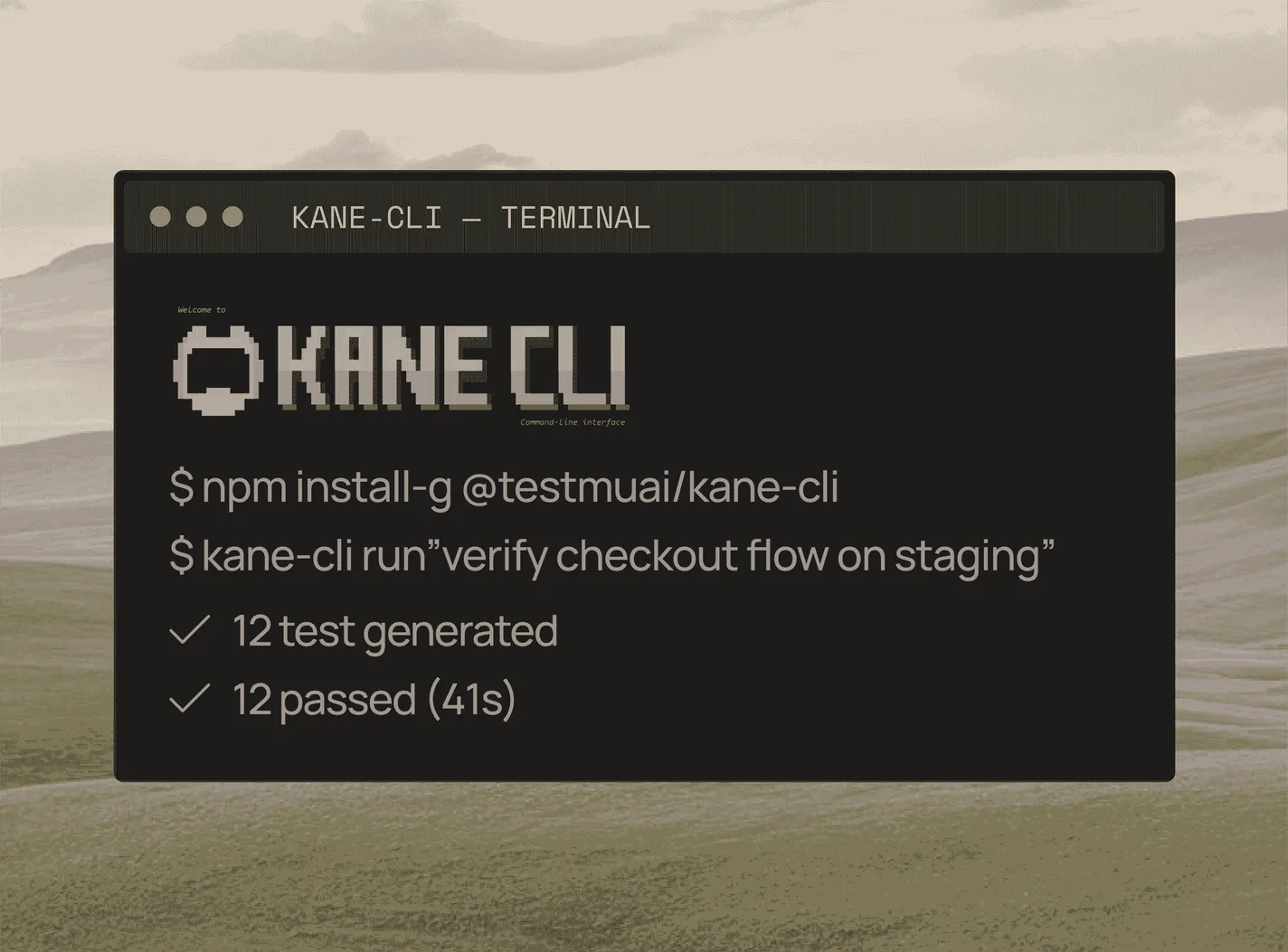
$ npm install -g @testmuai/kane-cli@latest
$ kane-cli --version
0.8.10

$ kane-cli doctor
error: mobile runs are supported on macOS (Apple Silicon) only - detected win32/x64.
No mobile CLI in this comparison is that narrow about its host. The same binary confirms the target switch that the mobile documentation describes, and the browser target is unaffected on every platform.
$ kane-cli run --help
  --target <name>   Where to run: desktop | emulator | simulator
                    (default: the saved session target)
That one constraint moves Kane CLI from first to last on the scale criterion, and the ranking below is what survives once it is priced in.
What Are the Best AI Mobile App Testing CLIs?
The six below are ranked on the nine criteria above, weighted toward what survives the session and what a pipeline receives when the run ends. The table maps each one to what it is and what CI actually gets back, and the write-ups follow in the same order.
| Tool | What it is | Native verdict | Reusable asset | Independent judge | What CI receives |
|---|---|---|---|---|---|
| Kane CLI | AI mobile and browser verification CLI | Yes | Committable test files | Yes | NDJSON, exit code, evidence pack |
| Appium | WebDriver automation framework | Partial | Your own test code | Yes | Your runner’s exit code |
| Google Android CLI | Agent access to the Android toolchain | Partial | Your instrumentation tests | No | Build output, analysis results |
| Claude Code + mobile MCP | Coding agent with device control | No | No | No | Accessibility snapshots, screenshots |
| Maestro | Declarative YAML flow runner | Partial | Your own YAML flows | Yes | Flow result, recordings |
| ARTEMIS | Natural-language Android automation agent | Partial | Your own Python SDK scripts | No | Session transcript, replay, optional report |
One row earns a machine-readable verdict from a plain-English objective. Two more gate a pipeline on assertions someone already wrote, which is a different and perfectly respectable job.
1. Kane CLI by TestMu AI
Kane CLI is the only tool in this comparison built as a verification layer rather than a control layer, and the only one where a mobile test starts as a sentence rather than a file. It takes the top slot because it answers all five gaps in section one, and TestMu AI builds it, so weigh that placement against the table rather than the byline.
The mobile target is a recent addition to a browser tool, and it shows in the scope. Full setup and flag coverage lives in the Kane CLI mobile testing documentation, and the wider command surface is on the Kane CLI page.
- A real verdict - the CLI exits 0 on pass, 1 on fail, 2 on setup or auth errors and 3 on timeout, so a failed check fails the build with no glue code.
- One objective, both platforms - the same sentence runs against
--target simulatoror--target emulator, against the “every flow lives twice” tax that defines Espresso and XCUITest shops. - It owns the device lifecycle - after a one-time
kane-cli doctor --installit discovers the device, boots it, installs your app and runs the test, so you never boot a simulator or run adb by hand. - Evidence that names the hardware - the result summary records the device model and OS version in the run environment, and per-step logs carry device logs from the emulator or simulator.
- Something that accumulates - objectives become committable test files that live in the repo and rerun, so coverage compounds instead of resetting each session.
- Human-in-the-loop that does not hang CI - the ask tool pauses for an OTP or a consent screen interactively and auto-disables when stdin is not a TTY, which matters more on mobile than anywhere else.
A mobile run needs three things: a target, an app and a device. The simulator target accepts a .zip build, the emulator target accepts an .apk, and both accept an uploaded app id.
npm install -g @testmuai/kane-cli
kane-cli login
kane-cli doctor --install

kane-cli run "Sign in and open the account tab" --target simulator --app ./builds/MyApp.zip
kane-cli run "Add the first item to the cart" --target emulator --app ./builds/app-debug.apk
Where it stops. Mobile testing is macOS on Apple Silicon only, so an Intel Mac, a Linux runner or a Windows box is out. Pointing a mobile run at a website is not supported yet, and you supply the virtual device yourself: Xcode 16 or newer for iOS, or Android Studio plus an arm64-v8a AVD. A non-interactive run also needs a device already set, or it exits and prints the fix.
Pick it when an engineer or an agent should be able to state a mobile objective and have an independent system plan it, run it, judge it, prove it and repeat it in CI, and your build machines are Macs.

Note: Turn a plain-English objective into a mobile run that exits 0 or 1 and seals an evidence pack with the device model and OS version. TestMu AI gives you Kane CLI credits on signup. Try it free!
2. Appium
Appium is the execution layer most of this category runs on, including parts of the AI tooling stacked above it. It describes itself as an open-source project and ecosystem of related software designed to facilitate UI automation of many app platforms, built around swappable drivers, clients and plugins.
Its span is why it survives every wave of replacements: mobile across iOS, Android and Tizen, browsers, macOS and Windows desktops, and TV systems including Roku, tvOS, Android TV and Samsung, spoken through the WebDriver protocol and its relatives.
- Language freedom - clients exist for every mainstream language, so the test lives in the stack your team already staffs.
- Driver architecture - each platform arrives as a swappable driver, which is how one API reaches phones, desktops and set-top boxes.
- Grid compatibility - it is the protocol nearly every device cloud accepts, which makes it the safest bet for portability.
- Agent-reachable - driving Appium from an MCP server is now a normal workflow, which our Appium MCP debugging guide walks through, and the Appium tutorial covers the fundamentals.
Where it stops. It is a framework, not a system. The documentation does not indicate built-in assertions or a test runner, so you author, you assert, you triage and you maintain. That maintenance burden is the reason this article’s category exists at all.
Pick it when you have significant existing Appium infrastructure and language-specific test code you intend to keep. To run that code headless, the guide to mobile app testing from the command line covers the Appium 3 server, drivers, and real-device runs from a terminal or CI job.
3. Google Android CLI with Antigravity
Android CLI reached stable 1.0 at Google I/O 2026, and it is the only entry here that gives an agent real toolchain access instead of screen access. Google describes it as a lightweight interface for AI agents to perform tasks and retrieve knowledge about Android development, naming Gemini in Android Studio, Antigravity, Claude Code and Codex among the agents it serves.
The commands are the interesting part, because they operate on the source and the build graph instead of the screen. An agent can call analyze-file to find errors and warnings using editor inspections, find-usages to trace references across a project, and render-compose-preview to render Compose UI, all without opening the IDE.
winget install -e --id Google.AndroidCLI
android init- Semantic analysis -
analyze-fileandfind-declarationgive an agent the same static understanding the IDE has, instead of guessing from source text. - Project lifecycle - creating projects, building, and deploying to virtual devices all happen from the terminal.
- Agent-agnostic - any agent that can execute shell commands works with it, which is a better distribution model than a plugin.
Where it stops. It is Android only, so every cross-platform team keeps a second stack. It runs the instrumentation tests you already wrote, which means the same platform writes the code, plans the check and grades it. Google’s own announcement carries no published token-efficiency or speed figures, so the numbers circulating in secondary coverage are not sourced here.
Pick it when you are Android-only and want agents working through the native toolchain instead of the screen.
4. Claude Code with a Mobile MCP Server
This is the tightest local build-test-fix loop available to an app developer in a terminal. mobile-mcp describes itself as an MCP server enabling scalable mobile automation through a platform-agnostic interface, letting agents interact with native iOS and Android apps through structured accessibility snapshots or coordinate-based taps.
The detail that makes it more than a screenshot clicker is that it reads real UI elements and returns structured, deterministic output rather than leaning on a vision model for most interactions. It reaches iOS simulators, Android emulators and USB-connected physical devices on both platforms, and works with Claude Code, Codex, Gemini and other MCP clients.
- Twenty-four documented tools - device and app management, screen interaction, text input, device logs, crash reports and batch command execution.
- Crash reach - access to device logs and crash reports is what closes the loop between a failed tap and the line of code that caused it.
- Cloud device tools - authenticate, list, allocate and release remote devices, so the loop is not strictly local.
- One install, any agent - it is an MCP server, so one setup serves whichever coding agent you standardise on.
Where it stops. It is documented as device automation and interaction only, with no built-in assertions and no test generation. Nothing persists as a rerunnable asset, nothing gates a merge, and the agent judging the result is the agent that wrote the code.
Pick it when you want a fast check on the simulator while you build, and nothing needs to survive the session.
5. Maestro
Maestro is the best flow-definition format in mobile, and the one artifact on this list a human and an agent can both read comfortably. It calls itself an open-source UI automation framework for mobile and web with built-in tolerance, zero-wait intelligence and declarative YAML syntax.
The design decision that earns the placement is what it refuses to touch. Maestro operates at “arm’s length”, piloting the device rather than the app, through the same accessibility layer real users rely on, so one flow covers native, React Native and Flutter without platform-specific test code.
- Built-in tolerance - it embraces the instability of mobile devices by automatically handling flakiness and UI settling, which is a deliberate answer to the flakiest tests in software.
- Zero-wait intelligence - it waits for network content and animations on its own, so manual
sleep()calls disappear from the flow. - System-wide control - because it pilots the device, it reaches permission dialogs, notifications and system settings that live outside the app.
- Idiomatic commands -
scrollUntilVisiblemimics a human visual search instead of requiring brittle coordinate logic.
Where it stops. It executes what you already wrote. Assertions, coverage and judgment stay with you, so a YAML file full of tap commands is automation with better ergonomics. Our Maestro mobile testing walkthrough covers the flow syntax and where the cloud runner fits.
Pick it when you want deterministic, human-readable flows and you are happy owning the assertions and the maintenance.
6. ARTEMIS by Google
ARTEMIS is Google’s Android automation agent, which translates natural-language commands into reliable Android automation. It automates end-to-end workflows, captures logs, and integrates seamlessly with AI coding assistants such as Antigravity, Codex, and Claude Code.
The ARTEMIS repository reports 99%+ task completion on Google Research’s AndroidWorld benchmark, which spans more than 100 multi-step tasks.
- Two execution profiles - Flash is a reactive, token-efficient loop at roughly 3 to 5 seconds per step with no planning overhead, and Pro is a multi-agent graph at roughly 15 to 40 seconds per step.
- A planner that writes checks - the Pro profile keeps a living Markdown task plan with milestones and
verifyandassertcheck items, and every action passes a pre-execution safety net before it runs. - Layered element targeting - element indices first, coordinates second, visual location third, which is what keeps a run alive on a custom-rendered screen.
- MCP native -
uv run artemis mcp --installwires it into Antigravity, Claude Code, Windsurf, Codex, Cursor and VS Code, so the device becomes a tool the agent you already run knows how to call. - Model choice - the repository lists Gemini, Claude, GPT-4o and Qwen-VL as supported multimodal backends, so the perception layer is not tied to one vendor.
You host it yourself. The project clones and starts from one script on macOS and Linux, needs Python 3.12 or newer, and ships under Apache 2.0.
git clone https://github.com/google/artemis.git && cd artemis
./start.sh

uv run artemis run "Open Settings, find Battery and tell me current level" --profile flash
uv run artemis ui
Where it stops. Android only, with iOS listed as a roadmap item rather than a shipped target. The repository documents no exit-code contract, so the result lands as a succeeded boolean that your own pytest assertion grades, and the system that planned and drove the run is also the one verifying it. The Flash profile drops the safety net, checkpoint verification, the final report and ADB shell access, so the fastest profile is also the one with the least evidence behind its result.
Pick it when your target is Android, you want an agent that can drive a screen no accessibility tree describes, and you are willing to own the assertion layer on top.
Limits of Kane CLI and Better-Fit Alternatives
A roundup that lands on the author’s own tool for every job has stopped being a roundup. On mobile the honest list of situations where something else wins is longer than it was on the browser side, because the mobile target is newer and narrower.
- Your build machines are not Macs - this one disqualifies the tool outright. Mobile runs need macOS on Apple Silicon, so a Linux CI runner or a Windows workstation rules Kane CLI out entirely for mobile, and Maestro or Appium is the answer.
- You need real devices, not virtual ones - Kane CLI mobile targets a local simulator or emulator. Firebase Test Lab and AWS Device Farm run physical hardware, and that difference decides bugs involving chipsets, radios and thermal behaviour.
- You are testing a mobile website - pointing a mobile run at a website is not supported yet, so mobile web belongs on a browser grid.
- Fast inner-loop checks - a mobile MCP server with Claude Code answers in seconds while you are mid-build. A planned, executed and evaluated run does more work than a logcat read needs.
There is also a friction point worth stating plainly. Maestro and Appium run with nothing to sign up for, while Kane CLI ties execution to a TestMu AI account. If a zero-account first run matters more than a verdict, start elsewhere.
The scale gap is answered elsewhere in the platform. Real-device breadth at TestMu AI lives in App Automation, which runs Appium, Espresso, XCUITest and Detox suites across 10,000+ real Android and iOS devices with parallel execution and automatic session artifacts, backed by the real device cloud. Running a fast local verdict on the emulator and a broad matrix on real hardware is the normal split, not a failure.
Picking an AI Mobile App Testing CLI by Use Case
Map your situation to a row and stop reading. The right answer changes with what has to happen after the run ends and with what your CI machines are, not with which device layer is underneath.
| What you are trying to do | Use this | Because |
|---|---|---|
| Gate a merge on a mobile check, on Mac runners | Kane CLI | Exit codes 0, 1, 2 and 3 map directly to pipeline outcomes |
| Gate a merge on Linux or Windows runners | Maestro or Appium | No host restriction, and both return a runner exit code |
| One test objective covering iOS and Android | Kane CLI | The same sentence runs against simulator and emulator targets |
| Check the app while you are building it | Claude Code with a mobile MCP | Structured accessibility snapshots plus crash logs in one session |
| Deterministic scripted flows a human maintains | Maestro | Declarative YAML with built-in tolerance and no account |
| Keep a large existing mobile suite | Appium | Every language and nearly every device cloud already speaks it |
| Android-only work inside the native toolchain | Google Android CLI | Semantic analysis and Compose previews without the IDE |
| Drive an Android screen with no usable accessibility tree | ARTEMIS | Element indices, OCR and vision models fall back to each other |
Two rows point at the same tool, and that reflects how the category actually splits. Gating a merge and authoring a suite from an objective are the two jobs that need an independent judge, and only one tool here was built to be one.
Conclusion
Start by checking what your CI machines are, because on mobile that single fact eliminates more options than any feature comparison. Mac runners open the whole list; Linux or Windows runners narrow it to Maestro and Appium before you compare anything else.
If you are on Apple Silicon, install Kane CLI with npm install -g @testmuai/kane-cli, run kane-cli doctor --install once, then point a single objective at a build you already trust and read the exit code. The three Kane CLI modes guide covers moving that command from your terminal into a pipeline.
Then decide where the local verdict stops and real hardware starts. An emulator that proves a flow works is worth having on every merge; the six versions of Android still in meaningful use are what the device matrix is for, and those are two different budgets.
Testμ 2026 covered this from several directions, in Local Agentic Theory for Accessible Mobile Games, Bringing Mobile App Validation in the Agentic Loop and AI in Mobile QA: What Actually Works Today?.
Author

Sai Krishna
Blogs: 23

Sai Krishna is Director of Engineering at TestMu AI, where he leads agentic AI for quality engineering, building AI agents that autonomously drive mobile and conversational test automation. His current focus is Agent Testing and Model Context Protocol (MCP) support for mobile. He is a core contributor and member of the Appium open-source project and the creator of AppiumTestDistribution and appium-device-farm. With over 14 years of experience including more than 9 years at Thoughtworks as a Principal Consultant, he holds a BSc in Electronics and speaks regularly at TestMu and Appium Conf on Appium, mobile automation, and agentic AI in testing.
Reviewer

Navin Chandra
Reviewer
Navin Chandra is a Member of Technical Staff at TestMu AI, building the open-source automation that powers its Selenium and Appium cloud grid. A committer to both Selenium and Appium, he implemented WebDriver BiDi support in Selenium for real-time browser events and bidirectional control and is developing Apple's iOS RemoteXPC protocol in Appium to enable low-level wireless communication with iOS system services. He contributes to Selenium across multiple language bindings as a member of the Selenium GitHub organization. He has served as a Google Summer of Code mentee and mentor at openSUSE and an LFX mentee at CNCF's KubeArmor, and is a SUSE Certified Deployment Specialist. Navin holds a B.Tech in Computer Science.


AI Mobile App Testing CLI FAQs
Did you find this page helpful?
More Related Blogs

TestMu AI forEnterprise
Get access to solutions built on Enterprise
grade security, privacy, & compliance
- Advanced access controls
- Advanced data retention rules
- Advanced Local Testing
- Premium Support options
- Early access to beta features
- Private Slack Channel
- Unlimited Manual Accessibility DevTools Tests