
E2E Testing for Chat, Voice, Phone and Video AI Agents
Run Thousands of Test Scenarios against Your Agent and Catch Hallucinations, Bias, and Toxicity Before Users Do.

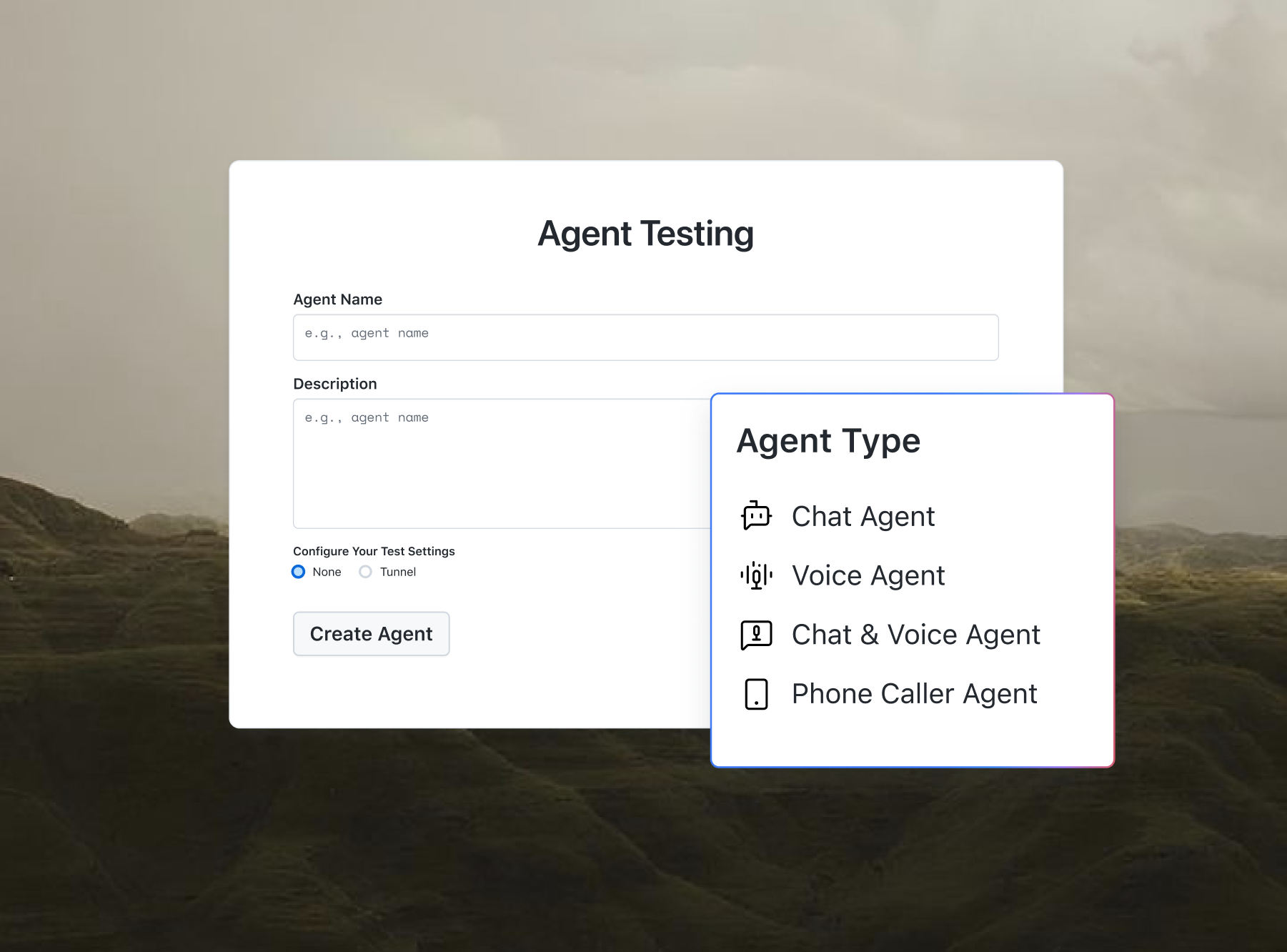
AI Companies to Know in 2026: 60+ Leaders Grouped by What They Actually Do
A current list of 60+ AI companies grouped by what they do: model labs, chips, cloud, data, coding, apps, testing and vertical AI. Facts as of Nov 2026.
Published on:
The most important AI companies in 2026 are OpenAI, Anthropic, Google DeepMind, Meta and xAI (now part of SpaceX) for frontier models, NVIDIA for chips, and Microsoft, Amazon and Google Cloud for enterprise AI platforms. This list groups 60+ AI companies by what they do, checked as of November 2026.
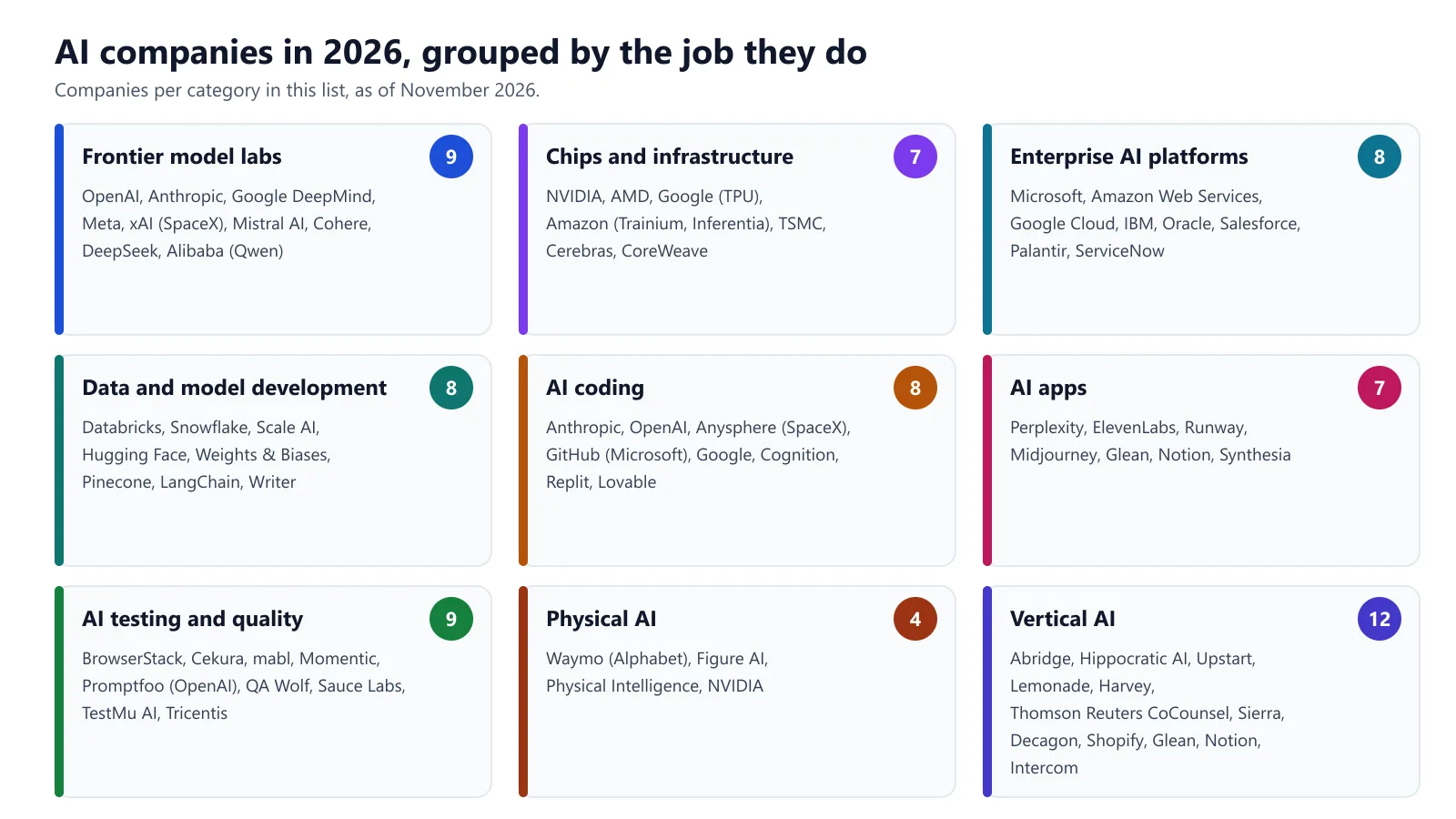
A ranked "top 10" hides the useful question, which is "which company do I use for this job?" So this list is grouped by category.
Within each category, order is alphabetical or by scale, not a quality ranking. Ownership changed a lot in 2026, so we start with that.
TL;DR
The top AI companies in 2026 group by layer: frontier labs such as OpenAI and Anthropic train the models, chipmakers and clouds run them, and data, coding, app, testing and industry companies build products on top. This list groups 60+ of them by what they do, with facts checked as of November 2026.
Top AI Companies by Layer in 2026
- OpenAI: Frontier model lab that makes ChatGPT, the GPT-6 models and the Codex coding agent. Publicly traded: no; OpenAI has submitted a confidential draft S-1 but has not set a date.
- Anthropic: Frontier model lab that makes the Claude models and the Claude Code coding agent. Publicly traded: yes, on the Nasdaq Global Select Market under the ticker ANT since November 19, 2026.
- Google DeepMind: Frontier model lab inside Alphabet that makes the Gemini models, which businesses buy through Google Cloud's Gemini Enterprise Agent Platform. Publicly traded: yes, through Alphabet.
- NVIDIA: Chip and infrastructure company that designs GPUs and the CUDA software platform used to train and run AI models, and has agreed to buy Hugging Face. Publicly traded: yes.
- Microsoft: Enterprise AI platform company that sells Microsoft Foundry (formerly Azure AI Foundry), Microsoft 365 Copilot and, through GitHub, GitHub Copilot. Publicly traded: yes.
- SpaceX: Space company that became an AI owner in 2026 by buying xAI, the maker of Grok, and Anysphere, the maker of the Cursor code editor. Publicly traded: yes, since June 2026.
- TestMu AI: AI testing company, and the publisher of this list, that tests web and mobile apps and the chat, voice, phone, video and image agents built on frontier AI models before they reach users. Publicly traded: no.
What Changed Among AI Companies in 2026?
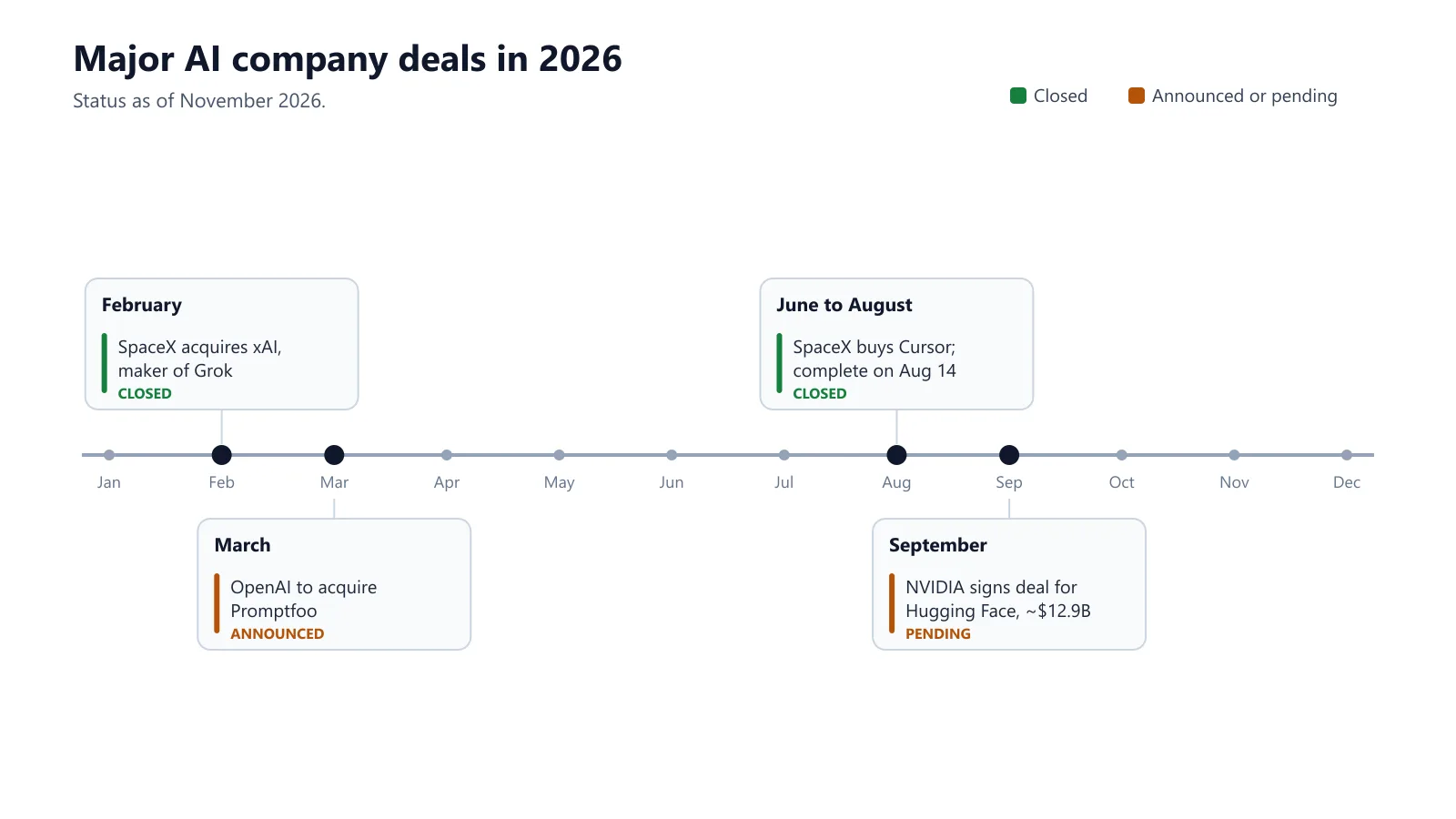
Consolidation was the story of 2026. These deals are confirmed by the companies or by primary filings:
| Date | Deal | Why it matters |
|---|---|---|
| Feb 2026 | SpaceX acquired xAI (maker of Grok) | A frontier model lab now sits inside a launch and satellite company |
| Mar 2026 | OpenAI announced it would acquire Promptfoo, an open-source AI red-teaming and testing tool | Model labs are pulling AI security testing in-house |
| Jun-Aug 2026 | SpaceX agreed to buy Anysphere, maker of Cursor, in a $60B all-stock deal; Cursor said the acquisition was complete on Aug 14, 2026 | A popular AI code editor is now owned by a company with its own model (Grok) |
| Sep 2026 | NVIDIA signed a definitive agreement to acquire Hugging Face for about $12.9B | A major open-model hub is moving under an AI chipmaker |
Earlier deals still shape the market: Meta invested about $14.3B for a 49% stake in Scale AI in June 2025 and hired its CEO to lead its superintelligence group, and Cognition (maker of Devin) acquired Windsurf in July 2025.
What this means for buyers: check who owns a tool before you sign a multi-year contract. The owner decides which models a tool favors, where data is processed and what the roadmap looks like.
Which AI Companies Build the Frontier Models?
Frontier labs train the large general models other companies build on.
| Company | Founded | HQ | Flagship products | Notes (as of Nov 2026) |
|---|---|---|---|---|
| OpenAI | 2015 | San Francisco | ChatGPT, GPT models, Codex | One of the most widely used consumer AI products; also sells API and enterprise plans |
| Anthropic | 2021 | San Francisco | Claude models, Claude Code | Strong in enterprise and coding use |
| Google DeepMind | 2010 (part of Google since 2014) | London | Gemini models | Powers the Gemini app, Google Search AI features and Google Cloud |
| Meta | 2004 | Menlo Park | Muse models (including the open-weight Muse Spark Open), Meta AI | Formed Meta Superintelligence Labs in 2025 after its Scale AI investment |
| xAI (SpaceX) | 2023 | US | Grok models | Part of SpaceX since February 2026; now operates as SpaceX Super Intelligence |
| Mistral AI | 2023 | Paris | Open-weight and commercial models, Vibe (formerly Le Chat) | Best-known European model lab; pitches sovereign deployment |
| Cohere | 2019 | Toronto | Command models, North agent platform | Focus on private and sovereign enterprise deployments |
| DeepSeek | 2023 | Hangzhou | Open-weight reasoning models | Showed strong models can be trained at lower cost |
| Alibaba (Qwen) | 1999 (Qwen since 2023) | Hangzhou | Qwen open-weight model family | Widely used base models for fine-tuning |
Which AI Companies Make the Chips and Infrastructure?
| Company | Founded | Flagship AI products |
|---|---|---|
| NVIDIA | 1993 | GPUs and the CUDA software stack used for most AI training and inference; agreed to acquire Hugging Face (Sep 2026) |
| AMD | 1969 | Instinct GPUs and ROCm software, the main GPU alternative to NVIDIA |
| Google (TPU) | 1998 | Tensor Processing Units, available through Google Cloud |
| Amazon (Trainium, Inferentia) | 1994 | AWS's own AI chips for training and inference |
| TSMC | 1987 | Manufactures most advanced AI chips for the companies above |
| Cerebras | 2015 | Wafer-scale chips and fast inference cloud |
| CoreWeave | 2017 | GPU cloud built for AI workloads |
Which AI Companies Sell Enterprise AI Platforms?
Most businesses buy AI through a cloud or software vendor they already use.
| Company | Founded | Flagship AI platform | Best fit |
|---|---|---|---|
| Microsoft | 1975 | Microsoft Foundry (formerly Azure AI Foundry), Microsoft 365 Copilot, GitHub Copilot | Companies standardized on Microsoft 365 and Azure |
| Amazon Web Services | 2006 (Amazon 1994) | Amazon Bedrock (many models), Bedrock AgentCore, AWS Quick | AWS-first engineering teams |
| Google Cloud | 2008 (Google 1998) | Gemini Enterprise Agent Platform (the evolution of Vertex AI, Apr 2026), Gemini Enterprise | Data teams on BigQuery and Google Workspace |
| IBM | 1911 | watsonx | Regulated enterprises wanting governance tooling and hybrid deployment |
| Oracle | 1977 | OCI AI infrastructure and AI in Oracle apps | Oracle database and ERP customers |
| Salesforce | 1999 | Agentforce | CRM-centric sales, service and marketing agents |
| Palantir | 2003 | AIP | Government and industrial operations on Palantir data platforms |
| ServiceNow | 2004 | ServiceNow Otto, AI agents | IT and employee service workflows |
Which AI Companies Power Data and Model Development?
| Company | What it does |
|---|---|
| Databricks | Data lakehouse plus Agent Bricks for building, evaluating and tuning AI agents |
| Snowflake | Data cloud with Cortex AI for running models next to governed data |
| Scale AI | Training data and evaluation for model labs and governments; 49% owned by Meta |
| Hugging Face | Hub for open models and datasets; NVIDIA signed a definitive agreement to acquire it in Sept 2026 (not yet closed) |
| Weights & Biases (CoreWeave) | Experiment tracking and model evaluation tooling |
| Pinecone | Managed vector database for retrieval |
| LangChain | Open-source agent frameworks (LangChain, LangGraph) and LangSmith for tracing and evals |
| Writer | Enterprise generative AI platform with its own Palmyra models |
Which AI Companies Lead in AI Coding?
AI coding is the fastest-moving category. We compare the tools in depth in our guide to AI coding agents; here is who makes them.
| Company | Product |
|---|---|
| Anthropic | Claude Code (terminal and IDE coding agent) |
| OpenAI | Codex (cloud and CLI coding agent) |
| Anysphere (SpaceX) | Cursor (AI code editor and agents) |
| GitHub (Microsoft) | GitHub Copilot, including the cloud coding agent |
| Gemini CLI, Antigravity | |
| Cognition | Devin (autonomous coding agent) and Devin Desktop (formerly Windsurf) |
| Replit | Replit Agent (build and deploy apps from prompts) |
| Lovable | Prompt-to-app builder |
Which AI Companies Build AI Apps People Use Every Day?
| Company | Product | Category |
|---|---|---|
| Perplexity | Answer engine and Comet browser | Search |
| ElevenLabs | Voice synthesis, voice agents | Voice |
| Runway | Video generation and editing | Video |
| Midjourney | Image generation | Images |
| Glean | Enterprise search and work agents | Workplace |
| Notion | Notion AI in docs and wikis | Productivity |
| Synthesia | AI video with digital avatars for training and marketing | Video |
Which AI Companies Test and Verify AI? (AI Testing and Quality)
As more software is written by AI and more customer conversations are handled by AI agents, a separate category checks that the output works. This category matters because a model company grading its own model has an obvious conflict.
Listed alphabetically; descriptions reflect each company's public site as of Nov 2026.
| Company | What it tests |
|---|---|
| BrowserStack | Cloud testing on real browsers and physical mobile devices, with AI helpers across the testing workflow |
| Cekura (YC F24) | Testing and monitoring for voice and chat AI agents |
| mabl | Agentic AI test automation for web, mobile and API |
| Momentic | AI-driven end-to-end testing for web, iOS and Android apps, tests written in plain language |
| Promptfoo (OpenAI) | Open-source evals and red-teaming for LLM apps; OpenAI announced its acquisition in March 2026 |
| QA Wolf | Managed QA service and AI agents that build and maintain end-to-end tests |
| Sauce Labs | Cloud testing on real devices, browsers and emulators; AI agents that generate, run and repair tests |
| TestMu AI | AI testing for apps and AI agents: KaneAI and Kane CLI (end-to-end), Agent Testing (chat, voice, phone, video and image agents), Agent Assurance (pre-release gate for tool-using agents), plus a cloud of 50,000+ real devices |
| Tricentis | Enterprise test automation (Tosca, Testim) and test management |
TestMu AI was named a Leader in the 2026 Gartner Magic Quadrant for Agentic Software Quality Assurance Platforms.

Note: Building an agent on one of these models? Before it talks to customers, run it through TestMu AI Agent Testing: 60 to 100+ generated scenarios, 15+ AI evaluators, and a Green, Yellow or Red go-live verdict.
Which AI Companies Are Building Physical AI?
| Company | Focus |
|---|---|
| Waymo (Alphabet) | Driverless ride-hailing |
| Figure AI | General-purpose humanoid robots |
| Physical Intelligence | Foundation models for robot control |
| NVIDIA | Isaac and Cosmos platforms for robot simulation and training |
Which AI Companies Serve Specific Industries?
Vertical AI companies package models into products for one industry. Below, each vertical lists representative companies, what their agents do, what typically goes wrong, and what a buyer should test before launch. Naming a company here describes its category, not a recommendation.
Healthcare and MedSpas
Representative companies: Abridge (clinical documentation from doctor-patient conversations), Hippocratic AI (patient-facing healthcare agents for non-diagnostic tasks).
What the agent does: drafts clinical notes, calls patients for reminders and follow-ups, answers pre-visit and aftercare questions. MedSpas use similar agents to book injectables and laser treatments and run intake.
What goes wrong: a note includes a symptom the patient never mentioned; a scheduling agent gives medical advice; intake misses a contraindication.
What to test before launch: note accuracy against the recorded conversation; refusal of diagnosis and dosing questions under pressure; a guaranteed human handoff when risk words appear; voice performance with real accents and background noise.
Fintech and Insurance
Representative companies: Upstart (AI lending marketplace), Lemonade (AI-driven insurance claims and policies), plus the model and platform vendors above, which financial institutions use for internal assistants.
What the agent does: answers account and policy questions, takes first notice of loss on claims, routes disputes, pre-fills applications.
What goes wrong: the agent promises an outcome it cannot grant; it reveals another customer's data after a session switch; behavior shifts after the vendor upgrades the model.
What to test before launch: authority limits checked in the system of record, not the chat text; identity and session isolation; the same scenario suite re-run on every model change; evidence stored for model risk and audit teams. See our guide to testing AI agents in insurance.
Legal and Compliance
Representative companies: Harvey (AI for law firms and in-house legal teams), Thomson Reuters CoCounsel (legal research and drafting assistant).
What the agent does: drafts and reviews contracts, summarizes discovery, answers research questions, qualifies new clients.
What goes wrong: invented case citations; privileged material sent outside the matter; advice given before a conflict check.
What to test before launch: every citation maps to a real source; retrieval stays inside the permitted document set; intake routes to a human before anything resembling advice.
E-Commerce Support
Representative companies: Sierra (customer experience agents for consumer brands), Decagon (AI customer support agents), Shopify (Sidekick for merchants).
What the agent does: order tracking, returns, exchanges, discount codes, product questions across chat, email and messaging apps.
What goes wrong: refunds or discounts above policy because a customer pushed; wrong order details; inconsistent answers across languages.
What to test before launch: refund and discount limits checked against the order system; persistence attacks (the same request phrased many ways); every supported language held to the same pass criteria. TestMu AI's chatbot testing scores conversations on 9 quality metrics including hallucination and completeness.
B2B SaaS Startups
Representative companies: Glean (enterprise search and agents), Notion (Notion AI), Intercom (Fin support agent), plus thousands of startups building on the model APIs above.
What the agent does: in-product copilots that answer how-to questions and take actions in a customer's workspace; support and onboarding agents.
What goes wrong: one tenant's data appears in another tenant's answer; an action runs with more permission than the user has; a model provider update silently changes behavior before a big customer demo.
What to test before launch: tenant isolation; permission checks on every action the agent can take; a regression suite run on each release and each model change. If your engineers use coding agents to ship faster, add an end-to-end check such as Kane CLI so agent-written features are tested in a real browser before merge.
How Should You Choose Between AI Companies?
- Start from the job, not the brand. A support agent, a code assistant and a data platform come from different categories above.
- Check ownership and model dependence. After 2026's deals, ask which model a product uses by default and whether you can switch.
- Ask where data is processed and stored. This matters for healthcare, finance, legal and any EU customers. See our explainer on sovereign AI.
- Run your own tests before you sign. Vendor benchmarks measure the vendor's tasks. Test the product on your workflows, with your edge cases, and keep the results.
- Plan for change. Models get upgraded every few months. Budget for re-testing every time.
Next Step
Picking an AI company is the easy part; proving its product works on your data, rules and customers is the hard part. If you are putting an AI agent in front of customers, run it through TestMu AI Agent Testing and get a go-live verdict before launch.
Conclusion
This list groups the AI companies that matter in 2026 by what they do: frontier model labs, chips and infrastructure, enterprise AI platforms, data and model tools, AI coding, everyday AI apps, AI testing, physical AI and industry-specific AI. The year's deals moved several of them under new owners, with xAI and Cursor now inside SpaceX and Hugging Face set to join NVIDIA. When you choose a vendor, start from the job, check which model it depends on and where your data goes, and test it on your own workflows before you sign.
Testing an AI agent? TestMu AI's Agent Testing validates chat, voice, phone, video and image agents before your customers reach them.
Author

Sirajuddin Khan
Blogs: 13

Sirajuddin Khan is Vice President of Product Management at TestMu AI, where he drives the company's agentic AI product strategy, building a suite of autonomous agents that includes Agentic Browsers and Agentic Visual Testing and shifting the unit of work from test execution to autonomous outcomes. One of the company's earliest product leaders, he has owned the roadmap for the high-performance execution cloud and grew the cross-browser testing products from early adoption to market leadership. He brings over a decade of experience across SaaS, B2B, and eCommerce, with earlier product roles at Wydr and ShopClues, where his catalog and search work cut delivery SLAs and lifted seller activity. Sirajuddin holds an MBA in Information Technology from Sikkim Manipal University and a B.Tech in Computer Science Engineering from Maharshi Dayanand University.
Reviewer

Mudit Singh
Reviewer
Mudit Singh is Co-Founder and Head of Growth at TestMu AI, and a member of the founding team that has grown the platform to 2.8M+ users across 132 countries. He drives growth and go-to-market across the full product portfolio, including KaneAI, Kane CLI, the Real Device Cloud, SmartUI, accessibility testing, and HyperExecute. Over more than eight years on the founding team he has helped build and bring these testing products to market from scratch, scaling the company from cross-browser testing into a full-stack agentic AI quality engineering cloud backed by Sequoia, Qualcomm Ventures, and Premji Invest. He brings over 15 years of experience building and marketing software products and holds a B.Tech in Computer Science from Jaypee Institute of Information Technology.


AI Companies FAQs
Did you find this page helpful?
More Related Blogs

TestMu AI forEnterprise
Get access to solutions built on Enterprise
grade security, privacy, & compliance
- Advanced access controls
- Advanced data retention rules
- Advanced Local Testing
- Premium Support options
- Early access to beta features
- Private Slack Channel
- Unlimited Manual Accessibility DevTools Tests