

Power Your Software Testing with AI Agents and Cloud
The Native AI-Agentic Cloud Platform to Supercharge Quality Engineering. Test Intelligently and Ship Faster.


- TestMu AI (Formerly LambdaTest)
- /
- Blog
- /
- AI Agents in Telecom Customer Service: A Complete Guide
AI Agents in Telecom Customer Service: A Complete Guide
AI agents in telecom customer service: what they do, the autonomy levels that set test rigor, where they fail on billing and troubleshooting, and how to test.
Last Updated on:
Every carrier deploying an AI agent gets asked for the same number in the first steering meeting: what share of contacts will it contain without a human. Containment is the metric the business case is built on, and it is the one metric that improves when the agent behaves badly.
An agent that walks a customer through nine turns of a failing troubleshooting tree and then loses them to abandonment records as a contained contact. So does one that answers a billing question wrongly and confidently. Both look like wins on the dashboard the deployment is judged by.
This guide covers what AI customer service in telecom actually looks like today, how to decide test rigor from what the agent is permitted to change, the failures specific to billing and troubleshooting, and the metrics that make a go-live decision defensible.
Overview
AI agents in telecom customer service handle billing, plan changes, activation, and troubleshooting contacts end to end over chat, voice, or a phone line. They interpret what the customer said, work through a multi-step diagnostic, and call into billing or provisioning systems to finish the task inside the same conversation.
What are the main agentic AI use cases in telecom?
- Bill explanation: a read-only lookup with arithmetic on top, covering proration, mid-cycle changes, and taxes. A confident approximation is a wrong answer, so every billing scenario needs an expected value computed independently before the agent is asked.
- Connectivity troubleshooting: a branching diagnostic that routinely runs past ten turns and may trigger a remote reset or line test. Context loss mid-tree sends the customer back to step one.
- Plan change: writes to billing and entitlements, so the failure is a wrong record rather than a wrong answer. The test has to confirm the customer agreed to the exact change that was applied.
- SIM and device activation: writes to provisioning, where a two-step change can half-succeed and leave a line inconsistent. Nothing in the transcript reveals it, so system state has to be read back after the run.
- Retention at cancellation: creates a commercial offer, which makes it the one use case where an adversarial test matters more than a happy-path one, because a helpful agent concedes terms nobody authorised.
How does autonomy level change how you test a telecom AI agent?
Scale rigor to what the agent may change without a human. An answers-only agent needs accuracy and escalation checks. One that writes to billing or provisioning needs system state verified after every run, because a clean transcript is not evidence the write succeeded. TestMu AI Agent Testing runs the conversations and scores phone agents on more than 30 call metrics.
The Containment Trap
Containment rate is the share of contacts handled end to end without escalation to a human. It is a genuine business metric, since every escalated call costs materially more than a contained one. The problem is that it is a measure of what did not happen, so it cannot distinguish a resolved contact from an abandoned one.
That matters because escalation refusal is one of the most common behaviours in a poorly tuned agent. Models are trained to be helpful, and handing off reads as unhelpful, so an under-tested agent keeps trying. Containment goes up, resolution goes down, and the two numbers are usually reported to different people.
The fix is to read containment only as part of a set. TestMu AI scores phone agents on more than 30 call metrics, and the ones that hold containment honest are first call resolution, escalation quality, and repeat contact behaviour. Any one of those on its own is similarly gameable.
What Telecom AI Agents Actually Do
A telecom AI agent handles a carrier support contact in natural language and completes the task against billing, provisioning, and network systems. The useful way to sort the use cases is by blast radius, because that is what determines how much testing each one earns.
Most vendors now market this as agentic AI in telecom. For a test plan the label carries exactly one useful implication: an agentic system picks its own next step, so the paths it can take are not enumerable in advance and cannot be covered by a fixed script. Everything else about the term is positioning.
| Use case | What the agent touches | Hardest part to get right | Blast radius |
|---|---|---|---|
| Outage and appointment status | Read-only lookup against network and field systems | Staleness. A cached status answer is worse than no answer | Low |
| Bill explanation | Read-only against billing, with arithmetic on top | Proration, mid-cycle changes, and taxes. Approximation is failure | Medium |
| Connectivity troubleshooting | Diagnostics, sometimes a remote reset or line test | Holding context across a long branching tree without looping | Medium |
| Plan change | Writes to billing and entitlements | Confirming the customer agreed to the exact change applied | High |
| SIM and device activation | Writes to provisioning | Partial failure states that leave a line half-provisioned | High |
| Retention at cancellation | Creates a commercial offer | Not inventing an offer, and not conceding one under pressure | High |
The rows divide into two categories that need different test strategies. The first three fail as a wrong answer, which a conversation-level evaluation can catch. The last three fail as a wrong record in a system of record, which it cannot, because the transcript can look perfect while the write went wrong.
Carriers already have deep coverage of the underlying systems. The telecom domain test cases library covers the provisioning, billing, and roaming paths themselves. What the agent adds is a non-deterministic layer above them that decides which of those paths to invoke.

Note: Long troubleshooting flows are where context breaks, and single-prompt checks never reach turn nine. TestMu AI runs full multi-turn calls against your agent. Start free
Let Autonomy Decide Test Rigor
Telecom already has a precedent for grading autonomy, though it sits on the network side rather than in customer service. TM Forum's Autonomous Networks Mission publishes a six-step taxonomy for measuring how autonomous a network scenario is, and defines Level 4 as decision-making based on intent-driven, predictive analysis with closed-loop management via AI modelling and continuous learning. TM Forum states that most operators today are between Levels 2 and 3.
Independent survey work puts a number on the leading edge. In the Bain and TM Forum Autonomous Network Survey 2025, covering 22 operators, Bain reports that 20% of surveyed operators had reached Level 4 or 5 in select domains.
No equivalent public standard exists for customer-service agents, which is precisely why deployments end up testing a billing-writing agent the same way they tested an FAQ bot. Borrow the idea rather than the framework, and grade the agent by what it can change without a human.
| Autonomy stage | What the agent is allowed to do | Minimum test coverage |
|---|---|---|
| Answers only | Explains bills, plans, outages. Changes nothing | Hallucination, completeness, escalation on out-of-scope requests |
| Proposes actions | Drafts a plan change for the customer to confirm | The above, plus confirmation-flow tests where the customer hesitates, changes their mind, or misunderstands |
| Executes reversible actions | Applies changes that support can undo, such as a line reset | The above, plus verifying system state after the run rather than trusting the transcript |
| Executes committing actions | Contract changes, provisioning, retention offers | The above, plus adversarial pressure tests, partial-failure tests, and an exportable audit trail per run |
The practical value of the ladder is that it stops the argument about how much testing is enough. Coverage is set by the permission the agent has been granted, and expanding that permission is what triggers the next tier of tests. For the general shape of these action-taking systems, our guide to agentic workflows covers the patterns underneath.

Where Telecom AI Agents Fail
Some of these are generic to conversational AI. The three that are specifically telecom are worth separating, because they are the ones a general chatbot test plan will not contain.
- Billing arithmetic is the distinctly telecom failure. Proration, mid-cycle plan changes, device instalments, and taxes compound, and a model asked to explain a charge will produce a confident number rather than decline. Every billing scenario needs an expected value computed independently.
- Context loss in a long diagnostic sends the customer back to step one. Troubleshooting trees run past ten turns routinely, which is well beyond where most evaluations stop looking.
- Transcription error on a poor line corrupts everything downstream, because the model only ever sees the transcript. Account numbers, device model names, and addresses are the highest-frequency casualties.
- Escalation refusal keeps a customer inside a loop the agent cannot resolve, and it is rewarded by the containment metric the deployment is judged on.
- Offer invention appears at cancellation, where an agent under pressure concedes a discount or a contract term nobody authorised. This is an adversarial test, not a happy-path one.
- Partial writes leave a line half-provisioned when a downstream system rejects the second half of a two-step change. The conversation ends politely and the account is inconsistent.
The last item is the one most likely to be missed entirely, because it is invisible from inside the conversation. Nothing in the transcript indicates that the provisioning call half-succeeded, so the only way to catch it is to assert on system state after the run.
The Test Matrix
Telecom scenarios have to be run across a second dimension that most industries can skip: the audio and speaker conditions the contact arrives in. A troubleshooting flow that scores well in clean audio tells you very little about the same flow from a moving car.
TestMu AI Agent Testing supplies both dimensions. It provides more than 200 voice profiles spanning 50 or more accents and dialects, and 15 background noise presets covering call center floors, outdoor and public spaces, poor cellular connections, and echo conditions. Persona types including International Caller, Digital Novice, Impatient User, and Angry User change how the same scenario is conducted.
# Generate phone scenarios across the personas that break telecom flows
testmu-a2a phone-scenarios generate \
  --project <project_id> \
  --count 40 \
  --personas "frustrated,confused,elderly,rushed"

# Run the suite and read the aggregate
testmu-a2a suites run --project <project_id> --name "Pre-launch"
testmu-a2a call-results summary <suite_id>
Build the matrix as scenario multiplied by condition, then read it as a grid rather than a single score. The result that matters is not the mean, it is the worst cell. A billing explanation that is accurate for a native speaker in a quiet room and wrong on a noisy cellular line has a defect, and the average will hide it. How the evaluation itself is structured is described in the evaluation architecture documentation.
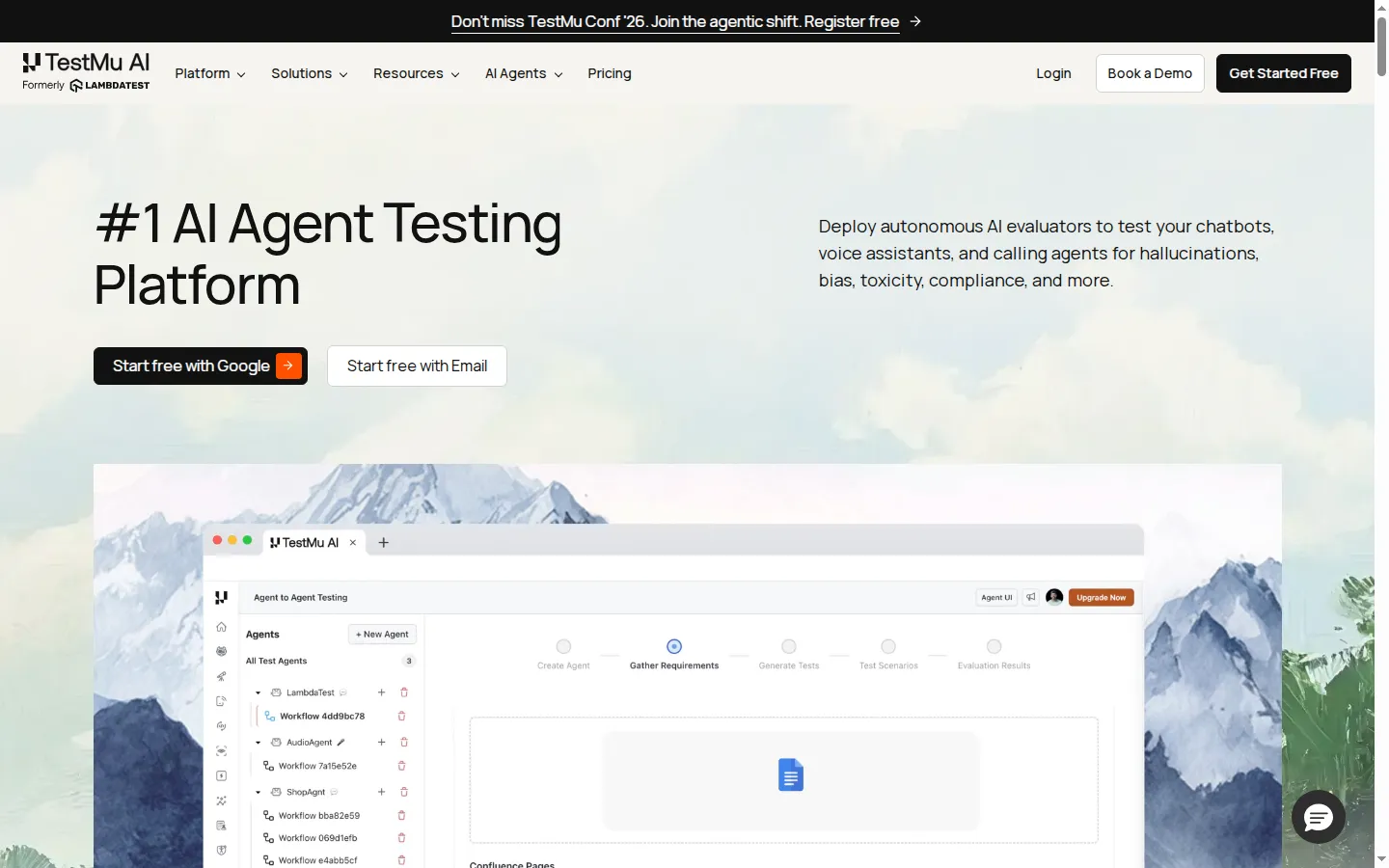
The three surfaces the Agent Testing platform names, chat, voice, and calling agents, map onto the three ways a carrier contact arrives, and each is scored against a different metric set.
Note: Run the same troubleshooting flow across 200+ voice profiles and 15 noise presets on TestMu AI, then read the worst cell rather than the average. The whole matrix runs from the terminal and gates a pipeline on exit code. See the Agent Testing CLI docs
Making the Go-Live Call
A go-live decision needs a verdict rather than a dashboard. TestMu AI rolls the metric scores into Green, Yellow, or Red, where Yellow means specific identified issues must be fixed rather than that the agent is nearly ready. Every score carries a High, Medium, or Low confidence level derived from how many scenarios produced it.
- Check intent recognition accuracy first, per audio condition. It is the ceiling on everything else, because an agent that misidentified the request cannot resolve it however well it then performs.
- Read escalation quality next to containment, never on its own. A high containment rate paired with weak escalation quality is the trap this article opened with.
- Treat any hallucinated billing figure as a launch blocker regardless of the aggregate score, since a wrong charge explanation generates a regulator-visible complaint rather than a support ticket.
- Verify system state after every scenario in the two high-blast-radius tiers, because a clean transcript is not evidence that the write succeeded.
- Discount a Green verdict that carries Low confidence. A metric derived from a dozen scenarios is a signal, not a clearance.
Teams that already run a contact center will find some of this familiar. Where it differs is that the checks have to run against a system whose output changes between identical runs, which is what our comparison of contact center testing tools covers in more depth.
Where to Start
Write down which autonomy stage your agent is actually at, using the four-row ladder above, and confirm it against what the integration can technically do rather than what the design document says. Most teams discover the agent has write access it was never meant to exercise.
Then take your five highest-volume contact reasons, build one scenario each with an independently computed expected answer, and run them across four personas and three audio conditions. Sixty runs is enough to find out whether the average has been hiding a bad cell.
If the deployment is phone-first, read our guide to voice AI in customer service alongside this one, since transcription accuracy sets the ceiling on every metric in the matrix above.
Author

Srinivasan Sekar
Blogs: 18


Srinivasan Sekar is Director of Engineering at TestMu AI (formerly LambdaTest), where he leads engineering and open-source initiatives behind the Selenium and Appium automation grid and owns TestMu AI's MCP Server. A committer to Appium and a contributor to Selenium, WebdriverIO, Taiko, and AppiumTestDistribution, he brings over 15 years of experience in quality engineering and open-source technologies. He is the author of the Apress book 'The MCP Standard: A Developer's Guide to Building Universal AI Tools with the Model Context Protocol,' a Certified Kubernetes and Cloud Native Associate, and an international conference speaker. Before TestMu AI he spent over eight years at Thoughtworks as a Principal Consultant and Quality Architect. Srinivasan holds a B.Tech in Information Technology from Anna University.
Reviewer

Saurabh Prakash
Reviewer
Saurabh Prakash is an Engineering Manager at TestMu AI (formerly LambdaTest), where he leads engineering on agentic AI development and scalable system architecture for the quality engineering platform. He has also contributed to Test at Scale, the company's open-source test intelligence platform. He brings over 9 years of experience across Node.js, Java, Spring, MVC, data structures, algorithms, and scalable system design, with earlier roles as SDE 2 at Zomato, Senior Software Engineer at LogicHub, and Software Development Engineer at Directi. Saurabh holds a B.Tech in Computer Science and Engineering from Delhi Technological University.


Telecom AI Agent FAQs
Did you find this page helpful?
More Related Blogs
TestMu AI forEnterprise
Get access to solutions built on Enterprise
grade security, privacy, & compliance
- Advanced access controls
- Advanced data retention rules
- Advanced Local Testing
- Premium Support options
- Early access to beta features
- Private Slack Channel
- Unlimited Manual Accessibility DevTools Tests