

Power Your Software Testing with AI Agents and Cloud
The Native AI-Agentic Cloud Platform to Supercharge Quality Engineering. Test Intelligently and Ship Faster.


- TestMu AI (Formerly LambdaTest)
- /
- Test Management
- /
- What Is Test Management
What Is Test Management? A Complete Guide to Process, Tools, and Metrics
The practice of planning, organizing, and controlling all software testing, so teams can track coverage, prioritize by risk, and confirm a release is ready to ship.
Last Updated on:
Test management is the practice of planning, prioritizing, running, and reporting software tests so a release decision rests on evidence instead of opinion. The Consortium for Information and Software Quality put the 2022 cost of poor software quality in the United States at $2.41 trillion, a figure its Cost of Poor Software Quality report ties to unaddressed defects.[1]
This guide covers the definition, why it matters, the benefits and core components, the process, metrics, tools, common challenges, and a maturity model for benchmarking your team.
Key Takeaways
- Evidence-based sign-off: A release decision needs traceable proof of what ran and what it found, not a status meeting.
- Requirements traceability matrix: Linking every requirement to its tests and defects is what surfaces a coverage gap before release rather than after.
- Risk-based prioritization: Rank modules by failure impact and rework history, then spend the deepest coverage on the top of that list.
- Defect escape rate: Measure production defects against total defects found, and treat anything above 5% as a process problem rather than bad luck.
- Spreadsheet breaking point: Around 200 cases, versioning and build-linked results stop being optional and a dedicated repository pays for itself.
- Level 3 to Level 4 jump: The largest measurable gain comes from becoming metrics-driven, not from buying another tool.
What Is Test Management?
Test management is the discipline of coordinating testing end to end: planning, design, execution, defect handling, and reporting, so release readiness rests on recorded evidence, not opinion.
The discipline spans the test plan through design, execution, and defect handling. It decides what gets tested and in what priority, records what ran and what it found, and links every result back to a requirement.
Without a structured process, testing becomes reactive. Bugs surface late, defects get missed, and release timelines slip.
Defects found late cost more to fix than defects found early, which is why the discipline pushes verification toward requirements review and design. The National Institute of Standards and Technology estimated the annual United States cost of an inadequate software testing infrastructure at up to $59.5 billion, of which $22.2 billion is avoidable through better testing infrastructure and standards.[2]
Good governance also shifts testing earlier, where defects are cheapest to fix: catching an issue during requirements review costs a fraction of catching it in production, where it brings customer impact, fix coordination, and reputational damage.
Why Is Test Management Important?
Test management matters because it turns testing activity into a confidence signal. Without it, stakeholders see how many tests ran but cannot tell which release risks are covered.
Teams ship more often, with more automation and more dependencies across APIs, devices, browsers, and data. Four questions decide whether that work produces confidence or noise: TestMu AI's Test Manager is built for that cadence, keeping plans, runs, and defects in one workspace.
- Scope: What are we testing for this release, and what is explicitly out of scope?
- Coverage: Which requirements and risks have test evidence behind them?
- Signal: Are failures informative, or dominated by noise (flaky tests, unstable environments)?
- Decision: Given the evidence, is the release risk acceptable, and what are the known gaps?
What Are the Benefits of a Test Management System?
A test management system gives one source of truth for coverage, removes duplicate and stale cases, shortens release reporting, and produces the audit trail that regulated teams need.
Those gains show up as five measurable changes once a team moves off spreadsheets:
- Single source of truth: Cases, runs, and defects live in one system, so nobody reconciles three spreadsheets to answer what was tested.
- Coverage visibility: Requirements map to tests, so an untested requirement surfaces during the cycle rather than in a production incident.
- Faster release reporting: Status comes from execution data instead of a manual roll-up, which removes the reporting scramble before every release gate.
- Audit readiness: Execution history, approvals, and version records are retained by default, which is what regulated and enterprise teams are audited against.
- Lower maintenance cost: Duplicate detection and stale-case flagging stop the repository growing faster than the team can curate it.
What Does Poor Software Quality Cost?
Poor software quality cost the United States $2.41 trillion in 2022,[1] and inadequate testing infrastructure carries an annual burden of up to $59.5 billion.[2] Four primary sources set the bar.
Cite these figures in your own release reports when you need to defend the budget for a dedicated QA program.
| Source | What it measures | Benchmark |
|---|---|---|
| CISQ (2022)[1] | Annual US cost of poor software quality | $2.41 trillion, dominated by operational software failures and unaddressed defects |
| NIST RTI Planning Report 02-3 (2002)[2] | Annual US cost of inadequate software testing infrastructure | $59.5 billion a year, of which the report estimates $22.2 billion is avoidable through improved testing infrastructure and standards |
| ISTQB Foundation Level Syllabus v4.0.1 (2024)[3] | Fundamental principles every testing program rests on | 7 testing principles, including "testing shows the presence of defects, not their absence" and "early testing saves time and money" |
| ISO/IEC/IEEE 29119 (Software Testing standard)[4] | International standard for software testing processes and documentation | 5 parts (Concepts, Processes, Documentation, Techniques, Keyword-driven testing) used as the reference framework in regulated industries |
The CISQ and NIST numbers anchor the economic case; the ISTQB principles anchor the discipline that prevents those costs; the ISO/IEC/IEEE 29119 standard anchors the documentation a regulated team will be audited against.
Where Does Testing Fit in the SDLC?
In the SDLC, test management decides when testing starts, which environments mirror production, how regression is contained, and how defects are triaged, so testing tracks each code change.
Across the software development life cycle (SDLC), that timing shows up as four concrete practices:
- Shift-left timing: Testing starts during refinement and design rather than after development hands the build over.
- Environment parity: Test environments and data match what production-like actually means for your risk profile.
- Regression strategy: A regression approach exists before delivery velocity collapses under endless manual retesting.
- Defect handling: Triage rules, ownership, and escalation paths are agreed before the first defect arrives.
What Are the Core Components?
The eight core components are standards and policy, test planning, test design, traceability, execution management, defect management, metrics and reporting, and improvement loops.
Each component covers a distinct area, from how quality is defined upfront to how feedback loops close after release:
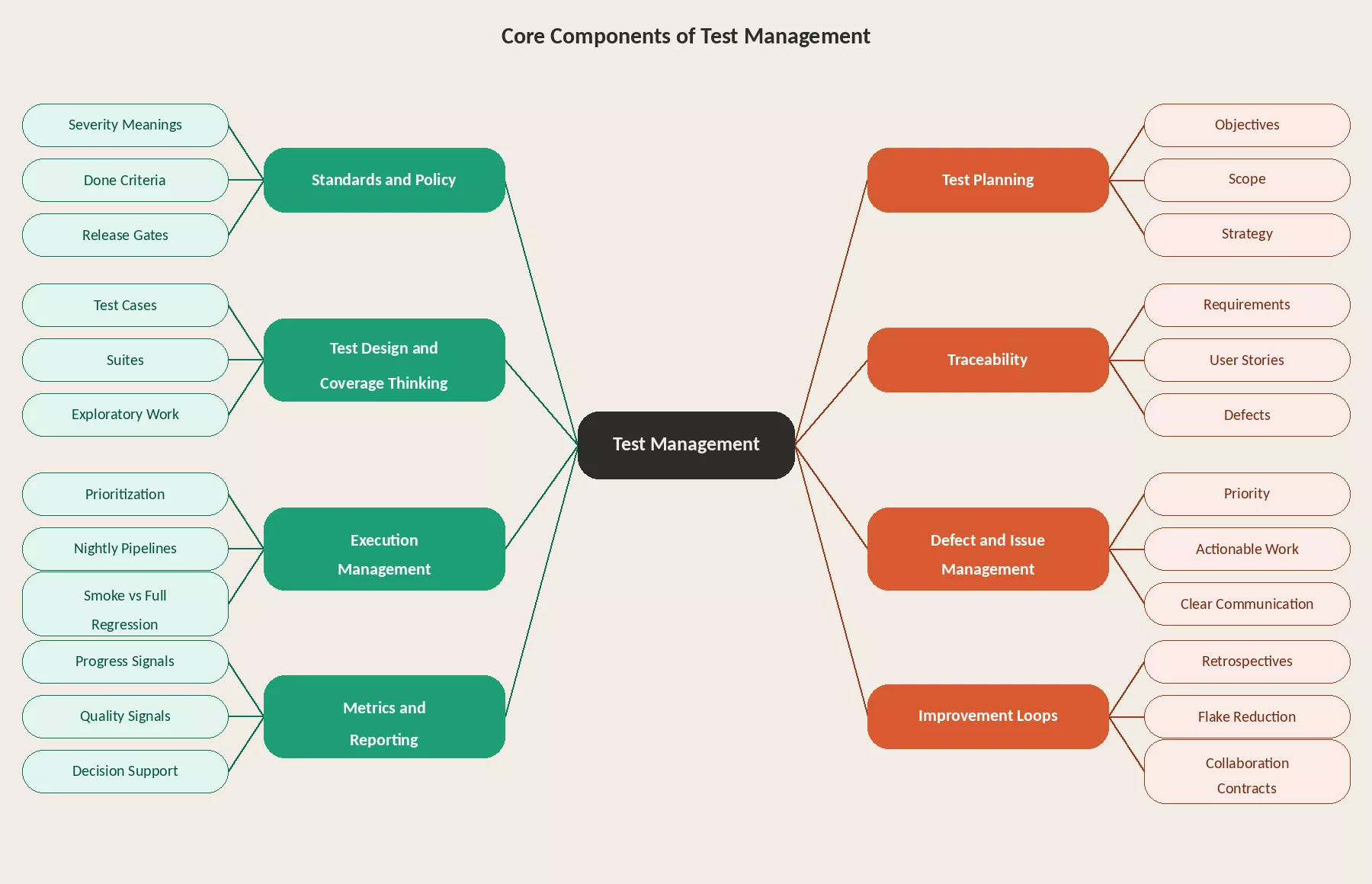
- Standards and policy: How quality is defined for your product line: severity meanings, done criteria, release gates (even if lightweight), and what "must never break."
- Test planning: Objectives, scope, strategy (levels of testing), environment needs, dependencies, and schedule assumptions.
- Test design and coverage thinking: Test cases, suites, charters for exploratory work, and the balance between manual judgment and automated guardrails.
- Traceability: Linking requirements or user stories to tests and defects so you can prove coverage and audit decisions, especially important for regulated, financial, healthcare, or enterprise workflows.
- Execution management: Running the right tests at the right time, prioritization, nightly pipelines, smoke vs full regression, and handling blockers.
- Defect and issue management: Making sure problems become actionable work with clear priority, not endless comment threads.
- Metrics and reporting: Progress and quality signals that support decisions, not dashboards that only count cases executed.
- Improvement loops: Retrospectives on testing, flake reduction, suite cleanup, faster feedback, and better collaboration contracts with engineering.

What Are the Steps in the Test Management Process?
The process runs in two phases. Planning covers organization, test planning, estimation, and risk analysis. Execution covers monitoring and control, issue management, and reporting.
Each phase contains structured activities that build on each other.
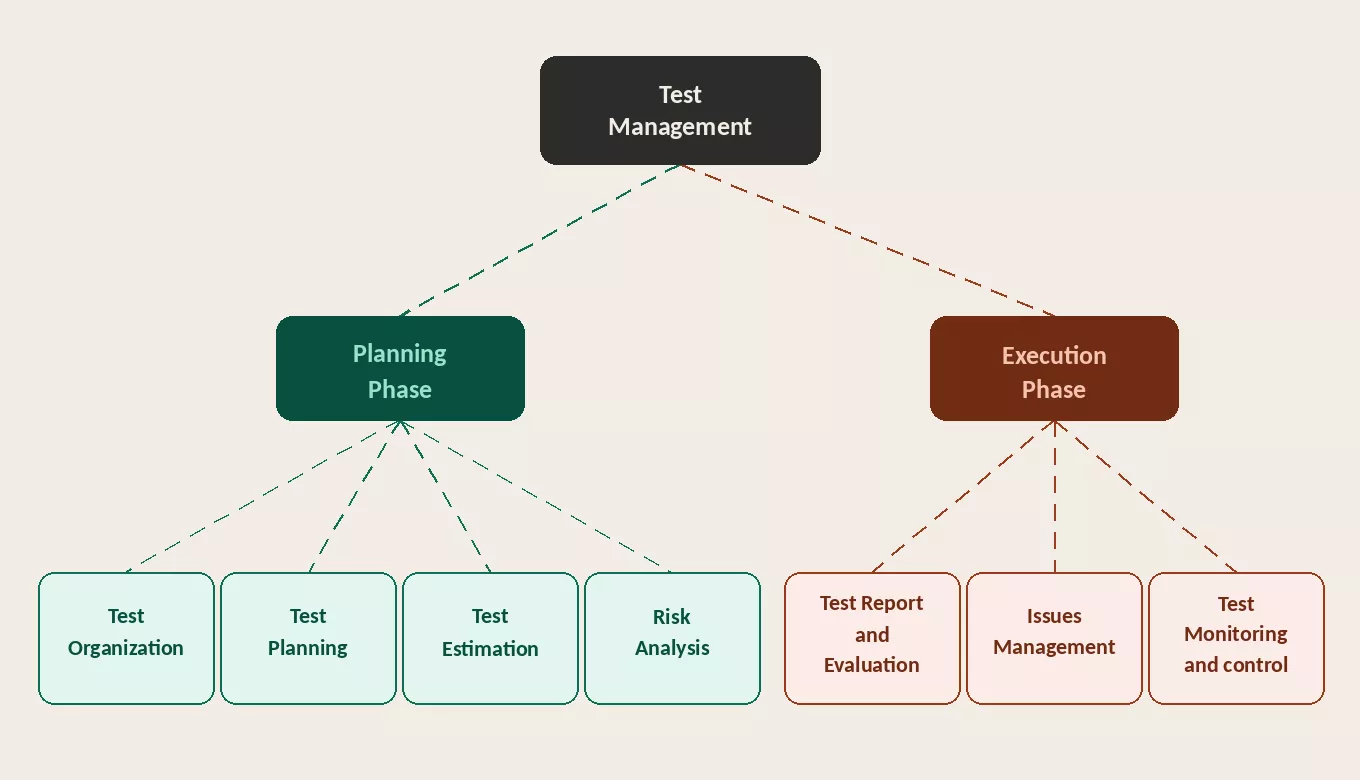
Planning Phase
- Test Organization: Define roles, ownership, communication rhythms, and escalation paths across the team.
- Test Planning: Set objectives, scope, strategy, environment needs, and schedule assumptions.
- Test Estimation: Estimate effort across people, tools, environments, data, and automation capacity.
- Risk Analysis: Identify what must not fail, assess impact, and prioritize coverage accordingly.
Execution Phase
- Test Monitoring and Control: Track progress against the plan, flag deviations early, and adjust scope or resources with explicit tradeoffs.
- Issues Management: Ensure defects become actionable work with clear ownership and priority, not just logged items.
- Test Report and Evaluation: Report release readiness with evidence, known issues, and residual risk. Close the loop by archiving artifacts, capturing lessons, and updating standards.
How Does Testing Work in Agile and CI/CD?
In Agile and CI/CD, testing runs continuously inside each iteration instead of as a final phase, shifting scope forces risk-based choices, and flaky tests count as engineering debt.
The discipline itself does not change in Agile. It compresses into iterations and ties to continuous delivery realities:
- Continuous testing: Tests run inside every iteration instead of waiting for a hardening phase before release.
- Scope volatility: Scope shifts mid-sprint, so coverage decisions follow risk and every tradeoff is stated openly.
- Flaky test ownership: Automation counts as part of the product system, so intermittent failures are tracked as engineering debt.
- Definition of done: Done means a testable increment measured by working software rather than by closed tickets.
Which Testing Types Are Covered?
Coverage spans unit, integration, functional, regression, performance, API, UI, security, exploratory, acceptance, and accessibility testing, each mapped to a stage and an execution mode.
Each type targets a different quality aspect: Which types a team can track at once usually comes down to the test management tools it runs on.
| Testing Type | Purpose | When | Manual / Automated |
|---|---|---|---|
| Unit Testing | Verify individual functions in isolation | During development | Automated |
| Integration Testing | Validate module and service interactions | After unit testing | Automated |
| Functional Testing | Confirm features match requirements | Each sprint/build | Both |
| Regression Testing | Ensure changes don't break existing features | After every change | Automated (recommended) |
| Performance Testing | Measure speed, scalability, stability | Pre-release | Automated |
| API Testing | Validate endpoints, data contracts, errors | Continuous | Automated |
| UI/UX Testing | Verify interface across browsers/devices | Each sprint | Both |
| Security Testing | Identify vulnerabilities (OWASP Top 10) | Pre-release | Both |
| Exploratory Testing | Discover edge cases through unscripted testing | Each sprint | Manual |
| UAT | Business users validate against their needs | Before production | Manual |
| Accessibility Testing | WCAG compliance for disabled users | Each release | Both |

Note: Run every test type in this table on a single AI-native testing platform. TestMu AI brings authoring, execution, and reporting into one workspace, with execution across 10,000+ real devices and 3,000+ browser and OS combinations. Try TestMu AI Test Manager free
Who Owns Testing in a Delivery Team?
A Test Manager or QA Lead owns strategy, coverage, and release sign-off. QA engineers own test design and execution, developers own testability, and product managers own risk acceptance.
Accountability sits with the Test Manager or QA Lead, but ownership is shared across four roles:
- Test Manager / QA defines strategy, tracks coverage, manages defect triage, and owns release sign-off. The responsibility of a test manager also includes team coordination, risk assessment, and ensuring testing aligns with business goals.
- QA Engineers own test design, coverage execution, exploratory judgment, and defect triage.
- Developers / Engineering own testability, unit and integration test health, and pipeline stability.
- Product Manager owns risk acceptance, deciding what ships with known limitations and what does not.
How Does Test Management Differ From Project Management?
Test management governs testing activities and measures defect density, coverage, and leakage. Project management governs the whole delivery and measures budget, schedule, and scope variance.
Confusing the two disciplines leads to either under-tested software or misallocated resources. Here is how they differ:
| Dimension | Test Management | Project Management |
|---|---|---|
| Scope | Testing activities only (planning, execution, defect tracking, reporting) | Entire project (requirements, design, dev, testing, deployment) |
| Primary Goal | Ensure software quality and reduce defects | Deliver on time, within budget, meeting requirements |
| Deliverables | Test plan, test cases, defect reports, test summary | Project plan, WBS, risk register, status reports |
| Owner | Test Manager / QA Lead | Project Manager / Delivery Manager |
| Key Metrics | Defect density, test coverage, pass/fail rates, defect leakage | Budget variance, schedule variance, scope completion |
Which Challenges Derail QA Teams Most Often?
The recurring challenges are a traceability matrix that decays as requirements change, execution results split across systems, flaky tests that mask real regressions, and estimates that never improve.
Each one has a specific failure mode and a specific fix:
- Traceability decay: Requirements change faster than the matrix is updated, so link every case to a requirement ID at creation rather than reconstructing links before an audit.
- Disconnected results: Pass and fail data sits in the pipeline while requirements sit in Jira, so status is stale by the time it reaches a stakeholder. Two-way sync removes the copy step.
- Flaky test noise: Intermittent failures with no code change train teams to ignore red builds. Quarantine a case after two non-deterministic failures instead of rerunning it.
- Estimates that never improve: Teams estimate from scratch each cycle and repeat the same error. Record planned against actual execution velocity and feed the gap into the next plan.
- Repository sprawl: Case counts grow faster than curation capacity, so schedule a suite review each release and retire cases that no longer map to a live requirement.
What Are Test Management Tools and How to Choose One?
A test management tool stores cases, runs, results, and requirement traceability in one system. Choose on workflow fit, integration depth, AI authoring, auditability, and migration path. Teams without a tooling budget can start with free test management tools and upgrade once execution history and audit trails matter.
Spreadsheets break down around 200 cases. A dedicated tool keeps cases versioned, executions tied to specific builds, and coverage visible to product and engineering in real time, with connections into Jira or a similar issue tracker.
When evaluating vendors, weigh the criteria below over raw feature count:
- Workflow fit: A Jira-native plugin works for teams whose work already lives in Jira; a standalone QA hub fits teams running cross-project programs. Map the tool to how your team already operates, not the reverse.
- Integration depth: Native two-way connections to your CI/CD pipeline, automation frameworks, and issue tracker matter far more than surface-level CSV imports. A tool that pushes execution back to Jira and pulls fix-version scope from sprints earns its place; one that only ingests data does not.
- AI test authoring and maintenance: Modern tools generate cases from a requirement, identify duplicates, and flag stale cases automatically. Without this, the repository grows faster than the team can curate it.
- Auditability: Enterprise and regulated teams need execution history, version control, permission controls, and structured reporting built in, not bolted on.
- Scale and migration path: The tool should support multi-team usage without admin overhead and import from spreadsheets or legacy tools with field mapping, so adoption does not require a migration project.
Test Management Platform by TestMu AI covers all five criteria in one workspace. It pairs AI case generation and a live requirements traceability matrix with execution on 10,000+ real devices and 3,000+ browser and OS combinations.
How to Bring Test Cases, Runs, and Reports Into One Workspace?
Fragmentation across separate tools is what slows releases as suites grow. Consolidating authoring, execution, defect logging, and reporting into one workspace removes the handoffs between them.
Cases live in one tool, execution results in another, and defects in a third, so every status update becomes a manual reconciliation job.
TestMu AI Test Manager brings manual and automated testing into one workspace, from AI-native test creation to execution across real browser and OS environments. Here is what that includes:
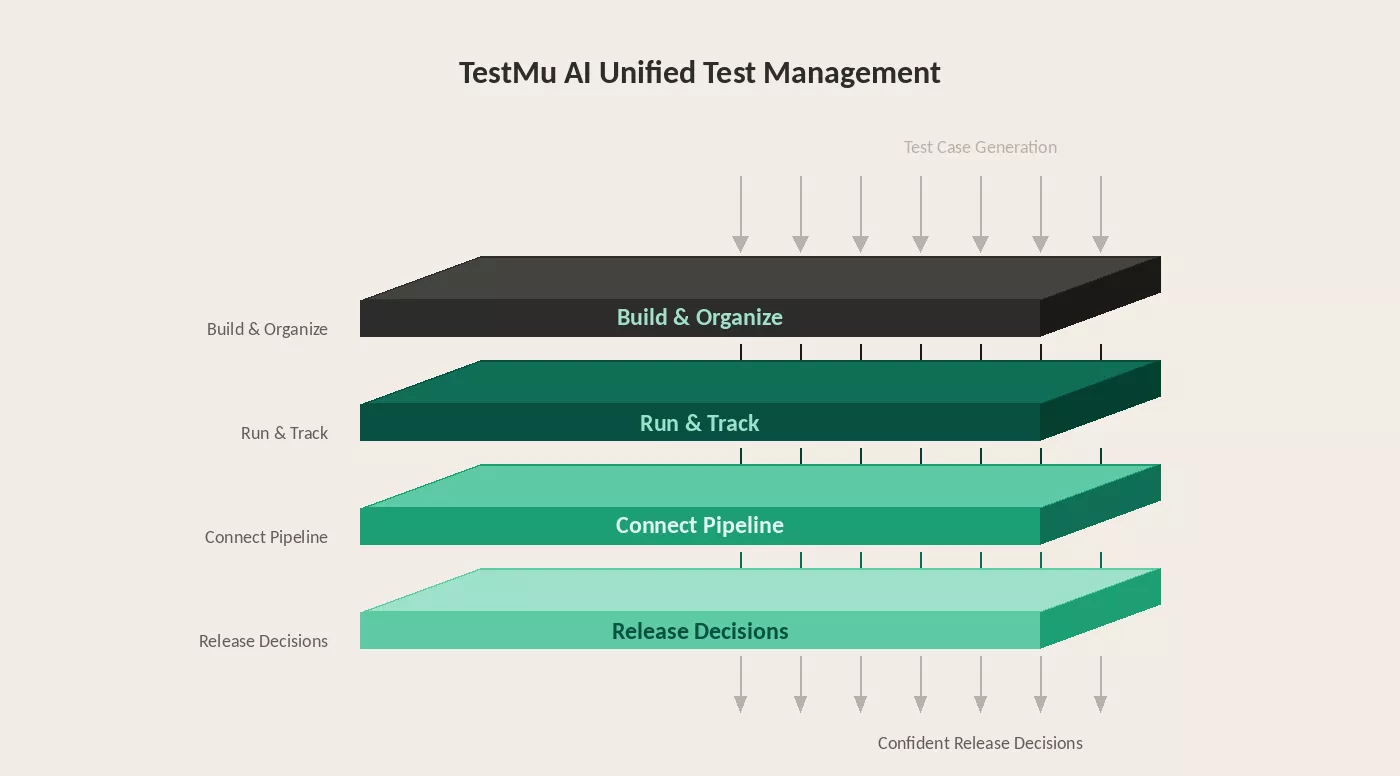
Building and organizing test cases
- AI test case generator: Describe a user flow, paste a requirement, or bring in a Jira ticket, image, video, or Figma flow. TestMu AI generates structured test cases with clear steps and scenarios ready for execution.
- Smart context memory layer: Scans your existing repository before every session, fills coverage gaps, and avoids generating duplicates. Existing duplicates are handled separately: the Test Deduplication Agent scores every match and leaves the delete or archive call to you.
- AI edge case generation: Expand any happy-path test case into edge cases, negative scenarios, and boundary conditions automatically.
- Unified test case repository: Version control, tagging, and reusable test modules in one place. Update a shared flow once and every case referencing it updates automatically.
- Scenario-based prioritization: Test cases are grouped into Must Have, Should Have, and Could Have scenarios, so testing is prioritized by impact and risk.
- One-click import: Migrate from legacy QA tools with automatic field mapping and zero data loss. See the walkthrough on one-click qTest migration in Test Manager.
Running and tracking execution
- Real-time execution tracking: Manual runs, automated results, and exploratory sessions appear on one dashboard. Coverage gaps and release readiness are visible to every stakeholder without a separate reporting layer.
- Customizable workflows: Customize test steps and actions the way your team works, built for teams managing large test suites at scale.
Connecting to your delivery pipeline
- Bug and defect tracker: Log bugs across 25+ bug tracking tools, with two-way real-time sync for Jira and Azure DevOps. Defects logged during a run flow in with full context attached.
- CI/CD pipeline coverage: Integrates with GitHub Actions and GitLab CI. Link pull requests to test cases and let quality gates block failing deployments automatically.
- 120+ integrations: Connect to Jira, GitHub, Jenkins, Slack, and CI/CD tools to bring testing into your existing workflow.
Making release decisions with confidence
- Requirement traceability: Map every requirement to its test cases and linked defects. Coverage gaps surface before release, not after.
Watch the full setup walkthrough, from AI case creation through execution and reporting, in one unified workflow.
Subscribe to the TestMu AI YouTube channel for the latest tutorials on modern software testing.
Which Metrics and KPIs Should You Track?
Track execution rate, pass rate, defect density, defect leakage, test coverage, resolution time, automation coverage, and cost per defect. Trend them across releases, not within one.
| Metric | Formula | What It Tells You | Target |
|---|---|---|---|
| Test Execution Rate | (Executed / Planned) × 100 | Plan completion | >95% |
| Pass Rate | (Passed / Executed) × 100 | Build quality | >90% |
| Defect Density | Defects / KLOC | Code quality | Decreasing |
| Defect Leakage | (Prod Defects / Total Defects) × 100 | Testing effectiveness | <5% |
| Test Coverage | (Reqs with Tests / Total Reqs) × 100 | Coverage completeness | 100% |
| Defect Resolution Time | Avg creation-to-closure | Fix-verify speed | Decreasing |
| Automation Coverage | (Automated / Total Tests) × 100 | Automation adoption | >70% regression |
| Cost Per Defect | Testing Cost / Defects Found | Testing efficiency | Decreasing |
Track these across release cycles, not just within one release. Trend analysis reveals whether your process is improving or degrading.
Manage Test Cases with Agentic AI Platform

What Do High-Performing QA Teams Do Differently?
High-performing teams treat risk as a living variable, keep a live traceability matrix so coverage gaps surface before release, and feed actual velocity back into the next estimate.
Most teams already have a test plan, a defect tracker, and coverage reports. The difference shows up in the decisions that fall outside the playbook.
Risk is treated as a living variable, not a one-time assessment. A module that was low risk in sprint 3 can carry significant risk by sprint 8 after multiple rounds of rework. High-performing test leads update the risk register mid-cycle and reallocate effort accordingly.
Coverage gaps are visible before release, not after. The requirement traceability matrix (RTM) makes this possible. When a requirement changes mid-sprint, the RTM immediately surfaces which test cases are now stale. Teams without a live RTM discover coverage gaps in production.
Estimation improves over time because data closes the loop. If the team consistently executes fewer test cases per day than planned, the next estimate reflects that. High-performing teams track the gap between planned and actual velocity every cycle and adjust. Most teams estimate from scratch every time and make the same mistakes repeatedly.
How Mature Is Your QA Process?
Maturity runs from Level 1 ad-hoc to Level 5 optimizing. Most teams sit between Level 2 and Level 3, and the largest return comes from reaching Level 4, where decisions become metrics-driven.
Use the model below to assess where your team sits and what to invest in next:
| Level | Name | Characteristics | What to Invest In |
|---|---|---|---|
| 1 | Ad-hoc | No formal test process. Testing is reactive, unplanned. Defects found by users in production. No documentation. | Create a basic test plan. Start logging defects in a tracker (even a spreadsheet). Assign someone to own testing. |
| 2 | Managed | Basic test plans exist. Defects are tracked. Some test cases documented. Testing is planned but inconsistent. | Adopt a dedicated tool such as TestMu AI Test Manager. Define entry and exit criteria. Standardize the test case format. |
| 3 | Defined | Standardized process across teams. Dedicated tool in use. Requirements traceability. Consistent reporting. | Begin automation (start with regression). Implement CI/CD test integration. Track key metrics (pass rate, defect density). |
| 4 | Measured | Metrics-driven decisions. Defect leakage tracked. Test coverage mapped to requirements. Automation covers regression. | Cut suite runtime (parallel execution with HyperExecute). Risk-based test selection. Cross-browser/device testing. |
| 5 | Optimizing | AI-powered test generation and maintenance. Continuous testing in CI/CD. Predictive quality analytics. Self-healing tests. | Use KaneAI for test creation and maintenance. Implement predictive defect detection. Continuous process improvement. |
Most teams fall between Level 2 and Level 3. The jump from Level 3 to Level 4, where testing becomes truly metrics-driven, is where the biggest ROI improvements happen. At Level 5, AI generates and maintains cases, so QA capacity shifts from writing tests to reviewing risk.
Conclusion
Test management is the operational backbone of software quality. The fundamentals are straightforward: plan, organize, execute, monitor, and report. The discipline is in doing each consistently, adapting when reality diverges from the plan, and closing the feedback loop so every cycle performs better than the last.
Start with one concrete step this week. If you do not yet have a centralized repository, move your cases into the TestMu AI Test Manager and link them to requirements as you import.
If you already have a tool but no live RTM, build the requirements traceability matrix first, because coverage gaps become visible the moment a requirement changes. If your suite is stable but slow, parallelize regression on HyperExecute and let KaneAI generate the next cycle of cases.
Read the Test Manager documentation to set up your first run with traceability and reporting in under twenty minutes, or jump straight to test case management to design cases that actually generate the evidence release decisions depend on.
Sources and References Used
- [1] The Cost of Poor Software Quality in the US: A 2022 Report - Consortium for Information and Software Quality (November 2022)
- [2] The Economic Impacts of Inadequate Infrastructure for Software Testing, RTI Planning Report 02-3 - National Institute of Standards and Technology (May 2002)
- [3] Certified Tester Foundation Level Syllabus v4.0.1 - International Software Testing Qualifications Board (November 2024)
- [4] ISO/IEC/IEEE 29119-1:2022 Software and systems engineering, Software testing, Part 1: General concepts - International Organization for Standardization (January 2022)
Author

Abhishek Mishra
Blogs: 15

Abhishek Mishra is a Technical Product Manager at TestMu AI (formerly LambdaTest), where he owns Test Manager, the test management product. He has over 8 years of experience in product management and market analysis, spanning AI-native software testing, product strategy, and analytics. On TestMu AI, he authored guides on test management and test case management. Previously, he served as the Product Lead at IndiaClan and co-founded Gartley618 Technologies, a firm focused on quantitative trading and blockchain. He holds a B.Tech degree.
On This Page
- What Is Test Management?
- Why It Matters
- Benefits
- What Poor Quality Costs
- Test Management in the SDLC?
- Core Components
- The Process
- Test Management in Agile and CI/CD?
- Testing Types Covered
- Who Is Responsible
- vs. Project Management
- Common Challenges
- Tools and How To Choose
- One Unified Workspace
- Metrics and KPIs
- High-Performing Teams
- Maturity Model
Test Management FAQs
Did you find this page helpful?
More Related Learning Hubs
TestMu AI forEnterprise
Get access to solutions built on Enterprise
grade security, privacy, & compliance
- Advanced access controls
- Advanced data retention rules
- Advanced Local Testing
- Premium Support options
- Early access to beta features
- Private Slack Channel
- Unlimited Manual Accessibility DevTools Tests