
Agent Assurance for your AI Deployment
Test how your agents actually behave across workflows, tools, and actions. Catch failures and vulnerabilities before they ship.
npm install -g @testmuai/rook
- TestMu AI (Formerly LambdaTest)
- /
- Learning Hub
- /
- Agent-as-a-Judge: How Agent Judges Grade What AI Agents Did
Agent-as-a-Judge: How Agent Judges Grade What AI Agents Did
Agent-as-a-judge uses an AI agent with tools to grade another agent's work. Compare it with LLM judges and see a recount of the DevAI judges' error direction.
Published on:
OVERVIEW
A coding agent finishes a machine learning task and its last message says the trained model is saved as fashionnet.pt in models/saved_models/. A judge that reads only the transcript can score that sentence and nothing else.
A judge that can open the workspace looks for the file, reads the training script that should have written it and rules on what it finds. That second judge is an agent, and grading with one is called agent-as-a-judge.
The saved-model requirement is real: it comes from DevAI, the code-generation benchmark where agent-as-a-judge was first measured. This guide recounts that benchmark's released human and agent judgments to show how often the agent judge agreed with people, and which way it erred when it did not.
Overview
Agent-as-a-judge is an evaluation method in which an AI agent with tools to open files, read code and search a run's history grades another agent's work one requirement at a time. In Zhuge et al.'s gray-box tests on the DevAI code-generation benchmark, it agreed with a human consensus on 86.61% to 92.07% of requirements.
Agent-as-a-Judge at a Glance
- How is an agent judge different from an LLM judge?: An agent judge locates the files a requirement names, reads them and, when it has the run's trajectory, pulls the relevant steps from it before deciding, while an LLM judge makes one model call over material someone else selected and placed in its prompt.
- DevAI benchmark: DevAI, the code-generation benchmark released with Zhuge et al.'s Agent-as-a-Judge paper, holds 55 AI development tasks with 365 requirements, and three human experts judged every requirement before settling on a consensus.
- Should an agent judge have write tools?: No, because checking with a write tool performs the action being checked, so an agent judge that calls a ticket tool to see whether the ticket exists files a new ticket.
- Is agent-as-a-judge proven outside coding agents?: No, because every agreement figure in Zhuge et al.'s Agent-as-a-Judge paper comes from 55 AI development tasks with small workspaces, so it does not transfer to support, browsing or workflow agents without a new comparison against human labels.
- Testing agents that act: TestMu AI's Agent Assurance, which is pre-alpha, has a judging subagent rule on each acceptance criterion from evidence it collects and reports a criterion it cannot settle as Unable to Verify, next to Pass and Fail.
Agent Judge Accuracy on DevAI
- How accurate is agent-as-a-judge compared with humans?: In Zhuge et al.'s Agent-as-a-Judge paper, the gray-box agent judge matched the DevAI human consensus on 86.61% to 92.07% of code-generation requirements, against 68.86% to 71.85% for a gray-box LLM judge.
- Do agent judges err toward false passes?: On DevAI, yes, because a 2026-10-19 recount of DevAI's released judgment files found the gray-box agent judge saying met where the human consensus said not met 64 times, against 50 the other way, across 1,098 requirement verdicts, though the direction changed by requirement category.
- How often were the agent judge's passes right?: A 2026-10-19 recount of DevAI's released judgment files found that humans confirmed 80.23% to 88.05% of the gray-box agent judge's met verdicts on code-generation tasks, so between one in five and one in eight passes were wrong.
- How long does an agent judge take?: Zhuge et al.'s Agent-as-a-Judge paper reports that its agent judge needed 118.43 minutes to judge all of DevAI's code-generation tasks, against 10.99 minutes for an LLM judge and a self-reported 86.5 hours, debate round included, for the three human experts.
What Is Agent-as-a-Judge?
Agent-as-a-judge is a way to evaluate an AI agent with another AI agent. The judge receives the task's requirements, the workspace the agent produced and, in some setups, the agent's step-by-step trajectory, and it uses tools to find and read the evidence for each requirement before it decides whether that requirement was met.
The term comes from Agent-as-a-Judge: Evaluate Agents with Agents by Mingchen Zhuge and 12 co-authors, first posted to arXiv on 14 October 2024, which calls it "an organic extension of the LLM-as-a-Judge framework, incorporating agentic features that enable intermediate feedback for the entire task-solving process". The authors tested it on code generation only, with DevAI, a benchmark they built of 55 AI development tasks and "a total of 365 hierarchical user requirements".
A revised version appeared in the ICML 2025 proceedings (PMLR volume 267), and its abstract keeps the same scope: "55 realistic AI code generation tasks" with 365 solution requirements. Earlier code benchmarks such as the HumanEval benchmark need no judge at all, because they score a model by running its completions against unit tests.
A January 2026 survey, Agent-as-a-Judge by Runyang You and seven co-authors, explains the shift to agentic judges by the limits of single-call ones. Their reliability, it says, "has become constrained by inherent biases, shallow single-pass reasoning, and the inability to verify assessments against real-world observations".
The related terms overlap but are not interchangeable:
- Agent judge - the agent doing the grading in an agent-as-a-judge setup, with access to the workspace and tools.
- Agentic judge - the survey's umbrella term for judges that plan, verify with tools, work with other agents or keep memory between judgments.
- Judge agent - in LangWatch's Scenario testing framework, an LLM-powered evaluator that reads a simulated conversation after every turn and decides whether the test continues, succeeds or fails.
- Gray-box and black-box judging - in the DevAI study, a gray-box judge also reads the developer agent's trajectory, while a black-box judge sees only the workspace the agent left behind.
How Is Agent-as-a-Judge Different From LLM-as-a-Judge?
An LLM judge makes one model call over material someone else selected and placed in its prompt. An agent judge chooses what to look at, which matters when the evidence is spread across a folder of files and a long run log.
| Aspect | LLM-as-a-judge | Agent-as-a-judge |
|---|---|---|
| Input | Whatever fits in the prompt: an answer, a transcript, a diff or a pasted file | The requirements plus access to the workspace, and in gray-box mode the trajectory |
| Steps per verdict | One model call | Several tool calls (build a file graph, locate, read, retrieve), then a decision |
| Agreement with human consensus, gray-box | 68.86% to 71.85% | 86.61% to 92.07% |
| Agreement with human consensus, black-box | 60.38% to 84.15% | 83.88% to 90.44% |
| Time to judge all of DevAI | 10.99 minutes | 118.43 minutes |
| Typical failure | Judges only what it was shown, so a file that was never pasted in cannot change the verdict | Trusts what a file appears to hold (a synthetic dataset passed for the real one) or misses a nuance in the requirement; repeats an earlier mistake when memory is on |
The agreement figures come from Table 3 of the Agent-as-a-Judge paper's full text, across MetaGPT, GPT-Pilot and OpenHands, and the times from its cost analysis. The LLM judge's best black-box figure, 84.15% on MetaGPT, says little: the authors note that "since MetaGPT rarely meets requirements, LLM-as-a-Judge easily identifies most cases as negative". The same table notes that gray-box runs "use carefully manually collected trajectory data", which it calls "nearly inaccessible in practical situations".
Against people, the paper's PDF reports that the three human experts, judging alone, matched their own later consensus on 76.23% to 92.63% of requirements, so the gray-box agent judge sits inside the range of a single expert. The human evaluation, debate round included, took the experts a self-reported 86.5 hours, while the agent judge needed 118.43 minutes and 30.58 USD in API calls against the 1,297.50 USD the authors estimate for the experts at 15 USD an hour: about 2.28% of the time and 2.36% of the cost. The paper's text gives 2.29% for cost and 2.36% for time, the other way round.
For a judge that only reads replies and transcripts, the LLM-as-a-judge guide covers rubric design, scoring methods and the biases to correct for. G-Eval is a metric of that kind: a judge model scores text against plain-language criteria, follows evaluation steps it generated itself and weights each rating by its token probability.
What Does an Agent Judge Do That a Single Model Call Cannot?
It goes and gets evidence. The DevAI judge was assembled from separate modules, and the best-performing version kept these:
- Graph - maps the project's files, modules and dependencies so the judge knows what exists before it reads anything.
- Locate - finds the folder or file a requirement refers to, such as
src/data_loader.py. - Read - opens files in many formats, code, images and documents included, so a requirement about a saved plot can be checked against the plot.
- Retrieve - pulls the relevant steps out of a long trajectory, which only a gray-box judge has.
- Ask - decides whether the requirement is satisfied, given everything the other modules gathered.
The search, memory and planning modules were dropped. Memory made results worse because an early wrong judgment fed later ones, and planning proved unstable.
How Each Judge Component Changed Agreement With Humans on the DevAI Coding Benchmark
| Judge built from | Agreement with human consensus (OpenHands) |
|---|---|
| Ask only | 65.03% |
| + graph | 75.95% |
| + read | 82.24% |
| + locate | 90.44% |
| + retrieve | 90.16% |
The figures are Table 4 of the ICML 2025 paper PDF, which ran the ablation on OpenHands: the project graph added 10.92 points, read another 6.29 and locating the right file 8.20, while adding retrieve left agreement slightly lower, at 90.16% against 90.44%. Its Table 10 swaps the judge's model, with agreement from 87.76% for Llama 3.2 90B to 92.95% for Claude 3.5 Sonnet, against 90.16% for the gpt-4o version used throughout (the figure Table 3 gives for OpenHands).
- Give the judge a map first - the project graph and the locate step together moved agreement about 19 points, more than any change of judge model did.
- Keep memory off until proven - an agent judge that remembers its earlier verdicts can repeat an early mistake down the whole task.
Gray-Box and Black-Box Agent Judges
The gray-box judge reads the developer agent's trajectory as well as its workspace, and it scored higher on two of the three developer agents. Those trajectories were collected by hand, so the black-box row of the comparison table is the closer guide for a judge you would run yourself.
- Log what your agent does - a judge can only retrieve steps that were recorded, so structured logs of tool calls and file writes turn a black-box judge into a gray-box one.
- Treat a trajectory as a claim - a log line saying a file was written is the agent's account; the file on disk is the evidence.
How Closely Do Agent Judges Agree With Human Judges on the DevAI Coding Benchmark?
The DevAI authors released every human consensus verdict and every gray-box agent judge verdict as JSON files, so the paper's agreement figures can be checked without an API key. A recount run on 2026-10-19 reproduces them and adds two things the paper's table does not show: the direction of each disagreement and how much agreement a judge that never looks at the work would get.
How the Agent Judge and Human Verdicts on DevAI Were Recounted
- Data - the files under
benchmark/judgment/in the MIT-licensed metauto-ai/agent-as-a-judge repository, read from its main branch at commit 43c2fa7b84ef; the judgment files date from the 2024-10-16 release commit. - Pairs compared - for each developer agent and each of the 55 tasks, the human consensus file against the gray-box agent judge file, requirement by requirement.
- Verdict values - each requirement holds
satisfied: trueorfalse; anything other than true counts as not met. - Error labels - a false met is the judge saying met where humans said not met; a false not met is the reverse.
- Tools - Node.js built-in fetch, no packages and no model calls, so the counts are deterministic.
// aaj-core.cjs: human vs agent-judge verdicts on DevAI
// node aaj-core.cjs  (Node 18+, no API key)
const repo = "metauto-ai/agent-as-a-judge";
const raw = "https://raw.githubusercontent.com/"
  + repo + "/main/";
const api = `https://api.github.com/repos/${repo}`;
const devs = ["MetaGPT", "GPT-Pilot", "OpenHands"];
const get = async (u) => (await fetch(u)).json();

(async () => {
  const tree = (await get(`${api}/git/trees/main`
    + "?recursive=1")).tree.map((x) => x.path);
  console.log(
    "Agent      Reqs   Agree  Human  Judge  FM  FN");
  for (const dev of devs) {
    const dir = `benchmark/judgment/${dev}/`;
    const files = tree.filter((p) => p.startsWith(
      dir + "human_as_a_judge/") && p.endsWith(".json"));
    let n = 0, ok = 0, fm = 0, fn = 0;
    let met = 0, said = 0;
    for (const hp of files) {
      const name = hp.split("/").pop();
      const ap = dir + "agent_as_a_judge/gray_box/"
        + name;
      if (!tree.includes(ap)) continue;
      const H = await get(raw + hp);
      const A = await get(raw + ap);
      const judge = new Map(A.requirements.map(
        (r) => [r.requirement_id, r.satisfied === true]));
      for (const r of H.requirements) {
        if (!judge.has(r.requirement_id)) continue;
        const a = judge.get(r.requirement_id);
        const h = r.satisfied === true;
        n++; met += h; said += a;
        if (a === h) ok++;
        else if (a) fm++;
        else fn++;
      }
    }
    const p = (x, d = 1) =>
      (100 * x / n).toFixed(d) + "%";
    console.log(dev.padEnd(10), String(n).padStart(4),
      p(ok, 2).padStart(7), p(met).padStart(6),
      p(said).padStart(6), String(fm).padStart(3),
      String(fn).padStart(3));
  }
  console.log("Human, Judge = share of requirements met");
  console.log("FM = judge met, humans not met");
  console.log("FN = judge not met, humans met");
})();
Agent Judge Agreement on DevAI by Developer Agent
Output of the script above, run on 2026-10-19:
Agent      Reqs   Agree  Human  Judge  FM  FN
MetaGPT     366  92.08%  22.1%  23.5%  17  12
GPT-Pilot   366  86.61%  44.5%  46.4%  28  21
OpenHands   366  90.16%  42.9%  43.4%  19  17
Human, Judge = share of requirements met
FM = judge met, humans not met
FN = judge not met, humans met- The paper's figures hold - 86.61% and 90.16% match Table 3 exactly, and 92.08% (337 of 366) differs from the paper's 92.07% only in the last digit, which suggests the paper cut the figure off rather than rounding it.
- Agreement tracks difficulty - the judge agreed most on MetaGPT, the agent that met only 22.1% of requirements, where saying not met is right most of the time.
- The judge is slightly generous - for every developer agent, the judge marked a larger share of requirements met than the humans did.
Agent Judge Agreement Against a Chance Baseline
Raw agreement flatters any judge on a benchmark where most requirements fail. An extended version of the same script adds three figures, each computed from counts the table above already holds: the agreement of a judge that answers not met to everything (100% minus the Human column), Cohen's kappa for the real judge (agreement minus chance agreement, divided by 1 minus chance agreement, with chance agreement taken from the Human and Judge columns) and the share of the judge's met verdicts that humans confirmed (judge met verdicts minus FM, divided by judge met verdicts). Output of that extension, run on 2026-10-19:
Chance check: agreement of a judge that always says
'not met', and Cohen's kappa of the agent judge
  MetaGPT   always-not-met 77.87%  kappa 0.78
  GPT-Pilot always-not-met 55.46%  kappa 0.73
  OpenHands always-not-met 57.10%  kappa 0.80

Judge 'met' verdicts that humans also marked met
  MetaGPT    69 of  86  80.23%
  GPT-Pilot 142 of 170  83.53%
OpenHands 140 of 159 88.05%- Free agreement on MetaGPT - a judge that never looks would match humans on 77.87% of MetaGPT requirements, so the agent judge's 92.08% adds about 14 points of real signal there.
- Kappa from 0.73 to 0.80 - corrected for chance, the agent judge's best result moves from MetaGPT to OpenHands, so the developer agent with the highest raw agreement was partly the easiest to judge.
- Between one in five and one in eight met verdicts were wrong - humans confirmed 80.23% to 88.05% of the judge's met verdicts, the figure that matters when a pass ships code.
Report a judge's agreement next to the base rate, and pick from the AI agent evaluation metrics the ones that survive class imbalance, such as precision on passes, before you trust a single percentage.
366 Requirements in the DevAI Judgment Files vs 365 in the Paper
The paper and the DevAI README say 365 requirements, and the 55 DevAI task files in the same repository do hold 365. The recount found 366 per developer agent, for a reason a check of the task 52 files traced:
- Where the extra one sits - the judgment files for task 52 use a five-requirement version of the task, with a dataset-preparation step in
src/data_loader.pythat the four-requirement task file does not have. - Effect on agreement - humans and the judge agreed on all five task 52 requirements for every developer agent, so dropping the extra one moves agreement by 0.03 points or less: 92.05%, 86.58% and 90.14% over 365 requirements.
- What to cite - quote the paper's 365 and its Table 3 figures, and note the extra row if you rerun the released files.
Do Agent Judges Err Toward False Passes or False Failures?
On DevAI, mostly false passes, which are an agent judge's false positives. In the recount the judge said met where humans said not met 17, 28 and 19 times for MetaGPT, GPT-Pilot and OpenHands, against 12, 21 and 17 errors in the other direction, or 64 against 50 overall.
A false met costs more than a false not met:
- False not met - sends a person to look at work that was fine, which costs review time and nothing else.
- False met - lets unfinished work through, and in an agent pipeline it often repeats the agent's own claim that the work was done, the failure the guide to agent action hallucination traces through agent runs.
- Gate on false met - when an agent judge decides releases, tune and audit it on its met verdicts first, because those are the errors that reach users.
Agent Judge Errors by DevAI Requirement Category
Nearly every DevAI requirement carries a category, and most also list prerequisite requirements, which the DevAI dataset card describes as "365 hierarchical user requirements" under an MIT licence. The same extension reads the category and prerequisites fields of each requirement in the human judgment files and splits the 1,098 verdict pairs along both:
Disagreements by requirement category, all agents
Category                      Reqs  Agree  FM  FN
Visualization                  198    91%  13   4
Machine Learning Method        186    91%  10   6
Data pre/postprocessing        183    89%   6  14
Dataset or Environment         180    87%  13  11
Other                          129    88%   9   7
Performance Metrics            105    93%   4   3
Human Computer Interaction      75    89%   4   4
Save Trained Model              39    90%   3   1
(no category)                    3    33%   2   0

By prerequisites (all agents)
  no prerequisite     297 reqs  88.22%  FM 17  FN 18
  has prerequisite    801 reqs  90.14%  FM 47  FN 32

FM = judge said met, humans said not met
FN = judge said not met, humans said met- Visualization leans to false passes - 13 false met against 4 false not met, the widest gap in that direction of any category, so plots and charts deserve a human spot check first.
- Data processing leans the other way - 14 false not met against 6 false met, so the error direction depends on the kind of requirement, and one global number hides it.
- Dependent requirements are judged no worse - requirements with prerequisites agreed slightly more often, 90.14% against 88.22%, though they carry most of the false passes because they are most of the set.
- Source data quirks - task 43 spells one category "Performence Metrics", which the script merges with Performance Metrics, and one requirement in task 38 has no category.
Why Must an Agent Judge Use Read-Only Tools?
Because checking with a write tool performs the action being checked. A judge that calls a ticket tool to see whether the ticket exists files a new ticket, and the verdict then describes the judge's work instead of the agent's.
The 2026 agentic judge survey lists safety among the four open challenges for the field: "Tool-augmented judges may access external systems such as search engines, code executors, or databases, which expands the attack surface for prompt injection, tool misuse, or unintended side effects."
- Read paths only - give the judge file reads, status endpoints, trace queries and read-only database credentials, never the write tools the agent under test holds.
- Untrusted input - the files and records a judge reads were produced by the agent under test, so treat any instructions inside them as data.
- Writes as unverified - when only a write could confirm a result, record the requirement as unverified instead of letting the judge act.
How to grade an agent on the traces and side effects it left, and how to test the checker itself, are covered in the guide to the verification agent, in its sections on grading an agent on evidence it left behind and on verifying the verifier.
What Should an Agent Judge Return When It Cannot See Evidence for a Requirement?
A third verdict, separate from met and not met. DevAI's judgment files allow only true or false, so every requirement the judge could not check was still forced into met or not met in the recount above.
That third verdict is most useful when it names what is missing, such as the file, record or log the judge needed, so the gap can be closed. SimpleQA, a factuality benchmark, scores a comparable third outcome: each reply is marked correct, incorrect or not attempted, so an abstention costs less than a wrong guess.
The guide to the test oracle problem covers how to report results nobody could verify. The Agent Assurance results and evidence guide defines Unable to Verify and reads pass rate and coverage apart: its worked example shows a 100% scenario pass rate on a run where 12 of 20 acceptance criteria ended Unable to Verify, a criterion coverage of 40%.
Limits of the Published Agent-as-a-Judge Research
The measured case for agent-as-a-judge rests on one benchmark, and the survey's PDF version adds the running costs: agentic evaluation "typically involves multiple reasoning steps, intermediate decisions, and coordination among multiple agents, all of which increase computation per evaluation."
- Code generation only - every agreement figure above comes from 55 AI development tasks with small workspaces, so it does not transfer to support, browsing or workflow agents without a new comparison against human labels. The GDPval benchmark has one such comparison for work deliverables: its paper checks an automated LLM grader against blinded occupation experts.
- The consensus is not ground truth - the DevAI authors say some error likely remains in their human consensus even after the experts debated each requirement.
- Gray-box data is hard to get - the strongest results used trajectories collected by hand, which a production agent rarely provides.
- Latency - the agent judge is the slower of the two, as the timing row of the comparison table shows, too slow for feedback loops that need an answer in seconds.
- Model drift - the judge-model swap described above moved agreement with no other change, so a judge needs re-checking against human labels whenever its model changes.
How Agent Assurance Uses Judges for Agents That Act
The DevAI judge graded code sitting in a folder. An agent that acts changes tickets, records and files in other systems, so its judge needs the same habits on a wider surface: one requirement at a time, evidence it collects itself and no writes of its own.
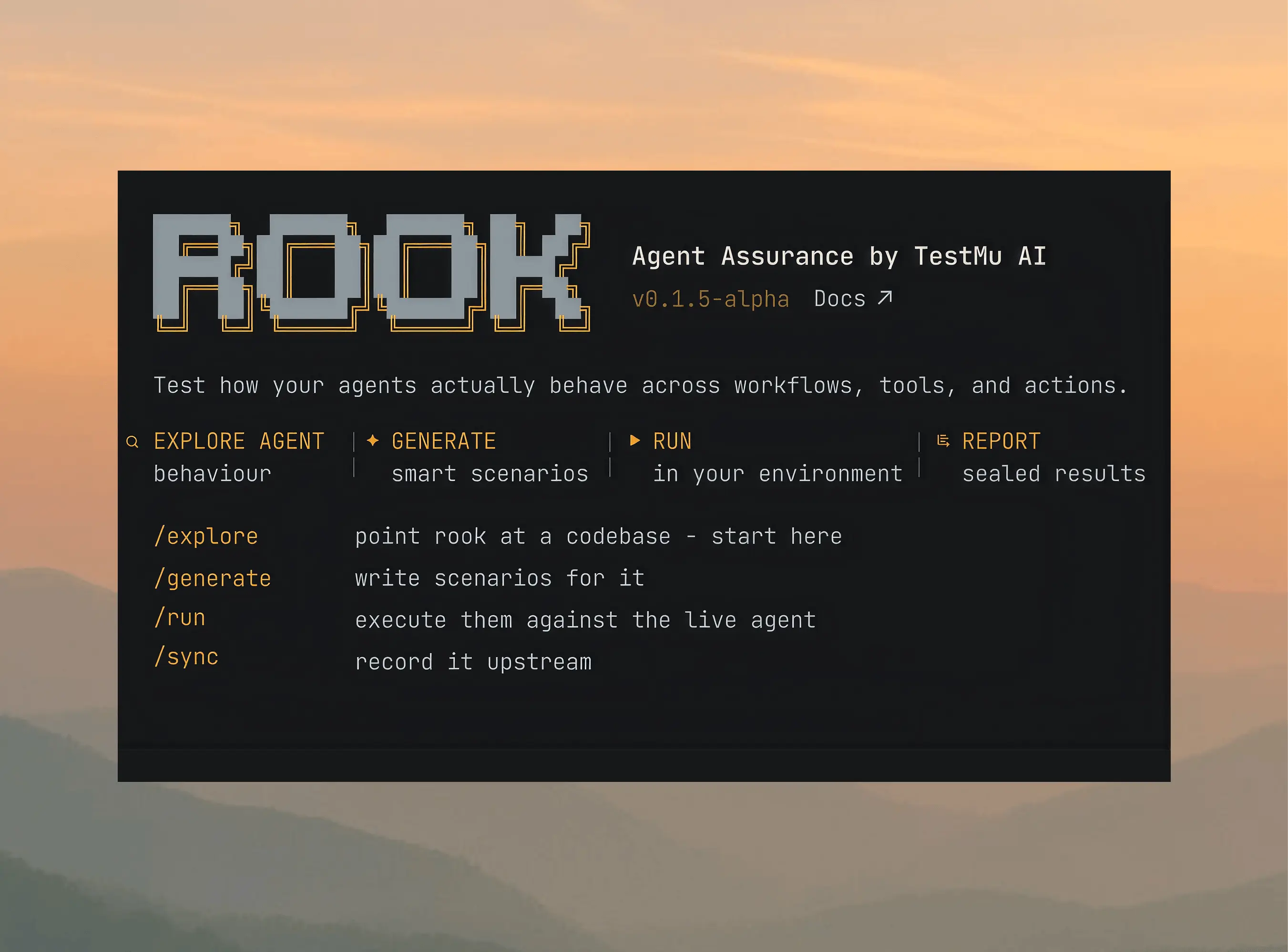
TestMu AI's Agent Assurance applies that design to agents you own. The product is pre-alpha and publicly installable; you add its command line, Rook CLI, from npm with one command:
npm install -g @testmuai/rookYou can run it on macOS and Linux, and 64-bit Windows through npm or WSL. For the npm install, have Node.js 20 or newer on the machine.
- A judge per criterion - scenarios are generated from your agent's code or spec with acceptance criteria, and a judging subagent rules on each criterion separately, the same unit DevAI's requirements use.
- Evidence the judge collects - the judge opens the files the run changed inside the paths your profile lists and any artifacts it left, lines every tool call up against the agent's declared tool list (the never-call entries too), and looks records up with a read-only MCP tool you have approved.
- Mixed checks - a model judge scores some criteria, while a read of the changed system or a rule such as a regex scores others, and in every case the agent's own claim that it acted is not accepted as proof.
- Read-only by instruction - judges are told to verify without changing anything, and each judge tool call passes the same permission gate as any other; the Rook CLI permissions and safety docs ask for a read endpoint, trace, file observation or read-only MCP tool, and read-only credentials are yours to supply.
- A third verdict - a criterion the judge cannot settle from evidence is reported as Unable to Verify, next to Pass and Fail, and the pass rate leaves it out.
Most eval and observability tools grade what an agent said and what its trace recorded; Agent Assurance looks at what the run changed and reports separately what it could not verify. It calls your actual agent before release, from a terminal or a CI job, and because the agent's writes during a run are real, point it at staging. It does not monitor production and is not a runtime guardrail.
Adding an Agent Judge to Your Own Agent Evaluations
Measure an agent-as-a-judge setup against people before you let it decide anything:
- Take requirements from tasks your agent already runs and have at least two people label each one met or not met, then settle their disagreements together, as a small golden dataset.
- Run your agent judge on the same requirements with read access to the workspace and the run's logs.
- Report agreement beside the always-not-met baseline, the false met and false not met counts, and the share of met verdicts people confirmed, the columns the DevAI recount produced.
A single labeller makes a weak reference, as the DevAI study shows. In the first arXiv version of the Agent-as-a-Judge paper, the DevAI expert who erred most differed from the final consensus on 23.77% of GPT-Pilot's requirements, and a majority vote of all three experts corrected most of those errors.
If the agent writes to files, tickets or databases, give the judge read-only access and a third verdict for missing evidence, or follow the Agent Assurance quickstart to install Rook CLI and see per-criterion verdicts with their evidence on an agent you own.
Author

Samyak Goyal
Blogs: 32

Samyak Goyal is a Senior Member of Technical Staff at TestMu AI engineering Kane CLI, the command-line tool that runs browser automation from the terminal, where a flow described in natural language executes in a real Chrome browser and returns pass or fail with shareable proof. He is a backend engineer with 4+ years of experience, previously an SDE at Innovaccer, where he built APIs, introduced Kafka, and cut deployment from weeks to hours. Samyak also builds multi-agent systems, skill-orchestration frameworks, and a personal copilot that indexes 200+ microservice repositories.
Reviewer

Sirajuddin Khan
Reviewer
Sirajuddin Khan is Vice President of Product Management at TestMu AI, where he drives the company's agentic AI product strategy, building a suite of autonomous agents that includes Agentic Browsers and Agentic Visual Testing and shifting the unit of work from test execution to autonomous outcomes. One of the company's earliest product leaders, he has owned the roadmap for the high-performance execution cloud and grew the cross-browser testing products from early adoption to market leadership. He brings over a decade of experience across SaaS, B2B, and eCommerce, with earlier product roles at Wydr and ShopClues, where his catalog and search work cut delivery SLAs and lifted seller activity. Sirajuddin holds an MBA in Information Technology from Sikkim Manipal University and a B.Tech in Computer Science Engineering from Maharshi Dayanand University.


Agent-as-a-Judge FAQs
Did you find this page helpful?
More Related Learning Hubs

TestMu AI forEnterprise
Get access to solutions built on Enterprise
grade security, privacy, & compliance
- Advanced access controls
- Advanced data retention rules
- Advanced Local Testing
- Premium Support options
- Early access to beta features
- Private Slack Channel
- Unlimited Manual Accessibility DevTools Tests