
Power Your Software Testing with AI Agents and Cloud
The Native AI-Agentic Cloud Platform to Supercharge Quality Engineering. Test Intelligently and Ship Faster.

- TestMu AI (Formerly LambdaTest)
- /
- Blog
- /
- Verification Agent: How It Works and Where It Fails
Verification Agent: How It Works and Where It Fails
A verification agent checks another system's work against evidence. Learn the architecture patterns, the generation-verification gap, and where each one fails.
Last Updated on:
A verification agent is an autonomous component that checks another system's output against evidence it can observe, then returns a verdict the calling system did not produce itself. On the MATH500 benchmark, Llama 3.3 70B Instruct produces a correct answer within 100 samples 98.6% of the time, while majority voting selects it 83.0% of the time.[1]
This guide covers the definition, how the verify loop works, why verification now costs more than generation, the generation-verification gap, the five architecture patterns, how to judge a verification signal, the failure modes, and how to verify the verifier.
Key Takeaways
- Oracle independence: A verdict is worth only as much as the distance between the evidence source and the system that produced the work.
- Selection beats generation: When correct answers already sit in the sample set, spending on a better selector recovers more accuracy than spending on a better generator.
- Policy over prompt: Move a safety rule out of the prompt and into the runtime, because a model can reason past an instruction but not past an enforced check.
- Proxy drift: Every verifier measures a stand-in for human intent, so a generator trained against a fixed verifier learns the stand-in rather than the goal.
- Stale green: Read coverage off the evidence a run actually produced instead of a checklist, or a passing result will outlive the behavior it once proved.
- Text-surface blindness: Unit tests, type checkers, and linters all read source code, so none of them can see a page that renders incorrectly.
What Is a Verification Agent?
A verification agent checks whether another system's output matches a stated expectation, using evidence it collects itself. The output is a verdict backed by an artifact, not a suggestion.
Three parts make the shape work. A claim states what should be true. An oracle supplies evidence about what is actually true. A comparison between the two produces the verdict. Remove any one part and the result stops being verification: a claim with no oracle stays unverified, and an oracle with no claim only produces telemetry.
The term carries two other meanings that searchers hit first. In municipal finance, the same job title describes a firm that recomputes escrow cash flows on a bond refunding. In payments and identity, agent verification means proving an autonomous agent is a registered party rather than an impersonator. Both are real jobs, and neither is the subject here.
How Does the Verification Loop Work?
A verifier captures a claim, collects evidence from a source the generator does not control, then compares the two. The independence of that evidence source decides what the verdict is worth.
Independence is the whole mechanism, and it is the part most implementations get wrong. A model that re-reads its own reasoning chain and declares it sound has gathered no new information. The same weights that produced the error produce the assessment of the error, so a confident mistake stays confident.
Anthropic describes the working version of the pattern in its Claude Opus 4.7 release. The model built a Rust text-to-speech engine from scratch. It then fed its own audio output through a speech recognizer to confirm the result matched the Python reference.[2] A speech recognizer shares no code path with the engine it grades, and that separation is what makes its answer usable as evidence.
A practical test follows from that example. Ask what would have to be broken for the oracle and the generator to fail together. If a single wrong assumption defeats both, the oracle adds nothing. If defeating both takes two unrelated faults, the verdict carries real information.
- Claim capture: The agent records the expectation before execution starts, so the bar cannot move to match whatever happened.
- Evidence collection: The agent gathers artifacts such as DOM state, HTTP status, console output, or a database row that the generator never wrote.
- Verdict emission: The agent returns pass, fail, or inconclusive plus the artifact, so a reviewer can reconstruct the decision months later.
Why Is Verification Harder Than Generation Now?
Generation got cheap and verification did not. Foundation models produce complex candidates quickly, so checking those solutions reliably is now the slower and more expensive half of the loop.
A 2026 arXiv paper on coding agent rewards states the inversion directly: as foundation models develop stronger reasoning capabilities and engineering harnesses grow more sophisticated, generating complex candidate solutions is no longer difficult, and reliably verifying them has become the harder problem.[3]
The classical intuition ran the other way. Checking a proof was assumed cheaper than finding one, and checking a patch cheaper than writing it. That assumption held while humans wrote the candidates, because a human produced few candidates and each one carried a rationale a reviewer could follow.
Volume broke the assumption. An agent that emits many candidate patches in the time a person writes one moves the cost center from authoring to adjudication, and adjudication does not parallelize the way generation does.
The NeurIPS 2026 workshop on agent verification frames the operational symptom in one line: improvements plateau, regressions slip through silently, and development turns into guesswork.[4]
Teams meeting this for the first time usually arrive through a related question about who decides what gets checked, which is covered in qa agent vs verification tool.

Note: Run evidence-backed browser checks on the same cloud grid as the rest of your suite with TestMu AI. Try free!
What Is the Generation-Verification Gap?
The generation-verification gap is Pass@K minus the success rate of the selection strategy. It measures how often a correct answer sits in the samples while the verifier fails to pick it out.
Stanford, the University of Wisconsin-Madison, and Together AI put numbers on the spread. On MATH500, Llama 3.3 70B Instruct reaches a correct answer within 100 samples 98.6% of the time, while majority voting selects a correct one 83.0% of the time. Their Weaver framework closes most of that distance and reaches 93.4% on the same benchmark.[1]
Reading the gap tells a team where to spend. A wide gap means the generator is already good enough and the selector is throwing away correct work, so budget belongs in verification. A narrow gap means the correct answer is rarely produced at all, and a better verifier changes nothing.
Verification quality also decouples from verification cost, which is the finding most likely to change an architecture decision. Distilling an ensemble of 70B verifiers into a single 400M cross-encoder preserved 98.2% of the accuracy gains while cutting inference compute by 99.97%.[1] A small dedicated verifier can carry most of the value of a large one.
What Are the Main Verification Agent Patterns?
Self-verification, a separate verifier model, runtime policy monitoring, execution-grounded checks, and formal proof cover most systems. They differ in how independent their evidence is.
Independence and cost move in opposite directions across the list. Self-verification is nearly free and shares every blind spot with the generator. Formal proof shares none of them and costs the most to write. Most production systems stack two or three patterns rather than picking one.
| Pattern | Where the evidence comes from | Its characteristic failure |
|---|---|---|
| Self-verification | The generating model re-examines its own output in a second pass | Confirms errors that follow from an assumption the model already holds |
| Separate verifier model | A second model scores or ranks candidate outputs | Position, verbosity, and self-preference bias reorder results independently of quality |
| Runtime policy monitoring | The runtime compares each action against a written specification as it executes | Covers only behavior someone thought to write a rule about |
| Execution-grounded checks | The system runs the software and observes real output, such as a rendered page or a test result | Proves only the paths that were actually executed |
| Formal proof | A checker proves the implementation satisfies a logical specification | Guarantees the spec, not the intent, and does not scale to most product code |
Picking between the five patterns is mostly a question of what a failure would cost. Ranking candidate summaries tolerates a biased verifier. Approving a refund does not, and that difference is what pushes teams toward execution-grounded and policy-based checks as stakes rise. The wider practice around this is set out in verification-driven development.

Austin Siewert
Co-Founder, Steadfast Systems
Discovered @TestMu AI yesterday. Best browser testing tool I've found for my use case. Great pricing model for the limited testing I do 👏
2M+ Devs and QAs rely on TestMu AI
Deliver immersive digital experiences with Next-Generation Mobile Apps and Cross Browser Testing Cloud

How to Judge Whether a Verification Signal Is Good?
Judge a verification signal on scalability, faithfulness, and robustness: whether it is cheap at volume, how much real intent it captures, and whether it survives optimization pressure.
Those three dimensions come from the coding agent rewards paper, which defines them precisely. Scalability is the precondition, asking whether the signal can be produced cheaply at the scale required. Faithfulness is the core quality, asking how much of the true user intent the signal reflects rather than a narrow surrogate. Robustness is the reliability of faithfulness under adversarial input and optimization pressure.[3]
Most teams optimize scalability and ignore robustness. A unit test suite scores high on scalability and can score badly on faithfulness, because passing tests is a surrogate for working software rather than the thing itself. That is the mechanism behind a green pipeline shipping a broken checkout page.
| Dimension | Question to ask | Symptom when it is weak |
|---|---|---|
| Scalability | Can this run on every change without someone rationing it? | The check gets moved to nightly, then quarterly, then nowhere |
| Faithfulness | Does passing this actually mean the user gets what they wanted? | Green builds ship visible defects and nobody can say which check should have caught it |
| Robustness | Does it still hold once someone optimizes against it? | Pass rates climb while user-reported defects stay flat |
How to Verify What an AI Coding Agent Shipped?
An AI coding agent checks the text surface only, so unit tests, type checkers, and linters all pass while a rendered page stays broken. Proving the UI works needs evidence from outside the code.
The blind spot is structural rather than a quality problem with any particular agent. Coding agents read source code, write source code, and reason about source code, and every verification primitive available to them operates on that same closed surface. None of those primitives opens a viewport, clicks a button, or confirms a redirect landed on the right URL.
That gap produces a specific failure class: code that is technically correct while the user-facing result is broken. A button wired to the wrong endpoint, a redirect that 404s, a modal that will not close, and a form whose validation never fires all survive a green test run, because nothing in the run ever looked at the screen.
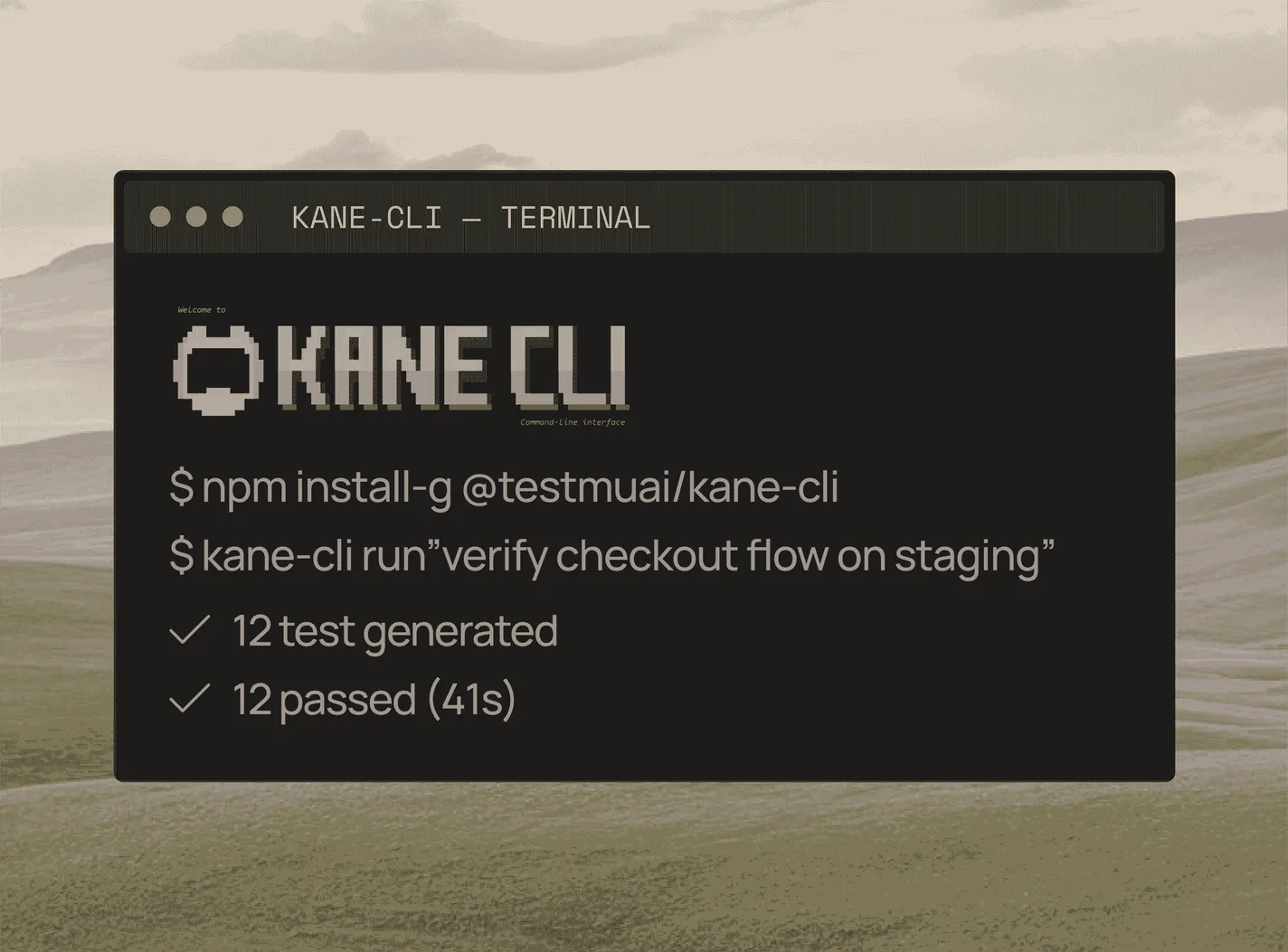
Kane CLI from TestMu AI addresses that gap by driving a real Chrome browser and anchoring the verdict to what the rendered page shows. An AI coding agent can call Kane CLI as a tool and receive a structured pass or fail it did not generate itself.
- Vision-based waiting: Kane CLI watches the rendered viewport rather than network idle or DOM ready, so canvas elements, shadow DOM, and streamed UI do not produce a premature verdict.
- Confidence-scored matching: Every element match reports a confidence score, and low-confidence matches are rejected up front instead of clicking a wrong element and reporting a pass.
- Sealed evidence packs: Each run produces results, per-step screenshots, a HAR network log, console NDJSON, and failure records, so a reviewer can reconstruct the verdict later.
The official documentation covers installation, objective syntax, and the CI configuration. A closely related distinction between judging code and proving it runs is covered in ai code review vs verification.
How to Verify AI Agents at Runtime?
Runtime verification checks an agent's actions against a written policy while the agent runs. The runtime enforces a policy, so an agent cannot argue past it the way it can past a prompt instruction.
Amazon Web Services released Dogwood in August 2026 as an open source governance language for agents and their tools, under an Apache 2.0 license.[5] Dogwood extends Cedar, and any syntactically valid Cedar policy is a syntactically valid Dogwood policy.
The design point worth borrowing is why point-in-time authorization was not enough. Cedar answers whether one request is allowed. Once agents compose multiple actions into longer workflows, the sequence itself becomes the thing a team wants to govern, and no single-request check can express a rule about a sequence.
Dogwood answers that with temporal operators drawn from Metric First-Order Temporal Logic. The operator formerly checks whether something happened inside a time window, while count_within, count_distinct_within, and sum_within tally, deduplicate, and total events across recent history. Those primitives express rules such as blocking a tool call after the agent has read sensitive data.
- Sequence rules: Deny an outbound send once the agent has already read a record marked confidential earlier in the same session.
- Rate limits: Cap how many times an agent may invoke a costly or irreversible tool inside a rolling window.
- Approval gates: Require a recorded human approval event before an action class executes, checked by the runtime rather than requested in the prompt.
Runtime checks and test-time checks answer different questions and both stay live. Test-time verification asks whether the agent worked before release, and runtime verification asks whether it is behaving right now. Teams building the second layer usually start from the instrumentation described in agent observability.
Where Does Verification Break Down?
Verification breaks down three ways: the verifier shares the generator's blind spot, the generator learns to satisfy the verifier instead of the goal, and a green result goes stale unnoticed.
Shared blind spots come from shared assumptions. A verifier built on the same model family, the same training data, or the same understanding of the spec will agree with the generator for the same wrong reasons. The failure is silent because agreement looks exactly like correctness.
The second failure grows over time. The coding agent rewards paper defines robustness as whether a verifier's judgments survive adversarial inputs and a strengthening generator.[3] Reading that forward, a generator improved against a fixed verifier optimizes the stand-in. Pass rates can then climb while the property anyone cared about stays flat.
Stale greens are the quietest of the three. A check that passed against last quarter's behavior keeps reporting success after the behavior changed, because nothing re-derives what the run actually proved. The defense is to compute coverage from the evidence a run produced rather than from a list someone maintains by hand, and to demote a passing result whose evidence is out of date.
- Rotating scenarios: Hold back a portion of verification cases and rotate them, so a generator cannot be tuned against the full set.
- Cross-family oracles: Source the verifier from a different model family or a non-model check, so the two do not share training assumptions.
- Passing-run review: Sample runs that passed, not only ones that failed, because a broken verifier shows up as silence rather than as an alert.
Demoting a stale green is only useful if the result lands in CI as something other than a failure the agent caused, because a pipeline that cannot tell those apart teaches the team to ignore both.
How Do You Verify the Verifier Itself?
Test a verifier the way you test any agent: run fixed scenarios, score the output against named metrics, and track those scores across model changes instead of trusting one green run.
A verifier is itself an agent, which means it inherits the whole problem it was built to solve. A verifier has its own failure rate. That rate moves when the underlying model is updated, and nothing in a passing run reports the change, so scoring against a fixed metric set is the only way the movement becomes visible.
TestMu AI ships a purpose-built agent ecosystem that keeps this layer in place across the testing lifecycle. The AI agents in it include the Chatbot Testing Agent, the VoiceBot Testing Agent, the Auto Healing Agent, the Root Cause Analysis Agent, and the Test Insights Agent. Each one reports into a single platform rather than as a separate point tool.
The agent testing platform scores chat and voice agents on 9 standardized metrics and phone agents on more than 30, including hallucination, bias, completeness, and context awareness, so a verifier's behavior is tracked as a number that moves rather than a verdict someone recalls. The walkthrough below shows how a scenario run produces those scores.

Two habits do most of the work here. Keep a small set of cases whose correct verdict is already known, including cases that should fail, and re-run them whenever the verifier's model or prompt changes. A verifier that never returns a failure on a suite containing known-bad cases is broken in the most expensive direction. Broader practice on this loop is covered in agentic qa.
Grading an Agent on Evidence It Left Behind
Every failure mode above shares a root cause: the only account of what the agent did is the agent's own. TestMu AI Agent Assurance takes the opposite input, reading the codebase of an agent you own to work out what it can actually do, generating scenarios for it, invoking it for real, and grading each criterion against what it observed rather than what the agent reported. Its Autonomous Agent category, for agents that call tools and write files, is on a waitlist today.
The terminal surface is rook, published under Apache 2.0 and still pre-alpha. A run walks four commands, explore to find the agents in a codebase, generate to write scenarios, run to execute them against the live agent, and report to read the result. What comes back is built for the problem this article keeps returning to:
- Per-criterion verdicts - each one quoting the evidence behind it, so a pass is traceable to a file that changed or a tool call that matched the agent's declared tool surface.
- An unverifiable class - criteria the run could not check are reported as such rather than folded into either column, which is the honest answer a silent green never gives.
- Run-to-run deltas - newly failing, newly fixed, and flaky scenarios, which is the comparison that catches a verifier drifting rather than a product regressing.
- Adversarial coverage - scenario classes spanning prompt injection, jailbreak, data exfiltration and PII leakage alongside the functional set.
One detail matters for the gate. A finished run exits 0 whether its scenarios passed or failed, so CI reads the verdicts out of the JSON report rather than branching on the exit status, and a run that never started is the only thing that exits non-zero. The documented caution is worth repeating: the agent under test is yours and its writes are real, so point it at staging.
Score AI Agents Against Fixed Quality Metrics

Conclusion
Start by auditing where your current verdicts come from. List every check that gates a release, and mark which ones read evidence the generating system does not control. Anything that fails that mark is reporting on itself, and a verification agent only adds value where that independence exists.
Then pick the cheapest independent oracle for the highest-stakes claim you have. For a rendered interface, that means running the real browser and reading the screen. For an agent workflow, it means a runtime policy the model cannot talk past. Add the second layer only after the first one produces artifacts you would show an auditor.
For the groundwork behind that first oracle, the AI agent testing guide covers how to structure scenarios and metrics, and agent automation testing walks through how an agent executes a run end to end.
A related Testμ 2026 session, The Human Quality Layer for AI Agents, goes further into this.
Sources and References Used
- [1] Shrinking the Generation-Verification Gap with Weak Verifiers - Saad-Falcon et al., Stanford University, University of Wisconsin-Madison and Together AI, arXiv (June 2025)
- [2] Introducing Claude Opus 4.7 - Anthropic (April 2026)
- [3] The Verification Horizon: No Silver Bullet for Coding Agent Rewards - Qwen Team, arXiv (June 2026)
- [4] Who Verifies the Agents? Toward Reliable Agent Development - NeurIPS 2026 Workshop, Sydney (December 2026)
- [5] Introducing Dogwood: Runtime Verification for AI Agents - Brooker, Tassarotti and Tristan, AWS Open Source Blog (August 2026)
Author

Prince Dewani
Blogs: 30

Prince Dewani is a Community Contributor at TestMu AI specializing in AI agents, software testing, QA, and SEO. He is certified in Selenium, Cypress, Playwright, Appium, Automation Testing, and KaneAI, and presented academic research on AI agents at PBCON-01. At TestMu AI, he has also carried out extensive cross-browser research on the support of modern web technologies such as WebGPU, WebAssembly, WebXR, WebGL2 and other web technologies, validating their compatibility and feature parity across major browsers and rendering engines through rigorous hands-on testing. Prince has hands-on experience building AI agent workflows using Anthropic Claude, Google Antigravity, n8n, LangChain, and other agentic frameworks, and works regularly with MCP and A2A protocols. He shares his work with 5,500+ QA engineers, developers, DevOps experts, tech leaders, and AI agent practitioners on LinkedIn.
Reviewer

Srinivasan Sekar
Reviewer
Srinivasan Sekar is Director of Engineering at TestMu AI, where he leads engineering and open-source initiatives behind the Selenium and Appium automation grid and owns TestMu AI's MCP Server. A committer to Appium and a contributor to Selenium, WebdriverIO, Taiko, and AppiumTestDistribution, he brings over 15 years of experience in quality engineering and open-source technologies. He is the author of the Apress book 'The MCP Standard: A Developer's Guide to Building Universal AI Tools with the Model Context Protocol,' a Certified Kubernetes and Cloud Native Associate, and an international conference speaker. Before TestMu AI he spent over eight years at Thoughtworks as a Principal Consultant and Quality Architect. Srinivasan holds a B.Tech in Information Technology from Anna University.


Verification Agent FAQs
Did you find this page helpful?
More Related Blogs

TestMu AI forEnterprise
Get access to solutions built on Enterprise
grade security, privacy, & compliance
- Advanced access controls
- Advanced data retention rules
- Advanced Local Testing
- Premium Support options
- Early access to beta features
- Private Slack Channel
- Unlimited Manual Accessibility DevTools Tests