
Agent Assurance for your AI Deployment
Test how your agents actually behave across workflows, tools, and actions. Catch failures and vulnerabilities before they ship.
npm install -g @testmuai/rook
- TestMu AI (Formerly LambdaTest)
- /
- Learning Hub
- /
- SimpleQA Benchmark: How It Scores Guesses and Abstentions
OVERVIEW
You are choosing a model for a support assistant, and three pages quote its score on the SimpleQA benchmark, OpenAI's test of short factual questions: a model card, a benchmark tracker and a vendor blog. The three numbers disagree, and the newest one is the highest.
Before you read the gap as progress, check which question set each page used, which grader model, which prompt, and which formula turned the grades into one number. On SimpleQA, the formula decides how much a model gains by guessing instead of saying it does not know.
For saturation, leaderboards and how SimpleQA sits among other benchmark families, read the overview of LLM benchmarks.
Overview
SimpleQA is OpenAI's factuality benchmark of 4,326 short questions, each with one indisputable answer. A grader marks every reply correct, incorrect or not attempted, and the headline F-score is the harmonic mean of the share answered correctly and the accuracy on attempted questions, so an abstention costs less than a wrong guess.
SimpleQA at a Glance
- SimpleQA F-score: The SimpleQA F-score equals 2c divided by the sum of 2c, 2i and n, where c, i and n count correct, incorrect and not attempted questions, so a wrong answer weighs twice as much as an abstention.
- Penalizes wrong answers?: Yes, but lightly, because under the SimpleQA F-score a guess still raises the expected score once the model's chance of being right passes about half of its current F-score.
- Run with web search?: No. The SimpleQA Verified dataset card says the benchmark is meant to be used without search or retrieval tools, because with tools it is trivial to solve, so a run with search measures something else.
- SimpleQA Verified: SimpleQA Verified is a 1,000-question subset of SimpleQA from Google DeepMind and Google Research, with near-duplicates removed, topics and answer types balanced, gold answers corrected and a revised GPT-4.1 grader prompt.
- Answer types: Dates are the largest answer type in SimpleQA, at 1,418 of 4,326 questions or 32.8%, against 22.2% of SimpleQA Verified, in a script count of both public CSV files.
- Comparable across leaderboards?: No. The SimpleQA paper headlines an F-score, OpenAI's simple-evals code returns the share graded correct, and Epoch AI reports plain accuracy after adding an instruction that discourages abstaining.
- Margin of error: A SimpleQA share-correct score near 40% carries a 95% margin of about 1.5 points on 4,326 questions, while a SimpleQA Verified accuracy near 55% carries about 3.1 points on 1,000 questions.
- Agent Assurance: For an agent you build, TestMu AI's Agent Assurance runs pre-release scenarios against the agent itself and returns Pass, Fail or Unable to Verify on every acceptance criterion, judged on the files, tool calls and records that each run leaves behind.
What Is SimpleQA, OpenAI's Benchmark of Short Fact-Seeking Questions?
SimpleQA is an OpenAI benchmark of 4,326 short, fact-seeking questions, introduced in the paper Measuring Short-Form Factuality in Large Language Models (Wei et al., November 2024). Each question has one reference answer, and the questions were "adversarially collected against GPT-4 responses"; at release, GPT-4o and Claude both scored below 50%.
The paper names false outputs "hallucinations" and narrows the problem to questions with a single answer, which makes grading tractable. SimpleQA measures one slice of that wider failure; its causes and other types are explained in the hub on AI hallucination.
The writing rules in Section 2 of the paper explain what kind of fact each question tests:
- One indisputable answer - a question must fix the scope of its answer, asking "which city" or "what year" rather than "where" or "when".
- Answers that do not change - TV, film, video game and sports questions typically name a point in time, and every question had to be answerable as of December 31, 2023.
- Two trainers agree - a second AI trainer answered each question independently, and a question was kept only when both answers matched and their 2 to 4 sources came from two different website domains.
- Hard for GPT-4 - a trainer kept a question only when at least one of four OpenAI model completions got it wrong.
- About 3% label error - a third trainer answered 1,000 sampled questions, and after manual review the authors traced 2.8% of the sample to real data problems such as ambiguous questions and sources that disagree.
There are no answer options. On a multiple-choice test such as the MMLU benchmark, a blind pick earns credit by chance; on SimpleQA a reply earns credit only when it contains the reference answer, and the grader also records when a model abstains. OpenAI's GDPval benchmark grades by comparison instead: experts weigh each model deliverable against a professional's version of the same task, then prefer one or call a tie.
What Kinds of Questions Are in SimpleQA?
A script run on 2026-10-20 read OpenAI's public SimpleQA CSV, which is byte-identical to the MIT-licensed SimpleQA copy on Hugging Face, and counted the topic and answer type stored in each row's metadata. The file holds 4,326 rows, and the counts below are the script's output.
Beside the original, the tables count SimpleQA Verified, the cleaned subset that Google DeepMind and Google Research built from it. Science and technology leads the original set, while Verified trims TV shows and video games:
| Topic | SimpleQA questions | SimpleQA Verified questions |
|---|---|---|
| Science and technology | 858 (19.8%) | 160 (16.0%) |
| Politics | 709 (16.4%) | 176 (17.6%) |
| Art | 550 (12.7%) | 145 (14.5%) |
| Other | 475 (11.0%) | 102 (10.2%) |
| Geography | 424 (9.8%) | 111 (11.1%) |
| Sports | 368 (8.5%) | 117 (11.7%) |
| Music | 341 (7.9%) | 102 (10.2%) |
| TV shows | 293 (6.8%) | 20 (2.0%) |
| History | 173 (4.0%) | 52 (5.2%) |
| Video games | 135 (3.1%) | 15 (1.5%) |
| Answer type | SimpleQA questions | SimpleQA Verified questions |
|---|---|---|
| Date | 1,418 (32.8%) | 222 (22.2%) |
| Person | 1,041 (24.1%) | 198 (19.8%) |
| Other | 777 (18.0%) | 249 (24.9%) |
| Number | 663 (15.3%) | 185 (18.5%) |
| Place | 427 (9.9%) | 146 (14.6%) |
A score's topic and answer-type mix shapes what it says about a model:
- Dates dominate the original - a model weak at exact dates loses about a third of the original set to one skill, and in the paper's third-trainer check an answer that gave only the year to a month-and-year question counted as incorrect.
- The labels are model-made - OpenAI tagged topics and answer types after the fact with a prompted ChatGPT classifier, so treat a per-topic score as a rough slice.
- The recount matches the paper - the script's ten topic counts equal the topic chart of the SimpleQA paper question for question, and its answer-type shares equal the paper's percentages.
How the SimpleQA Question Mix Was Counted
The two curl commands download both CSV files. The script itself, standard-library Python that is not published on this page, parses the metadata column of the original file and counts each field; this is its counting step:
BASE=https://openaipublic.blob.core.windows.net
curl -sLO $BASE/simple-evals/simple_qa_test_set.csv
HF=https://huggingface.co/datasets/google
V=$HF/simpleqa-verified/resolve/main
curl -sLO $V/simpleqa_verified.csv
meta = [ast.literal_eval(r["metadata"]) for r in orig]
topics = Counter(m["topic"] for m in meta)
types = Counter(m["answer_type"] for m in meta)An excerpt of its output (the topic counts are in the first table above), with each file's row count and the first 12 characters of its SHA-256 hash so you can check that your copy matches:
SimpleQA study, run 2026-10-20
simple_qa_test_set.csv  rows  4326  feee3f7e7db3
simpleqa_verified.csv   rows  1000  b5db21155444

Answer type              SimpleQA      Verified
Date                     1418 32.8%   222 22.2%
Person                   1041 24.1%   198 19.8%
Other                     777 18.0%   249 24.9%
Number                    663 15.3%   185 18.5%
Place                     427  9.9%   146 14.6%
How Is SimpleQA Graded? Correct, Incorrect and Not Attempted
A grader model sees the question, the gold target and the model's reply, and returns one of three letters. OpenAI's reference implementation, simpleqa_eval.py, holds the grader prompt, which says "Hedging and guessing are permissible, provided that the gold target is fully included and the response contains no incorrect information or contradictions." For a gold target of "120k", it counts "124k" as correct, "113k" as incorrect and "around 100k" as not attempted.
The grader is itself an LLM judge, so the usual cautions on LLM-as-a-judge apply: a different grader model or prompt can move a score. The three grades, as the SimpleQA paper defines them in Table 2:
| Grade | Definition in the paper | Effect on the F-score |
|---|---|---|
| Correct | "The predicted answer fully contains the reference answer without contradicting the reference answer." | Raises overall correct and correct given attempted |
| Incorrect | "The predicted answer contradicts the reference answer in any way, even if the contradiction is hedged." | Lowers correct given attempted |
| Not attempted | "The reference answer is not fully given in the answer, and there are no contradictions with the reference answer." | Lowers overall correct only |
The paper rolls the grades into overall correct, correct given attempted and the F-score, and the reference code computes the same three; the closed form of the F-score is from Appendix B:
overall correct          = c / (c + i + n)
correct given attempted  = c / (c + i)
F-score = harmonic mean of the two
= 2c / (2c + 2i + n)- Overall correct - the share of all questions answered correctly, which the paper compares to recall.
- Correct given attempted - the share correct among questions the model answered, which the paper compares to precision.
- Grader check - the authors read 100 correct, 100 incorrect and 100 not attempted grades by hand and found two disagreements with the grader, without a formal study.
- Example from the paper - a model that always answers and gets 30% right scores an F-score of 30%, and a model with 80% correct given attempted needs only 19% overall correct to come close (exactly 30.7%; the paper rounds it to 30%).
The SimpleQA F-Score Worked Through on Published Results
A script run on 2026-10-20 recomputed correct given attempted and the F-score for every row of Table 3 in the SimpleQA paper, from the row's own correct and incorrect shares. Of the paper's eight rows, seven agree within rounding; four are shown here, including the one that does not:
| Model (paper, Table 3) | Correct | Not attempted | Incorrect | Correct given attempted, published and recomputed | F-score |
|---|---|---|---|---|---|
| o1-preview | 42.7 | 9.2 | 48.1 | 47.0 and 47.0 | 44.8 |
| GPT-4o | 38.2 | 1.0 | 60.8 | 38.0 published, 38.6 recomputed | 38.4 |
| Claude-3.5-sonnet | 28.9 | 35.0 | 36.1 | 44.5 and 44.5 | 35.0 |
| o1-mini | 8.1 | 28.5 | 63.4 | 11.3 and 11.3 | 9.4 |
- GPT-4o's cell - 38.2 divided by 99.0 is 38.6%, and no rounding of 38.2 and 60.8 can give 38.0, so the published 38.0 is most likely a typo; the published F-score of 38.4 follows from 38.6.
- Two models, two strategies, one score - GPT-4o answered 99% of questions and Claude-3.5-sonnet 65%, and their F-scores of 38.4 and 35.0 sit 3.4 points apart although GPT-4o got 9.3 points more questions right.
- Worked GPT-4o example - with c = 38.2, i = 60.8 and n = 1.0, the F-score is 76.4 divided by (76.4 + 121.6 + 1.0), which is 38.4%.
Does SimpleQA Reward Guessing?
Yes, under the F-score, and at a lower confidence than the paper's own rule of thumb suggests. Section 2.4 and Appendix B of the SimpleQA paper make the case, crediting Adam Kalai for the point:
- The paper's rule - "if model performance is below 50%, it always makes sense for the model to try to guess if it is at least 50% sure that it will get an answer correct".
- Its proof - Appendix B writes the F-score as 2c / (2c + 2i + n) and shows that one extra guess at even odds has a higher expected score than one extra abstention.
- The exact break-even - working the same algebra for any confidence q, one more guess on a new question scores higher in expectation than abstaining on it when q is above c / (2c + 2i + n + 1), about half of the model's current F-score.
So a model at an F-score of 40% gains, on average, from guessing whenever it is more than about 20% sure. The paper's 50% rule is a sufficient condition; the actual break-even sits lower.
Guess or Abstain on SimpleQA: Expected Scores by Confidence
The same script simulates a model that already answers 35% of questions correctly and 5% wrongly, and is unsure about the other 60%. For those, its confidence q is calibrated, so it is right with probability q when it answers. The script compares answering all of them with abstaining on all of them under four scorings; the figures below are its output, run on 2026-10-20:
Guess or abstain on the unsure 60% of questions
Base: 35% correct, 5% wrong; q = confidence
Gain from guessing, per 100 questions
  q   accuracy  F-score  penalty 1  penalty 9
 0.1     +6.0     -9.0      -48.0     -480.0
 0.2    +12.0     -3.0      -36.0     -420.0
 0.3    +18.0     +3.0      -24.0     -360.0
 0.4    +24.0     +9.0      -12.0     -300.0
 0.5    +30.0    +15.0       +0.0     -240.0
 0.6    +36.0    +21.0      +12.0     -180.0
 0.7    +42.0    +27.0      +24.0     -120.0
 0.8    +48.0    +33.0      +36.0      -60.0
 0.9    +54.0    +39.0      +48.0       +0.0
Abstain-all F-score 50.0
On 4326 items (1514 right, 216 wrong, 2596 skipped),
one more guess beats abstaining on it
when q > c/(2c+2i+n+1) = 0.2500
Penalty p break-even q = p/(p+1): 0.500 and 0.900
The break-even confidence, read off the output, depends entirely on the scoring. Plain accuracy, the score that the reference code in OpenAI's simple-evals repository returns, rewards every guess:
| Scoring | Guessing pays when confidence is above | Who uses it |
|---|---|---|
| Plain accuracy | Zero: any guess helps | Epoch AI on SimpleQA Verified; simple-evals' returned score |
| F-score | 0.25 here, about half the current F-score | SimpleQA paper; SimpleQA Verified report |
| Penalty, p = 1 | 0.50 | The SimpleQA paper's penalty score, set to p = 1 |
| Penalty, p = 9 | 0.90 | The paper's worked threshold |
In the script's output, a model 30% sure of its unsure answers lifts its F-score by 3 points by guessing on all of them, while it would lower its p = 9 penalty score by 360 points per 100 questions. If you tune prompts against SimpleQA's F-score alone, the headline number can rise while the count of wrong answers grows, so report the incorrect share beside it.
The Penalty Score the SimpleQA Paper Proposes for Wrong Answers
The paper's alternative is a single score with no loophole: correct earns 1 point, not attempted 0, and incorrect minus p, averaged over all questions. The penalty is a choice you make for your own use case:
- Break-even rule - a guess pays when the chance of being right is above p / (p + 1), so p = 1 sets the bar at 50% and p = 9 at 90%.
- The paper's threshold - at p = 9 a model's score is positive only if at least 90% of the questions it attempts are correct, a bar the paper says none of its evaluated models met.
- Picking p - set it from the cost of a wrong answer in your product against the cost of "I don't know"; a support assistant quoting a refund policy deserves a higher p than a trivia bot.
What Changed in SimpleQA Verified?
SimpleQA Verified is a 1,000-question subset of SimpleQA from Google DeepMind and Google Research, described in the technical report SimpleQA Verified: A Reliable Factuality Benchmark to Measure Parametric Knowledge (Haas et al., September 2025), which cites noisy and incorrect labels, topical bias and redundancy in the original, such as 119 questions about the founding dates of Colombian municipalities. The report keeps the three grades and the F-score, which it labels F1, and grades with gpt-4.1-2025-04-14, the model OpenAI's current simple-evals code also uses for SimpleQA, but rewrites 88 of the 185 numeric gold answers with an acceptable range and tells the grader to judge only the part of a reply that answers the question and to count a hedge that lists several candidates without committing to one as not attempted. That grader prompt grew from 963 to 1,124 words, which is 16.7% longer, although the report calls it a 15% increase.
Table 2 of the report lists each filter that cut the set down, in order:
| Processing step | Questions left | What it removed |
|---|---|---|
| Original SimpleQA | 4,326 | Nothing yet |
| Unique source documents | 3,095 | All but one question per shared reference URL |
| Near-duplicates, embeddings | 2,871 | Questions above a 0.77 cosine similarity |
| Near-duplicates, TF-IDF | 2,664 | Word-overlap duplicates, reviewed by hand |
| Web publisher choices | 1,855 | Questions whose reference sites use robots.txt controls for AI crawlers from Google, OpenAI or Anthropic |
| Topic and answer-type balance | 1,218 | Over-represented dates, people and science questions |
| Conflicting sources, two passes | 1,073 | Ambiguous items and numbers outside a 5% margin across sources |
| Headroom | 1,000 | Questions every leading model already answered correctly |
The same script matched every row of the MIT-licensed SimpleQA Verified CSV on Hugging Face to its original through the original_index column and compared the two. Its output, run on 2026-10-20:
Verified items against their SimpleQA originals
  gold answer identical           833
  gold answer rewritten            79
    with different numbers in it   18
  numeric answer given a range     88
  question text edited             56
  topic label changed               0
  answer-type label changed        20
  flagged multi_step               73
flagged requires_reasoning 37- Most rewrites are formatting - dates move between "June 24th, 1896." and "June 24, 1896" styles; 18 rewritten answers differ in their digits, some only in form, such as "107.0" to "107", and some in substance, such as the date Panama decided to use DVB-T, which moved from "May 12, 2009" to "May 19, 2009".
- Some answers changed outright - the question that asked for the judging-panel member who crowned Reita Faria, Miss World 1966, now asks who crowned her, and its gold answer went from "Lady Annabel Birley" to "Lesley Langley".
- Every range is on a Number item - all 88 acceptable ranges sit on questions typed Number; in the report's own example, a reply of 8,333 against a gold 8,282 moves from incorrect to correct.
- Metadata matches the report - 37 questions flagged as needing reasoning and 73 as multi-step equal the report's 3.7% and 7.3%; topics were not relabelled, while 20 answer types were.
The dataset card sets one rule for running it: no search or retrieval tools. In its words, "With tools, the benchmark is trivial to solve which defeats its purpose."
Why Do SimpleQA Scores Differ Between Leaderboards?
Epoch AI runs SimpleQA Verified itself and, as its SimpleQA Verified methodology page (read on 2026-10-20) states, "We report the simple proportion of questions answered correctly." Since 2026-08-27 it appends an anti-abstention instruction that begins "This is a guessing game, not a test." Asked the bare question, Claude Haiku 4.5 declined on 82% of the 1,000 questions; across the re-evaluated models, declining fell from 15% of questions on average to under 1%.
Check each of these settings before comparing two figures:
- Question set - SimpleQA has 4,326 questions and SimpleQA Verified 1,000 harder, cleaned ones; the two are different tests.
- Formula - the SimpleQA paper and the Verified report headline an F-score, Epoch AI reports accuracy, and OpenAI's reference code returns the share graded correct as its score while only printing the F-score.
- Prompt - an anti-abstention instruction turns abstentions into guesses, which raises accuracy and removes most of the not attempted grades the F-score was designed around.
- Grader - the SimpleQA paper graded with a prompted ChatGPT classifier, OpenAI's current reference code grades with GPT-4.1 and the original prompt, and Verified uses GPT-4.1 with a longer prompt and numeric ranges.
- Model settings - reasoning effort, tools and system prompts differ between runs, and a run with search is not a SimpleQA run at all.
- Contamination - Epoch AI says it suspects Qwen3-Max-Instruct is contaminated on SimpleQA Verified.
The formula alone reorders models. A script run on 2026-10-20 ranked the models in Table 7 of the SimpleQA Verified report three ways, using the report's own percentages:
| Model (Verified report) | F-score (F1 in the report) | Accuracy | Rank by F-score | Rank by accuracy | Rank by penalty p = 1 |
|---|---|---|---|---|---|
| GPT 4.1 | 39.9 | 39.8 | 4 | 4 | 7 |
| Claude Opus 4 | 28.3 | 19.2 | 7 | 9 | 4 |
| Gemini 2.5 Flash | 28.2 | 27.8 | 8 | 7 | 11 |
| GPT 5 Mini | 24.6 | 17.3 | 9 | 10 | 5 |
| o4-mini | 23.4 | 23.0 | 10 | 8 | 12 |
- Same F-score, different behavior - Claude Opus 4 and Gemini 2.5 Flash score 28.3 and 28.2, yet Opus attempted 35.5% of questions and Flash 96.9%, and Flash answered 8.6 points more questions correctly.
- Penalty favors abstainers - with one point lost per wrong answer, Claude Opus 4 moves from seventh to fourth and GPT 4.1 drops from fourth to seventh.
- The top three hold - Gemini 2.5 Pro, GPT 5 and o3 stay in the top three under every scoring, and all 13 published F-score values match the recomputation.
Published SimpleQA and SimpleQA Verified Scores by Source and Scoring Method
The SimpleQA rows come from the paper and from the README of OpenAI's simple-evals repository, which no longer adds new models or results and does not label its SimpleQA column. The Epoch AI rows are the top three in its Creative Commons Attribution-licensed benchmark data download, listed under the model version names in that file, with each margin from Epoch's own standard error.
| Model | Question set and scoring | Headline score | Share correct, 95% margin | Source, date read |
|---|---|---|---|---|
| o1-preview | SimpleQA, F-score, ChatGPT grader | 44.8 | 42.7%, ±1.5 | SimpleQA paper, Table 3; 2026-10-20 |
| GPT-4o | SimpleQA, F-score, ChatGPT grader | 38.4 | 38.2%, ±1.4 | SimpleQA paper, Table 3; 2026-10-20 |
| Claude-3.5-sonnet (2024-06-20) | SimpleQA, F-score, ChatGPT grader | 35.0 | 28.9%, ±1.4 | SimpleQA paper, Table 3; 2026-10-20 |
| gpt-4.5-preview-2025-02-27 | SimpleQA, unlabelled column; the reference code scores the share correct | 62.5 | ±1.4 if share correct | simple-evals README; 2026-10-20 |
| o3 | SimpleQA, unlabelled column, no tools | 49.4 | ±1.5 if share correct | simple-evals README; 2026-10-20 |
| Gemini 2.5 Pro | SimpleQA Verified, F-score, GPT-4.1 grader | 55.6 | 55.3%, ±3.1 | Verified report, Table 7; 2026-10-20 |
| GPT 5 | SimpleQA Verified, F-score, GPT-4.1 grader | 52.3 | 50.9%, ±3.1 | Verified report, Table 7; 2026-10-20 |
| gemini-4-argon_high | SimpleQA Verified, accuracy, anti-abstention instruction | 76.0% | 76.0%, ±2.6 | Epoch AI data, run 2026-10-13; read 2026-10-20 |
| gpt-6-astra_max | SimpleQA Verified, accuracy, anti-abstention instruction | 75.6% | 75.6%, ±2.7 | Epoch AI data, run 2026-08-30; read 2026-10-20 |
| gpt-6.1-sol_max | SimpleQA Verified, accuracy, anti-abstention instruction | 73.9% | 73.9%, ±2.7 | Epoch AI data, run 2026-09-29; read 2026-10-20 |
- Comparing across rows - 76.0% accuracy with a guessing instruction and an F-score of 55.6 without one measure different things, so the gap between them mixes newer models with a different formula and prompt.
- How the margins were computed - 1.96 times the binomial standard error of the share correct, from 4,326 or 1,000 questions; Epoch AI's rows use the standard error in its file.
What Can't SimpleQA Tell You About Your Own Agent?
SimpleQA measures how often a bare model recalls an obscure public fact, and how often it abstains, with no tools. Your support assistant answers from your own documents, so measure its groundedness against a golden dataset of your users' questions; a high SimpleQA score says little about either. Before you build that set, compare the public RAG evaluation datasets by license, size and the skill each one tests.
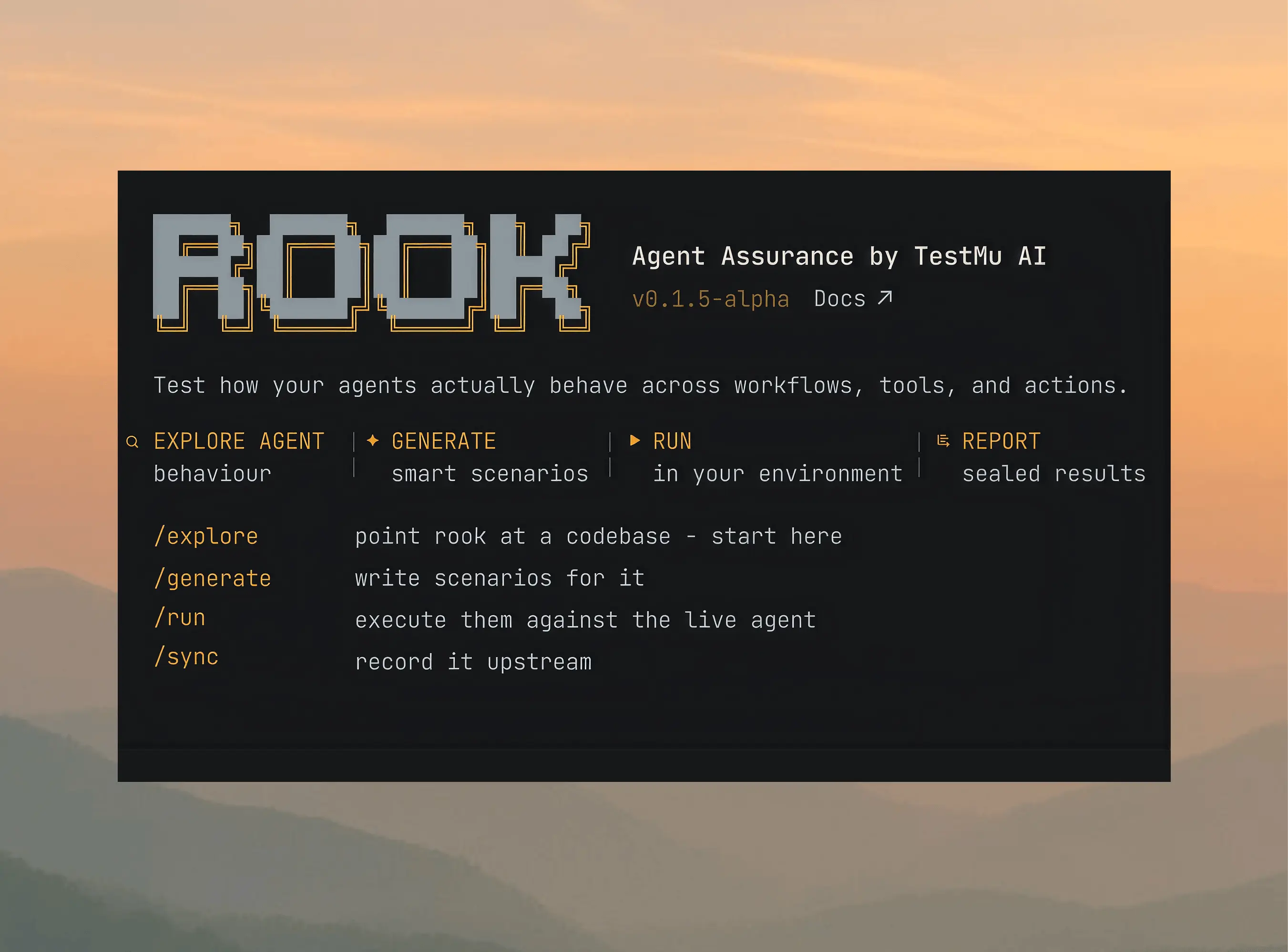
Once the assistant also opens cases, refunds orders or edits files, the question becomes what it did, which no reply grader observes. TestMu AI's Agent Assurance tests that layer before release. Its command line, Rook CLI, is still pre-alpha, and the public npm package installs it:
npm install -g @testmuai/rookBuilds of the current release cover macOS and Linux, and 64-bit Windows through npm or WSL. Ahead of an npm install, put Node.js 20 or later on the machine; Homebrew and the checksum-verifying shell script cover macOS and Linux and carry their own runtime, and every route is described in the Rook CLI installation guide.
Where most eval and observability tools judge the replies and the traces an agent logged, Agent Assurance looks for what each run changed and lists separately what it could not confirm. Several SimpleQA ideas carry over, with that change in what counts as evidence:
- Gold answer, then acceptance criteria - a SimpleQA item carries one reference string, while Agent Assurance writes scenarios with acceptance criteria from your agent's code, or from its PRD, spec, docs folder or API spec when there is no code to read.
- Not attempted, then Unable to Verify - SimpleQA's third grade records a model that abstained; Unable to Verify marks a criterion the run's evidence could not settle, and such a verdict is left out of the pass-rate denominator.
- Reply grader, then run evidence - SimpleQA's grader sees only the reply. In Agent Assurance, model judges score some criteria, though a message saying the case was filed proves nothing by itself: tool calls are checked against the tools the agent declares, and files, artifacts and records are read, records only through a read-only tool that you sign off on.
- Hallucination as an adversarial category - hallucination is one of the categories in the adversarial class, which a plain generate run plans for by default, next to prompt injection, data exfiltration and PII leakage.
Every run calls the real agent, and nothing it writes during the run is rolled back, so point it at staging. Watching production traffic and ranking foundation models are outside its job: the subject under test is your agent, not the model it calls.
If the assistant only talks to people, over chat, voice, phone, video or image, TestMu AI's Agent Testing fits better: for chat and voice agents its Hallucination Detection metric checks replies against the knowledge base and context you supply.
How to Read a SimpleQA Score Before Picking a Model
Epoch AI's benchmark data download (updated Oct. 19, 2026) shows why margins matter: its top three SimpleQA Verified rows sit within 2.1 points of each other, and each row's 95% margin is wider than that, so the three are a statistical tie. Write down the question set, formula, prompt and grader behind each number you plan to compare, then run through this list:
- Confirm whether the question set is SimpleQA or SimpleQA Verified.
- Confirm whether the formula is an F-score, accuracy or a penalty score, and ask for the not attempted share when only one number is given.
- Confirm the prompt and grader, including any instruction that discourages abstaining.
- Treat gaps smaller than the 95% margin as ties.
- Score your own assistant on your own questions before the model decision is final.
One more check comes after the model is chosen: once your assistant writes to records or files, the Agent Assurance overview explains how Rook CLI derives scenarios for it and where each verdict's evidence comes from.
Author

Anubhav Singhmaar
Blogs: 46

Anubhav Singhmaar is an AI Product Manager at TestMu AI driving Kane CLI, the command-line tool that brings browser automation to the terminal, turning natural-language flows into runs in a real Chrome browser that return pass or fail with shareable proof. He owns the roadmap and prioritization and works with engineering to ship developer-facing features. Before TestMu AI, he spent over four years at Sprinklr owning enterprise voice AI across APAC and EMEA. A mechanical engineer turned product manager, he grounds guidance in real QA workflows.
Reviewer

Samyak Goyal
Reviewer
Samyak Goyal is a Senior Member of Technical Staff at TestMu AI engineering Kane CLI, the command-line tool that runs browser automation from the terminal, where a flow described in natural language executes in a real Chrome browser and returns pass or fail with shareable proof. He is a backend engineer with 4+ years of experience, previously an SDE at Innovaccer, where he built APIs, introduced Kafka, and cut deployment from weeks to hours. Samyak also builds multi-agent systems, skill-orchestration frameworks, and a personal copilot that indexes 200+ microservice repositories.


SimpleQA FAQs
Did you find this page helpful?
More Related Learning Hubs

TestMu AI forEnterprise
Get access to solutions built on Enterprise
grade security, privacy, & compliance
- Advanced access controls
- Advanced data retention rules
- Advanced Local Testing
- Premium Support options
- Early access to beta features
- Private Slack Channel
- Unlimited Manual Accessibility DevTools Tests