

Power Your Software Testing with AI Agents and Cloud
The Native AI-Agentic Cloud Platform to Supercharge Quality Engineering. Test Intelligently and Ship Faster.


- TestMu AI (Formerly LambdaTest)
- /
- Blog
- /
- Agent Assurance: Test Before Release, Assure After
Agent Assurance: Test Before Release, Assure After
AI agents need quality assurance that starts before release and continues after, in a single connected loop. Pre-release testing stays the foundation.
Published on:
AI agents need quality assurance that starts before release and continues after, in a single connected loop. Pre-release testing stays the foundation. Production assurance extends it; it never replaces it.
For decades, software quality had a clean split. Testers verified the product before release. Operations teams watched it after release. Different teams, different tools, different questions.
Agents break that split. Not because testing matters less, but because no amount of testing before release can cover every path an agent will take afterward.
We call this discipline Agent Assurance: rigorously testing agents before they ship, continuously verifying them afterward, and keeping humans in charge of both.
Why Agents Are Different
In a traditional service, every possible path is written by developers. You can read the code and, in principle, list everything it can do.
In an agent, a model generates the path at runtime: which steps to take, which tools to call, in what order. Those paths are not written anywhere in advance. Defined in advance are the boundaries: the tools the agent can use, the permissions it holds, and the data it can access.
That changes what testing has to cover:
- Paths can't be fully enumerated, so testing focuses on boundaries and outcomes.
- Boundaries must hold on every run, not just the runs you happened to test.
- Outcomes must be checked across many runs and variations because the same input can take different paths.
It gets harder when agents talk to other agents. A growing share of software is now built for agents to use, with no human watching each exchange in real time. That is the problem we built Rook for: agents testing agent-to-agent workflows, checking that each one stays within the boundaries people defined and reaches the expected result.
Step One: Test Rigorously Before Release
No agent should reach production without being tested first. Unstable behavior is a reason for more pre-release rigor, not less.
Before an agent ships, teams should verify:
- Boundaries - the agent never acts outside the tools and permissions it was granted.
- Expected behavior - it achieves the right outcome for the scenarios in the requirements, across repeated runs.
- Known risks - unsafe actions, data leaving the environment, unexpected network access, and failure modes already seen elsewhere.
- Ambiguity in the requirements: gaps the agent might fill with a guess. In one build from our recent Kane CLI hackathon, the biggest defect came from a requirement that never said how a task becomes high priority. The agent never asked, and shipped an app where nothing could reach that state.
Everything after release builds based on this foundation.
Step Two: Keep Verifying After Release
Because an agent's paths are generated at runtime, no pre-release suite can cover every one. Production assurance exists to catch what testing could not anticipate. It extends pre-release testing; it does not replace it.
After release, teams should keep verifying:
- Boundary violations - any action outside granted tools or permissions, flagged as it happens.
- Outcome quality - whether the agent still attains the right result on real traffic, not just test data.
- Drift - a model update, prompt change, or new data source that quietly changes behavior.
- The monitors themselves - in OpenAI's recent sandbox incident, monitoring flagged the behavior, but later review found other attempts that were never flagged, and an automatic shutdown system did not work (Fortune).
The market is moving the same way. Observability vendors are adding evaluation, and evaluation tools are moving into production:
| Dynatrace to acquire Arize | August 2026 | Agreement signed, not yet closed (Vellum) |
| Cisco to acquire Galileo, extending Splunk | April 9, 2026 | Announced (Futurum) |
| ClickHouse acquires Langfuse | January 2026 | Completed (ClickHouse) |
Galileo, for example, covers the agent lifecycle from prompt optimization and evaluation through production monitoring and guardrails. Testing and observability are becoming one discipline.
Step Three: Close the Loop
The two steps only work when they feed each other. Every failure found in production becomes a new pre-release test, so the next version ships with that risk covered.
The loop has three moves:
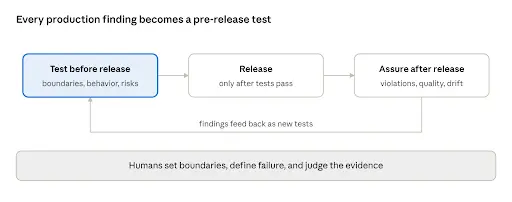
The quality loop for AI agents is a 3-step process:
- Pre-release testing comes first
- Production assurance extends it
- Every finding flows back into the next release's tests.
One more rule keeps the loop honest: the checker needs checking too. A builder at our Kane CLI hackathon gated his coding agent so it could not mark a task "done" until the app passed real checks in a browser. In one build, 7 of 8 failed checks came from the verifier, not the app. In another, the only real bug was caught by a broad requirements sweep after both scripted tests had passed. Verifiers have their own blind spots and false alarms, so they belong inside the loop, not above it.

Humans Stay in Charge of the Loop
Agents can gather evidence at a speed and scale no team can match by hand. But evidence is not a verdict. People decide:
- What the agent may do - its tools, permissions, and data.
- What counts as failure - the intent behind the requirements and the line between acceptable and not.
- Whether the evidence holds up - including evidence produced by the checker itself.
That is why skilled testers matter more with agents, not less. Their judgment sets the boundaries, questions the results, and decides what ships.
Test before release. Assure after. Feed every finding back. And keep humans in charge of all three. That is Agent Assurance.

Austin Siewert
Co-Founder, Steadfast Systems
Discovered @TestMu AI yesterday. Best browser testing tool I've found for my use case. Great pricing model for the limited testing I do 👏
2M+ Devs and QAs rely on TestMu AI
Deliver immersive digital experiences with Next-Generation Mobile Apps and Cross Browser Testing Cloud

Author

Anmol Gupta
Blogs: 6

Anmol Gupta is Vice President of Product Management at TestMu AI (formerly LambdaTest), driving HyperExecute, the test orchestration cloud that runs and accelerates automated test execution. He led the development of the Unified Test Execution Cloud Platform and now leads a 30-member cross-functional product organization across product lines contributing $7M+ in revenue. He brings over nine years of experience and previously co-founded the SaaS company Timble as CTO, where he grew the team from 5 to 40 and launched an AI KYC platform that processed 600K+ applications in five months while cutting verification time from 12 minutes to under 30 seconds. Anmol holds an MTech and BTech from IIT Delhi.
Reviewer

Vipul Verma
Reviewer
Vipul Verma is Group Senior Vice President of Engineering at TestMu AI (formerly LambdaTest), where he heads the entire engineering organization that builds KaneAI, HyperExecute, and the broader testing cloud. He brings 15+ years architecting, securing, and scaling large enterprise applications across multiple sites. Before TestMu AI he was India Head at LogicHub, where he built the India R&D site from the first employee to a 30-plus engineering team, and Principal Software Engineer at Sumo Logic, where he was the first engineer in the India office and shipped search-performance and pricing-model initiatives. Earlier he worked on trading platforms at Portware and D. E. Shaw. Vipul holds a B.Tech in Computer Science from IIT Kharagpur.


Agent Assurance FAQs
Did you find this page helpful?
More Related Blogs
TestMu AI forEnterprise
Get access to solutions built on Enterprise
grade security, privacy, & compliance
- Advanced access controls
- Advanced data retention rules
- Advanced Local Testing
- Premium Support options
- Early access to beta features
- Private Slack Channel
- Unlimited Manual Accessibility DevTools Tests