

Power Your Software Testing with AI Agents and Cloud
The Native AI-Agentic Cloud Platform to Supercharge Quality Engineering. Test Intelligently and Ship Faster.


- TestMu AI (Formerly LambdaTest)
- /
- Learning Hub
- /
- What Is SDET: Everything You Need to Know
What Is SDET: Everything You Need to Know
Learn what an SDET is, their role, skills, tools, and certifications. Explore responsibilities, career growth, and how SDETs differ from QA and testers.
Last Updated on:
The role of a SDET has become essential in modern software teams that prioritize automation, quality, and fast delivery. Their purpose is to build reliable, scalable test automation that supports continuous integration and ensures high software quality throughout the lifecycle.
TL;DR
- SDET stands for Software Development Engineer in Test, a role that pairs software development skill with testing responsibility rather than treating the two as separate jobs.
- The core of the work is writing test code. SDETs build automated suites across UI, API, and backend layers, plus the reusable frameworks those suites run on.
- SDETs join early in the development lifecycle instead of validating at the end, which is the clearest line between the role and traditional QA.
- The skill floor is a working language such as Java, Python, or JavaScript, framework design, CI/CD integration through tools like Jenkins or GitHub Actions, Git, and test data management.
- Day to day the role also covers test planning, security and performance checks, environment setup through Docker or cloud infrastructure, and defect tracking.
- Career paths run toward Lead SDET, Test Architect, DevOps Engineer, or QA Automation Manager, and the coding depth makes a move into pure development straightforward.
- Because SDET work lives inside the pipeline, the automation needs somewhere to execute. Running suites on the TestMu AI test automation cloud covers real browser and OS configurations without maintaining that grid in house.
What Is SDET?
An SDET (Software Development Engineer in Test) is a technical professional who applies both software development and testing skills to ensure the quality of software products.
SDETs are responsible for developing automated test cases and may also contribute to test automation frameworks depending on the team structure. They are involved throughout the software development lifecycle to support continuous testing and integration.
Key Responsibilities of an SDET
SDETs play a critical role in ensuring software quality. Their responsibilities span across automation, performance, integration, and continuous testing within the Software Development Life Cycle (SDLC). .
- Automation Development and Framework: Contributes to designing and maintaining automation frameworks for UI, API, and backend testing, ensuring tests are fast, reliable, and scalable.
- Test Strategy: Defines test strategies that align with business goals, maximize test coverage, and minimize release risks.
- API and Performance Testing: Develop architectural and technical design documents that describe how the system will be structured, how components will interact, and how requirements will be implemented.
- Security Testing: Convert the approved design into working software by writing clean, modular code, ensuring that each component aligns with specified logic, performance, and functionality expectations.
- Code Quality: Combine all coded modules into a complete system and conduct multiple testing levels, such as unit, integration, and system testing, to detect and resolve issues or inconsistencies.
- Static Analysis: Move the fully tested application into the production environment, configure it for end-user access, and verify it performs correctly under real-world usage conditions.
- Defect Management: Monitor the live system, resolve reported bugs, release updates, and adapt the software to changing user needs or technical environments over time.
- Test Data Handling: Manages dynamic and static test data for consistent and repeatable test executions.
- Environment Setup: Configures and manages test environments using Docker or cloud platforms such as TestMu AI, which offers ready-to-use test infrastructure for faster execution.
- Monitoring: Analyzes logs and metrics using tools like Kibana to identify issues and validate system behavior.
- Team Collaboration: Actively collaborates in Agile workflows, including sprint planning, daily standups, and retrospectives.
- CI/CD Integration: Integrates tests into CI/CD tools using Jenkins, GitHub Actions, or similar tools.

Note: Make testing a part of development, not an afterthought.Try TestMu AI Now!
SDET Skills and Tools
SDET skills sit at the intersection of programming, automation, and Quality Assurance (QA) practices. They utilize industry-standard tools to design, execute, and maintain reliable test solutions across various platforms.
Core SDET Skills Needed for the Role
Core skills for SDETs focus on technical aspects such as coding, creating test designs, and ensuring software quality practices.
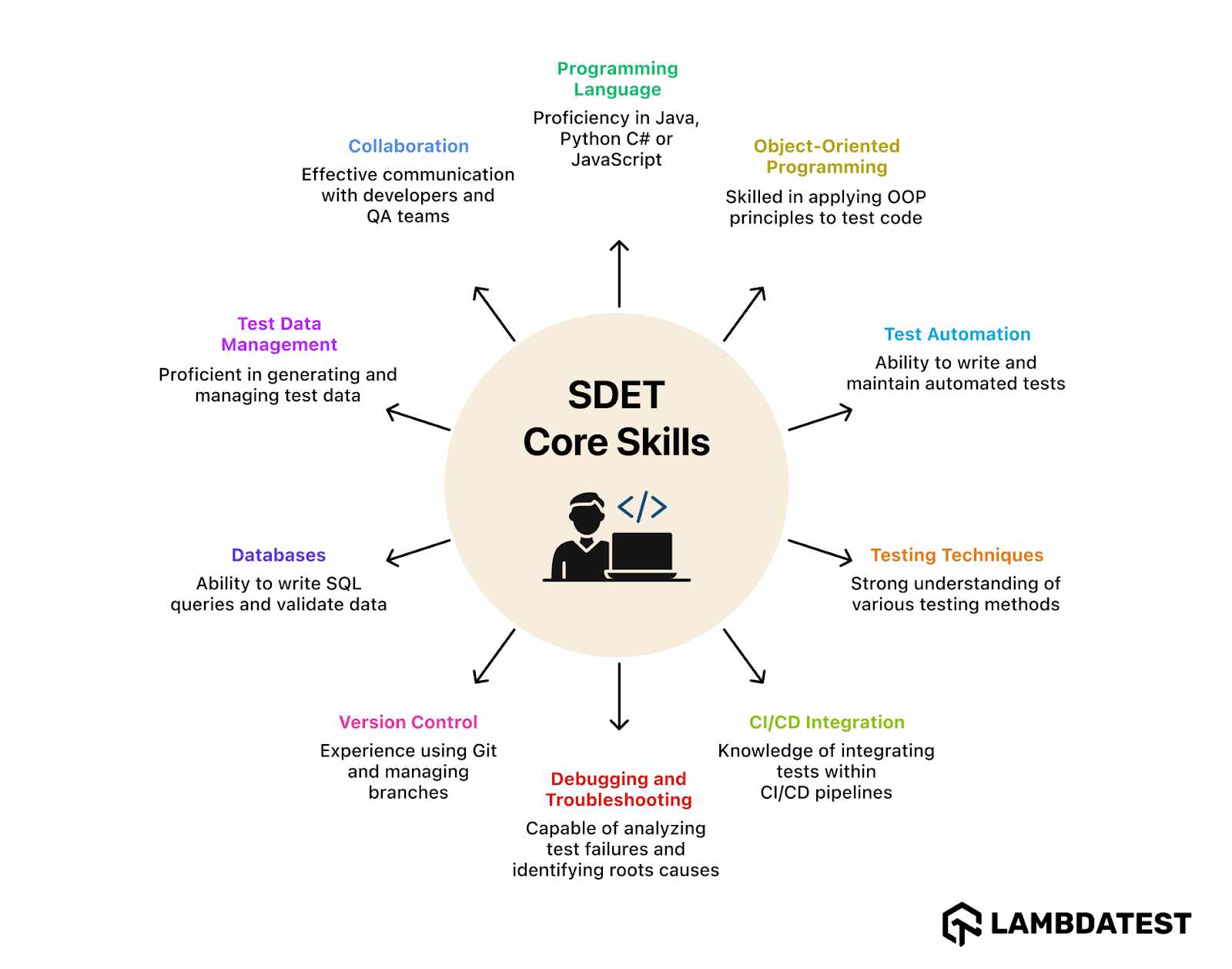
These skills enable them to build efficient, scalable, and maintainable automated testing solutions.
- Programming Languages: Proficient in Java, Python, C#, or JavaScript.
- Object-Oriented Programming (OOP): Skilled in applying OOP principles to test code.
- Test Automation: Ability to write and maintain automated tests for UI, API, and backend systems.
- Testing Techniques: Strong understanding of unit, integration, system, regression, and acceptance testing.
- CI/CD Integration:Knowledge of integrating tests within continuous integration and delivery pipelines.
- Debugging and Troubleshooting: Capable of analyzing test failures and identifying root causes.
- Version Control: Experience using Git and managing branches.
- Database Skills: Ability to write SQL queries and validate data.
- Test Data Management: Proficient in generating and managing test data.
- Collaboration: Effective communication with developers, QA teams, and DevOps engineers.
Common Automation Testing Tools Used by SDETs
Common automation testing tools used by SDETs support automation, API validation, performance testing, and continuous integration. Mastery of these tools ensures effective test execution, faster feedback, and improved software quality.
- Automation Frameworks: Selenium , Cypress, Playwright, Appium.
- API Testing Tools: Postman, REST-assured, SoapUI, Karate.
- CI/CD Tools: Jenkins, GitHub Actions, GitLab CI, Azure DevOps.
- Version Control Systems: Git, GitHub, GitLab, Bitbucket.
- Build Tools: Maven, Gradle, npm.
- Test Management Tools: TestRail, Zephyr, Xray.
- Performance Testing Tools: JMeter, Gatling, Locust.
- Static Code Analysis: SonarQube, ESLint, Checkstyle.
- Monitoring/Logging Tools: Kibana, Grafana, ELK Stack (as needed for test debugging).
- Containerization (Optional): Docker, Kubernetes (basic understanding).
Clone Selenium Skill and run your test on the first prompt.

Top Certifications for SDETs
There are no mandatory certifications specifically required to become an SDET. Most employers prioritize hands-on experience, strong programming fundamentals, and an understanding of testing methodologies over formal certification.
However, for those beginning their SDET journey, it's helpful to focus on foundational skills such as coding, automation frameworks, API testing, and CI/CD practices.
That said, certifications can still offer structured learning and formal recognition of skills. Here are a few recommended certifications and programs that are beneficial for SDETs and automation-focused professionals:
Suggested Certifications
- TestMu AI Certifications: TestMu AI offers a range of industry-relevant certifications designed to build and elevate your skills in test automation, scalable execution, and GenAI-native testing. These certifications are ideal for anyone starting their journey as an SDET or looking to upskill with modern tools and AI-driven testing techniques.
The beginner-friendly certifications that help you build a strong foundation in test automation include: Selenium 101, Cypress 101, Playwright 101, Appium 101, and Espresso 101.
TestMu AI also offers certifications designed around its core products to give you hands-on exposure to real-world, scalable test execution, such as HyperExecute.
To future-proof your testing career, you can also explore the KaneAI Certification, which introduces you to GenAI-native test creation and intelligent automation.
- ISTQB Foundation Level Certification: A well-known starting point for anyone in the testing profession. It covers essential testing principles such as test types (functional vs. non-functional), test planning, defect lifecycle, black-box/white-box techniques, traceability matrix, and more.
- Postman API Testing Certification: Recommended for SDETs working with RESTful APIs. It validates understanding of API requests, automated collections, and environment configurations.
- Azure DevOps Engineer Expert / AWS Developer Associate: Cloud-based certifications that are valuable for SDETs involved in cloud testing, infrastructure automation, and DevOps workflows.

While certifications can support learning and credibility, they are generally not considered a major hiring factor for SDET roles. Real-world experience, curiosity, and continuous improvement on the job are the keys to success in this field.
When and Why You Need an SDET?
SDETs are required when software projects demand high test coverage, automation, and fast release cycles. They provide the technical capability to validate complex systems efficiently and integrate testing into modern development workflows.
Typical scenarios include:
- Complex, Large-Scale Systems: When applications have multiple modules, services, or dependencies that require automated, maintainable, and consistent testing.
- Continuous Delivery Pipelines: When automated tests need to be integrated into CI/CD pipelines to enable fast, reliable, and repeatable deployments.
- API and Service Testing: When backend services, RESTful APIs, or microservices need automated validation at both functional and integration levels.
- Performance and Security Demands: When systems must meet performance benchmarks or security requirements that demand automated load, stress, and compliance testing.
- Frequent Release Cadence: When rapid or daily releases require continuous test execution to minimize risk and ensure stability without manual effort.
How to Transition into an SDET Role?
For professionals aspiring to become SDETs, follow the strategies below:
- Build Programming Skills: Start by learning programming languages like Java, Python, or C#.
- Gain Experience with Testing Tools: Familiarize yourself with tools like Selenium and Appium.
- Understand Software Development and Testing Methodologies: Learn about SDLC, Agile, and CI/CD practices.
- Engage in Relevant Training and Certification Programs: Take courses and earn certifications to prove your skills and knowledge.
If you're preparing for an SDET role, you can go through these common SDET interview questions that can help you land your dream job role.

SDET vs QA Engineer vs Tester: Key Differences
The SDET vs QA engineer comparison comes down to three things: technical focus, how early the role enters the Software Testing Life Cycle (STLC), and how much of the work is automated. Clarifying these distinctions helps define team structure, optimize workflows, and assign responsibilities effectively.
| Aspect | SDET | QA Engineer | Tester |
|---|---|---|---|
| Primary Role | Develop automated tests and testing tools. | Ensure product quality through test planning and execution. | Execute test cases to find defects |
| Technical Skills | Strong programming and automation skills. | Moderate technical knowledge, limited coding. | Basic technical knowledge, usually manual. |
| Test Focus | Automation, unit, integration, API, and performance tests. | Functional, regression, and usability tests. | Functional and regression testing. |
| Code Contribution | Writes and reviews code for tests and frameworks. | May write basic test scripts. | Rarely writes code. |
| Tool Usage | Advanced tools (e.g., Selenium, REST-assured, JUnit). | Test management and defect tracking tools. | Manual testing tools (e.g., TestRail). |
| Development Involvement | Deeply involved in the development lifecycle. | Collaborates with the dev and QA teams. | Typically involved in post-development. |
| Automation Responsibility | Builds and maintains automated test suites. | Uses existing automation tools. | Minimal or no involvement in automation. |
| Framework Design | May design or extend test frameworks. | Uses existing frameworks. | Does not design frameworks. |
| DevOps Integration | Integrates tests into CI/CD pipelines. | May assist with CI/CD testing. | Generally not involved in CI/CD. |
| Typical Background | Software engineering or computer science. | Computer science, engineering, or IT. | IT or domain-specific knowledge. |
A growing part of the SDET job is a system under test that did not exist a few years ago: AI agents that call tools, write files, and act on other systems, where there is no fixed contract to write assertions against. Agent Assurance closes that gap for test engineers. It reads the agent's codebase and derives the test suite, generating functional, non-functional, and adversarial scenarios such as prompt injection and instruction override, then invokes the agent for real and grades each criterion against observed evidence like files changed, artifacts, and tool calls, with three verdicts: Pass, Fail, or Unable to Verify, and the assurance gap reported beside the pass rate. It also runs in CI with exit codes that separate an agent failure from a scenario the harness could not test, the same gating discipline SDETs already apply to conventional suites.
Note: If your team is asked to sign off on an AI agent, coverage you can defend needs evidence, not the agent's own report. Early access is opening in batches. Join the Agent Assurance waitlist
Conclusion
continues to evolve beyond traditional testing. Their deep integration into development workflows enables faster defect detection, reduces production risks, and supports scalable automation initiatives.
For organizations aiming to implement robust testing infrastructure and engineering practices, SDETs are not optional; they are essential for maintaining velocity and stability in complex environments.
As tools and technologies continue to advance, the value of technically skilled SDETs will only grow in shaping high-quality software delivery.
For practitioner accounts, see The SDET Skill Stack for the Agentic Era and Why AI Needs Forward-Deployed Engineers from Testμ 2026.
Citations
- Rise of the Software Development Engineer in Test – SDET: https://www.cigniti.com/blog/rise-of-the-software-development-engineer-in-test-sdet/
- SDET Overview and Career Path: https://www.academia.edu/44546730/SDET_Overview_and_Career_Path
Author

Nandini Pawar
Blogs: 7


Nandini Pawar is a Tech Marketing Specialist at TestMu AI, where she creates educational content and certification programs around automation testing and AI. With certifications in Selenium, Cypress, Appium, Playwright, KaneAI, and Automation Testing, she combines technical understanding with content strategy to support the QA community. Nandini has played an active role in shaping TestMu AI’s learning ecosystem, helping thousands of testers upskill through structured, accessible resources. Her data-informed approach to content blends creativity with long-term impact, making her a valuable contributor to TestMu AI’s mission of advancing software testing education.
Reviewer

Himanshu Sheth
Reviewer
Himanshu Sheth is the Director of Marketing (Technical Content) at TestMu AI, with over 8 years of hands-on experience in Selenium, Cypress, and other test automation frameworks. He has authored more than 130 technical blogs for TestMu AI, covering software testing, automation strategy, and CI/CD. At TestMu AI, he leads the technical content efforts across blogs, YouTube, and social media, while closely collaborating with contributors to enhance content quality and product feedback loops. He has done his graduation with a B.E. in Computer Engineering from Mumbai University. Before TestMu AI, Himanshu led engineering teams in embedded software domains at companies like Samsung Research, Motorola, and NXP Semiconductors. He is a core member of DZone and has been a speaker at several unconferences focused on technical writing and software quality.


SDET FAQs
Did you find this page helpful?
More Related Learning Hubs
TestMu AI forEnterprise
Get access to solutions built on Enterprise
grade security, privacy, & compliance
- Advanced access controls
- Advanced data retention rules
- Advanced Local Testing
- Premium Support options
- Early access to beta features
- Private Slack Channel
- Unlimited Manual Accessibility DevTools Tests