

Power Your Software Testing with AI Agents and Cloud
The Native AI-Agentic Cloud Platform to Supercharge Quality Engineering. Test Intelligently and Ship Faster.


- TestMu AI (Formerly LambdaTest)
- /
- Blog
- /
- Equivalence Partitioning in Software Testing: A Comprehensive Guide
Equivalence Partitioning in Software Testing: A Comprehensive Guide
Discover the power of Equivalence Partitioning and learn how this technique simplifies test case design, reduces redundancies, and enhances test coverage.
Last Updated on:
On This Page
- What is Equivalence Partitioning?
- Types of Equivalence Classes
- Step-by-Step Process of Equivalence Partitioning
- Equivalence Partitioning vs. Boundary Value Analysis
- Advantages of Equivalence Partitioning
- Limitations of Equivalence Partitioning
- Best Practices for Implementing EP
- Real-World Examples of EP
- Tools and Resources for EP
- AI-Assisted Partitioning
- Conclusion
Equivalence partitioning splits input data into classes whose values are expected to produce the same result, so a tester runs one value per class instead of every input.
A field that accepts ages 18 to 60 has three classes: below 18, 18 to 60, and above 60. That turns a large input space into three test cases without losing coverage of the rules.
This guide covers the types of equivalence classes, the step-by-step process, how the technique compares with boundary value analysis, its advantages, limitations, best practices, real-world examples, tools, and AI-assisted partitioning.
Overview
To optimize software testing, use equivalence partitioning to divide input data into valid and invalid classes and test only representative values from each group. This black-box testing technique reduces redundant test cases while maintaining comprehensive coverage, allowing testers to identify system defects efficiently without executing every possible input.
Key Features of Equivalence Partitioning
- Redundancy reduction: Equivalence Partitioning simplifies test case design by selecting representative values from each equivalence class to minimize redundant test cases.
- Coverage maximization: This technique improves test coverage by ensuring all relevant input scenarios are evaluated using a smaller, optimized set of test cases.
- Rapid defect detection: The method helps testers find potential software issues faster by focusing on varied and representative input conditions rather than testing every single possible input.
- Boundary Value Analysis: Boundary Value Analysis targets the extreme upper and lower limits of input ranges to reveal defects that often arise near boundaries.
Steps to Implement Equivalence Partitioning
- Input identification: Input identification allows testers to analyze input fields and understand their impact on the system before defining equivalence classes.
- Class definition: Class definition divides input data into valid sets that the system accepts and invalid sets that the system rejects.
- Representative selection: Representative selection picks typical values from each equivalence class to avoid the need to test every single possible input.
- Test execution: Test execution involves running the selected representative test cases and analyzing the results to identify and resolve system defects.
Tools and Resources
- Selenium: Selenium automates the execution of test cases derived from equivalence classes to reduce manual testing effort and improve efficiency.
- Playwright: Playwright automates the creation and execution of tests based on equivalence classes to improve testing efficiency and reduce manual effort.
- TestMu AI: TestMu AI provides comprehensive training resources and materials to help testers understand and implement Equivalence Partitioning effectively in their workflows.
What Is Equivalence Partitioning?
A black-box testing technique, Equivalence Partitioning, divides input data into different groups or separate sets where similar behavior is expected.
Testers do not test each and every single possible input value, but instead select representative values. This is done from each equivalence class in order to verify the system’s behavior.
Key Points to Understand:
- Equivalence classes are divided into valid and invalid sets.
- Test cases are chosen from each class to reduce redundancy while maintaining effective coverage.
Types of Equivalence Classes
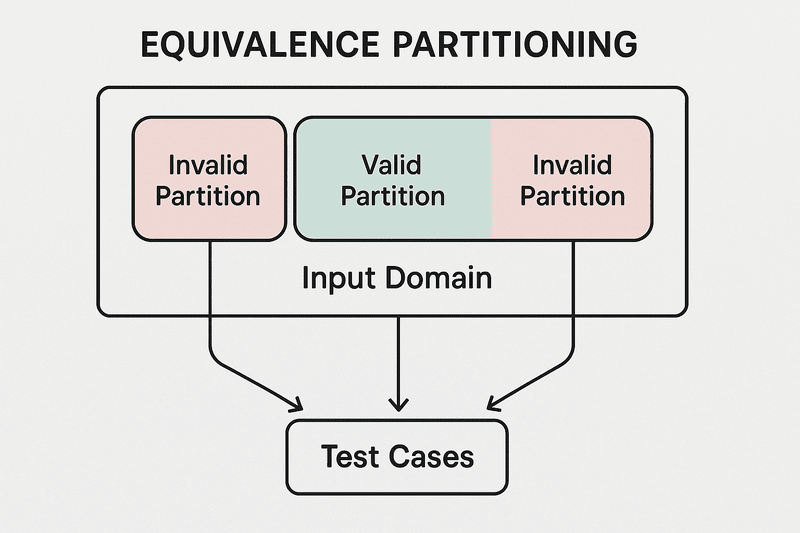
There are two primary types of equivalence classes:
Valid Equivalence Classes
- These are input sets for the system to process correctly and accept. For example, valid equivalence classes could be any integer from 18 to 60, as a form asks for an age. It should be an inclusive range.
Invalid Equivalence Classes
- The system will handle or reject all of these sets of inputs without any errors. Like 17 or even 61, examples do include ages greater than 60 or less than 18.
Example:
- For a login form requiring a username and password, valid classes might include correct usernames and passwords, while invalid classes might include empty fields or incorrect combinations.

Note: Capture automated Firefox screenshots across 3000+ real browsers and OS. Try TestMu AI Today!
Step-by-Step Process of Equivalence Partitioning
Implementing Equivalence Partitioning effectively involves the following steps:
- Identify Input Variables: Acknowledge that the system’s output surely will be affected by input variables, as well as input fields, so identify them first.
- Define Equivalence Classes: Then data must be categorized into valid and invalid classes, based on the input variables.
- Select Representative Test Cases: Pick typical values from each equivalence class to cut test case load.
- Create Test Cases: Develop test cases using the selected representative values from the equivalence classes.
- Execute and Analyze: Run the tests and analyze the results to identify defects.
Equivalence Partitioning vs. Boundary Value Analysis
Equivalence Partitioning focuses upon dividing input data into meaningful groups, whereas BVA targets the edges of these groups, as the defects often arise near the boundaries of input ranges, where BVA helps in revealing them.
Equivalence Partitioning
- Concentrates on the inputs that are anticipated to behave in a similar manner.
- Representative values from each class are selected, which facilitates the reduction of the number of test cases.
Boundary Value Analysis
- The focus here is on testing input data extremes that include upper, lower boundary values in the equivalence classes.
- Usually, this process is used along with Equivalence Partitioning to provide more thorough and in-depth testing while reducing the number of test cases altogether.
Let’s take at look at the following tabular comparison of Equivalence Partitioning & Boundary Value Analysis to understand them better:
Advantages of Equivalence Partitioning
The advantages of Equivalence Partitioning include:
- Reduced Test Cases: Testers are able to reduce the number of tests greatly just by selecting representative values out from each equivalence class while maintaining strong test coverage.
- Efficient Test Case Design: It simplifies the process of creating test cases via its focus on the classes needing testing. It does not focus on all possible values.
- Improved Defect Detection: EP finds possible defects faster because it focuses on many input situations.
- Enhanced Test Coverage: All relevant scenarios are tested, despite the fewer test cases than usual.
Limitations of Equivalence Partitioning
While Equivalence Partitioning is highly effective, it does have certain limitations:
- Assumption of Homogeneous Behavior: EP assumes that all inputs in a class will behave similarly, which may not always be true.
- Complex Input Scenarios: EP may not be as effective when inputs have interdependencies or when testing complex system behavior.
- Limited Focus: EP primarily focuses on input validation, which means output or system behavior might not be thoroughly tested.
Best Practices for Implementing Equivalence Partitioning
To get the most out of Equivalence Partitioning, follow these best practices:
- Thorough Requirement Analysis: Ensure you have a solid understanding of the system’s requirements to define accurate equivalence classes.
- Regular Review and Update: Equivalence classes should be updated as the system evolves, ensuring comprehensive coverage.
- Combine with Other Techniques: Combine Equivalence Partitioning with boundary value analysis for broader test coverage.
- Leverage Automation: Use test automation tools to efficiently create and execute tests based on equivalence classes, reducing manual effort.
Real-World Examples of Equivalence Partitioning
Example 1 – Age ValidationFor an application that validates users’ ages:
- Valid Class: Ages between 18 and 60.
- Invalid Classes: Ages below 18 and above 60.
Test cases could include ages like 18, 30, 45, and 60 for valid input, and 17, 61 for invalid input.Example 2 – Login Form ValidationFor a login form:
- Valid Classes: Correct username and password.
- Invalid Classes: Empty fields, incorrect password, incorrect username.
Tools and Resources for Equivalence Partitioning
Many tools can assist in automating test case creation based on Equivalence Partitioning:
- Test Automation Tools: Tools like Selenium and Playwright can automate the process of creating and running tests.
- Training Resources: TestMu AI offers various resources to help testers better understand and implement Equivalence Partitioning.
- Community Forums: Platforms like Reddit are valuable for discussing challenges and best practices.

Can AI Agents Generate Equivalence Classes?
Yes. An LLM coding assistant reads a function signature, an OpenAPI schema or a written requirement and returns a draft set of valid and invalid classes. A tester still has to verify each class against the requirement.
- Spec to classes: Give an assistant such as GitHub Copilot or Claude Code a validation rule or an OpenAPI schema and it lists the valid and invalid partitions with one representative value for each.
- Undocumented rules: The model only sees the text you hand it. A rule that lives in a ticket or in a developer conversation produces a missing class, so a generated list is a draft and not a coverage claim.
- Property-based generation: Libraries such as Hypothesis for Python and fast-check for JavaScript take a declared input domain and generate values across it. That is equivalence partitioning written as code instead of a table.
- Overlap review: Merge any two generated partitions that exercise the same behavior. An assistant will emit duplicate classes because it has no view of the tests you already run.
- Schema as the source: Point the assistant at the OpenAPI or JSON Schema file rather than the prose requirement. Declared types, enums and ranges map directly onto classes, which removes most of the guessing.
Conclusion
Equivalence Partitioning is a powerful technique that simplifies software testing, reduces test cases, and improves coverage. It is particularly valuable for black-box testing, where internal system logic is not available. By focusing on representative test cases, this method ensures that you are testing the most relevant scenarios with minimal effort. Whether you’re an experienced SDET or a beginner, incorporating Equivalence Partitioning into your testing strategy can help you optimize your test coverage and improve software quality.
Author

Poornima Pandey
Blogs: 8


Poornima is a Community Contributor at TestMu AI, bringing over 4 years of experience in marketing within the software testing domain. She holds certifications in Automation Testing, KaneAI, Selenium, Appium, Playwright, and Cypress. At TestMu AI, she contributes to content around AI-powered test automation, modern QA practices, and testing tools, across blogs, webinars, social media, and YouTube. Poornima plays a key role in scripting and strategizing YouTube content, helping grow the brand's presence among testers and developers.


Equivalence Partitioning FAQs
Did you find this page helpful?
More Related Blogs
TestMu AI forEnterprise
Get access to solutions built on Enterprise
grade security, privacy, & compliance
- Advanced access controls
- Advanced data retention rules
- Advanced Local Testing
- Premium Support options
- Early access to beta features
- Private Slack Channel
- Unlimited Manual Accessibility DevTools Tests